Laser-Liquid Interaction in Laser-Induced Forward Transfer (LIFT) Printing: A Multiscale Perspective on Bubble Dynamics and Material Ejection
Pith reviewed 2026-06-27 08:06 UTC · model grok-4.3
The pith
The cavitation bubble provides the transient mechanical bridge between optical energy deposition and the hydrodynamic ejection process in LIFT printing.
A machine-rendered reading of the paper's core claim, the machinery that carries it, and where it could break.
Core claim
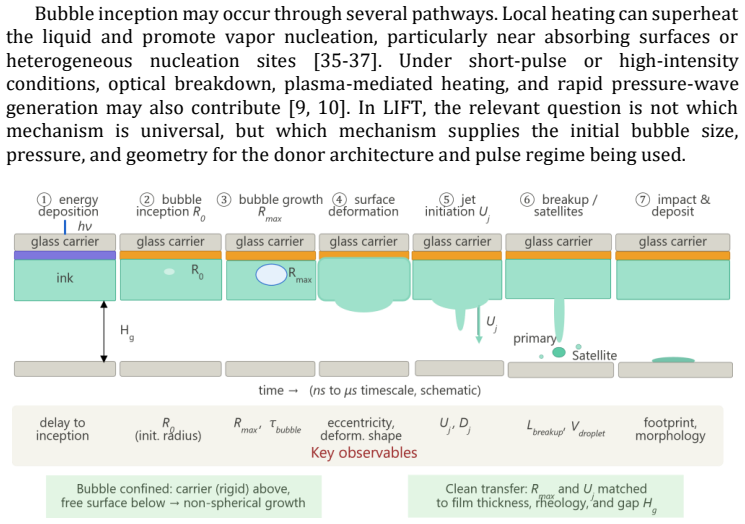
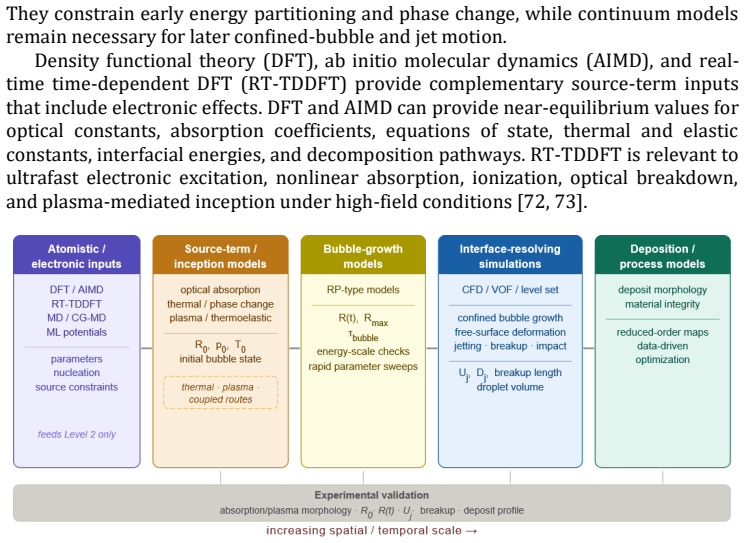
The cavitation bubble provides the transient mechanical bridge between optical energy deposition and the hydrodynamic ejection process. This chapter presents LIFT from a multiscale perspective centered on bubble dynamics and material ejection. It first reviews major LIFT donor architectures. Then, it examines how donor ribbon design, absorbing-layer properties, laser parameters, material rheology, control bubble inception/growth, jet formation, droplet breakup, and final deposition. Modeling approaches are discussed as tools for connecting experimental observations across time and length scales.
What carries the argument
The cavitation bubble formed in the confined donor layer, acting as the mechanical intermediary that converts absorbed laser energy into hydrodynamic motion and material ejection.
Load-bearing premise
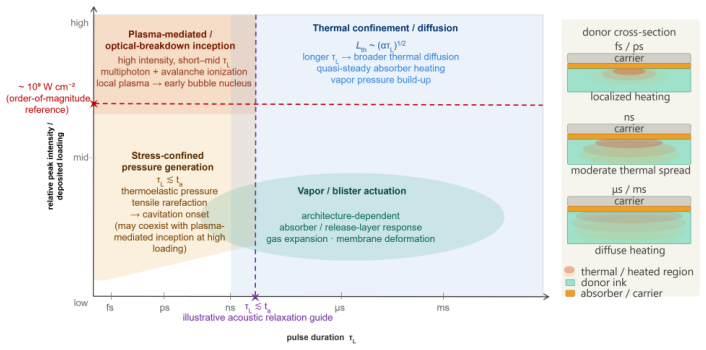
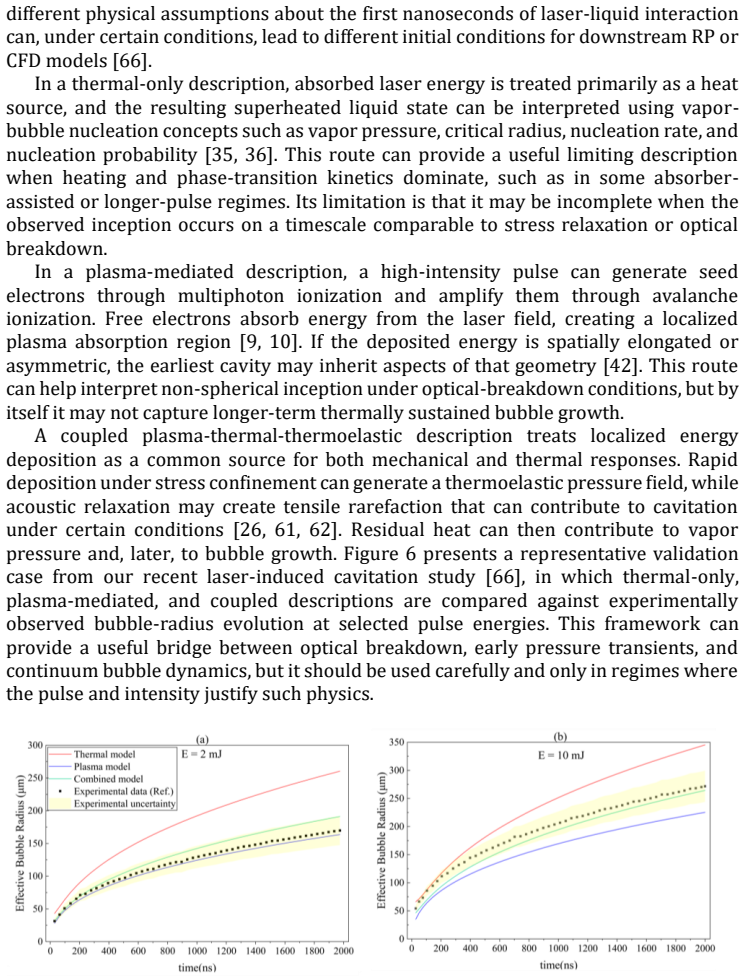
Comparisons of thermal-only, plasma-mediated, and coupled plasma-thermal-thermoelastic frameworks for early-stage bubble inception can usefully supply initial conditions for downstream jetting models without new quantitative validation data.
What would settle it
A time-resolved measurement of early bubble pressure or radius evolution that quantitatively matches one inception framework while showing clear mismatch to the others.
Figures


read the original abstract
Laser-induced forward transfer (LIFT) is a nozzle-free laser-assisted printing method that provides an advanced manufacturing route for spatially selective deposition of functional inks, nanoparticle suspensions, polymers, hydrogels, biological materials, and other difficult-to-nozzle formulations. The apparent simplicity of LIFT, however, conceals a strongly coupled laser-liquid interaction. Laser energy is absorbed within a confined donor architecture, converted into thermal and plasma responses, and then transformed into bubble-mediated motion of the donor material. The cavitation bubble provides the transient mechanical bridge between optical energy deposition and the hydrodynamic ejection process. This chapter presents LIFT from a multiscale perspective centered on bubble dynamics and material ejection. It first reviews major LIFT donor architectures. Then, it examines how donor ribbon design, absorbing-layer properties, laser parameters, material rheology, control bubble inception/growth, jet formation, droplet breakup, and final deposition. Modeling approaches are discussed as tools for connecting experimental observations across time and length scales, ranging from reduced-order estimates to interface-resolving simulations and data-driven process maps. As one illustrative mechanistic example, thermal-only, plasma-mediated, and coupled plasma-thermal-thermoelastic frameworks for early-stage bubble inception are briefly compared to show how different inception assumptions can provide initial conditions for downstream bubble growth and jetting models. This chapter concludes by identifying opportunities for bubble-aware donor design, time-resolved diagnostics, benchmark datasets, and predictive LIFT process maps based on intermediate bubble and jet observables.
Editorial analysis
A structured set of objections, weighed in public.
Referee Report
Summary. The manuscript is a multiscale review of laser-induced forward transfer (LIFT) printing. It positions the cavitation bubble as the transient mechanical bridge between optical energy deposition in a confined donor and the subsequent hydrodynamic ejection process. The text reviews major donor architectures, examines how ribbon design, absorbing-layer properties, laser parameters, and material rheology control bubble inception/growth, jet formation, droplet breakup, and deposition, discusses modeling approaches ranging from reduced-order estimates to interface-resolving simulations, and provides an illustrative comparison of thermal-only, plasma-mediated, and coupled plasma-thermal-thermoelastic frameworks for early-stage bubble inception as example initial conditions for downstream models. It concludes by identifying opportunities for bubble-aware donor design, time-resolved diagnostics, benchmark datasets, and predictive process maps.
Significance. If the synthesis of existing literature holds, the review supplies a coherent organizing framework that connects optical, thermal, plasma, and hydrodynamic scales in LIFT. By centering bubble dynamics, it can help researchers select appropriate inception models for jetting simulations and highlights concrete next steps (benchmark datasets, intermediate observables) that would improve reproducibility across experimental and computational studies in laser-assisted printing and related fluid-dynamics applications.
minor comments (2)
- [Abstract] The abstract and introduction refer to the work as both a 'chapter' and a manuscript submitted to a journal; clarify the intended publication format and whether any sections are adapted from prior book-chapter material.
- Figure captions and axis labels for any schematic diagrams of donor architectures or bubble-evolution timelines should explicitly state the time and length scales represented so that readers can immediately map them to the multiscale discussion.
Simulated Author's Rebuttal
We thank the referee for their detailed summary of the manuscript, positive assessment of its significance, and recommendation for minor revision. No specific major comments were raised in the report.
Circularity Check
No significant circularity
full rationale
The manuscript is a review/perspective chapter that surveys existing LIFT donor architectures, rheology effects, and modeling frameworks drawn from external literature. It presents no original derivations, fitted parameters, or predictive equations of its own; the sole illustrative comparison of thermal/plasma/thermoelastic inception models is explicitly framed as a brief example supplying initial conditions for downstream models rather than a new quantitative claim. No self-citation load-bearing steps, self-definitional loops, or renamed empirical patterns appear in the provided text.
Axiom & Free-Parameter Ledger
Reference graph
Works this paper leans on
-
[1]
Pere Serra; Alberto Pique. (2019). Laser-Induced Forward Transfer: Fundamentals and Applications. Advanced Materials Technologies. https://doi.org/10.1002/admt.201800099
-
[2]
Philippe Delaporte; Anne-Patricia Alloncle. (2016). Laser-induced forward transfer: A high resolution additive manufacturing technology. Optics & Laser Technology. https://doi.org/10.1016/j.optlastec.2015.09.022
-
[3]
Arnold; Pere Serra; Alberto Pique
Craig B. Arnold; Pere Serra; Alberto Pique. (2007). Laser Direct -Write Techniques for Printing of Complex Materials. MRS Bulletin. https://doi.org/10.1557/mrs2007.11
-
[4]
Marcos Fernandez -Pradas; Pere Serra
J. Marcos Fernandez -Pradas; Pere Serra. (2020). Laser -Induced Forward Transfer: A Method for Printing Functional Inks. Crystals. https://doi.org/10.3390/cryst10080651
-
[5]
Christos Boutopoulos; Ioannis Kalpyris; Efthymis Serpetzoglou. (2014). Laser -induced forward transfer of silver nanoparticle ink: time -resolved imaging of the jetting dynamics and correlation with the printing quality. Microfluidics and Nanofluidics. https://doi.org/10.1007/s10404-013-1248-z
-
[6]
Claudia Unger; Martin Gruene; Lothar Koch. (2011). Time-resolved imaging of hydrogel printing via laser-induced forward transfer. Applied Physics A. https://doi.org/10.1007/s00339-010-6030-4
-
[7]
M. Duocastella; J. M. Fernandez -Pradas; J. L. Mor enza; P. Serra. (2010). Sessile droplet formation in the laser -induced forward transfer of liquids: A time -resolved imaging study. Thin Solid Films. https://doi.org/10.1016/j.tsf.2010.03.082
-
[8]
Nathan R. Schiele; David T. Corr; Yong Huang. (2010). Laser -based direct-write techniques for cell printing. Biofabrication. https://doi.org/10.1088/1758-5082/2/3/032001
-
[9]
J. Noack; A. Vogel. (1999). Laser -induced plasma formation in water at nanosec ond to femtosecond time scales: calculation of thresholds, absorption coefficients, and energy density. IEEE Journal of Quantum Electronics. https://doi.org/10.1109/3.777215
-
[10]
Joachim Noack; Daniel X. Hammer; Gary D. Noojin. (1998). Influence of pulse d uration on mechanical effects after laser -induced breakdown in water. Journal of Applied Physics. https://doi.org/10.1063/1.367512
-
[11]
Alfred Vogel; Vasan Venugopalan. (2003). Mechanisms of Pulsed Laser Ablation of Biological Tissues. Chemical Reviews. https://doi.org/10.1021/cr010379n
-
[12]
J. Bohandy; B. F. Kim; F. J. Adrian. (1986). Metal deposition from a supported metal film using an excimer laser. Journal of Applied Physics. https://doi.org/10.1063/1.337287
-
[13]
D. Mayerhofer; F. Keilmann; C. K. N. Pa tel. (1991). Laser -induced forward transfer of aluminium. Applied Surface Science. https://doi.org/10.1016/0169-4332(91)90072-R
-
[14]
Y. Nakata; T. Okada; M. Maeda. (2002). Experimental investigation of laser induced forward transfer process of metal thin films. Applied Surface Science. https://doi.org/10.1016/S0169-4332(01)00765-6
-
[15]
Fabien Guillemot; Agnes Souquet; Sylvain Catros. (2010). Laser -Assisted Cell Printing: Principle, Physical Parameters Versus Cell Fate and Perspectives in Tissue Engineering. Nanomedicine. https://doi.org/10.2217/nnm.10.14
-
[16]
Sylvain Catros; Bertrand Guillotin; Marketa Bacakova. (2011). Effect of laser energy, substrate film thickness and bioink viscosity on viability of endothelial cells printed by Laser-Assisted Bioprinting. Applied Surface Science. https://doi.org/10.1016/j.apsusc.2010.11.049
-
[17]
Bela Hopp. (2012). Femtosecond laser printing of living cells using absorbing film -assisted laser- induced forward transfer. Optical Engineering. https://doi.org/10.1117/1.OE.51.1.014302
-
[18]
D. P. Banks; K. Kaur; R. Gazia. (2008). Triazene photopolymer dynamic release layer -assisted femtosecond laser-induced forward transfer with an active carrier substrate. EPL (Europhysics Letters). https://doi.org/10.1209/0295-5075/83/38003
-
[19]
James Shaw -Stewart; Thomas Lippert; Matthias Nagel. (2012). A simple model for flyer velocity from laser -induced forward transfer with a dynamic release layer. Applied Surface Science. https://doi.org/10.1016/j.apsusc.2011.08.111
-
[20]
Yongxiang Hu; Han C heng; Jiaxi Xu. (2017). A coupling model to simulate the dynamic process of blister-actuated nanosecond laser -induced forward transfer. Journal of Physics D: Applied Physics. https://doi.org/10.1088/1361-6463/aa7b08
-
[21]
Emre Turkoz; Romain Fardel; Craig B. Arnold. (2018). Advances in Blister-Actuated Laser-Induced Forward Transfer (BA -LIFT). Laser Printing of Functional Materials. https://doi.org/10.1002/9783527805105.ch5
-
[22]
Brent R. Lewis; Edward C. Kinzel; Normand M. Laurendeau. (2006). Planar laser im aging and modeling of matrix-assisted pulsed-laser evaporation direct write in the bubble regime. Journal of Applied Physics. https://doi.org/10.1063/1.2234542
-
[23]
Yafu Lin; Kevin Foy; Yong Huang. (2008). Bubble Formation Modeling in Matrix -Assisted Pulsed- Laser Evaporation Direct Write. ASME International Manufacturing Science and Engineering Conference. https://doi.org/10.1115/MSEC_ICMP2008-72241
-
[24]
Muhammad Ali; Emeline Pages; Alexandre Ducom. (2014). Controlling laser-induced jet formation for biopri nting mesenchymal stem cells with high viability and high resolution. Biofabrication. https://doi.org/10.1088/1758-5082/6/4/045001 20
-
[25]
Jinlong Chang; Xuming Sun. (2023). Laser -induced forward transfer based laser bioprinting in biomedical applications. Fr ontiers in Bioengineering and Biotechnology. https://doi.org/10.3389/fbioe.2023.1255782
-
[26]
Guenther Paltauf; Peter E. Dyer. (2003). Photomechanical Processes and Effects in Ablation. Chemical Reviews. https://doi.org/10.1021/cr010436c
-
[27]
Leonid V. Zhigilei; Barbara J. Garrison. (2000). Microscopic mechanisms of laser ablation of organic solids in the thermal and stress confinement irradiation regimes. Journal of Applied Physics. https://doi.org/10.1063/1.373816
-
[28]
Christos Boutopoulos; Marianneza Chat zipetrou; Athanasios G. Papathanasiou. (2014). Time - resolved imaging and immobilization study of biomaterials on hydrophobic and superhydrophobic surfaces by means of laser -induced forward transfer. Laser Physics Letters. https://doi.org/10.1088/1612 - 2011/11/10/105603
-
[29]
A. L. Yarin. (2006). Drop Impact Dynamics: Splashing, Spreading, Receding, Bouncing. Annual Review of Fluid Mechanics. https://doi.org/10.1146/annurev.fluid.38.050304.092144
-
[30]
Shuqi Zhou; Chaoran Dou; Jianzhi Li; Qiqi Zhang; Qilin Dai; Ben Xu. (2023). Experimental investigation of various energy -absorbing layer materials and sodium alginate viscosities on the jet formation in laser -induced-forward-transfer (LIFT) bioprinting. Journal of Applied Physics, 133, 204701. https://doi.org/10.1063/5.0145737
-
[31]
R. C. Y. Auyeung; H. Kim; N. A. Charipar; A. J. Birnbaum; S. A. Mathews; A. Pique. (2011). Laser forward transfer based on a spatial light modulator. Applied Physics A. https://doi.org/10.1007/s00339- 010-6054-9
-
[32]
R. Pohl; M. Jansink; G. R. B. E. Romer; A. J. Huis in 't Veld. (2015). Solid-phase laser-induced forward transfer of variable shapes using a liquid -crystal spatial light modulator. Applied Physics A. https://doi.org/10.1007/s00339-015-9212-2
-
[33]
J. Moreno -Labella; R. Candorcio -Simon; D. Munoz -Martin. (2025). Blister -actuated laser-induced forward transfer (BA-LIFT): Understanding blister dynamics for enhanced process control. Optics & Laser Technology. https://doi.org/10.1016/j.optlastec.2024.112087
-
[34]
D. Kim; colleagues. (2024). Dynamics of Blister Actuation in Laser -Induced Forward Transfer for Contactless Microchip Transfer. Nanomaterials. https://doi.org/10.3390/nano14231926
-
[35]
F. Caupin; E. Herbert. (2 006). Cavitation in water: a review. Comptes Rendus Physique. https://doi.org/10.1016/j.crhy.2006.10.015
-
[36]
S. D. Lubetkin. (2004). Gas -vapor bubble nucleation -a unified approach. Journal of Colloid and Interface Science. https://doi.org/10.1016/j.jcis.2004.06.020
-
[37]
D. Navon; E. Shneidman; S. Brandon. (2015). Vapor -liquid nucleation: the solid touch. Advances in Colloid and Interface Science. https://doi.org/10.1016/j.cis.2014.07.011
-
[38]
Christopher Earls Brennen. (2013). Cavitation and Bubble Dynamic s. Cambridge University Press book. https://doi.org/10.1017/CBO9781107338760
-
[39]
Werner Lauterborn; Thomas Kurz. (2010). Physics of bubble oscillations. Reports on Progress in Physics. https://doi.org/10.1088/0034-4885/73/10/106501
-
[40]
J. R. Blake; D. C. Gibson. (1987). Cavitation Bubbles Near Boundaries. Annual Review of Fluid Mechanics. https://doi.org/10.1146/annurev.fl.19.010187.000531
-
[41]
Rui Zhao; Zhong-cheng Liang; Rong-qing Xu. (2008). Dynamics of Laser-Induced Cavitation Bubble near Solid Boundary. Japanese Journal of Applied Physics. https://doi.org/10.1143/JJAP.47.5482
-
[42]
Daniel X. Hammer; Robert J. Thomas; Martin Frenz. (1996). Shock wave and cavitation bubble measurements of ultrashort -pulse laser -induced breakdown in water. SPIE Proceeding s. https://doi.org/10.1117/12.239605
-
[43]
R. Candorcio-Simon; D. Munoz-Martin; colleagues. (2021). Cavitation bubble evidence in BA -LIFT processes. Results in Physics. https://doi.org/10.1016/j.rinp.2021.103955
-
[44]
P. Prentice; S. Zolotovskaya; E. Rafailov. (2010). Novel laser-induced cavitation: the constrained ring bubble. Proceedings of SPIE. https://doi.org/10.1117/12.837463
-
[45]
A. Soare; R. Dijkink; M. Rodriguez Pascual; C. Sun; P. W. Cains; D. Lohse; A. I. Stankiewicz; H. J. M. Kramer. (2011). Cryst al Nucleation by Laser -Induced Cavitation. Crystal Growth & Design. https://doi.org/10.1021/cg2000014
-
[46]
Brian Derby. (2010). Inkjet Printing of Functional and Structural Materials: Fluid Property Requirements, Feature Stability, and Resolution. Annual R eview of Materials Research. https://doi.org/10.1146/annurev-matsci-070909-104502
-
[47]
Detlef Lohse. (2022). Fundamental Fluid Dynamics Challenges in Inkjet Printing. Annual Review of Fluid Mechanics. https://doi.org/10.1146/annurev-fluid-022321-114001
-
[48]
Stephen D. Hoath; Oliver G. Harlen; Ian M. Hutchings. (2012). Jetting behavior of polymer solutions in drop-on-demand inkjet printing. Journal of Rheology. https://doi.org/10.1122/1.4724331
-
[49]
Nuno Reis; Chris Ainsley; Brian Derby. (2005). Ink-jet delivery of particle suspensions by piezoelectric droplet ejectors. Journal of Applied Physics. https://doi.org/10.1063/1.1888026 21
-
[50]
Osman A. Basaran. (2002). Small -scale free surface flows with breakup: Drop formation and emerging applications. AIChE Journal. https://doi.org/10.1002/aic.690480902
-
[51]
C. Josserand; S. T. Thoroddsen. (2016). Drop Impact on a Solid Surface. Annual Review of Fluid Mechanics. https://doi.org/10.1146/annurev-fluid-122414-034401
-
[52]
Qingfeng Li; David Grojo; Anne -Patricia Alloncle. (2019). Jetting regimes of double -pulse laser - induced forward transfer. Optical Materials Express. https://doi.org/10.1364/OME.9.003476
-
[53]
Emre Turkoz; SeungYeon Kang; Luc Deike. (2018). Subthreshold laser jetting via flow -focusing in laser-induced forward transfer. Physical Review Fluids. https://doi.org/10.1103/PhysRevFluids.3.082201
-
[54]
Alfred Vogel; Joachim Noack. (1998). Shock -wave energy and acoustic energy dissipation after laser-induced breakdown. SPIE Proceedings. https://doi.org/10.1117/12.308163
-
[55]
Y. Nakata; T. Okada; M. Maeda. (2002). Optimization of laser -induced forward transfer process of metal thin films. Applied Surface Science. https://doi.org/10.1016/S0169-4332(02)00351-3
-
[56]
Andrea Prosperetti. (1982). A generalization of the Rayleigh-Plesset equation of bubble dynamics. The Physics of Fluids. https://doi.org/10.1063/1.863775
-
[57]
C. W. Hirt; B. D. Nichols. (1981). Volume of fluid (VOF) method for the dynamics of free boundaries. Journal of Computational Physics. https://doi.org/10.1016/0021-9991(81)90145-5
-
[58]
Mark Sussman; Peter Smereka; Stanley Osher. (1994). A Level Set Approach for Computing Solutions to Incompressible Two -Phase Flow. Journal of Computational Physics. https://doi.org/10.1006/jcph.1994.1155
-
[59]
R uben Scardovelli; Stephane Zaleski. (1999). Direct Numerical Simulation of Free -Surface and Interfacial Flow. Annual Review of Fluid Mechanics. https://doi.org/10.1146/annurev.fluid.31.1.567
-
[60]
Jie Qu; Chaoran Dou; Ben Xu; Jianzhi Li; Zhonghao Rao; Andrew Tsin. (2021). Printing quality improvement for laser -induced forward transfer bioprinting: Numerical modeling and experimental validation. Physics of Fluids, 33, 071906. https://doi.org/10.1063/5.0054675
-
[61]
Rinat O. Esenaliev; Steven L. Jacques. (1996). Transient and permanent cavitation in collagen gels by laser-induced thermoelastic pressure waves. SPIE Proceedings. https://doi.org/10.1117/12.239572
-
[62]
P. R. Williams; R. L. Williams. ( 2004). Cavitation and the tensile strength of liquids under dynamic stressing. Molecular Physics. https://doi.org/10.1080/00268970412331292786
-
[63]
Yi Feng; Dui Qin; Mingxi Wan. (2015). Laser -Induced Cavitation and Photoacoustic Cavitation. Cavitation in Biomedicine. https://doi.org/10.1007/978-94-017-7255-6_8
-
[64]
Thorsten Wuest; Daniel Weimer; Christopher Irgens. (2016). Machine learning in manufacturing: advantages, challenges, and applications. Production & Manufacturing Research. https://doi.org/10.1080/21693277.2016.1192517
-
[65]
S. Mahadevan; P. Nath; Z. Hu. (2022). Uncertainty Quantification for Additive Manufacturing Process Improvement: Recent Advances. ASCE-ASME Journal of Risk and Uncertainty in Engineering Systems, Part B: Mechanical Engineering. https://doi.org/10.1115/1.4053184
-
[66]
Shuqi Zhou; Abdol Hadi Mokarizadeh; Ben Xu. (2026). From Optical Breakdown to Bubble Inception: A Coupled Plasma-Thermal Framework for Nanosecond Laser-Induced Cavitation in Water. arXiv preprint. arXiv:2605.23620. https://arxiv.org/abs/2605.23620
Pith/arXiv arXiv 2026
-
[67]
Shuqi Zhou; Ben Xu. (2025). A CFD Study of the Influence of Porous Structure Placement on Jet Formation in Laser-Induced-Forward-Transfer (LIFT) Printing. Conference presentation / conference-stage manuscript, SHTC 2025
2025
-
[68]
G. Menzl; M. A. Gonzalez; P. Geiger; F. Caupin; J. L. F. Abascal; C. Valeriani; C. Dellago. (2016). Molecular mechanism for cavitation in water under tension. Proceedings of the National Academy of Sciences, 113(48), 13582-13587. https://doi.org/10.1073/pnas.1608421113
-
[69]
B. R. Novak; E. J. Maginn; M. J. McCready. (2007). Comparison of heterogeneous and homogeneous bubble nucleation using molecular simulations. Physical Review B, 75(8), 085413. https://doi.org/10.1103/PhysRevB.75.085413
-
[70]
S. Maheshwari; M. van der Hoef; A. Prosperetti; D. Lohse. (2018). Dynamics of formation of a vapor nanobubble around a heated nanoparticle. Journal of Physical Chemistry C, 122(36), 20571 -20580. https://doi.org/10.1021/acs.jpcc.8b04017
-
[71]
L. V. Zhigilei; Z. Lin; D. S. Ivanov. (2009). Atomistic modeling of short pulse laser ablation of metals: Connections between melting, spallation, and phase explosion. Journal of Physical Chemistry C, 113(27), 11892-11906. https://doi.org/10.1021/jp902294m
-
[72]
R. Xu; J. Chen; Q. Meng. (2021). Probing laser-induced plasma generation in liquid water. Journal of the American Chemical Society, 143(27), 10382-10388. https://doi.org/10.1021/jacs.1c04675
-
[73]
T. Otobe; M. Yamagiwa; J. -I. Iwata; K. Yabana; T. Nakano; G. F. Bertsch. (2 008). First -principles electron dynamics simulation for optical breakdown of dielectrics under an intense laser field. Physical Review B, 77(16), 165104. https://doi.org/10.1103/PhysRevB.77.165104
-
[74]
K. P. Santo; M. L. Berkowitz. (2015). Shock wave induced collapse of arrays of nanobubbles located next to a lipid membrane: Coarse -grained computer simulations. Journal of Physical Chemistry B, 119(29), 8879-8889. https://doi.org/10.1021/jp505720d 22
-
[75]
J. Behler; G. Csanyi. (2021). Machine learning potential s for extended systems: A perspective. European Physical Journal B, 94(7), 142. https://doi.org/10.1140/epjb/s10051-021-00156-1
-
[76]
Ziwen Jia; Ding Li; Ye Tian; Haipeng Pan; Qiang Zhong; Zhifeng Yao; Yuan Lu; Jinjia Guo; Ronger Zheng. (2023). Early dynamics of laser-induced plasma and cavitation bubble in water. Spectrochimica Acta Part B: Atomic Spectroscopy, 206, 106713. https://doi.org/10.1016/j.sab.2023.106713
discussion (0)
Sign in with ORCID, Apple, or X to comment. Anyone can read and Pith papers without signing in.