Three-Phase Evolution of Aspect Ratio in Fast and Slow CMEs from the Sun to 1 AU
Pith reviewed 2026-06-27 08:08 UTC · model grok-4.3
The pith
CME aspect ratios follow a three-phase rise-saturation-decline pattern from the Sun to 1 AU.
A machine-rendered reading of the paper's core claim, the machinery that carries it, and where it could break.
Core claim
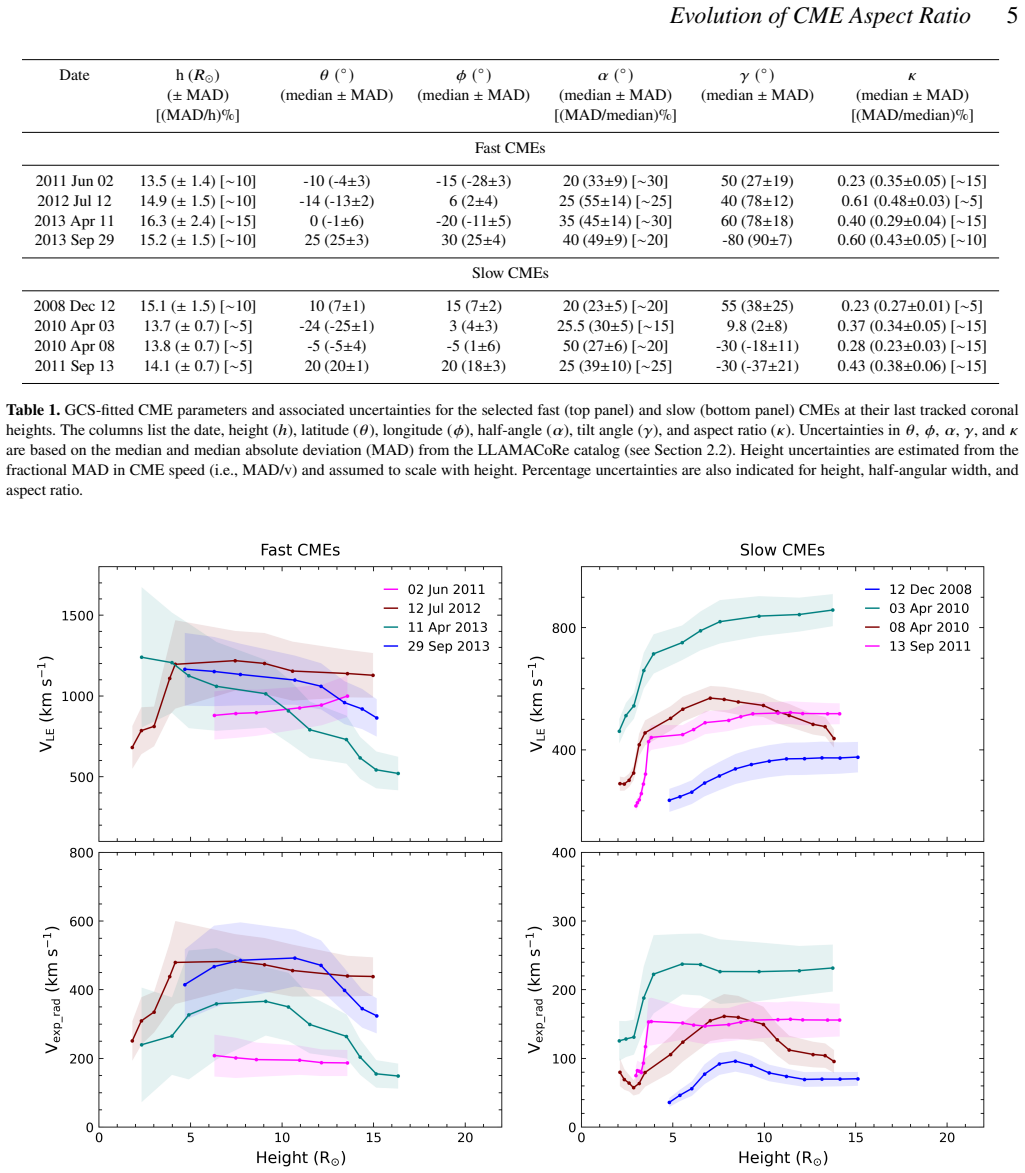
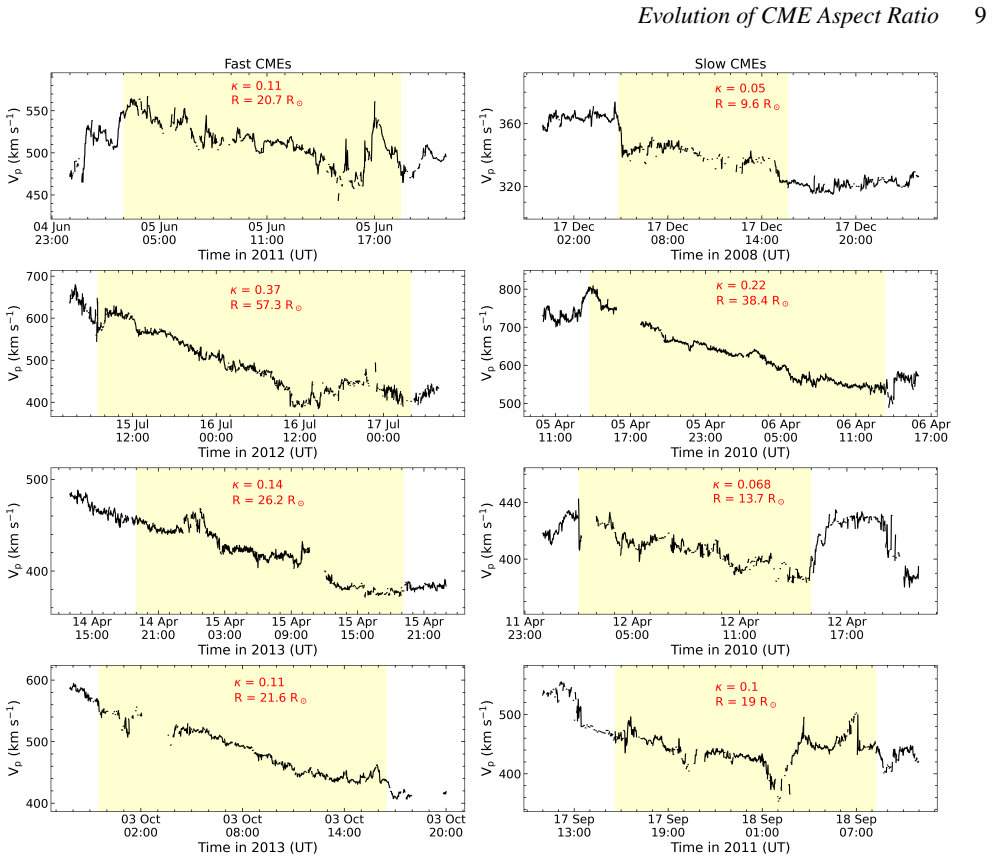
Aspect ratio does not stay constant but rises in the low-middle corona below roughly 10-15 solar radii, saturates at intermediate heights, and declines in interplanetary space; the expansion-speed ratio drops correspondingly, with fast CMEs producing more radially extended structures at 1 AU than slow CMEs.
What carries the argument
Three-phase evolution of aspect ratio measured by GCS model fits to multipoint coronagraph data combined with in-situ magnetic-cloud geometry at 1 AU.
If this is right
- Arrival-time and size forecasts at Earth require explicit aspect-ratio evolution rather than a fixed value.
- Fast CMEs arrive as more radially extended structures than slow CMEs, altering their expected geoeffectiveness.
- Expansion efficiency drops once the saturation phase ends, so models must capture the transition to heliosphere-dominated propagation.
- Accounting for the decline phase improves estimates of radial size and magnetic-field strength at Earth.
Where Pith is reading between the lines
- Space-weather models could test whether the saturation height correlates with the point where magnetic pressure equals solar-wind ram pressure.
- Similar phase changes may appear in other geometric quantities such as width or curvature when tracked over the same distance range.
- Closer-in observations could locate the exact transition height between the rise and saturation phases for individual events.
Load-bearing premise
The Graduated Cylindrical Shell model applied to multipoint images together with corrected in-situ magnetic-cloud measurements yields comparable and unbiased aspect-ratio values from the corona to 1 AU.
What would settle it
A set of Earth-directed CMEs whose aspect ratios remain roughly constant or follow a different distance dependence across the full range from corona to 1 AU.
Figures



read the original abstract
Coronal mass ejections (CMEs) undergo significant geometric evolution as they propagate from the Sun to 1 AU, influencing their radial size, expansion, and space weather impact. We investigate the evolution of CME aspect ratio and expansion dynamics for four fast and four slow Earth-directed CMEs. Using multipoint coronagraphic observations with the Graduated Cylindrical Shell (GCS) model and corrected in situ measurements of associated magnetic clouds (MCs) at 1 AU, we track the evolution of aspect ratio from the low-middle corona to interplanetary space. We find that aspect ratio does not remain constant but exhibits a systematic three-phase evolution: a rise phase in the low-middle corona ($\lesssim10$-$15\,R_{\odot}$), a saturation phase at intermediate heights, and then a decline phase in the interplanetary space. The ratio of radial expansion speed to leading-edge speed ($V_{\rm exp}/V_{\rm LE}$) decreases substantially from the corona to 1 AU, indicating a reduction in radial expansion efficiency during interplanetary propagation. The consistent evolution of aspect ratio and $V_{\rm exp}/V_{\rm LE}$ suggests a transition from magnetically dominated expansion in the corona to a regime increasingly controlled by the heliospheric environment. We note that fast CMEs show stronger early expansion and evolve into larger, more radially extended structures, whereas slow CMEs exhibit a more gradual rise and a steeper decline. These results demonstrate that CME geometry evolves significantly during propagation and highlight the need to incorporate aspect ratio evolution in models to improve predictions of CME size, arrival time, and geoeffectiveness.
Editorial analysis
A structured set of objections, weighed in public.
Referee Report
Summary. The paper analyzes the aspect ratio evolution of four fast and four slow Earth-directed CMEs from the low-middle corona to 1 AU using multipoint coronagraphic observations fitted with the Graduated Cylindrical Shell (GCS) model and corrected in-situ magnetic cloud measurements. It reports that aspect ratio exhibits a systematic three-phase evolution (rise phase ≲10-15 R_⊙, saturation at intermediate heights, decline in interplanetary space), accompanied by a decrease in V_exp/V_LE, with fast CMEs showing stronger early expansion than slow ones. The work concludes that this indicates a transition from magnetically dominated to heliospherically controlled expansion.
Significance. If the three-phase evolution and the comparability of the two aspect-ratio proxies hold after the requested clarifications, the result would be significant for CME propagation physics and space-weather modeling, as it quantifies geometric changes over the full Sun-to-1-AU range and highlights the need to include aspect-ratio evolution in arrival-time and geoeffectiveness predictions. The use of multi-viewpoint GCS reconstructions combined with corrected in-situ data on a sample of eight events is a clear methodological strength.
major comments (2)
- [Abstract] Abstract: The central claim of a systematic three-phase evolution is stated without any quantitative aspect-ratio values, uncertainties, event-by-event statistics, or description of the objective criteria used to delineate the rise, saturation, and decline phases. This information is load-bearing for assessing whether the reported phases are robust or could arise from measurement scatter.
- [Abstract] Abstract and data-analysis section: The three-phase claim spanning the corona-to-1-AU range rests on the assumption that GCS-derived aspect ratios and corrected in-situ magnetic-cloud aspect ratios measure the same geometric quantity without major systematic offsets. No cross-validation on overlapping events or discussion of possible projection/identification differences between the two proxies is provided; such an offset could produce an artificial saturation-then-decline signature.
minor comments (1)
- [Abstract] The abstract mentions “corrected in situ magnetic cloud measurements” but does not cite the specific correction procedure or reference; adding this citation would improve traceability.
Simulated Author's Rebuttal
We thank the referee for their thorough review and valuable suggestions. We have carefully considered each comment and provide point-by-point responses below. Where appropriate, we have revised the manuscript to address the concerns raised.
read point-by-point responses
-
Referee: [Abstract] Abstract: The central claim of a systematic three-phase evolution is stated without any quantitative aspect-ratio values, uncertainties, event-by-event statistics, or description of the objective criteria used to delineate the rise, saturation, and decline phases. This information is load-bearing for assessing whether the reported phases are robust or could arise from measurement scatter.
Authors: We agree with the referee that the abstract would be improved by including quantitative details. In the revised version, we have incorporated average aspect ratio values with their standard deviations (e.g., initial aspect ratio of 0.25 ± 0.05 rising to 0.45 ± 0.08 in the corona for fast CMEs), event-by-event statistics in a new table, and a description of the phase delineation criteria based on changes in the slope of aspect ratio versus distance profiles. revision: yes
-
Referee: [Abstract] Abstract and data-analysis section: The three-phase claim spanning the corona-to-1-AU range rests on the assumption that GCS-derived aspect ratios and corrected in-situ magnetic-cloud aspect ratios measure the same geometric quantity without major systematic offsets. No cross-validation on overlapping events or discussion of possible projection/identification differences between the two proxies is provided; such an offset could produce an artificial saturation-then-decline signature.
Authors: This is a valid concern. We have added a new paragraph in the methods section discussing the comparability of the two proxies, including potential systematic offsets from projection effects in GCS and the selection of magnetic cloud intervals. Although cross-validation on events with overlapping radial ranges is not possible with our dataset (as the techniques apply to distinct heliocentric distance regimes), the consistency of the three-phase evolution across independent events and the correlation with the V_exp/V_LE ratio supports that the observed trend is not an artifact of a constant offset. We have also revised the abstract to reflect this nuance. revision: partial
Circularity Check
No circularity: purely observational data analysis
full rationale
The paper reports empirical measurements of CME aspect ratio evolution using the GCS model on multipoint coronagraph observations and corrected in-situ MC data at 1 AU. No mathematical derivation, prediction, or ansatz is presented that reduces by construction to fitted parameters or self-citations; the three-phase pattern is extracted directly from the tracked observables across distance. The work contains no load-bearing self-citation chains, uniqueness theorems, or renaming of known results as new derivations. The central claim remains an independent observational finding.
Axiom & Free-Parameter Ledger
axioms (2)
- domain assumption The Graduated Cylindrical Shell (GCS) model accurately reconstructs CME 3D geometry from multipoint coronagraph observations.
- domain assumption Corrected in-situ measurements at 1 AU correspond to the same CME structures observed near the Sun.
Reference graph
Works this paper leans on
-
[1]
Agarwal A., Mishra W., 2024, @doi [ ] 10.1093/mnras/stae2260 , https://ui.adsabs.harvard.edu/abs/2024MNRAS.534.2458A 534, 2458
-
[2]
Agarwal A., Mishra W., 2025, @doi [ ] 10.3847/1538-4357/adbaeb , https://ui.adsabs.harvard.edu/abs/2025ApJ...982..183A 982, 183
-
[3]
Agarwal A., Mishra W., Owens M. J., Amerstorfer T., 2026, @doi [Space Weather] https://doi.org/10.1029/2025SW004911 , 24, e2025SW004911
-
[4]
Barnard L., Owens M., 2022, @doi [Frontiers in Physics] 10.3389/fphy.2022.1005621 , https://ui.adsabs.harvard.edu/abs/2022FrP....1005621B 10, 1005621
-
[5]
Barnard L. A., de Koning C. A., Scott C. J., Owens M. J., Wilkinson J., Davies J. A., 2017, @doi [Space Weather] 10.1002/2017SW001609 , https://ui.adsabs.harvard.edu/abs/2017SpWea..15..782B 15, 782
-
[6]
Barnard L., Owens M., Scott C., Lang M., Lockwood M., 2023, @doi [Space Weather] 10.1029/2023SW003487 , https://ui.adsabs.harvard.edu/abs/2023SpWea..2103487B 21, e2023SW003487
-
[7]
Bosman E., Bothmer V., Nistic \`o G., Vourlidas A., Howard R. A., Davies J. A., 2012, @doi [ ] 10.1007/s11207-012-0123-5 , http://adsabs.harvard.edu/abs/2012SoPh..281..167B 281, 167
-
[8]
R., Vourlidas A., Stenborg G., Dal Lago A., Mendon c a R
Braga C. R., Vourlidas A., Stenborg G., Dal Lago A., Mendon c a R. R. S. d., Echer E., 2020, @doi [Journal of Geophysical Research (Space Physics)] 10.1029/2020JA027885 , https://ui.adsabs.harvard.edu/abs/2020JGRA..12527885B 125, e27885
-
[9]
Braga C. R., Vourlidas A., Liewer P. C., Hess P., Stenborg G., Riley P., 2022, @doi [ ] 10.3847/1538-4357/ac90bf , https://ui.adsabs.harvard.edu/abs/2022ApJ...938...13B 938, 13
-
[10]
Brueckner G. E., et al., 1995, @doi [ ] 10.1007/BF00733434 , http://adsabs.harvard.edu/abs/1995SoPh..162..357B 162, 357
-
[11]
Byrne J. P., Maloney S. A., McAteer R. T. J., Refojo J. M., Gallagher P. T., 2010, @doi [Nature Communications] 10.1038/ncomms1077 , http://adsabs.harvard.edu/abs/2010NatCo...1E..74B 1
-
[12]
Cremades H., Iglesias F. A., Merenda L. A., 2020, @doi [ ] 10.1051/0004-6361/201936664 , https://ui.adsabs.harvard.edu/abs/2020A&A...635A.100C 635, A100
-
[13]
Davies J. A., et al., 2009, @doi [ ] 10.1029/2008GL036182 , http://adsabs.harvard.edu/abs/2009GeoRL..3602102D 36, 2102
-
[14]
Davies J. A., et al., 2012, @doi [ ] 10.1088/0004-637X/750/1/23 , http://adsabs.harvard.edu/abs/2012ApJ...750...23D 750, 23
-
[15]
A., Perry C
Davies J. A., Perry C. H., Trines R. M. G. M., Harrison R. A., Lugaz N., M \"o stl C., Liu Y. D., Steed K., 2013, , 776, 1
2013
-
[16]
Davies E. E., et al., 2021, @doi [ ] 10.1051/0004-6361/202040113 , https://ui.adsabs.harvard.edu/abs/2021A&A...656A...2D 656, A2
-
[17]
D \'e moulin P., Dasso S., 2009, @doi [ ] 10.1051/0004-6361/200810971 , http://adsabs.harvard.edu/abs/2009A
-
[18]
D \'e moulin P., Dasso S., Janvier M., 2013, @doi [ ] 10.1051/0004-6361/201220535 , https://ui.adsabs.harvard.edu/abs/2013A&A...550A...3D 550, A3
-
[19]
D \'e moulin P., Dasso S., Lanabere V., Janvier M., 2020, @doi [ ] 10.1051/0004-6361/202038077 , https://ui.adsabs.harvard.edu/abs/2020A&A...639A...6D 639, A6
-
[20]
Dumbovi \'c M., et al., 2026, @doi [Space Weather] 10.1029/2025SW004750 , https://ui.adsabs.harvard.edu/abs/2026SpWea..2404750D 24, e2025SW004750
-
[21]
Gopalswamy N., Lara A., Lepping R. P., Kaiser M. L., Berdichevsky D., St. Cyr O. C., 2000, @doi [ ] 10.1029/1999GL003639 , http://adsabs.harvard.edu/abs/2000GeoRL..27..145G 27, 145
-
[22]
Gopalswamy N., Akiyama S., Yashiro S., Xie H., M \"a kel \"a P., Michalek G., 2014, @doi [ ] 10.1002/2014GL059858 , https://ui.adsabs.harvard.edu/abs/2014GeoRL..41.2673G 41, 2673
-
[23]
Gopalswamy N., Yashiro S., Xie H., Akiyama S., M \"a kel \"a P., 2015, @doi [Journal of Geophysical Research (Space Physics)] 10.1002/2015JA021446 , https://ui.adsabs.harvard.edu/abs/2015JGRA..120.9221G 120, 9221
-
[24]
Harrison R. A., et al., 2018, @doi [ ] 10.1007/s11207-018-1297-2 , http://adsabs.harvard.edu/abs/2018SoPh..293...77H 293, 77
-
[25]
Heinemann S. G., et al., 2019, @doi [ ] 10.1007/s11207-019-1515-6 , https://ui.adsabs.harvard.edu/abs/2019SoPh..294..121H 294, 121
-
[26]
Hinterreiter J., et al., 2021, @doi [Space Weather] 10.1029/2021SW002836 , https://ui.adsabs.harvard.edu/abs/2021SpWea..1902836H 19, e02836
-
[27]
A., Moses, J., Vourlidas, A., et al
Howard R. A., et al., 2008, @doi [ ] 10.1007/s11214-008-9341-4 , http://adsabs.harvard.edu/abs/2008SSRv..136...67H 136, 67
-
[28]
T., Saba J
Hundhausen A., 1999, in Strong K. T., Saba J. L. R., Haisch B. M., Schmelz J. T., eds, The many faces of the sun: a summary of the results from NASA's Solar Maximum Mission.. p. 143
1999
-
[29]
Huttunen K. E. J., Schwenn R., Bothmer V., Koskinen H. E. J., 2005, @doi [Annales Geophysicae] 10.5194/angeo-23-625-2005 , https://ui.adsabs.harvard.edu/abs/2005AnGeo..23..625H 23, 625
-
[30]
Isavnin A., 2016, @doi [ ] 10.3847/1538-4357/833/2/267 , https://ui.adsabs.harvard.edu/abs/2016ApJ...833..267I 833, 267
-
[31]
Isavnin A., Vourlidas A., Kilpua E. K. J., 2013, @doi [ ] 10.1007/s11207-012-0214-3 , https://ui.adsabs.harvard.edu/abs/2013SoPh..284..203I 284, 203
-
[32]
L., Kucera, T., Davila, J., et al
Kaiser M. L., Kucera T. A., Davila J. M., St. Cyr O. C., Guhathakurta M., Christian E., 2008, @doi [ ] 10.1007/s11214-007-9277-0 , http://adsabs.harvard.edu/abs/2008SSRv..136....5K 136, 5
-
[33]
Kay C., Gopalswamy N., 2018, @doi [Journal of Geophysical Research (Space Physics)] 10.1029/2018JA025780 , https://ui.adsabs.harvard.edu/abs/2018JGRA..123.7220K 123, 7220
-
[34]
Kay C., Nieves-Chinchilla T., 2021, @doi [Journal of Geophysical Research (Space Physics)] 10.1029/2020JA028911 , https://ui.adsabs.harvard.edu/abs/2021JGRA..12628911K 126, 2020JA028911
-
[35]
Kay C., Opher M., 2015, @doi [ ] 10.1088/2041-8205/811/2/L36 , https://ui.adsabs.harvard.edu/abs/2015ApJ...811L..36K 811, L36
-
[36]
Kay C., Palmerio E., 2024, @doi [Space Weather] 10.1029/2023SW003796 , https://ui.adsabs.harvard.edu/abs/2024SpWea..2203796K 22, e2023SW003796
-
[37]
Kay C., Opher M., Colaninno R. C., Vourlidas A., 2016, @doi [ ] 10.3847/0004-637X/827/1/70 , https://ui.adsabs.harvard.edu/abs/2016ApJ...827...70K 827, 70
-
[38]
Khuntia S., Mishra W., Wang Y., Mishra S. K., Nieves-Chinchilla T., Lyu S., 2024, @doi [ ] 10.1093/mnras/stae2523 , https://ui.adsabs.harvard.edu/abs/2024MNRAS.535.2585K 535, 2585
-
[39]
Khuntia S., Mishra W., Agarwal A., 2025, @doi [ ] 10.1051/0004-6361/202452866 , https://ui.adsabs.harvard.edu/abs/2025A&A...698A..79K 698, A79
-
[40]
King J. H., Papitashvili N. E., 2005, @doi [Journal of Geophysical Research (Space Physics)] 10.1029/2004JA010649 , https://ui.adsabs.harvard.edu/abs/2005JGRA..110.2104K 110, A02104
-
[41]
Krall J., St. Cyr O. C., 2006, @doi [ ] 10.1086/508337 , https://ui.adsabs.harvard.edu/abs/2006ApJ...652.1740K 652, 1740
-
[42]
Krall J., Chen J., Duffin R. T., Howard R. A., Thompson B. J., 2001, @doi [ ] 10.1086/323844 , https://ui.adsabs.harvard.edu/abs/2001ApJ...562.1045K 562, 1045
-
[43]
Lepping R. P., Burlaga L. F., Jones J. A., 1990, @doi [ ] 10.1029/JA095iA08p11957 , http://adsabs.harvard.edu/abs/1990JGR....9511957L 95, 11957
-
[44]
Liu Y., Richardson J. D., Belcher J. W., 2005, @doi [ ] 10.1016/j.pss.2004.09.023 , http://adsabs.harvard.edu/abs/2005P
-
[45]
Liu Y., Luhmann J. G., Bale S. D., Lin R. P., 2011, @doi [ ] 10.1088/0004-637X/734/2/84 , http://adsabs.harvard.edu/abs/2011ApJ...734...84L 734, 84
-
[46]
Lynch B. J., Zurbuchen T. H., Fisk L. A., Antiochos S. K., 2003, @doi [Journal of Geophysical Research (Space Physics)] 10.1029/2002JA009591 , https://ui.adsabs.harvard.edu/abs/2003JGRA..108.1239L 108, 1239
-
[47]
Lyu S., Wang Y., Li X., Guo J., Wang C., Zhang Q., 2021, @doi [ ] 10.3847/1538-4357/abd9c9 , https://ui.adsabs.harvard.edu/abs/2021ApJ...909..182L 909, 182
-
[48]
Lyu S., Wang Y., Li X., Zhang Q., 2023, @doi [ ] 10.1051/0004-6361/202243912 , https://ui.adsabs.harvard.edu/abs/2023A&A...672A.100L 672, A100
-
[49]
M., Wiegand C., Mullinix R., Mays M
Maddox M. M., Wiegand C., Mullinix R., Mays M. L., Chulaki A., Kuznetsova M. M., Pulkkinen A. A., Zheng Y., 2014, in AGU Fall Meeting Abstracts. pp SM31A--4183
2014
-
[50]
Manchester W., Kilpua E. K. J., Liu Y. D., Lugaz N., Riley P., T \"o r \"o k T., Vr s nak B., 2017, @doi [ ] 10.1007/s11214-017-0394-0 , http://adsabs.harvard.edu/abs/2017SSRv..212.1159M 212, 1159
-
[51]
Mayank P., Vaidya B., Mishra W., Chakrabarty D., 2024, @doi [ ] 10.3847/1538-4365/ad08c7 , https://ui.adsabs.harvard.edu/abs/2024ApJS..270...10M 270, 10
-
[52]
Mierla M., et al., 2010, @doi [Annales Geophysicae] 10.5194/angeo-28-203-2010 , http://adsabs.harvard.edu/abs/2010AnGeo..28..203M 28, 203
-
[53]
Mishra W., Srivastava N., 2013, @doi [ ] 10.1088/0004-637X/772/1/70 , http://adsabs.harvard.edu/abs/2013ApJ...772...70M 772, 70
-
[54]
Mishra W., Teriaca L., 2023, @doi [Journal of Astrophysics and Astronomy] 10.1007/s12036-023-09910-6 , https://ui.adsabs.harvard.edu/abs/2023JApA...44...20M 44, 20
-
[55]
Mishra W., Wang Y., 2018, @doi [ ] 10.3847/1538-4357/aadb9b , http://adsabs.harvard.edu/abs/2018ApJ...865...50M 865, 50
-
[56]
Mishra W., Srivastava N., Davies J. A., 2014, @doi [ ] 10.1088/0004-637X/784/2/135 , http://adsabs.harvard.edu/abs/2014ApJ...784..135M 784, 135
-
[57]
Mishra W., Srivastava N., Chakrabarty D., 2015, @doi [ ] 10.1007/s11207-014-0625-4 , http://adsabs.harvard.edu/abs/2015SoPh..290..527M 290, 527
-
[58]
Mishra W., Wang Y., Srivastava N., 2016, @doi [ ] 10.3847/0004-637X/831/1/99 , http://adsabs.harvard.edu/abs/2016ApJ...831...99M 831, 99
-
[59]
Mishra W., Wang Y., Srivastava N., Shen C., 2017, @doi [ ] 10.3847/1538-4365/aa8139 , http://adsabs.harvard.edu/abs/2017ApJS..232....5M 232, 5
-
[60]
Mishra W., Wang Y., Teriaca L., Zhang J., Chi Y., 2020, @doi [Frontiers in Astronomy and Space Sciences] 10.3389/fspas.2020.00001 , https://ui.adsabs.harvard.edu/abs/2020FrASS...7....1M 7, 1
-
[61]
Mishra W., Doshi U., Srivastava N., 2021, @doi [Frontiers in Astronomy and Space Sciences] 10.3389/fspas.2021.713999 , https://ui.adsabs.harvard.edu/abs/2021FrASS...8..142M 8, 142
-
[62]
Mishra W., Wang Y., Lyu S., Khuntia S., 2023, @doi [ ] 10.3847/1538-4357/ace691 , https://ui.adsabs.harvard.edu/abs/2023ApJ...952..173M 952, 173
-
[63]
E., Pomoell J., Kumari A., Vainio R., Kilpua E
Morosan D. E., Pomoell J., Kumari A., Vainio R., Kilpua E. K. J., 2022, @doi [ ] 10.1051/0004-6361/202244432 , https://ui.adsabs.harvard.edu/abs/2022A&A...668A..15M 668, A15
-
[64]
M \"o stl C., et al., 2014, @doi [ ] 10.1088/0004-637X/787/2/119 , http://adsabs.harvard.edu/abs/2014ApJ...787..119M 787, 119
-
[65]
M \"o stl C., et al., 2015, @doi [Nature Communications] 10.1038/ncomms8135 , http://adsabs.harvard.edu/abs/2015NatCo...6E7135M 6, 7135
-
[66]
Nieves-Chinchilla T., Linton M. G., Hidalgo M. A., Vourlidas A., 2018, @doi [ ] 10.3847/1538-4357/aac951 , https://ui.adsabs.harvard.edu/abs/2018ApJ...861..139N 861, 139
-
[67]
Nikou E., Zhang J., Dhakal S. K., Dupertuis M., 2025, @doi [ ] 10.3847/1538-4357/adcef0 , https://ui.adsabs.harvard.edu/abs/2025ApJ...987..157N 987, 157
-
[68]
Odstrcil D., Vandas M., Pizzo V. J., MacNeice P., 2003, in Velli M., Bruno R., Malara F., Bucci B., eds, American Institute of Physics Conference Series Vol. 679, Solar Wind Ten. pp 699--702, @doi 10.1063/1.1618690
-
[69]
Owens M. J., Crooker N. U., 2006, @doi [Journal of Geophysical Research (Space Physics)] 10.1029/2006JA011641 , https://ui.adsabs.harvard.edu/abs/2006JGRA..11110104O 111, A10104
-
[70]
Owens M. J., Cargill P. J., Pagel C., Siscoe G. L., Crooker N. U., 2005, @doi [Journal of Geophysical Research (Space Physics)] 10.1029/2004JA010814 , https://ui.adsabs.harvard.edu/abs/2005JGRA..110.1105O 110, A01105
-
[71]
Owens M. J., Merkin V. G., Riley P., 2006, @doi [Journal of Geophysical Research (Space Physics)] 10.1029/2005JA011460 , https://ui.adsabs.harvard.edu/abs/2006JGRA..111.3104O 111, A03104
-
[72]
Owens M. J., Lockwood M., Barnard L. A., 2017, @doi [Scientific Reports] 10.1038/s41598-017-04546-3 , https://ui.adsabs.harvard.edu/abs/2017NatSR...7.4152O 7, 4152
-
[73]
Owens M. J., Barnard L. A., Verbeke C., McGinness B. P. S., Turner H., Chi Y., Gyeltshen D., Lockwood M., 2025, @doi [Space Weather] https://doi.org/10.1029/2025SW004397 , 23, e2025SW004397
-
[74]
Patsourakos S., Vourlidas A., Kliem B., 2010, @doi [ ] 10.1051/0004-6361/200913599 , https://ui.adsabs.harvard.edu/abs/2010A&A...522A.100P 522, A100
-
[75]
Pluta A., Mrotzek N., Vourlidas A., Bothmer V., Savani N., 2019, @doi [ ] 10.1051/0004-6361/201833829 , https://ui.adsabs.harvard.edu/abs/2019A&A...623A.139P 623, A139
-
[76]
Pomoell J., Poedts S., 2018, @doi [Journal of Space Weather and Space Climate] 10.1051/swsc/2018020 , https://ui.adsabs.harvard.edu/abs/2018JSWSC...8A..35P 8, A35
-
[77]
Richardson I. G., Cane H. V., 2004, @doi [Journal of Geophysical Research (Space Physics)] 10.1029/2004JA010598 , http://adsabs.harvard.edu/abs/2004JGRA..10909104R 109, 9104
-
[78]
Rollett T., M \"o stl C., Isavnin A., Davies J. A., Kubicka M., Amerstorfer U. V., Harrison R. A., 2016, @doi [ ] 10.3847/0004-637X/824/2/131 , https://ui.adsabs.harvard.edu/abs/2016ApJ...824..131R 824, 131
-
[79]
Ruffenach A., et al., 2012, @doi [Journal of Geophysical Research (Space Physics)] 10.1029/2012JA017624 , https://ui.adsabs.harvard.edu/abs/2012JGRA..117.9101R 117, A09101
-
[80]
Sachdeva N., Subramanian P., Vourlidas A., Bothmer V., 2017, @doi [ ] 10.1007/s11207-017-1137-9 , https://ui.adsabs.harvard.edu/abs/2017SoPh..292..118S 292, 118
discussion (0)
Sign in with ORCID, Apple, or X to comment. Anyone can read and Pith papers without signing in.