Time-dependent cosmic-ray escape from wind bubbles: hard spectra formation
Pith reviewed 2026-06-27 08:35 UTC · model grok-4.3
The pith
Wind bubbles produce cosmic-ray escape spectra harder than the standard E to the minus two during the wind-driven phase.
A machine-rendered reading of the paper's core claim, the machinery that carries it, and where it could break.
Core claim
During the wind driven phase, the downstream escaping spectra from wind bubbles can be harder than ∼E^{-2}, the conventional expectation from diffusive shock acceleration, because cosmic rays are continuously injected at the termination shock and propagate by advection and diffusion until they reach the time-dependent position of the forward shock treated as a free escape boundary.
What carries the argument
The time-dependent forward shock treated as a free escape boundary in a one-dimensional spherical advection-diffusion transport model solved via stochastic differential equations.
If this is right
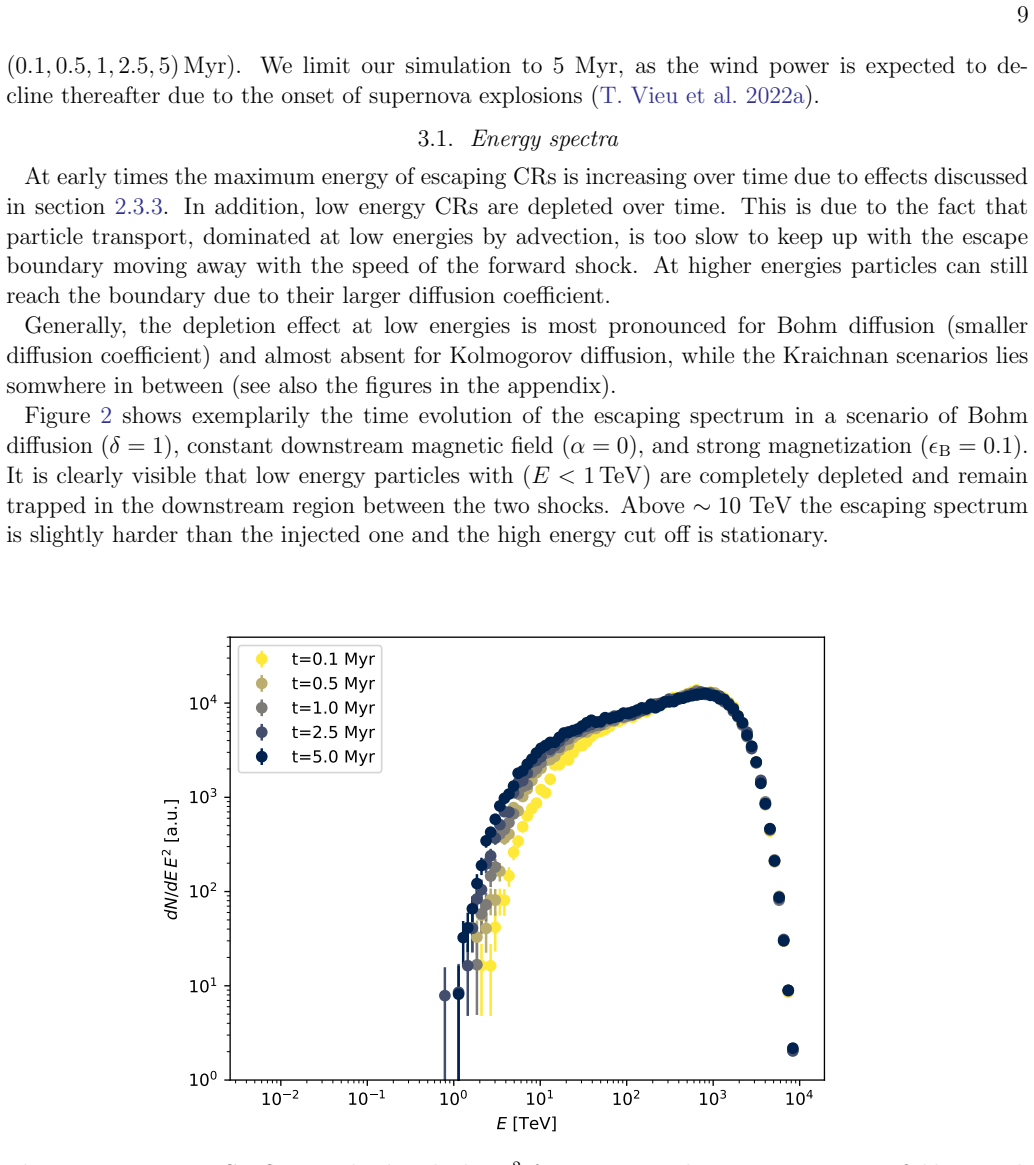
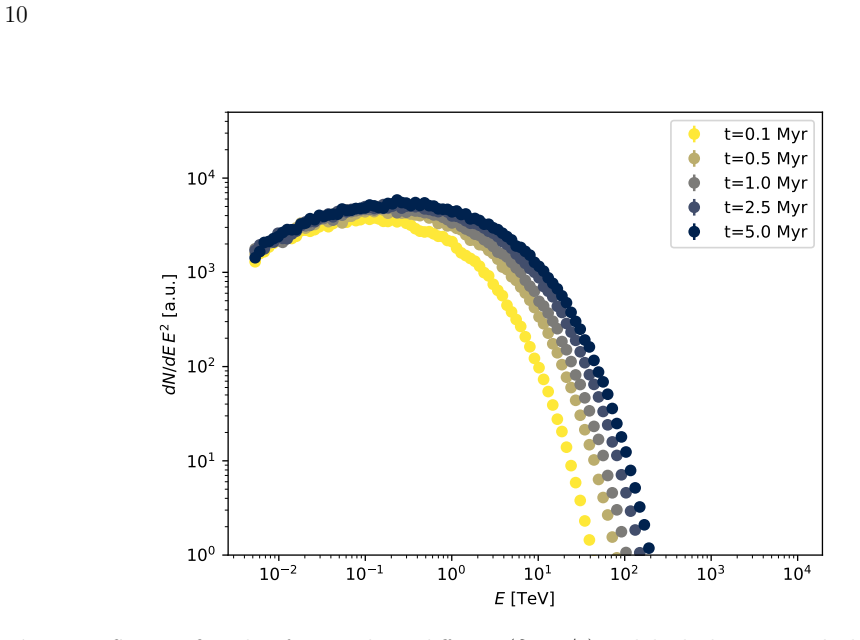
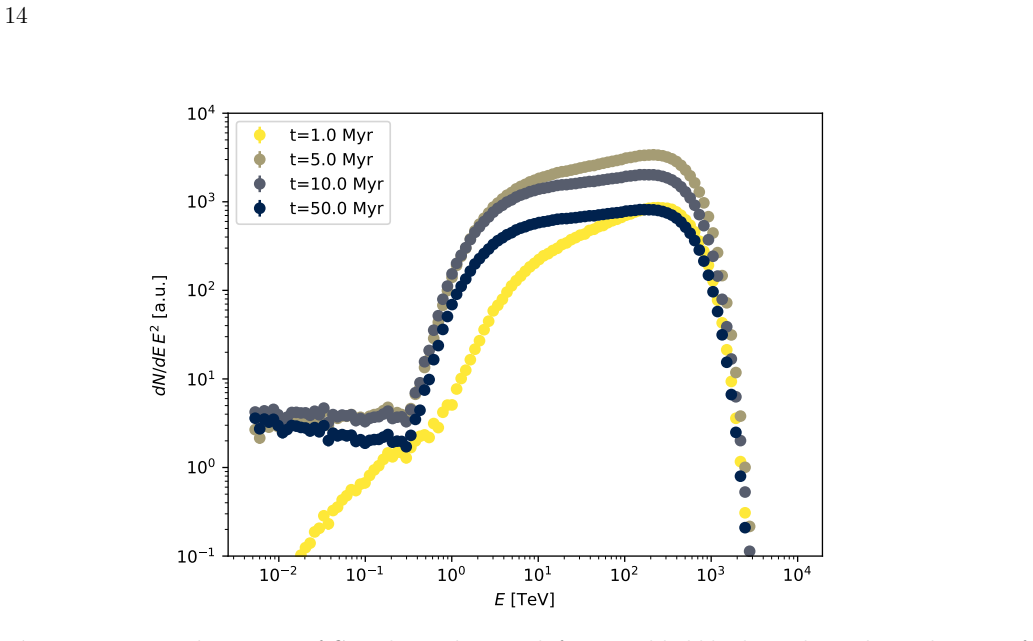
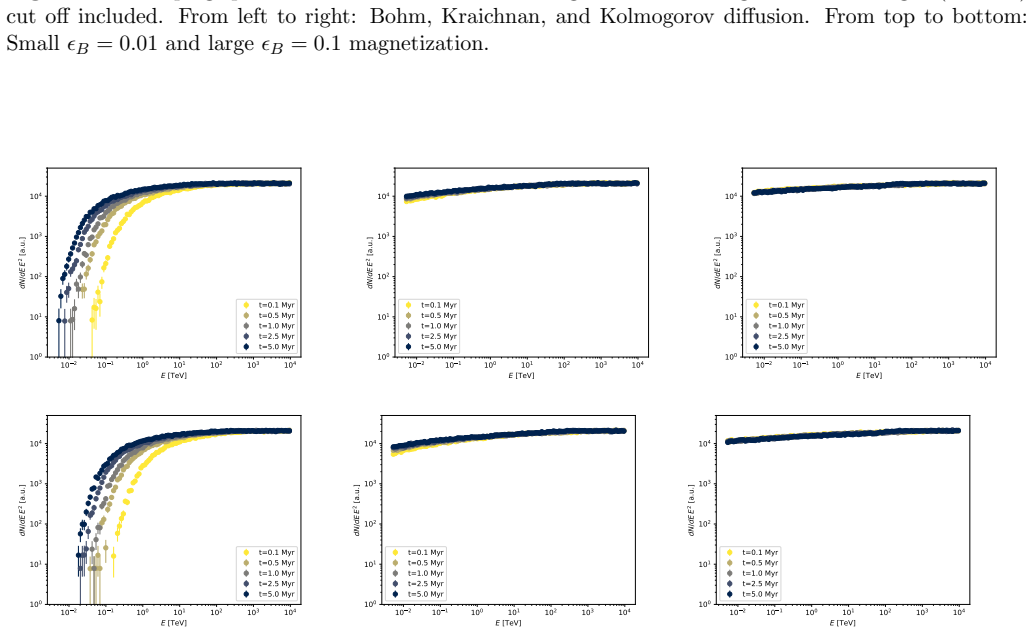
- The initial energy spectrum can be significantly suppressed at the lowest energies, depending on the turbulence model chosen.
- Low-energy particles experience efficient confinement inside the bubble.
- This confinement produces observable effects in multi-messenger radiation and the cosmic-ray grammage accumulated within the bubble.
Where Pith is reading between the lines
- The same time-dependent escape boundary could alter spectra from other expanding shocks whose forward edges move outward on comparable timescales.
- If wind bubbles contribute substantially to the galactic cosmic-ray population, their hardened output would shift the composite spectrum at certain energies.
- Gamma-ray or neutrino observations targeting individual bubbles could directly test the predicted low-energy suppression feature.
Load-bearing premise
The forward shock functions purely as a free escape boundary whose position evolves with time, with no reflection or re-acceleration of particles occurring there.
What would settle it
A measurement of the escaping cosmic-ray spectrum from a wind bubble in its wind-driven phase that shows a spectral index of -2 or softer would contradict the reported hardening.
Figures







read the original abstract
Overview: Wind-driven bubbles are dynamic systems that can accelerate cosmic rays, depending on their physical properties, up to very high energies. We investigate how a time-dependent description of the particle transport may impact the escaping cosmic-ray flux. Model: The wind bubble system is modeled as spherically symmetric. Cosmic rays are continuously injected at the position of the termination shock and propagate through advection and diffusion until the escape at the time-dependent position of the forward shock, which is treated as a free escape boundary. Methods: The one-dimensional spherical time-dependent transport equation is solved by transforming it into the corresponding set of stochastic differential equations, and integrated with a modified version of the open source cosmic-ray propagation framework CRPropa. Results: We find that, during the wind driven phase, the downstream escaping spectra from wind bubbles can be harder than $\sim E^{-2}$, the conventional expectation from diffusive shock acceleration. Depending on the turbulence model the initial energy spectrum can be significantly suppressed at lowest energies, which could be an observable feature to distinguish between different turbulence realizations. This effect could lead to an efficient confinement of low energy particles, potentially leading to observable implication in terms of multi-messenger radiation and cosmic-ray accumulated grammage within the bubble.
Editorial analysis
A structured set of objections, weighed in public.
Referee Report
Summary. The manuscript models cosmic-ray transport in spherically symmetric wind bubbles by solving the time-dependent 1D transport equation via stochastic differential equations in a modified CRPropa framework. Particles are injected continuously at the termination shock, advected and diffused, and escape only when they reach the outward-moving forward shock, which is imposed as a free-escape boundary. The central claim is that escaping spectra during the wind-driven phase can be harder than ~E^{-2}, with additional low-energy suppression that depends on the turbulence model and possible implications for multi-messenger signals and grammage.
Significance. If the numerical result is robust, the work supplies a concrete time-dependent mechanism capable of producing spectra harder than standard DSA expectations from wind bubbles, with potential observational signatures in low-energy suppression. The SDE implementation for evolving boundaries is a methodological asset that enables the time-dependent treatment.
major comments (1)
- [Model section] Model section (description of forward-shock boundary): the forward shock is treated strictly as a time-dependent absorbing free-escape boundary. This choice directly controls the residence-time distribution that produces the reported hardening; the manuscript does not test alternatives such as partial reflection, finite shock thickness, or re-acceleration at the forward shock. Because the skeptic note identifies this as the load-bearing assumption, a sensitivity study with at least one modified boundary condition is required to confirm that the E^{-2} violation survives.
minor comments (2)
- The abstract refers to 'downstream escaping spectra' while the geometry is spherically symmetric; a brief clarification of what 'downstream' denotes in this context would improve readability.
- The turbulence-model dependence is stated qualitatively; adding a short table or figure panel that quantifies the low-energy suppression for the two turbulence realizations would strengthen the claim of an observable discriminator.
Simulated Author's Rebuttal
We thank the referee for the constructive review and for recognizing the potential significance of the time-dependent mechanism and the SDE implementation. We address the single major comment below.
read point-by-point responses
-
Referee: [Model section] Model section (description of forward-shock boundary): the forward shock is treated strictly as a time-dependent absorbing free-escape boundary. This choice directly controls the residence-time distribution that produces the reported hardening; the manuscript does not test alternatives such as partial reflection, finite shock thickness, or re-acceleration at the forward shock. Because the skeptic note identifies this as the load-bearing assumption, a sensitivity study with at least one modified boundary condition is required to confirm that the E^{-2} violation survives.
Authors: We agree that the strictly absorbing free-escape boundary at the forward shock is a central modeling choice that shapes the residence-time distribution and the resulting spectral hardening. This boundary condition is physically motivated by the expectation that particles crossing the forward shock enter the interstellar medium and are no longer confined to the bubble. Nevertheless, we acknowledge that the robustness of the E^{-2} violation under alternative treatments has not been demonstrated. In the revised manuscript we will add a sensitivity study implementing at least one modified boundary condition (e.g., a partially reflecting boundary with a tunable reflection coefficient) and will show whether the reported hardening persists. The new results will be presented in an expanded Model section or dedicated appendix. revision: yes
Circularity Check
Numerical integration of transport equation produces emergent hardening; no circular reduction
full rationale
The paper solves the one-dimensional spherical time-dependent transport equation numerically by conversion to stochastic differential equations and integration in CRPropa. Cosmic-ray injection occurs at the termination shock and escape is imposed at the time-dependent forward-shock position treated as a free-escape boundary. The reported spectral indices harder than E^{-2} are outputs of this integration under the stated boundary conditions and advection-diffusion physics. No parameter is fitted to the target spectrum, no output is defined in terms of itself, and no load-bearing step reduces by construction to a self-citation or ansatz imported from prior work by the same authors. The model assumptions are explicit inputs; the hardening is an emergent numerical result rather than a definitional identity.
Axiom & Free-Parameter Ledger
free parameters (1)
- turbulence model parameters
axioms (2)
- domain assumption Spherically symmetric geometry
- domain assumption Forward shock as free escape boundary
Reference graph
Works this paper leans on
-
[1]
Science , year = 2005, month = sep, volume = 309, pages =
Voyager 1 in the Foreshock, Termination Shock, and Heliosheath. Science , year = 2005, month = sep, volume = 309, pages =. doi:10.1126/science.1117569 , adsurl =
-
[2]
Physics of the Inner Heliosheath , year = 2006, series =
Low-energy ions near the termination shock. Physics of the Inner Heliosheath , year = 2006, series =. doi:10.1063/1.2359308 , adsurl =
-
[3]
Science , year = 2005, month = sep, volume = 309, pages =
Voyager 1 Explores the Termination Shock Region and the Heliosheath Beyond. Science , year = 2005, month = sep, volume = 309, pages =. doi:10.1126/science.1117684 , adsurl =
-
[4]
, year = 2008, month = jul, volume = 454, pages =
An asymmetric solar wind termination shock. , year = 2008, month = jul, volume = 454, pages =. doi:10.1038/nature07022 , adsurl =
-
[5]
Physics of the Inner Heliosheath , year = 2006, series =
Termination shock particle spectral features. Physics of the Inner Heliosheath , year = 2006, series =. doi:10.1063/1.2359310 , adsurl =
-
[6]
Modeling of the Heliospheric Interface, Magnetic Field, and Cosmic-Ray Transport. , keywords =. doi:10.1086/512848 , adsurl =
-
[7]
Advances in Space Research , year = 2009, month = may, volume = 43, pages =
The acceleration of Anomalous Cosmic Rays by stochastic acceleration in the heliosheath. Advances in Space Research , year = 2009, month = may, volume = 43, pages =. doi:10.1016/j.asr.2009.02.010 , adsurl =
-
[8]
, archivePrefix = "arXiv", eprint =
A Magnetic Reconnection Mechanism for the Generation of Anomalous Cosmic Rays. , archivePrefix = "arXiv", eprint =. doi:10.1088/0004-637X/709/2/963 , adsurl =
-
[9]
, archivePrefix = "arXiv", eprint =
A Model of Acceleration of Anomalous Cosmic Rays by Reconnection in the Heliosheath. , archivePrefix = "arXiv", eprint =. doi:10.1088/0004-637X/703/1/8 , adsurl =
-
[10]
, keywords =
The Theory of Anomalous Cosmic Rays. , keywords =
-
[11]
Astrophysics and Space Science Library , year = 2009, series =
Nonlinear Cosmic Ray Diffusion Theories. Astrophysics and Space Science Library , year = 2009, series =. doi:10.1007/978-3-642-00309-7 , adsurl =
-
[12]
Amsterdam: North-Holland, 1990, edited by Ginzburg, V.L
Astrophysics of cosmic rays. Amsterdam: North-Holland, 1990, edited by Ginzburg, V.L. , year = 1990, adsurl =
1990
-
[13]
1997 , chapter=
Complex Variables: Introduction and Applications , author=. 1997 , chapter=
1997
-
[14]
, archivePrefix = "arXiv", eprint =
Transport of Cosmic-Ray Protons in Intermittent Heliospheric Turbulence: Model and Simulations. , archivePrefix = "arXiv", eprint =. doi:10.1088/0004-637X/781/2/93 , adsurl =
-
[15]
Anomalous Transport of High-energy Cosmic Rays in Galactic Superbubbles. I. Numerical Simulations. , keywords =. doi:10.1088/0004-637X/749/2/178 , adsurl =
-
[16]
Anomalous diffusion in disordered media: Statistical mechanisms, models and physical applications. Phys. Rep. , year = 1990, volume = 195, pages =
1990
-
[17]
Annals of Mathematical Statistics , year = 1958, volume = 29, pages =
A Note on the Generation of Random Normal Deviates. Annals of Mathematical Statistics , year = 1958, volume = 29, pages =
1958
-
[18]
, year = 2006, month = jan, volume = 439, pages =
The scaling laws of human travel. , year = 2006, month = jan, volume = 439, pages =. doi:10.1038/nature04292 , adsurl =
-
[19]
Journal of the American Statistical Association , volume =
A Method for Simulating Stable Random Variables , author =. Journal of the American Statistical Association , volume =. 1976 , publisher =
1976
-
[20]
Physics Letters A , year = 1998, month = feb, volume = 239, pages =
A fractional diffusion equation to describe L \'e vy flights. Physics Letters A , year = 1998, month = feb, volume = 239, pages =. doi:10.1016/S0375-9601(97)00947-X , adsurl =
-
[21]
Soviet Journal of Experimental and Theoretical Physics , year = 1995, month = nov, volume = 81, pages =
Stochastic transport and fractional derivatives. Soviet Journal of Experimental and Theoretical Physics , year = 1995, month = nov, volume = 81, pages =
1995
-
[22]
Anisotropic Three-Dimensional Focused Transport of Solar Energetic Particles in the Inner Heliosphere. , keywords =. doi:10.1088/0004-637X/709/2/912 , adsurl =
-
[23]
, eprint =
Anomalous transport and particle acceleration at shocks. , eprint =
-
[24]
, year = 2001, month = feb, volume = 95, pages =
Anomalous Cosmic Rays: Messengers from the Outer Heliosphere. , year = 2001, month = feb, volume = 95, pages =
2001
-
[25]
8th International Conference of Numerical Modeling of Space Plasma Flows (ASTRONUM 2013) , year = 2014, series =
Numerical Modeling of Anomalous Transport of Cosmic Rays. 8th International Conference of Numerical Modeling of Space Plasma Flows (ASTRONUM 2013) , year = 2014, series =
2013
-
[26]
Handbook of stochastic methods for physics, chemistry and the natural sciences
-
[27]
and De Fabritiis, G
Gorenflo, R. and De Fabritiis, G. and Mainardi, F. Discrete random walk models for symmetric L\'evy-Feller diffusion processes. Physica A: Statistical Mechanics and its Applications. 1999
1999
-
[28]
Scaling Theory for Cross-Field Transport of Cosmic Rays in Turbulent Fields. , keywords =. doi:10.1088/0004-637X/711/2/997 , adsurl =
-
[29]
Numerical Approximation of a Fractional-In-Space Diffusion Equation, I , author =
-
[30]
Physica A Statistical Mechanics and its Applications , eprint =
Stochastic calculus for assets with non-Gaussian price fluctuations. Physica A Statistical Mechanics and its Applications , eprint =. doi:10.1016/S0378-4371(02)00803-8 , adsurl =
-
[31]
Physics of Plasmas , year = 2014, month = feb, volume = 21, number = 2, eid =
A gedankenexperiment for anomalous diffusion in a charge-fluctuating dusty plasma. Physics of Plasmas , year = 2014, month = feb, volume = 21, number = 2, eid =. doi:10.1063/1.4865408 , adsurl =
-
[32]
Velocity Correlation and the Spatial Diffusion Coefficients of Cosmic Rays: Compound Diffusion. , keywords =. doi:10.1086/308492 , adsurl =
-
[33]
Fractional Schr \"o dinger equation. , eprint =. doi:10.1103/PhysRevE.66.056108 , adsurl =
-
[34]
, archivePrefix = "arXiv", eprint =
Superdiffusion of Cosmic Rays: Implications for Cosmic Ray Acceleration. , archivePrefix = "arXiv", eprint =. doi:10.1088/0004-637X/784/1/38 , adsurl =
-
[35]
Sub- and superdiffusive molecular displacement laws in disordered porous media probed by nuclear magnetic resonance. , keywords =. doi:10.1103/PhysRevE.74.066309 , adsurl =
-
[36]
Non-Gaussian statistics and superdiffusion in a driven-dissipative dusty plasma. , keywords =. doi:10.1103/PhysRevE.78.046403 , adsurl =
-
[37]
Competition between subdiffusion and L \'e vy flights: A Monte Carlo approach. , keywords =. doi:10.1103/PhysRevE.75.056702 , adsurl =
-
[38]
Journal of Computational and Applied Mathematics , keywords =
Fox H functions in fractional diffusion. Journal of Computational and Applied Mathematics , keywords =
-
[39]
Matsumoto, Makoto and Nishimura, Takuji , title =. ACM Trans. Model. Comput. Simul. , issue_date =. 1998 , issn =. doi:10.1145/272991.272995 , acmid =
-
[40]
Journal of Computational and Applied Mathematics , keywords =
Finite difference approximations for fractional advection-dispersion flow equations. Journal of Computational and Applied Mathematics , keywords =
-
[41]
Meerschaert and Charles Tadjeran
Mark M. Meerschaert and Charles Tadjeran. Finite difference approximations for two-sided space-fractional partial differential equations. Applied Numerical Mathematics. 2006. doi:10.1016/j.apnum.2005.02.008
-
[42]
, year = 2000, month = dec, volume = 339, pages =
The random walk's guide to anomalous diffusion: a fractional dynamics approach. , year = 2000, month = dec, volume = 339, pages =. doi:10.1016/S0370-1573(00)00070-3 , adsurl =
-
[43]
Journal of Physics A Mathematical General , year = 2004, month = aug, volume = 37, pages =
TOPICAL REVIEW: The restaurant at the end of the random walk: recent developments in the description of anomalous transport by fractional dynamics. Journal of Physics A Mathematical General , year = 2004, month = aug, volume = 37, pages =. doi:10.1088/0305-4470/37/31/R01 , adsurl =
-
[44]
EPL (Europhysics Letters) , keywords =
Deriving fractional Fokker-Planck equations from a generalised master equation. EPL (Europhysics Letters) , keywords =. doi:10.1209/epl/i1999-00279-7 , adsurl =
-
[45]
Planetary and Space Science , year = 1965, month = jan, volume = 13, pages =
The passage of energetic charged particles through interplanetary space. Planetary and Space Science , year = 1965, month = jan, volume = 13, pages =. doi:10.1016/0032-0633(65)90131-5 , adsurl =
-
[46]
Evidence of Superdiffusive Transport of Electrons Accelerated at Interplanetary Shocks. , keywords =. doi:10.1086/525523 , adsurl =
-
[47]
Astrophysics and Space Sciences Transactions , year = 2008, month = jul, volume = 4, pages =
Observations of anomalous transport of energetic electrons in the heliosphere. Astrophysics and Space Sciences Transactions , year = 2008, month = jul, volume = 4, pages =. doi:10.5194/astra-4-27-2008 , adsurl =
-
[49]
Ion Superdiffusion at the Solar Wind Termination Shock. , keywords =. doi:10.1088/0004-637X/693/2/L118 , adsurl =
-
[50]
Nonclassical Transport and Particle-Field Coupling: from Laboratory Plasmas to the Solar Wind. , keywords =. doi:10.1007/s11214-013-9966-9 , adsurl =
-
[51]
, eprint =
Anomalous transport of cosmic ray electrons. , eprint =
-
[52]
A new theory for perpendicular transport of cosmic rays. , keywords =. doi:10.1051/0004-6361:20077260 , adsurl =
-
[53]
Journal of Physics A Mathematical General , year = 2007, month = sep, volume = 40, pages =
Generalized compound transport of charged particles in turbulent magnetized plasmas. Journal of Physics A Mathematical General , year = 2007, month = sep, volume = 40, pages =. doi:10.1088/1751-8113/40/36/017 , adsurl =
-
[54]
Fractional Kinetics. Physics Today , keywords =. doi:10.1063/1.1535007 , adsurl =
-
[55]
Fractional Calculus and Applied Analysis , volume=
The space-fractional diffusion-advection equation: Analytical solutions and critical assessment of numerical solutions , author=. Fractional Calculus and Applied Analysis , volume=. 2014 , publisher=
2014
-
[56]
Sign for Super-diffusive Transport of Energetic Ions Associated with a Coronal-mass-ejection-driven Interplanetary Shock. , keywords =. doi:10.1088/2041-8205/731/2/L34 , adsurl =
-
[57]
Journal of Computational Physics , year = 2007, month = jan, volume = 220, pages =
A second-order accurate numerical method for the two-dimensional fractional diffusion equation. Journal of Computational Physics , year = 2007, month = jan, volume = 220, pages =. doi:10.1016/j.jcp.2006.05.030 , adsurl =
-
[58]
Quasi-ballistic and superdiffusive transport for impulsive solar particle events. , keywords =. doi:10.1051/0004-6361/201016278 , adsurl =
-
[59]
Compound and Perpendicular Diffusion of Cosmic Rays and Random Walk of the Field Lines. I. Parallel Particle Transport Models. , keywords =. doi:10.1086/507415 , adsurl =
-
[60]
From L \'e vy Walks to Superdiffusive Shock Acceleration. , keywords =. doi:10.1088/0004-637X/778/1/35 , adsurl =
-
[61]
Superdiffusive and Subdiffusive Transport of Energetic Particles in Solar Wind Anisotropic Magnetic Turbulence. , keywords =. doi:10.1086/502676 , adsurl =
-
[62]
Advances in Space Research , year = 2012, month = jun, volume = 49, pages =
Anomalous particle transport in the heliosphere. Advances in Space Research , year = 2012, month = jun, volume = 49, pages =. doi:10.1016/j.asr.2011.10.022 , adsurl =
-
[63]
Scale-invariant motion in intermittent chaotic systems. , keywords =. doi:10.1103/PhysRevE.47.851 , adsurl =
-
[64]
A Generalized Nonlinear Guiding Center Theory for the Collisionless Anomalous Perpendicular Diffusion of Cosmic Rays. , keywords =. doi:10.1088/0004-637X/716/1/671 , adsurl =
-
[65]
Modeling the Modulation of Galactic and Jovian Electrons by Stochastic Processes. , keywords =. doi:10.1088/0004-637X/735/2/83 , adsurl =
-
[66]
Computer Physics Communications , year = 2012, month = mar, volume = 183, pages =
A stochastic differential equation code for multidimensional Fokker-Planck type problems. Computer Physics Communications , year = 2012, month = mar, volume = 183, pages =. doi:10.1016/j.cpc.2011.11.014 , adsurl =
-
[67]
Time-Dependent Acceleration of Interstellar Pickup Ions at the Heliospheric Termination Shock Using a Focused Transport Approach. , keywords =. doi:10.1088/0004-637X/693/1/534 , adsurl =
-
[68]
A Hitch-hiker's Guide to Stochastic Differential Equations. Solution Methods for Energetic Particle Transport in Space Physics and Astrophysics. , keywords =. doi:10.1007/s11214-017-0351-y , archivePrefix =. 1703.06192 , primaryClass =
work page internal anchor Pith review Pith/arXiv arXiv doi:10.1007/s11214-017-0351-y
-
[69]
, keywords =
Computation of cosmic-ray acceleration by Ito's stochastic differential equations. , keywords =
-
[70]
A more accurate numerical scheme for diffusive shock acceleration. , keywords =. doi:10.1111/j.1365-2966.2010.17868.x , archivePrefix =. 1103.3049 , primaryClass =
-
[71]
Physics of Plasmas , year = 2022, volume =
A nonlinear model of diffusive particle acceleration at a planar shock. Physics of Plasmas , year = 2022, volume =. doi:10.1063/5.0094667 , adsurl =
-
[72]
Calculation of Diffusive Shock Acceleration of Charged Particles by Skew Brownian Motion. , keywords =. doi:10.1086/309429 , adsurl =
-
[73]
On the Origin of the Cosmic Radiation. Phys. Rev. , year = 1949, volume =. doi:10.1103/PhysRev.75.1169 , adsurl =
-
[74]
, keywords =
The structure of cosmic ray shocks. , keywords =
-
[75]
The acceleration of cosmic rays in shock fronts - II. , keywords =. doi:10.1093/mnras/182.3.443 , adsurl =
-
[76]
The acceleration of cosmic rays in shock fronts - I. , keywords =. doi:10.1093/mnras/182.2.147 , adsurl =
-
[77]
doi:10.1086/182658 , Journal =
Particle acceleration by astrophysical shocks. , keywords =. doi:10.1086/182658 , adsurl =
-
[78]
CRPropa 3.2 - an advanced framework for high-energy particle propagation in extragalactic and galactic spaces. , keywords =. doi:10.1088/1475-7516/2022/09/035 , archivePrefix =. 2208.00107 , primaryClass =
-
[79]
Energy Spectrum of Fast Second Order Fermi Accelerators as Sources of Ultra-High-Energy Cosmic Rays
Energy spectrum of fast second order Fermi accelerators as sources of ultra-high-energy cosmic rays. Astroparticle Physics , keywords =. doi:10.1016/j.astropartphys.2018.04.004 , archivePrefix =. 1612.03675 , primaryClass =
work page internal anchor Pith review Pith/arXiv arXiv doi:10.1016/j.astropartphys.2018.04.004 2018
-
[80]
1951 , publisher=
It. 1951 , publisher=
1951
-
[81]
Cosmic-Ray Spectra at Spherical Termination Shocks. , keywords =. doi:10.1086/375054 , adsurl =
discussion (0)
Sign in with ORCID, Apple, or X to comment. Anyone can read and Pith papers without signing in.