Closure-channel identifiability and two-channel recovery in monatomic kinetic normal shocks
Pith reviewed 2026-06-28 18:11 UTC · model grok-4.3
The pith
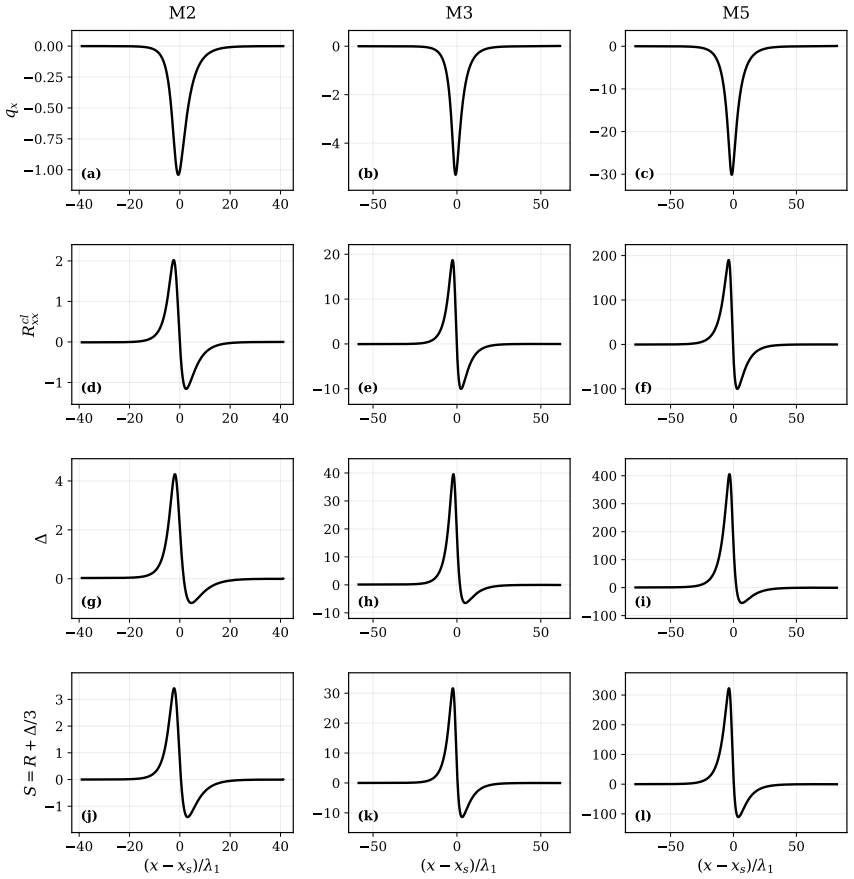
The one-dimensional heat-flux budget in monatomic normal shocks observes only the projected fourth-order channel S = R_cl_xx + Δ/3, not the separate tensorial and scalar parts.
A machine-rendered reading of the paper's core claim, the machinery that carries it, and where it could break.
Core claim
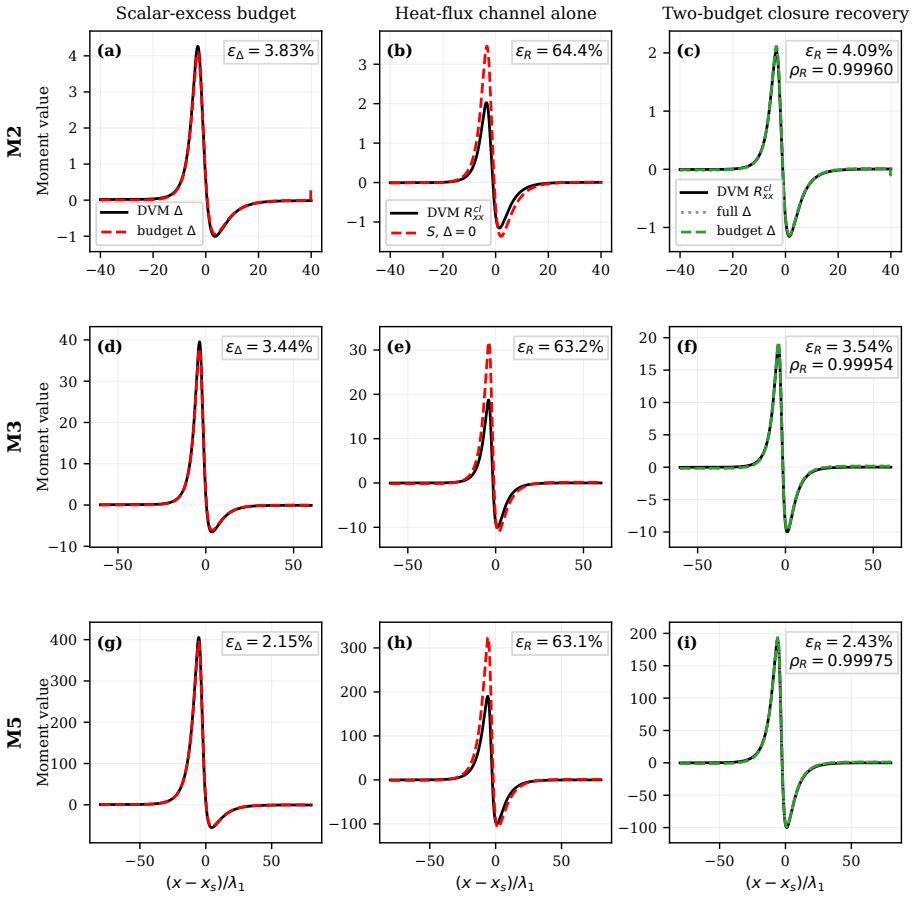
Residual agreement in a kinetic or moment equation does not automatically identify every higher-order closure variable entering a nonequilibrium shock. The kinematic part of the result is independent of the collision operator: the one-dimensional heat-flux budget observes the projected fourth-order channel S=R^{cl}_{xx}+Δ/3, not the tensorial R26-level moment R^{cl}_{xx} separately from the scalar fourth-order excess Δ. The observation map therefore has a one-dimensional null space, so a heat-flux residual can be small while the split between tensorial anisotropy and isotropic tail intensity remains wrong. A DVM-consistent scalar-excess budget supplies the missing channel and gives the two-c
What carries the argument
The projected fourth-order observation channel S = R^{cl}_{xx} + Δ/3, whose one-dimensional null space is filled by an independent DVM-consistent scalar-excess budget to produce the algebraic recovery R^{cl}_{xx} = S - Δ/3.
If this is right
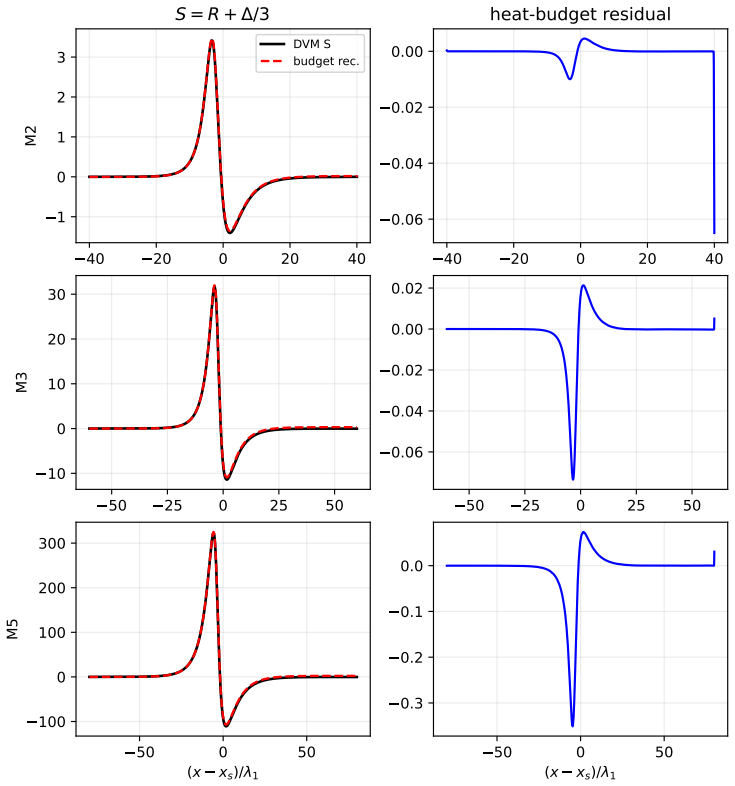
- In BGK shocks at Mach 2-5 the two-channel reconstruction reduces active-zone R_cl_xx error from 63-64% to 2.4-4.1%.
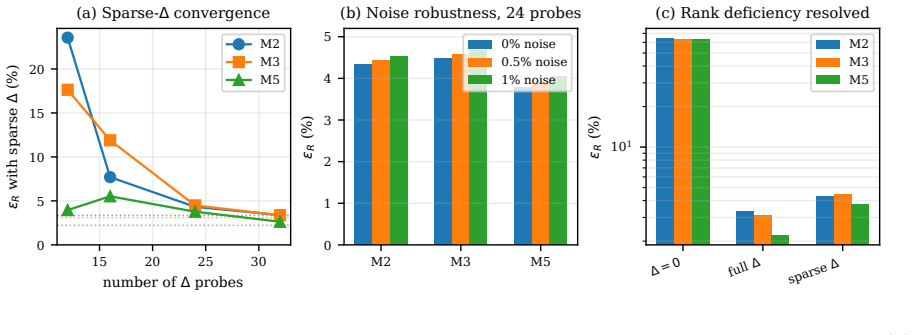
- Sparse scalar-excess interpolation at 24 probe points recovers R_cl_xx with errors below 4.5%, and below 4.7% when 1% probe noise is added.
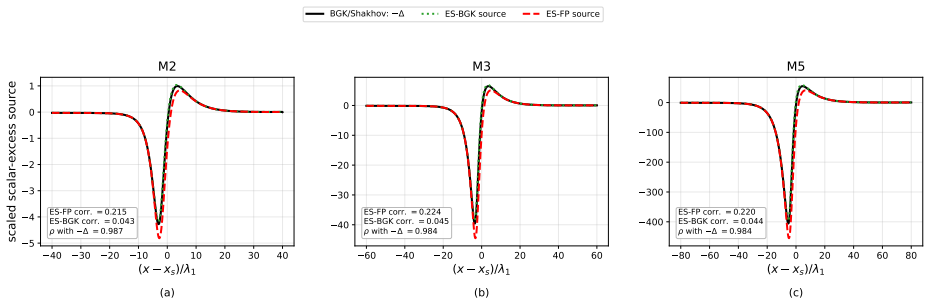
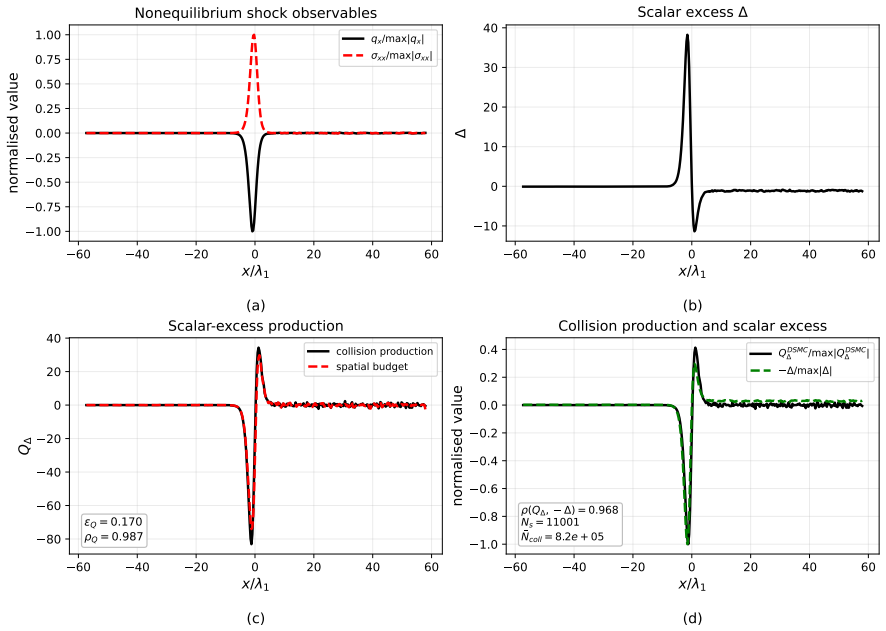
- The Shakhov collision model adjusts the heat-flux relaxation to the correct Prandtl number but leaves the even |c|^4 scalar-excess source unchanged.
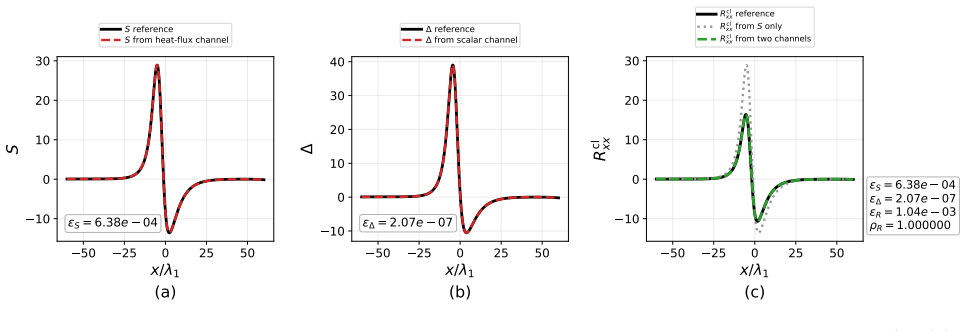
- Direct discrete checks in the Shakhov channel recover S, Δ and R_cl_xx with errors 6.4×10^{-4}, 2.1×10^{-7} and 1.0×10^{-3} respectively.
Where Pith is reading between the lines
- The same projection null space may appear in higher-dimensional or multi-species kinetic flows, requiring analogous second-channel budgets for closure recovery.
- Collision operators that alter the scalar-excess source term could be ranked by how well they close the fourth-order system once the two-channel split is enforced.
- In high-Mach astrophysical shocks the method offers a low-cost route to improved tensorial moment accuracy without solving the full higher-moment hierarchy.
Load-bearing premise
The scalar-excess budget equation stays independent of the heat-flux budget under the same collision operator.
What would settle it
A direct DVM computation that measures R_cl_xx, S and Δ separately and finds R_cl_xx does not equal S minus Δ/3 would falsify the two-channel reconstruction.
Figures
read the original abstract
Residual agreement in a kinetic or moment equation does not automatically identify every higher-order closure variable entering a nonequilibrium shock. We formulate this issue as an observability problem for the fourth-order closure content of monatomic normal shocks and follow it through a hierarchy of collision models and diagnostics. The kinematic part of the result is independent of the collision operator: the one-dimensional heat-flux budget observes the projected fourth-order channel $S=R^{\cl}_{xx}+\Delta/3$, not the tensorial R26-level moment $R^{\cl}_{xx}$ separately from the scalar fourth-order excess $\Delta$. The observation map therefore has a one-dimensional null space, so a heat-flux residual can be small while the split between tensorial anisotropy and isotropic tail intensity remains wrong. A DVM-consistent scalar-excess budget supplies the missing channel and gives the two-channel reconstruction $R^{\cl}_{xx}=S-\Delta/3$ without direct $R^{\cl}_{xx}$ data. Across BGK shocks at Mach 2--5, this reduces the active-zone $R^{\cl}_{xx}$ error from about $63$--$64\%$ to $2.4$--$4.1\%$. Sparse scalar-excess interpolation is used only as an information-reduction test: a representative 24-probe operating point gives $R^{\cl}_{xx}$ errors below $4.5\%$, and below $4.7\%$ with $1\%$ probe noise. Collision-model diagnostics then separate the invariant observation channel from the model-dependent source law. Shakhov changes the heat-flux relaxation to the correct Prandtl number but is neutral in the even $|\boldsymbol c|^4$ scalar-excess source; a direct discrete Shakhov channel check recovers $S$, $\Delta$ and $R^{\cl}_{xx}$ with errors $6.4\times10^{-4}$, $2.1\times10^{-7}$ and $1.0\times10^{-3}$, respectively.
Editorial analysis
A structured set of objections, weighed in public.
Referee Report
Summary. The manuscript formulates an observability problem for fourth-order closure content in monatomic normal shocks. It shows that the one-dimensional heat-flux budget observes only the projected combination S = R^{cl}_{xx} + Δ/3 (independent of the collision operator), leaving a one-dimensional null space. A DVM-consistent scalar-excess budget is introduced to supply the missing independent channel, enabling the algebraic two-channel recovery R^{cl}_{xx} = S - Δ/3. Numerical results for BGK shocks at Mach 2–5 report reduction of active-zone R^{cl}_{xx} error from 63–64% to 2.4–4.1%, with additional sparse-probe tests (24 probes, with/without 1% noise) and Shakhov-model diagnostics confirming recovery of S, Δ, and R^{cl}_{xx}.
Significance. If the claimed linear independence of the scalar-excess budget holds under the same operator, the work supplies a concrete, operator-aware method to resolve a structural identifiability limitation in moment closures for nonequilibrium shocks. The quantitative error reductions, sparse-probe robustness, and explicit separation of kinematic observation from model-dependent sources are strengths that could inform higher-order moment methods in kinetic theory.
major comments (2)
- [two-channel reconstruction paragraph and associated derivation] The central two-channel recovery R^{cl}_{xx} = S - Δ/3 rests on the scalar-excess budget being linearly independent of the heat-flux budget when both are derived from the identical collision operator (BGK or Shakhov). The abstract asserts DVM-consistency and independence, but an explicit rank check or source-term comparison (e.g., showing the even |c|^4 source is not proportional to the heat-flux source) is required in the derivation section to confirm the combined system is full rank; without it the algebraic split remains formally under-determined.
- [numerical results section] Table or figure reporting the 63–64% → 2.4–4.1% error reduction: the active-zone definition and the precise norm used for the R^{cl}_{xx} residual should be stated explicitly, together with the number of independent shock profiles and Mach-number range, so that the quoted improvement can be reproduced from the same initial data.
minor comments (2)
- [abstract and § on kinematic observation] Notation: the symbol Δ is introduced as the scalar fourth-order excess but its precise moment definition (integral of |c|^4 f or deviation from equilibrium) should be written once in the kinematic-observation paragraph for clarity.
- [collision-model diagnostics paragraph] The Shakhov diagnostics report errors of order 10^{-3}–10^{-7}; a brief statement on whether these are L2 or pointwise maxima, and over what spatial domain, would aid comparison with the BGK results.
Simulated Author's Rebuttal
We thank the referee for the careful and constructive review. We respond point-by-point to the two major comments below, agreeing to strengthen the manuscript with the requested clarifications and explicit verifications.
read point-by-point responses
-
Referee: [two-channel reconstruction paragraph and associated derivation] The central two-channel recovery R^{cl}_{xx} = S - Δ/3 rests on the scalar-excess budget being linearly independent of the heat-flux budget when both are derived from the identical collision operator (BGK or Shakhov). The abstract asserts DVM-consistency and independence, but an explicit rank check or source-term comparison (e.g., showing the even |c|^4 source is not proportional to the heat-flux source) is required in the derivation section to confirm the combined system is full rank; without it the algebraic split remains formally under-determined.
Authors: We agree that an explicit verification of linear independence will strengthen the derivation. In the revised manuscript we will insert, immediately after the presentation of the two budgets, a direct side-by-side comparison of the collision source terms under both the BGK and Shakhov operators. This comparison will demonstrate that the even |c|^4 scalar-excess source is not proportional to the heat-flux source (their ratio is neither constant nor operator-independent), thereby confirming that the two observation channels are linearly independent and the combined algebraic system is full rank. The added material uses only quantities already present in the DVM-consistent formulation and does not alter any numerical results. revision: yes
-
Referee: [numerical results section] Table or figure reporting the 63–64% → 2.4–4.1% error reduction: the active-zone definition and the precise norm used for the R^{cl}_{xx} residual should be stated explicitly, together with the number of independent shock profiles and Mach-number range, so that the quoted improvement can be reproduced from the same initial data.
Authors: We will revise the numerical-results section and the caption of the relevant table/figure to state explicitly: (i) the active zone is the interval in which the normalized heat flux exceeds the threshold 0.01, (ii) the reported error is the L² norm of the pointwise residual over that zone, and (iii) the statistics are compiled from five independent shock profiles spanning Mach numbers 2, 3, 4 and 5. These definitions are already used in the underlying data generation; making them explicit will allow exact reproduction without changing any computed values. revision: yes
Circularity Check
No significant circularity; kinematic observation and model diagnostics remain independent
full rationale
The paper explicitly identifies the collision-operator-independent kinematic relation S = R_cl_xx + Δ/3 and its one-dimensional null space, then supplies an independent scalar-excess budget whose source law is separated via collision-model diagnostics (BGK vs. Shakhov). The two-channel algebraic recovery is presented as a direct consequence of these two distinct equations, with explicit numerical verification and direct discrete checks rather than any self-definitional reduction, fitted-input renaming, or load-bearing self-citation chain. The derivation chain is therefore self-contained against the stated benchmarks.
Axiom & Free-Parameter Ledger
axioms (2)
- domain assumption The scalar-excess budget is independent of the heat-flux budget and consistent with discrete velocity methods
- domain assumption BGK and Shakhov operators are representative collision models for monatomic normal shocks
Reference graph
Works this paper leans on
-
[1]
Bhatnagar, P. L. and Gross, E. P. and Krook, M. , title =. Physical Review , volume =. 1954 , doi =
1954
-
[2]
Shakhov, E. M. , title =. Fluid Dynamics , volume =. 1968 , doi =
1968
-
[3]
1988 , doi =
Cercignani, Carlo , title =. 1988 , doi =
1988
-
[4]
2007 , doi =
Sone, Yoshio , title =. 2007 , doi =
2007
-
[5]
, title =
Bird, Graeme A. , title =. 1994 , url =
1994
-
[6]
Mathematical Models and Methods in Applied Sciences , volume =
Mieussens, Luc , title =. Mathematical Models and Methods in Applied Sciences , volume =. 2000 , doi =
2000
-
[7]
Journal of Computational Physics , volume =
Filbet, Francis and Jin, Shi , title =. Journal of Computational Physics , volume =. 2010 , doi =
2010
-
[8]
Acta Numerica , volume =
Dimarco, Giacomo and Pareschi, Lorenzo , title =. Acta Numerica , volume =. 2014 , doi =
2014
-
[9]
Communications on Pure and Applied Mathematics , volume =
Grad, Harold , title =. Communications on Pure and Applied Mathematics , volume =. 1949 , doi =
1949
-
[10]
David , title =
Levermore, C. David , title =. Journal of Statistical Physics , volume =. 1996 , doi =
1996
-
[11]
2005 , doi =
Struchtrup, Henning , title =. 2005 , doi =
2005
-
[12]
Physics of Fluids , volume =
Struchtrup, Henning and Torrilhon, Manuel , title =. Physics of Fluids , volume =. 2003 , doi =
2003
-
[13]
Journal of Fluid Mechanics , volume =
Torrilhon, Manuel and Struchtrup, Henning , title =. Journal of Fluid Mechanics , volume =. 2004 , doi =
2004
-
[14]
Annual Review of Fluid Mechanics , volume =
Torrilhon, Manuel , title =. Annual Review of Fluid Mechanics , volume =. 2016 , doi =
2016
-
[15]
, title =
Gu, Xiao-Jun and Emerson, David R. , title =. Journal of Fluid Mechanics , volume =. 2009 , doi =
2009
-
[16]
Journal of Computational Physics , volume =
Lou, Qin and Meng, Xuhui and Karniadakis, George Em , title =. Journal of Computational Physics , volume =. 2021 , doi =
2021
-
[17]
Journal of Computational Physics , volume =
Raissi, Maziar and Perdikaris, Paris and Karniadakis, George Em , title =. Journal of Computational Physics , volume =. 2019 , doi =
2019
-
[18]
and Lu, Lu and Perdikaris, Paris and Wang, Sifan and Yang, Liu , title =
Karniadakis, George Em and Kevrekidis, Ioannis G. and Lu, Lu and Perdikaris, Paris and Wang, Sifan and Yang, Liu , title =. Nature Reviews Physics , volume =. 2021 , doi =
2021
-
[19]
SIAM Journal on Scientific Computing , volume =
Oh, Jaemin and Cho, Seung Yeon and Yun, Seok-Bae and Park, Eunbyung and Hong, Youngjoon , title =. SIAM Journal on Scientific Computing , volume =. 2025 , doi =
2025
-
[20]
AIAA Journal , volume =
Fei, Fei and Liu, Haihong and Liu, Zhaohui and Zhang, Jun , title =. AIAA Journal , volume =. 2020 , doi =
2020
-
[21]
Physics of Fluids , volume =
Shoja-Sani, Ahmad and Roohi, Ehsan and Stefanov, Stefan , title =. Physics of Fluids , volume =. 2021 , doi =
2021
-
[22]
Chapman, Sydney and Cowling, T. G. , title =. 1970 , note =
1970
-
[23]
Springer Series in Computational Mathematics , volume =
Rjasanow, Sergej and Wagner, Wolfgang , title =. Springer Series in Computational Mathematics , volume =. 2005 , doi =
2005
-
[24]
, title =
Holway, Lowell H. , title =. Physics of Fluids , volume =. 1966 , doi =
1966
-
[25]
Physical Review Letters , volume =
Struchtrup, Henning and Torrilhon, Manuel , title =. Physical Review Letters , volume =. 2007 , doi =
2007
-
[27]
, title =
Mott-Smith, Harold M. , title =. Physical Review , volume =. 1951 , doi =
1951
-
[28]
, title =
Alsmeyer, H. , title =. Journal of Fluid Mechanics , volume =. 1976 , doi =
1976
-
[29]
Ivanov, M. S. and Gimelshein, S. F. , title =. Annual Review of Fluid Mechanics , volume =. 1998 , doi =
1998
-
[30]
1976 Density profiles in argon and nitrogen shock waves measured by the absorption of an electron beam
Alsmeyer, H. 1976 Density profiles in argon and nitrogen shock waves measured by the absorption of an electron beam . Journal of Fluid Mechanics 74 (3), 497--513
1976
-
[31]
Bhatnagar, P. L. , Gross, E. P. & Krook, M. 1954 A model for collision processes in gases. i. small amplitude processes in charged and neutral one-component systems . Physical Review 94 (3), 511--525
1954
-
[32]
1994 Molecular Gas Dynamics and the Direct Simulation of Gas Flows\/
Bird, Graeme A. 1994 Molecular Gas Dynamics and the Direct Simulation of Gas Flows\/ . Oxford: Clarendon Press
1994
-
[33]
Springer
Cercignani, Carlo 1988 The Boltzmann Equation and Its Applications\/ . Springer
1988
-
[34]
Acta Numerica 23 , 369--520
Dimarco, Giacomo & Pareschi, Lorenzo 2014 Numerical methods for kinetic equations . Acta Numerica 23 , 369--520
2014
-
[35]
AIAA Journal 58 (6), 2596--2608
Fei, Fei , Liu, Haihong , Liu, Zhaohui & Zhang, Jun 2020 A benchmark study of kinetic models for shock waves . AIAA Journal 58 (6), 2596--2608
2020
-
[36]
Journal of Computational Physics 229 (20), 7625--7648
Filbet, Francis & Jin, Shi 2010 A class of asymptotic-preserving schemes for kinetic equations and related problems with stiff sources . Journal of Computational Physics 229 (20), 7625--7648
2010
-
[37]
Communications on Pure and Applied Mathematics 2 (4), 331--407
Grad, Harold 1949 On the kinetic theory of rarefied gases . Communications on Pure and Applied Mathematics 2 (4), 331--407
1949
-
[38]
2009 A high-order moment approach for capturing non-equilibrium phenomena in the transition regime
Gu, Xiao-Jun & Emerson, David R. 2009 A high-order moment approach for capturing non-equilibrium phenomena in the transition regime . Journal of Fluid Mechanics 636 , 177--216
2009
-
[39]
1966 New statistical models for kinetic theory: methods of construction
Holway, Lowell H. 1966 New statistical models for kinetic theory: methods of construction . Physics of Fluids 9 (9), 1658--1673
1966
-
[40]
Ivanov, M. S. & Gimelshein, S. F. 1998 Computational hypersonic rarefied flows . Annual Review of Fluid Mechanics 30 , 469--505
1998
-
[41]
, Lu, Lu , Perdikaris, Paris , Wang, Sifan & Yang, Liu 2021 Physics-informed machine learning
Karniadakis, George Em , Kevrekidis, Ioannis G. , Lu, Lu , Perdikaris, Paris , Wang, Sifan & Yang, Liu 2021 Physics-informed machine learning . Nature Reviews Physics 3 , 422--440
2021
-
[42]
David 1996 Moment closure hierarchies for kinetic theories
Levermore, C. David 1996 Moment closure hierarchies for kinetic theories . Journal of Statistical Physics 83 , 1021--1065
1996
-
[43]
Journal of Computational Physics 447 , 110676
Lou, Qin , Meng, Xuhui & Karniadakis, George Em 2021 Physics-informed neural networks for solving forward and inverse flow problems via the Boltzmann--BGK formulation . Journal of Computational Physics 447 , 110676
2021
-
[44]
Mathematical Models and Methods in Applied Sciences 10 (8), 1121--1149
Mieussens, Luc 2000 Discrete velocity model and implicit scheme for the BGK equation of rarefied gas dynamics . Mathematical Models and Methods in Applied Sciences 10 (8), 1121--1149
2000
-
[45]
1951 The solution of the Boltzmann equation for a shock wave
Mott-Smith, Harold M. 1951 The solution of the Boltzmann equation for a shock wave . Physical Review 82 (6), 885--892
1951
-
[46]
SIAM Journal on Scientific Computing 47 (2), C451--C474
Oh, Jaemin , Cho, Seung Yeon , Yun, Seok-Bae , Park, Eunbyung & Hong, Youngjoon 2025 Separable physics-informed neural networks for solving the BGK model of the Boltzmann equation . SIAM Journal on Scientific Computing 47 (2), C451--C474
2025
-
[47]
Journal of Computational Physics 378 , 686--707
Raissi, Maziar , Perdikaris, Paris & Karniadakis, George Em 2019 Physics-informed neural networks: A deep learning framework for solving forward and inverse problems involving nonlinear partial differential equations . Journal of Computational Physics 378 , 686--707
2019
-
[48]
ArXiv:2605.29211, arXiv:arXiv: 2605.29211
Roohi, Ehsan 2026 Closure-level observability in neural kinetic shock solvers. ArXiv:2605.29211, arXiv:arXiv: 2605.29211
Pith/arXiv arXiv 2026
-
[49]
Shakhov, E. M. 1968 Generalization of the Krook kinetic relaxation equation . Fluid Dynamics 3 (5), 95--96
1968
-
[50]
Birkh\"auser
Sone, Yoshio 2007 Molecular Gas Dynamics: Theory, Techniques, and Applications\/ . Birkh\"auser
2007
-
[51]
Springer
Struchtrup, Henning 2005 Macroscopic Transport Equations for Rarefied Gas Flows\/ . Springer
2005
-
[52]
Physics of Fluids 15 (9), 2668--2680
Struchtrup, Henning & Torrilhon, Manuel 2003 Regularization of Grad 's 13 moment equations: Derivation and linear analysis . Physics of Fluids 15 (9), 2668--2680
2003
-
[53]
Physical Review Letters 99 , 014502
Struchtrup, Henning & Torrilhon, Manuel 2007 H theorem, regularization, and boundary conditions for linearized 13 moment equations . Physical Review Letters 99 , 014502
2007
-
[54]
Annual Review of Fluid Mechanics 48 , 429--458
Torrilhon, Manuel 2016 Modeling nonequilibrium gas flow based on moment equations . Annual Review of Fluid Mechanics 48 , 429--458
2016
-
[55]
Journal of Fluid Mechanics 513 , 171--198
Torrilhon, Manuel & Struchtrup, Henning 2004 Regularized 13-moment equations: shock structure calculations and comparison to Burnett models . Journal of Fluid Mechanics 513 , 171--198
2004
discussion (0)
Sign in with ORCID, Apple, or X to comment. Anyone can read and Pith papers without signing in.