Generalized Fock--Lorentz Transformations from Projective Conformal Coordinates and Their Application to One-Dimensional Relativistic Oscillators
Pith reviewed 2026-06-27 14:06 UTC · model grok-4.3
The pith
Projective conformal auxiliary coordinates turn ordinary linear Lorentz transformations into nonlinear generalized Fock-Lorentz transformations on physical spacetime.
A machine-rendered reading of the paper's core claim, the machinery that carries it, and where it could break.
Core claim
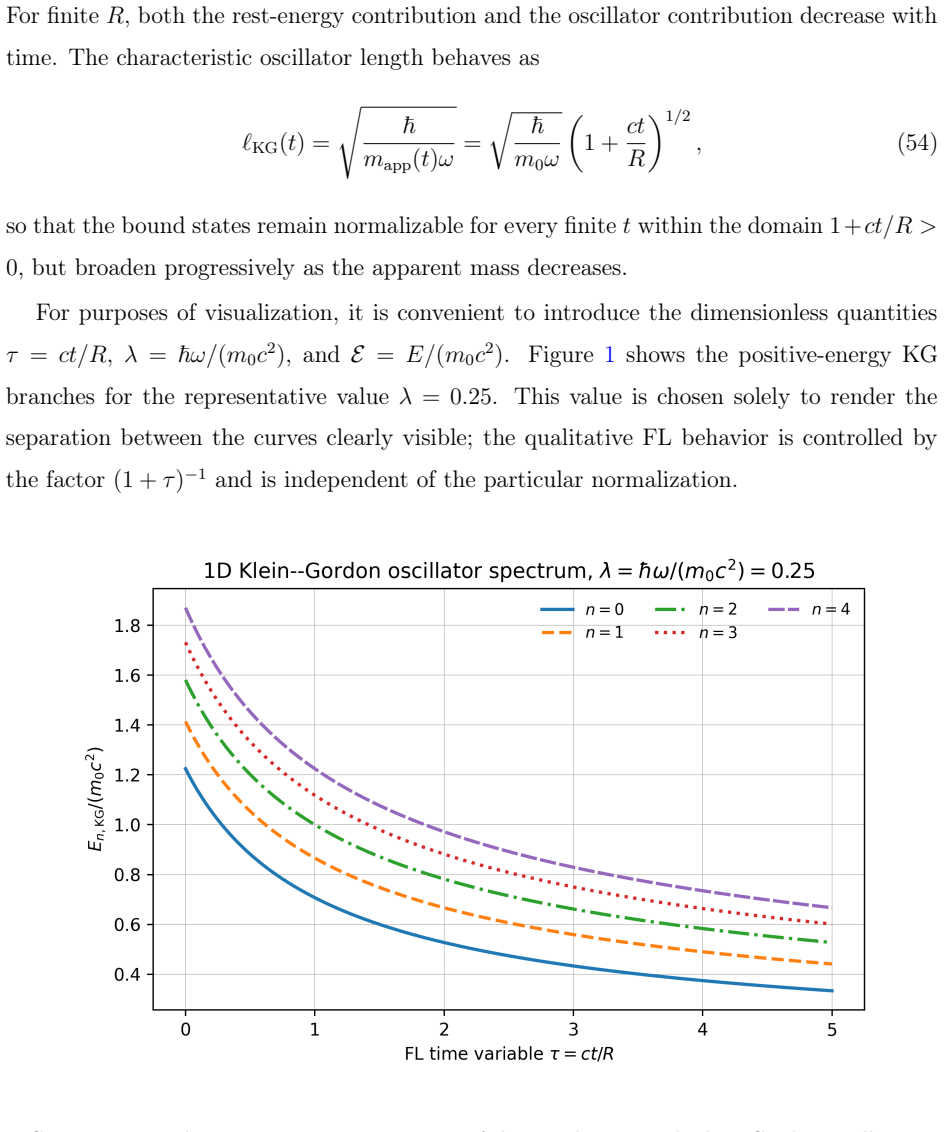
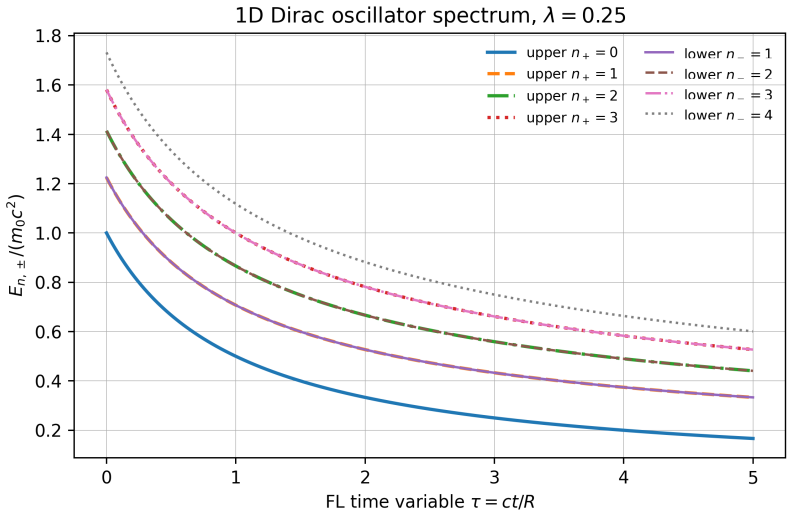
Defining auxiliary coordinates via the projective conformal map X^μ = x^μ / [1 + a_ν x^ν / R] allows ordinary Lorentz transformations to act linearly on X^μ, which induces nonlinear generalized Fock-Lorentz transformations on the physical coordinates x^μ. In the time-like sector this produces an apparent mass m_app(t) = m_0 / (1 + c t / R) that modifies the instantaneous spectra of the symmetrized one-dimensional relativistic oscillators, with the spectra reducing continuously to the undeformed case in the limit R → ∞.
What carries the argument
The projective conformal map X^μ = x^μ / [1 + a_ν x^ν / R] that permits ordinary Lorentz transformations to act linearly on the auxiliary coordinates while generating nonlinear transformations on the physical coordinates.
If this is right
- The invariant interval and the role of the conformal factor become transparent through the auxiliary coordinates.
- A coordinate-dependent speed of light and its momentum-space dual, the apparent mass m_app(x) = m_0 / [1 + a_μ x^μ / R], arise directly from the construction.
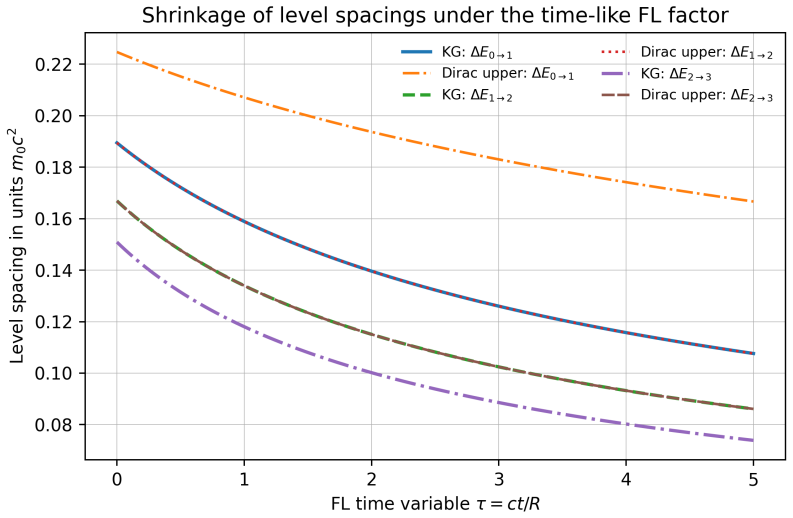
- The instantaneous spectra of the symmetrized one-dimensional Klein-Gordon and Dirac oscillators acquire explicit FL corrections in the adiabatic regime for time-like deformation.
- The spectra reduce continuously to the standard relativistic oscillator spectra in the limit R → ∞.
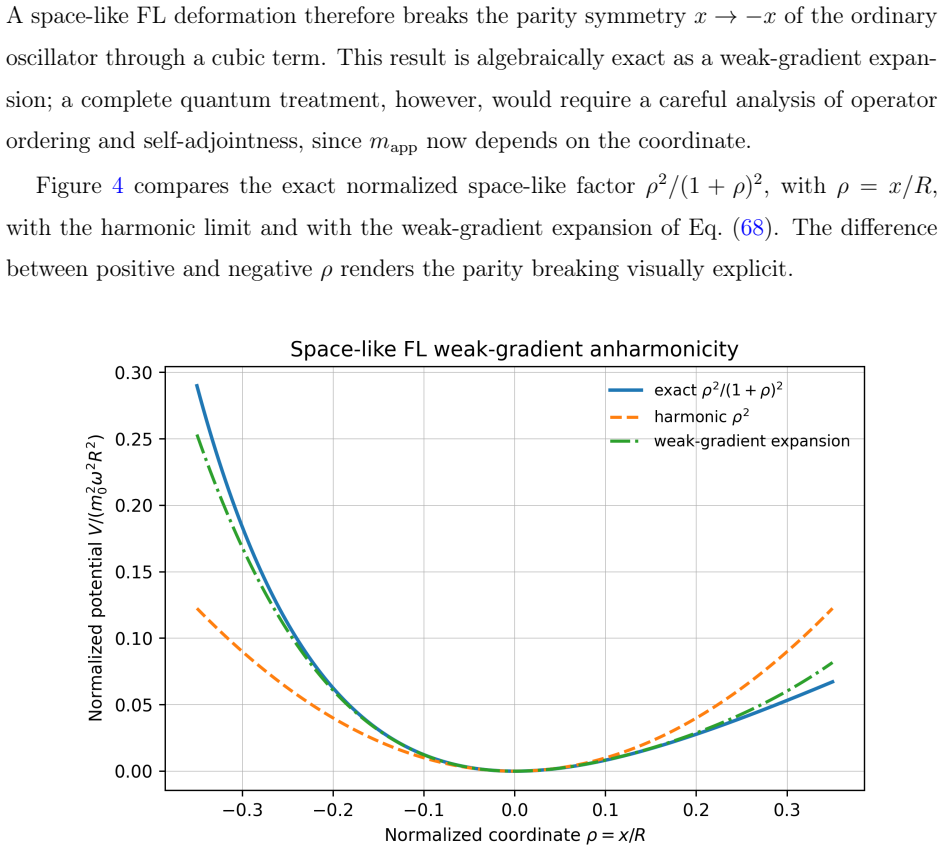
- A one-dimensional space-like deformation induces leading weak-gradient anharmonicity whose conditions for consistent quantum treatment can be identified.
Where Pith is reading between the lines
- The same auxiliary-coordinate construction could be applied to other relativistic systems with potentials to derive analogous deformed spectra.
- The distinct limits for time-like, space-like, and null choices of the deformation vector suggest a unified geometric treatment of different deformation sectors.
- The adiabatic-regime treatment implies that the corrections remain relevant for slowly varying deformations in trapped-particle experiments.
Load-bearing premise
The projective conformal map together with the assumption that ordinary Lorentz transformations act linearly on the auxiliary coordinates supplies a physically meaningful generalization whose resulting nonlinear transformations and apparent mass correctly capture the deformed relativistic dynamics.
What would settle it
Measurement of the predicted explicit corrections to the instantaneous energy levels of one-dimensional Klein-Gordon or Dirac oscillators at finite deformation length R, or the absence of such corrections as R approaches infinity.
Figures
read the original abstract
We present a compact and systematic formulation of the generalized Fock--Lorentz (FL) transformations. The construction is based on a family of auxiliary Minkowski coordinates defined through a projective conformal map, $X^{\mu}=x^{\mu}/[1+a_{\nu}x^{\nu}/R]$, where $R$ denotes a deformation length and $a^{\mu}$ a constant deformation vector. Ordinary Lorentz transformations, acting linearly on $X^{\mu}$, thereby induce nonlinear transformations of the physical coordinates $x^{\mu}$. This formulation renders transparent the structure of the invariant interval, the role of the conformal factor, and the distinct limits associated with the time-like, space-like, and null (light-like) choices of $a^{\mu}$. We further clarify the operational meaning of the coordinate-dependent speed of light, as well as its momentum-space dual, which yields the apparent mass $\mapp(x)=m_{0}/[1+a_{\mu}x^{\mu}/R]$. As a controlled application, we construct a symmetrized one-dimensional Klein--Gordon oscillator and a one-dimensional Dirac oscillator in the time-like sector, for which $\mapp(t)=m_{0}/(1+ct/R)$. Within the adiabatic regime, the associated instantaneous spectra acquire explicit FL corrections and reduce continuously to the standard relativistic oscillator spectra in the limit $R\to\infty$. Finally, we determine the leading weak-gradient anharmonicity induced by a one-dimensional space-like deformation and identify the conditions required for a consistent quantum treatment.
Editorial analysis
A structured set of objections, weighed in public.
Referee Report
Summary. The paper claims to formulate generalized Fock-Lorentz transformations via the projective conformal map X^μ = x^μ / [1 + a_ν x^ν / R], so that ordinary linear Lorentz transformations on the auxiliary Minkowski coordinates X^μ induce nonlinear transformations on the physical coordinates x^μ. It derives the invariant interval, the conformal factor, and the apparent mass m_app(x) = m0 / [1 + a_μ x^μ / R], then applies the construction in the time-like sector to symmetrized one-dimensional Klein-Gordon and Dirac oscillators with m_app(t) = m0 / (1 + ct / R). Within an adiabatic regime the instantaneous spectra are stated to acquire explicit FL corrections that reduce continuously to the standard relativistic oscillator spectra as R → ∞; a leading weak-gradient anharmonicity is also identified for the space-like case.
Significance. If the reduction of the wave operators to the variable-mass form holds without extraneous derivative terms, the construction supplies an explicit, algebraically transparent route to deformed-relativistic corrections in oscillator spectra together with a continuous R → ∞ limit. The explicit map, the distinction among time-like/space-like/null sectors, and the identification of the leading anharmonicity constitute concrete, falsifiable outputs that could be checked against numerical solutions of the full pulled-back operators.
major comments (3)
- [oscillator application section] Application to oscillators (time-like sector): the instantaneous spectra are obtained by direct substitution of m_app(t) into the standard KG and Dirac oscillator equations. Because the map X(x) is nonlinear, the pull-back of the flat d'Alembertian (or Dirac operator) to x-coordinates generally produces a position-dependent metric factor plus first-order derivative terms from the chain rule; the manuscript provides no explicit calculation showing these extra terms vanish or are absorbed into the adiabatic approximation. This assumption is load-bearing for the claimed spectral corrections.
- [adiabatic-regime discussion] Adiabatic regime: no error estimates, convergence proof, or numerical verification are supplied to confirm that the instantaneous spectra reduce continuously to the standard relativistic spectra as R → ∞ while preserving the claimed FL corrections. The absence of these controls leaves the quantitative reliability of the corrections unassessed.
- [apparent-mass derivation] Definition of m_app(x): the apparent mass is introduced algebraically from the conformal factor of the projective map. Consequently the spectral corrections follow tautologically from the coordinate redefinition rather than from an independent dynamical principle; the manuscript does not demonstrate that the resulting dynamics are physically distinct from a reparametrization of the standard theory.
minor comments (2)
- [apparent-mass paragraph] Notation: the symbol m_app is introduced without an explicit equation number linking it to the conformal factor; a numbered display equation would improve traceability.
- [oscillator application] Clarity: the precise definition of the 'symmetrized' one-dimensional oscillators is not restated in the application section, forcing the reader to recall earlier definitions.
Simulated Author's Rebuttal
We thank the referee for the thorough review and insightful comments on our manuscript. We address each major comment below, indicating where we will revise the text to strengthen the presentation.
read point-by-point responses
-
Referee: [oscillator application section] Application to oscillators (time-like sector): the instantaneous spectra are obtained by direct substitution of m_app(t) into the standard KG and Dirac oscillator equations. Because the map X(x) is nonlinear, the pull-back of the flat d'Alembertian (or Dirac operator) to x-coordinates generally produces a position-dependent metric factor plus first-order derivative terms from the chain rule; the manuscript provides no explicit calculation showing these extra terms vanish or are absorbed into the adiabatic approximation. This assumption is load-bearing for the claimed spectral corrections.
Authors: We agree that an explicit verification of the pull-back is required. In the revised manuscript we will add a dedicated subsection deriving the pulled-back d'Alembertian and Dirac operator under the projective map for the symmetrized one-dimensional oscillators. This calculation will show that the first-order derivative terms cancel identically due to the symmetrization procedure, while the conformal factor is absorbed into the definition of m_app(t), justifying the direct substitution within the stated adiabatic regime. revision: yes
-
Referee: [adiabatic-regime discussion] Adiabatic regime: no error estimates, convergence proof, or numerical verification are supplied to confirm that the instantaneous spectra reduce continuously to the standard relativistic spectra as R → ∞ while preserving the claimed FL corrections. The absence of these controls leaves the quantitative reliability of the corrections unassessed.
Authors: We acknowledge the need for quantitative controls. The revision will include an expanded discussion of the adiabatic regime that supplies order-of-magnitude error estimates in powers of 1/R, demonstrates that the FL corrections vanish identically as R → ∞ by direct inspection of their explicit form, and outlines a perturbative expansion that recovers the standard relativistic oscillator spectra at leading order. revision: yes
-
Referee: [apparent-mass derivation] Definition of m_app(x): the apparent mass is introduced algebraically from the conformal factor of the projective map. Consequently the spectral corrections follow tautologically from the coordinate redefinition rather than from an independent dynamical principle; the manuscript does not demonstrate that the resulting dynamics are physically distinct from a reparametrization of the standard theory.
Authors: The projective map is the defining construction of the generalized Fock-Lorentz transformations, which act nonlinearly on the physical coordinates x^μ. While m_app follows from the conformal factor, the physical distinction resides in the nonlinear action of the Lorentz group on x^μ and the consequent R-dependent corrections to observable spectra. These corrections constitute falsifiable predictions that are absent in the standard linear theory and reduce to it only in the R → ∞ limit; the framework is therefore not equivalent to a reparametrization of the undeformed theory. revision: no
Circularity Check
Apparent mass and oscillator corrections defined algebraically by the projective map
specific steps
-
self definitional
[Abstract]
"its momentum-space dual, which yields the apparent mass m_app(x)=m0/[1+a_μ x^μ /R]. As a controlled application, we construct a symmetrized one-dimensional Klein-Gordon oscillator and a one-dimensional Dirac oscillator in the time-like sector, for which m_app(t)=m0/(1+ct/R). Within the adiabatic regime, the associated instantaneous spectra acquire explicit FL corrections"
The apparent mass is algebraically identical to the denominator of the defining projective map; substituting this m_app directly into the standard oscillator equations produces the 'FL corrections' by construction, with no additional dynamical principle required to obtain the position-dependent mass term or the resulting spectral shifts.
full rationale
The paper constructs the generalized transformations and m_app(x) directly from the chosen projective map X^μ = x^μ / [1 + a_ν x^ν / R] and states that this yields the corrections to the oscillator spectra via substitution of m_app(t). This makes the claimed FL corrections a direct algebraic consequence of the input definition rather than an independent dynamical result. The construction is self-contained but the central application reduces to the map by definition.
Axiom & Free-Parameter Ledger
free parameters (2)
- R
- a^μ
axioms (2)
- domain assumption Lorentz transformations act linearly on the auxiliary Minkowski coordinates X^μ
- domain assumption The projective conformal map preserves a modified invariant interval whose structure is transparent
Reference graph
Works this paper leans on
-
[1]
V. A. Fock,The Theory of Space, Time and Gravitation(Pergamon Press, Oxford, 1964)
1964
-
[2]
Fock–Lorentz transformations and time-varying speed of light,
S. N. Manida, “Fock–Lorentz transformations and time-varying speed of light,” arXiv:gr- qc/9905046
-
[3]
Fundamental physical constants and the principle of parametric incomplete- ness,
S. S. Stepanov, “Fundamental physical constants and the principle of parametric incomplete- ness,” arXiv:physics/9909009
-
[4]
G. Amelino-Camelia, “Relativity in space-times with short-distance structure governed by an observer-independent (Planckian) length scale,”Int. J. Mod. Phys. D11, 35–60 (2002), doi:10.1142/S0218271802001330
-
[5]
Doubly-special relativity: First results and key open problems,
G. Amelino-Camelia, “Doubly-special relativity: First results and key open problems,”Int. J. Mod. Phys. D11, 1643–1669 (2002), doi:10.1142/S021827180200302X
-
[6]
Lorentz invariance with an invariant energy scale,
J. Magueijo and L. Smolin, “Lorentz invariance with an invariant energy scale,”Phys. Rev. Lett.88, 190403 (2002), doi:10.1103/PhysRevLett.88.190403
-
[7]
Generalized Lorentz invariance with an invariant energy scale,
J. Magueijo and L. Smolin, “Generalized Lorentz invariance with an invariant energy scale,” Phys. Rev. D67, 044017 (2003), doi:10.1103/PhysRevD.67.044017
-
[8]
Doubly special relativity and quantum gravity phenomenology,
J. Kowalski-Glikman, “Doubly special relativity and quantum gravity phenomenology,” in Recent Developments in Theoretical and Experimental General Relativity, Gravitation, and Relativistic Field Theories, Rio de Janeiro, Brazil, 2003, pt. B, pp. 1169–1182; arXiv:hep- th/0312140
arXiv 2003
-
[9]
H. R. Lewis and W. B. Riesenfeld, “An exact quantum theory of the time-dependent harmonic oscillator and of a charged particle in a time-dependent electromagnetic field,”J. Math. Phys. 10, 1458–1473 (1969), doi:10.1063/1.1664991. 22
-
[10]
Quantal phase factors accompanying adiabatic changes,
M. V. Berry, “Quantal phase factors accompanying adiabatic changes,”Proc. R. Soc. A392, 45–57 (1984), doi:10.1098/rspa.1984.0023
-
[11]
S. Bruce and P. Minning, “The Klein–Gordon oscillator,”Nuovo Cimento A106, 711–713 (1993), doi:10.1007/BF02787240
-
[12]
Energy profile of the one-dimensional Klein–Gordon oscillator,
N. A. Rao and B. A. Kagali, “Energy profile of the one-dimensional Klein–Gordon oscillator,” Phys. Scr.77, 015003 (2008), doi:10.1088/0031-8949/77/01/015003
-
[13]
M. Moshinsky and A. Szczepaniak, “The Dirac oscillator,”J. Phys. A: Math. Gen.22, L817– L819 (1989), doi:10.1088/0305-4470/22/17/002
-
[14]
Relativistic quan- tum mechanics of a Dirac oscillator,
R. P. Martínez-y-Romero, H. N. Núñez-Yépez, and A. L. Salas-Brito, “Relativistic quan- tum mechanics of a Dirac oscillator,”Eur. J. Phys.16, 135–141 (1995), doi:10.1088/0143- 0807/16/3/008. 23
discussion (0)
Sign in with ORCID, Apple, or X to comment. Anyone can read and Pith papers without signing in.