Statistical Mechanics and Symmetries of Non-Abelian Anyon Proliferation: From Deformation to Decoherence
Pith reviewed 2026-06-27 09:32 UTC · model grok-4.3
The pith
Beyond a threshold, two proliferating non-Abelian anyon species destroy topological order by condensing their shared Abelian fusion outcome.
A machine-rendered reading of the paper's core claim, the machinery that carries it, and where it could break.
Core claim
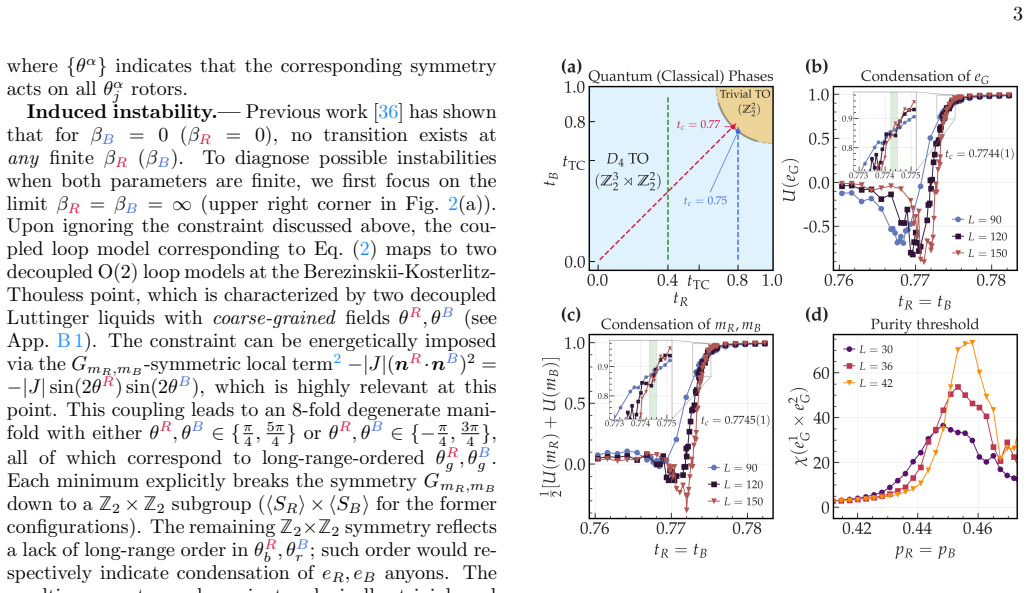
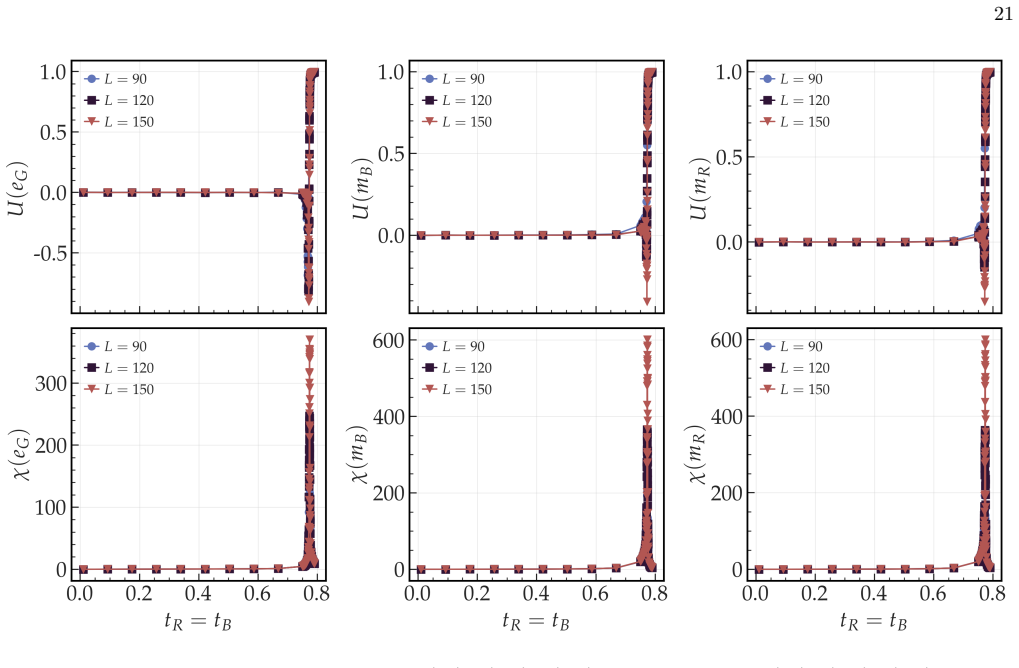
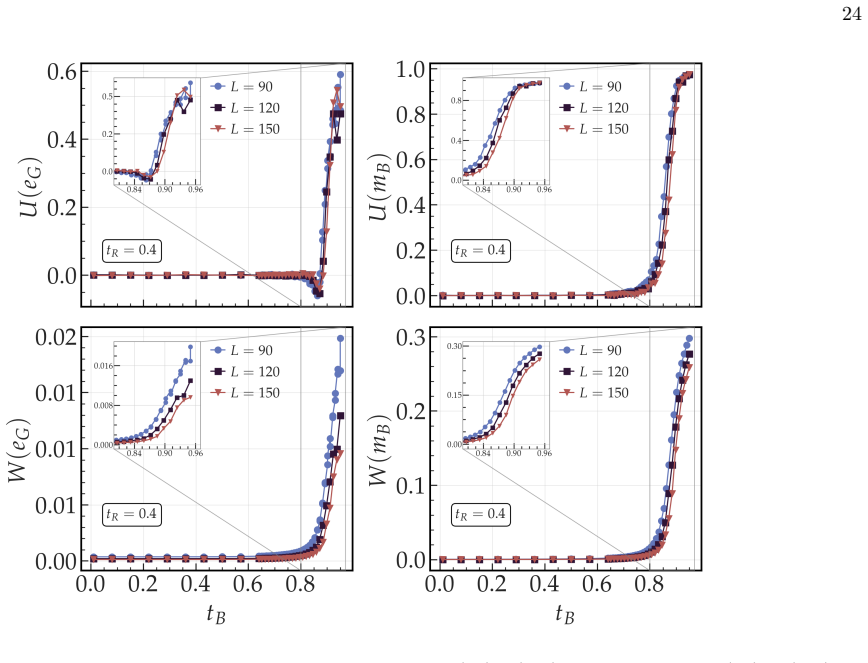
We show that beyond a finite threshold, proliferation of two non-Abelian anyon species parasitically condenses a shared Abelian-anyon fusion outcome, destroying the topological order. Our symmetry-based approach sharply differentiates the resulting trivial phase from that obtained by condensing all Abelian charges; in other words, the trivial phase remembers which anyons condensed. This framework provides a first step into identifying the relevant symmetry for optimal decoders, conditioned on syndrome measurements, of non-Abelian topological order.
What carries the argument
Symmetry-based statistical mechanics models whose symmetries expose the corrupting anyonic excitations under deformations and quantum channels.
If this is right
- The trivial phase obtained after proliferation remembers which non-Abelian species condensed.
- The same symmetry framework distinguishes this phase from the one reached by condensing every Abelian charge.
- The approach supplies a concrete first step toward symmetry-conditioned optimal decoders for non-Abelian topological order.
Where Pith is reading between the lines
- Decoder design for non-Abelian codes could be conditioned on the specific fusion channels revealed by syndrome statistics.
- The parasitic-condensation mechanism may generalize to other non-Abelian orders once their fusion rules are mapped to analogous stat-mech symmetries.
- Experimental platforms that realize multiple anyon species could test the threshold by monitoring whether the shared Abelian outcome appears in fusion statistics.
Load-bearing premise
Instabilities of topological order to deformations and decoherence are generically captured by stat-mech models whose symmetries naturally expose the corrupting anyonic excitations.
What would settle it
Monte Carlo runs or syndrome measurements in which two non-Abelian anyon species proliferate past the reported threshold without condensing their shared Abelian fusion product, or in which the two kinds of trivial phase become indistinguishable under the symmetry analysis.
Figures







read the original abstract
Topological quantum computation relies on braiding non-Abelian anyons, but requires the underlying topological order to survive imperfect state preparation and environmental noise. We show that the instability of topological order to wavefunction deformations and to decoherence, with the latter probed by syndrome distributions, are generically captured by stat-mech models whose symmetries naturally expose the corrupting anyonic excitations. As an example, we combine this framework with Monte-Carlo simulations to resolve the stability of $D_4$ topological order under deformations and quantum channels that proliferate multiple non-Abelian anyon species that individually are unable to condense. We show that beyond a finite threshold, proliferation of two non-Abelian anyon species parasitically condenses a shared Abelian-anyon fusion outcome, destroying the topological order. Our symmetry-based approach sharply differentiates the resulting trivial phase from that obtained by condensing all Abelian charges; in other words, the trivial phase "remembers" which anyons condensed. This framework provides a first step into identifying the relevant symmetry for optimal decoders, conditioned on syndrome measurements, of non-Abelian topological order.
Editorial analysis
A structured set of objections, weighed in public.
Referee Report
Summary. The paper develops a statistical mechanics framework whose symmetries capture the effects of wavefunction deformations and decoherence (via syndrome distributions) on non-Abelian topological order. For D4 order, Monte Carlo simulations show that proliferation of two non-Abelian anyon species beyond a finite threshold induces parasitic condensation of a shared Abelian fusion channel, destroying topological order. The resulting trivial phase is distinguished from that obtained by condensing all Abelian charges because it retains memory of the condensed anyons. The framework is positioned as a step toward identifying symmetries for optimal decoders conditioned on syndrome measurements.
Significance. If the mapping and numerical results hold, the work provides a symmetry-based route to analyze stability thresholds for non-Abelian anyons under combined deformations and noise, with a concrete distinction between trivial phases that could inform decoder design. The use of stat-mech models with explicit symmetries and Monte Carlo evidence for the parasitic condensation threshold constitutes a substantive contribution; the absence of free parameters in the symmetry construction is a strength.
major comments (1)
- [§4.2, Eq. (17)] §4.2, Eq. (17): the mapping from syndrome distributions to the stat-mech Hamiltonian assumes that the two non-Abelian species share a single Abelian fusion channel without deriving the fusion rules from the D4 category; a explicit check that this channel is the only possible shared outcome under the given symmetries would strengthen the parasitic condensation claim.
minor comments (2)
- [Figure 3] Figure 3 caption: the error bars on the order parameter are not described; adding the number of independent runs and the precise definition of the condensation diagnostic would improve reproducibility.
- [§3.1] §3.1: the statement that the models are 'parameter-free' should be qualified by noting that the anyon fusion multiplicities are taken from the D4 category rather than derived within the stat-mech construction.
Simulated Author's Rebuttal
We thank the referee for their positive evaluation and recommendation of minor revision. We address the major comment below and will revise the manuscript accordingly.
read point-by-point responses
-
Referee: [§4.2, Eq. (17)] §4.2, Eq. (17): the mapping from syndrome distributions to the stat-mech Hamiltonian assumes that the two non-Abelian species share a single Abelian fusion channel without deriving the fusion rules from the D4 category; a explicit check that this channel is the only possible shared outcome under the given symmetries would strengthen the parasitic condensation claim.
Authors: We agree that an explicit derivation of the fusion rules strengthens the presentation. In the D4 anyon model the fusion rules follow from the representation theory of the dihedral group D4. The two non-Abelian anyon species under consideration (those that individually cannot condense) have a unique shared Abelian fusion channel; all other potential channels are excluded by the associativity constraints and the group multiplication table of D4. This is the channel appearing in Eq. (17). We will insert a short derivation, including the relevant fusion table excerpt, immediately before Eq. (17) in the revised §4.2. revision: yes
Circularity Check
No significant circularity identified
full rationale
The paper constructs a symmetry-based statistical mechanics mapping to capture wavefunction deformations and decoherence effects on non-Abelian anyon topological order, then applies Monte-Carlo sampling to identify a proliferation threshold where two non-Abelian species induce parasitic Abelian condensation. No load-bearing step reduces by definition or self-citation to its own inputs; the phase distinction and stability threshold emerge from the symmetry analysis and numerical results rather than from fitted parameters renamed as predictions or from uniqueness theorems imported from the authors' prior work. The framework is presented as generic and externally falsifiable via the simulations, rendering the derivation self-contained.
Axiom & Free-Parameter Ledger
axioms (1)
- domain assumption Instabilities of topological order to deformations and decoherence are generically captured by stat-mech models whose symmetries naturally expose the corrupting anyonic excitations.
Reference graph
Works this paper leans on
-
[1]
Lu, arXiv e-prints , arXiv:2404.06514 (2024), arXiv:2404.06514 [quant-ph]
T.-C. Lu, arXiv e-prints , arXiv:2404.06514 (2024), arXiv:2404.06514 [quant-ph]
Pith/arXiv arXiv 2024
-
[2]
J. Y. Lee, “Exact calculations of coherent information for toric codes under decoherence: Identifying the funda- mental error threshold,” (2024), arXiv:2402.16937 [cond- mat.stat-mech]
arXiv 2024
-
[3]
Kitaev, Annals of Physics303(2003), 10.1016/s0003- 4916(02)00018-0
A. Kitaev, Annals of Physics303(2003), 10.1016/s0003- 4916(02)00018-0
-
[4]
Mochon, Phys
C. Mochon, Phys. Rev. A67, 022315 (2003)
2003
-
[5]
Mochon, Phys
C. Mochon, Phys. Rev. A69, 032306 (2004)
2004
-
[6]
M. H. Freedman, M. Larsen, and Z. Wang, Commun. Math. Phys.227, 605 (2002), arXiv:quant-ph/0001108
Pith/arXiv arXiv 2002
-
[7]
M. Freedman, C. Nayak, and K. Walker, Physical Re- view B73(2006), 10.1103/physrevb.73.245307
-
[8]
Nayak, S
C. Nayak, S. H. Simon, A. Stern, M. Freedman, and S. Das Sarma, Rev. Mod. Phys.80, 1083 (2008)
2008
-
[9]
P. Sala, J. Alicea, and R. Verresen, Phys. Rev. X15, 031002 (2025)
2025
-
[10]
Stability and Loop Models from Decohering Non-Abelian Topological Order,
P. Sala and R. Verresen, “Stability and Loop Models from Decohering Non-Abelian Topological Order,” (2024), arXiv:2409.12230 [quant-ph]
arXiv 2024
-
[11]
C. Castelnovo and C. Chamon, Physical Review B77 (2008), 10.1103/physrevb.77.054433
-
[12]
Haegeman, K
J. Haegeman, K. Van Acoleyen, N. Schuch, J. I. Cirac, and F. Verstraete, Phys. Rev. X5, 011024 (2015)
2015
-
[13]
Zhu and G.-M
G.-Y. Zhu and G.-M. Zhang, Phys. Rev. Lett.122, 9 176401 (2019)
2019
-
[15]
W.-T. Xu and N. Schuch, Physical Review B104(2021), 10.1103/physrevb.104.155119
-
[16]
W.-T. Xu, J. Garre-Rubio, and N. Schuch, Physical Re- view B106(2022), 10.1103/physrevb.106.205139
-
[17]
A. Schotte, J. Carrasco, B. Vanhecke, L. Vanderstraeten, J. Haegeman, F. Verstraete, and J. Vidal, Physical Re- view B100(2019), 10.1103/physrevb.100.245125
-
[18]
Fendley, Annals of Physics323, 3113–3136 (2008)
P. Fendley, Annals of Physics323, 3113–3136 (2008)
2008
-
[19]
Iqbal, N
M. Iqbal, N. Tantivasadakarn, R. Verresen, S. L. Camp- bell, J. M. Dreiling, C. Figgatt, J. P. Gaebler, J. Jo- hansen, M. Mills, S. A. Moses, J. M. Pino, A. Ransford, M. Rowe, P. Siegfried, R. P. Stutz, M. Foss-Feig, A. Vish- wanath, and H. Dreyer, Nature626, 505 (2024)
2024
-
[20]
Haegeman, V
J. Haegeman, V. Zauner, N. Schuch, and F. Verstraete, Nature communications6, 8284 (2015)
2015
-
[21]
Schuch, D
N. Schuch, D. Poilblanc, J. I. Cirac, and D. Perez-Garcia, Physical review letters111, 090501 (2013)
2013
-
[22]
Schuch, I
N. Schuch, I. Cirac, and D. P´ erez-Garc´ ıa, Annals of Physics325, 2153 (2010)
2010
-
[23]
Vanhove, M
R. Vanhove, M. Bal, D. J. Williamson, N. Bultinck, J. Haegeman, and F. Verstraete, Physical review letters 121, 177203 (2018)
2018
-
[24]
Lootens, J
L. Lootens, J. Fuchs, J. Haegeman, C. Schweigert, and F. Verstraete, SciPost Physics10, 053 (2021)
2021
-
[25]
Lootens, C
L. Lootens, C. Delcamp, G. Ortiz, and F. Verstraete, PRX Quantum4, 020357 (2023)
2023
-
[26]
Lootens, C
L. Lootens, C. Delcamp, and F. Verstraete, PRX Quan- tum5, 010338 (2024)
2024
-
[27]
B. Yoshida, Physical Review B93(2016), 10.1103/phys- revb.93.155131
-
[28]
J. W. ESSAM and M. E. FISHER, Rev. Mod. Phys.42, 271 (1970)
1970
-
[29]
Binder and D
K. Binder and D. P. Landau, Phys. Rev. B30, 1477 (1984)
1984
-
[30]
S. Jin, A. Sen, and A. W. Sandvik, Phys. Rev. Lett. 108, 045702 (2012)
2012
-
[31]
Houtappel, Physica16, 425 (1950)
R. Houtappel, Physica16, 425 (1950)
1950
-
[32]
Hasse diagrams for gapless spt and ssb phases with non-invertible symmetries,
L. Bhardwaj, D. Pajer, S. Schafer-Nameki, and A. War- man, “Hasse diagrams for gapless spt and ssb phases with non-invertible symmetries,” (2024), arXiv:2403.00905 [cond-mat.str-el]
arXiv 2024
-
[33]
Castelnovo and C
C. Castelnovo and C. Chamon, Phys. Rev. B77, 054433 (2008)
2008
-
[34]
Huxford, D
J. Huxford, D. X. Nguyen, and Y. B. Kim, SciPost Phys. 15, 253 (2023)
2023
- [35]
-
[36]
Gapped Parent Hamiltonians for the Strongly Deformed Toric Code,
N. Manoj, Z. Weinstein, and J. Alicea, “Gapped Parent Hamiltonians for the Strongly Deformed Toric Code,” (2026), in preparation
2026
-
[37]
Sahayet al., (2026), in preparation
R. Sahayet al., (2026), in preparation
2026
-
[38]
Lee and J
J. Lee and J. M. Kosterlitz, Phys. Rev. B43, 3265 (1991)
1991
-
[39]
Lee and J
J. Lee and J. M. Kosterlitz, Phys. Rev. Lett.65, 137 (1990)
1990
-
[40]
Obstruction to ergodicity from locality andu(1) higher symmetries on the lattice,
R. Sohal and R. Verresen, “Obstruction to ergodicity from locality andu(1) higher symmetries on the lattice,” (2025), arXiv:2511.21815 [cond-mat.str-el]
arXiv 2025
-
[41]
A. Y. Kitaev, Annals of physics303, 2 (2003)
2003
-
[42]
Ostrik, arXiv preprint math/0202130 (2002)
V. Ostrik, arXiv preprint math/0202130 (2002)
Pith/arXiv arXiv 2002
-
[43]
Etingof, D
P. Etingof, D. Nikshych, and V. Ostrik, Annals of math- ematics , 581 (2005)
2005
-
[44]
Y.-Z. You, Z. Bi, A. Rasmussen, K. Slagle, and C. Xu, Physical review letters112, 247202 (2014)
2014
-
[45]
L. Lootens, R. Vanhove, and F. Verstraete, arXiv preprint arXiv:1907.02520 (2019). [73]GAP – Groups, Algorithms, and Programming, Version 4.15.1, The GAP Group (2025)
Pith/arXiv arXiv 1907
-
[46]
M. B. S ¸ahino˘ glu, D. Williamson, N. Bultinck, M. Mari¨ en, J. Haegeman, N. Schuch, and F. Verstraete, inAnnales Henri Poincar´ e, Vol. 22 (Springer, 2021) pp. 563–592
2021
-
[47]
Bultinck, M
N. Bultinck, M. Mari¨ en, D. J. Williamson, M. B. S ¸ahino˘ glu, J. Haegeman, and F. Verstraete, Annals of physics378, 183 (2017)
2017
-
[48]
D. J. Williamson, N. Bultinck, and F. Verstraete, arXiv preprint arXiv:1711.07982 (2017)
Pith/arXiv arXiv 2017
-
[49]
Binder, Zeitschrift f¨ ur Physik B Condensed Matter 43, 119 (1981)
K. Binder, Zeitschrift f¨ ur Physik B Condensed Matter 43, 119 (1981)
1981
-
[50]
Binder, Phys
K. Binder, Phys. Rev. Lett.47, 693 (1981)
1981
-
[51]
Burnell, Annual Review of Condensed Matter Physics 9, 307–327 (2018)
F. Burnell, Annual Review of Condensed Matter Physics 9, 307–327 (2018)
2018
-
[52]
F. A. Bais and J. K. Slingerland, Phys. Rev. B79, 045316 (2009)
2009
-
[53]
Kong, Nuclear Physics B886, 436 (2014), arXiv:1307.8244 [cond-mat.str-el]
L. Kong, Nuclear Physics B886, 436 (2014), arXiv:1307.8244 [cond-mat.str-el]
arXiv 2014
-
[54]
Kitaev, Annals of Physics321, 2–111 (2006)
A. Kitaev, Annals of Physics321, 2–111 (2006). 10 APPENDIX CONTENTS A. Loop model derivation for two non-Abelian anyon proliferation 11
2006
-
[55]
High-temperature expansion of spin Hamiltonian 11
-
[56]
Effective theory at the transition 13
Symmetry groupG mR,mB 12 B. Effective theory at the transition 13
-
[57]
Consistent quantum field theory 13
-
[58]
Monte Carlo methods 16
Symmetry-broken phase inβ R, βB → ∞limit 14 C. Monte Carlo methods 16
-
[59]
Monte Carlo simulations 16
-
[60]
Derivation of anyon condensation observables 16
-
[61]
Phase diagram analysis when proliferating two non-Abelions 20
Binder cumulants for multi-dimensional order parameters 18 D. Phase diagram analysis when proliferating two non-Abelions 20
-
[62]
Ginzburg-Landau theory 20
-
[63]
Numerical evidence for absence of intermediate phases 20
-
[64]
Energy distribution at critical point 20
-
[65]
Two non-Abelian errors plus one Abelian error 23
Numerical analysis at infinite deformation strength 22 E. Two non-Abelian errors plus one Abelian error 23
-
[66]
Loop model and spin Hamiltonian 23
-
[67]
Emergence of Toric Code phase 24 b
Phase boundary analysis 24 a. Emergence of Toric Code phase 24 b. Infinitely strong deformation 25 F. Three non-Abelian errors 26
-
[68]
High-temperature expansion of spin Hamiltonian 27
-
[69]
Three non-Abelian errors plus three Abelian errors 29
Symmetry groupG mR,mB ,mG 28 G. Three non-Abelian errors plus three Abelian errors 29
-
[70]
Local spin formulation 31
-
[71]
Charge condensate 32 b
Distinguishing maximal condensations using symmetry-breaking patterns 32 a. Charge condensate 32 b. Dyon condensate 33 H. Decohered density matrix 34
-
[72]
Numerical evidence for purity instability 34
-
[73]
Eigenvalues of maximally decohered density matrix 35 11 Appendix A: Loop model derivation for two non-Abelian anyon proliferation
-
[74]
topological weight
High-temperature expansion of spin Hamiltonian As shown in Sec. C in Ref. [36], evaluation of the norm⟨β R, βB|βB, βR⟩yields the loop model ⟨βB, βR|βB, βR⟩=Z(β R, βB) = X LR,LB tR |LR|tB |LB | 2CLR ∪LB √ 2 |LR|+|LB | .(A1) Here we propose a local spin Hamiltonian inspired by the Hamiltonian obtained from applying ungauging maps on |βR⟩[36]. We verify that...
-
[75]
fusion rules
Symmetry groupG mR,mB The symmetry groupG mR,mB of the Ising-like Hamiltonian in Eq. (A2) can be expressed asG mR,mB ∼= Z3 2 ⋊Z 2 2 ∼= Z4 2 ⋊Z 2, or in terms of its generators as GmR,mB ∼= ⟨VR⟩ × ⟨VB⟩ × ⟨TG⟩ ⋊ ⟨SR⟩ × ⟨SB⟩ ∼= ⟨VR⟩ × ⟨VB⟩ × ⟨SR⟩ × ⟨SB⟩ ⋊⟨T G⟩.(A9) The action of the semidirect product is specified by the presentation of this group: GmR,mB = ...
-
[76]
The second column provides an identification of Irr(G mR,mB) with the anyons generated by fusion descendants ofm R, mB
The first header row lists a representative element from each conjugacy class, and the second header row lists conjugacy class sizes. The second column provides an identification of Irr(G mR,mB) with the anyons generated by fusion descendants ofm R, mB. The first four classes comprise the centerZ(G mR,mB) =⟨V R⟩ × ⟨VB⟩; each non-center coset ofZ(G mR,mB) ...
-
[77]
This theory consists of 2 Luttinger liquids with fieldsθ α, ϕα forα=R, Bcoupled to an Ising CFT with order parameter fieldϕ G and mass fieldϵ G
Consistent quantum field theory We propose a consistent field theory that captures the phase transitions of interest. This theory consists of 2 Luttinger liquids with fieldsθ α, ϕα forα=R, Bcoupled to an Ising CFT with order parameter fieldϕ G and mass fieldϵ G. Each Luttinger Liquid, which independently realize a disordered phase terminating on a BKT poi...
-
[78]
[46, 54], the microscopic Hamiltonian is given by H=− X α∈{R,G,B} X s∈{C} Aα s − X t∈{△} Bα t .(B5) 15 FIG
Symmetry-broken phase inβ R, βB → ∞limit In the kagome-lattice model ofD 4 topological order presented in Ref. [46, 54], the microscopic Hamiltonian is given by H=− X α∈{R,G,B} X s∈{C} Aα s − X t∈{△} Bα t .(B5) 15 FIG. 5.Kagome latticeD 4 Hamiltonian terms. 12-body star operatorA R s and 3-body triangle operatorB G t in the kagome lattice realization ofD ...
-
[79]
To simplify the single-site Monte Carlo updates, we tile the stacked honeycomb lattices with a rectangular lattice (see Fig
Monte Carlo simulations This section discusses in detail the Monte Carlo simulation procedure used to sample the local stat-mech models for wavefunction deformation and the density matrix purity. To simplify the single-site Monte Carlo updates, we tile the stacked honeycomb lattices with a rectangular lattice (see Fig. 6). We take system sizes of the form...
-
[80]
For instance, consider the Wilson operator ˆWeG(g, g′) =Q g′′∈γv,v′ Z G g′′ that creates a pair ofe G Abelian charges at center of starsgandg ′
Derivation of anyon condensation observables The form ofW a(x, y) in the classical stat-mech model can be easily obtained when the deformations characterizing |βB, βR⟩commute with the operator ˆWa(x, y). For instance, consider the Wilson operator ˆWeG(g, g′) =Q g′′∈γv,v′ Z G g′′ that creates a pair ofe G Abelian charges at center of starsgandg ′. Hereγ v,...
-
[81]
self-correlation
Binder cumulants for multi-dimensional order parameters The definition of the Binder cumulant involves the ratio of the second and fourth moments of the order parameter distributions [77]. Without loss of generality, consider the magnetization given bym= P j mj, and the symmetric observablem 2, which we refer to asmagnetization-squared. Supposem 2 is a me...
discussion (0)
Sign in with ORCID, Apple, or X to comment. Anyone can read and Pith papers without signing in.