Cascading Smoothers for Multigrid
Pith reviewed 2026-06-27 08:49 UTC · model grok-4.3
The pith
Cascading smoothers, optimized sequentially by Frobenius norm minimization, match or exceed classical smoothers in multigrid V-cycles across many problems without tuning.
A machine-rendered reading of the paper's core claim, the machinery that carries it, and where it could break.
Core claim
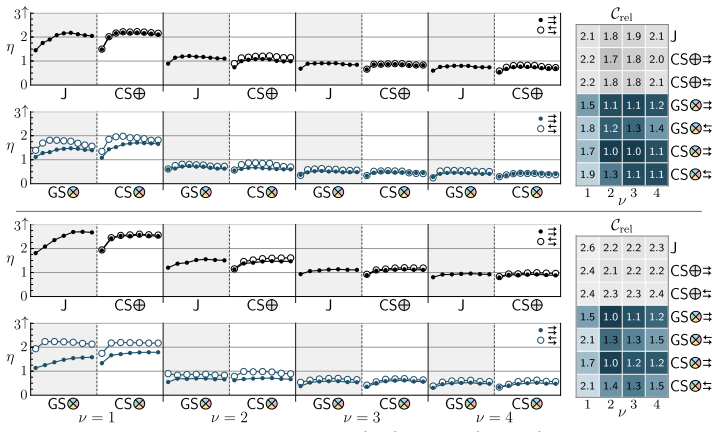
Cascading smoothers consist of an ordered sequence of single-step block-diagonal smoothers, with each level in the cascade optimised to maximally damp the output of prior steps via a Frobenius norm minimisation of the corresponding error propagators. The additive formulation is analogous to Jacobi and the multiplicative to Gauss-Seidel. When used within a standard multigrid V-cycle, they deliver convergence that closely matches or significantly outperforms optimally-damped classical counterparts on finite difference, finite element, and discontinuous Galerkin discretisations of Poisson, elliptic interface, and Stokes systems as well as multiphase variants, while requiring no parameter tuning
What carries the argument
Cascading smoothers defined by sequential Frobenius-norm minimization of error propagators in additive or multiplicative block-diagonal form.
Load-bearing premise
Sequential Frobenius-norm minimization at each cascade level produces stable and effective damping for arbitrary discretizations and operators without introducing new instabilities.
What would settle it
Finding a discretization or operator where the cascading smoothers diverge or perform substantially worse than their optimally damped classical counterparts on a standard test problem would falsify the effectiveness.
Figures




read the original abstract
Multigrid methods are among the most effective frameworks for solving large-scale sparse systems. However, achieving their hallmark linear scaling and rapid convergence crucially depends on an effective smoother algorithm, whose design is often highly problem-dependent. This paper develops a new approach, referred to as \textit{cascading smoothers} due to their operation as an ordered sequence of single-step block-diagonal smoothers. Each level in the cascade is optimised to maximally damp the output of prior steps via a Frobenius norm minimisation of the corresponding error propagators. In particular, we develop an additive (resp., multiplicative) formulation analogous to Jacobi (resp., Gauss-Seidel). Applied within a standard multigrid V-cycle, we show they are remarkably effective across a wide array of problems, including finite difference, finite element, and discontinuous Galerkin discretisations applied to Poisson, elliptic interface, and Stokes systems as well as multiphase variants. In every case, cascading smoothers closely match or significantly outperform their optimally-damped classical counterparts, yet require no parameter tuning apart from a few discrete solver choices. Additionally, the approach is highly parallelisable and robust to geometric and operator complexities such as unstructured meshes and high-contrast coefficients.
Editorial analysis
A structured set of objections, weighed in public.
Referee Report
Summary. The manuscript introduces cascading smoothers for multigrid, consisting of ordered sequences of single-step block-diagonal smoothers (additive or multiplicative) in which each stage is chosen by direct Frobenius-norm minimization of the error propagator that remains after the preceding stages. These smoothers are inserted into standard V-cycles and are asserted to be effective, without parameter tuning beyond a few discrete choices, for finite-difference, finite-element and discontinuous-Galerkin discretizations of Poisson, elliptic-interface, Stokes and multiphase problems on both structured and unstructured meshes.
Significance. If the reported numerical performance is reproducible, the construction supplies a largely parameter-free route to effective smoothers for a range of operators that are otherwise difficult to treat with classical damped Jacobi or Gauss-Seidel methods. The emphasis on sequential norm minimization and the claimed robustness to high-contrast coefficients and geometric complexity constitute a potentially useful addition to the multigrid toolbox.
major comments (2)
- The central construction minimizes the Frobenius norm of each successive error propagator, yet the manuscript supplies no analysis showing that this procedure guarantees that the spectral radius of the composite smoother remains strictly less than one. Because the Frobenius norm only bounds the 2-norm and does not control the spectral radius for non-normal matrices, the procedure can in principle produce an unstable smoother for the Stokes or high-contrast DG operators that are included in the claimed test suite.
- The abstract asserts that the cascading smoothers 'closely match or significantly outperform their optimally-damped classical counterparts' across every listed discretization and PDE; however, the provided text contains no quantitative tables, iteration counts, or convergence-rate comparisons that would allow an independent assessment of this performance claim.
Simulated Author's Rebuttal
We thank the referee for the careful reading and constructive comments. We respond point by point to the major comments below.
read point-by-point responses
-
Referee: The central construction minimizes the Frobenius norm of each successive error propagator, yet the manuscript supplies no analysis showing that this procedure guarantees that the spectral radius of the composite smoother remains strictly less than one. Because the Frobenius norm only bounds the 2-norm and does not control the spectral radius for non-normal matrices, the procedure can in principle produce an unstable smoother for the Stokes or high-contrast DG operators that are included in the claimed test suite.
Authors: We agree that the manuscript provides no theoretical analysis guaranteeing that the spectral radius of the composite smoother is strictly less than one. The Frobenius-norm minimization reduces the Frobenius norm (hence bounds the 2-norm) of each successive propagator, but this does not control the spectral radius for non-normal matrices. The paper relies on numerical evidence of stable convergence for the Stokes and high-contrast DG cases. In revision we will add an explicit discussion of this limitation together with the observed empirical stability. revision: yes
-
Referee: The abstract asserts that the cascading smoothers 'closely match or significantly outperform their optimally-damped classical counterparts' across every listed discretization and PDE; however, the provided text contains no quantitative tables, iteration counts, or convergence-rate comparisons that would allow an independent assessment of this performance claim.
Authors: The full manuscript contains numerical results with iteration counts and convergence comparisons. To make the abstract claim directly verifiable, we will add a compact summary table of key metrics and insert explicit references from the abstract and introduction to the relevant tables and figures. revision: yes
Circularity Check
No circularity: cascading smoothers defined by explicit independent Frobenius minimization
full rationale
The paper defines cascading smoothers directly via sequential Frobenius-norm minimization of error propagators at each cascade level (additive or multiplicative). This is an optimization procedure applied to the constructed propagators rather than a fit to solution data or a self-referential definition. Effectiveness is shown via numerical experiments on multiple discretizations and operators; no load-bearing self-citation, uniqueness theorem, or renaming of known results is present in the provided text. The central construction does not reduce to its inputs by definition.
Axiom & Free-Parameter Ledger
axioms (1)
- domain assumption Error propagators of block-diagonal smoothers can be minimized level-by-level via Frobenius norm to produce an effective cascade.
Reference graph
Works this paper leans on
-
[1]
Adams, M
M. Adams, M. Brezina, J. Hu, and R. Tuminaro,Parallel multigrid smoothing: polynomial versus Gauss-Seidel, Journal of Computational Physics, 188 (2003), pp. 593–610, https://doi.org/10.1016/ S0021-9991(03)00194-3
2003
-
[2]
J. Adsuara, I. Cordero-Carri ´on, P. Cerd ´a-Dur´an, and M. Aloy,Scheduled Relaxation Jacobi method: Improvements and applications, Journal of Computational Physics, 321 (2016), pp. 369–413, https://doi.org/10.1016/j.jcp.2016.05.053
-
[3]
J. Adsuara, I. Cordero-Carri ´on, P. Cerd´a-Dur´an, V. Mewes, and M. Aloy,On the equivalence between the Scheduled Relaxation Jacobi method and Richardson’s non-stationary method, Journal of Computational Physics, 332 (2017), pp. 446–460, https://doi.org/10.1016/j.jcp.2016.12.020
-
[4]
A. H. Baker, R. D. Falgout, T. V. Kolev, and U. M. Yang,Multigrid smoothers for ultraparallel 23 computing, SIAM Journal on Scientific Computing, 33 (2011), pp. 2864–2887, https://doi.org/10. 1137/100798806
2011
-
[5]
Birken, J
P. Birken, J. Bull, and A. Jameson,A study of multigrid smoothers used in compressible CFD based on the convection diffusion equation, in 7th European Congress on Computational Methods in Applied Sciences and Engineering, ECCOMAS Congress 2016, National Technical University of Athens, 2016, pp. 2648–2663
2016
-
[6]
W. L. Briggs, V. E. Henson, and S. F. McCormick,A Multigrid Tutorial, Second Edition, Society for Industrial and Applied Mathematics, second ed., 2000, https://doi.org/10.1137/1.9780898719505
-
[7]
O. Br¨oker and M. J. Grote,Sparse approximate inverse smoothers for geometric and algebraic multi- grid, Applied Numerical Mathematics, 41 (2002), pp. 61–80, https://doi.org/10.1016/S0168-9274(01) 00110-6
-
[8]
O. Br¨oker, M. J. Grote, C. Mayer, and A. Reusken,Robust parallel smoothing for multigrid via sparse approximate inverses, SIAM Journal on Scientific Computing, 23 (2001), pp. 1396–1417, https://doi.org/10.1137/S1064827500380623
-
[9]
J. Brown, Y. He, S. MacLachlan, M. Menickelly, and S. M. Wild,Tuning multigrid methods with robust optimization and local Fourier analysis, SIAM Journal on Scientific Computing, 43 (2021), pp. A109–A138, https://doi.org/10.1137/19M1308669
-
[10]
L. Claus and M. Bolten,Nonoverlapping block smoothers for the Stokes equations, Numerical Linear Algebra with Applications, 28 (2021), p. e2389, https://doi.org/10.1002/nla.2389
-
[11]
B. Cockburn, G. Kanschat, D. Sch ¨otzau, and C. Schwab,Local discontinuous Galerkin methods for the Stokes system, SIAM Journal on Numerical Analysis, 40 (2002), pp. 319–343, https: //doi.org/10.1137/S0036142900380121
-
[12]
J. W. Demmel,Applied Numerical Linear Algebra, Society for Industrial and Applied Mathematics, 1997, https://doi.org/10.1137/1.9781611971446
-
[13]
P. E. Farrell, Y. He, and S. P. MacLachlan,A local Fourier analysis of additive Vanka relaxation for the Stokes equations, Numerical Linear Algebra with Applications, 28 (2021), p. e2306, https: //doi.org/10.1002/nla.2306
-
[14]
D. Fortunato, C. H. Rycroft, and R. I. Saye,Efficient operator-coarsening multigrid schemes for local discontinuous Galerkin methods, SIAM Journal on Scientific Computing, 41 (2019), pp. A3913– A3937, https://doi.org/10.1137/18M1206357
-
[15]
M. J. Grote and T. Huckle,Parallel preconditioning with sparse approximate inverses, SIAM Journal on Scientific Computing, 18 (1997), pp. 838–853, https://doi.org/10.1137/S1064827594276552
-
[16]
F. H. Harlow and J. E. Welch,Numerical Calculation of Time-Dependent Viscous Incompressible Flow of Fluid with Free Surface, The Physics of Fluids, 8 (1965), pp. 2182–2189, https://doi.org/10. 1063/1.1761178
1965
-
[17]
Huckle and M
T. Huckle and M. Sedlacek,Smoothing and regularization with modified sparse approximate inverses, Journal of Electrical and Computer Engineering, 2010 (2010), p. 930218, https://doi.org/doi.org/10. 1155/2010/930218
2010
-
[18]
J. Lottes,Optimal polynomial smoothers for multigrid V-cycles, Numerical Linear Algebra with Applications, 30 (2023), p. e2518, https://doi.org/10.1002/nla.2518
-
[19]
2003.Iterative Methods for Sparse Linear Systems(second ed.)
Y. Saad,Iterative Methods for Sparse Linear Systems, Society for Industrial and Applied Mathematics, second ed., 2003, https://doi.org/10.1137/1.9780898718003
-
[20]
R. I. Saye,Efficient multigrid solution of elliptic interface problems using viscosity-upwinded local discontinuous Galerkin methods, Communications in Applied Mathematics and Computational Science, 14 (2019), pp. 247–283, https://doi.org/10.2140/camcos.2019.14.247
-
[21]
R. I. Saye,Fast multigrid solution of high-order accurate multiphase Stokes problems, Communications in Applied Mathematics and Computational Science, 15 (2020), pp. 147–196, https://doi.org/10. 2140/camcos.2020.15.33
2020
-
[22]
R. I. Saye,A comparative study of efficient multigrid solvers for high-order local discontinuous Galerkin methods: Poisson, elliptic interface, and multiphase Stokes problems, Communications in Applied Mathematics and Computational Science, 20 (2025), pp. 253–291, https://doi.org/10.2140/camcos. 2025.20.253
-
[23]
R. I. Saye,Efficient multigrid solvers for mixed-degree local discontinuous Galerkin multiphase Stokes problems, 2025, https://doi.org/10.48550/arXiv.2506.09933, https://arxiv.org/abs/2506.09933
work page internal anchor Pith review Pith/arXiv arXiv doi:10.48550/arxiv.2506.09933 2025
-
[24]
K. St¨uben,A review of algebraic multigrid, Journal of Computational and Applied Mathematics, 128 (2001), pp. 281–309, https://doi.org/10.1016/S0377-0427(00)00516-1. Numerical Analysis 2000. Vol. VII: Partial Differential Equations
-
[25]
Tang and W
W.-P. Tang and W. L. Wan,Sparse approximate inverse smoother for multigrid, SIAM Jour- nal on Matrix Analysis and Applications, 21 (2000), pp. 1236–1252, https://doi.org/10.1137/ S0895479899339342. [26]U. Trottenberg, C. Oosterlee, and A. Sch ¨uller,Multigrid, Academic Press, 2001. 24
2000
-
[26]
B. van Leer, C.-H. Tai, and K. G. Powell,Design of optimally smoothing multi-stage schemes for the Euler equations, in 9th Computational Fluid Dynamics Conference, 1989, pp. 40–59, https://doi.org/10.2514/6.1989-1933
-
[27]
S. P. Vanka,Block-implicit multigrid solution of Navier-Stokes equations in primitive variables, Journal of Computational Physics, 65 (1986), pp. 138–158, https://doi.org/10.1016/0021-9991(86)90008-2
-
[28]
S. P. Vanka,A calculation procedure for three-dimensional steady recirculating flows using multigrid methods, Computer Methods in Applied Mechanics and Engineering, 55 (1986), pp. 321–338, https://doi.org/10.1016/0045-7825(86)90058-7. [30]P. Wesseling,An Introduction to Multigrid Methods, John Wiley & Sons, 1992. [31]R. Wienands and W. Joppich,Practical F...
-
[29]
X. I. Yang and R. Mittal,Acceleration of the Jacobi iterative method by factors exceeding 100 using scheduled relaxation, Journal of Computational Physics, 274 (2014), pp. 695–708, https: //doi.org/10.1016/j.jcp.2014.06.010
-
[30]
bubble” surrounded by gas, and a gas “bubble
I. Yavneh,On Red-Black SOR Smoothing in Multigrid, SIAM Journal on Scientific Computing, 17 (1996), pp. 180–192, https://doi.org/10.1137/0917013. 25 CASCADING SMOOTHERS FOR MULTIGRID SUPPLEMENTARY MATERIAL Robert I. Saye Lawrence Berkeley National Laboratory, Berkeley, California, USA|rsaye@lbl.gov|June 5, 2026 SM5. Multicoloured Cascading Smoothers.As no...
discussion (0)
Sign in with ORCID, Apple, or X to comment. Anyone can read and Pith papers without signing in.