Massively parallel flow routing and drainage area determination
Pith reviewed 2026-06-27 06:35 UTC · model grok-4.3
The pith
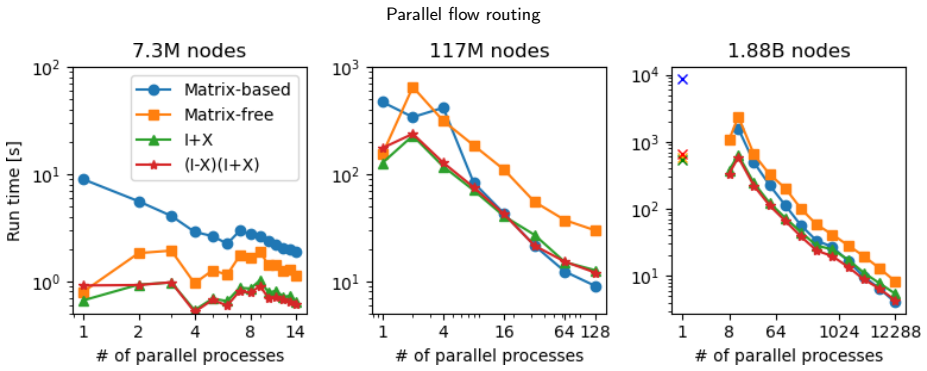
Parallel algorithm variations route flow on 1.88 billion point DEMs in 4 seconds using 12,288 processes.
A machine-rendered reading of the paper's core claim, the machinery that carries it, and where it could break.
Core claim
Variations on the Richardson et al. (2014) method can be implemented to solve the flow routing and drainage-area problems on massively parallel computers, with the strongest result being that a model containing 1.88 billion points can be processed in 4.0 seconds on 12,288 processes.
What carries the argument
A family of distributed flow-routing algorithms and their implementation variants that partition the DEM across processes and exchange only the minimal neighbor information required to resolve flow directions and accumulate drainage areas.
If this is right
- Flow routing and drainage-area calculations become practical for DEMs containing billions of cells on current supercomputers.
- Higher-resolution or larger-extent elevation data can be used directly in hydrological models without first down-sampling.
- The same partitioning and neighbor-exchange strategy applies to any grid-based accumulation or path-following computation on distributed memory machines.
- Runtime remains acceptable even when the number of processes grows into the low tens of thousands.
Where Pith is reading between the lines
- Similar parallelization tactics could be applied to other accumulation problems on unstructured meshes, such as contaminant transport or sediment routing.
- The observed scaling behavior supplies a concrete benchmark for testing future load-balancing libraries aimed at irregular grid graphs.
- If the communication pattern stays sparse, the same code base could support on-the-fly routing inside ensemble weather or climate simulations.
Load-bearing premise
The proposed algorithm variations can be coded so that communication overhead and load imbalance remain small enough at 12,288 processes to preserve both correctness and the reported wall-clock times.
What would settle it
An independent run on the same 1.88-billion-point model and 12,288-process configuration that either produces flow paths differing from the sequential reference or requires substantially more than 4 seconds because of communication stalls.
Figures



read the original abstract
Digital elevation models (DEMs) have reached resolutions and sizes that only parallel computaters can efficiently process. One important application of DEMs is predicting how much water flows where, the so-called ``flow routing problem'' (a variation of which is the problem of determining the drainage area upstream of a point in a DEM). The traditional algorithm for flow routing is sequential, and attempts to parallelize this method have so far only been moderately successful. Herein, we build on earlier work in Richardson et al. (2014) and propose an algorithm and several variations that can efficiently solve the flow routing problem on very large models with very large numbers of parallel processes. For the largest model we use, with 1.88 billion points, the best algorithm herein can route water in 4.0 seconds on 12,288 processes of a computer cluster.
Editorial analysis
A structured set of objections, weighed in public.
Referee Report
Summary. The manuscript proposes parallel algorithms and variations, extending Richardson et al. (2014), for solving the flow routing and drainage area problems on large digital elevation models (DEMs). The central empirical claim is that the best variant processes a DEM with 1.88 billion points in 4.0 seconds using 12,288 processes on a computer cluster.
Significance. If the reported timings are shown to reflect correct results with proper verification, the work would address a practical need for scalable processing of high-resolution DEMs in hydrology and geosciences. The absence of any algorithm description, pseudocode, validation data, or scaling analysis in the provided text leaves the significance of the performance claim unestablished.
major comments (3)
- [Abstract] Abstract: The headline performance claim (4.0 s on 1.88 B points, 12 288 processes) is presented without any reference to validation against analytic solutions, sequential reference implementations, error metrics, or baseline comparisons. This omission makes it impossible to determine whether the timings reflect correct flow routing or implementation artifacts.
- [Abstract] Abstract: No description is given of the proposed variations on the Richardson et al. (2014) method, nor of how boundary handling, halo exchanges, or load balancing are managed at 12 288 processes. Without these details the claim that linear scaling is preserved cannot be evaluated.
- [Abstract] Abstract: The manuscript supplies no quantitative data on communication volume, load-imbalance metrics, or global reduction costs, all of which are load-bearing for the parallel-efficiency claim at the reported scale.
minor comments (1)
- [Abstract] Abstract, line 2: 'computaters' is a typographical error and should read 'computers'.
Simulated Author's Rebuttal
We thank the referee for the detailed and constructive report. We address each major comment below and will incorporate the suggested improvements in the revised manuscript.
read point-by-point responses
-
Referee: [Abstract] Abstract: The headline performance claim (4.0 s on 1.88 B points, 12 288 processes) is presented without any reference to validation against analytic solutions, sequential reference implementations, error metrics, or baseline comparisons. This omission makes it impossible to determine whether the timings reflect correct flow routing or implementation artifacts.
Authors: We agree that the abstract should reference the validation performed. We will revise the abstract to include a brief statement on validation against analytic solutions and sequential reference implementations, along with the error metrics achieved. The main text will be checked to ensure these validations are presented with sufficient detail and baseline comparisons. revision: yes
-
Referee: [Abstract] Abstract: No description is given of the proposed variations on the Richardson et al. (2014) method, nor of how boundary handling, halo exchanges, or load balancing are managed at 12 288 processes. Without these details the claim that linear scaling is preserved cannot be evaluated.
Authors: The abstract is concise by nature and omits these algorithmic details. We will add a short overview sentence to the abstract describing the variations on the Richardson et al. (2014) method and the approaches to boundary handling, halo exchanges, and load balancing. The main text already expands on these topics and will be reviewed for clarity. revision: yes
-
Referee: [Abstract] Abstract: The manuscript supplies no quantitative data on communication volume, load-imbalance metrics, or global reduction costs, all of which are load-bearing for the parallel-efficiency claim at the reported scale.
Authors: We acknowledge that the current manuscript does not provide these quantitative metrics. We will add data on communication volume, load-imbalance metrics, and global reduction costs, including new tables or figures in the results section to support the parallel-efficiency claims. revision: yes
Circularity Check
No circularity: empirical performance claims with no derivational reduction
full rationale
The paper presents an algorithmic extension of Richardson et al. (2014) for parallel flow routing on DEMs and reports measured wall-clock times (e.g., 4.0 s on 1.88 B points with 12,288 processes). These are direct experimental results, not predictions or derivations from equations. No self-definitional steps, fitted inputs renamed as predictions, or load-bearing self-citation chains appear; the cited prior work is external and the claims remain falsifiable against independent implementations or hardware runs. The derivation chain is therefore self-contained.
Axiom & Free-Parameter Ledger
Reference graph
Works this paper leans on
-
[1]
Efficient flow computation on massive grid terrain datasets. GeoInformatica 7, 283–313. URL:http://doi.org/10.1023/A:1025526421410, doi:10.1023/A:1025526421410. Arndt, D., Bangerth, W., Bergbauer, M., Blais, B., Fehling, M., Gassmöller, R., Heister, T., Heltai, L., Kronbichler, M., Maier, M., Munch, P., Scheuerman, S., Turcksin, B., Uzunbajakau, S., Wells...
-
[2]
The deal.ii library, version 9.7,
The deal.II library, version 9.7. Journal of Numerical Mathematics 33, 403–415. doi:10.1515/jnma-2025-0115. Arndt, D., Bangerth, W., Davydov, D., Heister, T., Heltai, L., Kronbichler, M., Maier, M., Pelteret, J.P., Turcksin, B., Wells, D.,
-
[3]
The deal.ii finite element library: Design, features, and insights,
The deal.II finite element library: design, features, and insights. Computers & Mathematics with Applications 81, 407–422. URL:https: //arxiv.org/abs/1910.13247, doi:10.1016/j.camwa.2020.02.022. Balay, S., Abhyankar, S., Adams, M.F., Benson, S., Brown, J., Brune, P., Buschelman, K., Constantinescu, E., Dalcin, L., Dener, A., Eijkhout, V., Faibussowitsch, ...
-
[4]
Technical Report ANL-21/39 - Revision 3.24
PETSc/TAO Users Manual. Technical Report ANL-21/39 - Revision 3.24. Argonne National Laboratory. doi:10.2172/2998643. Balay, S., Abhyankar, S., Adams, M.F., Benson, S., Brown, J., Brune, P., Buschelman, K., Constantinescu, E.M., Dalcin, L., Dener, A., Eijkhout, V., Faibussowitsch, J., Gropp, W.D., Hapla, V., Isaac, T., Jolivet, P., Karpeev, D., Kaushik, D...
-
[5]
PETSc Web page.https://petsc.org/. URL:https://petsc.org/. Bangerth,W.,Burstedde,C.,Heister,T.,Kronbichler,M.,2011. Algorithmsanddatastructuresformassivelyparallelgenericadaptivefiniteelement codes. ACM Transactions on Mathematical Software 38, 14/1–28. Barnes,R.,2016. Parallelpriority-flooddepressionfillingfortrillioncelldigitalelevationmodelsondesktopso...
-
[6]
A very efficient o(n), implicit and parallel method to solve the stream power equation governing fluvial incisionandlandscapeevolution. Geomorphology180-181,170–179. URL:https://www.sciencedirect.com/science/article/pii/ S0169555X12004618, doi:https://doi.org/10.1016/j.geomorph.2012.10.008. Burstedde, C., Wilcox, L.C., Ghattas, O., 2011.p4est: Scalable al...
-
[7]
European Space Agency,
Upslope area—forming and solving the flow matrix, mathworks.http://blogs.mathworks.com/steve/2007/08/07/ upslope-area-flow-matrix/. European Space Agency,
2007
-
[8]
Copernicus Global Digital Elevation Model, distributed by OpenTopography.https://doi.org/10.5069/ G9028PQB. doi:10.5069/G9028PQB. accessed: 2026-03-19. Freeman,T.,1991.Calculatingcatchmentareawithdivergentflowbasedonaregulargrid.Computers&Geosciences17,413–422.URL:https:// www.sciencedirect.com/science/article/pii/009830049190048I, doi:https://doi.org/10....
-
[9]
Efficient parallel computation of ilu(k) preconditioners, in: Proceedings of the 1999 ACM/IEEE Conference on Supercomputing,AssociationforComputingMachinery,NewYork,NY,USA.p.29–es.URL:https://doi.org/10.1145/331532.331561, doi:10.1145/331532.331561. Hysom, D., Pothen, A.,
-
[10]
SIAM Journal on Scientific Computing 22, 2194–2215
A scalable parallel algorithm for incomplete factor preconditioning. SIAM Journal on Scientific Computing 22, 2194–2215. doi:10.1137/S1064827500376193. Jenson, S.K., Domingue, J.O.,
-
[11]
Water Resources Research 58, e2021WR030948
An improved D8-LTD for the extraction of total con- tributing area (TCA) by adopting the strategies of path independency and local dispersion. Water Resources Research 58, e2021WR030948. URL:https://agupubs.onlinelibrary.wiley.com/doi/abs/10.1029/2021WR030948, doi:https://doi.org/ 10.1029/2021WR030948,arXiv:https://agupubs.onlinelibrary.wiley.com/doi/pdf/...
-
[12]
ASTER Global Digital Elevation Model V003.https: //www.earthdata.nasa.gov/data/catalog/lpcloud-astgtm-003. doi:10.5067/ASTER/ASTGTM.003. accessed: 2026-03-19. O’Callaghan, J.F., Mark, D.M.,
-
[13]
Computer Vision, Graphics, and Image Processing 28, 323–344
The extraction of drainage networks from digital elevation data. Computer Vision, Graphics, and Image Processing 28, 323–344. URL:https://www.sciencedirect.com/science/article/pii/S0734189X84800110, doi:https: //doi.org/10.1016/S0734-189X(84)80011-0. Quarteroni, A., Valli, A.,
-
[14]
Domain Decomposition Methods for Partial Differential Equations. Clarendon Press, Oxford. Richardson,A.,Hill,C.N.,Perron,J.T.,2014. IDA:Animplicit,parallelizablemethodforcalculatingdrainagearea. WaterResourcesResearch50, 4110–4130. URL:https://agupubs.onlinelibrary.wiley.com/doi/abs/10.1002/2013WR014326, doi:10.1002/2013WR014326, arXiv:https://agupubs.onl...
-
[15]
The approximate arithmetical solution by finite differences of physical problems involving differential equations, with an application to the stresses in a masonry dam. Philosophical Transactions of the Royal Society of London, Series A: Containing Papers of a Mathematical or Physical Character 210, 307–357. URL:http://doi.org/10.1098/rsta.1911.0009, doi:...
-
[16]
Environmental Modelling & Software 25, 770–781
Topotoolbox: A set of matlab functions for topographic analysis. Environmental Modelling & Software 25, 770–781. URL:https://www.sciencedirect.com/science/article/pii/S1364815209003053, doi:https://doi.org/10.1016/ j.envsoft.2009.12.002. Tarboton, D.G.,
2009
-
[17]
Water Resources Research 33, 309–319
A new method for the determination of flow directions and upslope areas in grid digital elevation models. Water Resources Research 33, 309–319. URL:http://doi.org/10.1029/96WR03137, doi:10.1029/96WR03137. Wallace,R.,Tarboton,D.,Watson,D.,Schreuders,K.,Tesfa,T.,2010. Parallelalgorithmsforprocessinghydrologicpropertiesfromdigitalterrain, in:Proceedingsofthe...
discussion (0)
Sign in with ORCID, Apple, or X to comment. Anyone can read and Pith papers without signing in.