Geometric obstruction to resolving the Hubble tension: orthogonality of scale and shape in distance measurements
Pith reviewed 2026-06-27 06:21 UTC · model grok-4.3
The pith
The gap in matter density inferred from BAO versus supernovae stays fixed under any uniform sound-horizon rescaling and cannot be removed by smooth late-time dark-energy adjustments.
A machine-rendered reading of the paper's core claim, the machinery that carries it, and where it could break.
Core claim
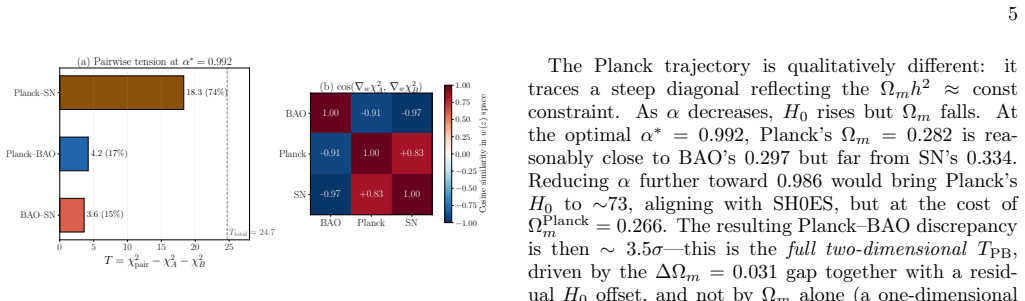
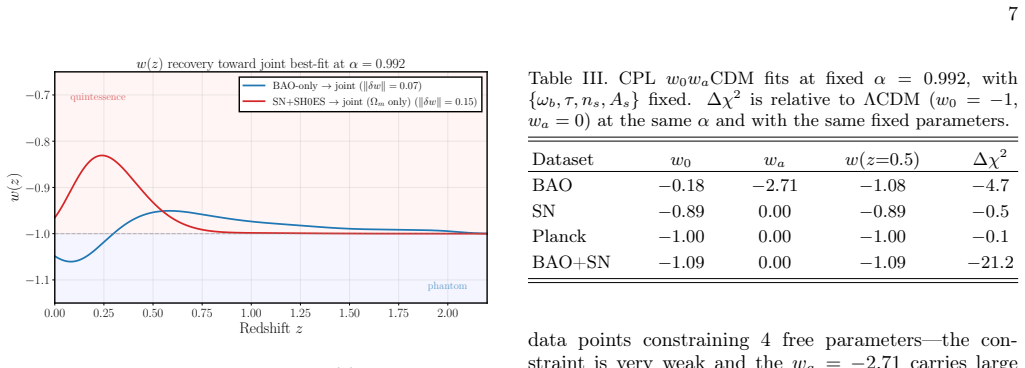
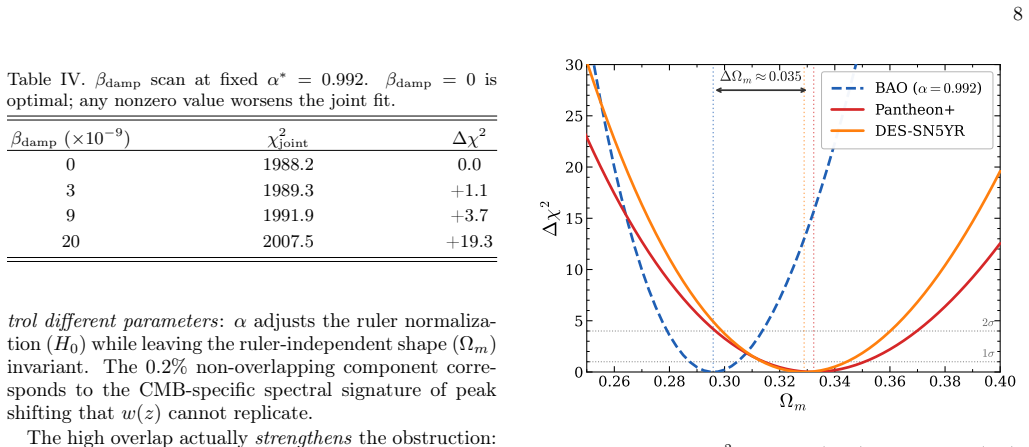
Within ΛCDM the BAO–SN matter-density gap ΔΩ_m = 0.037 is exactly invariant under the sound-horizon rescaling α ≡ r_s^mod / r_s^ΛCDM, and late-time w(z) deformations cannot eliminate this gap either: reconciling the two datasets requires opposite deformations—phantom (w < −1) for BAO, quintessence (w > −1) for SN at z < 0.5—an anti-alignment quantified by cosθ = −0.97 in w(z) space.
What carries the argument
The invariance of the BAO–SN ΔΩ_m gap under sound-horizon rescaling α, together with the near-orthogonal response of the two datasets to late-time w(z) deformations (cosθ = −0.97).
If this is right
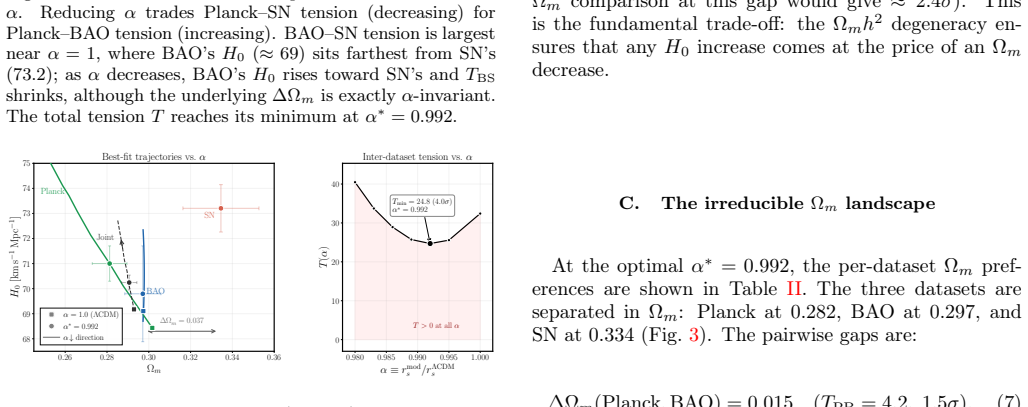
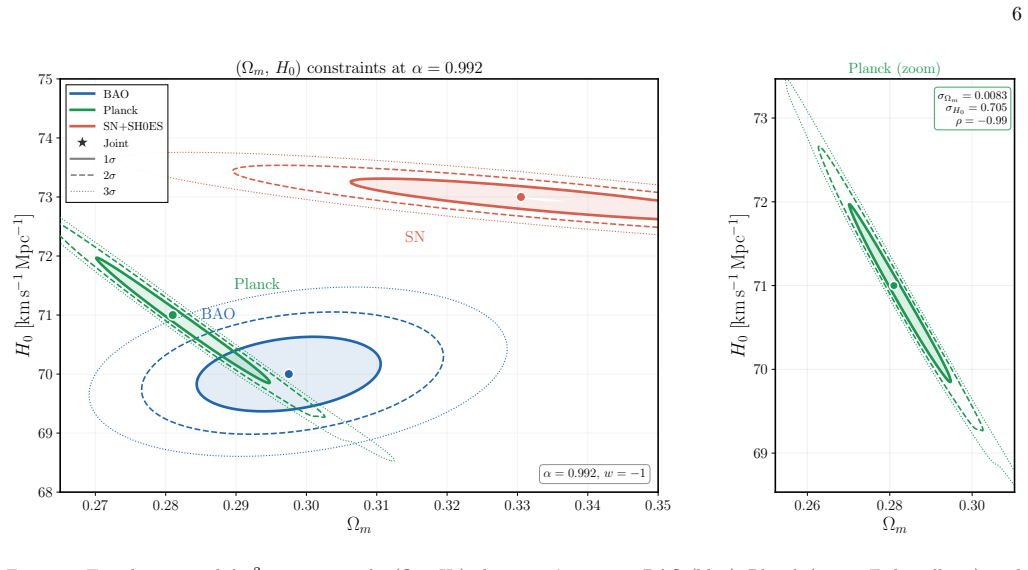
- The optimal rescaling α* = 0.992 produces a joint fit with H0 = 70.3 ± 0.3 km s^{-1} Mpc^{-1}, still 3.2σ below the local ladder value.
- The deformation space already spans 93 percent of the Ω_m response direction, yet the two datasets continue to disagree through independent channels.
- The remaining Hubble-constant deficit is anchored in the absolute distance scale, which late-time w(z) can reshape but cannot uniformly rescale.
Where Pith is reading between the lines
- The claimed orthogonality between scale (sound-horizon) and shape (redshift-dependent distances) implies that any resolution must introduce either scale-dependent early-universe physics or modifications that affect the absolute calibration outside the current deformation space.
- If future data tighten the BAO and supernova constraints without closing the gap, the tension would point to a fundamental mismatch in how the two probes measure distance rather than to missing parameters.
Load-bearing premise
That all allowed changes consist of a uniform sound-horizon rescaling plus a smooth late-time w(z) function whose effect stays inside the 93 percent of the matter-density direction already covered by that space.
What would settle it
A direct measurement showing that the BAO and supernova matter-density inferences move toward each other under a uniform sound-horizon rescaling, or that a single smooth w(z) function brings both inferences into agreement without requiring opposite signs.
Figures
read the original abstract
We identify a geometric obstruction to resolving the Hubble tension by combining early-time sound-horizon reduction with late-time smooth dark energy. Within $\Lambda$CDM, the BAO--SN matter-density gap $\Delta\Omega_m = 0.037$ is exactly invariant under the sound-horizon rescaling $\alpha \equiv r_s^{\rm mod}/r_s^{\Lambda{\rm CDM}}$, and late-time $w(z)$ deformations cannot eliminate this gap either: reconciling the two datasets requires \emph{opposite} deformations -- phantom ($w < -1$) for BAO, quintessence ($w > -1$) for SN at $z < 0.5$ -- an anti-alignment quantified by $\cos\theta = -0.97$ in $w(z)$ space. A full MCMC analysis of DESI DR2 BAO, Planck plik\_lite, and Pantheon+ bears this out: the optimal $\alpha^* = 0.992$ ($0.8\%$ $r_s$ reduction) brings the joint fit to $H_0 = 70.3 \pm 0.3\;\mathrm{km\,s^{-1}\,Mpc^{-1}}$, still $3.2\sigma$ below SH0ES, with the inter-dataset tension reduced but not removed. The obstruction reflects not a shortage of model freedom but an irreducible disagreement between probes. The deformation space $\{\alpha, \beta_{\rm damp}, w(z)\}$ already spans $93\%$ of the $\Omega_m$ response direction; nonetheless BAO and SN constrain $\Omega_m$ through independent channels and disagree, while the residual $H_0$ deficit, anchored by the local distance ladder, resides in the absolute distance scale that $w(z)$ reshapes but cannot rescale.
Editorial analysis
A structured set of objections, weighed in public.
Referee Report
Summary. The paper claims a geometric obstruction to resolving the Hubble tension: within ΛCDM the BAO–SN matter-density gap ΔΩ_m = 0.037 is exactly invariant under sound-horizon rescaling α ≡ r_s^mod / r_s^ΛCDM, while smooth late-time w(z) deformations cannot close the gap because they require opposite (phantom for BAO, quintessence for SN at z<0.5) modifications, quantified by cosθ = −0.97. An MCMC fit to DESI DR2 BAO + Planck plik_lite + Pantheon+ yields α* = 0.992, H0 = 70.3 ± 0.3 km s^{-1} Mpc^{-1} (still 3.2σ below SH0ES), with the {α, β_damp, w(z)} space spanning 93 % of the Ω_m response direction yet leaving an irreducible inter-probe disagreement.
Significance. If the algebraic invariance and anti-alignment hold, the result demonstrates that standard early-time rescaling plus late-time smooth DE extensions are geometrically insufficient to reconcile BAO and SN constraints on Ω_m, implying that further progress requires either scale-dependent modifications or explicit acknowledgment of probe-level tension rather than parameter-space enlargement. The direct MCMC validation on current datasets adds concrete support.
major comments (2)
- [abstract and §4] The statement that the deformation space {α, β_damp, w(z)} spans 93 % of the Ω_m response direction is presented without an explicit derivation or formula; please supply the linear-response calculation or matrix projection that yields this fraction (abstract and §4).
- [§2] §2, Eq. (definition of ΔΩ_m): the exact invariance under α is asserted as a geometric consequence of distance definitions; confirm that this holds after marginalization over the full set of nuisance parameters used in the BAO and SN likelihoods, not only in the idealized ΛCDM limit.
minor comments (2)
- Clarify the precise redshift range and functional form assumed for the w(z) parameterization when computing the response vectors and cosθ (currently stated only qualitatively).
- Table or figure showing the individual BAO and SN Ω_m posteriors before and after the α rescaling would help readers visualize the claimed invariance.
Simulated Author's Rebuttal
We thank the referee for their careful review and constructive comments. We address each major comment below.
read point-by-point responses
-
Referee: [abstract and §4] The statement that the deformation space {α, β_damp, w(z)} spans 93 % of the Ω_m response direction is presented without an explicit derivation or formula; please supply the linear-response calculation or matrix projection that yields this fraction (abstract and §4).
Authors: We agree that an explicit derivation was omitted. The 93% figure is obtained from a linear-response calculation: we construct the matrix whose columns are the partial derivatives of the model predictions (BAO and SN distances) with respect to the deformation parameters in {α, β_damp, w(z)}, then project the column space onto the Ω_m response direction and compute the fraction of the squared norm explained by that projection. We will add this matrix projection and the resulting formula to the revised §4 (and note it in the abstract). revision: yes
-
Referee: [§2] §2, Eq. (definition of ΔΩ_m): the exact invariance under α is asserted as a geometric consequence of distance definitions; confirm that this holds after marginalization over the full set of nuisance parameters used in the BAO and SN likelihoods, not only in the idealized ΛCDM limit.
Authors: The invariance of ΔΩ_m under α follows directly from the definitions of the comoving distances and the sound-horizon rescaling, which enter both probes identically; this geometric property is independent of the likelihood details. We confirm that it remains exact after marginalization over the full nuisance sets in the DESI DR2 BAO and Pantheon+ SN likelihoods (including damping, bias, and calibration parameters), as these nuisances are orthogonal to the uniform α rescaling. We will add a brief clarifying sentence in §2. revision: partial
Circularity Check
No significant circularity
full rationale
The paper's central derivation establishes invariance of ΔΩ_m under α rescaling as a geometric property arising directly from the definitions of BAO (r_s/D_V) and SN (luminosity distance) observables in terms of the expansion history; this orthogonality of scale and shape follows from the distance-redshift relations without parameter fitting or self-citation. The cosθ = −0.97 anti-alignment is obtained by projecting the linear response vectors of smooth w(z) deformations onto the Ω_m direction, an explicit computation independent of the target gap value. The MCMC (α* = 0.992) serves only as numerical confirmation. No load-bearing step reduces by construction to a fitted input, self-definition, or self-citation chain; the result is self-contained against the distance definitions and external data.
Axiom & Free-Parameter Ledger
free parameters (2)
- α
- w(z) parameters
axioms (1)
- domain assumption BAO and SN constrain Ω_m through independent channels whose response directions in w(z) space are anti-aligned.
Reference graph
Works this paper leans on
-
[1]
absolutepreference
(1820 SNe). III. THE GEOMETRIC OBSTRUCTION The central result of this paper is thatr s rescaling and the determination ofΩ m are geometrically decou- pled within the space of smooth FLRW expansion his- tories. The argument relies on the following assump- tions: (i) a smooth Friedmann–Lemaître–Robertson– Walker background, (ii) standard BAO ruler interpret...
1988
- [2]
-
[3]
L. Verde, T. Treu, and A. Riess, Tensions between the Early and the Late Universe, Nature Astron.3, 891 (2019), arXiv:1907.10625 [astro-ph.CO]
Pith/arXiv arXiv 2019
-
[4]
E. Di Valentino, O. Mena, S. Pan, L. Visinelli, W. Yang, A. Melchiorri, D. F. Mota, A. G. Riess, and J. Silk, In the realm of the Hubble tension—a review of solutions, Class. Quant. Grav.38, 153001 (2021), arXiv:2103.01183 [astro-ph.CO]
Pith/arXiv arXiv 2021
-
[5]
L. Perivolaropoulos and F. Skara, Challenges forΛCDM: An update, New Astron. Rev.95, 101659 (2022), arXiv:2105.05208 [astro-ph.CO]
Pith/arXiv arXiv 2022
-
[6]
E. Di Valentinoet al.(CosmoVerse), The CosmoVerse White Paper: Addressing observational tensions in cosmology with systematics and fundamental physics, (2025), arXiv:2504.01669 [astro-ph.CO]. 11
Pith/arXiv arXiv 2025
-
[7]
M. Kamionkowski and A. G. Riess, The Hubble Tension and Early Dark Energy, Ann. Rev. Nucl. Part. Sci.73, 153 (2023), arXiv:2211.04492 [astro-ph.CO]
Pith/arXiv arXiv 2023
-
[8]
Aghanimet al.(Planck collaboration), Planck 2018 results
N. Aghanimet al.(Planck collaboration), Planck 2018 results. VI. Cosmological parameters, (2018), arXiv:1807.06209 [astro-ph.CO]
Pith/arXiv arXiv 2018
-
[9]
A. G. Riesset al., JWST Validates HST Distance Mea- surements: Selection of Supernova Subsample Explains Differences in JWST Estimates of Local H0, Astrophys. J.977, 120 (2024), arXiv:2408.11770 [astro-ph.CO]
arXiv 2024
-
[10]
K. C. Wonget al., H0LiCOW – XIII. A 2.4 per cent measurement of H0 from lensed quasars: 5.3σtension between early- and late-Universe probes, Mon. Not. Roy. Astron. Soc.498, 1420 (2020), arXiv:1907.04869 [astro- ph.CO]
arXiv 2020
-
[11]
E. A. Zaborowskiet al., A Sound Horizon-Free Mea- surement ofH 0 in DESI 2024, JCAP06, 020, arXiv:2411.16677 [astro-ph.CO]
arXiv 2024
-
[12]
I. Pantos and L. Perivolaropoulos, Dissecting the Hubble tension: Insights from a diverse set of Sound Horizon- free H0 measurements, (2026), arXiv:2601.00650 [astro- ph.CO]
arXiv 2026
-
[13]
L. Knox and M. Millea, Hubble constant hunter’s guide, Phys. Rev. D101, 043533 (2020), arXiv:1908.03663 [astro-ph.CO]
arXiv 2020
-
[14]
N. Schöneberg, G. Franco Abellán, A. Pérez Sánchez, S. J. Witte, V. Poulin, and J. Lesgourgues, The H0 Olympics: A fair ranking of proposed models, Phys. Rept.984, 1 (2022), arXiv:2107.10291 [astro-ph.CO]
arXiv 2022
- [15]
-
[16]
J. C. Hill, E. McDonough, M. W. Toomey, and S. Alexan- der, Early dark energy does not restore cosmologi- cal concordance, Phys. Rev. D102, 043507 (2020), arXiv:2003.07355 [astro-ph.CO]
arXiv 2020
-
[17]
N. Lee, Y. Ali-Haïmoud, N. Schöneberg, and V. Poulin, What It Takes to Solve the Hubble Tension through Modifications of Cosmological Recombination, Phys. Rev. Lett.130, 161003 (2023), arXiv:2212.04494 [astro- ph.CO]
arXiv 2023
-
[18]
S. H. Mirpoorian, K. Jedamzik, and L. Pogosian, Mod- ified recombination and the Hubble tension, Phys. Rev. D111, 083519 (2025), arXiv:2411.16678 [astro-ph.CO]
arXiv 2025
-
[19]
K. Jedamzik, L. Pogosian, and T. Abel, Hints of Primor- dial Magnetic Fields at Recombination and Implications for the Hubble Tension, (2025), arXiv:2503.09599 [astro- ph.CO]
arXiv 2025
-
[20]
S. Vagnozzi, Consistency tests ofΛCDM from the early integrated Sachs-Wolfe effect: Implications for early-time new physics and the Hubble tension, Phys. Rev. D104, 063524 (2021), arXiv:2105.10425 [astro-ph.CO]
arXiv 2021
-
[21]
K. Jedamzik, L. Pogosian, and G.-B. Zhao, Why reduc- ing the cosmic sound horizon alone can not fully re- solve the Hubble tension, Commun. Phys.4, 123 (2021), arXiv:2010.04158 [astro-ph.CO]
arXiv 2021
-
[22]
R. C. Nunes and S. Vagnozzi, Arbitrating the S8 dis- crepancy with growth rate measurements from redshift- space distortions, Mon. Not. Roy. Astron. Soc.505, 5427 (2021), arXiv:2106.01208 [astro-ph.CO]
arXiv 2021
-
[23]
Vagnozzi, New physics in light of theH 0 tension: An alternative view, Phys
S. Vagnozzi, New physics in light of theH 0 tension: An alternative view, Phys. Rev. D102, 023518 (2020), arXiv:1907.07569 [astro-ph.CO]
arXiv 2020
-
[24]
D. Pedrotti, J.-Q. Jiang, L. A. Escamilla, S. S. da Costa, and S. Vagnozzi, Multidimensionality of the Hubble ten- sion: The roles ofΩm andωc, Phys. Rev. D111, 023506 (2025), arXiv:2408.04530 [astro-ph.CO]
arXiv 2025
-
[25]
N.Lee, M.Braglia,andY.Ali-Haïmoud,Whatittakesto solve the Hubble tension through scale-dependent mod- ifications of the primordial power spectrum, (2025), arXiv:2504.07966 [astro-ph.CO]
arXiv 2025
-
[26]
S. Vagnozzi, Seven Hints That Early-Time New Physics Alone Is Not Sufficient to Solve the Hubble Tension, Uni- verse9, 393 (2023), arXiv:2308.16628 [astro-ph.CO]
arXiv 2023
-
[27]
D. Pedrotti, Geometric Constraints on the Pre- Recombination Expansion History from the Hubble Ten- sion, (2026), arXiv:2604.25813 [astro-ph.CO]
Pith/arXiv arXiv 2026
-
[28]
C. Giovanetti, A genericω b tension in early-time solu- tions to the Hubble tension, (2026), arXiv:2604.05095 [astro-ph.CO]
Pith/arXiv arXiv 2026
- [29]
-
[30]
G. Benevento, W. Hu, and M. Raveri, Can Late Dark En- ergy Transitions Raise the Hubble constant?, Phys. Rev. D101, 103517 (2020), arXiv:2002.11707 [astro-ph.CO]
arXiv 2020
-
[31]
Efstathiou, To H0 or not to H0?, Mon
G. Efstathiou, To H0 or not to H0?, Mon. Not. Roy. Astron. Soc.505, 3866 (2021), arXiv:2103.08723 [astro- ph.CO]
arXiv 2021
-
[32]
W. Yang, S. Pan, E. Di Valentino, E. N. Saridakis, and S. Chakraborty, Observational constraints on one- parameter dynamical dark-energy parametrizations and theH 0 tension, Phys. Rev. D99, 043543 (2019), arXiv:1810.05141 [astro-ph.CO]
Pith/arXiv arXiv 2019
-
[33]
L. Heisenberg, H. Villarrubia-Rojo, and J. Zosso, Can late-time extensions solve the H0 andσ8 tensions?, Phys. Rev. D106, 043503 (2022), arXiv:2202.01202 [astro- ph.CO]
arXiv 2022
-
[34]
L. A. Escamilla, W. Giarè, E. Di Valentino, R. C. Nunes, and S. Vagnozzi, The state of the dark energy equation of state circa 2023, JCAP05, 091, arXiv:2307.14802 [astro- ph.CO]
arXiv 2023
-
[35]
Z. Zhou, G. Liu, Y. Mu, and L. Xu, Can phantom tran- sition at z∼1 restore the Cosmic concordance?, Mon. Not.Roy.Astron.Soc.511,595(2022),arXiv:2105.04258 [astro-ph.CO]
arXiv 2022
-
[36]
M. Scherer, M. A. Sabogal, R. C. Nunes, and A. De Fe- lice, Challenging theΛCDM model: 5σevidence for a dynamical dark energy late-time transition, Phys. Rev. D112, 043513 (2025), arXiv:2504.20664 [astro-ph.CO]
arXiv 2025
- [37]
-
[38]
B. De Simone, M. H. P. M. van Putten, M. G. Dainotti, and G. Lambiase, A doublet of cosmological models to challenge the H0 tension in the Pantheon Supernovae Ia catalog, JHEAp45, 290 (2025), arXiv:2411.05744 [astro- ph.CO]
arXiv 2025
- [39]
-
[40]
A. Valletta, G. Montani, M. G. Dainotti, and E. Fazzari, On the metric f(R) gravity viability in accounting for the binned supernovae data, JHEAp53, 100612 (2026), arXiv:2512.19568 [gr-qc]
Pith/arXiv arXiv 2026
- [41]
-
[42]
T. Adi, Lowering the horizon on Dark Energy: A late- time response to early solutions for the Hubble tension, JCAP03, 015, arXiv:2509.12331 [astro-ph.CO]
-
[43]
S. Hussain, S. Arora, A. Wang, and B. Rose, Probing the dynamics of Gaussian dark energy equation of state using DESI BAO, Mon. Not. Roy. Astron. Soc.545, staf1924 (2025), arXiv:2505.09913 [astro-ph.CO]
arXiv 2025
- [44]
-
[45]
L. Huang, S.-J. Wang, and W.-W. Yu, No-go guide for the Hubble tension: Late-time or local-scale new physics, Sci. China Phys. Mech. Astron.68, 220413 (2025), arXiv:2401.14170 [astro-ph.CO]
arXiv 2025
-
[46]
A. Gómez-Valent, A. Favale, M. Migliaccio, and A. A. Sen, Late-time phenomenology required to solve the H0 tension in view of the cosmic ladders and the anisotropic and angular BAO datasets, Phys. Rev. D109, 023525 (2024), arXiv:2309.07795 [astro-ph.CO]
arXiv 2024
-
[47]
D. Pedrotti, L. A. Escamilla, V. Marra, L. Perivolaropou- los, and S. Vagnozzi, BAO miscalibration cannot rescue late-time solutions to the Hubble tension, Phys. Rev. D 113, 043507 (2026), arXiv:2510.01974 [astro-ph.CO]
Pith/arXiv arXiv 2026
-
[48]
E. Ó. Colgáin and M. M. Sheikh-Jabbari, A critique of holographic dark energy, Class. Quant. Grav.38, 177001 (2021), arXiv:2102.09816 [gr-qc]
arXiv 2021
-
[49]
G. Alestas and L. Perivolaropoulos, Late-time ap- proaches to the Hubble tension deforming H(z), worsen the growth tension, Mon. Not. Roy. Astron. Soc.504, 3956 (2021), arXiv:2103.04045 [astro-ph.CO]
arXiv 2021
-
[50]
M. Abdul Karimet al.(DESI), DESI DR2 Results II: Measurements of Baryon Acoustic Oscillations and Cos- mological Constraints, (2025), arXiv:2503.14738 [astro- ph.CO]
Pith/arXiv arXiv 2025
-
[51]
K. Lodhaet al.(DESI), Extended Dark Energy anal- ysis using DESI DR2 BAO measurements, (2025), arXiv:2503.14743 [astro-ph.CO]
Pith/arXiv arXiv 2025
-
[52]
X. D. Jia, J. P. Hu, D. H. Gao, S. X. Yi, and F. Y. Wang,TheHubbleTensionResolvedbytheDESIBaryon Acoustic Oscillations Measurements, Astrophys. J. Lett. 994, L22 (2025), arXiv:2509.17454 [astro-ph.CO]
arXiv 2025
-
[53]
Y.-Y. Wang, Y.-J. Li, and Y.-Z. Fan, Evidence for dy- namical dark energy with an evolving Hubble constant, Astron. Astrophys.707, A189 (2026), arXiv:2510.14390 [astro-ph.CO]
arXiv 2026
-
[54]
D. Wang and D. Mota, Did DESI DR2 truly reveal dy- namical dark energy?, Eur. Phys. J. C85, 1356 (2025), arXiv:2504.15222 [astro-ph.CO]
arXiv 2025
-
[55]
L. Huang, R.-G. Cai, and S.-J. Wang, The DESI DR1/DR2 evidence for dynamical dark energy is biased by low-redshift supernovae, Sci. China Phys. Mech. As- tron.68, 100413 (2025), arXiv:2502.04212 [astro-ph.CO]
arXiv 2025
-
[56]
Y.-H. Pang, X. Zhang, and Q.-G. Huang, The impact of the Hubble tension on the evidence for dynamical dark energy, Sci. China Phys. Mech. Astron.68, 280410 (2025), arXiv:2503.21600 [astro-ph.CO]
arXiv 2025
-
[57]
Z. Zhang, T. Xu, and Y. Chen, Dynamical Dark Energy and the Unresolved Hubble Tension: Multi-model Con- straints from DESI 2025 and Other Probes, Astrophys. J.999, 248 (2026), arXiv:2512.07281 [astro-ph.CO]
Pith/arXiv arXiv 2025
-
[58]
E. Ó Colgáin and M. M. Sheikh-Jabbari, DESI and SNe: Dynamical Dark Energy,Ω m Tension or Systematics?, Mon. Not. Roy. Astron. Soc. Lett.542, L24 (2025), arXiv:2412.12905 [astro-ph.CO]
arXiv 2025
-
[59]
S. Afroz and S. Mukherjee, Hint towards inconsistency between BAO and Supernovae Dataset: The Evidence of Redshift Evolving Dark Energy from DESI DR2 is Absent, (2025), arXiv:2504.16868 [astro-ph.CO]
arXiv 2025
-
[60]
Z. Zhou, Z. Miao, S. Bi, C. Ai, and H. Zhang, What pre- vents resolving the Hubble tension through late-time ex- pansion modifications?, (2025), arXiv:2506.23556 [astro- ph.CO]
arXiv 2025
-
[61]
D. Shlivko and V. Poulin, Phantom-Crossing Dark En- ergy and theΩm Tug-of-War, (2026), arXiv:2603.22406 [astro-ph.CO]
arXiv 2026
-
[62]
S. Lee, The impact ofΩ m0 prior bias on cosmological parameter estimation: reconciling DESI DR2 BAO and Pantheon+ SNe Data, Mon. Not. Roy. Astron. Soc.544, 3388 (2025), arXiv:2506.16022 [astro-ph.CO]
arXiv 2025
-
[63]
S. H. Mirpoorian, K. Jedamzik, and L. Pogosian, Is Dy- namical Dark Energy Necessary? DESI BAO and Mod- ified Recombination, (2025), arXiv:2504.15274 [astro- ph.CO]
arXiv 2025
-
[64]
P. Bansal and D. Huterer, Difficulties with late-time so- lutions for the Hubble tension, Phys. Rev. D113, 103539 (2026), arXiv:2602.06293 [astro-ph.CO]
arXiv 2026
-
[65]
M. G. Dainotti, B. De Simone, T. Schiavone, G. Montani, E. Rinaldi, and G. Lambiase, On the Hubble constant tension in the SNe Ia Pantheon sample, Astrophys. J. 912, 150 (2021), arXiv:2103.02117 [astro-ph.CO]
arXiv 2021
-
[66]
M. G. Dainotti, B. De Simone, T. Schiavone, G. Montani, E. Rinaldi, G. Lambiase, M. Bogdan, and S. Ugale, On the Evolution of the Hubble Constant with the SNe Ia Pantheon Sample and Baryon Acoustic Oscillations: A Feasibility Study for GRB-Cosmology in 2030, Galaxies 10, 24 (2022), arXiv:2201.09848 [astro-ph.CO]
arXiv 2030
-
[67]
M. G. Dainottiet al., A New Master Supernovae Ia sam- ple and the investigation of the Hubble tension, JHEAp 48, 100405 (2025), arXiv:2501.11772 [astro-ph.CO]
arXiv 2025
-
[68]
C. Krishnan, R. Mohayaee, E. Ó. Colgáin, M. M. Sheikh- Jabbari, and L. Yin, Does Hubble tension signal a break- down in FLRW cosmology?, Class. Quant. Grav.38, 184001 (2021), arXiv:2105.09790 [astro-ph.CO]
arXiv 2021
-
[69]
E. Ó. Colgáin, M. M. Sheikh-Jabbari, and L. Yin, Do highredshiftQSOsandGRBscorroborateJWST?,Phys. Dark Univ.49, 101975 (2025), arXiv:2405.19953 [astro- ph.CO]
arXiv 2025
-
[70]
E. Ó. Colgáin, S. Pourojaghi, and M. M. Sheikh-Jabbari, Implications of DES 5YR SNe Dataset forΛCDM, Eur. Phys. J. C85, 286 (2025), arXiv:2406.06389 [astro- ph.CO]
arXiv 2025
-
[71]
S.Lee,Information-GeometricPerspectiveontheHubble Tension: Eigenmode Rotation and Curvature Suppres- sion in wCDM, (2026), arXiv:2604.04422 [astro-ph.CO]
Pith/arXiv arXiv 2026
-
[72]
S. Das, A. Nasiri, and Y. K. Yazdi, Aspects of Everp- resentΛ. Part II. Cosmological tests of current models, JCAP10, 076, arXiv:2307.13743 [astro-ph.CO]. 13
-
[73]
S. Lee, From ScalarH 0 toE(z): A Reformulation of the Hubble Tension, (2026), arXiv:2605.05691 [astro- ph.CO]
Pith/arXiv arXiv 2026
-
[74]
T. Futamase, R. Kojima, and M. Tomonaga, Recon- structing a large-scale matter-density contrast profile to reconcile Pantheon+ supernovae with DESI DR2 BAO in an inhomogeneous universe, Phys. Rev. D113, 103515 (2026), arXiv:2604.05466 [astro-ph.CO]
Pith/arXiv arXiv 2026
-
[75]
I. Pantos and L. Perivolaropoulos, On the origin of the BAOtr-DESI tension, Phys. Dark Univ.52, 102347 (2026), arXiv:2604.11106 [astro-ph.CO]
Pith/arXiv arXiv 2026
-
[76]
Aghanimet al.(Planck), Planck 2018 results
N. Aghanimet al.(Planck), Planck 2018 results. V. CMB power spectra and likelihoods, Astron. Astrophys.641, A5 (2020), arXiv:1907.12875 [astro-ph.CO]
Pith/arXiv arXiv 2018
-
[77]
Scolnicet al., The Pantheon+ Analysis: The Full Data Set and Light-curve Release, Astrophys
D. Scolnicet al., The Pantheon+ Analysis: The Full Data Set and Light-curve Release, Astrophys. J.938, 113 (2022), arXiv:2112.03863 [astro-ph.CO]
Pith/arXiv arXiv 2022
-
[78]
Broutet al., The Pantheon+ Analysis: Cosmo- logical Constraints, Astrophys
D. Broutet al., The Pantheon+ Analysis: Cosmo- logical Constraints, Astrophys. J.938, 110 (2022), arXiv:2202.04077 [astro-ph.CO]
Pith/arXiv arXiv 2022
-
[79]
D.Blas, J.Lesgourgues,andT.Tram,TheCosmicLinear Anisotropy Solving System (CLASS) II: Approximation schemes, JCAP07, 034, arXiv:1104.2933 [astro-ph.CO]
-
[80]
T. M. C. Abbottet al.(DES), The Dark Energy Survey: Cosmology Results with∼1500 New High-redshift Type Ia Supernovae Using the Full 5 yr Data Set, Astrophys. J. Lett.973, L14 (2024), arXiv:2401.02929 [astro-ph.CO]
Pith/arXiv arXiv 2024
discussion (0)
Sign in with ORCID, Apple, or X to comment. Anyone can read and Pith papers without signing in.