Maestro: Workload-Aware Cross-Cluster Scheduling for LLM-Based Multi-Agent Systems
Pith reviewed 2026-06-27 06:07 UTC · model grok-4.3
The pith
Maestro schedules LLM multi-agent workflows using per-stage predictions of output length and memory to reduce reserved high-bandwidth memory and improve deadline attainment.
A machine-rendered reading of the paper's core claim, the machinery that carries it, and where it could break.
Core claim
Maestro explicitly leverages agent semantics by predicting output length and memory usage of each stage to drive a hierarchical scheduler. This enables dynamic multi-model co-location via hierarchical weight caching and elastic memory provisioning at the node level, latency-aware routing at the cluster level to avoid cold-start delays and overloads, and workflow-aware prioritization at the global level to minimize head-of-line blocking. The result is substantially lower memory reservations and higher service level objective attainment in high-contention scenarios.
What carries the argument
The hierarchical scheduler driven by predictions of per-stage output length and memory usage, with node-level co-location, cluster-level routing, and global prioritization.
If this is right
- Dynamic multi-model co-location via weight caching and elastic provisioning reduces memory fragmentation and over-provisioning.
- Latency-aware routing across clusters prevents cold-start delays and memory overloads.
- Workflow-aware prioritization at the global level minimizes head-of-line blocking for interactive tasks.
- Overall resource efficiency improves under strict GPU budgets for multi-agent workloads.
- These techniques allow better handling of non-deterministic decode costs and heavy-tailed requirements.
Where Pith is reading between the lines
- Accurate stage predictions could be extended to other iterative AI pipelines beyond multi-agent systems.
- Cloud operators might adopt similar hierarchical approaches when deploying agentic applications at scale.
- Further gains may come from integrating better prediction models or feedback loops from actual execution.
- The approach highlights the value of incorporating workflow semantics into scheduling decisions for variable-cost tasks.
Load-bearing premise
The predictions of output length and memory usage of each stage are accurate enough to drive effective hierarchical scheduling decisions without introducing new bottlenecks or misallocations.
What would settle it
Running the system with deliberately inaccurate predictions of stage lengths and memory needs and observing whether the reported memory savings and SLO improvements disappear.
Figures


read the original abstract
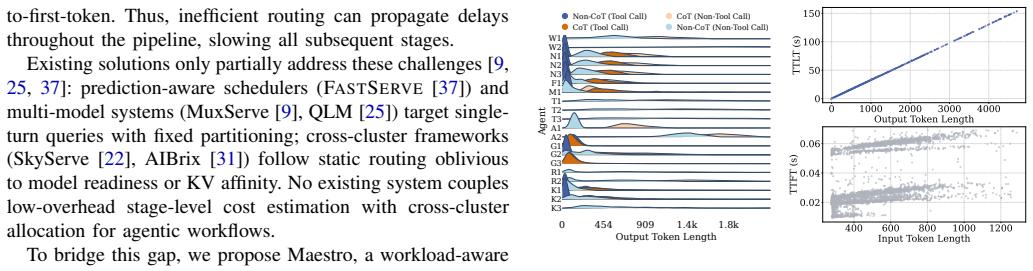
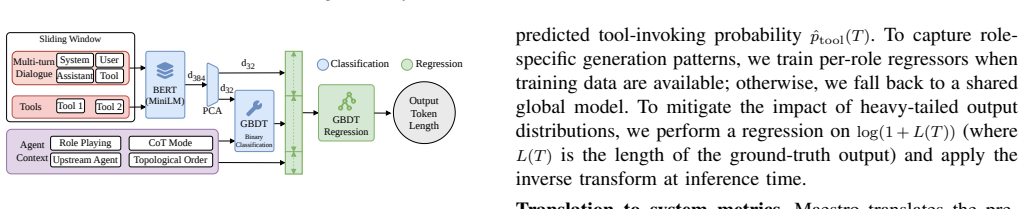
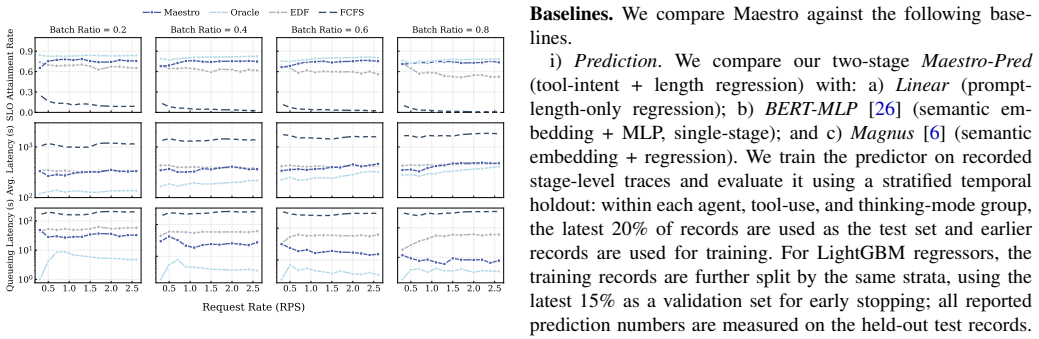
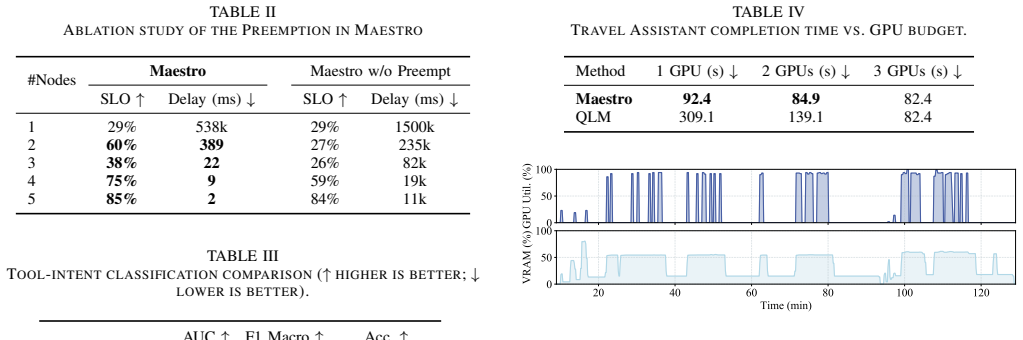
Large Language Model based Multi-Agent Systems (LLM-MAS) have emerged as a powerful paradigm for tackling complex tasks by breaking them into collaborative workflows of specialized LLM-powered agents. However, deploying such multi-agent workloads at scale poses significant system challenges. Each user query spawns an iterative pipeline of LLM calls, greatly amplifying resource consumption compared to single-turn queries. In resource-constrained cloud settings, these workflows face non-deterministic and input-dependent costs at decode stage, heavy-tailed multi-model requirements with memory fragmentation and over-provisioning, and cross-cluster scheduling trade-offs. We present Maestro, a workload-aware scheduling system designed for LLM-MAS serving under strict GPU budgets. Maestro explicitly leverages agent semantics and roles: it predicts the output length and memory usage of each stage and uses this prediction to drive a hierarchical scheduler. At the node level, Maestro enables dynamic multi-model co-location via hierarchical weight caching and elastic memory provisioning. At the cluster level, it performs latency-aware routing to avoid cold-start delays and memory overloads. At the global level, it enforces workflow-aware prioritization to minimize head-of-line blocking for interactive tasks. Across prototype experiments and trace-driven simulations, Maestro reduces KV-reservation HBM by 67.2% and improves high-contention SLO attainment over EDF by 23.6 percentage points.
Editorial analysis
A structured set of objections, weighed in public.
Referee Report
Summary. The paper presents Maestro, a workload-aware cross-cluster scheduling system for LLM-based multi-agent systems (LLM-MAS). It predicts per-stage output length and memory usage to drive a three-level hierarchical scheduler: node-level dynamic multi-model co-location via hierarchical weight caching and elastic provisioning; cluster-level latency-aware routing to avoid cold starts and overloads; and global-level workflow-aware prioritization to reduce head-of-line blocking. The system targets non-deterministic decode costs, heavy-tailed multi-model memory fragmentation, and cross-cluster trade-offs under strict GPU budgets. Prototype experiments and trace-driven simulations are reported to yield a 67.2% reduction in KV-reservation HBM and a 23.6 percentage point improvement in high-contention SLO attainment versus EDF.
Significance. If the prediction accuracy and experimental results hold under rigorous validation, the work would be significant for efficient serving of iterative multi-agent LLM workflows in memory-constrained environments. The explicit use of agent semantics and roles to inform scheduling decisions offers a targeted approach to the fragmentation and over-provisioning problems that standard schedulers like EDF do not address. Reproducible code or machine-checked elements are not mentioned.
major comments (2)
- [Abstract] Abstract: The headline claims (67.2% KV-reservation HBM reduction and 23.6pp SLO gain over EDF) rest entirely on the accuracy of the per-stage output-length and memory-usage predictors that feed the hierarchical scheduler. No experimental details, error bars, dataset descriptions, predictor validation, or sensitivity analysis appear in the abstract, making it impossible to determine whether the data support the central claims.
- [Abstract] The load-bearing assumption that predictions of output length and memory usage are sufficiently accurate to enable effective node-level co-location, cluster-level routing, and global prioritization without introducing fragmentation or cold-start delays is not accompanied by any reported error metrics or ablation on prediction quality. Given the abstract's own emphasis on non-deterministic decode-stage costs and heavy-tailed requirements, this gap directly affects both reported metrics.
Simulated Author's Rebuttal
We thank the referee for highlighting the need for greater transparency in the abstract regarding predictor accuracy. We agree that the headline results depend on this component and will revise the abstract to include key validation details drawn from the body of the paper.
read point-by-point responses
-
Referee: [Abstract] Abstract: The headline claims (67.2% KV-reservation HBM reduction and 23.6pp SLO gain over EDF) rest entirely on the accuracy of the per-stage output-length and memory-usage predictors that feed the hierarchical scheduler. No experimental details, error bars, dataset descriptions, predictor validation, or sensitivity analysis appear in the abstract, making it impossible to determine whether the data support the central claims.
Authors: We accept this observation. The full manuscript reports predictor validation (including MAPE for output-length prediction, memory-usage error distributions, dataset descriptions from production traces, and sensitivity ablations) in Sections 4.2 and 5.1. The abstract will be revised to concisely reference these results (e.g., “with 12.4% MAPE on output length”) so readers can assess support for the reported gains. revision: yes
-
Referee: [Abstract] The load-bearing assumption that predictions of output length and memory usage are sufficiently accurate to enable effective node-level co-location, cluster-level routing, and global prioritization without introducing fragmentation or cold-start delays is not accompanied by any reported error metrics or ablation on prediction quality. Given the abstract's own emphasis on non-deterministic decode-stage costs and heavy-tailed requirements, this gap directly affects both reported metrics.
Authors: We agree the abstract should address this directly. The paper contains error metrics and ablations showing that prediction errors do not materially increase fragmentation or cold-start rates under the evaluated workloads. We will add a short clause to the abstract summarizing these findings (e.g., “prediction errors remain below thresholds that would degrade co-location or routing benefits”) while retaining the length constraint. revision: yes
Circularity Check
No circularity in derivation chain
full rationale
The paper presents Maestro as an empirical scheduling system whose headline gains (67.2% KV-reservation HBM reduction and 23.6 pp SLO improvement) are obtained from prototype experiments and trace-driven simulations rather than from any closed mathematical derivation. The abstract describes the use of per-stage output-length and memory predictions to drive hierarchical decisions, but supplies no equations, fitted parameters, self-citations, or uniqueness theorems that would reduce those measured outcomes to the inputs by construction. Because the central claims rest on external, falsifiable benchmarks instead of self-referential definitions or load-bearing self-citations, the derivation chain is self-contained.
Axiom & Free-Parameter Ledger
Reference graph
Works this paper leans on
-
[1]
Enabling scalable and adaptive ma- chine learning training via serverless computing on public cloud
Ahsan Ali et al. “Enabling scalable and adaptive ma- chine learning training via serverless computing on public cloud”.Performance Evaluation 2025
2025
-
[2]
Alibaba Cloud documentation
Alibaba Cloud.Internet Access Performance. Alibaba Cloud documentation
-
[3]
Training a Helpful and Harmless Assistant with Reinforcement Learning from Human Feedback
Yuntao Bai et al.Training a Helpful and Harmless Assistant with Reinforcement Learning from Human Feedback. arXiv:2204.05862. 2022
work page internal anchor Pith review Pith/arXiv arXiv 2022
-
[4]
LongBench v2: Towards Deeper Un- derstanding and Reasoning on Realistic Long-context Multitasks
Yushi Bai et al. “LongBench v2: Towards Deeper Un- derstanding and Reasoning on Realistic Long-context Multitasks”.ACL 2025
2025
-
[5]
AgentVerse: Facilitating Multi- Agent Collaboration and Exploring Emergent Behav- iors
Weize Chen et al. “AgentVerse: Facilitating Multi- Agent Collaboration and Exploring Emergent Behav- iors”.ICLR 2024
2024
-
[6]
Enabling efficient batch serving for LMaaS via generation length prediction
Ke Cheng et al. “Enabling efficient batch serving for LMaaS via generation length prediction”.ICWS 2024
2024
-
[7]
Mina: Fine-Grained In-network Aggregation Resource Scheduling for Machine Learn- ing Service
Shichen Dong et al. “Mina: Fine-Grained In-network Aggregation Resource Scheduling for Machine Learn- ing Service”.IEEE INFOCOM 2025
2025
-
[8]
Improving factuality and reasoning in language models through multiagent debate
Yilun Du et al. “Improving factuality and reasoning in language models through multiagent debate”.ICML 2024
2024
-
[9]
MuxServe: flexible spatial- temporal multiplexing for multiple LLM serving
Jiangfei Duan et al. “MuxServe: flexible spatial- temporal multiplexing for multiple LLM serving”. ICML 2024. 10
2024
-
[10]
Serving DNNs like Clock- work: Performance Predictability from the Bottom Up
Arpan Gujarati et al. “Serving DNNs like Clock- work: Performance Predictability from the Bottom Up”. USENIX OSDI 2020
2020
-
[11]
DeepSeek-R1: Incentivizing Reasoning Capability in LLMs via Reinforcement Learning
Daya Guo et al.DeepSeek-R1: Incentivizing reason- ing capability in LLMs via reinforcement learning. arXiv:2501.12948. 2025
work page internal anchor Pith review Pith/arXiv arXiv 2025
-
[12]
Large language model based multi- agents: a survey of progress and challenges
Taicheng Guo et al. “Large language model based multi- agents: a survey of progress and challenges”.IJCAI 2024
2024
-
[13]
Measuring Mathematical Prob- lem Solving With the MATH Dataset
Dan Hendrycks et al. “Measuring Mathematical Prob- lem Solving With the MATH Dataset”.NeurIPS 2021
2021
-
[14]
MetaGPT: Meta Programming for A Multi-Agent Collaborative Framework
Sirui Hong et al. “MetaGPT: Meta Programming for A Multi-Agent Collaborative Framework”.ICLR 2024
2024
-
[15]
S3: Increasing GPU Utilization during Generative Inference for Higher Throughput
Yunho Jin et al. “S3: Increasing GPU Utilization during Generative Inference for Higher Throughput”.NeurIPS 2023
2023
-
[16]
Efficient memory management for large language model serving with pagedattention
Woosuk Kwon et al. “Efficient memory management for large language model serving with pagedattention”. SOSP 2023
2023
-
[17]
Parrot: Efficient serving of LLM- based applications with semantic variable
Chaofan Lin et al. “Parrot: Efficient serving of LLM- based applications with semantic variable”.OSDI 2024
2024
-
[18]
Efficient Serving of LLM Applications with Probabilistic Demand Modeling
Yifei Liu et al.Efficient Serving of LLM Applications with Probabilistic Demand Modeling. arXiv:2506.14851. 2025
work page internal anchor Pith review arXiv 2025
-
[19]
Kale: Elastic GPU Scheduling for Online DL Model Training
Ziyang Liu et al. “Kale: Elastic GPU Scheduling for Online DL Model Training”.ACM SoCC 2024
2024
-
[20]
Castor: Optimizing Deep Learning Job Scheduling in Multi-Tenant GPU Clusters via In- telligent Colocation
Yizhou Luo et al. “Castor: Optimizing Deep Learning Job Scheduling in Multi-Tenant GPU Clusters via In- telligent Colocation”
-
[21]
Prediction-assisted online distributed deep learning workload scheduling in GPU clusters
Ziyue Luo et al. “Prediction-assisted online distributed deep learning workload scheduling in GPU clusters”. IEEE INFOCOM 2025
2025
-
[22]
SkyServe: Serving AI Models across Regions and Clouds with Spot Instances
Ziming Mao et al. “SkyServe: Serving AI Models across Regions and Clouds with Spot Instances”.EuroSys 2025
2025
-
[23]
O-RAN Intelligence Orches- tration Framework for Quality-Driven xApp Deploy- ment and Sharing
Federico Mungari et al. “O-RAN Intelligence Orches- tration Framework for Quality-Driven xApp Deploy- ment and Sharing”.IEEE Transactions on Mobile Com- puting 2025
2025
-
[24]
Xinglin Pan et al.Efficient MoE Inference with Fine- Grained Scheduling of Disaggregated Expert Paral- lelism. arXiv:2512.21487. 2025
-
[25]
Queue management for slo-oriented large language model serving
Archit Patke et al. “Queue management for slo-oriented large language model serving”.ACM SoCC 2024
2024
-
[26]
Efficient Interactive LLM Serving with Proxy Model-based Sequence Length Prediction
Haoran Qiu et al. “Efficient Interactive LLM Serving with Proxy Model-based Sequence Length Prediction”. ASPLOS Cloud Intelligence/AIOps Workshop 2024
2024
-
[27]
SQuAD: 100,000+ Questions for Machine Comprehension of Text
Pranav Rajpurkar et al. “SQuAD: 100,000+ Questions for Machine Comprehension of Text”.EMNLP 2016
2016
-
[28]
GPQA: A Graduate-Level Google-Proof Q&A Benchmark
David Rein et al.GPQA: A Graduate-Level Google- Proof Q&A Benchmark. arXiv:2311.12022. 2023
work page internal anchor Pith review Pith/arXiv arXiv 2023
-
[29]
FlexGen: High-Throughput Genera- tive Inference of Large Language Models with a Single GPU
Ying Sheng et al. “FlexGen: High-Throughput Genera- tive Inference of Large Language Models with a Single GPU”.ICML 2023
2023
-
[30]
Kaggle dataset
Pavan Subhash.IBM HR Analytics Employee Attrition & Performance. Kaggle dataset. 2017
2017
-
[31]
The AIBrix Team et al.AIBrix: Towards Scalable, Cost- Effective Large Language Model Inference Infrastruc- ture. arXiv:2504.03648. 2025
-
[32]
LLaMA: Open and Efficient Foundation Language Models
Hugo Touvron et al.LLaMA: Open and Efficient Foun- dation Language Models. arXiv:2302.13971. 2023
work page internal anchor Pith review Pith/arXiv arXiv 2023
-
[33]
SELA: Smart Edge LLM Agent to Optimize Response Trade-offs of AI Assistants
Shreshth Tuli et al. “SELA: Smart Edge LLM Agent to Optimize Response Trade-offs of AI Assistants”.PACM IMWUT 2025
2025
-
[34]
Mixture-of-Agents Enhances Large Language Model Capabilities
Junlin Wang et al.Mixture-of-agents enhances large language model capabilities. arXiv:2406.04692. 2024
work page internal anchor Pith review Pith/arXiv arXiv 2024
-
[35]
Plan-and-Solve Prompting: Improving Zero-Shot Chain-of-Thought Reasoning by Large Lan- guage Models
Lei Wang et al. “Plan-and-Solve Prompting: Improving Zero-Shot Chain-of-Thought Reasoning by Large Lan- guage Models”.ACL 2023
2023
-
[36]
KAIOps: A Platform Solution of End-to-End Multi-Modal AIOps for AI Training at Scale
Zeying Wang et al. “KAIOps: A Platform Solution of End-to-End Multi-Modal AIOps for AI Training at Scale”.IEEE/ACM ASE 2025
2025
-
[37]
Fast Distributed Inference Serving for Large Language Models
Bingyang Wu et al.Fast Distributed Inference Serving for Large Language Models. arXiv:2305.05920. 2024
work page internal anchor Pith review Pith/arXiv arXiv 2024
-
[38]
AutoGen: Enabling Next-Gen LLM Applications via Multi-Agent Conversation
Qingyun Wu et al.AutoGen: Enabling Next-Gen LLM Applications via Multi-Agent Conversation. arXiv:2308.08155. 2023
work page internal anchor Pith review Pith/arXiv arXiv 2023
-
[39]
An Yang et al.Qwen3 Technical Report. arXiv:2505.09388. 2025
work page internal anchor Pith review Pith/arXiv arXiv 2025
-
[40]
KAIR: A Statistical and Causal Ap- proach to Pinpointing Stragglers in Distributed Model Training
Yitang Yang et al. “KAIR: A Statistical and Causal Ap- proach to Pinpointing Stragglers in Distributed Model Training”.IEEE/ACM ASE 2025
2025
-
[41]
ReAct: Synergizing reasoning and acting in language models
Shunyu Yao et al. “ReAct: Synergizing reasoning and acting in language models”.ICLR 2023
2023
-
[42]
Orca: A Distributed Serving System for Transformer-Based Generative Models
Gyeong-In Yu et al. “Orca: A Distributed Serving System for Transformer-Based Generative Models”. USENIX OSDI 2022
2022
-
[43]
Torpor: GPU-enabled serverless computing for low-latency, resource-efficient infer- ence
Minchen Yu et al. “Torpor: GPU-enabled serverless computing for low-latency, resource-efficient infer- ence”.USENIX ATC 2025
2025
-
[44]
Prism: Unleashing GPU Sharing for Cost-Efficient Multi-LLM Serving
Shan Yu et al. “Prism: Unleashing GPU Sharing for Cost-Efficient Multi-LLM Serving”. 2026
2026
-
[45]
Yijiong Yu et al.OpenCSG Chinese Corpus: A Series of High-quality Chinese Datasets for LLM Training. arXiv:2501.08197. 2025
-
[46]
Cauchy: A Cost-Efficient LLM Serving System through Adaptive Heterogeneous De- ployment
Yihui Zhang et al. “Cauchy: A Cost-Efficient LLM Serving System through Adaptive Heterogeneous De- ployment”.ACM SoCC 2025
2025
-
[47]
Cuckoo: Deadline-Aware Job Packing on Heterogeneous GPUs for DL Model Train- ing
Yuzhang Zhang et al. “Cuckoo: Deadline-Aware Job Packing on Heterogeneous GPUs for DL Model Train- ing”.ACM SoCC 2025
2025
-
[48]
Lingxiao Zhao et al.Enabling Disaggregated Multi- Stage MLLM Inference via GPU-Internal Scheduling and Resource Sharing. arXiv:2512.17574. 2025
-
[49]
Judging LLM-as-a-Judge with MT-Bench and Chatbot Arena
Lianmin Zheng et al. “Judging LLM-as-a-Judge with MT-Bench and Chatbot Arena”.NeurIPS 2023
2023
-
[50]
SGLang: efficient execution of structured language model programs
Lianmin Zheng et al. “SGLang: efficient execution of structured language model programs”.NeurIPS 2024
2024
-
[51]
Espresso: Cost-Efficient Large Model Training by Exploiting GPU Heterogeneity in the Cloud
Qiannan Zhou et al. “Espresso: Cost-Efficient Large Model Training by Exploiting GPU Heterogeneity in the Cloud”.IEEE INFOCOM 2025. 11
2025
discussion (0)
Sign in with ORCID, Apple, or X to comment. Anyone can read and Pith papers without signing in.