Deep Sleep Classification via EEG Signal Criticality: A Passive BCI Approach for Sleep-Improvement Neurofeedback
Pith reviewed 2026-06-27 05:23 UTC · model grok-4.3
The pith
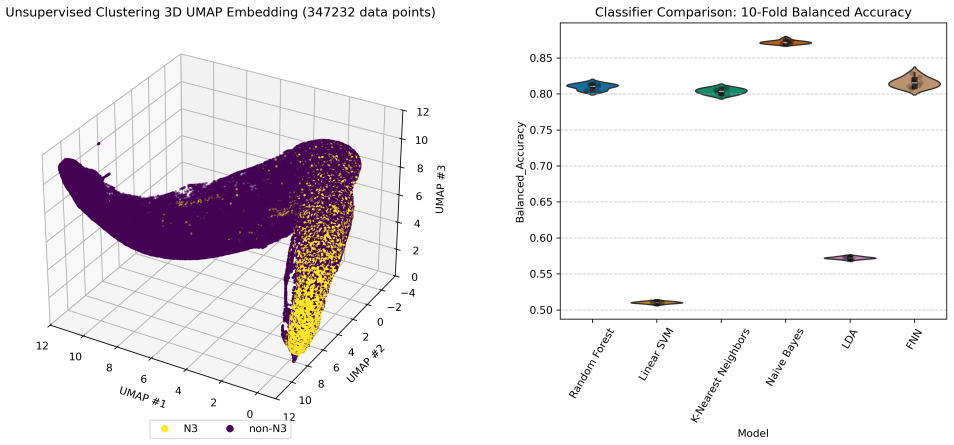
DFA-derived criticality features from EEG enable Naive Bayes to classify deep sleep at 87% balanced accuracy for passive BCI neurofeedback.
A machine-rendered reading of the paper's core claim, the machinery that carries it, and where it could break.
Core claim
Probabilistic decoding of EEG criticality provides a high-accuracy sensing mechanism for pBCIs. Naive Bayes achieved the highest mean balanced accuracy of 87.17 percent plus or minus 0.24 percent, significantly outperforming a fully connected deep neural network at 81.58 percent and Random Forest at 80.97 percent on DFA-derived features from 347,232 EEG epochs.
What carries the argument
DFA-derived criticality features extracted from EEG epochs, visualized via UMAP and fed to classifiers to distinguish N3 sleep stages.
If this is right
- The pipeline supports state-dependent neurofeedback such as targeted auditory stimulation during identified N3 periods to enhance cognitive recovery.
- Because linear classifiers perform near chance while probabilistic and tree-based models succeed, the criticality features lie on a distinctly non-linear manifold.
- The approach supplies a passive sensing component that can drive closed-loop interventions independent of explicit user commands.
Where Pith is reading between the lines
- The same DFA features could be tested on other sleep stages or clinical populations to check whether the non-linear separation holds more broadly.
- Real-time implementation would require validating whether the 10-fold accuracy survives streaming data with variable epoch lengths and movement artifacts.
- Age-matched control datasets would clarify whether the reported performance depends on the older-women cohort or reflects a general property of criticality in sleep.
Load-bearing premise
That DFA criticality features specifically and robustly mark N3 sleep without being confounded by age-related EEG changes, recording artifacts, or label noise across the 347,232 epochs.
What would settle it
Re-training and testing the same classifiers on a held-out EEG dataset recorded from younger adults using the same DFA pipeline; a drop below 75 percent balanced accuracy would indicate the features do not generalize beyond the original cohort.
Figures

read the original abstract
Automated sleep staging is a fundamental application of passive Brain-Computer Interfaces (pBCI), decoding spontaneous neural states to enable closed-loop interventions independent of user intent. This study evaluates criticality features derived from Detrended Fluctuation Analysis (DFA) for the specific identification of deep sleep (N3). We analyzed $347,232$ EEG epochs from $290$ older women using UMAP manifold learning to visualize state transitions. Subsequently, six classifiers were benchmarked via 10-fold cross-validation, using balanced accuracy to determine the optimal "state-sensing" engine for neurofeedback.Naive Bayes achieved the highest mean balanced accuracy ($87.17\% \pm 0.24\%$), significantly outperforming a fully connected deep neural network (FNN: $81.58\%$) and Random Forest ($80.97\%$). Linear models (LDA: $57.21\%$; SVM: $51.01\%$) performed poorly, indicating that DFA-derived criticality features reside on a distinct, non-linear manifold. Probabilistic decoding of EEG criticality provides a high-accuracy sensing mechanism for pBCIs. This robust classification pipeline supports the development of state-dependent neurofeedback, such as targeted auditory stimulation, to enhance cognitive recovery.
Editorial analysis
A structured set of objections, weighed in public.
Referee Report
Summary. The manuscript claims that Detrended Fluctuation Analysis (DFA) criticality features extracted from EEG can classify deep sleep (N3) with high accuracy for passive BCI neurofeedback applications. On 347,232 epochs from 290 older women, UMAP visualization is followed by 10-fold cross-validation of six classifiers; Naive Bayes yields the highest mean balanced accuracy (87.17% ± 0.24%), outperforming FNN (81.58%) and Random Forest (80.97%), while linear models perform poorly. The conclusion is that probabilistic decoding of EEG criticality supplies a robust, high-accuracy sensing mechanism for state-dependent interventions such as auditory stimulation.
Significance. If the performance is shown to be driven by N3-specific criticality rather than demographic confounds and if methodological details are supplied, the work could support development of passive BCIs for sleep enhancement. The large epoch count and direct classifier benchmarking are positive; however, the approach relies on fitted classifier hyperparameters and external dataset CV rather than parameter-free derivations or machine-checked proofs.
major comments (3)
- [Methods] Methods (DFA implementation): no values or selection procedure are given for DFA box sizes, detrending order, or scaling-range limits. These free parameters directly determine the criticality features whose classification performance is reported as 87.17%; without them the result cannot be reproduced or evaluated for robustness.
- [Dataset and Participants] Dataset and Participants: the cohort consists exclusively of 290 older women with no younger control group or explicit correction for known age-related EEG alterations (reduced slow-wave amplitude, changed 1/f spectra). Because DFA exponents are sensitive to these spectral properties, the reported superiority of Naive Bayes may reflect demographic confounds rather than N3-specific dynamics, weakening the generalizability claim for a pBCI pipeline.
- [Evaluation protocol] Evaluation protocol: the manuscript provides no description of the sleep-stage labeling procedure, preprocessing pipeline, artifact quantification, or whether the 10-fold CV is performed in a subject-independent manner. These omissions are load-bearing for the central claim that the pipeline constitutes a “robust classification” mechanism, as inter-subject variability and label noise could inflate the balanced-accuracy figures.
minor comments (1)
- [Abstract] The abstract states that Naive Bayes “significantly” outperforms the other classifiers but does not name the statistical test or correction for multiple comparisons.
Simulated Author's Rebuttal
We thank the referee for the detailed and constructive comments. We address each major point below and indicate the corresponding revisions.
read point-by-point responses
-
Referee: [Methods] Methods (DFA implementation): no values or selection procedure are given for DFA box sizes, detrending order, or scaling-range limits. These free parameters directly determine the criticality features whose classification performance is reported as 87.17%; without them the result cannot be reproduced or evaluated for robustness.
Authors: We agree that explicit DFA parameters are required for reproducibility. The revised manuscript will specify the box-size range (4 to 128 samples), linear detrending order, and scaling-range selection criteria, along with a short robustness check across nearby parameter choices. revision: yes
-
Referee: [Dataset and Participants] Dataset and Participants: the cohort consists exclusively of 290 older women with no younger control group or explicit correction for known age-related EEG alterations (reduced slow-wave amplitude, changed 1/f spectra). Because DFA exponents are sensitive to these spectral properties, the reported superiority of Naive Bayes may reflect demographic confounds rather than N3-specific dynamics, weakening the generalizability claim for a pBCI pipeline.
Authors: The analysis uses the MrOS cohort of older women, a large, well-characterized sleep dataset. We will add an explicit limitations paragraph acknowledging age-related spectral changes and the absence of younger controls, while noting that the reported performance is valid within this demographic and that extension to other groups remains future work. revision: partial
-
Referee: [Evaluation protocol] Evaluation protocol: the manuscript provides no description of the sleep-stage labeling procedure, preprocessing pipeline, artifact quantification, or whether the 10-fold CV is performed in a subject-independent manner. These omissions are load-bearing for the central claim that the pipeline constitutes a “robust classification” mechanism, as inter-subject variability and label noise could inflate the balanced-accuracy figures.
Authors: The revised Methods section will detail the AASM-based labeling used in the source dataset, the bandpass filtering and artifact rejection steps, and will state that the 10-fold CV was performed on pooled epochs (not subject-independent). We will also discuss the implications of this choice and, if space permits, report a supplementary subject-wise leave-one-out result. revision: yes
Circularity Check
No circularity: empirical CV accuracies on external dataset
full rationale
The paper's central results are balanced accuracies (e.g., Naive Bayes 87.17% ± 0.24%) obtained via 10-fold cross-validation on DFA criticality features extracted from 347232 EEG epochs of 290 subjects. These are direct empirical measurements on held-out folds; no equations, fitted parameters, or self-citations reduce the reported performance numbers to quantities defined by the inputs. The pipeline (DFA feature extraction → UMAP visualization → standard classifier benchmarking) contains no self-definitional steps, no 'prediction' that is statistically forced by a fit, and no load-bearing self-citation chain. The derivation is therefore self-contained against external benchmarks.
Axiom & Free-Parameter Ledger
free parameters (2)
- DFA box sizes and detrending order
- Classifier hyperparameters and data balancing procedure
axioms (2)
- domain assumption Sleep stage labels serve as reliable ground truth for supervised training
- domain assumption EEG epochs can be treated as independent samples for cross-validation
Reference graph
Works this paper leans on
-
[1]
Wolpaw and E
J. Wolpaw and E. W. Wolpaw, Eds.,Brain- Computer Interfaces: Principles and Practice. New York, USA: Oxford University Press, 2012
2012
-
[2]
Robotic and virtual reality BCIs using spatial tactile and auditory odd- ball paradigms,
T. Rutkowski, “Robotic and virtual reality BCIs using spatial tactile and auditory odd- ball paradigms,”Frontiers in Neurorobotics, vol. 10, p. 20, 2016. [Online]. Available:http : //journal.frontiersin.org/article/10. 3389/fnbot.2016.00020
-
[3]
Towards pas- sive brain–computer interfaces: Applying brain– computer interface technology to human–machine systems in general,
T. O. Zander and C. Kothe, “Towards pas- sive brain–computer interfaces: Applying brain– computer interface technology to human–machine systems in general,”Journal of Neural Engineer- ing, vol. 8, no. 2, p. 025 005, 2011
2011
-
[4]
Pas- sive BCI for task-load and dementia biomarker elucidation,
T. M. Rutkowski, Q. Zhao, M. S. Abe, et al., “Pas- sive BCI for task-load and dementia biomarker elucidation,” in41st Annual International Confer- ence of the IEEE Engineering in Medicine and Biology Society (EMBC), IEEE Engineering in Medicine and Biology Society, Berlin, Germany: IEEE Press, 2019, ThC01.1
2019
-
[5]
Sleep monitoring - multivariate and multimodal brain and peripheral body signal processing methods for sleep and consciousness level assessment,
T. M. Rutkowski, “Sleep monitoring - multivariate and multimodal brain and peripheral body signal processing methods for sleep and consciousness level assessment,” inAbstract Book of the Third APSIPA Workshop on the Frontier in Biomedical Signal Processing and Systems (APSIPA BioSiPS 2015), APSIPA, 2015, pp. 5–6
2015
-
[6]
T. M. Rutkowski, “Automatic sleep staging and apnea events classification from EEG and mul- timodal physiological signals – synchrosquezing transform processing and Riemannian geometry classification approaches,” inThe 4th Annual IIIS Symposium – Poster Session Abstracts, University of Tsukuba, Tsukuba, Japan, 2016, p. 6. [Online]. Available:http : / / wp...
2016
-
[7]
Perspective: Home-based sleep inter- vention for dementia prevention,
S. Narebski, T. Komendzinski, and T. M. Rutkowski, “Perspective: Home-based sleep inter- vention for dementia prevention,” inExtended Ab- stracts of The 8th Annual Conference on Cog- nitive Computational Neuroscience, Amsterdam, The Netherlands, 2025, A112. [Online]. Available: https : / / 2025 . ccneuro . org / abstract _ pdf / Narebski _ 2025 _ Perspect...
2025
-
[8]
C. Iber, S. Ancoli-Israel, A. Chesson, and S. F. Quan,The AASM Manual for the Scoring of Sleep and Associated Events: Rules, Terminology and Technical Specifications. Westchester, IL: Ameri- can Academy of Sleep Medicine, 2007
2007
-
[9]
Auditory closed-loop stimulation of the sleep slow oscillation enhances memory,
H.-V . V . Ngo, T. Martinetz, J. Born, and M. Mölle, “Auditory closed-loop stimulation of the sleep slow oscillation enhances memory,”Neuron, vol. 78, no. 3, pp. 545–553, 2013
2013
-
[10]
Phase-locked loop for pre- cisely timed acoustic stimulation during sleep,
G. Santostasi et al., “Phase-locked loop for pre- cisely timed acoustic stimulation during sleep,” Journal of neuroscience methods, vol. 259, pp. 101–114, 2016
2016
-
[11]
Acoustic enhancement of sleep slow oscillations and concomitant memory improvement in older adults.,
N. Papalambros et al., “Acoustic enhancement of sleep slow oscillations and concomitant memory improvement in older adults.,”Frontiers in Human Neuroscience, vol. 11, p. 109, 2017
2017
-
[12]
The criticality hypothesis: How local cortical networks might optimize information pro- cessing,
J. M. Beggs, “The criticality hypothesis: How local cortical networks might optimize information pro- cessing,”Philosophical Transactions of the Royal Society A: Mathematical, Physical and Engineer- ing Sciences, vol. 366, no. 1864, pp. 329–343, 2008
2008
-
[13]
Criticality as a signature of healthy neural systems,
P. Massobrio, L. De Arcangelis, V . Pasquale, H. J. Jensen, and D. Plenz, “Criticality as a signature of healthy neural systems,”Frontiers in systems neu- roscience, vol. 9, p. 22, 2015
2015
-
[14]
A new hy- pothesis for sleep: Tuning for criticality,
B. A. Pearlmutter and C. J. Houghton, “A new hy- pothesis for sleep: Tuning for criticality,”Neural computation, vol. 21, no. 6, pp. 1622–1641, 2009
2009
-
[15]
Dementia digital neuro- biomarker study from theta-band EEG fluctua- tion analysis in facial and emotional identification short-term memory oddball paradigm,
T. M. Rutkowski, M. S. Abe, S. Tokunaga, T. Komendzinski, et al., “Dementia digital neuro- biomarker study from theta-band EEG fluctua- tion analysis in facial and emotional identification short-term memory oddball paradigm,” in2022 44th Annual International Conference of the IEEE Engineering in Medicine Biology Society (EMBC), Glasgow, UK: IEEE Press, 20...
2022
-
[16]
Machine learning approach for early onset dementia neurobiomarker using eeg network topology features,
T. M. Rutkowski, M. S. Abe, T. Komendzinski, H. Sugimoto, S. Narebski, et al., “Machine learning approach for early onset dementia neurobiomarker using eeg network topology features,”Frontiers in Human Neuroscience, vol. 17, 2023
2023
-
[17]
T. M. Rutkowski, T. Komendzi ´nski, et al., “Mild cognitive impairment prediction and cognitive score regression in the elderly using EEG topologi- cal data analysis and machine learning with aware- ness assessed in affective reminiscent paradigm,” Frontiers in Aging Neuroscience, vol. 15, 2024
2024
-
[18]
Long-range temporal correlations and scaling behavior in human brain oscillations,
K. Linkenkaer-Hansen, V . V . Nikouline, J. M. Palva, and R. J. Ilmoniemi, “Long-range temporal correlations and scaling behavior in human brain oscillations,”Journal of Neuroscience, vol. 21, no. 4, pp. 1370–1377, 2001
2001
-
[19]
Neurotech- nology and AI approach for early dementia onset biomarker from EEG in emotional stimulus eval- uation task,
T. M. Rutkowski, M. S. Abe, et al., “Neurotech- nology and AI approach for early dementia onset biomarker from EEG in emotional stimulus eval- uation task,” in2021 43rd Annual International Conference of the IEEE Engineering in Medicine Biology Society (EMBC), 2021, pp. 6675–6678
2021
-
[20]
Scarpetta et al.,Criticality of neuronal avalanches in human sleep and their relationship with sleep macro-and micro-architecture
S. Scarpetta et al.,Criticality of neuronal avalanches in human sleep and their relationship with sleep macro-and micro-architecture. iscience, 26 (10), 107840, 2023
2023
-
[21]
The national sleep research resource: Towards a sleep data commons,
G.-Q. Zhang et al., “The national sleep research resource: Towards a sleep data commons,”Journal of the American Medical Informatics Association, vol. 25, no. 10, pp. 1351–1358, 2018
2018
-
[22]
Sleep-disordered breathing and cognition in older women,
A. P. Spira et al., “Sleep-disordered breathing and cognition in older women,”Journal of the Ameri- can Geriatrics Society, vol. 56, no. 1, pp. 45–50, 2008
2008
-
[23]
Appendicular bone den- sity and age predict hip fracture in women,
S. R. Cummings et al., “Appendicular bone den- sity and age predict hip fracture in women,”JAMA, vol. 263, no. 5, pp. 665–668, 1990
1990
-
[24]
“MINI-MENTAL STATE
M. F. Folstein, S. E. Folstein, and P. R. McHugh, ““MINI-MENTAL STATE”: A practical method for grading the cognitive state of patients for the clinician,”Journal of Psychiatric Research, vol. 12, no. 3, pp. 189–198, 1975
1975
-
[25]
The modified mini-mental state examination (3MS),
E Teng and H Chui, “The modified mini-mental state examination (3MS),”Can J Psychiatry, vol. 41, no. 2, pp. 114–21, 1987
1987
-
[26]
A manual of stan- dardized terminology, techniques and scoring sys- tem for sleep stages of human subjects,
A. Rechtschaffen and A. Kales, “A manual of stan- dardized terminology, techniques and scoring sys- tem for sleep stages of human subjects,” 1968
1968
-
[27]
The AASM manual for the scoring of sleep and associated events: Rules, terminology, and technical specification,
C. Iber, “The AASM manual for the scoring of sleep and associated events: Rules, terminology, and technical specification,”American Academy of Sleep Medicine, 2007
2007
-
[28]
UMAP: Uniform Manifold Approximation and Projection for Dimension Reduction
L. McInnes, J. Healy, and J. Melville, “UMAP: uniform manifold approximation and projec- tion for dimension reduction,”arXiv preprint arXiv:1802.03426, 2018
work page internal anchor Pith review Pith/arXiv arXiv 2018
discussion (0)
Sign in with ORCID, Apple, or X to comment. Anyone can read and Pith papers without signing in.