Grain Alignment and Dust Evolution Physics with Polarisation (GRADE-POL). II. On the physical basis of Serkowski and super-Serkowski polarisation spectra
Pith reviewed 2026-06-27 06:43 UTC · model grok-4.3
The pith
Radiative torque alignment boosted by B-star radiation below the Lyman limit accounts for super-Serkowski polarisation spectra.
A machine-rendered reading of the paper's core claim, the machinery that carries it, and where it could break.
Core claim
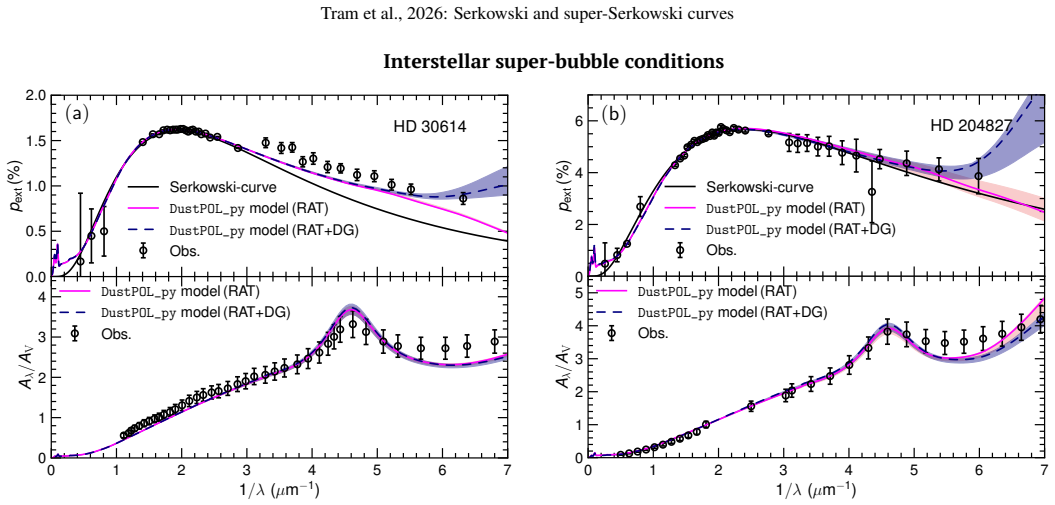
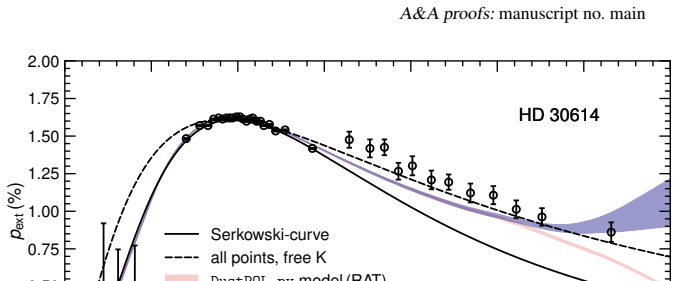
For the super-Serkowski spectra of HD 30614 and HD 204827, RAT alignment enhanced by radiation produced from a B-type star below the Lyman limit can reasonably explain the observations and a combination with the DG alignments results in a better fit for λ^{-1} ≥ 5.5 μm^{-1}. For the Serkowski spectra in HD 37903 and HD 161056, only RAT alignment by itself under the typical interstellar radiation field above the Lyman limit, within a typical cold neutral medium, can account for the observed spectra, with a combination of a very inefficient DG alignment.
What carries the argument
The joint effect of paramagnetic relaxation (DG alignment) and radiative torque (RAT alignment) under different radiation fields: either the scaled interstellar radiation field above the Lyman limit or an additional component from a B-type star below 912 Å.
If this is right
- The model predicts the starlight polarisation spectrum from infrared to far-UV wavelengths.
- RAT alignment enhanced by B-type star radiation below the Lyman limit explains the super-Serkowski excess at mid-UV wavelengths.
- A combination with DG alignment provides a better fit for wavelengths shorter than about 0.18 micrometers.
- Standard interstellar radiation field with inefficient DG alignment accounts for regular Serkowski spectra in a cold neutral medium.
Where Pith is reading between the lines
- Local radiation environments near B-type stars may be responsible for enhanced grain alignment in certain lines of sight.
- The modelling framework could be tested against future UV spectrophotometry data from space missions.
- Super-Serkowski features might serve as tracers of specific stellar radiation influences rather than solely grain property variations.
Load-bearing premise
The radiation field incident on the grains is either the standard interstellar radiation field above the Lyman limit or an additional component from a B-type star below 912 Å, adopted as input to match the polarisation data rather than derived from independent observations.
What would settle it
Spectroscopic observations confirming the absence of additional B-type star radiation below 912 Å along the sightlines to HD 30614 and HD 204827, or failure of the predicted spectra to match new UV polarisation measurements.
Figures




read the original abstract
Optical-to-near infrared interstellar polarisation, induced by aligned dust grains, generally follows a convex wavelength dependence, known as the Serkowski relation. However, observations in the ultraviolet (UV) and at [mid-]infrared wavelengths indicated that some of the spectra do not follow this relation. Specifically, about 25% show an excess in the degree of polarisation at mid-UV wavelengths ($\lambda^{-1} > 3\,\rm \mu m^{-1}$), referred to as the super-Serkowski polarisation. In this study, we re-examine both the Serkowski and super-Serkowski spectra based on the joint effect of paramagnetic relaxation (DG alignment) and radiative torque (RAT) alignment. We used the observational data for HD 30614, HD 204827, HD 37903 and HD 161056 to constrain our modelling. We examined two types of radiation fields: one derived from the scaled interstellar radiation field and another originating from a B-type star. For the super-Serkowski spectra of HD 30614 and HD 204827, our model demonstrates that RAT alignment enhanced by radiation produced from a B-type star below the Lyman limit ($\lambda=912 \r{A}$) can reasonably explain the observations and that a combination with the DG alignments results in a better fit for $\lambda^{-1}\geq 5.5\,\rm \mu m^{-1}$. For the Serkowski spectra in HD 37903 and HD 161056, only RAT alignment by itself under the typical interstellar radiation field above the Lyman limit, within a typical cold neutral medium, can account for the observed spectra, with a combination of a very inefficient DG alignment. The capacity of our model to predict the starlight polarisation spectrum up to from infrared to far-UV is thus a promising tool for interpreting future missions that observe spectrophotometry in the UV bands.
Editorial analysis
A structured set of objections, weighed in public.
Referee Report
Summary. The manuscript claims that joint radiative torque (RAT) alignment and Davis-Greenstein (DG) paramagnetic relaxation, under either a scaled interstellar radiation field above the Lyman limit or an additional B-type star radiation component below 912 Å, can reproduce both standard Serkowski polarization spectra (HD 37903, HD 161056) and super-Serkowski spectra with UV excess (HD 30614, HD 204827) from IR to far-UV, using observational data from these four stars to constrain the modeling.
Significance. If the radiation fields are independently anchored, the model supplies a physical mechanism for the full wavelength dependence of interstellar polarization, including the ~25% of sightlines showing super-Serkowski behavior. The capacity to predict spectra across IR to far-UV is a clear strength for interpreting future UV spectrophotometry missions.
major comments (2)
- [Abstract] Abstract: the claim that RAT alignment enhanced by B-star radiation below the Lyman limit explains the super-Serkowski spectra of HD 30614 and HD 204827 rests on adopting this radiation field as an input chosen to match the polarization data rather than deriving its strength or spectrum from independent sight-line constraints (stellar parameters, distances, or UV photometry/spectroscopy specific to these lines of sight). This renders the explanation post-hoc and non-unique, as the short-wavelength flux can be scaled to fit any observed UV excess.
- [Abstract] Abstract and modeling description: the manuscript states that a combination with DG alignment improves the fit for λ^{-1} ≥ 5.5 μm^{-1}, yet provides no quantitative assessment of how many free parameters (RAT efficiency scaling, DG efficiency, radiation scaling factors) are adjusted versus predicted from first principles, leaving the degree of tuning unclear.
minor comments (1)
- [Abstract] Abstract: the wavelength threshold for the UV excess is given as λ^{-1} > 3 μm^{-1} while the DG improvement is stated for λ^{-1} ≥ 5.5 μm^{-1}; ensure consistent notation and ranges throughout.
Simulated Author's Rebuttal
We thank the referee for the detailed and constructive report. We address the two major comments below and outline the revisions we will make.
read point-by-point responses
-
Referee: [Abstract] Abstract: the claim that RAT alignment enhanced by B-star radiation below the Lyman limit explains the super-Serkowski spectra of HD 30614 and HD 204827 rests on adopting this radiation field as an input chosen to match the polarization data rather than deriving its strength or spectrum from independent sight-line constraints (stellar parameters, distances, or UV photometry/spectroscopy specific to these lines of sight). This renders the explanation post-hoc and non-unique, as the short-wavelength flux can be scaled to fit any observed UV excess.
Authors: We agree that the B-star radiation component is introduced as a scaled input to reproduce the UV excess in the two super-Serkowski sightlines and is not derived from independent constraints specific to HD 30614 and HD 204827. This choice is motivated by the physical expectation that additional short-wavelength flux below 912 Å can enhance RAT alignment at small grain sizes, but we acknowledge the post-hoc character of the scaling. In the revised manuscript we will (i) explicitly state that the scaling factors are fitted rather than predicted a priori, (ii) discuss possible nearby B-type stars or local radiation-field variations that could motivate the enhancement, and (iii) note that the same scaling cannot be applied indiscriminately to all sightlines, as demonstrated by the successful fits to the two Serkowski stars with the standard ISRF alone. revision: partial
-
Referee: [Abstract] Abstract and modeling description: the manuscript states that a combination with DG alignment improves the fit for λ^{-1} ≥ 5.5 μm^{-1}, yet provides no quantitative assessment of how many free parameters (RAT efficiency scaling, DG efficiency, radiation scaling factors) are adjusted versus predicted from first principles, leaving the degree of tuning unclear.
Authors: We accept that the current text does not quantify the number of adjusted versus fixed parameters. In the revised version we will add a dedicated paragraph (and, if space permits, a short table) that lists (a) parameters taken directly from theory or prior literature (grain size distribution, magnetic susceptibility for DG, baseline RAT efficiency), (b) parameters that are varied to fit the four sightlines (radiation-field scaling factors for the two super-Serkowski stars, DG efficiency for all stars), and (c) the resulting number of degrees of freedom. This will make the degree of tuning explicit and allow readers to judge the predictive power of the joint RAT+DG framework. revision: yes
Circularity Check
Radiation field below Lyman limit selected and scaled to fit super-Serkowski spectra of HD 30614/HD 204827 rather than derived independently
specific steps
-
fitted input called prediction
[Abstract]
"We used the observational data for HD 30614, HD 204827, HD 37903 and HD 161056 to constrain our modelling. [...] For the super-Serkowski spectra of HD 30614 and HD 204827, our model demonstrates that RAT alignment enhanced by radiation produced from a B-type star below the Lyman limit (λ=912 Å) can reasonably explain the observations and that a combination with the DG alignments results in a better fit for λ^{-1}≥5.5 μm^{-1}."
The radiation-field type (scaled ISRF vs. B-star spectrum below Lyman limit) and its scaling are chosen among the two examined options specifically to reproduce the observed polarisation curves of the target stars. The 'demonstration' that this choice explains the data is therefore the direct output of the fitting process used to constrain the model, not an independent prediction.
full rationale
The paper constrains its RAT+DG model directly on the polarisation spectra of four named stars and selects the B-star radiation component (below 912 Å) as the input that reproduces the UV excess. This choice is presented as the physical explanation, but the abstract explicitly states the data are used 'to constrain our modelling' and that the chosen field 'can reasonably explain the observations' with a 'better fit' when DG is added. No independent derivation of the field strength or spectrum from stellar parameters, distances or UV photometry of these sight-lines is indicated in the provided text. The central claim therefore reduces to a fitted-input demonstration rather than a first-principles prediction.
Axiom & Free-Parameter Ledger
free parameters (2)
- RAT alignment efficiency scaling
- DG alignment efficiency
axioms (2)
- domain assumption Grain alignment is governed by the joint action of radiative torques and paramagnetic relaxation.
- domain assumption The radiation field below the Lyman limit can be approximated by scaling a B-star spectrum.
Reference graph
Works this paper leans on
-
[1]
, year =
Hoang, Thiem and Lazarian, A , title =. , year =
-
[2]
Hoang, Thiem , journal =. 2017 , rating =. doi:10.3847/1538-4357/836/1/13 , abstract =
-
[4]
arXiv preprint arXiv:2412.19701 , year=
Magnetic fields on different spatial scales of the L328 cloud , author=. arXiv preprint arXiv:2412.19701 , year=
-
[5]
Reissl, Stefan and Guillet, Vincent and Brauer, Robert and Levrier, François and Boulanger, François and Klessen, Ralf S. , journal =. 2020 , title =. doi:10.1051/0004-6361/201937177 , eprint =
-
[6]
The Orion molecular cloud and star-forming region. , keywords =. doi:10.1146/annurev.aa.27.090189.000353 , adsurl =
-
[7]
The Polarizing Power of the Interstellar Medium in Taurus
The Polarizing Power of the Interstellar Medium in Taurus. ApJl , keywords =. doi:10.1086/311337 , archivePrefix =. astro-ph/9803199 , primaryClass =
work page internal anchor Pith review Pith/arXiv arXiv doi:10.1086/311337
-
[8]
The Efficiency of Grain Alignment in Dense Interstellar Clouds: a Reassessment of Constraints from Near-Infrared Polarization. ApJ , keywords =. doi:10.1086/525040 , archivePrefix =. 0711.2536 , primaryClass =
work page internal anchor Pith review Pith/arXiv arXiv doi:10.1086/525040
-
[9]
Planck intermediate results. XX. Comparison of polarized thermal emission from Galactic dust with simulations of MHD turbulence. A&A , keywords =. doi:10.1051/0004-6361/201424086 , archivePrefix =. 1405.0872 , primaryClass =
work page internal anchor Pith review Pith/arXiv arXiv doi:10.1051/0004-6361/201424086
-
[11]
Comparing Submillimeter Polarized Emission with Near-infrared Polarization of Background Stars for the Vela C Molecular Cloud. ApJ , keywords =. doi:10.3847/1538-4357/aa62a7 , eprint =
-
[12]
The Far-infrared Polarization Spectrum of Ophiuchi A from HAWC+/SOFIA Observations. ApJ , keywords =. doi:10.3847/1538-4357/ab3407 , archivePrefix =. 1905.00705 , primaryClass =
-
[13]
Planck 2018 results. XII. Galactic astrophysics using polarized dust emission. A&A , keywords =. doi:10.1051/0004-6361/201833885 , primaryClass =
-
[14]
HAWC+/SOFIA Multiwavelength Polarimetric Observations of OMC-1. , keywords =. doi:10.3847/1538-4357/aafd37 , primaryClass =
-
[15]
Polarimetry of Stars and Planetary Systems , year = 2015, pages =
Interstellar Polarization. Polarimetry of Stars and Planetary Systems , year = 2015, pages =
2015
-
[16]
Tracing magnetic fields with aligned grains. , keywords =. doi:10.1016/j.jqsrt.2007.01.038 , primaryClass =
-
[17]
ARAA , year = 2015, month = aug, volume =
Interstellar Dust Grain Alignment. ARAA , year = 2015, month = aug, volume =. doi:10.1146/annurev-astro-082214-122414 , adsurl =
-
[18]
Radiative torques: analytical model and basic properties. , keywords =. doi:10.1111/j.1365-2966.2007.11817.x , primaryClass =
-
[19]
Radiative torque alignment: essential physical processes. , keywords =. doi:10.1111/j.1365-2966.2008.13249.x , primaryClass =
-
[20]
Rotational disruption of dust grains by radiative torques in strong radiation fields. Nature Astronomy , keywords =. doi:10.1038/s41550-019-0763-6 , primaryClass =
-
[23]
The Photodetector Array Camera and Spectrometer (PACS) on the Herschel Space Observatory. A&A , keywords =. doi:10.1051/0004-6361/201014535 , primaryClass =
-
[24]
The dust opacity exponent and the gas-to-dust mass ratio g2d
Gas and dust in the star-forming region Oph A. The dust opacity exponent and the gas-to-dust mass ratio g2d. A&A , keywords =. doi:10.1051/0004-6361/201525641 , primaryClass =
-
[25]
A Unified Model of Grain Alignment: Radiative Alignment of Interstellar Grains with Magnetic Inclusions. ApJ , keywords =. doi:10.3847/0004-637X/831/2/159 , primaryClass =
-
[26]
Polarized Far-Infrared and Submillimeter Emission from Interstellar Dust
Polarized Far-Infrared and Submillimeter Emission from Interstellar Dust. ApJ , keywords =. doi:10.1088/0004-637X/696/1/1 , archivePrefix =. 0809.2094 , primaryClass =
work page internal anchor Pith review Pith/arXiv arXiv doi:10.1088/0004-637x/696/1/1 2094
-
[28]
Physics of the Interstellar and Intergalactic Medium
-
[29]
Determination of the gas-to-dust ratio in nearby dense clouds using X-ray absorption measurements
Determination of the gas-to-dust ratio in nearby dense clouds using X-ray absorption measurements. A&A , keywords =. doi:10.1051/0004-6361:20030942 , archivePrefix =. astro-ph/0306447 , primaryClass =
work page internal anchor Pith review Pith/arXiv arXiv doi:10.1051/0004-6361:20030942
-
[30]
Dust models compatible with Planck intensity and polarization data in translucent lines of sight
Dust models compatible with Planck intensity and polarization data in translucent lines of sight. A&A , keywords =. doi:10.1051/0004-6361/201630271 , archivePrefix =. 1710.04598 , primaryClass =
work page internal anchor Pith review Pith/arXiv arXiv doi:10.1051/0004-6361/201630271
-
[31]
Modeling Rotational Disruption of Grains and Microwave Emission from Spinning Dust in AGB Envelopes. ApJ , keywords =. doi:10.3847/1538-4357/ab7b5e , archivePrefix =. 1907.10654 , primaryClass =
-
[32]
Journal of Astronomical Instrumentation , keywords =
HAWC+, the Far-Infrared Camera and Polarimeter for SOFIA. Journal of Astronomical Instrumentation , keywords =. doi:10.1142/S2251171718400081 , adsurl =
-
[33]
Discrete-dipole approximation for scattering calculations. JOSAA , keywords =. doi:10.1364/JOSAA.11.001491 , adsurl =
-
[34]
The discrete dipole approximation for periodic targets I. theory and tests
Discrete-dipole approximation for periodic targets: theory and tests. JOSAA , keywords =. doi:10.1364/JOSAA.25.002693 , archivePrefix =. 0809.0338 , primaryClass =
work page internal anchor Pith review Pith/arXiv arXiv doi:10.1364/josaa.25.002693
-
[35]
Optics Express , year = 2012, month = jan, volume =
Fast near field calculations in the discrete dipole approximation for regular rectilinear grids. Optics Express , year = 2012, month = jan, volume =. doi:10.1364/OE.20.001247 , adsurl =
-
[36]
The global dust SED: Tracing the nature and evolution of dust with DustEM
The global dust SED: tracing the nature and evolution of dust with DustEM. A&A , keywords =. doi:10.1051/0004-6361/201015292 , archivePrefix =. 1010.2769 , primaryClass =
work page internal anchor Pith review Pith/arXiv arXiv doi:10.1051/0004-6361/201015292
-
[37]
A&A , keywords =
Multicolour photometry of stars in the Ophiuchus dark cloud region. A&A , keywords =
-
[38]
A&A , keywords =
Physical parameters of stars in the Scorpio-Centaurus OB association. A&A , keywords =
-
[39]
Interstellar reddening from the HIPPARCOS and TYCHO catalogues. I. Distances to nearby molecular clouds and star forming regions. A&A , keywords =
-
[40]
Stellar Rotation in Young Clusters: The First 4 Million Years. , keywords =. doi:10.1086/380931 , adsurl =
-
[41]
A Preliminary VLBA Distance to the Core of Ophiuchus, with an Accuracy of 4%
A Preliminary VLBA Distance to the Core of Ophiuchus, with an Accuracy of 4\. ApJl , keywords =. doi:10.1086/529548 , archivePrefix =. 0801.2192 , primaryClass =
work page internal anchor Pith review Pith/arXiv arXiv doi:10.1086/529548
-
[42]
Hipparcos distances of Ophiuchus and Lupus cloud complexes
Hipparcos distance estimates of the Ophiuchus and the Lupus cloud complexes. A&A , keywords =. doi:10.1051/0004-6361:20079110 , archivePrefix =. 0801.3346 , primaryClass =
work page internal anchor Pith review Pith/arXiv arXiv doi:10.1051/0004-6361:20079110
-
[43]
On the Distance to the Ophiuchus Star-Forming Region
On the distance to the Ophiuchus star-forming region. Astronomische Nachrichten , keywords =. doi:10.1002/asna.200710827 , archivePrefix =. 0709.0505 , primaryClass =
work page internal anchor Pith review Pith/arXiv arXiv doi:10.1002/asna.200710827
-
[44]
A Study of the Ophiuchi Cloud: Mapping the Distribution and the Motions of Interstellar Gas. ApJ , keywords =. doi:10.1086/587132 , adsurl =
-
[45]
The Gould s Belt Distances Survey (GOBELINS). I. Trigonometric Parallax Distances and Depth of the Ophiuchus Complex. ApJ , keywords =. doi:10.3847/1538-4357/834/2/141 , archivePrefix =. 1611.06466 , primaryClass =
work page internal anchor Pith review Pith/arXiv arXiv doi:10.3847/1538-4357/834/2/141
-
[46]
Role of magnetic fields in the evolution of five dark cloud complexes. , keywords =. doi:10.1086/112031 , adsurl =
-
[47]
The Cobwebs of Ophiuchus. I. Strands of 13CO: The Mass Distribution. ApJ , keywords =. doi:10.1086/167244 , adsurl =
-
[48]
The Cobwebs of Ophiuchus. II. 13CO Filament Kinematics. ApJ , keywords =. doi:10.1086/167245 , adsurl =
-
[49]
From filamentary clouds to prestellar cores to the stellar IMF: Initial highlights from the Herschel Gould Belt Survey. A&A , keywords =. doi:10.1051/0004-6361/201014666 , archivePrefix =. 1005.2618 , primaryClass =
work page internal anchor Pith review Pith/arXiv arXiv doi:10.1051/0004-6361/201014666
-
[50]
The Spitzer c2d Legacy Results: Star Formation Rates and Efficiencies; Evolution and Lifetimes
The Spitzer c2d Legacy Results: Star-Formation Rates and Efficiencies; Evolution and Lifetimes. ApJs , keywords =. doi:10.1088/0067-0049/181/2/321 , archivePrefix =. 0811.1059 , primaryClass =
work page internal anchor Pith review Pith/arXiv arXiv doi:10.1088/0067-0049/181/2/321
-
[51]
The James Clerk Maxwell Telescope Legacy Survey of Nearby Star-forming Regions in the Gould Belt
The James Clerk Maxwell Telescope Legacy Survey of Nearby Star-forming Regions in the Gould Belt. , keywords =. doi:10.1086/521277 , archivePrefix =. 0707.0169 , primaryClass =
work page internal anchor Pith review Pith/arXiv arXiv doi:10.1086/521277
-
[52]
Wide-field Infrared Polarimetry of the Ophiuchi Cloud Core. ApJs , keywords =. doi:10.1088/0067-0049/220/1/17 , adsurl =
-
[53]
A First Look at BISTRO Observations of The $\rho$ Oph-A core
A First Look at BISTRO Observations of the Oph-A core. ApJ , keywords =. doi:10.3847/1538-4357/aabd82 , archivePrefix =. 1804.09313 , primaryClass =
work page internal anchor Pith review Pith/arXiv arXiv doi:10.3847/1538-4357/aabd82
-
[54]
RADMC-3D: A multi-purpose radiative transfer tool
-
[55]
A Young Radio-emitting Magnetic B Star in the Rho Ophiuchi Cloud. ApJ , keywords =. doi:10.1086/166979 , adsurl =
-
[56]
Chandra Observations of a Young Embedded Magnetic B Star in the rho Ophiuchus Cloud
Chandra Observations of a Young Embedded Magnetic B Star in the Ophiuchus Cloud. , keywords =. doi:10.1093/pasj/55.5.981 , archivePrefix =. astro-ph/0309164 , primaryClass =
work page internal anchor Pith review Pith/arXiv arXiv doi:10.1093/pasj/55.5.981
-
[57]
, year = 2012, month = sep, volume =
Magnetic Fields in Molecular Clouds. , year = 2012, month = sep, volume =. doi:10.1146/annurev-astro-081811-125514 , adsurl =
-
[58]
Protostars and Planets IV , year = 2000, editor =
Polarized Light from Star-Forming Regions. Protostars and Planets IV , year = 2000, editor =
2000
-
[59]
Sensitivity of Polarization to Grain Shape. I. Convex Shapes , author=. The Astrophysical Journal , volume=. 2024 , publisher=
2024
-
[60]
Bianchi, S. , journal =. 2024 , title =. doi:10.1051/0004-6361/202451086 , eprint =
-
[61]
A&A , keywords =
Interstellar radiation field and dust temperatures in the diffuse interstellar matter and in giant molecular clouds. A&A , keywords =
-
[62]
arXiv e-prints , keywords =
Rotational Disruption of Astrophysical Dust and Ice: Theory and Applications. arXiv e-prints , keywords =
-
[63]
The evolution of amorphous hydrocarbons in the ISM: dust modelling from a new vantage point
The evolution of amorphous hydrocarbons in the ISM: dust modelling from a new vantage point. A&A , keywords =. doi:10.1051/0004-6361/201321686 , archivePrefix =. 1411.6293 , primaryClass =
work page internal anchor Pith review Pith/arXiv arXiv doi:10.1051/0004-6361/201321686
-
[64]
The size distribution of interstellar grains. ApJ , keywords =. doi:10.1086/155591 , adsurl =
-
[65]
Condition for the formation of micron-sized dust grains in dense molecular cloud cores
Condition for the formation of micron-sized dust grains in dense molecular cloud cores. , keywords =. doi:10.1093/mnrasl/slt081 , archivePrefix =. 1306.5575 , primaryClass =
work page internal anchor Pith review Pith/arXiv arXiv doi:10.1093/mnrasl/slt081
-
[66]
arXiv e-prints , keywords =
Modelling Grain Alignment, Disruption, Extinction and Polarization of Active Galactic Nuclei by Dust Grains subject to Radiative Torques. arXiv e-prints , keywords =
-
[67]
Optical Properties of Interstellar Graphite and Silicate Grains. ApJ , keywords =. doi:10.1086/162480 , adsurl =
-
[68]
Physical Model of Dust Polarization by Radiative Torque Alignment and Disruption and Implications for Grain Internal Structures. ApJ , keywords =. doi:10.3847/1538-4357/ab8e33 , archivePrefix =. 1911.00654 , primaryClass =
-
[70]
Understanding Polarized Dust Emission from Ophiuchi A in Light of Grain Alignment and Disruption by Radiative Torques. ApJ , keywords =. doi:10.3847/1538-4357/abc6fe , primaryClass =
-
[71]
Rotational Disruption of Astrophysical Dust and Ice Theory and Applications. Galaxies , keywords =. doi:10.3390/galaxies8030052 , primaryClass =
-
[72]
Star Formation in 30 Doradus. ApJ , keywords =. doi:10.1088/0004-637X/739/1/27 , archivePrefix =. 1106.2801 , primaryClass =
work page internal anchor Pith review Pith/arXiv arXiv doi:10.1088/0004-637x/739/1/27
-
[73]
The R136 star cluster hosts several stars whose individual masses greatly exceed the accepted 150M _ solar stellar mass limit. , keywords =. doi:10.1111/j.1365-2966.2010.17167.x , archivePrefix =. 1007.3284 , primaryClass =
-
[74]
Velocity profiles of [C _ II ], [C _ I ], CO, and [O _ I ] and physical conditions in four star-forming regions in the Large Magellanic Cloud. A&A , keywords =. doi:10.1051/0004-6361/201833398 , archivePrefix =. 1808.08826 , primaryClass =
work page internal anchor Pith review Pith/arXiv arXiv doi:10.1051/0004-6361/201833398
-
[75]
Radiative and mechanical feedback into the molecular gas in the Large Magellanic Cloud. II. 30 Doradus. A&A , keywords =. doi:10.1051/0004-6361/201935215 , archivePrefix =. 1905.10051 , primaryClass =
-
[76]
A model for atomic and molecular interstellar gas: The Meudon PDR code
A Model for Atomic and Molecular Interstellar Gas: The Meudon PDR Code. ApJs , keywords =. doi:10.1086/503252 , archivePrefix =. astro-ph/0602150 , primaryClass =
work page internal anchor Pith review Pith/arXiv arXiv doi:10.1086/503252
-
[77]
Models of irradiated molecular shocks
Models of irradiated molecular shocks. A&A , keywords =. doi:10.1051/0004-6361/201834248 , archivePrefix =. 1901.04273 , primaryClass =
work page internal anchor Pith review Pith/arXiv arXiv doi:10.1051/0004-6361/201834248 1901
-
[78]
Interstellar shock waves with magnetic precursors. ApJ , keywords =. doi:10.1086/158416 , adsurl =
-
[79]
Molecular and Ionized Hydrogen in 30 Doradus. I. Imaging Observations. ApJ , keywords =. doi:10.1088/0004-637X/807/2/117 , archivePrefix =. 1504.04951 , primaryClass =
work page internal anchor Pith review Pith/arXiv arXiv doi:10.1088/0004-637x/807/2/117
-
[80]
A&A , keywords =
ISO-SWS observations of OMC-1: H\_2 and fine structure lines. A&A , keywords =
-
[81]
title Measuring the black hole masses of high-redshift quasars
New determinations of the critical velocities of C-type shock waves in dense molecular clouds: application to the outflow source in Orion. , keywords =. doi:10.1046/j.1365-8711.2002.05373.x , adsurl =
-
[83]
Formation of Massive Molecular Cloud Cores by Cloud-cloud Collision
Formation of Massive Molecular Cloud Cores by Cloud-Cloud Collision. ApJl , keywords =. doi:10.1088/2041-8205/774/2/L31 , archivePrefix =. 1305.4655 , primaryClass =
work page internal anchor Pith review Pith/arXiv arXiv doi:10.1088/2041-8205/774/2/l31 2041
-
[84]
Dense gas formation in the Musca filament due to the dissipation of a supersonic converging flow. A&A , keywords =. doi:10.1051/0004-6361/201937104 , archivePrefix =. 2009.03083 , primaryClass =
-
[85]
Formation of the Musca filament: evidence for asymmetries in the accretion flow due to a cloud-cloud collision. A&A , keywords =. doi:10.1051/0004-6361/202038281 , archivePrefix =. 2010.12479 , primaryClass =
-
[86]
First Observations of the Magnetic Field inside the Pillars of Creation: Results from the BISTRO Survey. ApJl , keywords =. doi:10.3847/2041-8213/aac771 , archivePrefix =. 1805.11554 , primaryClass =
work page internal anchor Pith review Pith/arXiv arXiv doi:10.3847/2041-8213/aac771 2041
-
[87]
SOFIA Community Science I: HAWC+ Polarimetry of 30 Doradus
discussion (0)
Sign in with ORCID, Apple, or X to comment. Anyone can read and Pith papers without signing in.