REVIEW 3 major objections 3 minor 34 references
Reported gains from iterative visual self-correction in VLMs are a measurement mirage that disappears under any shippable stopping rule.
Reviewed by Pith at T0; open to challenge. T0 means a machine referee read the full paper against a public rubric. the ladder, T0–T4 →
T0 review · grok-4.5
2026-07-12 14:10 UTC pith:6AVSL3D6
load-bearing objection The +2.4pp iterative gain is an oracle mirage; under every shippable stopping rule the loop does not beat step 0, and the honest-trajectory protocol is the part worth keeping. the 3 major comments →
Iterative Visual Thinking and the Self-Correction Mirage in VLM Grounding
The pith
A machine-rendered reading of the paper's core claim, the machinery that carries it, and where it could break.
Core claim
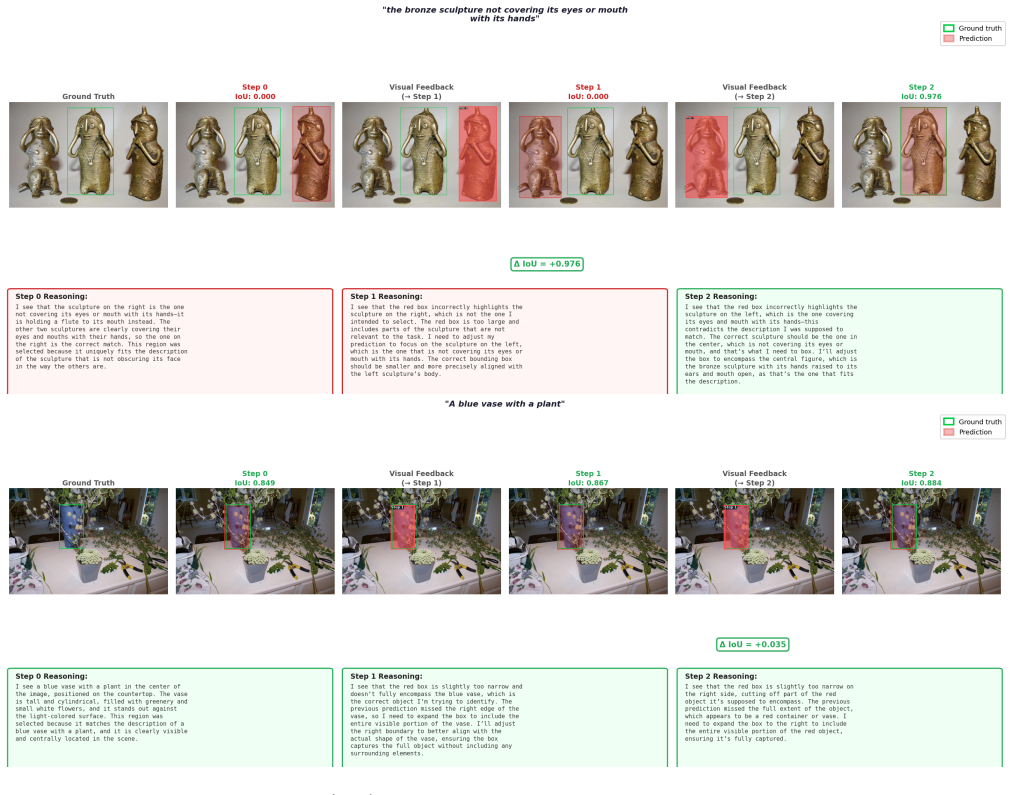
The +2.4 pp Acc@0.5 improvement claimed for Iterative Visual Thinking over a single-shot base is an artifact of an oracle that retains, per sample, the trajectory step nearest the ground-truth box. Once accuracy is re-measured under any fixed label-free stopping rule, the improvement disappears and stopping at the first prediction matches the base while beating every shippable alternative. The model can generate a better box somewhere in its trajectory but cannot identify it; self-verification confidence correlates only weakly with correctness and the loop responds to the mere presence of a rendered box rather than its quality.
What carries the argument
Honest-trajectory evaluation: accuracy measured only under fixed, label-free stopping policies, together with an explicit oracle-shippable gap that quantifies how much of the reported gain depends on knowing the answer in advance.
Load-bearing premise
The weak correlation between self-verification scores and correctness, plus one counterfactual overlay experiment, are taken as sufficient proof that the failure is pure verification rather than limited generation ability or training artifacts.
What would settle it
Train or prompt a model that, on the same trajectories, can select the highest-IoU step with label-free confidence scores whose correlation with true IoU exceeds roughly 0.6; if that selection recovers most of the oracle gain under a deployable rule, the verification-failure claim is falsified.
If this is right
- Any iterative visual grounding result that reports only the best-in-trajectory box must be re-scored under fixed stopping rules before it can be treated as a real improvement.
- Test-time scaling for spatial tasks cannot be assumed to work by simple self-correction loops; the missing piece is a reliable verifier, not more generation steps.
- Training recipes that use teacher-generated correction traces and IoU rewards can teach the model to produce better intermediate boxes without teaching it to stop on them.
- Published numbers that silently keep the oracle step systematically overstate the practical value of multi-step visual reasoning.
Where Pith is reading between the lines
- The same oracle-versus-deployable gap likely contaminates other multi-step VLM pipelines that claim test-time gains from self-reflection or tool use.
- A cheap external verifier (even a small specialist model) could convert the latent better boxes into real shippable gains without changing the generator.
- If verification remains hard, the practical research priority for grounding may shift from longer thinking to better single-shot localization or retrieval of external spatial knowledge.
Editorial analysis
A structured set of objections, weighed in public.
Referee Report
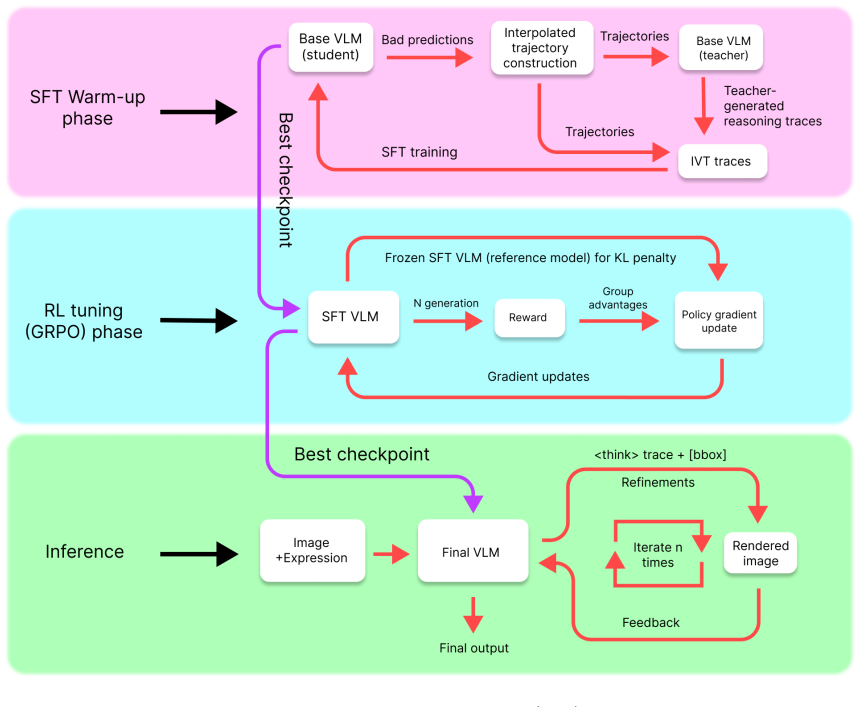
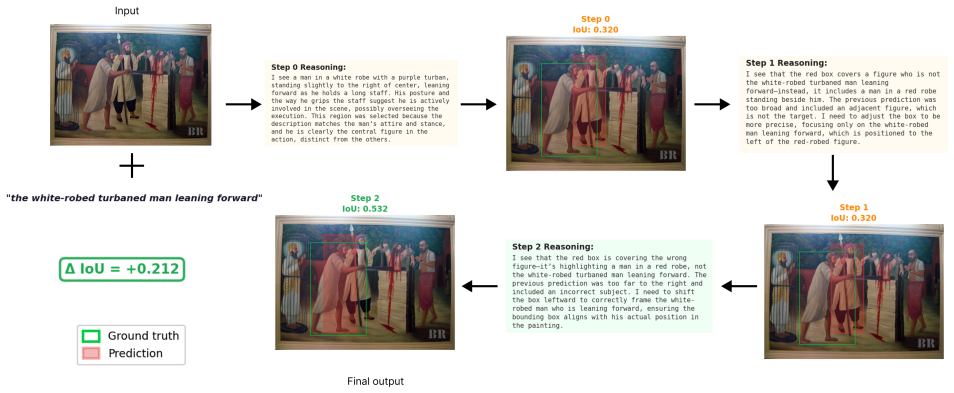
Summary. The paper constructs Iterative Visual Thinking (IVT), a multi-step visual self-correction procedure for VLM spatial grounding: the model predicts a box, sees it rendered, and refines. Training uses a two-phase recipe (supervised warm-up in which a teacher VLM converts the base model’s own errors into corrective reasoning traces, followed by GRPO with a simple IoU reward). Under the conventional practice of retaining, per sample, the trajectory step closest to ground truth, IVT yields +2.4 pp Acc@0.5 over the single-shot base. The authors show this gain is an oracle mirage: under every fixed label-free stopping rule the improvement vanishes and stopping at step 0 matches the base and dominates all shippable policies. They diagnose a verification failure (self-verification confidence correlates only weakly with correctness, r≈0.22; a counterfactual overlay reacts to box presence rather than correctness) and propose an honest-trajectory evaluation protocol that reports accuracy under label-free policies together with the explicit oracle–shippable gap.
Significance. If the measurement result holds, the work supplies a timely and practically important corrective to evaluation practice in iterative / test-time-compute VLMs. It cleanly separates generation capacity from selection capacity and demonstrates that a common (often implicit) oracle selection systematically inflates reported gains. The honest-trajectory protocol is a concrete, adoptable recommendation. The annotation-free training recipe is a useful engineering contribution. The causal claim that the failure mode is verification rather than generation is secondary; even if that attribution is only partially supported, the primary empirical finding (oracle gain is non-deployable) remains valuable for the field.
major comments (3)
- [Experiments / re-scoring results] The central empirical claim (that the +2.4 pp Acc@0.5 disappears under every deployable label-free rule and that step-0 is optimal) requires a fully explicit table of all policies tested (fixed step k, confidence threshold, entropy, majority vote over trajectory, etc.), with Acc@0.5, confidence intervals or multi-seed statistics, and the precise definition of each rule. Without that table the assertion that “every shippable rule” is beaten by step 0 cannot be audited.
- [Analysis / verification failure] The interpretive claim that “the model can generate a better box somewhere but cannot identify it” is load-bearing for the verification-failure diagnosis. The single Pearson r≈0.22 is a weak association; the manuscript should add rank correlation, reliability diagrams, and a controlled ablation that replaces the model’s own verifier with an external oracle (or stronger VLM) verifier to quantify how much of the oracle–shippable gap is closed by better verification alone.
- [Introduction / Related Work] The claim that oracle best-step selection is representative of “how such systems are usually reported” is an axiom of the paper. It needs concrete citations to prior iterative grounding or visual self-correction works that actually used (or can be shown to have used) this selection; otherwise the “mirage” framing risks over-generalizing from a single evaluation convention.
minor comments (3)
- [entire manuscript] The full manuscript text supplied for review is heavily corrupted by encoding artifacts, rendering many section headings, equations and table captions unreadable. A clean PDF is required for final production.
- [Method / GRPO stage] Notation for the IoU reward scaling and the precise GRPO hyperparameters should be collected in a single table or appendix for reproducibility.
- [Discussion / Protocol] A short discussion of how the honest-trajectory protocol would apply to non-grounding iterative VLM tasks (e.g., visual chain-of-thought) would broaden impact without lengthening the main argument.
Circularity Check
No significant circularity: the paper exposes an oracle-selection mirage in prior evaluation practice and re-scores under label-free policies that do not reduce to ground-truth by construction.
full rationale
This is an empirical ML paper whose central claim is that a common reporting practice (keeping, per sample, the trajectory step closest to the ground-truth box) is non-deployable and produces a measurement mirage. The paper's own positive numbers are obtained under fixed label-free stopping rules (including step-0), and the oracle-shippable gap is reported explicitly rather than hidden. There is no derivation in which a fitted parameter, self-defined quantity, or self-citation uniqueness theorem is renamed as a prediction of the same quantity. The training recipe (base-model errors turned into teacher traces, then GRPO with IoU) and the diagnostic correlations (r≈0.22, counterfactual overlay) are ordinary experimental inputs; they do not force the headline result by construction. Self-citation, if any, is not load-bearing for the measurement claim. The derivation chain is therefore self-contained against external benchmarks and exhibits no circular reduction of the kind the analyzer flags. Score 0 is the correct honest finding.
Axiom & Free-Parameter Ledger
free parameters (4)
- iteration budget / max trajectory length
- Acc@0.5 / IoU success threshold
- GRPO / RL hyperparameters and IoU reward scaling
- self-verification confidence threshold for early stopping
axioms (4)
- domain assumption IoU (and Acc@0.5) is an adequate scalar reward and success metric for spatial grounding quality.
- domain assumption A teacher VLM can turn base-model prediction errors into useful corrective reasoning traces without human annotation.
- ad hoc to paper Oracle selection of the trajectory step with highest IoU to ground truth is representative of how iterative systems are "usually reported."
- domain assumption Label-free stopping rules (fixed step, model confidence, etc.) exhaust the set of deployable policies worth comparing.
invented entities (2)
-
Iterative Visual Thinking (IVT)
no independent evidence
-
Honest-trajectory evaluation protocol
no independent evidence
read the original abstract
Letting a vision-language model (VLM) think longer at test time has driven much recent progress. A natural way to bring this to spatial grounding is visual self-correction: the model predicts a bounding box, sees it rendered on the image, and refines it over several steps. We build a faithful instance of this idea, Iterative Visual Thinking (IVT), with a two-phase recipe: a supervised warm-up in which the base model's own predictions serve as realistic errors that a teacher VLM turns into corrective reasoning traces (yielding training data without human annotation), followed by GRPO with a simple IoU reward. Measured the way such systems are usually reported, it works: the trained model surpasses the single-shot base by +2.4pp Acc@0.5. We show this gain is a measurement mirage. The reported number silently keeps, per sample, the trajectory step closest to the ground-truth box: an oracle that needs the very answer it predicts. Re-scored under deployable, label-free stopping rules the improvement vanishes, and the best policy is not to iterate at all: stopping at step 0 matches the base and beats every shippable rule. The cause is a verification failure, since the model can generate a better box somewhere in its trajectory but cannot identify it. Self-verification confidence correlates only weakly with correctness (r about 0.22), and a counterfactual overlay shows the loop reacts to the presence of a rendered box rather than its correctness. We distill the lesson into an honest-trajectory evaluation protocol: accuracy under fixed label-free policies plus an explicit oracle-shippable gap.
Figures

Reference graph
Works this paper leans on
-
[1]
write newline
" write newline "" before.all 'output.state := FUNCTION n.dashify 't := "" t empty not t #1 #1 substring "-" = t #1 #2 substring "--" = not "--" * t #2 global.max substring 't := t #1 #1 substring "-" = "-" * t #2 global.max substring 't := while if t #1 #1 substring * t #2 global.max substring 't := if while FUNCTION format.date year duplicate empty "emp...
-
[2]
Shuai Bai, Yuxuan Cai, Ruizhe Chen, Keqin Chen, Xionghui Chen, Zesen Cheng, Lianghao Deng, Wei Ding, Chang Gao, Chunjiang Ge, et al. Qwen3-VL technical report. arXiv preprint arXiv:2511.21631, 2025 a
Pith/arXiv arXiv 2025
-
[3]
UniVG-R1 : Reasoning guided universal visual grounding with reinforcement learning
Sule Bai, Mingxing Li, Yong Liu, Jing Tang, Haoji Zhang, Lei Sun, Xiangxiang Chu, and Yansong Tang. UniVG-R1 : Reasoning guided universal visual grounding with reinforcement learning. arXiv preprint arXiv:2505.14231, 2025 b
Pith/arXiv arXiv 2025
-
[4]
Ground-R1 : Incentivizing grounded visual reasoning via reinforcement learning
Meng Cao, Haoze Zhao, Can Zhang, Xiaojun Chang, Ian Reid, and Xiaodan Liang. Ground-R1 : Incentivizing grounded visual reasoning via reinforcement learning. arXiv preprint arXiv:2505.20272, 2025
arXiv 2025
-
[5]
Gary Chan, and Hongyang Zhang
Jierun Chen, Fangyun Wei, Jinjing Zhao, Sizhe Song, Bohuai Wu, Zhuoxuan Peng, S.-H. Gary Chan, and Hongyang Zhang. Revisiting Referring Expression Comprehension Evaluation in the Era of Large Multimodal Models . In Proceedings of the IEEE/CVF Conference on Computer Vision and Pattern Recognition, pages 513--524, 2025 a
2025
-
[6]
Shikra : Unleashing multimodal LLM 's referential dialogue magic
Keqin Chen, Zhao Zhang, Weili Zeng, Richong Zhang, Feng Zhu, and Rui Zhao. Shikra : Unleashing multimodal LLM 's referential dialogue magic. arXiv preprint arXiv:2306.15195, 2023
Pith/arXiv arXiv 2023
-
[7]
Yang Chen, Yufan Shen, Wenxuan Huang, Sheng Zhou, Qunshu Lin, Xinyu Cai, Zhi Yu, Jiajun Bu, Botian Shi, and Yu Qiao. Learning only with images: Visual reinforcement learning with reasoning, rendering, and visual feedback. arXiv preprint arXiv:2507.20766, 2025 b
Pith/arXiv arXiv 2025
-
[8]
QLoRA : Efficient finetuning of quantized language models
Tim Dettmers, Artidoro Pagnoni, Ari Holtzman, and Luke Zettlemoyer. QLoRA : Efficient finetuning of quantized language models. Advances in Neural Information Processing Systems, 36, 2023
2023
-
[9]
Ref-adv: Exploring MLLM visual reasoning in referring expression tasks
Qihua Dong, Kuo Yang, Lin Ju, Handong Zhao, Yitian Zhang, Yizhou Wang, Huimin Zeng, Jianglin Lu, and Yun Fu. Ref-adv: Exploring MLLM visual reasoning in referring expression tasks. In The Fourteenth International Conference on Learning Representations, 2026
2026
-
[10]
GRIT : Teaching MLLMs to think with images
Yue Fan, Xuehai He, Diji Yang, Kaizhi Zheng, Ching-Chen Kuo, Yuting Zheng, Sravana Jyothi Narayanaraju, Xinze Guan, and Xin Eric Wang. GRIT : Teaching MLLMs to think with images. In NeurIPS, 2025
2025
-
[11]
DeepSeek-R1 : Incentivizing reasoning capability in LLMs via reinforcement learning
Daya Guo, Dejian Yang, He Zhang, Junxiao Song, Ruoyu Zhang, Runxin Xu, Qihao Zhu, Shirong Ma, Peiyi Wang, Xiao Bi, et al. DeepSeek-R1 : Incentivizing reasoning capability in LLMs via reinforcement learning. arXiv preprint arXiv:2501.12948, 2025
Pith/arXiv arXiv 2025
-
[12]
LoRA : Low-rank adaptation of large language models
Edward J Hu, Yelong Shen, Phillip Wallis, Zeyuan Allen-Zhu, Yuanzhi Li, Sheng Wang, Lu Wang, and Weizhu Chen. LoRA : Low-rank adaptation of large language models. In ICLR, 2022
2022
-
[13]
Large language models cannot self-correct reasoning yet
Jie Huang, Xinyun Chen, Swaroop Mishra, Huaixiu Steven Zheng, Adams Wei Yu, Xinying Song, and Denny Zhou. Large language models cannot self-correct reasoning yet. In ICLR, 2024
2024
-
[14]
Vision- R1 : Incentivizing reasoning capability in multimodal large language models
Wenxuan Huang, Bohan Jia, Zijie Zhai, Shaosheng Cao, Zheyu Ye, Fei Zhao, Zhe Xu, Xu Tang, Yao Hu, and Shaohui Lin. Vision- R1 : Incentivizing reasoning capability in multimodal large language models. In ICLR, 2026
2026
-
[15]
MDETR -- modulated detection for end-to-end multi-modal understanding
Aishwarya Kamath, Mannat Singh, Yann LeCun, Gabriel Synnaeve, Ishan Misra, and Nicolas Carion. MDETR -- modulated detection for end-to-end multi-modal understanding. In ICCV, 2021
2021
-
[16]
Can large vision-language models correct semantic grounding errors by themselves? In CVPR, 2025
Yuan-Hong Liao, Rafid Mahmood, Sanja Fidler, and David Acuna. Can large vision-language models correct semantic grounding errors by themselves? In CVPR, 2025
2025
-
[17]
Microsoft COCO : Common objects in context
Tsung-Yi Lin, Michael Maire, Serge Belongie, James Hays, Pietro Perona, Deva Ramanan, Piotr Doll \'a r, and C Lawrence Zitnick. Microsoft COCO : Common objects in context. In ECCV, 2014
2014
-
[18]
Grounding DINO : Marrying DINO with grounded pre-training for open-set object detection
Shilong Liu, Zhaoyang Zeng, Tianhe Ren, Feng Li, Hao Zhang, Jie Yang, Chunyuan Li, Jianwei Yang, Hang Su, Jun Zhu, et al. Grounding DINO : Marrying DINO with grounded pre-training for open-set object detection. In ECCV, 2024
2024
-
[19]
Self-refine: Iterative refinement with self-feedback
Aman Madaan, Niket Tandon, Prakhar Gupta, Skyler Hallinan, Luyu Gao, Sarah Wiegreffe, Uri Alon, Nouha Dziri, Shrimai Prabhumoye, Yiming Yang, et al. Self-refine: Iterative refinement with self-feedback. Advances in Neural Information Processing Systems, 36, 2023
2023
-
[20]
Generation and comprehension of unambiguous object descriptions
Junhua Mao, Jonathan Huang, Alexander Toshev, Oana Camburu, Alan Yuille, and Kevin Murphy. Generation and comprehension of unambiguous object descriptions. In CVPR, 2016
2016
-
[21]
Training language models to follow instructions with human feedback
Long Ouyang, Jeffrey Wu, Xu Jiang, Diogo Almeida, Carroll Wainwright, Pamela Mishkin, Chong Zhang, Sandhini Agarwal, Katarina Slama, Alex Ray, et al. Training language models to follow instructions with human feedback. Advances in Neural Information Processing Systems, 35: 0 27730--27744, 2022
2022
-
[22]
Grounding multimodal large language models to the world
Zhiliang Peng, Wenhui Wang, Li Dong, Yaru Hao, Shaohan Huang, Shuming Ma, Qixiang Ye, and Furu Wei. Grounding multimodal large language models to the world. In ICLR, 2024
2024
-
[23]
CogCoM : A visual language model with chain-of-manipulations reasoning
Ji Qi, Ming Ding, Weihan Wang, Yushi Bai, Qingsong Lv, Wenyi Hong, Bin Xu, Lei Hou, Juanzi Li, Yuxiao Dong, and Jie Tang. CogCoM : A visual language model with chain-of-manipulations reasoning. In ICLR, 2025
2025
-
[24]
Tarr, Aviral Kumar, and Katerina Fragkiadaki
Gabriel Sarch, Snigdha Saha, Naitik Khandelwal, Ayush Jain, Michael J. Tarr, Aviral Kumar, and Katerina Fragkiadaki. Grounded reinforcement learning for visual reasoning. arXiv preprint arXiv:2505.23678, 2025
Pith/arXiv arXiv 2025
-
[25]
Objects365 : A large-scale, high-quality dataset for object detection
Shuai Shao, Zeming Li, Tianyuan Zhang, Chao Peng, Gang Yu, Xiangyu Zhang, Jing Li, and Jian Sun. Objects365 : A large-scale, high-quality dataset for object detection. In ICCV, 2019
2019
-
[26]
Zhihong Shao, Peiyi Wang, Qihao Zhu, Runxin Xu, Junxiao Song, Xiao Bi, Haowei Zhang, Mingchuan Zhang, Y.K. Li, Y. Wu, and Daya Guo. DeepSeekMath : Pushing the limits of mathematical reasoning in open language models. arXiv preprint arXiv:2402.03300, 2024
Pith/arXiv arXiv 2024
-
[27]
VLM-R1 : A stable and generalizable R1 -style large vision-language model
Haozhan Shen, Peng Liu, Jingcheng Li, Chunxin Fang, Yibo Ma, Jiajia Liao, Qiaoli Shen, Zilun Zhang, Kangjia Zhao, Qianqian Zhang, Ruochen Xu, and Tiancheng Zhao. VLM-R1 : A stable and generalizable R1 -style large vision-language model. arXiv preprint arXiv:2504.07615, 2025
Pith/arXiv arXiv 2025
-
[28]
Reflexion: Language agents with verbal reinforcement learning
Noah Shinn, Federico Cassano, Ashwin Gopinath, Karthik Narasimhan, and Shunyu Yao. Reflexion: Language agents with verbal reinforcement learning. Advances in Neural Information Processing Systems, 36, 2023
2023
-
[29]
Qwen2-VL : Enhancing vision-language model's perception of the world at any resolution
Peng Wang, Shuai Bai, Sinan Tan, Shijie Wang, Zhihao Fan, Jinze Bai, Keqin Chen, Xuejing Liu, Jialin Wang, Wenbin Ge, et al. Qwen2-VL : Enhancing vision-language model's perception of the world at any resolution. arXiv preprint arXiv:2409.12191, 2024
Pith/arXiv arXiv 2024
-
[30]
Chain-of-thought prompting elicits reasoning in large language models
Jason Wei, Xuezhi Wang, Dale Schuurmans, Maarten Bosma, Brian Ichter, Fei Xia, Ed Chi, Quoc V Le, and Denny Zhou. Chain-of-thought prompting elicits reasoning in large language models. In NeurIPS, 2022
2022
-
[31]
Visual planning: Let's think only with images
Yi Xu, Chengzu Li, Han Zhou, Xingchen Wan, Caiqi Zhang, Anna Korhonen, and Ivan Vuli\' c . Visual planning: Let's think only with images. In ICLR, 2026
2026
-
[32]
Ferret: Refer and ground anything anywhere at any granularity
Haoxuan You, Haotian Zhang, Zhe Gan, Xianzhi Du, Bowen Zhang, Zirui Wang, Liangliang Cao, Shih-Fu Chang, and Yinfei Yang. Ferret: Refer and ground anything anywhere at any granularity. In ICLR, 2024
2024
-
[33]
Critic- V : VLM critics help catch VLM errors in multimodal reasoning
Di Zhang, Jingdi Lei, Junxian Li, Xunzhi Wang, Yujie Liu, Zonglin Yang, Jiatong Li, Weida Wang, Suorong Yang, Jianbo Wu, Peng Ye, Wanli Ouyang, and Dongzhan Zhou. Critic- V : VLM critics help catch VLM errors in multimodal reasoning. In CVPR, 2025 a
2025
-
[34]
R1-VL : Learning to reason with multimodal large language models via step-wise group relative policy optimization
Jingyi Zhang, Jiaxing Huang, Huanjin Yao, Shunyu Liu, Xikun Zhang, Shijian Lu, and Dacheng Tao. R1-VL : Learning to reason with multimodal large language models via step-wise group relative policy optimization. In ICCV, 2025 b
2025
discussion (0)
Sign in with ORCID, Apple, or X to comment. Anyone can read and Pith papers without signing in.