Direct detection of cool molecular gas in a star-forming galaxy at z=7.31
Pith reviewed 2026-06-27 06:27 UTC · model grok-4.3
The pith
A massive molecular gas reservoir exists in a galaxy only 700 million years after the Big Bang.
A machine-rendered reading of the paper's core claim, the machinery that carries it, and where it could break.
Core claim
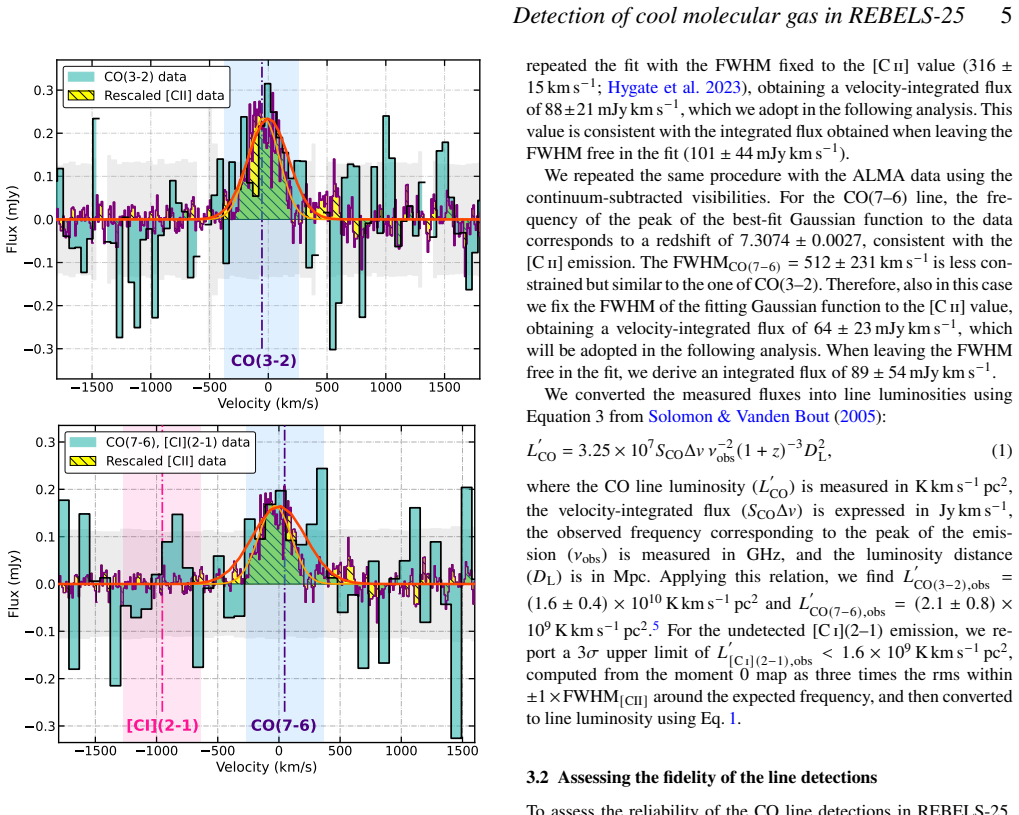
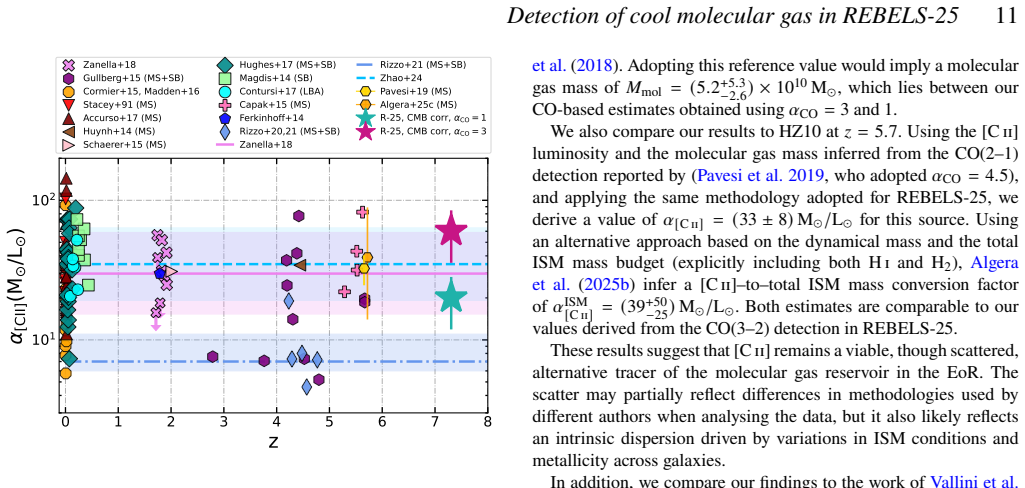
Deep VLA and ALMA observations detect CO(3-2) and CO(7-6) in REBELS-25 at z=7.31. The CMB-corrected CO(3-2) flux yields M_mol = (1.0 ± 0.4) × 10^11 (α_CO/3) M_⊙. TUNER modeling gives an independent mass of (1.8^{+1.0}_{-0.9}) × 10^11 M_⊙. This confirms a very massive gas reservoir only ≃700 Myr after the Big Bang, with f_gas ≃ 0.95, δ_GDR ≃ 6 × 10^2, and au_dep ≃ 1.2 Gyr, plus an empirical α_[C II] = (60 ± 25) M_⊙/L_⊙.
What carries the argument
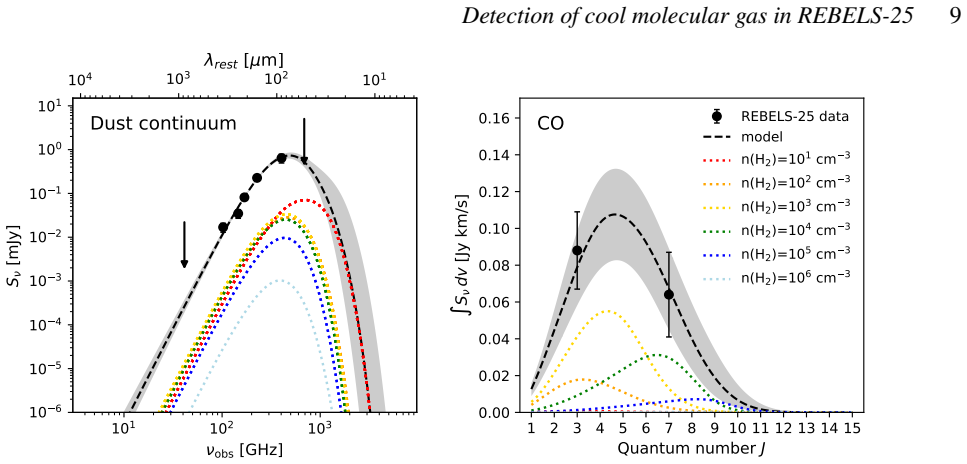
CMB-corrected CO(3-2) flux combined with the TUNER radiative transfer model that self-consistently accounts for excitation, optical depth, and CMB effects to recover molecular gas mass independent of r_31 and α_CO.
If this is right
- Low-J CO lines remain detectable at z>7, enabling direct molecular gas measurements in the Epoch of Reionization.
- Galaxies can maintain gas fractions near unity at early times while following extrapolated main-sequence scaling relations.
- [C II] emission provides a viable alternative tracer for molecular gas mass with a conversion factor around 60 solar masses per solar luminosity.
- The gas-to-dust ratio reaches values of several hundred at these redshifts.
Where Pith is reading between the lines
- Future facilities could routinely map molecular gas distributions in the first galaxies rather than relying solely on dust or [C II].
- The short depletion timescale relative to the age of the universe at z=7.31 implies rapid gas replenishment or inefficient star formation.
- If similar reservoirs exist in other REBELS galaxies, the total molecular gas budget at z>7 would be substantially higher than previously estimated from dust alone.
Load-bearing premise
The radiative transfer model calibrated on lower-redshift galaxies correctly describes the excitation and optical depth conditions in this z=7.31 system.
What would settle it
A deeper observation that yields a significantly lower CO(3-2) flux after CMB correction, or a direct dynamical mass measurement showing the gas mass is much smaller than derived.
Figures


read the original abstract
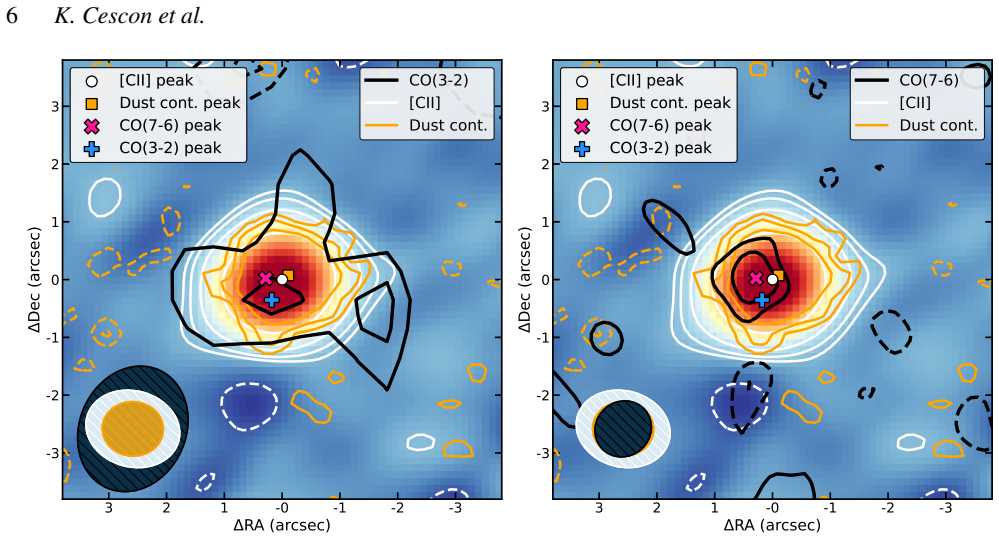
We investigate the molecular gas content and interstellar medium (ISM) conditions of REBELS-25, a massive, star-forming galaxy at $z=7.31$. Deep VLA Q-band and ALMA Band 3 observations reveal CO(3-2) and CO(7-6) emission (both at $\sim3.5\sigma$), and provide an upper limit on [C I](2-1). From the CMB-corrected CO(3-2) flux-representing the highest-redshift detection of a low-$J$ CO transition to date-we derive a molecular gas mass of $M_{\rm mol}=(1.0\pm0.4)\times10^{11}\,(\alpha_{\rm CO}/(3\,$M$_{\odot}$(K$\,$\kms$\,$pc$^2)^{-1}))\,$M$_{\odot}$, directly confirming the presence of a very massive gas reservoir only $\simeq700\,$Myr after the Big Bang. This implies an extreme gas fraction of $f_{\rm gas}\simeq0.95$, a gas-to-dust ratio of $\delta_{\rm GDR}\simeq6\times10^2$, and a depletion timescale of $\tau_{\rm dep}\simeq1.2\,$Gyr, broadly consistent with extrapolated scaling relations for main-sequence galaxies at lower redshift. Using the radiative transfer code TUNER, we self-consistently model CO and dust continuum emission in the context of the significant CMB background, constraining ISM properties and recovering $M_{\rm mol}= (1.8^{+1.0}_{-0.9})\times10^{11}\,$M$_{\odot}$, independent of assumptions about $r_{31}$ and $\alpha_{\rm CO}$. We further discuss the use of alternative molecular gas tracers at early epochs. Combining CO and [C II] measurements, we infer an empirical [C II]-to-H$_2$ conversion factor of $\alpha_{\rm [C II]}=(60\pm25)\,$M$_{\odot}$/L$_{\odot}$, suggesting [C II] remains a viable molecular gas tracer in the Epoch of Reionization. These results demonstrate the detectability of low-$J$ CO emission even at $z>7$, paving the way for next-generation facilities, and provide critical insights into the rapid mass assembly of galaxies during the first billion years of cosmic history.
Editorial analysis
A structured set of objections, weighed in public.
Referee Report
Summary. The paper reports ~3.5σ detections of CO(3-2) and CO(7-6) in the z=7.31 galaxy REBELS-25 from VLA Q-band and ALMA Band 3 data, derives M_mol=(1.0±0.4)×10^11 (α_CO/3) M_⊙ from the CMB-corrected CO(3-2) flux, and uses the TUNER radiative transfer code to obtain M_mol=(1.8^{+1.0}_{-0.9})×10^{11} M_⊙ independent of r_31 and α_CO while also discussing an empirical α_[C II] conversion factor.
Significance. If the detections and TUNER modeling hold, the result would provide direct evidence for a massive molecular gas reservoir at z>7 and demonstrate the viability of low-J CO at early epochs; the model-independent mass estimate is a notable technical strength when the code is shown to be robust.
major comments (2)
- [Abstract, modeling paragraph] Abstract and modeling paragraph: the headline claim that TUNER recovers M_mol independent of r_31 and α_CO rests on the model's ability to correctly solve for excitation, optical depth, and CMB effects at z=7.31; the code is calibrated on lower-redshift systems, yet no test or external benchmark for the high-z regime is provided, making this assumption load-bearing for the reported (1.8^{+1.0}_{-0.9})×10^{11} M_⊙ value.
- [Abstract] Abstract: both lines are detected at only ~3.5σ; without explicit details on baseline subtraction, error budgets, or the precise significance calculation in the observations section, it is difficult to assess whether the fluxes are robust enough to support the derived gas mass and f_gas≃0.95.
minor comments (1)
- [Abstract] The abstract states an upper limit on [C I](2-1) but does not specify the corresponding luminosity or how it constrains the ISM parameters in the TUNER fit.
Simulated Author's Rebuttal
We thank the referee for their constructive and detailed comments on our manuscript. We address each major comment below in a point-by-point manner and have revised the manuscript accordingly where the concerns can be directly addressed through additional text or clarifications.
read point-by-point responses
-
Referee: [Abstract, modeling paragraph] Abstract and modeling paragraph: the headline claim that TUNER recovers M_mol independent of r_31 and α_CO rests on the model's ability to correctly solve for excitation, optical depth, and CMB effects at z=7.31; the code is calibrated on lower-redshift systems, yet no test or external benchmark for the high-z regime is provided, making this assumption load-bearing for the reported (1.8^{+1.0}_{-0.9})×10^{11} M_⊙ value.
Authors: We appreciate the referee highlighting the importance of validating TUNER's applicability at z=7.31. TUNER solves the radiative transfer equations self-consistently for level populations, optical depths, and excitation, with the elevated CMB temperature at high redshift explicitly included as an input; r_31 and α_CO are therefore derived outputs rather than assumed inputs. The underlying atomic and molecular physics governing CO excitation remains unchanged with redshift, and the dominant high-z modification (CMB) is modeled directly. In the revised manuscript we have added a dedicated paragraph in the modeling section that acknowledges the low-z calibration basis of TUNER, explains why the physical framework still applies, and notes the consistency between the TUNER-derived mass and the independent CO(3-2) luminosity-based estimate. We agree that an external high-z benchmark would be valuable but lies outside the scope of the present work. revision: partial
-
Referee: [Abstract] Abstract: both lines are detected at only ~3.5σ; without explicit details on baseline subtraction, error budgets, or the precise significance calculation in the observations section, it is difficult to assess whether the fluxes are robust enough to support the derived gas mass and f_gas≃0.95.
Authors: We agree that the marginal significance of the detections requires fuller documentation. In the revised manuscript we have substantially expanded the 'Observations and Data Reduction' section to provide: (i) the precise baseline-subtraction procedure applied to both the VLA and ALMA spectra, (ii) a complete error budget that includes thermal noise, flux-calibration uncertainties, and any residual baseline or pointing errors, and (iii) the exact significance calculation (integrated line flux divided by the rms measured in line-free channels, scaled by the number of channels in the integration window). These additions allow readers to evaluate the robustness of the reported fluxes and the resulting gas-mass and gas-fraction estimates. revision: yes
Circularity Check
No significant circularity in derivation chain
full rationale
The paper reports direct CO(3-2) and CO(7-6) detections, applies a CMB correction to the observed flux, and converts to M_mol using a conventional alpha_CO factor. Separately, it applies the external TUNER radiative-transfer code to jointly fit the line and continuum data while solving for excitation and optical depth, yielding an alternative M_mol value. No equation or modeling step is shown to be defined in terms of the output mass, no fitted parameter is relabeled as a prediction, and no load-bearing uniqueness theorem or ansatz is imported via self-citation. The lower-redshift calibration of TUNER is an applicability assumption, not a definitional reduction. The chain therefore remains self-contained against external benchmarks.
Axiom & Free-Parameter Ledger
free parameters (1)
- alpha_CO
axioms (2)
- domain assumption CO(3-2) emission traces the total molecular hydrogen reservoir after CMB correction
- domain assumption TUNER radiative transfer accurately recovers ISM conditions under strong CMB background at z=7.31
Reference graph
Works this paper leans on
-
[1]
Planck 2018 results. VI. Cosmological parameters. , keywords =. doi:10.1051/0004-6361/201833910 , archivePrefix =. 1807.06209 , primaryClass =
work page internal anchor Pith review Pith/arXiv arXiv doi:10.1051/0004-6361/201833910 2018
-
[2]
Atomic carbon at redshift ~2.5
Atomic carbon at redshift 2.5. , keywords =. doi:10.1051/0004-6361:200400085 , archivePrefix =. astro-ph/0409711 , primaryClass =
work page internal anchor Pith review Pith/arXiv arXiv doi:10.1051/0004-6361:200400085
-
[3]
Astropy: A Community Python Package for Astronomy
Astropy: A community Python package for astronomy. , keywords =. doi:10.1051/0004-6361/201322068 , archivePrefix =. 1307.6212 , primaryClass =
work page internal anchor Pith review Pith/arXiv arXiv doi:10.1051/0004-6361/201322068
-
[4]
Matplotlib: A 2D Graphics Environment. Computing in Science and Engineering , keywords =. doi:10.1109/MCSE.2007.55 , adsurl =
-
[5]
Charles R. Harris and K. Jarrod Millman and St. Array programming with. 2020 , month = sep, journal =. doi:10.1038/s41586-020-2649-2 , publisher =
-
[6]
The Carbon-to-H _ 2 , CO-to-H _ 2 conversion factors, and carbon abundance on kiloparsec scales in nearby galaxies. , keywords =. doi:10.1093/mnras/stab1035 , archivePrefix =. 2104.05985 , primaryClass =
-
[7]
The Distribution of Atomic Carbon in the Orion Giant Molecular Cloud 1. , keywords =. doi:10.1086/338761 , adsurl =
-
[8]
The subthermal excitation of the C I lines in the molecular gas reservoirs of galaxies: its significance and potential utility. , keywords =. doi:10.1093/mnras/stab3194 , archivePrefix =. 2111.02260 , primaryClass =
-
[9]
Automated Mining of the ALMA Archive in the COSMOS Field (A ^ 3 COSMOS). II. Cold Molecular Gas Evolution out to Redshift 6. , keywords =. doi:10.3847/1538-4357/ab578d , archivePrefix =. 1910.12883 , primaryClass =
-
[10]
In pursuit of giants. I. The evolution of the dust-to-stellar mass ratio in distant dusty galaxies. , keywords =. doi:10.1051/0004-6361/202038405 , archivePrefix =. 2008.09995 , primaryClass =
-
[11]
2022, , 134, 114501, 10.1088/1538-3873/ac9642
CASA, the Common Astronomy Software Applications for Radio Astronomy. , keywords =. doi:10.1088/1538-3873/ac9642 , archivePrefix =. 2210.02276 , primaryClass =
work page internal anchor Pith review Pith/arXiv arXiv doi:10.1088/1538-3873/ac9642
-
[12]
Reionization Era Bright Emission Line Survey: Selection and Characterization of Luminous Interstellar Medium Reservoirs in the z > 6.5 Universe. , keywords =. doi:10.3847/1538-4357/ac5a4a , archivePrefix =. 2106.13719 , primaryClass =
-
[13]
REBELS-25: discovery of a dynamically cold disc galaxy at z = 7.31. , keywords =. doi:10.1093/mnras/stae2217 , archivePrefix =. 2405.06025 , primaryClass =
-
[14]
REBELS-IFU: Evidence for metal-rich massive galaxies at z -0.5ex 6-8. arXiv e-prints , keywords =. doi:10.48550/arXiv.2501.10559 , archivePrefix =. 2501.10559 , primaryClass =
-
[15]
REBELS-IFU: Evidence for metal-rich massive galaxies at z -0.5ex 6 - 8. , keywords =. doi:10.1093/mnras/staf2023 , archivePrefix =. 2501.10559 , primaryClass =
-
[16]
The ALMA REBELS Survey: discovery of a massive, highly star-forming, and morphologically complex ULIRG at z = 7.31. , keywords =. doi:10.1093/mnras/stad1212 , archivePrefix =. 2304.09206 , primaryClass =
-
[17]
The ALMA REBELS Survey: dust continuum detections at z > 6.5. , keywords =. doi:10.1093/mnras/stac1779 , archivePrefix =. 2203.15136 , primaryClass =
-
[18]
Andromeda's Dust. , keywords =. doi:10.1088/0004-637X/780/2/172 , archivePrefix =. 1306.2304 , primaryClass =
work page internal anchor Pith review Pith/arXiv arXiv doi:10.1088/0004-637x/780/2/172
-
[19]
H2 and its relation to CO in the LMC and other magellanic irregulars
H\_2 and its relation to CO in the LMC and other magellanic irregular galaxies. , keywords =. doi:10.48550/arXiv.astro-ph/9709194 , archivePrefix =. astro-ph/9709194 , primaryClass =
work page internal anchor Pith review Pith/arXiv arXiv doi:10.48550/arxiv.astro-ph/9709194
-
[20]
The ALMA REBELS Survey: the first infrared luminosity function measurement at z 7. , keywords =. doi:10.1093/mnras/stad1259 , archivePrefix =. 2303.11321 , primaryClass =
-
[21]
Gone with the heat: a fundamental constraint on the imaging of dust and molecular gas in the early Universe. Royal Society Open Science , keywords =. doi:10.1098/rsos.160025 , archivePrefix =. 1605.03885 , primaryClass =
work page internal anchor Pith review Pith/arXiv arXiv doi:10.1098/rsos.160025
-
[22]
Black hole accretion and star formation as drivers of gas excitation and chemistry in Mrk231
Black hole accretion and star formation as drivers of gas excitation and chemistry in Markarian 231. , keywords =. doi:10.1051/0004-6361/201014682 , archivePrefix =. 1005.2877 , primaryClass =
work page internal anchor Pith review Pith/arXiv arXiv doi:10.1051/0004-6361/201014682
-
[23]
I CO/N(H 2) Conversions and Molecular Gas Abundances in Spiral and Irregular Galaxies. , keywords =. doi:10.1086/166011 , adsurl =
-
[24]
Fast rotating and low-turbulence discs at z ≃ 4.5: Dynamical evidence of their evolution into local early-type galaxies. , keywords =. doi:10.1051/0004-6361/202039807 , archivePrefix =. 2011.05340 , primaryClass =
-
[25]
Robust H I kinematics of gas-rich ultra-diffuse galaxies: hints of a weak-feedback formation scenario. , keywords =. doi:10.1093/mnras/staa1256 , archivePrefix =. 2004.14392 , primaryClass =
-
[26]
Regular rotation and low turbulence in a diverse sample of z 4.5 galaxies observed with ALMA. , keywords =. doi:10.1093/mnras/stad530 , archivePrefix =. 2302.03049 , primaryClass =
-
[27]
A tight angular-momentum plane for disc galaxies. , keywords =. doi:10.1051/0004-6361/202141574 , archivePrefix =. 2107.02809 , primaryClass =
-
[28]
Blue monsters at z > 10: Where all their dust has gone. , keywords =. doi:10.1051/0004-6361/202452707 , archivePrefix =. 2410.19042 , primaryClass =
-
[29]
The dust enrichment of early galaxies in the JWST and ALMA era. , keywords =. doi:10.1093/mnras/stad2734 , archivePrefix =. 2305.01681 , primaryClass =
-
[30]
On the stunning abundance of super-early, luminous galaxies revealed by JWST. , keywords =. doi:10.1093/mnras/stad1095 , archivePrefix =. 2208.00720 , primaryClass =
-
[31]
The brightest galaxies at cosmic dawn. , keywords =. doi:10.1093/mnras/stad035 , archivePrefix =. 2207.14808 , primaryClass =
-
[32]
Balancing the efficiency and stochasticity of star formation with dust extinction in z 10 galaxies observed by JWST. , keywords =. doi:10.1093/mnras/stac3578 , archivePrefix =. 2208.12826 , primaryClass =
-
[33]
Seen and unseen: bursty star formation and its implications for observations of high-redshift galaxies with JWST. , keywords =. doi:10.1093/mnras/stad2902 , archivePrefix =. 2305.02713 , primaryClass =
-
[34]
EAS2024, European Astronomical Society Annual Meeting , year = 2024, month = jul, eid =
A Theoretical Framework for Dust in the High Redshift Universe. EAS2024, European Astronomical Society Annual Meeting , year = 2024, month = jul, eid =
2024
-
[35]
Are the newly-discovered z 13 drop-out sources starburst galaxies or quasars?. , keywords =. doi:10.1093/mnrasl/slac035 , archivePrefix =. 2201.00823 , primaryClass =
-
[36]
ALMA characterizes the dust temperature of z 5.5 star-forming galaxies. , keywords =. doi:10.1093/mnras/staa2545 , archivePrefix =. 2005.07716 , primaryClass =
-
[37]
ALMA Imaging of Gas and Dust in a Galaxy Protocluster at Redshift 5.3: [C II] Emission in ``Typical'' Galaxies and Dusty Starbursts 1 Billion Years after the Big Bang. , keywords =. doi:10.1088/0004-637X/796/2/84 , archivePrefix =. 1404.7159 , primaryClass =
work page internal anchor Pith review Pith/arXiv arXiv doi:10.1088/0004-637x/796/2/84
-
[38]
Rise of the Titans: Gas Excitation and Feedback in a Binary Hyperluminous Dusty Starburst Galaxy at z 6. , keywords =. doi:10.3847/1538-4357/abcf2e , archivePrefix =. 2010.15183 , primaryClass =
-
[39]
Dust Grain Size Distributions and Extinction in the Milky Way, LMC, and SMC
Dust Grain-Size Distributions and Extinction in the Milky Way, Large Magellanic Cloud, and Small Magellanic Cloud. , keywords =. doi:10.1086/318651 , archivePrefix =. astro-ph/0008146 , primaryClass =
work page internal anchor Pith review Pith/arXiv arXiv doi:10.1086/318651
-
[40]
Cold dust and low [O III]/[C II] ratios: an evolved star-forming population at redshift 7. , keywords =. doi:10.1093/mnras/stad3111 , archivePrefix =. 2301.09659 , primaryClass =
-
[41]
Accurate simultaneous constraints on the dust mass, temperature, and emissivity index of a galaxy at redshift 7.31. , keywords =. doi:10.1093/mnras/stae1994 , archivePrefix =. 2408.02267 , primaryClass =
-
[42]
Impact of X-rays on CO emission from high-z galaxies. , keywords =. doi:10.1093/mnras/stz2837 , archivePrefix =. 1910.07550 , primaryClass =
-
[43]
ALMA Observations of [OI]145um and [NII]205um Emission lines from Star-Forming Galaxies at z 7. arXiv e-prints , keywords =. doi:10.48550/arXiv.2504.03831 , archivePrefix =. 2504.03831 , primaryClass =
-
[44]
Deep into the structure of the first galaxies: SERRA views
Deep into the structure of the first galaxies: SERRA views. , keywords =. doi:10.1093/mnras/stz1383 , archivePrefix =. 1905.08254 , primaryClass =
work page internal anchor Pith review Pith/arXiv arXiv doi:10.1093/mnras/stz1383 1905
-
[45]
REBELS-IFU: Dust Build-up in Massive Galaxies at Redshift 7. arXiv e-prints , keywords =. doi:10.48550/arXiv.2501.10508 , archivePrefix =. 2501.10508 , primaryClass =
-
[46]
REBELS-IFU: dust build-up in massive galaxies at redshift 7. , keywords =. doi:10.1093/mnras/staf1897 , archivePrefix =. 2501.10508 , primaryClass =
-
[47]
The Star Formation Law in Nearby Galaxies on Sub-Kpc Scales
The Star Formation Law in Nearby Galaxies on Sub-Kpc Scales. , keywords =. doi:10.1088/0004-6256/136/6/2846 , archivePrefix =. 0810.2541 , primaryClass =
work page internal anchor Pith review Pith/arXiv arXiv doi:10.1088/0004-6256/136/6/2846
-
[48]
Scaling Relations between Gas and Star Formation in Nearby Galaxies
Scaling Relations between Gas and Star Formation in Nearby Galaxies. Computational Star Formation , year = 2011, editor =. doi:10.1017/S1743921311000597 , archivePrefix =. 1012.3749 , primaryClass =
work page internal anchor Pith review Pith/arXiv arXiv doi:10.1017/s1743921311000597 2011
-
[49]
The Star Formation Efficiency in Nearby Galaxies: Measuring Where Gas Forms Stars Effectively
The Star Formation Efficiency in Nearby Galaxies: Measuring Where Gas Forms Stars Effectively. , keywords =. doi:10.1088/0004-6256/136/6/2782 , archivePrefix =. 0810.2556 , primaryClass =
work page internal anchor Pith review Pith/arXiv arXiv doi:10.1088/0004-6256/136/6/2782
-
[50]
A Remarkably Luminous Galaxy at z=11.1 Measured with Hubble Space Telescope Grism Spectroscopy
A Remarkably Luminous Galaxy at z=11.1 Measured with Hubble Space Telescope Grism Spectroscopy. , keywords =. doi:10.3847/0004-637X/819/2/129 , archivePrefix =. 1603.00461 , primaryClass =
work page internal anchor Pith review Pith/arXiv arXiv doi:10.3847/0004-637x/819/2/129
-
[51]
UV Luminosity Functions at redshifts z~4 to z~10: 10000 Galaxies from HST Legacy Fields
UV Luminosity Functions at Redshifts z 4 to z 10: 10,000 Galaxies from HST Legacy Fields. , keywords =. doi:10.1088/0004-637X/803/1/34 , archivePrefix =. 1403.4295 , primaryClass =
work page internal anchor Pith review Pith/arXiv arXiv doi:10.1088/0004-637x/803/1/34
-
[52]
Deep Constraints on [CII]158 m in JADES-GS-z14-0: Further Evidence for a Galaxy with Low Gas Content at z=14.2. arXiv e-prints , keywords =. doi:10.48550/arXiv.2502.01610 , archivePrefix =. 2502.01610 , primaryClass =
-
[53]
The eventful life of a luminous galaxy at z = 14: metal enrichment, feedback, and low gas fraction?. , keywords =. doi:10.1051/0004-6361/202452451 , archivePrefix =. 2409.20533 , primaryClass =
-
[54]
Spectroscopic confirmation of two luminous galaxies at a redshift of 14. , keywords =. doi:10.1038/s41586-024-07860-9 , archivePrefix =. 2405.18485 , primaryClass =
-
[55]
A population of red candidate massive galaxies 600 Myr after the Big Bang. , keywords =. doi:10.1038/s41586-023-05786-2 , archivePrefix =. 2207.12446 , primaryClass =
-
[56]
JWST NIRSpec Spectroscopy of the Remarkable Bright Galaxy GHZ2/GLASS-z12 at Redshift 12.34. , keywords =. doi:10.3847/1538-4357/ad5f88 , archivePrefix =. 2403.10238 , primaryClass =
-
[57]
Accelerated formation of ultra-massive galaxies in the first billion years. , keywords =. doi:10.1038/s41586-024-08094-5 , archivePrefix =. 2309.02492 , primaryClass =
-
[58]
Normal, dust-obscured galaxies in the epoch of reionization. , keywords =. doi:10.1038/s41586-021-03846-z , archivePrefix =. 2109.10378 , primaryClass =
-
[59]
Epoch of Reionization giants: Properties of dusty galaxies at z 7
The ALMA REBELS Survey. Epoch of Reionization giants: Properties of dusty galaxies at z 7. , keywords =. doi:10.1093/mnras/stac460 , archivePrefix =. 2202.07666 , primaryClass =
-
[60]
The ALMA REBELS survey: the dust content of z 7 Lyman break galaxies. , keywords =. doi:10.1093/mnras/stac537 , archivePrefix =. 2202.11118 , primaryClass =
-
[61]
The Brightest z 8 Galaxies over the COSMOS UltraVISTA Field. , keywords =. doi:10.3847/1538-4357/ab3792 , archivePrefix =. 1902.10713 , primaryClass =
-
[62]
PHIBSS: molecular gas content and scaling relations in z~1-3 normal star forming galaxies
Phibss: Molecular Gas Content and Scaling Relations in z -0.5ex 1-3 Massive, Main-sequence Star-forming Galaxies. , keywords =. doi:10.1088/0004-637X/768/1/74 , archivePrefix =. 1211.5743 , primaryClass =
work page internal anchor Pith review Pith/arXiv arXiv doi:10.1088/0004-637x/768/1/74
-
[63]
PHIBSS: Unified Scaling Relations of Gas Depletion Time and Molecular Gas Fractions
PHIBSS: Unified Scaling Relations of Gas Depletion Time and Molecular Gas Fractions. , keywords =. doi:10.3847/1538-4357/aaa4b4 , archivePrefix =. 1702.01140 , primaryClass =
work page internal anchor Pith review Pith/arXiv arXiv doi:10.3847/1538-4357/aaa4b4
-
[64]
The Evolution of the Star-Forming Interstellar Medium Across Cosmic Time. , keywords =. doi:10.1146/annurev-astro-082812-141034 , archivePrefix =. 2003.06245 , primaryClass =
-
[65]
Cool Gas in High Redshift Galaxies
Cool Gas in High-Redshift Galaxies. , keywords =. doi:10.1146/annurev-astro-082812-140953 , archivePrefix =. 1301.0371 , primaryClass =
work page internal anchor Pith review Pith/arXiv arXiv doi:10.1146/annurev-astro-082812-140953
-
[66]
On the effect of the Cosmic Microwave Background in high-redshift (sub-)millimeter observations
On the Effect of the Cosmic Microwave Background in High-redshift (Sub-)millimeter Observations. , keywords =. doi:10.1088/0004-637X/766/1/13 , archivePrefix =. 1302.0844 , primaryClass =
work page internal anchor Pith review Pith/arXiv arXiv doi:10.1088/0004-637x/766/1/13
-
[67]
VLA Legacy Survey of Molecular Gas in Massive Star-forming Galaxies at High Redshift. , keywords =. doi:10.3847/1538-4357/acb931 , archivePrefix =. 2302.03713 , primaryClass =
-
[68]
The CO Luminosity Density at High-z (COLDz) Survey: A Sensitive, Large-area Blind Search for Low-J CO Emission from Cold Gas in the Early Universe with the Karl G. Jansky Very Large Array. , keywords =. doi:10.3847/1538-4357/aacb79 , archivePrefix =. 1808.04372 , primaryClass =
work page internal anchor Pith review Pith/arXiv arXiv doi:10.3847/1538-4357/aacb79
-
[69]
COLDz: Shape of the CO Luminosity Function at High Redshift and the Cold Gas History of the Universe
COLDz: Shape of the CO Luminosity Function at High Redshift and the Cold Gas History of the Universe. , keywords =. doi:10.3847/1538-4357/aafc27 , archivePrefix =. 1808.04371 , primaryClass =
work page internal anchor Pith review Pith/arXiv arXiv doi:10.3847/1538-4357/aafc27
-
[70]
A generator approach to stochastic monotonicity and propagation of order
Molecular Gas at High Redshift. , keywords =. doi:10.1146/annurev.astro.43.051804.102221 , archivePrefix =. astro-ph/0508481 , primaryClass =
work page internal anchor Pith review Pith/arXiv arXiv doi:10.1146/annurev.astro.43.051804.102221
-
[71]
The AURORA Survey: High-Redshift Empirical Metallicity Calibrations from Electron Temperature Measurements at z=2-10. arXiv e-prints , keywords =. doi:10.48550/arXiv.2508.10099 , archivePrefix =. 2508.10099 , primaryClass =
work page internal anchor Pith review Pith/arXiv arXiv doi:10.48550/arxiv.2508.10099
-
[72]
Direct T _ e -based Metallicities of z = 2 9 Galaxies with JWST/NIRSpec: Empirical Metallicity Calibrations Applicable from Reionization to Cosmic Noon. , keywords =. doi:10.3847/1538-4357/ad15fc , archivePrefix =. 2303.08149 , primaryClass =
work page internal anchor Pith review Pith/arXiv arXiv doi:10.3847/1538-4357/ad15fc
-
[73]
The chemical enrichment in the early Universe as probed by JWST via direct metallicity measurements at z 8. , keywords =. doi:10.1093/mnras/stac2737 , archivePrefix =. 2207.12375 , primaryClass =
-
[74]
Novel z 10 auroral line measurements extend the gradual offset of the FMR deep into the first Gyr of cosmic time. arXiv e-prints , keywords =. doi:10.48550/arXiv.2506.15779 , archivePrefix =. 2506.15779 , primaryClass =
work page internal anchor Pith review Pith/arXiv arXiv doi:10.48550/arxiv.2506.15779
-
[75]
The rise of the galactic empire: luminosity functions at z 17 and z 25 estimated with the MIDIS + NGDEEP ultra-deep JWST/NIRCam dataset. arXiv e-prints , keywords =. doi:10.48550/arXiv.2503.15594 , archivePrefix =. 2503.15594 , primaryClass =
-
[76]
Exploring Cosmic Dawn with PANORAMIC I: The Bright End of the UVLF at $z\sim9 -17$
Exploring Cosmic Dawn with PANORAMIC I: The Bright End of the UVLF at z 9 -17. arXiv e-prints , keywords =. doi:10.48550/arXiv.2507.06292 , archivePrefix =. 2507.06292 , primaryClass =
work page internal anchor Pith review Pith/arXiv arXiv doi:10.48550/arxiv.2507.06292
-
[77]
A dusty, normal galaxy in the epoch of reionization
A dusty, normal galaxy in the epoch of reionization. , keywords =. doi:10.1038/nature14164 , archivePrefix =. 1503.00002 , primaryClass =
work page internal anchor Pith review Pith/arXiv arXiv doi:10.1038/nature14164
-
[78]
The AURORA Survey: A New Era of Emission-line Diagrams with JWST/NIRSpec. , keywords =. doi:10.3847/1538-4357/adad68 , archivePrefix =. 2407.00157 , primaryClass =
-
[79]
Atomic and molecular gas as traced by [C II] emission. , keywords =. doi:10.1051/0004-6361/202452282 , archivePrefix =. 2410.14284 , primaryClass =
-
[80]
[C II] Emission in a Self-regulated Interstellar Medium. , keywords =. doi:10.3847/1538-4357/ad2eac , archivePrefix =. 2308.07338 , primaryClass =
discussion (0)
Sign in with ORCID, Apple, or X to comment. Anyone can read and Pith papers without signing in.