Momentum Space Algorithm for Electronic Structure of Double-Incommensurate Trilayer Graphene
Pith reviewed 2026-06-27 05:51 UTC · model grok-4.3
The pith
A momentum space algorithm with four-dimensional lattice truncation computes electronic structure for double-incommensurate trilayer graphene with improved convergence.
A machine-rendered reading of the paper's core claim, the machinery that carries it, and where it could break.
Core claim
The momentum space algorithm for double-incommensurate trilayers is an exact transformation of the tight-binding model into a four-dimensional lattice space; the introduced truncation scheme improves convergence of the density of states and momentum local density of states without significant errors, and numerical tests on twisted trilayer graphene show it captures altered band behavior near flat bands at magic angles.
What carries the argument
The efficient truncation scheme of the four-dimensional lattice, which approximates the infinite momentum lattice while preserving essential physics of the tight-binding model.
If this is right
- Density of states and momentum local density of states converge faster than with prior continuum descriptions.
- The method reveals altered band behavior near flat bands at magic angles due to its higher-order accuracy.
- Convergence estimates hold for the implemented ab initio model of twisted trilayer graphene.
- The parallel structure to classical band structure enables direct comparison with experimental observables.
Where Pith is reading between the lines
- The truncation approach could be adapted to compute other observables such as conductivity or optical responses in similar incommensurate systems.
- Higher accuracy near magic angles may help model interaction-driven effects like superconductivity when combined with many-body methods.
- The four-dimensional lattice representation might allow systematic error bounds that are harder to obtain in real-space tight-binding calculations.
Load-bearing premise
The truncation scheme of the four-dimensional lattice improves convergence without introducing significant errors or losing essential physics of the original tight-binding model.
What would settle it
A computation with successively finer truncations that shows the density of states or local density of states near the magic angles changing by more than the reported convergence threshold would falsify the accuracy claim.
Figures



read the original abstract
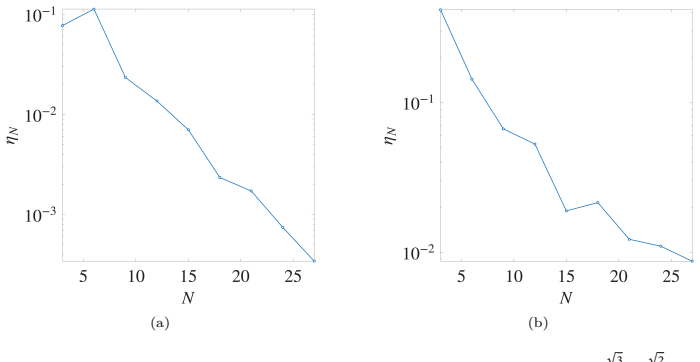
Numerical algorithms for computing electronic structure of incommensurate 2D materials using ab initio models is critical for predicting material properties and guiding experiment. For bilayers, momentum space and continuum models have been introduced to approximate observables of ab initio tight-binding models using a momenta description despite the lack of periodicity in the tight-binding model required for Bloch theory. A similar structure has been introduced for double-incommensurate trilayers using a continuum model, where the three lattices are all mutually incommensurate. However, this description leads to a four-dimensional lattice space, and numerical convergence of the density of states was observed to have poor convergence. In this work, we introduce a momentum space framework for double incommensurate trilayer graphene, and introduce an efficient truncation scheme of the four-dimensional lattice to drastically improve convergence of the density of states and momentum local density of states (a parallel object to classical band structure). We implement this algorithm on an ab initio model of twisted trilayer graphene and validate convergence estimates. We further verify numerically that the momentum space algorithm, inherently higher order than the continuum model as it is an exact transformation of the tight-binding model, captures altered band behavior near the flat bands at magic angles.
Editorial analysis
A structured set of objections, weighed in public.
Referee Report
Summary. The paper introduces a momentum-space framework for the electronic structure of double-incommensurate trilayer graphene. It replaces the continuum model with an exact transformation of the ab initio tight-binding Hamiltonian, yielding a four-dimensional momentum lattice, and proposes an efficient truncation scheme that is asserted to restore rapid convergence of the density of states and momentum-resolved local density of states while preserving the essential physics near magic-angle flat bands.
Significance. If the truncation is shown to be faithful, the algorithm would supply a systematically improvable, higher-order alternative to continuum models for incommensurate trilayers, enabling reliable numerical access to band reconstructions that are currently inaccessible.
major comments (2)
- [Abstract] Abstract: the assertion that the truncation 'drastically improves convergence … without introducing significant errors or losing essential physics' rests solely on observed numerical convergence of integrated quantities (DOS, MLDOS). No a-priori bound is supplied on the neglected interlayer matrix elements, which decay only polynomially; convergence of an integrated observable does not guarantee that eigenvalue rearrangements inside the flat-band window are preserved.
- [Abstract] The central claim that the momentum-space algorithm is 'inherently higher order than the continuum model' and 'an exact transformation' is load-bearing, yet the manuscript provides no explicit error estimate or comparison that quantifies the order improvement once the four-dimensional lattice is truncated.
Simulated Author's Rebuttal
We thank the referee for their careful reading and constructive comments. We address the two major comments point by point below, indicating the revisions we intend to make to the manuscript.
read point-by-point responses
-
Referee: [Abstract] Abstract: the assertion that the truncation 'drastically improves convergence … without introducing significant errors or losing essential physics' rests solely on observed numerical convergence of integrated quantities (DOS, MLDOS). No a-priori bound is supplied on the neglected interlayer matrix elements, which decay only polynomially; convergence of an integrated observable does not guarantee that eigenvalue rearrangements inside the flat-band window are preserved.
Authors: We agree that the manuscript relies on numerical evidence of convergence for the DOS and MLDOS (including momentum-resolved quantities near the flat bands) rather than an a-priori bound on the truncation error for the polynomially decaying interlayer couplings. Convergence of integrated observables does not rigorously guarantee preservation of all eigenvalue rearrangements. We will revise the abstract to moderate the language, removing the claim of 'without introducing significant errors or losing essential physics' and instead stating that the truncation is validated by observed numerical convergence. We will also add a short paragraph in the main text acknowledging this limitation and noting that a rigorous a-priori error analysis for the flat-band window remains future work. revision: yes
-
Referee: [Abstract] The central claim that the momentum-space algorithm is 'inherently higher order than the continuum model' and 'an exact transformation' is load-bearing, yet the manuscript provides no explicit error estimate or comparison that quantifies the order improvement once the four-dimensional lattice is truncated.
Authors: The phrase 'exact transformation' in the abstract refers specifically to the untruncated momentum-space formulation, which is derived directly from the ab initio tight-binding Hamiltonian without the approximations inherent to continuum models (such as dispersion linearization). This establishes the base algorithm as higher-order in fidelity to the tight-binding model. The truncation is presented as a separate numerical approximation whose practical effect is demonstrated through convergence studies. We acknowledge that the manuscript does not supply an explicit error estimate or quantitative comparison of the truncated four-dimensional lattice versus continuum models. We will revise the abstract to clarify this distinction and avoid any implication of a quantified order improvement for the truncated version. revision: yes
Circularity Check
No circularity: derivation self-contained via exact transformation and numerical validation
full rationale
The paper defines its momentum-space algorithm as an exact transformation of the tight-binding model and validates the truncation scheme through direct numerical convergence of DOS and MLDOS on an ab initio model of twisted trilayer graphene. No quoted step reduces a claimed prediction or uniqueness result to a fitted parameter, self-citation chain, or ansatz defined by the authors' own prior work; the central claims rest on the stated transformation property and external numerical checks rather than internal redefinition.
Axiom & Free-Parameter Ledger
Reference graph
Works this paper leans on
-
[1]
Electronic spectral properties of incommensurate twisted trilayer graphene
Amorim, B., Castro, E.V., 2018. Electronic spectral prop- erties of incommensurate twisted trilayer graphene. URL: https://arxiv.org/abs/1807.11909, doi:10.48550/ARXIV.1807.11909
work page internal anchor Pith review Pith/arXiv arXiv doi:10.48550/arxiv.1807.11909 2018
-
[2]
Exact ground state of interact- ing electrons in magic angle graphene
Becker, S., Lin, L., Stubbs, K.D., 2025. Exact ground state of interact- ing electrons in magic angle graphene. Communications in Mathematical Physics 406, 148. URL:https://doi.org/10.1007/s00220-025-05300-x, doi:10.1007/s00220-025-05300-x
-
[3]
Bistritzer, R., MacDonald, A.H., 2011. Moiré bands in twisted double-layer graphene. Proceedings of the National Academy of Sciences of the United States of America 108, 12233–12237. doi:10.1073/pnas.1108174108
-
[4]
Generalized Kubo formulas for the transport properties of incommensurate 2D atomic heterostructures
Cancès, E., Cazeaux, P., Luskin, M., 2017. Generalized Kubo formulas for the transport properties of incommensurate 2D atomic heterostructures. Journal of Mathematical Physics 58, 063–502. doi:10.1063/1.4984041. 50
-
[5]
Semiclassical analysis of two- scale electronic hamiltonians for twisted bilayer graphene
Cancès, E., Meng, L., 2023. Semiclassical analysis of two- scale electronic hamiltonians for twisted bilayer graphene. URL: https://arxiv.org/abs/2311.14011,arXiv:2311.14011
arXiv 2023
-
[6]
Cao, Y., Fatemi, V., Fang, S., Watanabe, K., Taniguchi, T., Kaxi- ras, E., Jarillo-Herrero, P., 2018. Unconventional superconductivity in magic-angle graphene superlattices. Nature 556, 43–50. URL: https://doi.org/10.1038/nature26160, doi:10.1038/nature26160
work page internal anchor Pith review doi:10.1038/nature26160 2018
-
[7]
QM/MM Methods for Crystalline Defects
Chen, H., Ortner, C., 2016. QM/MM Methods for Crystalline Defects. Part 1: Locality of the Tight Binding Model. Multiscale Modeling & Simulation 14, 232–264. URL: http://epubs.siam.org/doi/10.1137/15M1022628, doi:10.1137/15M1022628
-
[8]
Electronic structure theory of weakly interacting bilayers
Fang, S., Kaxiras, E., 2016. Electronic structure theory of weakly interacting bilayers. Physical Review B 93, 235153. URL: https://link.aps.org/doi/10.1103/PhysRevB.93.235153, doi:10.1103/PhysRevB.93.235153
-
[9]
Guo, Y., Pack, J., Swann, J., Holtzman, L., Cothrine, M., Watanabe, K., Taniguchi, T., Mandrus, D.G., Barmak, K., Hone, J., Millis, A.J., Pasupathy, A., Dean, C.R., 2025. Superconductivity in 5.0◦twisted bilayer wse2. Nature 637, 839–845. URL: https://doi.org/10.1038/s41586-024-08381-1, doi:10.1038/s41586-024-08381-1
-
[10]
Tight-binding model for graphene𝜋-bands from maximally localized Wannier functions
Jung, J., MacDonald, A.H., 2013. Tight-binding model for graphene𝜋-bands from maximally localized Wannier functions. Physical Review B 87, 195450. URL: https://link.aps.org/doi/10.1103/PhysRevB.87.195450, doi:10.1103/PhysRevB.87.195450
-
[11]
Evidence for unconventional superconductivity in twisted trilayer graphene
Kim, H., Choi, Y., Lewandowski, C., Thomson, A., Zhang, Y., Polski, R., Watanabe, K., Taniguchi, T., Alicea, J., Nadj-Perge, S., 2022. Evidence for unconventional superconductivity in twisted trilayer graphene. Nature 606, 494–500. URL: https://doi.org/10.1038/s41586-022-04715-z, doi:10.1038/s41586-022-04715-z
-
[12]
Kress, R., 1998. Numerical Analysis. volume 181 ofGrad- uate Texts in Mathematics. Springer New York, New York, NY. URL: http://link.springer.com/10.1007/978-1-4612-0599-9, doi:10.1007/978-1-4612-0599-9
-
[13]
Fractional chern insulator states in twisted bilayer graphene: An analytical approach
Ledwith, P.J., Tarnopolsky, G., Khalaf, E., Vishwanath, A., 2020. Fractional chern insulator states in twisted bilayer graphene: An analytical approach. Phys. Rev. Res. 2, 023237. URL: https://link.aps.org/doi/10.1103/PhysRevResearch.2.023237, doi:10.1103/PhysRevResearch.2.023237
-
[14]
Quantum phases in twisted homobilayer transition metal dichalcogenides
Li, B., Qiu, W.X., Wu, F., MacDonald, A.H., 2025. Quantum phases in twisted homobilayer transition metal dichalcogenides. URL: https://arxiv.org/abs/2509.07360,arXiv:2509.07360. 51
arXiv 2025
-
[15]
Electronic Observables for Relaxed Bilayer Two-Dimensional Heterostructures in Momentum Space
Massatt, D., Carr, S., Luskin, M., 2023. Electronic Observables for Relaxed Bilayer Two-Dimensional Heterostructures in Momentum Space. Multiscale Modeling & Simulation 21, 1344–1378. doi:10.1137/21M1451208
-
[16]
Incommensurate Heterostructures in Momentum Space
Massatt, D., Carr, S., Luskin, M., Ortner, C., 2018. Incommensurate Heterostructures in Momentum Space. Multiscale Modeling & Simulation 16, 429–451. URL:https://epubs.siam.org/doi/10.1137/17M1141035, doi:10.1137/17M1141035
-
[17]
Commensurate and incommensurate double moiré interference in twisted trilayer graphene
Meng, H., Zhan, Z., Yuan, S., 2023. Commensurate and incommensurate double moiré interference in twisted trilayer graphene. Phys. Rev. B 107, 035109. URL: https://link.aps.org/doi/10.1103/PhysRevB.107.035109, doi:10.1103/PhysRevB.107.035109
-
[18]
Flatbands and per- fect metal in trilayer moiré graphene
Mora, C., Regnault, N., Bernevig, B.A., 2019. Flatbands and per- fect metal in trilayer moiré graphene. Phys. Rev. Lett. 123, 026402. URL: https://link.aps.org/doi/10.1103/PhysRevLett.123.026402, doi:10.1103/PhysRevLett.123.026402
-
[19]
Construction and accuracy of electronic continuum models of incommensurate bi- layer 2d materials
Quan, X., Watson, A.B., Massatt, D., 2025. Construction and accuracy of electronic continuum models of incommensurate bi- layer 2d materials. Electronic Structure 7, 035005. URL: https://doi.org/10.1088/2516-1075/ae0545, doi:10.1088/2516- 1075/ae0545
-
[20]
Re- view: moiré-of-moiré superlattice in twisted trilayer graphene
Ren, W., Zhu, Z., Zhang, X., Luskin, M., Wang, K., 2025. Re- view: moiré-of-moiré superlattice in twisted trilayer graphene. Journal of Physics: Condensed Matter 37, 353001. URL: https://doi.org/10.1088/1361-648X/adf6f9, doi:10.1088/1361- 648X/adf6f9
-
[21]
Fourier Analysis, Self-Adjointness
Simon, B., Reed, M., 2007. Fourier Analysis, Self-Adjointness. volume 2 of Methods of Modern Mathematical Physics. 1 ed., Acad. Pr, San Diego
2007
-
[22]
Song, Z.D., Bernevig, B.A., 2022. Magic-angle twisted bilayer graphene as a topological heavy fermion problem. Phys. Rev. Lett. 129, 047601. URL: https://link.aps.org/doi/10.1103/PhysRevLett.129.047601, doi:10.1103/PhysRevLett.129.047601
-
[23]
Watson, A.B., Kong, T., MacDonald, A.H., Luskin, M.,
-
[24]
Journal of Mathematical Physics 64, 031502
Bistritzer–MacDonald dynamics in twisted bilayer graphene. Journal of Mathematical Physics 64, 031502. URL: https://doi.org/10.1063/5.0115771, doi:10.1063/5.0115771, arXiv:https://pubs.aip.org/aip/jmp/article-pdf/doi/10.1063/5.0115771/16792366/031502_1_online.pdf
-
[25]
The kernel polynomial method
Weiße, A., Wellein, G., Alvermann, A., Fehske, H., 2006. The kernel polynomial method. Reviews of Modern Physics 78, 275–
2006
-
[26]
URL: https://link.aps.org/doi/10.1103/RevModPhys.78.275, doi:10.1103/RevModPhys.78.275. 52
-
[27]
Xie, M., Macdonald, A.H., 2021. Weak-field hall resistivity and spin-valley flavor symmetry breaking in magic-angle twisted bilayer graphene. Physical Review Letters 127. doi:10.1103/PhysRevLett.127.196401
-
[28]
A high-order regularized delta-Chebyshev method for com- puting spectral densities
Yi, J., Massatt, D., Horning, A., Luskin, M., Pixley, J.H., Kaye, J., 2025. A high-order regularized delta-Chebyshev method for com- puting spectral densities. URL: https://arxiv.org/abs/2512.03149, doi:10.48550/ARXIV.2512.03149
-
[29]
Twisted trilayer graphene, quasiperiodic superconductor
Zhang, X., Zhu, Z., Wilson, J.H., Foster, M.S., 2025. Twisted trilayer graphene, quasiperiodic superconductor. URL: https://arxiv.org/abs/2512.22340,arXiv:2512.22340
arXiv 2025
-
[30]
Twisted trilayer graphene: A precisely tunable plat- form for correlated electrons
Zhu, Z., Carr, S., Massatt, D., Luskin, M., Kaxiras, E., 2020a. Twisted trilayer graphene: A precisely tunable plat- form for correlated electrons. Phys. Rev. Lett. 125, 116404. URL: https://link.aps.org/doi/10.1103/PhysRevLett.125.116404, doi:10.1103/PhysRevLett.125.116404
-
[31]
Mod- eling mechanical relaxation in incommensurate trilayer van der waals heterostructures
Zhu, Z., Cazeaux, P., Luskin, M., Kaxiras, E., 2020b. Mod- eling mechanical relaxation in incommensurate trilayer van der waals heterostructures. Phys. Rev. B 101, 224107. URL: https://link.aps.org/doi/10.1103/PhysRevB.101.224107, doi:10.1103/PhysRevB.101.224107. 53 (a) (b) (c) (d) Figure 6: Semilogy of the relative𝑊-error for a range of Chebyshev order𝑃:...
discussion (0)
Sign in with ORCID, Apple, or X to comment. Anyone can read and Pith papers without signing in.