Invariant Measures and Weak-Magic-Injection Asymptotics in Random Monitored Quantum Circuits
Pith reviewed 2026-06-27 06:41 UTC · model grok-4.3
The pith
Random monitored quantum circuits admit a unique stationary law with dimension-dependent magic asymptotics in the weak injection limit.
A machine-rendered reading of the paper's core claim, the machinery that carries it, and where it could break.
Core claim
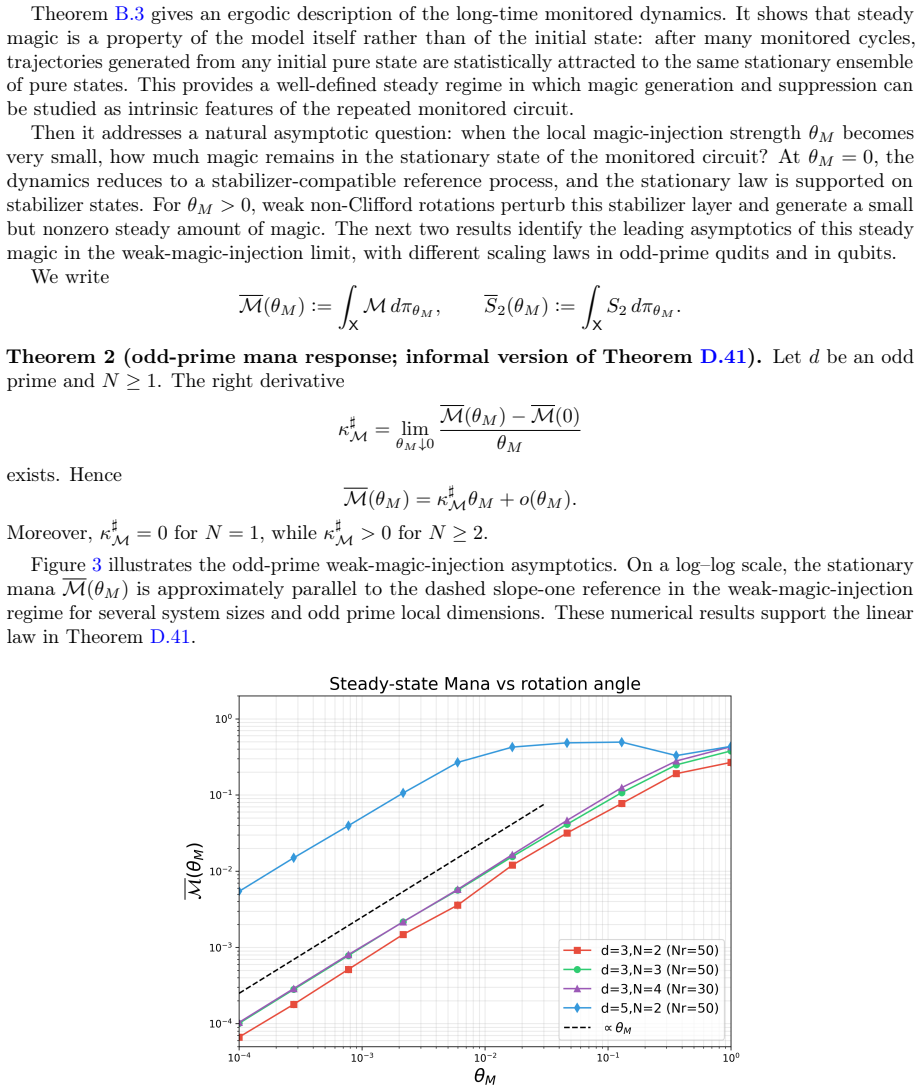
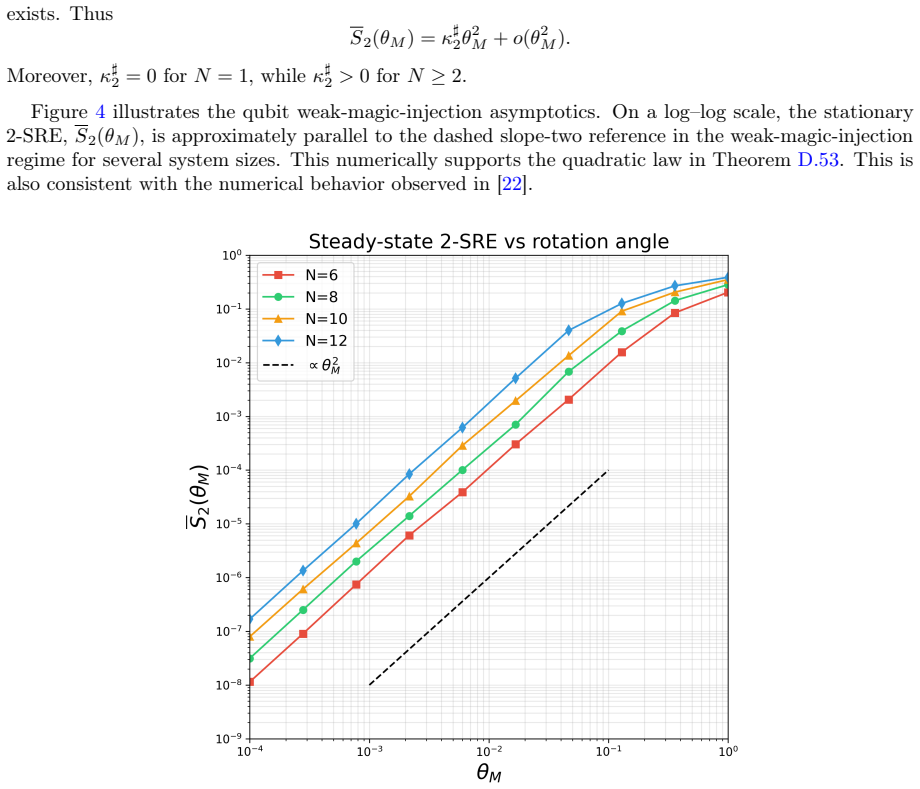
We prove the existence and uniqueness of the stationary law for the monitored quantum circuit dynamics, giving an ergodic description of the long-time behavior. In the weak-magic-injection limit, the steady Gross-Wigner mana has a linear leading asymptotic in odd-prime local dimension, while the steady 2-stabilizer Rényi entropy has a quadratic leading asymptotic in qubit systems.
What carries the argument
The stationary law derived from the random Clifford-driven monitored circuits, which supports the ergodic description and enables calculation of the magic asymptotics under weak non-Clifford injection.
If this is right
- The long-time dynamics become independent of initial conditions due to the unique stationary distribution.
- Steady-state magic content is determined by the scaling of the injection strength and the choice of resource measure.
- The power of the leading asymptotic reflects the local geometry of each magic measure around the stabilizer states.
- This framework allows analytical treatment of the competition between scrambling, measurements, and resource injection.
Where Pith is reading between the lines
- The difference in scaling suggests that qubit systems suppress magic accumulation more strongly near the stabilizer layer compared to higher-dimensional systems.
- Similar stationary laws might exist for other types of monitored dynamics or different gate sets.
- The results could be extended to study how magic affects measurement-induced phase transitions in these circuits.
- Experimental verification could involve preparing small quantum circuits and measuring the relevant resource quantifiers in the steady state.
Load-bearing premise
The monitored circuits are driven exclusively by random Clifford gates with only weak non-Clifford perturbations in the weak-magic-injection scaling regime.
What would settle it
A numerical computation of the steady-state Gross-Wigner mana for small odd-prime dimensional systems or 2-stabilizer Rényi entropy for qubits, in the limit of vanishing magic injection strength, that deviates from the predicted linear or quadratic scaling would falsify the asymptotics.
Figures


read the original abstract
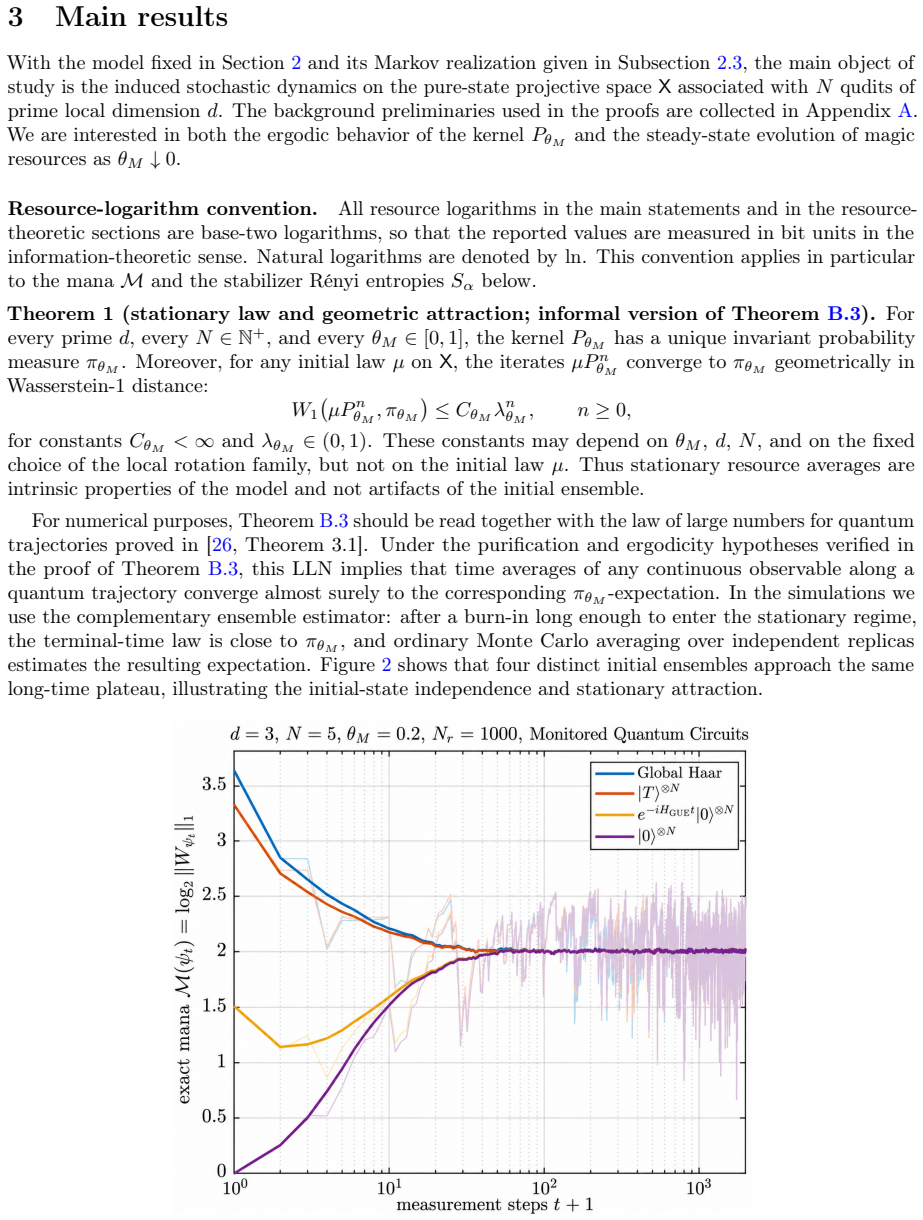
Monitored quantum circuits provide a natural setting in which scrambling, measurements, and measurement-conditioned updates compete within a stochastic many-body dynamics. From the viewpoint of nonstabilizer resource theory, this competition is especially relevant because Clifford-compatible operations preserve the stabilizer structure, while weak non-Clifford perturbations inject magic resource. Most of the existing understanding of monitored quantum circuits has been shaped by numerical simulations and phenomenological descriptions, while a rigorous dynamics theory remains less developed. In this paper, we address this gap by developing an analytical framework which lays a rigorous mathematical foundation for the study of random monitored quantum dynamics. Specifically, we study a class of monitored quantum circuits driven by random Clifford. We prove the existence and uniqueness of the stationary law, which gives an ergodic description of the long-time dynamics. We then resolve the leading asymptotics of steady magic in the weak-magic-injection limit. This tangent description makes the contrast between resource measures transparent: in odd-prime local dimension, the steady Gross--Wigner mana has a linear leading asymptotic, whereas in qubit systems the steady 2-stabilizer R\'enyi entropy has a quadratic leading asymptotic. These different powers reflect the distinct local geometries of the two resource measures near the stabilizer layer. In this way, this work develops an analytical framework that first establishes the stationary ergodic dynamics of random monitored quantum circuits.
Editorial analysis
A structured set of objections, weighed in public.
Referee Report
Summary. The paper develops an analytical framework for random monitored quantum circuits driven exclusively by random Clifford gates with weak non-Clifford perturbations. It proves existence and uniqueness of the stationary law of the induced Markov process, yielding an ergodic description of the long-time dynamics. It then derives the leading asymptotics of steady-state magic in the weak-magic-injection limit, establishing a linear leading term for the Gross-Wigner mana in odd-prime local dimension and a quadratic leading term for the 2-stabilizer Rényi entropy in qubit systems; these scalings are attributed to the distinct local geometries of the two resource measures near the stabilizer layer.
Significance. If the claimed proofs and expansions hold, the work supplies a rigorous ergodic-theory foundation for magic-resource dynamics in monitored circuits, replacing purely numerical or phenomenological descriptions with an explicit stationary measure and perturbative asymptotics. The explicit contrast between linear and quadratic vanishing orders, tied to local geometry, is a clear conceptual advance in resource theory.
major comments (2)
- [Abstract] Abstract (and the model definition): the existence/uniqueness proof for the stationary law is asserted for the Markov process generated by random Clifford gates plus weak non-Clifford injection, yet no explicit construction of the transition kernel, compactness argument, or application of standard ergodic theorems (e.g., on the space of density operators) is visible; without these steps the claim that the stationary law is unique and ergodic cannot be verified.
- [Abstract] Abstract (weak-magic-injection asymptotics): the linear leading term for Gross-Wigner mana (odd-prime dimension) and quadratic term for 2-stabilizer Rényi entropy (qubits) are stated as following from a perturbative expansion around the stabilizer layer, but no explicit Taylor expansion, error bound, or scaling assumption on the injection strength is provided; the claimed powers therefore rest on an unshown local-geometry calculation.
minor comments (2)
- The double-dash notation “Gross--Wigner mana” should be standardized to the conventional single hyphen or the full name with citation.
- [Abstract] The phrase “tangent description” in the final sentence of the abstract is unclear; a more precise statement of the perturbative regime would improve readability.
Simulated Author's Rebuttal
We thank the referee for the thoughtful report and constructive suggestions. We address each major comment below. The full manuscript contains the detailed proofs referenced in the abstract; we will revise the abstract and model section to improve visibility of the key steps without altering the results.
read point-by-point responses
-
Referee: [Abstract] Abstract (and the model definition): the existence/uniqueness proof for the stationary law is asserted for the Markov process generated by random Clifford gates plus weak non-Clifford injection, yet no explicit construction of the transition kernel, compactness argument, or application of standard ergodic theorems (e.g., on the space of density operators) is visible; without these steps the claim that the stationary law is unique and ergodic cannot be verified.
Authors: The transition kernel is constructed explicitly in Section II as the composition of random Clifford unitaries (drawn uniformly from the Clifford group) followed by weak non-Clifford injections at each site. The state space is the compact convex set of density operators on a finite-dimensional Hilbert space, which is compact in the trace norm. Irreducibility follows from the fact that the Clifford group generates a transitive action on stabilizer states while the weak injections ensure positive probability of reaching any magic direction; aperiodicity is immediate from the continuous-time embedding. These properties allow direct application of the standard ergodic theorem for Markov processes on compact metric spaces, yielding uniqueness of the stationary measure. We will add a one-sentence pointer to Section II in the abstract and expand the model definition paragraph to name the compactness and ergodicity arguments. revision: partial
-
Referee: [Abstract] Abstract (weak-magic-injection asymptotics): the linear leading term for Gross-Wigner mana (odd-prime dimension) and quadratic term for 2-stabilizer Rényi entropy (qubits) are stated as following from a perturbative expansion around the stabilizer layer, but no explicit Taylor expansion, error bound, or scaling assumption on the injection strength is provided; the claimed powers therefore rest on an unshown local-geometry calculation.
Authors: The local-geometry calculation appears in Section IV (and Appendix B). For odd-prime dimension the mana is expanded to first order in the injection strength ε; the linear term is the directional derivative of the mana functional at the stabilizer boundary, which is nonzero. For qubits the 2-stabilizer Rényi entropy has vanishing first derivative at the stabilizer layer, so the leading term is quadratic and given by the Hessian; an explicit error bound O(ε^3) is derived from the C^3 smoothness of both functionals on the compact set of states. The scaling assumption is ε → 0 with system size fixed. We will insert a brief clause in the abstract referencing this expansion and the resulting powers. revision: partial
Circularity Check
No significant circularity detected
full rationale
The derivation establishes existence and uniqueness of the stationary measure for the Markov process generated by random Clifford gates plus weak non-Clifford perturbations via standard ergodic-theory arguments on compact state spaces, followed by local Taylor expansions of the resource measures (linear vanishing of mana in odd-prime dimension, quadratic for qubit 2-Rényi entropy). These steps rely on the stated circuit assumptions and local geometry of the quantifiers rather than any fitted parameters, self-citations, or ansatzes that reduce the claims to their inputs by construction. The framework is self-contained against external benchmarks of Markov-chain ergodicity and perturbative analysis.
Axiom & Free-Parameter Ledger
Reference graph
Works this paper leans on
-
[1]
Brian Skinner, Jonathan Ruhman, and Adam Nahum. Measurement-induced phase transitions in the dynamics of entanglement.Physical Review X, 9:031009, 2019. doi: 10.1103/PhysRevX.9.031009
-
[2]
Soonwon Choi, Yimu Bao, Xiao-Liang Qi, and Ehud Altman. Quantum error correction in scrambling dynamics and measurement-induced phase transition.Physical Review Letters, 125:030505, 2020. doi: 10.1103/PhysRevLett.125.030505
-
[3]
Michael J. Gullans and David A. Huse. Dynamical purification phase transition induced by quantum measurements.Physical Review X, 10:041020, 2020. doi: 10.1103/PhysRevX.10.041020
-
[4]
Google Quantum AI and Collaborators. Measurement-induced entanglement and teleportation on a noisy quantum processor.Nature, 622:481–486, 2023. doi: 10.1038/s41586-023-06505-7
-
[5]
PhD thesis, California Institute of Technology, 1997
Daniel Eric Gottesman.Stabilizer Codes and Quantum Error Correction. PhD thesis, California Institute of Technology, 1997. arXiv:quant-ph/9705052
Pith/arXiv arXiv 1997
-
[6]
Improved simulation of Stabilizer circuits.Physical Review A, 70:052328, 2004
Scott Aaronson and Daniel Gottesman. Improved simulation of Stabilizer circuits.Physical Review A, 70:052328, 2004. doi: 10.1103/PhysRevA.70.052328
-
[7]
Sergey Bravyi and Alexei Kitaev. Universal quantum computation with ideal Clifford gates and noisy ancillas.Physical Review A, 71:022316, 2005. doi: 10.1103/PhysRevA.71.022316
-
[8]
Earl T. Campbell, Barbara M. Terhal, and Christophe Vuillot. Roads towards fault-tolerant universal quantum computation.Nature, 549(7671):172–179, 2017. doi: 10.1038/nature23460
-
[9]
Sergey Bravyi and David Gosset. Improved classical simulation of quantum circuits dominated by Clifford gates.Physical Review Letters, 116:250501, 2016. doi: 10.1103/PhysRevLett.116.250501
-
[10]
David Gross. Hudson’s theorem for finite-dimensional quantum systems.Journal of Mathematical Physics, 47(12):122107, 2006. doi: 10.1063/1.2393152. 14
-
[11]
Negative quasi-probability as a resource for quantum computation.New Journal of Physics, 14:113011, 2012
Victor Veitch, Christopher Ferrie, David Gross, and Joseph Emerson. Negative quasi-probability as a resource for quantum computation.New Journal of Physics, 14:113011, 2012. doi: 10.1088/ 1367-2630/14/11/113011
2012
-
[12]
Victor Veitch, S. A. Hamed Mousavian, Daniel Gottesman, and Joseph Emerson. The resource theory of stabilizer quantum computation.New Journal of Physics, 16:013009, 2014. doi: 10.1088/ 1367-2630/16/1/013009
2014
-
[13]
Wallman, Victor Veitch, and Joseph Emerson
Mark Howard, Joel J. Wallman, Victor Veitch, and Joseph Emerson. Contextuality supplies the ‘magic’ for quantum computation.Nature, 510(7505):351–355, 2014. doi: 10.1038/nature13460
-
[14]
Mark Howard and Earl T. Campbell. Application of a resource theory for magic states to fault-tolerant quantum computing.Physical Review Letters, 118:090501, 2017. doi: 10.1103/PhysRevLett.118. 090501
-
[15]
Xin Wang, Mark M. Wilde, and Yuan Su. Efficiently computable bounds for magic state distillation. Physical Review Letters, 124:090505, 2020. doi: 10.1103/PhysRevLett.124.090505
-
[16]
Lorenzo Leone, Salvatore F. E. Oliviero, and Alioscia Hamma. Stabilizer Rényi entropy.Physical Review Letters, 128:050402, 2022. doi: 10.1103/PhysRevLett.128.050402
-
[17]
Stabilizer entropies and nonstabilizerness monotones.Quantum, 7: 1092, 2023
Tobias Haug and Lorenzo Piroli. Stabilizer entropies and nonstabilizerness monotones.Quantum, 7: 1092, 2023. doi: 10.22331/q-2023-08-28-1092
-
[18]
Stabilizer entropies are monotones for magic-state resource theory
Lorenzo Leone and Lennart Bittel. Stabilizer entropies are monotones for magic-state resource theory. Physical Review A, 110:L040403, 2024. doi: 10.1103/PhysRevA.110.L040403
-
[19]
Pradeep Niroula, Christopher David White, Qingfeng Wang, Sonika Johri, Daiwei Zhu, Christopher Monroe, Crystal Noel, and Michael J. Gullans. Phase transition in magic with random quantum circuits.Nature Physics, 20:1786–1792, 2024. doi: 10.1038/s41567-024-02637-3
-
[20]
Dynamical magic transitions in monitored Clifford+Tcircuits.PRX Quantum, 5:030332, 2024
Mircea Bejan, Campbell McLauchlan, and Benjamin Béri. Dynamical magic transitions in monitored Clifford+Tcircuits.PRX Quantum, 5:030332, 2024. doi: 10.1103/PRXQuantum.5.030332
-
[21]
Fux, Emanuele Tirrito, Marcello Dalmonte, and Rosario Fazio
Gerald E. Fux, Emanuele Tirrito, Marcello Dalmonte, and Rosario Fazio. Entanglement– nonstabilizerness separation in hybrid quantum circuits.Physical Review Research, 6:L042030,
-
[22]
doi: 10.1103/PhysRevResearch.6.L042030
-
[23]
Annarita Scocco, Wai-Keong Mok, Leandro Aolita, Mario Collura, and Tobias Haug. Rise and fall of nonstabilizerness via random measurements.Physical Review Research, 8(1):013217, 2026. doi: 10.1103/31sq-k4m3
-
[24]
Magic transition in measurement-only circuits.npj Quantum Information, 11:166, 2025
Poetri Sonya Tarabunga and Emanuele Tirrito. Magic transition in measurement-only circuits.npj Quantum Information, 11:166, 2025. doi: 10.1038/s41534-025-01104-y
-
[25]
Magic spreading in random quantum circuits
Xhek Turkeshi, Emanuele Tirrito, and Piotr Sierant. Magic spreading in random quantum circuits. Nature Communications, 16:2575, 2025. doi: 10.1038/s41467-025-57704-x
-
[26]
Tristan Benoist, Martin Fraas, Yan Pautrat, and Clément Pellegrini. Invariant measure for quantum trajectories.Probability Theory and Related Fields, 174(1–2):307–334, 2019. doi: 10.1007/s00440-018-0862-9
-
[27]
Limit theorems for quantum trajectories
Tristan Benoist, Jan-Luka Fatras, and Clément Pellegrini. Limit theorems for quantum trajectories. Stochastic Processes and their Applications, 164:288–310, 2023. doi: 10.1016/j.spa.2023.07.014
-
[28]
Mark Howard and Jirí Vala. Qudit versions of the qubit “pi-over-eight” gate.Physical Review A, 86 (2):022316, 2012. doi: 10.1103/PhysRevA.86.022316
-
[29]
Third moments of qudit Clifford orbits and 3-designs based on magic orbits, 2024
Huangjun Zhu, Chengsi Mao, and Changhao Yi. Third moments of qudit Clifford orbits and 3-designs based on magic orbits, 2024. arXiv preprint arXiv:2410.13575; DOI: 10.48550/arXiv.2410.13575
-
[30]
Optimal Transport: Old and New, volume 338 of Grundlehren der mathematischen Wissenschaften
Cédric Villani.Optimal Transport: Old and New, volume 338 ofGrundlehren der mathematischen Wissenschaften. Springer, Berlin, 2009. doi: 10.1007/978-3-540-71050-9. 15
-
[31]
Billingsley.Convergence of probability measures
Patrick Billingsley.Convergence of Probability Measures. Wiley Series in Probability and Statistics. John Wiley & Sons, New York, second edition, 1999. doi: 10.1002/9780470316962
-
[32]
Tweedie.Markov Chains and Stochastic Stability
Sean Meyn and Richard L. Tweedie.Markov Chains and Stochastic Stability. Cambridge University Press, Cambridge, second edition, 2009
2009
-
[33]
Springer, Cham, third edition, 2021
Olav Kallenberg.Foundations of Modern Probability, volume 99 ofProbability Theory and Stochastic Modelling. Springer, Cham, third edition, 2021. doi: 10.1007/978-3-030-61871-1
-
[34]
Lower bounds on the non-Clifford resources for quantum computations.Quantum Science and Technology, 5(3):035009,
Michael Beverland, Earl Campbell, Mark Howard, and Vadym Kliuchnikov. Lower bounds on the non-Clifford resources for quantum computations.Quantum Science and Technology, 5(3):035009,
-
[35]
doi: 10.1088/2058-9565/ab8963
-
[36]
Lower bound for theT count via unitary stabilizer nullity.Physical Review Applied, 19:034052, 2023
Jiaqing Jiang and Xin Wang. Lower bound for theT count via unitary stabilizer nullity.Physical Review Applied, 19:034052, 2023. doi: 10.1103/PhysRevApplied.19.034052
-
[37]
David Gross, Koenraad Audenaert, and Jens Eisert. Evenly distributed unitaries: On the structure of unitary designs.Journal of Mathematical Physics, 48(5):052104, 2007. doi: 10.1063/1.2716992
-
[38]
Christoph Dankert, Richard Cleve, Joseph Emerson, and Etera Livine. Exact and approximate unitary2-designs and their application to fidelity estimation.Physical Review A, 80:012304, 2009. doi: 10.1103/PhysRevA.80.012304
-
[39]
Multiqubit Clifford groups are unitary 3-designs.Physical Review A, 96(6):062336,
Huangjun Zhu. Multiqubit Clifford groups are unitary 3-designs.Physical Review A, 96(6):062336,
-
[40]
doi: 10.1103/PhysRevA.96.062336
-
[41]
William Fulton and Joe Harris.Representation Theory: A First Course, volume 129 ofGraduate Texts in Mathematics. Springer, New York, 1991. doi: 10.1007/978-1-4612-0979-9
-
[42]
Cambridge University Press, Cambridge, 2018
John Watrous.The Theory of Quantum Information. Cambridge University Press, Cambridge, 2018. doi: 10.1017/9781316848142
-
[43]
Xin Wang, Mark M. Wilde, and Yuan Su. Quantifying the magic of quantum channels.New Journal of Physics, 21(10):103002, oct 2019. doi: 10.1088/1367-2630/ab451d
-
[44]
Stability of the spectrum for transfer operators.Annali della Scuola Normale Superiore di Pisa - Classe di Scienze, Ser
Gerhard Keller and Carlangelo Liverani. Stability of the spectrum for transfer operators.Annali della Scuola Normale Superiore di Pisa - Classe di Scienze, Ser. 4, 28(1):141–152, 1999
1999
-
[45]
Springer-Verlag, Berlin–Heidelberg–New York, 1969
Marius Iosifescu and Radu Theodorescu.Random Processes and Learning, volume 150 ofGrundlehren der mathematischen Wissenschaften. Springer-Verlag, Berlin–Heidelberg–New York, 1969
1969
-
[46]
Frank Norman.Markov Processes and Learning Models, volume 84 ofMathematics in Science and Engineering
M. Frank Norman.Markov Processes and Learning Models, volume 84 ofMathematics in Science and Engineering. Academic Press, New York, 1972
1972
-
[47]
Martin Hairer and Andrew J. Majda. A simple framework to justify linear response theory.Nonlin- earity, 23(4):909–922, 2010. doi: 10.1088/0951-7715/23/4/008
-
[48]
C. T. Ionescu Tulcea and G. Marinescu. Théorie ergodique pour des classes d’opérations non complètement continues.Annals of Mathematics, 52(1):140–147, 1950. doi: 10.2307/1969514. 16 Appendix A Preliminaries This appendix records the probabilistic, Pauli–Clifford, and resource-theoretic facts used later. We state them in the form needed in the proofs and ...
-
[49]
If xmeas ∈H ψ, then ψ is already an eigenstate of any representative of¯Pmeas, so the nonzero post-measurement state equalsψandν d(ϕ) =ν d(ψ)
-
[50]
Hence Stabd,N(ϕ)contains the abelian subgroup corresponding to the subspace Hψ + Fdxmeas, whose cardinality isd|H ψ|
If xmeas ∈H ⊥ ψ \H ψ, then every phase-free Pauli class corresponding to an element ofHψ still stabilizes ϕ, and the class ¯Pmeas itself also stabilizes ϕ with the observed eigenvalue. Hence Stabd,N(ϕ)contains the abelian subgroup corresponding to the subspace Hψ + Fdxmeas, whose cardinality isd|H ψ|. Therefore, |Stab d,N(ϕ)| ≥d|H ψ|,soν d(ϕ)≤ν d(ψ)−1
-
[51]
first zero step
Finally, ifxmeas /∈H⊥ ψ, consider the commutator character χxmeas : Hψ →F d, P measPh =ω χxmeas(h)PhPmeas, where Ph is any Pauli representative of the class corresponding toh∈H ψ. Since xmeas /∈H⊥ ψ, this homomorphism is nontrivial, so its kernelK := kerχ xmeas has cardinality |K| = |Hψ|/d. Every class corresponding to h∈K commutes with ¯Pmeas and still s...
-
[52]
There exists a constantCLR <∞such that 0≤ M(θM)≤C LR θM ,0≤θ M ≤1.(212)
-
[53]
There exists a unique zero-mean Poisson solution uM := (I−P 0)−1M= ∞X n=0 P n 0 M ∈ B 1, π 0(uM) = 0,(213) where the inversion operator(I−P 0)−1 is defined in B1,0 :={f∈ B 1 : π0(f) = 0}. 94
-
[54]
Webeginbyverifyingthattheodd-primemanaobservablehastheregularityrequiredbytheperturbative framework developed above
For everyθM ∈[0,1]one has the exact identity M(θM) =π θM (PθM −P 0)uM .(214) Moreover, M(θM) = ∞X n=0 πθM (PθM −P 0)P n 0 M ,(215) and the seriesP∞ n=0(PθM −P 0)P n 0 Mis absolutely convergent in(C(X),∥ · ∥ 0). Webeginbyverifyingthattheodd-primemanaobservablehastheregularityrequiredbytheperturbative framework developed above. In particular, we show thatM ...
-
[55]
for everyn≥0,h n ∈ H2 andh n ≥0
-
[56]
there existCh <∞andρ h ∈(0,1)such that, for everyn≥0, ∥hn∥H2 ≤C hρn h.(291) Consequently, for everyn≥0and every(s, v)∈ bX2, 0≤h n(s, v)≤C hρn h∥v∥2.(292) 118
-
[57]
Since q∈ H 2 and zn ∈ H 2 for all n≥ 0, where H2 is the class of Definition D.25, the recursion(290) and the boundedness ofeP2 on H2 imply inductively thathn ∈ H2 for everyn≥0
for everyn≥0and everyR <∞, sup s∈S(2) stab,∥v∥≤R (P n 0 S2)((κ(2) s )−1(θv)) θ2 −h n(s, v) − − → θ↓0 0.(293) Proof.We first prove (i) and (ii). Since q∈ H 2 and zn ∈ H 2 for all n≥ 0, where H2 is the class of Definition D.25, the recursion(290) and the boundedness ofeP2 on H2 imply inductively thathn ∈ H2 for everyn≥0. Moreover,q≥0,z n ≥0, and eP2 is posi...
-
[58]
for everyn∈N, everyθ M ∈[0,1], and everyf∈ B 1, ∥P n θM f∥0 ≤C 1M n∥f∥0;(379)
-
[59]
for everyn∈N, everyθ M ∈[0,1], and everyf∈ B 1, ∥P n θM f∥ B1 ≤C 2βn∥f∥ B1 +C 3M n∥f∥0;(380)
-
[60]
for everyθ M ∈[0,1], the part ofσ(P θM )lying in{|z|> β}contains no residual spectrum
-
[61]
(i) Fixδ >0andr∈(β, M), and set η := ln(r/β) ln(M/β) >0, V δ,r :={z∈C : |z| ≤rordist(z, σ(P 0))≤δ}
for everyθ M ∈[0,1], |||PθM −P 0||| ≤τ(θ M).(381) Then the following conclusions hold. (i) Fixδ >0andr∈(β, M), and set η := ln(r/β) ln(M/β) >0, V δ,r :={z∈C : |z| ≤rordist(z, σ(P 0))≤δ}. Then there exist constants θ0 = θ0(δ, r) > 0, AKL(r) > 0, BKL(δ, r) > 0, CKL(δ, r) > 0and DKL(δ, r)>0such that for0≤θ M ≤θ 0 andz∈C\V δ,r ∥(z−P θM )−1f∥ B1 ≤A KL∥f∥ B1 +B...
-
[62]
For any fixedδ > 0and r∈ (γ, 1), there exist constantsθ0 = θ0(δ, r) > 0, AKL(r) > 0, BKL(δ, r) > 0, CKL(δ, r)>0andD KL(δ, r)>0such that for0≤θ M ≤θ 0 andz∈C\V δ,r ∥(z−P θM )−1f∥ B1 ≤A KL∥f∥ B1 +B KL∥f∥0,∀f∈ B 1,(382) and |||(z−P θM )−1 −(z−P 0)−1||| ≤τ(θ M)η CKL∥(z−P 0)−1∥B1→B1 +D KL∥(z−P 0)−1∥2 B1→B1 (383) where τ(θM) = C∗θM for some constantC∗ > 0indepe...
-
[63]
For each fixedθM ∈[0,1]there existsr ∗(θM)∈(0,1)such that σ(PθM )∩ {|z|> r ∗(θM)}={1}.(385) In particular,1is the unique peripheral eigenvalue ofPθM; its eigenspace is one-dimensional, and in fact1is algebraically simple. Proof. Step 1: verification of (379).Since PθM is a Markov operator, for everyn∈N , every θM ∈[0,1], and everyf∈ B 1 = Lip(X), we have ...
discussion (0)
Sign in with ORCID, Apple, or X to comment. Anyone can read and Pith papers without signing in.