Overview of the Theory of Extremely Correlated Fermi Liquids
Pith reviewed 2026-06-27 05:27 UTC · model grok-4.3
The pith
The ECFL theory accounts for density-dependent linear resistivity and small quasiparticle weight in single-layer high-Tc cuprates using the t-J model near the Mott limit.
A machine-rendered reading of the paper's core claim, the machinery that carries it, and where it could break.
Core claim
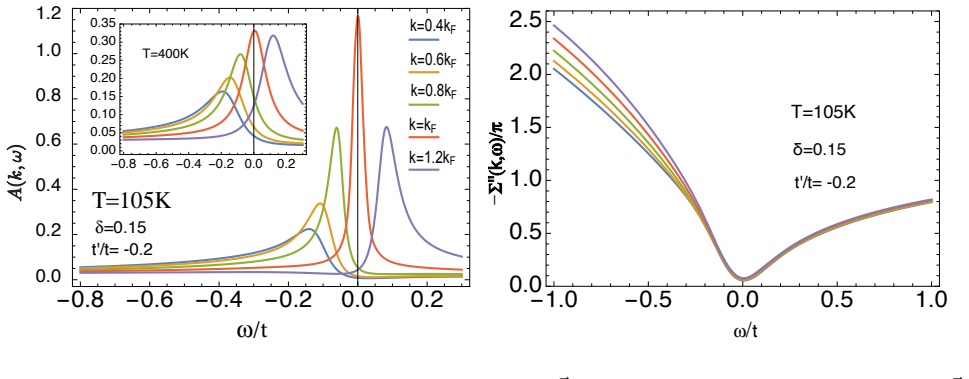
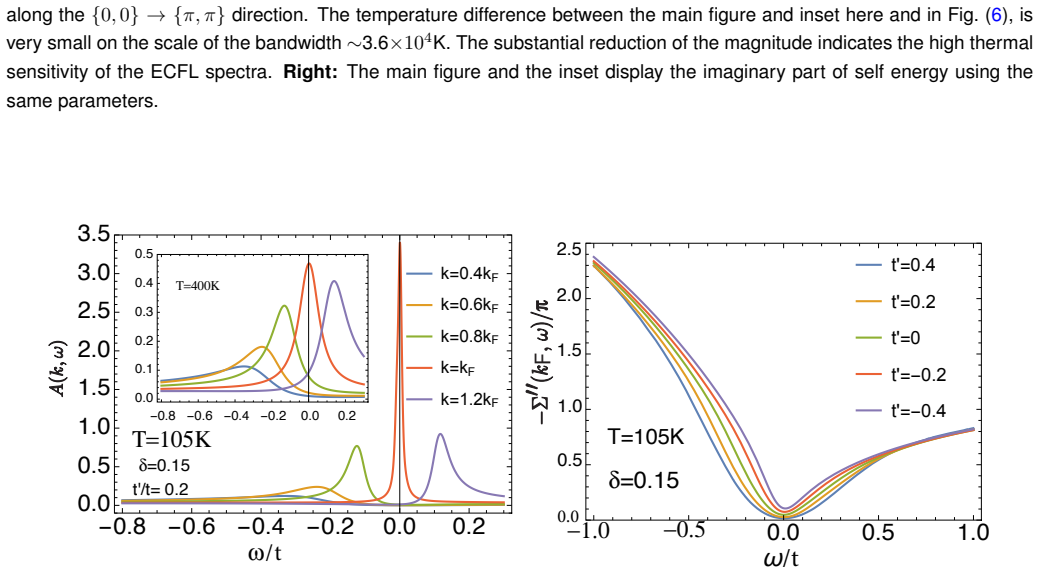
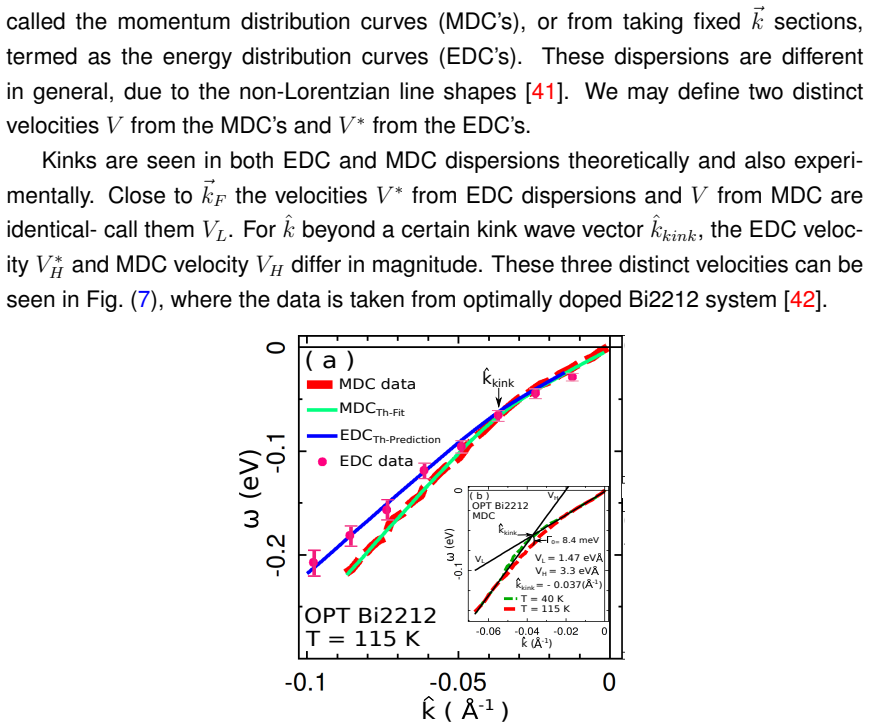
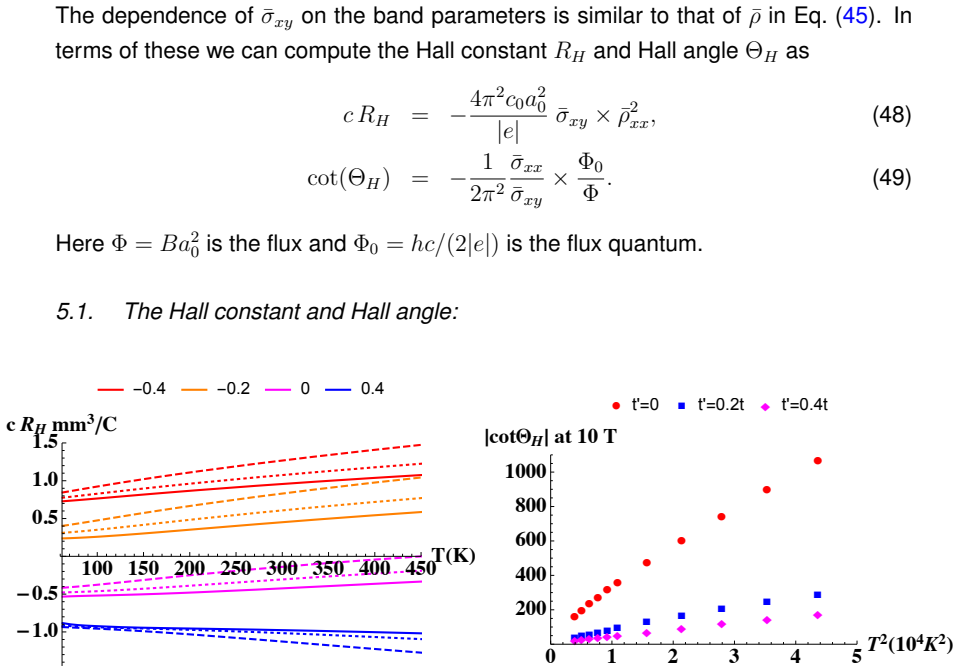
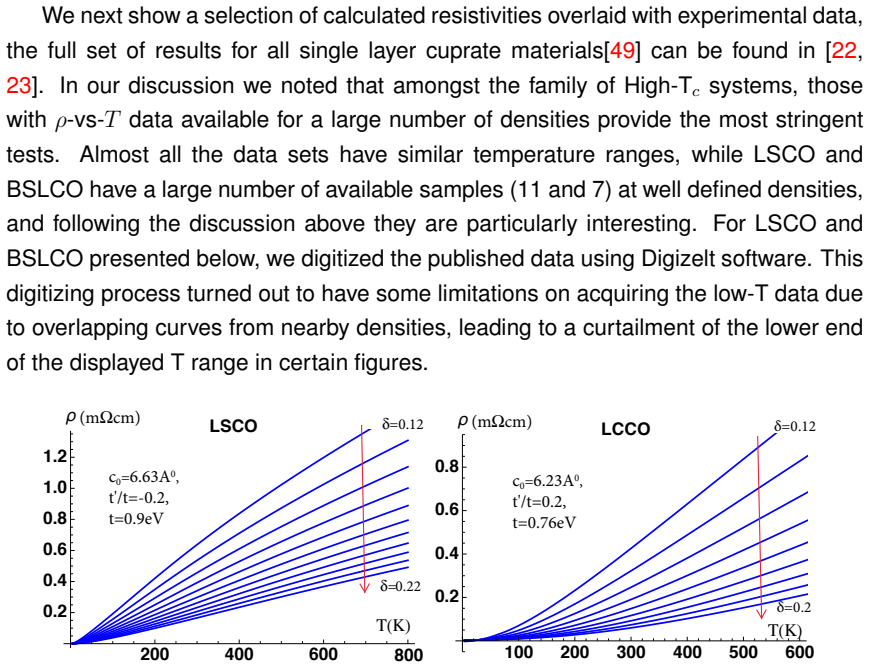
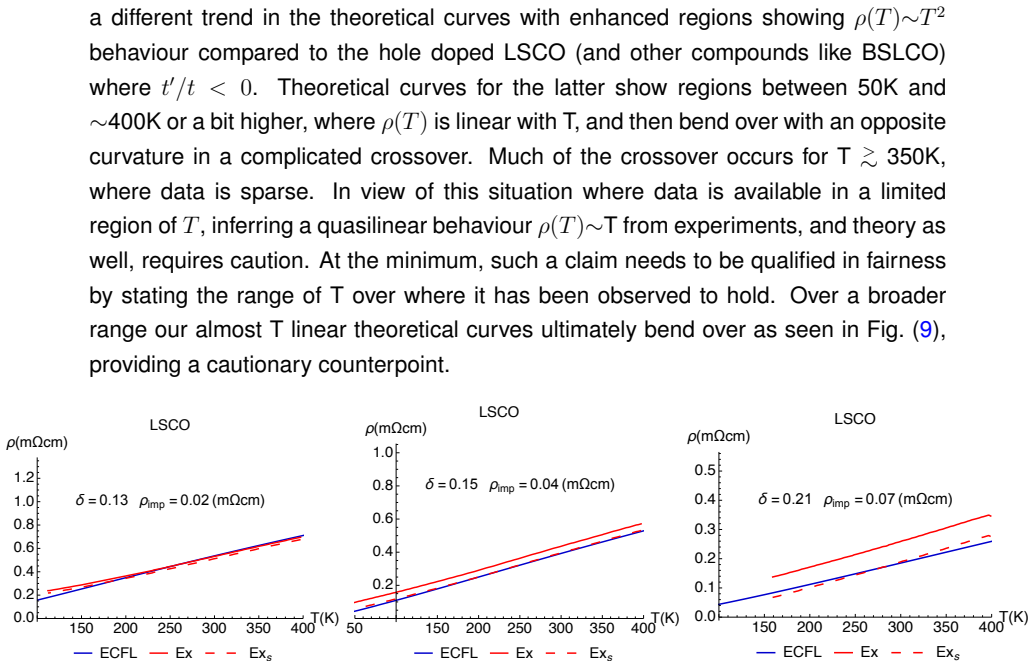
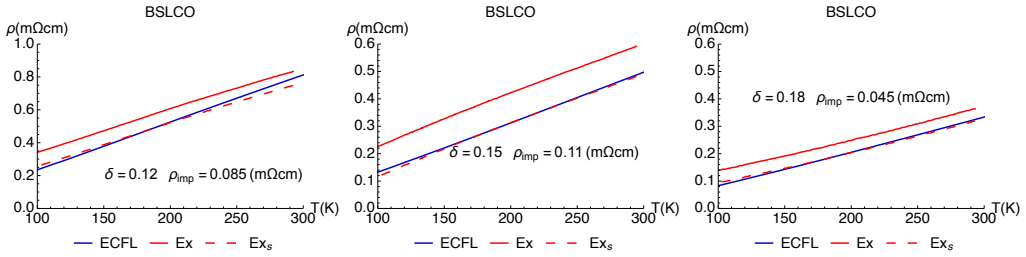
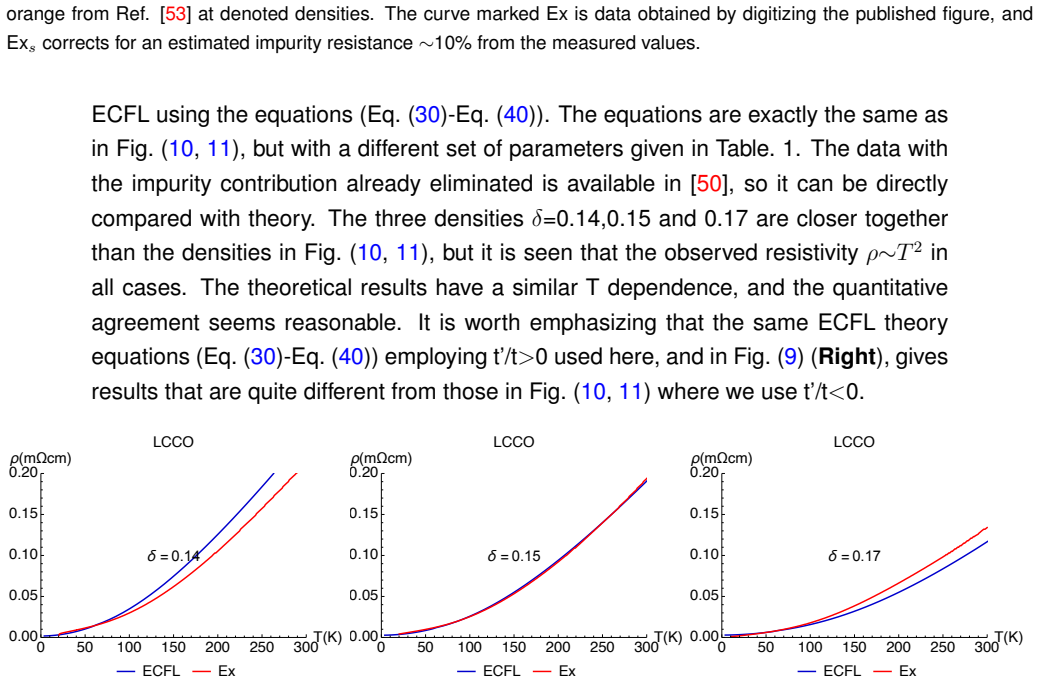
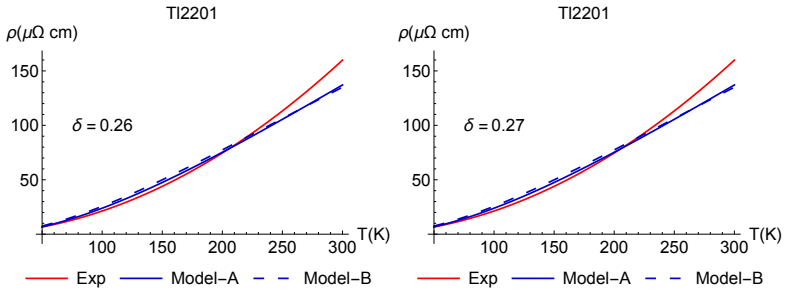
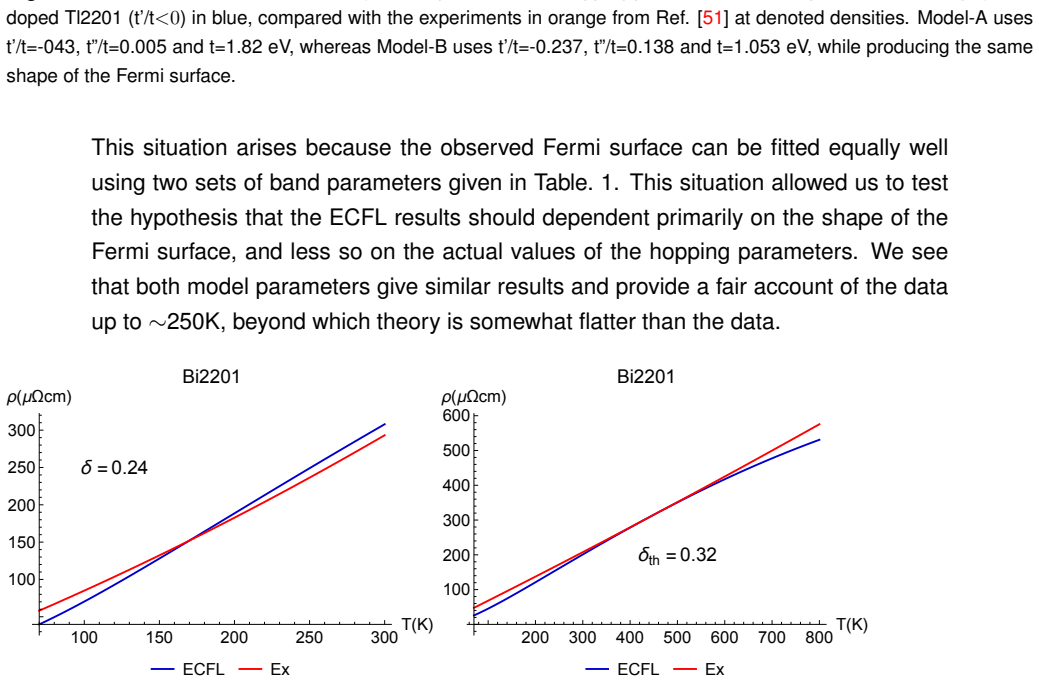
The ECFL theory yields a density dependent quasilinear T-dependence in resistivity, an unusually small quasiparticle weight, and distinct low-temperature emergent scales that dominate transport, thermodynamics and spectral properties of single-layer High Tc systems, as demonstrated through comparisons with experimental resistivity and spectral data.
What carries the argument
The ECFL approximation applied to the t-J model, which generates the Green's function equations and spectral properties incorporating extreme correlations near the Mott limit.
If this is right
- Resistivity displays a quasilinear T-dependence that depends on carrier density.
- The quasiparticle weight remains unusually small across the relevant doping range.
- Distinct low-temperature emergent scales govern transport, thermodynamics, and spectral properties.
- These predictions align with available data from single-layer high-Tc materials.
Where Pith is reading between the lines
- The same framework could be tested for consistency with thermodynamic quantities such as specific heat in the same systems.
- Similar emergent scales might appear in other doped Mott insulators outside the cuprate family.
- Targeted experiments on the density dependence of the resistivity slope could provide a direct test independent of spectral data.
Load-bearing premise
The t-J model plus the ECFL approximation accurately captures the low-energy physics of single-layer high-Tc cuprates close to the Mott insulating limit.
What would settle it
A resistivity measurement in single-layer high-Tc systems showing temperature dependence that does not vary with density in the predicted quasilinear manner, or spectral functions inconsistent with the calculated small quasiparticle weight.
Figures
read the original abstract
The Extremely Correlated Fermi Liquids (ECFL) theory is reviewed as a framework for understanding the $t$-$J$ model in metallic systems close to the Mott insulating limit. This overview presents the underlying ideas and the resulting equations in a form accessible to nonexperts. We compare theoretical results with all available resistivity data for single-layer High-T$_{c}$ systems, and with some spectral data. The highlighted results include a density dependent quasilinear T-dependence in resistivity, an unusually small quasiparticle weight, and distinct low-temperature emergent scales that dominate transport, thermodynamics and spectral properties of single-layer High T$_c$ systems. Suggestions are made for further experiments to probe the physics of these challenging quantum many-body systems.
Editorial analysis
A structured set of objections, weighed in public.
Referee Report
Summary. The manuscript is an overview of the Extremely Correlated Fermi Liquids (ECFL) theory as a framework for the t-J model in metallic systems near the Mott insulating limit. It presents the underlying ideas and resulting equations accessibly, then compares theoretical results to all available resistivity data for single-layer high-Tc systems and some spectral data. Key highlighted outputs include a density-dependent quasilinear T-dependence in resistivity, an unusually small quasiparticle weight, and distinct low-temperature emergent scales dominating transport, thermodynamics, and spectral properties.
Significance. If the ECFL approximation is valid, the work supplies a coherent theoretical account of several anomalous features in single-layer cuprates, including specific predictions for resistivity and spectral functions that could guide further experiments. The accessible presentation of the integral equations and the breadth of resistivity comparisons constitute a useful service to the field.
major comments (2)
- [Abstract and approximation scheme sections] The central claim that ECFL applied to the t-J model reproduces the observed density-dependent quasilinear resistivity and small Z rests on the validity of the ECFL projection/approximation near half-filling; the manuscript presents the resulting equations and numerical solutions but supplies no independent verification such as recovery of known limits, comparison to exact diagonalization, or DMFT on the identical Hamiltonian (see abstract and the sections describing the approximation scheme).
- [Abstract] Experimental comparisons inherit the uncertainty of the uncontrolled approximation; the abstract asserts matches to resistivity and spectral data, yet the manuscript does not report quantitative fit metrics, error bars, or controls for post-hoc parameter choices that would allow assessment of whether the agreement is robust (abstract).
minor comments (2)
- Notation for the auxiliary-particle representation and the projection operator should be defined explicitly on first use to aid non-expert readers.
- Figure captions for resistivity plots should state the precise doping values, temperature ranges, and any fitting windows used.
Simulated Author's Rebuttal
We thank the referee for the careful reading and constructive feedback on our overview manuscript. We address each major comment below.
read point-by-point responses
-
Referee: [Abstract and approximation scheme sections] The central claim that ECFL applied to the t-J model reproduces the observed density-dependent quasilinear resistivity and small Z rests on the validity of the ECFL projection/approximation near half-filling; the manuscript presents the resulting equations and numerical solutions but supplies no independent verification such as recovery of known limits, comparison to exact diagonalization, or DMFT on the identical Hamiltonian (see abstract and the sections describing the approximation scheme).
Authors: The ECFL projection and resulting integral equations are derived in a sequence of earlier papers, where recovery of known limits (such as the Fermi liquid regime at low doping) has been demonstrated analytically and numerically. This manuscript is an overview that focuses on presenting the equations accessibly and applying the results to experimental data rather than repeating those benchmarks. We agree that a brief reference to those prior validations would be helpful and will add a short clarifying paragraph in the approximation scheme section. New direct comparisons to ED or DMFT on the identical Hamiltonian are outside the scope of an overview paper. revision: partial
-
Referee: [Abstract] Experimental comparisons inherit the uncertainty of the uncontrolled approximation; the abstract asserts matches to resistivity and spectral data, yet the manuscript does not report quantitative fit metrics, error bars, or controls for post-hoc parameter choices that would allow assessment of whether the agreement is robust (abstract).
Authors: The comparisons shown are qualitative, illustrating that the theory captures the observed trends (density-dependent quasilinear resistivity, small Z, and emergent scales) across multiple compounds. No quantitative fit metrics or error bars are provided because the emphasis is on the overall physical behavior rather than statistical fitting. Parameters such as J/t are fixed by the t-J model and doping is the primary variable. We will revise the abstract to replace the phrasing of direct 'matches' with language indicating that the theory 'accounts for the main features of' the data, thereby reflecting the qualitative nature of the comparison more accurately. revision: yes
Circularity Check
No significant circularity detected in the derivation chain.
full rationale
The paper is an overview presenting the ECFL framework, its underlying ideas, and the resulting integral equations for the t-J model near the Mott limit. The highlighted outputs (density-dependent quasilinear resistivity, small Z, emergent scales) are obtained by applying those equations to the model and comparing to data. No quoted step in the abstract or described structure reduces a claimed prediction to a fitted input by construction, nor does any load-bearing premise rest solely on an unverified self-citation chain. The derivation is presented as self-contained within the ECFL scheme, with external data comparisons serving as tests rather than tautological restatements. This is the expected outcome for an overview paper whose central content is the exposition of an independent theoretical framework.
Axiom & Free-Parameter Ledger
Reference graph
Works this paper leans on
-
[1]
B. S. Shastry, Extremely Correlated Fermi Liquids , Phys. Rev. Letts.107, 056403 (2011)
2011
-
[2]
It involves the neglect of a three body term which becomes very small near half filling
Thet-Jmodel can be obtained from the large U Hubbard model, by a canonical transformation that eliminates doubly occupied sites. It involves the neglect of a three body term which becomes very small near half filling. A.B.Harris, R.V.Lange,Phys.Rev.157, 295 (1967); K.A.Chao, J.Spalek, A.M. Oles, J.Phys.C10, L271(1977). 3Based on a Colloquium at the Max Pl...
1967
-
[3]
Compilation of reprints on the Extremely Correlated Fermi Liquid theory (with comments):https://escholarship.org/uc/item/9pf2t069
-
[4]
Martin, A
S. Martin, A. T. Fiory, R. M. Fleming, L. F . Schneemeyer, and J. V. Waszczak, Normal-state transport properties ofBi 2+xSr2−yCuO6±δ crystals, Phys. Rev. B 41, 846 (1990)
1990
-
[5]
B. G. Wells, Z. X. Shen, D. S. Dessau, W. E. Spicer, C. G. Olson, D. B. Mitzi, A. Kaputalnik, R. S. List and A. Arko, Angle-Resolved Photoemission Study of Bi 2Sr2CaCu2O8+δ: Metallicity of the Bi-O Plane, Phys. Rev. Letts.65, 3056 (1990)
1990
-
[6]
L. D. Landau, I. Y . Pomeranchuk, On the Properties of Metals at Very Low Tem- peratures, Sov. J. Exp. Theor. Phys.7, 379, (1937)
1937
-
[7]
W. E. Lawrence and J. W. Wilkins, Electron-electron scattering in the transport coefficients of simple metals, Phys. Rev. B7, 2317 (1973)
1973
-
[8]
M. J. Rice, Electron-Electron Scattering in Transition Metals, Phys. Rev. Letts. 20, 1439 (1968)
1968
-
[9]
Miyake, T
K. Miyake, T. Matsuura and C. M. Varma, Relation Between Resistivity and Ef- fective Mass in Heavy-Fermion and A-15 Compunds, Sol. State. Comm.71, 1149 (1989)
1989
-
[10]
Luttinger and J.C
J.M. Luttinger and J.C. Ward, Ground-State Energy of a Many-Fermion System. II, Phys. Rev. 118 (1960) 1417
1960
-
[11]
Georges, G
A. Georges, G. Kotliar, W. Krauth, and M. J. Rozenberg, Dynamical mean-field theory of strongly correlated fermion systems and the limit of infinite dimensions, Rev. Mod. Phys. 68, 13 (1996)
1996
-
[12]
K. G. Wilson, The renormalization group: Critical phenomena and the Kondo problem, Rev. Mod. Phys. 47, 773 (1975)
1975
-
[13]
H. R. Krishnamurthy, J. W. Wilkins, and K. G. Wilson, Renormalization-group approach to the Anderson model of dilute magnetic alloys. I. Static properties for the symmetric case, Phys. Rev. B 21, 1003 (1980); Renormalization-group approach to the Anderson model of dilute magnetic alloys. II. Static properties for the asymmetric case, Phys. Rev. B 21, 1044...
1980
-
[14]
It asserts that under that assumption, the volume (or area in 2-d) of the Fermi surface atT= 0is unchanged from that of the Fermi gas with the same band structure parameters
This theorem [10] is based on the assumption that perturbation theory to all or- ders is convergent. It asserts that under that assumption, the volume (or area in 2-d) of the Fermi surface atT= 0is unchanged from that of the Fermi gas with the same band structure parameters. There are further subtleties relating to finite T definitions of the Fermi surfac...
-
[15]
B.S. Shastry, Fermi Surface Volume of Interacting Systems, arXiv:1808.00405v3, Annals of Physics405, 155 (2019). https: //doi.org/ 10.1016/j.aop.2019.03.016
-
[16]
Oshikawa, Topological approach to Luttinger’s theorem and the Fermi surface of a Kondo lattice, Phys
M. Oshikawa, Topological approach to Luttinger’s theorem and the Fermi surface of a Kondo lattice, Phys. Rev. Lett.84, 3370 (2000)
2000
-
[17]
Yu. A. Izyumov, B. M. Letfulov, J. Phys.: Condens. Matter 2 (1990) 8905–8923
1990
-
[18]
B. S. Shastry, Extremely Correlated Quantum Liquids, Phys. Rev. B81, 045121 (2010); arXiv.org:0911.4327
work page internal anchor Pith review Pith/arXiv arXiv 2010
-
[19]
B. S. Shastry, Theory of extreme correlations using canonical Fermions and path integrals, arXiv:1312.1892 (2013), Ann. Phys.343, 164-199 (2014). DOI:http://dx.doi.org/10.1016/j.aop.2014.02.005. (Erratum) Ann. Phys. Vol. 373, 717-718 (2016). DOI:http://dx.doi.org/10.1016/j.aop.2016.08.015
work page internal anchor Pith review Pith/arXiv arXiv doi:10.1016/j.aop.2014.02.005 2013
-
[20]
D. J. Amit and H. Keiter, Functional Integral Approach to the Magnetic Impurity Problem: The Superiority of the Two-Variable Method, Jour. Low. Temp. Phys.11, 603 (1973)
1973
-
[21]
R. Žitko, D. Hansen, E. Perepelitsky, J. Mravlje, A. Georges and B. S. Shas- try, Extremely correlated Fermi liquid theory meets Dynamical mean-field theory: Analytical insights into the doping-driven Mott transition, arXiv:1309.5284 (2013), Phys. Rev.B 88, 235132 (2013)
work page internal anchor Pith review Pith/arXiv arXiv 2013
-
[22]
B. S. Shastry and P . Mai, Aspects of the Normal State Resistivity of Cuprate Superconductors, arXiv:1911.09119; Phys. Rev. B101,115121(2020); DOI: https://doi.org/10.1103/PhysRevB.101.115121
-
[23]
S. Shears, M. Arciniaga and B. S. Shastry, Aspects of the normal state resistivity of cuprate superconductorsBi 2Sr2CuO6+x,T l 2Ba2CuO6+x and 36 HgBa 2CuO4+x, Phys. Rev. B111, 245146 (2025); https://DOI: 10.1103/89cj- 5qhs; arXiv:2502.00293
-
[24]
Diagrammatic $\lambda$ series for extremely correlated Fermi liquids
E. Perepelitsky and B. S. Shastry, Diagrammaticλseries for extremely cor- related Fermi liquids, arXiv: 1410.5174, Ann. Phys.357, 1 (2015). doi: https://doi.org/10.1016/j.aop.2015.03.010
work page internal anchor Pith review Pith/arXiv arXiv doi:10.1016/j.aop.2015.03.010 2015
-
[25]
minimal the- ory
These equations can be found in [35, 26]. These correspond to the “minimal the- ory” of [24] Eqs. (63-67). In earlier work, e.g. [1], slightly different equations are reported. The reported equations added extra terms to the equations of motion, which vanish in an exact treatment but not in the approximate version. The moti- vation was to obtain great sym...
-
[26]
Code of the calculations of spectral functions and resistivity in [22, 23] is available in two formats: S. Shears, M. Arciniaga and B. S. Shastry, Aspects of the normal state resistivity of cuprate superconductors Bi2201, Tl2201 and Hg1201 Zenodo:https://doi.org/10.5281/zenodo.18085923 Github:https://github.com/marcinia-sudo/2DECFL2ndOrder
-
[27]
Calculated spectral functions, electron self-energy and resistivity used in [22, 23] is available in two formats: S. Shears, M. Arciniaga and B. Sriram Shastry, Aspects of the normal state resis- tivity of cuprate superconductors Bi2201, Tl2201 and Hg1201, Zenodo:https://doi.org/10.5281/zenodo.18350589 Github:https://github.com/s-shears/
-
[28]
Extremely Correlated Fermi Liquid study of theU=∞Anderson Impurity Model
“Extremely Correlated Fermi Liquid study of theU=∞Anderson Impurity Model”, B. S. Shastry, E. Perepelitsky and A. C. Hewson, arXiv:1307.3492 [cond- mat.str-el], Phys. Rev.B 88, 205108 (2013)
-
[29]
Horvati ´c and V
B. Horvati ´c and V. Zlati ´c, Perturbation expansion for the asymmetric Anderson Hamiltonian II. General asymmetry, Phys. Status Solidi 111, 65 (1982)
1982
-
[30]
Rok Žitko, H. R. Krishnamurthy and B. S. Shastry, Reversal of particle-hole scattering-rate asymmetry in Anderson impurity model, arXiv:1807.11343, Phys. Rev. B98, 161121(R) (2018). DOI: https://doi.org/10.1103/PhysRevB.98.161121 37
work page internal anchor Pith review Pith/arXiv arXiv doi:10.1103/physrevb.98.161121 2018
-
[31]
Haule and G
K. Haule and G. Kotliar, Thermoelectrics near the Mott localization-delocalization transition, in Properties and Appli- cations of Thermoelectric Materials, edited by V. Zlati´c and A. C. Hewson (Springer, Dordrecht, 2009), p. 119
2009
-
[32]
S. R. White, Early Days of DMRG, Nat. Phys. Rev.5, 264 (2023)
2023
-
[33]
P . Mai, S. R. White and B. S. Shastry, The t-t’-J model in one dimension us- ing extremely correlated Fermi liquid theory and time dependent density matrix renormalization group, arXiv:1712.05396, Phys. Rev. B98, 035108 (2018). DOI: 10.1103/PhysRevB.98.035108
work page internal anchor Pith review Pith/arXiv arXiv doi:10.1103/physrevb.98.035108 2018
-
[34]
E. Perepelitsky and B. S. Shastry, ECFL in the limit of infinite dimensions, arXiv: 1309.5373 (2013), Annals of Physics338, 283-301 (2013)
-
[35]
B. S. Shastry and P . Mai, Extremely Correlated Fermi Liquid theory of thet- Jmodel in 2 dimensions: Low energy properties,arXiv:1703.08142, New Jour. Phys.20013027 (2018). DOI: https://doi.org/10.1088/1367-2630/aa9b74
-
[36]
Extremely correlated fermi liquid of $t$-$J$ model in two dimensions
P . Mai and B. S. Shastry, Extremely correlated fermi liquid oft-Jmodel in two dimensions, arXiv:1808.09788; Phys. Rev. B98, 205106 (2018). DOI: https://doi.org/10.1103/PhysRevB.98.205106
work page internal anchor Pith review Pith/arXiv arXiv doi:10.1103/physrevb.98.205106 2018
-
[37]
Non-perturbative construction of the Luttinger-Ward functional
M. Potthoff, Non-perturbative construction of the Luttinger-Ward functional, arXiv.cond-mat/0406671; Condens. Matter Phys. 9, 557 (2006)
work page internal anchor Pith review Pith/arXiv arXiv 2006
-
[38]
de Dominicis and P .C
C. de Dominicis and P .C. Martin, Stationary Entropy Principle and Renormaliza- tion in Normal and Superfluid Systems. I. Algebraic Formulation, J. Math. Phys.5 14 (1964)
1964
-
[39]
Extremely Correlated Fermi Liquid Description of Normal State ARPES in Cuprates
G.-H. Gweon, B. S. Shastry and G. D. Gu, Extremely Correlated Fermi Liquid Description of Normal State ARPES in Cuprates, arXiv:1104.2631 (2011), Phys. Rev. Letts. 107, 056404 (2011). DOI: 10.1103/PhysRevLett.107.056404
work page internal anchor Pith review Pith/arXiv arXiv doi:10.1103/physrevlett.107.056404 2011
-
[40]
P . A. Casey, J. D. Koralek, N. C. Plumb, D. S. Dessau and P . W. Anderson, Accu- rate theoretical fits to laser-excited photoemission spectra in the normal phase of high-temperature superconductors et al, Nature Physics 4, 210 (2008)
2008
-
[41]
Matsuyama, E
K. Matsuyama, E. Perepelitsky and B. S. Shastry, Origin of kinks in the energy dispersion of strongly correlated matter, Phys. Rev. B95, 165435 (2017) 38
2017
-
[42]
Kaminski, M
A. Kaminski, M. Randeria, J. C. Campuzano, M. R. Norman, H. Fretwell, J. Mesot, T. Sato, T. Takahashi, and K. Kadowaki, Phys. Rev. Lett. 86, 1070 (2001)
2001
-
[43]
Fukuyama, H
H. Fukuyama, H. Ebisawa, and Y . Wada: Prog. Theor. Phys.42494 (1969); H. Kohno and K. Y amada, Prog. Theor. Phys.80623 (1988);P . Voruganti, A. Golubentsev and S. John, Phys. Rev.B 45, 13945 (1992)
1969
-
[44]
L-F Arsenault and A.M. S. Tremblay Phys. Rev.B 88, 205109 (2013)
2013
-
[45]
H Takagi, T Ido , S Ishibashi, M Uota, S Uchida and Y Tokura Phys. Rev. B 40, 2254 (1989)
1989
-
[46]
T R Chien, Z Z Wang and N P Ong Phys. Rev. Lett. 67, 2088 (1991); N P Ong and P W Anderson Phys. Rev. Lett. 78, 977 (1997)
2088
-
[47]
B. S. Shastry, Electrothermal transport coefficients at finite frequencies, Rep. Prog. Phys.72, 016501 (2009)
2009
-
[48]
Shears, B
S. Shears, B. S. Shastry and M. Arciniaga, Extremely Correlated Fermi Liquid Theory -cot Θ H and Related Results, SCFS25 Conference on Current Trends in Strongly Correlated and Frustrated Systems, 10-14 November 2025, MPIKS, Dresden, Germany; and in preparation
2025
-
[49]
We will refer to the different families by their popular acronyms LSCO (La2−xSrxCuO4), BSLCO (Bi2Sr2−xLaxCuO6+δ), LCCO (La2−xCexCuO4), Bi2201 (Bi2Sr2CuO6+x), Tl2201 (Tl2Ba2CuO6+x), Hg1201 (HgBa2CuO4+x)
-
[50]
Sarkar, R
T. Sarkar, R. L. Green and S. Das Sarma, Anomalous normal-state resistivity in superconductingLa 2−xCe xCuO4: Fermi liquid or strange metal?, Phys. Rev. B 98, 224503 (2018)
2018
-
[52]
Berben, S
M. Berben, S. Smit, C. Duffy , Y .-T. Hsu , L. Bawden, F . Heringa, F . Gerritsen , S. Cassanelli, X. Feng, S. Bron, E. van Heumen, Y . Huang, F . Bertran , T. K. Kim , C. Cacho, A. Carrington, M. S. Golden, and N. E. Hussey, Superconducting dome and pseudogap endpoint in Bi2201, Phys. Rev. Materials6, 044804 (2022). 39
2022
-
[53]
Y . Ando, Y . Kurita, S. Komiya, S. Ono, and K. Segawa, Electronic Phase Diagram of High-Tc Cuprates from a Mapping of the In-Plane Resistivity Curvature, Phys. Rev. Lett.93, 267001 (2004)
2004
-
[54]
T Fiory, S
A. T Fiory, S. Martin, R. M. Fleming, L. F . Schneemeyer, J. V. Waszczak, A. F . Hebard and S. A. Sunshine, Transport, Tunneling, X-Ray, and penetration depth studies of superconductingBi 2+xSr2−yCuO6±δ crystals, PhysicaC, 162-164, 1195 (1989)
1989
-
[55]
J. R. Cooper, J. C. Baglo, C. Putzke and A. Carrington, Thermoelectric power of overdoped Tl2201 crystals: charge density waves and T 1 and T2 resistivities , Supercond. Sci. Technol.37, 015017 (2024)
2024
-
[56]
Y amamoto, W
A. Y amamoto, W. Hu and S. Tajima, Thermoelectric power and resistivity of HgBa 2CuO4+δ over a wide doping range, Phys. Rev. B63, 024504 (2000)
2000
-
[57]
P . K. Mang, S. Larochelle, A. Mehta, O. P . Vajk, A. S. Erickson, L. Lu, W. J. L. Buyers, A. F . Marshall, K. Prokes, and M. Greven,Phase decomposition and chemical inhomogeneity inN d 2−xCe xCuO4±δ, Phys. Rev. B70, 094507 (2004)
2004
-
[58]
4 of [23]
The labels of the theoretical and experimental curves was inadvertently inter- changed in the related Fig. 4 of [23]. I thank Dr A. T. Fiory for pointing this out this error
-
[59]
J. E. Hirsch, Attractive Interaction in Pairing in Fermion Systems with Strong On- Site Repulsion, Phys. Rev. Letts.54, 1317 ( 1985)
1985
-
[60]
P . W. Anderson, The Resonating Valence Bond State in La2CuO4 and Supercon- ductivity, Science235, 1196 (1987)
1987
-
[61]
Baskaran, Z
G. Baskaran, Z. Zou and P . W. Anderson, The Resonating Valence Bond State and High T c Superconductivity- A Mean Fied Theory, Sol. St. Comm.63, 973 (1987)
1987
-
[62]
B 373664 (1988)
G.Kotliar, Resonating valence bonds and d-wave superconductivity, Phys.Rev. B 373664 (1988)
1988
-
[63]
Gros, Physics of projected wavefunctions, Ann
C. Gros, Physics of projected wavefunctions, Ann. Phys.189, 53 (1989). 40
1989
-
[64]
B. S. Shastry, Extremely Correlated Superconductors, arXiv:2102.08395; Annals of Physics,434, 168614 (2021); https://doi.org/10.1016/j.aop.2021.168614
-
[65]
L. P . Gor’kov, On the energy spectrum of Superconductors, Sov. Phys. JETP7, 505 (1958)
1958
-
[66]
A. A. Abrikosov, L. Gor’kov and I. Dzyaloshinski,Methods of Quantum Field The- ory in Statistical Physics, Prentice-Hall, Englewood Cliffs, NJ (1963)
1963
-
[67]
Engelsberg, Functional Derivative Techniques in the Theory of Superconduc- tivity, Phys
S. Engelsberg, Functional Derivative Techniques in the Theory of Superconduc- tivity, Phys. Rev.126, 1251 (1962)
1962
-
[68]
B. S. Shastry, Method for reconstructing the self-energy from the spectral func- tion, Phys. Rev. B110155149 (2024)
2024
-
[69]
W. Ding, R. Žitko, P . Mai, E. Perepelitsky and B. S. Shastry, Strange metal from Gutzwiller correlations in infinite dimensions, Phys. Rev. B96, 054114 (2017). 41
2017
discussion (0)
Sign in with ORCID, Apple, or X to comment. Anyone can read and Pith papers without signing in.