Programmable Synthetic Motion at a Time-Varying Interface
Pith reviewed 2026-06-27 05:39 UTC · model grok-4.3
The pith
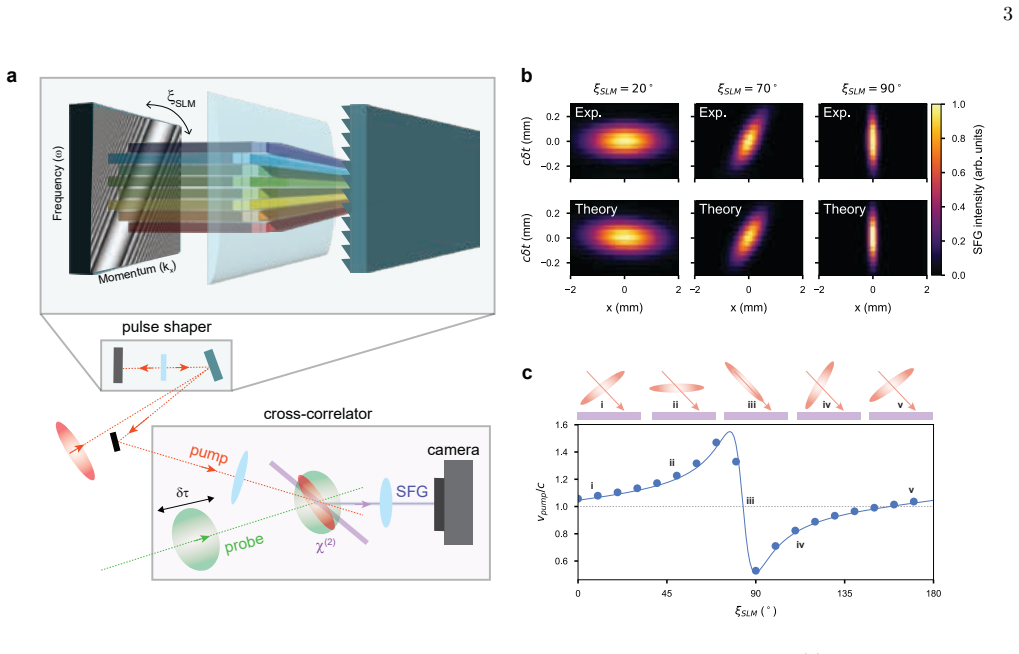
A spatial light modulator imprints tunable pulse-front tilt on a pump pulse to induce programmable synthetic motion at an ITO interface across sub- and superluminal velocities.
A machine-rendered reading of the paper's core claim, the machinery that carries it, and where it could break.
Core claim
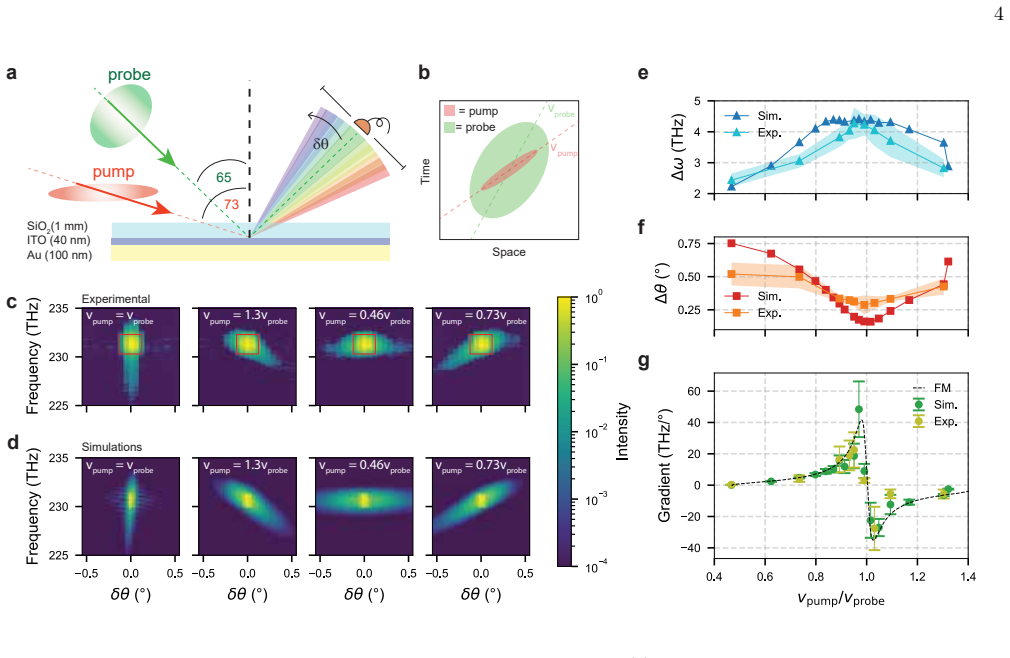
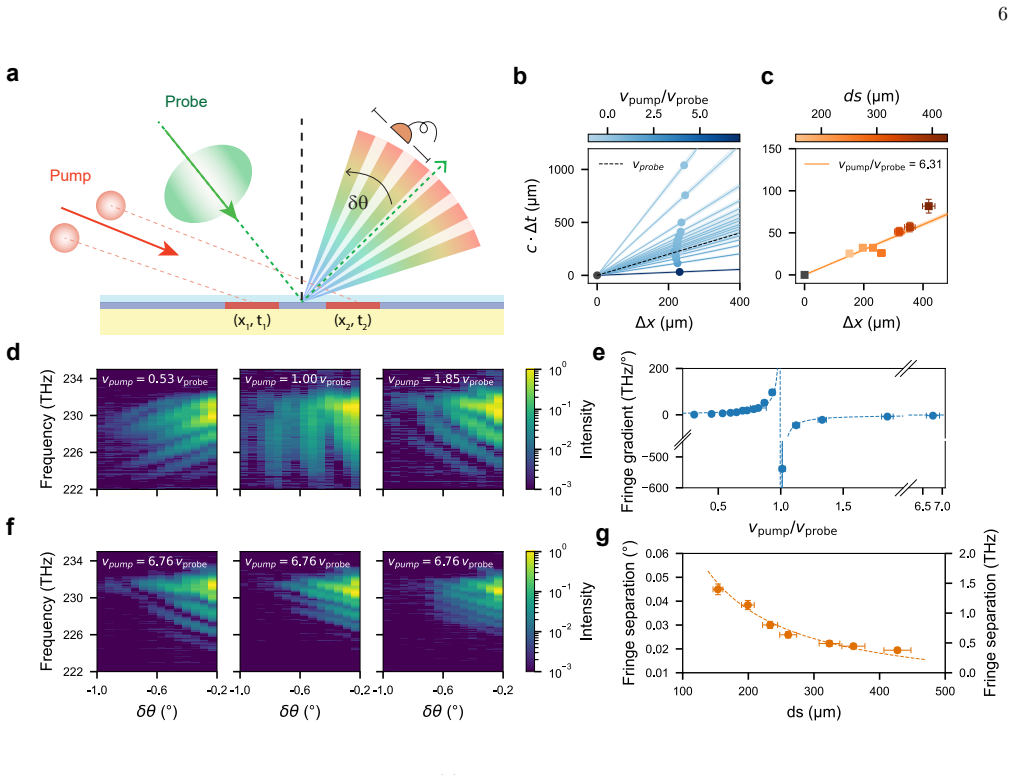
By using a spatial light modulator in a 4f geometry to imprint continuously tunable pulse-front tilt onto a high-intensity pump pulse, reflectivity modulations are induced at a sub-wavelength indium tin oxide thin film with synthetic velocities spanning the sub- and superluminal regimes. The angle-resolved spectrum of a scattered probe pulse reveals space-time diffraction patterns whose gradient and bandwidth vary continuously with synthetic velocity, in excellent agreement with theory. Splitting the shaped pump into two independently controlled pulses yields space-time double-slit diffraction with tunable fringe separation and frequency-momentum gradient.
What carries the argument
Pulse-front tilt imprinted by a spatial light modulator in 4f geometry, which sets the synthetic velocity of pump-induced reflectivity modulations at the ITO interface.
If this is right
- Synthetic velocity can be tuned continuously from sub- to superluminal values by adjusting the pulse-front tilt.
- Space-time diffraction patterns appear whose slope and spectral width follow the synthetic velocity as theory requires.
- Two-pulse operation produces space-time double-slit diffraction whose fringe spacing and frequency-momentum gradient are independently controllable.
- The same platform supports future non-linear and periodic space-time trajectories for analogue relativistic studies.
Where Pith is reading between the lines
- The single-SLM approach may allow rapid switching between different synthetic-velocity trajectories within one experiment.
- Extending the method to thicker films or different materials could test how interface thickness affects the observed bandwidth scaling.
- Combining this programmable interface with existing metasurface designs might enable hybrid devices that add spatial phase control to the temporal motion.
Load-bearing premise
The pump-induced reflectivity modulations on the ITO film can be modeled as a simple time-varying interface with a well-defined synthetic velocity without significant material nonlinearity, heating, or higher-order scattering.
What would settle it
Measure the angle-resolved spectrum of the scattered probe and check whether the gradient and bandwidth of the observed space-time diffraction patterns fail to vary continuously with the programmed synthetic velocity in the manner predicted by theory.
Figures

read the original abstract
Space-time metamaterials that exhibit synthetic motion promise arbitrary control over the momentum, frequency and energy of scattered light, but realising the required space-time modulation in a programmable way remains a challenge. Here we program synthetic motion using a single spatial light modulator in a 4f geometry which imprints a continuously tunable pulse-front tilt onto a high-intensity pump pulse, inducing reflectivity modulations at a sub-wavelength indium tin oxide thin film with synthetic velocities spanning the sub- and superluminal regimes. The angle-resolved spectrum of a scattered probe pulse reveals space-time diffraction patterns whose gradient and bandwidth vary continuously with synthetic velocity, in excellent agreement with theory. Splitting the shaped pump into two independently controlled pulses yields space-time double-slit diffraction with tunable fringe separation and frequency-momentum gradient. This programmable platform opens a path towards non-linear and periodic space-time trajectories for tabletop analogue studies of relativistic phenomena and space-time metasurfaces.
Editorial analysis
A structured set of objections, weighed in public.
Referee Report
Summary. The manuscript demonstrates programmable synthetic motion at a time-varying interface by using a single spatial light modulator in a 4f geometry to imprint a tunable pulse-front tilt on a high-intensity pump pulse. This induces reflectivity modulations on a sub-wavelength ITO thin film with synthetic velocities spanning sub- and superluminal regimes. Angle-resolved spectra of the scattered probe pulse show space-time diffraction patterns whose gradient and bandwidth vary continuously with synthetic velocity, in excellent agreement with theory; splitting the pump into two pulses yields tunable space-time double-slit diffraction.
Significance. If the central modeling assumption holds, the work provides a flexible, programmable platform for realizing space-time metamaterials and tabletop analogue studies of relativistic phenomena, representing a notable experimental advance in optics and metamaterials.
major comments (1)
- [Abstract / theory comparison] The central claim requires that the observed angle-resolved spectra arise solely from a programmable synthetic velocity at a moving interface whose response is linear in the pump-induced modulation. The manuscript models the high-intensity pump-induced reflectivity modulations on the ITO film as a simple time-varying interface (see abstract and theory comparison sections), but does not appear to include explicit checks such as intensity scaling, temperature monitoring, or comparison to a linear-response simulation to exclude contributions from free-carrier generation, Kerr nonlinearity, or local heating, which are known to occur in ITO under high-intensity illumination and could produce additional amplitude/phase gradients.
minor comments (1)
- [Abstract] The abstract states 'excellent agreement with theory' but the provided text lacks details on error analysis, exclusion criteria, or quantitative metrics for the agreement; these should be added for full assessment.
Simulated Author's Rebuttal
We thank the referee for their careful reading of the manuscript and for highlighting the importance of verifying the linear-response assumption underlying the central claim. We address this point below.
read point-by-point responses
-
Referee: [Abstract / theory comparison] The central claim requires that the observed angle-resolved spectra arise solely from a programmable synthetic velocity at a moving interface whose response is linear in the pump-induced modulation. The manuscript models the high-intensity pump-induced reflectivity modulations on the ITO film as a simple time-varying interface (see abstract and theory comparison sections), but does not appear to include explicit checks such as intensity scaling, temperature monitoring, or comparison to a linear-response simulation to exclude contributions from free-carrier generation, Kerr nonlinearity, or local heating, which are known to occur in ITO under high-intensity illumination and could produce additional amplitude/phase gradients.
Authors: We agree that explicit verification of linearity strengthens the central claim. In the revised manuscript we will add pump-intensity scaling measurements showing that the observed space-time diffraction gradient and bandwidth scale linearly with pump fluence below the intensities used in the main experiments; this data will be presented in a new supplementary figure. We will also add a direct comparison between the measured spectra and a linear time-varying interface simulation (using the same parameters as the existing theory curves) in the supplementary information. Direct temperature monitoring was not performed in the original setup; we will note this limitation explicitly and argue that the reversible, damage-free character of the modulations together with the quantitative match to the linear model already constrain significant thermal contributions. These additions address the referee’s concern while preserving the manuscript’s scope and conclusions. revision: yes
Circularity Check
No circularity; experimental measurements compared to independent theory
full rationale
The paper reports an experimental demonstration using an SLM to program pulse-front tilt on a pump pulse, inducing time-varying reflectivity modulations on an ITO film, followed by angle-resolved spectral measurements of the scattered probe that are stated to agree with theory. No derivation chain, equations, or predictions are presented that reduce by construction to fitted inputs or self-citations; the central results are direct observations whose comparison to theory is external and falsifiable. No self-definitional steps, fitted parameters renamed as predictions, or load-bearing self-citations appear in the provided text.
Axiom & Free-Parameter Ledger
axioms (1)
- domain assumption Reflectivity modulations from the shaped pump can be treated as a moving interface with well-defined synthetic velocity
Reference graph
Works this paper leans on
-
[1]
Letψ(x) be the argument ofF
Compute the transformF(x) off(k x) exp[iϕ(kx)]. Letψ(x) be the argument ofF
-
[2]
Opti- cal set-up
Compute the inverse transformf ′(kx) ofp D∆(x) exp[iψ(x)]. Updateϕ(k x) with the argument off ′ When|F| 2 converges toD ∆,ϕ(k x) gives the required phase pattern to create the double-slit. Asϕis one- dimensional, it is applied on the SLM by rotating to achieve the required space-time rotation of the double 8 slit, and with a uniform phase in the orthogona...
-
[3]
Chen, H.-T., Taylor, A. J. & Yu, N. A review of meta- surfaces: physics and applications.Reports on Progress in Physics79, 076401 (2016). 9
2016
-
[4]
Galiffi, E.et al.Photonics of time-varying media.Ad- vanced Photonics4, 014002 (2022)
2022
-
[5]
& Shalaev, V
Shaltout, A., Kildishev, A. & Shalaev, V. Time-varying metasurfaces and Lorentz non-reciprocity.Optical Mate- rials Express5, 2459 (2015)
2015
-
[6]
Lyubarov, M.et al.Amplified emission and lasing in photonic time crystals.Science377, 425–428 (2022)
2022
-
[7]
Kinsey, N.et al.Epsilon-near-zero Al-doped ZnO for ultrafast switching at telecom wavelengths.Optica2, 616–622 (2015)
2015
-
[8]
Z., De Leon, I
Alam, M. Z., De Leon, I. & Boyd, R. W. Large optical nonlinearity of indium tin oxide in its epsilon-near-zero region.Science352, 795–797 (2016)
2016
-
[9]
Caspani, L.et al.Enhanced Nonlinear Refractive Index inϵ-Near-Zero Materials.Physical Review Letters116, 233901 (2016)
2016
-
[10]
URLhttps://doi.org/10.1038/ s41377-026-02346-x
Li, Y.et al.Ultrafast Switching of Optical Proper- ties in a Doped Semiconductor by Intense Femtosec- ond Laser Pulses.in production, Light: Science & Applications(2026). URLhttps://doi.org/10.1038/ s41377-026-02346-x
2026
-
[11]
Karl, N.et al.Frequency conversion in a time-variant di- electric metasurface.Nano Letters20, 7052–7058 (2020)
2020
-
[12]
Zhou, Y.et al.Broadband frequency translation through time refraction in an epsilon-near-zero material.Nature Communications11, 2180 (2020)
2020
-
[13]
Applied Sciences10, 1318 (2020)
Bruno, V.et al.Broad Frequency Shift of Paramet- ric Processes in Epsilon-Near-Zero Time-Varying Media. Applied Sciences10, 1318 (2020)
2020
-
[14]
Tirole, R.et al.Double-slit time diffraction at optical frequencies.Nature Physics1–4 (2023)
2023
-
[15]
Tirole, R.et al.Saturable time-varying mirror based on an ENZ material (2022). 2202.05937
arXiv 2022
-
[16]
Galiffi, E.et al.Optical coherent perfect absorption and amplification in a time-varying medium.Nature Photon- ics1–7 (2026)
2026
-
[17]
Nature Photonics1–9 (2026)
Jaffray, W.et al.All-optical polarization control in time- varying low-index films via plasma symmetry breaking. Nature Photonics1–9 (2026)
2026
-
[18]
Bolotovski˘ ı, B. M. & Ginzburg, V. L. The Vavilov- Cerenkov Effect and the Doppler Effect in the Motion of Sourceswith Superluminal Velocity in Vacuum.Soviet Physics Uspekhi15, 184 (1972)
1972
-
[19]
M., Shalaev, V
Shaltout, A. M., Shalaev, V. M. & Brongersma, M. L. Spatiotemporal light control with active metasurfaces. Science364, eaat3100 (2019)
2019
-
[20]
Liberal, I., Ganfornina-Andrades, A. & V´ azquez-Lozano, J. E. Spatiotemporal symmetries and energy-momentum conservation in uniform spacetime metamaterials (2024). 2407.15592
arXiv 2024
-
[21]
B., Galiffi, E
Pendry, J. B., Galiffi, E. & Huidobro, P. A. Gain in time-dependent media—a new mechanism.Journal of the Optical Society of America B38, 3360 (2021)
2021
-
[22]
Cromb, M.et al.Amplification of waves from a rotating body.Nature Physics16, 1069–1073 (2020)
2020
-
[23]
& Segev, M
Sharabi, Y., Dikopoltsev, A., Lustig, E., Lumer, Y. & Segev, M. Spatiotemporal photonic crystals.Optica9, 585–592 (2022)
2022
-
[24]
space-time lens
Ostrovskii, L. A. A boundary with accelerating motion as a “space-time lens”.Radiophysics and Quantum Elec- tronics18, 456–457 (1975)
1975
-
[25]
Kinder, K. D., Bahrami, A. & Caloz, C. Scattering and Chirping at Accelerated Interfaces (2025). 2506.19575
arXiv 2025
-
[26]
Sounas, D. L. & Al` u, A. Non-reciprocal photonics based on time modulation.Nature Photonics11, 774–783 (2017)
2017
-
[27]
V., Touboul, M., Sapienza, R., Craster, R
Raziman, T. V., Touboul, M., Sapienza, R., Craster, R. V. & Rodr´ ıguez-Fortu˜ no, F. J. Surface Plasmon Polariton Excitation in Time-modulated Media.arXiv 2507.05126 (2025)
arXiv 2025
-
[28]
Koufidis, S. F. & McCall, M. W. Coupling light waves to gravitational waves.Physical Review D112, 104033 (2025)
2025
-
[29]
& Caloz, C
Bahrami, A., Deck-L´ eger, Z.-L. & Caloz, C. Electrody- namics of Accelerated-Modulation Space-Time Metama- terials.Physical Review Applied19, 054044 (2023)
2023
-
[30]
Horsley, S. A. R. & Pendry, J. B. Quantum electrody- namics of time-varying gratings.Proceedings of the Na- tional Academy of Sciences120, e2302652120 (2023)
2023
-
[31]
Sloan, J., Rivera, N., Joannopoulos, J. D. & Soljaˇ ci´ c, M. Controlling two-photon emission from superluminal and accelerating index perturbations.Nature Physics18, 67– 74 (2022)
2022
-
[32]
Kort-Kamp, W. J. M., Azad, A. K. & Dalvit, D. A. R. Space-Time Quantum Metasurfaces.Physical Review Letters127, 043603 (2021)
2021
-
[33]
Guo, X., Ding, Y., Duan, Y. & Ni, X. Nonreciprocal metasurface with space–time phase modulation.Light: Science & Applications8, 123 (2019)
2019
-
[34]
Jaffray, W.et al.Spatio-spectral optical fission in time- varying subwavelength layers.Nature Photonics1–9 (2025)
2025
-
[35]
Ball, A.et al.A Space-Time Knife-Edge in Epsilon-Near- Zero Films for Ultrafast Pulse Characterization.Laser & Photonics Reviews19(2024)
2024
-
[36]
M., van de Groep, J., Brongersma, M
Fan, Q., Shaltout, A. M., van de Groep, J., Brongersma, M. L. & Lindenberg, A. M. Ultrafast Wavefront Shaping via Space-Time Refraction.ACS Photonics10, 2467– 2473 (2023)
2023
-
[37]
C.et al.Space-time optical diffraction from synthetic motion.Nature Communications16, 5147 (2025)
Harwood, A. C.et al.Space-time optical diffraction from synthetic motion.Nature Communications16, 5147 (2025)
2025
-
[38]
Piccardo, M.et al.Trends in relativistic laser–matter interaction: the promises of structured light.Optica12, 732–752 (2025)
2025
-
[39]
Liberman, A.et al.Direct observation of a wakefield generated with structured light.Nature Communications 16, 10957 (2025)
2025
-
[40]
H.et al.Spatiotemporal control of laser in- tensity.Nature Photonics12, 262–265 (2018)
Froula, D. H.et al.Spatiotemporal control of laser in- tensity.Nature Photonics12, 262–265 (2018)
2018
-
[41]
& Thaury, C
Caizergues, C., Smartsev, S., Malka, V. & Thaury, C. Phase-locked laser-wakefield electron acceleration.Na- ture Photonics14, 475–479 (2020)
2020
-
[42]
Belgiorno, F.et al.Hawking Radiation from Ultrashort Laser Pulse Filaments.Physical Review Letters105, 203901 (2010)
2010
-
[43]
Henstridge, M.et al.Synchrotron radiation from an ac- celerating light pulse.Science362, 439–442 (2018)
2018
-
[44]
Vaz, G.et al.Space-time beams with tunable or- bital group velocity for plasma superradiance.arXiv 2602.18838 (2026). URLhttp://arxiv.org/abs/2602. 18838
Pith/arXiv arXiv 2026
-
[45]
& Wang, Y.-T
Horsley, S., Galiffi, E. & Wang, Y.-T. Eigenpulses of Dispersive Time-Varying Media.Physical Review Letters 130, 203803 (2023)
2023
-
[46]
& Trebino, R
Akturk, S., Gu, X., Zeek, E. & Trebino, R. Pulse-front tilt caused by spatial and temporal chirp.Optics Express 12, 4399–4410 (2004). 10
2004
-
[47]
Kondakci, H. E. & Abouraddy, A. F. Optical space- time wave packets having arbitrary group velocities in free space.Nature Communications10, 929 (2019)
2019
-
[48]
Potenza, M. A. C.et al.Three dimensional imaging of short pulses.Optics Communications229, 381–390 (2004)
2004
-
[49]
Science Advances11, eadu8850 (2025)
Gurung, S.et al.Control of ultrafast hot electron dy- namics in epsilon-near-zero conductive oxide thin films. Science Advances11, eadu8850 (2025)
2025
-
[50]
C.et al.Intraband and Interband Competi- tion Drives Ultrafast Modulations of Indium Tin Oxide
Harwood, A. C.et al.Intraband and Interband Competi- tion Drives Ultrafast Modulations of Indium Tin Oxide. arXiv2605.21432 (2026). URLhttp://arxiv.org/abs/ 2605.21432
Pith/arXiv arXiv 2026
-
[51]
Vaddi, Y.et al.Parametric Amplification of Opti- cal Pulses through Synthetic Motion in a Time-Varying Medium.Nano Letters(2026)
2026
-
[52]
& Segev, M
Sharabi, Y., Lustig, E. & Segev, M. Disordered Photonic Time Crystals.Physical Review Letters126, 163902 (2021)
2021
-
[53]
& Galdi, V
Coppolaro, M., Moccia, M., Castaldi, G. & Galdi, V. Ex- ploring aperiodic order in photonic time crystals.Physi- cal Review Applied24, L011001 (2025)
2025
-
[54]
Four-dimensional optics using time-varying metamaterials.Science379, 1190–1191 (2023)
Engheta, N. Four-dimensional optics using time-varying metamaterials.Science379, 1190–1191 (2023)
2023
-
[55]
Cordaro, A.et al.Solving integral equations in free space with inverse-designed ultrathin optical metagratings.Na- ture Nanotechnology1–8 (2023)
2023
-
[56]
K.et al.Nonlocal flat optics for size-selective image processing and denoising.Nature Communications 16, 4473 (2025)
Chamoli, S. K.et al.Nonlocal flat optics for size-selective image processing and denoising.Nature Communications 16, 4473 (2025)
2025
-
[57]
Hayran, Z., Khurgin, J. B. & Monticone, F.ℏωversus ℏk: dispersion and energy constraints on time-varying photonic materials and time crystals [Invited].Optical Materials Express12, 3904 (2022)
2022
-
[58]
Koufidis, S. F. & McCall, M. W. Gravitational waves on the optical bench.Optics Letters50, 5901–5904 (2025)
2025
-
[59]
Yablonovitch, E. Accelerating reference frame for elec- tromagnetic waves in a rapidly growing plasma: Unruh- Davies-Fulling-DeWitt radiation and the nonadiabatic Casimir effect.Physical Review Letters62, 1742–1745 (1989)
1989
-
[60]
Gerchberg, R. W. & Saxton, W. O. A Practical Algo- rithm for the Determination of Phase from Image and Diffraction Plane Pictures.Optik35, 237–246 (1972)
1972
-
[61]
Optics Letters42, 3225–3228 (2017)
Reshef, O.et al.Beyond the perturbative description of the nonlinear optical response of low-index materials. Optics Letters42, 3225–3228 (2017). Acknowledgements The authors would like to thank Simon Horsley for useful discussions. This work was supported by The Val O’Donoghue Scholarship in Natural Sciences (ACH), the Engineering and Physical Sciences R...
discussion (0)
Sign in with ORCID, Apple, or X to comment. Anyone can read and Pith papers without signing in.