Existence Precedes Value: Joint Modeling of Observational Existence and Evolving States in Time Series Forecasting
Pith reviewed 2026-06-27 07:22 UTC · model grok-4.3
The pith
Time series forecasting must jointly infer both whether future observations will exist and what their values will be.
A machine-rendered reading of the paper's core claim, the machinery that carries it, and where it could break.
Core claim
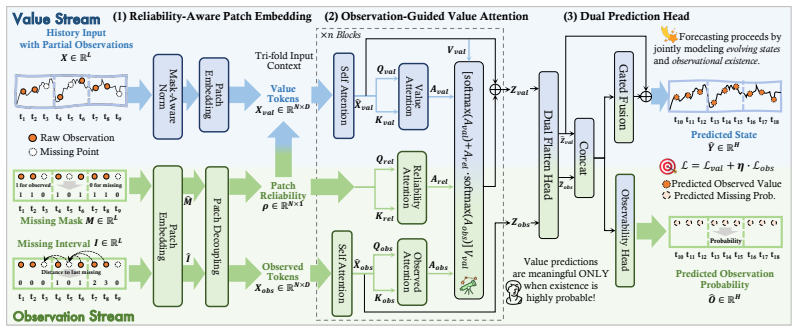
Timeflies reformulates forecasting as the joint problem of future observability inference and value estimation by running an observation stream and a value stream that interact through reliability-aware embedding, observation-guided dependency modeling, and joint prediction.
What carries the argument
Dual observation and value streams coupled by reliability-aware embedding, observation-guided dependency modeling, and joint prediction modules.
Load-bearing premise
The three dedicated modules can capture the interaction between observation dynamics and state evolution without introducing new fitting artifacts.
What would settle it
A controlled comparison on held-out data with truly unknown future timestamps in which the joint model shows no accuracy gain over separate observability-then-value pipelines.
Figures

read the original abstract
Real-world time series are often highly incomplete and irregular due to sensor dormancy, transmission delays, and event-driven sampling, making reliable forecasting fundamentally challenging. Existing methods have evolved from impute-then-forecast pipelines to continuous-time models such as Neural ODEs and continuous-time graph networks. While these approaches improve the modeling of historical irregularity, they still rely on an implicit oracle assumption at inference time: the timestamps of future valid observations are presumed to be known in advance. This assumption limits practical relevance, since in many real systems the more fundamental question is not only what the future value will be, but also whether a valid observation will occur at all. In this paper, we propose Timeflies, a unified framework that reformulates forecasting as a joint problem of future observability inference and value estimation. To explicitly model the interaction between observation dynamics and state evolution, Timeflies adopts an observation stream and a value stream, coupled through three dedicated modules for reliability-aware embedding, observation-guided dependency modeling, and joint prediction. We further construct Shadow, a benchmark that combines natural missingness from public datasets with real-world industrial data, and introduce the Observation-Value Joint Entropy (OVJE) metric to comprehensively evaluate this coupled predictability. Extensive experiments show that Timeflies consistently outperforms existing methods, highlighting the importance of explicitly modeling future observability in time series forecasting with missing values. Code and dataset are available in https://github.com/ant-intl/Timeflies.
Editorial analysis
A structured set of objections, weighed in public.
Referee Report
Summary. The paper claims that real-world time series forecasting is limited by an implicit oracle assumption of known future observation timestamps in existing methods (including Neural ODEs and continuous-time graph networks). It proposes Timeflies, which reformulates the task as joint future observability inference and value estimation via coupled observation and value streams with three modules (reliability-aware embedding, observation-guided dependency modeling, joint prediction). The work introduces the Shadow benchmark (combining public datasets with industrial data) and the OVJE metric, reporting consistent outperformance that highlights the value of explicitly modeling observational existence.
Significance. If the claimed gains are shown to arise specifically from the joint modeling rather than benchmark construction, metric choice, or unadjusted baselines, the result would be significant for practical deployment in domains with sensor dormancy and irregular sampling. The public release of code and the Shadow dataset strengthens reproducibility and enables follow-up work.
major comments (2)
- [Experiments] Experiments section: the central claim that Timeflies's advantage stems from the three dedicated modules requires explicit confirmation that baselines were adapted to predict observability (rather than retaining oracle access to future timestamps). Without this control, outperformance on Shadow/OVJE does not isolate the joint-modeling contribution.
- [Experiments] Experiments section: results should be reported under standard value-only metrics (MAE/RMSE) on the underlying public datasets in addition to OVJE. If gains vanish or become metric-specific under these controls, the necessity of the observation-value interaction modeling is not established.
minor comments (1)
- The abstract states that code and dataset are available, which is a positive contribution; the manuscript should include a direct link or repository reference in the main text as well.
Simulated Author's Rebuttal
We thank the referee for the constructive feedback. The suggestions help clarify the experimental evidence for the joint modeling contribution. We address each major comment below.
read point-by-point responses
-
Referee: [Experiments] Experiments section: the central claim that Timeflies's advantage stems from the three dedicated modules requires explicit confirmation that baselines were adapted to predict observability (rather than retaining oracle access to future timestamps). Without this control, outperformance on Shadow/OVJE does not isolate the joint-modeling contribution.
Authors: We agree that isolating the joint-modeling contribution requires this control. The original baselines were run in their standard configurations, which retain oracle access to future timestamps as described in the manuscript's motivation. In the revision we will adapt the baselines to also predict observability (using the same OVJE metric and coupled prediction setup where feasible) and report the updated comparisons. This will directly test whether the gains arise from the three modules rather than task formulation. revision: yes
-
Referee: [Experiments] Experiments section: results should be reported under standard value-only metrics (MAE/RMSE) on the underlying public datasets in addition to OVJE. If gains vanish or become metric-specific under these controls, the necessity of the observation-value interaction modeling is not established.
Authors: We concur that standard value-only metrics provide an important additional control. The revised manuscript will include MAE and RMSE results on the public-dataset portions of Shadow (separate from the industrial data) for Timeflies and all baselines. These results will be presented alongside the OVJE numbers to assess whether advantages persist under conventional value forecasting evaluation. revision: yes
Circularity Check
No significant circularity detected in derivation or claims
full rationale
The paper describes Timeflies as a framework with three explicit modules (reliability-aware embedding, observation-guided dependency modeling, joint prediction) for joint observability and value forecasting, plus a new benchmark Shadow and OVJE metric. No equations, fitted parameters renamed as predictions, self-definitional steps, or load-bearing self-citations appear in the provided text. The central claim of outperformance rests on empirical experiments rather than reducing by construction to inputs or prior author work. This is a standard non-circular empirical modeling paper.
Axiom & Free-Parameter Ledger
Reference graph
Works this paper leans on
-
[1]
Saits: Self-attention-based imputation for time series
Wenjie Du, David Côté, and Yan Liu. Saits: Self-attention-based imputation for time series. Expert Systems with Applications, 219:119619, 2023
2023
-
[2]
Jie Yang, Yifan Hu, Kexin Zhang, Luyang Niu, Philip S Yu, and Kaize Ding. Revisiting multivariate time series forecasting with missing values.arXiv preprint arXiv:2509.23494, 2025
-
[3]
Imputeformer: Low rankness- induced transformers for generalizable spatiotemporal imputation
Tong Nie, Guoyang Qin, Wei Ma, Yuewen Mei, and Jian Sun. Imputeformer: Low rankness- induced transformers for generalizable spatiotemporal imputation. InProceedings of the 30th ACM SIGKDD conference on knowledge discovery and data mining, pages 2260–2271, 2024
2024
-
[4]
Informer: Beyond efficient transformer for long sequence time-series forecasting
Haoyi Zhou, Shanghang Zhang, Jieqi Peng, Shuai Zhang, Jianxin Li, Hui Xiong, and Wancai Zhang. Informer: Beyond efficient transformer for long sequence time-series forecasting. In Proceedings of the AAAI conference on artificial intelligence, volume 35, pages 11106–11115, 2021
2021
-
[5]
Pe- riodicity decoupling framework for long-term series forecasting
Tao Dai, Beiliang Wu, Peiyuan Liu, Naiqi Li, Jigang Bao, Yong Jiang, and Shu-Tao Xia. Pe- riodicity decoupling framework for long-term series forecasting. InInternational Conference on Learning Representations, 2024
2024
-
[6]
Irregular multivariate time series forecasting: A transformable patching graph neural networks approach
Weijia Zhang, Chenlong Yin, Hao Liu, Xiaofang Zhou, and Hui Xiong. Irregular multivariate time series forecasting: A transformable patching graph neural networks approach. InThe International Conference on Machine Learning, 2024
2024
-
[7]
Hi-patch: Hierarchical patch GNN for irregular multivariate time series
Yicheng Luo, Bowen Zhang, Zhen Liu, and Qianli Ma. Hi-patch: Hierarchical patch GNN for irregular multivariate time series. InThe International Conference on Machine Learning, 2025
2025
-
[8]
The value of bat- tery energy storage in the continuous intraday market: Forecast vs
Timothée Hornek, Youngsub Lee, Sergio Potenciano Menci, and Ivan Pavi´c. The value of bat- tery energy storage in the continuous intraday market: Forecast vs. perfect foresight strategies. In2025 IEEE Kiel PowerTech, pages 1–7. IEEE, 2025
2025
-
[9]
Rethinking irregular time series forecasting: A simple yet effective baseline
Xvyuan Liu, Xiangfei Qiu, Xingjian Wu, Zhengyu Li, Chenjuan Guo, Jilin Hu, and Bin Yang. Rethinking irregular time series forecasting: A simple yet effective baseline. InProceedings of the AAAI Conference on Artificial Intelligence, volume 40, pages 23873–23881, 2026
2026
-
[10]
Transductive lstm for time-series prediction: An ap- plication to weather forecasting.Neural Networks, 125:1–9, 2020
Zahra Karevan and Johan AK Suykens. Transductive lstm for time-series prediction: An ap- plication to weather forecasting.Neural Networks, 125:1–9, 2020
2020
-
[11]
FinTSB: A Comprehensive and Practical Benchmark for Financial Time Series Forecasting
Yifan Hu, Yuante Li, Peiyuan Liu, Yuxia Zhu, Naiqi Li, Tao Dai, Shu-tao Xia, Dawei Cheng, and Changjun Jiang. Fintsb: A comprehensive and practical benchmark for financial time series forecasting.arXiv preprint arXiv:2502.18834, 2025
work page internal anchor Pith review Pith/arXiv arXiv 2025
-
[12]
A short-term traffic flow prediction model based on an improved gate recurrent unit neural network.IEEE Transactions on Intelligent Transportation Systems, 23(9):16654–16665, 2021
Wanneng Shu, Ken Cai, and Neal Naixue Xiong. A short-term traffic flow prediction model based on an improved gate recurrent unit neural network.IEEE Transactions on Intelligent Transportation Systems, 23(9):16654–16665, 2021
2021
-
[13]
Heterogeneous multivariate time series imputation by transformer model with missing position encoding.Expert Systems with Applications, 271:126435, 2025
Caizheng Liu, Zhengyu Zhu, Wanming Hao, and Gangcan Sun. Heterogeneous multivariate time series imputation by transformer model with missing position encoding.Expert Systems with Applications, 271:126435, 2025
2025
-
[14]
Ginar+: A robust end-to-end framework for multivariate time series forecasting with missing values.IEEE Transactions on Knowledge and Data Engineering, 2025
Chengqing Yu, Fei Wang, Zezhi Shao, Tangwen Qian, Zhao Zhang, Wei Wei, Zhulin An, Qi Wang, and Yongjun Xu. Ginar+: A robust end-to-end framework for multivariate time series forecasting with missing values.IEEE Transactions on Knowledge and Data Engineering, 2025
2025
-
[15]
Analysis of missingness scenarios for observational health data.Journal of Personalized Medicine, 14(5):514, 2024
Alireza Zamanian, Henrik von Kleist, Octavia-Andreea Ciora, Marta Piperno, Gino Lancho, and Narges Ahmidi. Analysis of missingness scenarios for observational health data.Journal of Personalized Medicine, 14(5):514, 2024
2024
-
[16]
Data-driven causal analysis of observational biological time series.Elife, 11:e72518, 2022
Alex Eric Yuan and Wenying Shou. Data-driven causal analysis of observational biological time series.Elife, 11:e72518, 2022. 10
2022
-
[17]
Enhancing the locality and breaking the memory bottleneck of transformer on time series forecasting
Shiyang Li, Xiaoyong Jin, Yao Xuan, Xiyou Zhou, Wenhu Chen, Yu-Xiang Wang, and Xifeng Yan. Enhancing the locality and breaking the memory bottleneck of transformer on time series forecasting. InAdvances in Neural Information Processing Systems, volume 32, 2019
2019
-
[18]
Autoformer: Decomposition transformers with auto-correlation for long-term series forecasting
Haixu Wu, Jiehui Xu, Jianmin Wang, and Mingsheng Long. Autoformer: Decomposition transformers with auto-correlation for long-term series forecasting. InAdvances in Neural Information Processing Systems, volume 34, pages 22419–22430, 2021
2021
-
[19]
Deep learning for time series forecast- ing: a survey.International Journal of Machine Learning and Cybernetics, 16(7):5079–5112, 2025
Xiangjie Kong, Zhenghao Chen, Weiyao Liu, Kaili Ning, Lechao Zhang, Syauqie Muham- mad Marier, Yichen Liu, Yuhao Chen, and Feng Xia. Deep learning for time series forecast- ing: a survey.International Journal of Machine Learning and Cybernetics, 16(7):5079–5112, 2025
2025
-
[20]
Seg- RNN: Segment recurrent neural network for long-term time series forecasting.IEEE Internet of Things Journal, 2025
Shengsheng Lin, Weiwei Lin, Wentai Wu, Feiyu Zhao, Ruichao Mo, and Haotong Zhang. Seg- RNN: Segment recurrent neural network for long-term time series forecasting.IEEE Internet of Things Journal, 2025
2025
-
[21]
Yixuan Tan, Liyan Xie, and Xiuyuan Cheng. Neural differential recurrent neural network with adaptive time steps.arXiv preprint arXiv:2306.01674, 2023
-
[22]
TimesNet: Temporal 2d-variation modeling for general time series analysis
Haixu Wu, Tengge Hu, Yong Liu, Hang Zhou, Jianmin Wang, and Mingsheng Long. TimesNet: Temporal 2d-variation modeling for general time series analysis. InInternational Conference on Learning Representations, 2023
2023
-
[23]
MICN: Multi-scale local and global context modeling for long-term series forecasting
Huiqiang Wang, Jian Peng, Feihu Huang, Jince Wang, Junhui Chen, and Yifei Xiao. MICN: Multi-scale local and global context modeling for long-term series forecasting. InInternational Conference on Learning Representations, 2022
2022
-
[24]
FACT: Fine-grained across-variable convolution for multivariate time series forecasting
Huiqiang Wang, Jieming Shi, and Li Qing. FACT: Fine-grained across-variable convolution for multivariate time series forecasting. InThe International Conference on Learning Repre- sentations, 2026
2026
-
[25]
Are transformers effective for time series forecasting? InProceedings of the AAAI conference on artificial intelligence, volume 37, pages 11121–11128, 2023
Ailing Zeng, Muxi Chen, Lei Zhang, and Qiang Xu. Are transformers effective for time series forecasting? InProceedings of the AAAI conference on artificial intelligence, volume 37, pages 11121–11128, 2023
2023
-
[26]
TimeMixer: Decomposable multiscale mixing for time series forecasting
Shiyu Wang, Haixu Wu, Xiaoming Shi, Tengge Hu, Huakun Luo, Lintao Ma, James Y Zhang, and Jun Zhou. TimeMixer: Decomposable multiscale mixing for time series forecasting. In International Conference on Learning Representations, 2024
2024
-
[27]
OLinear: A linear model for time series forecasting in orthogonally transformed domain
Wenzhen Yue, Yong Liu, Hao Wang, Haoxuan Li, Xianghua Ying, Ruohao Guo, Bowei Xing, and Ji Shi. OLinear: A linear model for time series forecasting in orthogonally transformed domain. InNeural Information Processing Systems, 2026
2026
-
[28]
Adaptive multi-scale decompo- sition framework for time series forecasting.Proceedings of the AAAI Conference on Artificial Intelligence, 39(16):17359–17367, 2025
Yifan Hu, Peiyuan Liu, Peng Zhu, Dawei Cheng, and Tao Dai. Adaptive multi-scale decompo- sition framework for time series forecasting.Proceedings of the AAAI Conference on Artificial Intelligence, 39(16):17359–17367, 2025
2025
-
[29]
Bridging past and future: Distribution-aware alignment for time series forecasting
Yifan Hu, Jie Yang, Tian Zhou, Peiyuan Liu, Yujin Tang, Rong Jin, and Liang Sun. Bridging past and future: Distribution-aware alignment for time series forecasting. InThe Fourteenth International Conference on Learning Representations, 2026
2026
-
[30]
TimeFilter: Patch-specific spatial-temporal graph filtration for time series forecasting
Yifan Hu, Guibin Zhang, Peiyuan Liu, Disen Lan, Naiqi Li, Dawei Cheng, Tao Dai, Shu-Tao Xia, and Shirui Pan. TimeFilter: Patch-specific spatial-temporal graph filtration for time series forecasting. InInternational Conference on Machine Learning, 2025
2025
-
[31]
Connecting the dots: Multivariate time series forecasting with graph neural networks
Zonghan Wu, Shirui Pan, Guodong Long, Jing Jiang, Xiaojun Chang, and Chengqi Zhang. Connecting the dots: Multivariate time series forecasting with graph neural networks. InPro- ceedings of the 26th ACM SIGKDD international conference on knowledge discovery & data mining, pages 753–763, 2020
2020
-
[32]
Msgnet: Learning multi-scale inter-series correlations for multivariate time series forecasting.Proceedings of the AAAI Conference on Artificial Intelligence, 2024
Wanlin Cai, Yuxuan Liang, Xianggen Liu, Jianshuai Feng, and Yuankai Wu. Msgnet: Learning multi-scale inter-series correlations for multivariate time series forecasting.Proceedings of the AAAI Conference on Artificial Intelligence, 2024. 11
2024
-
[33]
FEDformer: Fre- quency enhanced decomposed transformer for long-term series forecasting
Tian Zhou, Ziqing Ma, Qingsong Wen, Xue Wang, Liang Sun, and Rong Jin. FEDformer: Fre- quency enhanced decomposed transformer for long-term series forecasting. InInternational Conference on Machine Learning, pages 27268–27286. PMLR, 2022
2022
-
[34]
Time- Bridge: Non-stationarity matters for long-term time series forecasting
Peiyuan Liu, Beiliang Wu, Yifan Hu, Naiqi Li, Tao Dai, Jigang Bao, and Shu-tao Xia. Time- Bridge: Non-stationarity matters for long-term time series forecasting. InInternational Con- ference on Machine Learning, 2024
2024
-
[35]
Nguyen, Phanwadee Sinthong, and Jayant Kalagnanam
Yuqi Nie, Nam H. Nguyen, Phanwadee Sinthong, and Jayant Kalagnanam. A time series is worth 64 words: Long-term forecasting with transformers. InInternational Conference on Learning Representations, 2023
2023
-
[36]
iTransformer: Inverted transformers are effective for time series forecasting
Yong Liu, Tengge Hu, Haoran Zhang, Haixu Wu, Shiyu Wang, Lintao Ma, and Mingsheng Long. iTransformer: Inverted transformers are effective for time series forecasting. InInter- national Conference on Learning Representations, 2024
2024
-
[37]
A survey of forecasting methods for irregular time series
Xuanying Li, Sha Xiang, and Cheng Dai. A survey of forecasting methods for irregular time series. InIEEE International Conferences on Internet of Things, pages 83–90, 2025
2025
-
[38]
Gru-ode-bayes: Continuous modeling of sporadically-observed time series.Advances in neural information processing systems, 32, 2019
Edward De Brouwer, Jaak Simm, Adam Arany, and Yves Moreau. Gru-ode-bayes: Continuous modeling of sporadically-observed time series.Advances in neural information processing systems, 32, 2019
2019
-
[39]
Latent ordinary differential equa- tions for irregularly-sampled time series.Advances in neural information processing systems, 32, 2019
Yulia Rubanova, Ricky TQ Chen, and David K Duvenaud. Latent ordinary differential equa- tions for irregularly-sampled time series.Advances in neural information processing systems, 32, 2019
2019
-
[40]
Modeling irregular time series with continuous recurrent units
Mona Schirmer, Mazin Eltayeb, Stefan Lessmann, and Maja Rudolph. Modeling irregular time series with continuous recurrent units. InInternational conference on machine learning, pages 19388–19405. PMLR, 2022
2022
-
[41]
Christian Klötergens, Vijaya Krishna Yalavarthi, Randolf Scholz, Maximilian Stubbemann, Stefan Born, and Lars Schmidt-Thieme. Physiome-ode: A benchmark for irregularly sampled multivariate time series forecasting based on biological odes.arXiv preprint arXiv:2502.07489, 2025
work page internal anchor Pith review Pith/arXiv arXiv 2025
-
[42]
Biased temporal convolution graph net- work for time series forecasting with missing values
Xiaodan Chen, Xiucheng Li, Bo Liu, and Zhijun Li. Biased temporal convolution graph net- work for time series forecasting with missing values. InInternational Conference on Learning Representations, 2024
2024
-
[43]
Grafiti: Graphs for fore- casting irregularly sampled time series
Vijaya Krishna Yalavarthi, Kiran Madhusudhanan, Randolf Scholz, Nourhan Ahmed, Johannes Burchert, Shayan Jawed, Stefan Born, and Lars Schmidt-Thieme. Grafiti: Graphs for fore- casting irregularly sampled time series. InProceedings of the AAAI Conference on Artificial Intelligence, pages 16255–16263, 2024
2024
-
[44]
Taha Aksu, Gerald Woo, Juncheng Liu, Xu Liu, Chenghao Liu, Silvio Savarese, Caiming Xiong, and Doyen Sahoo. Gift-EV AL: A benchmark for general time series forecasting model evaluation.arXiv preprint arXiv:2410.10393, 2024
-
[45]
Crossformer: Transformer utilizing cross-dimension depen- dency for multivariate time series forecasting
Yunhao Zhang and Junchi Yan. Crossformer: Transformer utilizing cross-dimension depen- dency for multivariate time series forecasting. InInternational Conference on Learning Rep- resentations, 2023
2023
-
[46]
WPMixer: Efficient multi-resolution mixing for long-term time series forecasting
Md Mahmuddun Nabi Murad, Mehmet Aktukmak, and Yasin Yilmaz. WPMixer: Efficient multi-resolution mixing for long-term time series forecasting. InProceedings of the AAAI conference on artificial intelligence, volume 39, pages 19581–19588, 2025
2025
-
[47]
Pytorch: An imperative style, high-performance deep learning library
Adam Paszke, Sam Gross, Francisco Massa, Adam Lerer, James Bradbury, Gregory Chanan, Trevor Killeen, Zeming Lin, Natalia Gimelshein, Luca Antiga, et al. Pytorch: An imperative style, high-performance deep learning library. InAdvances in Neural Information Processing Systems, volume 32, 2019
2019
-
[48]
Freq.” denotes sampling frequency, “#Var
Diederik P Kingma. Adam: A method for stochastic optimization. InInternational Conference on Learning Representations, 2015. 12 A Additional Experimental Details A.1 Dataset Details Tab. 4 provides a detailed characterization of theShadowbenchmark, which integrates 15 public datasets fromGIFT-Evalwith 16 proprietary e-commerce datasets spanning domains su...
2015
discussion (0)
Sign in with ORCID, Apple, or X to comment. Anyone can read and Pith papers without signing in.