The entropy of black hole under second-order deviation from equilibrium
Pith reviewed 2026-06-27 03:25 UTC · model grok-4.3
The pith
The entropy of a dynamical black hole equals the area of its apparent horizon at second order when the null energy condition holds for infalling matter.
A machine-rendered reading of the paper's core claim, the machinery that carries it, and where it could break.
Core claim
Using perturbative expansion of the apparent horizon in Gaussian null coordinates up to second order and a modified canonical energy in the covariant phase space formalism, the entropy variation is shown to obey a balance law with the energy flux. When the null energy condition holds for the infalling matter, the entropy equals exactly the area of the apparent horizon at second order, and the second law holds for the entropy variation.
What carries the argument
Modified canonical energy in the covariant phase space formalism, which relates the second-order entropy variation to the energy flux through the apparent horizon.
If this is right
- The second law of black hole thermodynamics holds at second order for small deviations from equilibrium under the null energy condition.
- Entropy identification with apparent horizon area extends from first order to second order when the null energy condition is satisfied.
- A balance law equates the second-order change in entropy directly to the integrated energy flux crossing the horizon.
- The area law for entropy may continue to hold in some cases even when the null energy condition is violated.
Where Pith is reading between the lines
- Numerical simulations of perturbed black holes could test whether the second-order area-entropy match survives beyond the analytic assumptions.
- The result suggests a possible route to checking thermodynamic consistency in dynamical spacetimes without assuming stationarity at every order.
- If the area law persists without the null energy condition, it would imply that entropy-area relations are more robust than the energy condition itself.
Load-bearing premise
The second-order perturbative expansion of the apparent horizon geometry in Gaussian null coordinates plus the modified canonical energy fully accounts for all contributions to the entropy variation without omissions from higher orders or coordinate choices.
What would settle it
An explicit second-order perturbation of a stationary black hole where the null energy condition holds for the matter but the computed entropy differs from the apparent horizon area at second order.
Figures

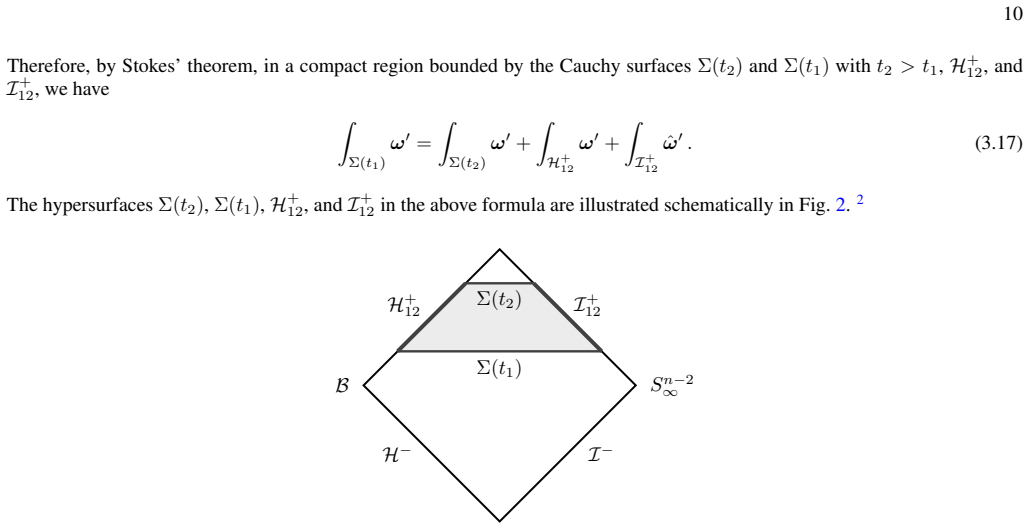
read the original abstract
We investigate the entropy of a dynamical black hole arising from second-order perturbations of a general stationary background with a bifurcate Killing horizon. Using Gaussian null coordinates, we study the geometry of the apparent horizon perturbatively up to second order. Within the covariant phase space formalism, to explore the contribution of matter fields, we introduce a new modified canonical energy, and establish a balance law relating the second-order variation of the entropy to the energy flux entering the black hole. We show that the entropy is given precisely by the area of the apparent horizon at second order when the null energy condition holds for the infalling matter, and that the variation of the entropy also obeys the second law. We also discuss the possibility that the area law continues to hold when the null energy condition is violated.
Editorial analysis
A structured set of objections, weighed in public.
Referee Report
Summary. The paper studies second-order perturbations of a stationary black hole with a bifurcate Killing horizon. Using Gaussian null coordinates, the apparent horizon is expanded perturbatively to second order. Within the covariant phase space formalism, a modified canonical energy is introduced whose balance law is used to relate the second-order entropy variation to the infalling energy flux. The central claim is that, when the null energy condition holds, the entropy equals the area of the apparent horizon at second order and the second law is satisfied; the possibility of the area law persisting when NEC is violated is also discussed.
Significance. If the second-order equality holds without omitted cross terms, the result would strengthen the identification of black-hole entropy with apparent-horizon area beyond first order and furnish a concrete check of the second law for dynamical horizons. The modified canonical energy construction, if shown to be complete, could serve as a reusable tool for higher-order calculations in covariant phase space. The discussion of NEC violation supplies a falsifiable extension that future work could test against exact solutions or numerical evolutions.
major comments (1)
- [Section introducing the modified canonical energy and the balance law (abstract and associated derivation)] The balance law for the newly introduced modified canonical energy must be shown to capture all second-order contributions arising from the simultaneous expansion of the metric perturbations and the location of the apparent horizon in Gaussian null coordinates. In particular, Lie-dragging terms along the perturbed generators and quadratic stress-tensor back-reaction must be demonstrated to cancel or be absorbed; otherwise the asserted equality between entropy variation and area variation fails.
minor comments (2)
- The abstract states the final result but supplies no explicit expansion steps or error estimates; a short appendix or subsection summarizing the second-order GNC expansion of the apparent-horizon generators would improve readability.
- Notation for the modified canonical energy should be introduced with a clear comparison to the standard canonical energy so that readers can identify precisely which terms have been altered.
Simulated Author's Rebuttal
We thank the referee for their careful reading of the manuscript and for highlighting the need for explicit verification of all second-order terms in the balance law. We address the major comment below and agree that additional detail will strengthen the presentation.
read point-by-point responses
-
Referee: [Section introducing the modified canonical energy and the balance law (abstract and associated derivation)] The balance law for the newly introduced modified canonical energy must be shown to capture all second-order contributions arising from the simultaneous expansion of the metric perturbations and the location of the apparent horizon in Gaussian null coordinates. In particular, Lie-dragging terms along the perturbed generators and quadratic stress-tensor back-reaction must be demonstrated to cancel or be absorbed; otherwise the asserted equality between entropy variation and area variation fails.
Authors: We agree that an explicit demonstration of the cancellation or absorption of these terms is necessary for full rigor. In the construction of the modified canonical energy (Section 3), the definition is chosen to be Lie-dragged along the perturbed null generators, ensuring that the associated terms from the simultaneous expansion of the metric and apparent horizon location are absorbed into the flux integrals of the balance law. The quadratic stress-tensor back-reaction is included at second order through the matter contribution to the canonical energy; under the null energy condition these terms are non-negative and do not alter the equality between the second-order entropy variation and the apparent-horizon area variation. To make this transparent, we will revise the manuscript by expanding the derivation in Section 3 and adding an appendix that displays the relevant second-order expansions term by term. revision: yes
Circularity Check
No significant circularity; derivation applies standard covariant phase space to perturbative geometry
full rationale
The paper performs a second-order perturbative expansion of the apparent horizon in Gaussian null coordinates and introduces a modified canonical energy within the covariant phase space formalism to derive a balance law. The claim that entropy equals apparent-horizon area (when NEC holds) follows from this balance law applied to the perturbative quantities, without any quoted step in which a fitted parameter is relabeled as a prediction, a result is defined in terms of itself, or a load-bearing uniqueness theorem reduces to a self-citation chain. The derivation remains independent of its own outputs and is self-contained against the external benchmarks of the covariant phase space formalism and the null energy condition.
Axiom & Free-Parameter Ledger
axioms (2)
- domain assumption The background spacetime is stationary with a bifurcate Killing horizon.
- domain assumption Gaussian null coordinates can be used to describe the apparent horizon geometry perturbatively to second order.
invented entities (1)
-
modified canonical energy
no independent evidence
Reference graph
Works this paper leans on
-
[1]
modified canonical energy(n−1)-forms
For this purpose, we choose the Bondi gauge for the physical background metricg ab. The corresponding unphysical background metric ˆgab = Ω2gab, where the conformal factor isΩ = 1/r, then admits, in a neighborhood ofI +, the asymptotic form ˆgab = (dˆΩ)a(dˆu)b + (dˆΩ)b(dˆu)a + ˆγij(dxi)a(dxj)b +O(Ω).(3.19) Hereˆuis a future directed affine parameter on th...
-
[2]
In the following, we prove this statement using the method of [28], together with the boundary conditions and a consequence of the null energy condition
Case I In this case, we assume that the null energy condition holds and show thatδθ v = 0. In the following, we prove this statement using the method of [28], together with the boundary conditions and a consequence of the null energy condition. First, we assume thatδθ v →0at late times along the event horizon, which means that the perturbed black hole eve...
-
[3]
(4.41) and (4.42) may no longer hold
Case II In this case, we no longer impose the null energy condition, thus the two conditions in Eqs. (4.41) and (4.42) may no longer hold. Comparing Eq. (4.39) with Eq. (2.41), it appears that under second-order perturbations the area of the apparent horizon does not always proportional to the dynamical black hole entropy, since there remain extra terms t...
-
[4]
R. M. Wald, Living Rev. Rel.4, 6 (2001), arXiv:gr-qc/9912119
Pith/arXiv arXiv 2001
-
[5]
A. Strominger and C. Vafa, Phys. Lett. B379, 99 (1996), arXiv:hep-th/9601029
Pith/arXiv arXiv 1996
-
[6]
J. M. Maldacena, Adv. Theor. Math. Phys.2, 231 (1998), arXiv:hep-th/9711200
Pith/arXiv arXiv 1998
- [7]
-
[8]
J. D. Bekenstein, Phys. Rev. D7, 2333 (1973)
1973
-
[9]
J. M. Bardeen, B. Carter, and S. W. Hawking, Commun. Math. Phys.31, 161 (1973)
1973
-
[10]
S. W. Hawking, Commun. Math. Phys.43, 199 (1975), [Erratum: Commun.Math.Phys. 46, 206 (1976)]
1975
-
[11]
Lee and R
J. Lee and R. M. Wald, J. Math. Phys.31, 725 (1990)
1990
-
[12]
R. M. Wald, J. Math. Phys.31, 2378 (1990)
1990
-
[13]
R. M. Wald, Phys. Rev. D48, R3427 (1993), arXiv:gr-qc/9307038
Pith/arXiv arXiv 1993
-
[14]
V . Iyer and R. M. Wald, Phys. Rev. D50, 846 (1994), arXiv:gr-qc/9403028
Pith/arXiv arXiv 1994
-
[15]
S. Hollands, R. M. Wald, and V . G. Zhang, Phys. Rev. D110, 024070 (2024), arXiv:2402.00818 [hep-th]
arXiv 2024
-
[16]
Dong, JHEP01, 044 (2014), arXiv:1310.5713 [hep-th]
X. Dong, JHEP01, 044 (2014), arXiv:1310.5713 [hep-th]
Pith/arXiv arXiv 2014
-
[17]
A. C. Wall, Int. J. Mod. Phys. D24, 1544014 (2015), arXiv:1504.08040 [gr-qc]
Pith/arXiv arXiv 2015
-
[18]
H. Furugori, K. Nishii, D. Yoshida, and K. Yoshimura, Phys. Rev. D112, 104049 (2025), arXiv:2507.14105 [gr-qc]
arXiv 2025
-
[19]
D. Kong, Y . Tian, H. Zhang, and J. Zhao, Phys. Rev. D111, 084005 (2025), arXiv:2412.00647 [hep-th]
arXiv 2025
-
[20]
A. Ashtekar, D. E. Paraizo, and J. Shu, (2025), arXiv:2512.11659 [gr-qc]
Pith/arXiv arXiv 2025
-
[21]
A. Ashtekar, D. E. Paraizo, and J. Shu, (2026), arXiv:2604.00170 [gr-qc]
Pith/arXiv arXiv 2026
-
[22]
A. Ashtekar and B. Krishnan, Living Reviews in Relativity7(2004), 10.12942/lrr-2004-10
-
[23]
M. R. Visser and Z. Yan, JHEP10, 029 (2024), arXiv:2403.07140 [hep-th]
arXiv 2024
-
[24]
W. Jia, Q. Qi, and C. Gao, (2025), arXiv:2509.05700 [hep-th]
Pith/arXiv arXiv 2025
-
[25]
S. Hollands, ´A. D. Kov´acs, and H. S. Reall, JHEP08, 258 (2022), arXiv:2205.15341 [hep-th]
arXiv 2022
-
[26]
S. Bhattacharyya, P. Dhivakar, A. Dinda, N. Kundu, M. Patra, and S. Roy, JHEP09, 169 (2021), arXiv:2105.06455 [hep-th]
arXiv 2021
-
[27]
S. Hollands and R. M. Wald, Commun. Math. Phys.321, 629 (2013), arXiv:1201.0463 [gr-qc]
Pith/arXiv arXiv 2013
-
[28]
V . Iyer and R. M. Wald, Phys. Rev. D52, 4430 (1995), arXiv:gr-qc/9503052
Pith/arXiv arXiv 1995
-
[29]
S. Hollands and A. Ishibashi, in 7th Hungarian Relativity Workshop (RW 2003) (2003) pp. 51–61, arXiv:hep-th/0311178
Pith/arXiv arXiv 2003
-
[30]
R. M. Wald and A. Zoupas, Phys. Rev. D61, 084027 (2000), arXiv:gr-qc/9911095
Pith/arXiv arXiv 2000
-
[31]
R. D. Sorkin and M. Varadarajan, Class. Quant. Grav.13, 1949 (1996), arXiv:gr-qc/9510031
Pith/arXiv arXiv 1949
-
[32]
R. D. Sorkin, in Heat Kernels and Quantum Gravity (1995) arXiv:gr-qc/9508002
Pith/arXiv arXiv 1995
discussion (0)
Sign in with ORCID, Apple, or X to comment. Anyone can read and Pith papers without signing in.