Cell Division Changes Fate Decisions in a Genetic Toggle Switch
Pith reviewed 2026-06-27 02:25 UTC · model grok-4.3
The pith
Cell division can redirect trajectories with identical initial conditions to opposing stable states in a genetic toggle switch.
A machine-rendered reading of the paper's core claim, the machinery that carries it, and where it could break.
Core claim
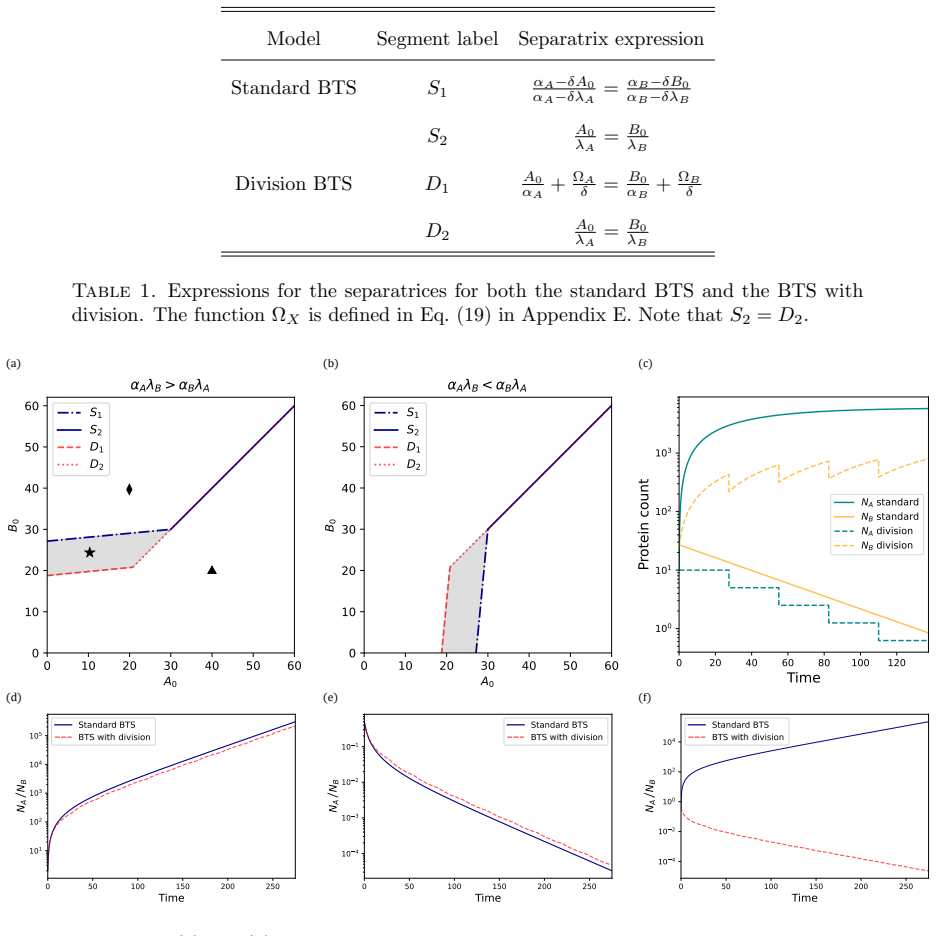
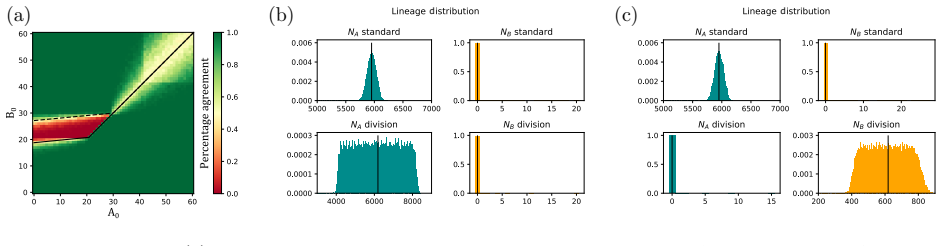
In a simplified Boolean toggle switch, analytical separatrices show that including cell division redirects some trajectories with identical initial conditions to opposing stable states, creating a region of disagreement where neglecting division leads to incorrect fate predictions.
What carries the argument
Analytical separatrices for the Boolean toggle switch with and without division
If this is right
- Standard models of multistable gene networks that neglect division will mispredict fates inside the disagreement region.
- Cell division can change which stable state is reached from a given starting point of gene expression.
- Fate decision boundaries in regulatory networks are reshaped by the timing and rules of division.
- Predictions of cellular differentiation outcomes must incorporate division when the initial condition lies near the separatrix.
Where Pith is reading between the lines
- Faster-dividing cells could systematically reach different fates than slower-dividing cells under the same initial conditions.
- Similar redirection effects may appear in other multistable regulatory motifs beyond the toggle switch.
- Synthetic biology circuits could be engineered to make fate decisions division-dependent by tuning the disagreement region.
Load-bearing premise
The simplified Boolean toggle switch with its particular update rules and division implementation is a faithful enough representation of real genetic toggle-switch dynamics.
What would settle it
Tracking gene expression trajectories in a synthetic toggle switch circuit and finding that cells with identical initial conditions always reach the same stable state regardless of division would falsify the redirection effect.
Figures

read the original abstract
Gene regulatory networks govern cellular fate decisions through multistable dynamics. The genetic toggle switch is a canonical model of such behaviour; yet, the impact of cell division on its dynamics remains poorly understood. We derive analytical separatrices for a simplified Boolean toggle switch with and without division. We show that division can redirect trajectories with identical initial conditions to opposing stable states, and we define a region of disagreement where fate decisions are predicted incorrectly if division is neglected. Our results imply that division can fundamentally reshape fate boundaries in multistable regulatory networks.
Editorial analysis
A structured set of objections, weighed in public.
Referee Report
Summary. The manuscript analyzes a simplified Boolean model of the genetic toggle switch and derives analytical separatrices for the system dynamics with and without cell division. It shows that division can redirect trajectories with identical initial conditions to opposing stable states and defines a disagreement region where fate decisions are incorrectly predicted if division is neglected. The results are used to argue that division can fundamentally reshape fate boundaries in multistable regulatory networks.
Significance. If the analytical separatrices and redirection effect are correctly derived within the Boolean model, the work supplies a concrete, discrete example of how cell division alters multistable fate decisions. This could motivate inclusion of division in other network models, but the broader claim for real genetic networks rests on an untested assumption that the Boolean results are representative rather than discretization artifacts.
major comments (2)
- [Abstract] Abstract: the claim of deriving analytical separatrices and a disagreement region is asserted without any equations, derivation steps, or explicit definition of the update rules and division implementation, preventing verification that the separatrices are indeed analytical or that the redirection holds for the stated initial conditions.
- [Discussion] The central implication that division reshapes fate boundaries in multistable networks requires evidence that the disagreement region survives outside the specific Boolean rules; no continuous ODE counterpart, asynchronous update comparison, or parameter sweep on division partitioning is referenced to test robustness.
minor comments (1)
- [Abstract] The abstract and title should explicitly qualify the results as applying to a particular Boolean implementation rather than general toggle-switch dynamics.
Simulated Author's Rebuttal
We thank the referee for their constructive comments on our manuscript. We address the major comments point by point below.
read point-by-point responses
-
Referee: [Abstract] Abstract: the claim of deriving analytical separatrices and a disagreement region is asserted without any equations, derivation steps, or explicit definition of the update rules and division implementation, preventing verification that the separatrices are indeed analytical or that the redirection holds for the stated initial conditions.
Authors: The abstract is a high-level summary and does not include equations by design. The Boolean update rules are explicitly defined in Section 2, the cell-division implementation (including partitioning) is given in Section 3, and the analytical derivations of the separatrices (with all intermediate steps) appear in Sections 4 and 5 together with the closed-form expressions. These sections allow complete verification of both the separatrices and the redirection effect for the stated initial conditions. We therefore see no need to alter the abstract itself. revision: no
-
Referee: [Discussion] The central implication that division reshapes fate boundaries in multistable networks requires evidence that the disagreement region survives outside the specific Boolean rules; no continuous ODE counterpart, asynchronous update comparison, or parameter sweep on division partitioning is referenced to test robustness.
Authors: The manuscript deliberately restricts itself to a Boolean model precisely because this setting permits exact analytical separatrices. The central result is therefore model-specific: within these rules, division creates a disagreement region. We do not present the Boolean case as a universal proof for all regulatory networks. To meet the referee’s concern we will add a short paragraph in the Discussion that explicitly states the limitation and notes that extensions to continuous or asynchronous formulations are left for future work. revision: partial
Circularity Check
No circularity: analytical separatrices derived directly from explicit Boolean rules
full rationale
The paper states it derives analytical separatrices for a simplified Boolean toggle switch with and without division, then shows redirection of trajectories and a disagreement region. These steps rest on the model's stated update rules and division implementation, which are taken as given inputs rather than fitted or self-referentially defined. No self-citation chains, ansatz smuggling, or renaming of known results appear in the abstract or description. The derivation chain is therefore self-contained against the model's own equations; the skeptic concern about model fidelity to real biology is a question of external validity, not internal circularity.
Axiom & Free-Parameter Ledger
axioms (1)
- domain assumption The Boolean toggle switch with its update rules is an adequate model for studying division effects on fate boundaries.
Reference graph
Works this paper leans on
-
[1]
Maizels, R. J. & Briscoe, J. Gene regulatory networks: from correlative models to causal explanations. Nature Reviews Genetics27,485–498 (Mar. 2026)
2026
-
[2]
& Collins, J
Bal´ azsi, G., van Oudenaarden, A. & Collins, J. J. Cellular Decision Making and Biological Noise: From Microbes to Mammals.Cell144,910–925 (Mar. 2011)
2011
-
[3]
Perkins, T. J. & Swain, P. S. Strategies for cellular decision-making.Molecular Systems Biology5(Nov. 2009)
2009
-
[4]
E., Coomer, M
Ham, L., Woodward, T. E., Coomer, M. A. & Stumpf, M. P. Mapping, Modeling, and Reprogramming Cell-Fate Decision-Making Systems.Annual Review of Biomedical Data Science8(2025)
2025
-
[5]
Gardner Charles R
Timothy S. Gardner Charles R. Cantor, J. J. C. Construction of a genetic toggle switch in Escherichia coli.Nature403,339–342 (Jan. 2000)
2000
-
[6]
Lee, S., Lewis, D. E. & Adhya, S. The Developmental Switch in Bacteriophageλ: A Critical Role of the Cro Protein.Journal of Molecular Biology430,58–68 (Jan. 2018)
2018
-
[7]
& Little, J
Atsumi, S. & Little, J. W. A synthetic phageλregulatory circuit.Proceedings of the National Academy of Sciences103,19045–19050 (Dec. 2006)
2006
-
[8]
B., Kobiler, O., Stavans, J., Court, D
Oppenheim, A. B., Kobiler, O., Stavans, J., Court, D. L. & Adhya, S. Switches in Bacteriophage Lambda Development.Annual Review of Genetics39,409–429 (Dec. 2005)
2005
-
[9]
& Burrage, K
Tian, T. & Burrage, K. Bistability and switching in the lysis/lysogeny genetic regulatory network of bacteriophageλ.Journal of Theoretical Biology227,229–237 (Mar. 2004)
2004
-
[10]
& Peterson, C
Chickarmane, V., Enver, T. & Peterson, C. Computational Modeling of the Hematopoietic Erythroid- Myeloid Switch Reveals Insights into Cooperativity, Priming, and Irreversibility.PLoS Computational Biology5(ed Antia, R.) e1000268 (Jan. 2009). 6
2009
-
[11]
& Tian, T
Duff, C., Smith-Miles, K., Lopes, L. & Tian, T. Mathematical modelling of stem cell differentiation: the PU.1–GATA-1 interaction.Journal of Mathematical Biology64,449–468 (Apr. 2011)
2011
-
[12]
Lipshtat, A., Loinger, A., Balaban, N. Q. & Biham, O. Genetic Toggle Switch without Cooperative Binding.Physical Review Letters96,188101 (May 2006)
2006
-
[13]
Strasser, M., Theis, F. J. & Marr, C. Stability and Multiattractor Dynamics of a Toggle Switch Based on a Two-Stage Model of Stochastic Gene Expression.Biophysical Journal102,19–29 (Jan. 2012)
2012
-
[14]
& Demongeot, J
Cinquin, O. & Demongeot, J. High-dimensional switches and the modelling of cellular differentiation. Journal of Theoretical Biology233,391–411 (Apr. 2005)
2005
-
[15]
Biswas, K., Jolly, M. K. & Ghosh, A. Mean residence times of TF-TF and TF-miRNA toggle switches. Journal of Biosciences47(Apr. 2022)
2022
-
[16]
H., Perez-Carrasco, R
Beentjes, C. H., Perez-Carrasco, R. & Grima, R. Exact solution of stochastic gene expression models with bursting, cell cycle and replication dynamics.Physical Review E101,032403 (2020)
2020
-
[17]
& Klumpp, S
Bierbaum, V. & Klumpp, S. Impact of the cell division cycle on gene circuits.Physical Biology12, 066003 (Sept. 2015)
2015
-
[18]
E., Tordera, V
P´ erez-Ort´ ın, J. E., Tordera, V. & Ch´ avez, S. Homeostasis in the Central Dogma of molecular biology: the importance of mRNA instability.RNA Biology16,1659–1666 (Sept. 2019)
2019
-
[19]
& Barkai, N
Voichek, Y., Bar-Ziv, R. & Barkai, N. Expression homeostasis during DNA replication.Science351, 1087–1090 (Mar. 2016)
2016
-
[20]
& Grima, R
Jia, C., Singh, A. & Grima, R. Concentration fluctuations in growing and dividing cells: Insights into the emergence of concentration homeostasis.PLoS computational biology18,e1010574 (2022)
2022
-
[21]
H.Nonlinear Dynamics and Chaos(CRC Press, May 2018)
Strogatz, S. H.Nonlinear Dynamics and Chaos(CRC Press, May 2018)
2018
-
[22]
& Zhang, W
Li, J. & Zhang, W. Transition between monostability and bistability of a genetic toggle switch in Escherichia coli.Discrete & Continuous Dynamical Systems - B25,1871–1894 (2020)
2020
-
[23]
& Amir, A
Soifer, I., Robert, L. & Amir, A. Single-cell analysis of growth in budding yeast and bacteria reveals a common size regulation strategy.Current Biology26,356–361 (2016)
2016
-
[24]
& Grima, R
Jia, C. & Grima, R. Frequency domain analysis of fluctuations of mRNA and protein copy numbers within a cell lineage: theory and experimental validation.Physical Review X11,021032 (2021)
2021
-
[25]
Tanouchi, Y.et al.Long-term growth data of Escherichia coli at a single-cell level.Scientific data4, 170036 (2017)
2017
-
[26]
Schwanh¨ ausser, B.et al.Global quantification of mammalian gene expression control.Nature473, 337–342 (May 2011)
2011
-
[27]
B., Levine, A
Elowitz, M. B., Levine, A. J., Siggia, E. D. & Swain, P. S. Stochastic gene expression in a single cell. Science297,1183–1186 (2002)
2002
-
[28]
& McKane, A
Biancalani, T., Dyson, L. & McKane, A. J. Noise-Induced Bistable States and Their Mean Switching Time in Foraging Colonies.Physical Review Letters112,038101 (Jan. 2014)
2014
-
[29]
Loinger, A., Lipshtat, A., Balaban, N. Q. & Biham, O. Stochastic simulations of genetic switch systems. Physical Review E75,021904 (Feb. 2007)
2007
-
[30]
& Page, K
Perez-Carrasco, R., Guerrero, P., Briscoe, J. & Page, K. M. Intrinsic Noise Profoundly Alters the Dynamics and Steady State of Morphogen-Controlled Bistable Genetic Switches.PLOS Computational Biology12(ed Tusscher, T.) e1005154 (Oct. 2016)
2016
-
[31]
& Grima, R
Jia, C., Singh, A. & Grima, R. Cell size distribution of lineage data: analytic results and parameter inference.Iscience24(2021)
2021
-
[32]
Stefan, M. I. & Le Nov` ere, N. Cooperative Binding.PLoS Computational Biology9(ed Wodak, S.) e1003106 (June 2013)
2013
-
[33]
On the Use of the Hill Functions in Mathematical Models of Gene Regulatory Networks
Santill´ an, M. On the Use of the Hill Functions in Mathematical Models of Gene Regulatory Networks. Mathematical Modelling of Natural Phenomena3,85–97 (2008)
2008
-
[34]
Mez˝ o, I.The Lambert W Function: Its Generalizations and Applications(Chapman and Hall/CRC, Mar. 2022)
2022
-
[35]
Gillespie, D. T. A general method for numerically simulating the stochastic time evolution of coupled chemical reactions.Journal of Computational Physics22,403–434 (1976)
1976
-
[36]
& Hasty, J
Lu, T., Volfson, D., Tsimring, L. & Hasty, J. Cellular growth and division in the Gillespie algorithm. Systems Biology1,121–128 (June 2004). 7 AppendixA.Reaction Scheme for the Toggle Switch The toggle switch motif can be described via the following reaction scheme: GA αA − − →GA +P A,(8) GB αB − − →GB +P B,(9) GA +h 1PB kA+ − − −⇀↽− − − kA− G∗ A,(10) GB ...
2004
discussion (0)
Sign in with ORCID, Apple, or X to comment. Anyone can read and Pith papers without signing in.