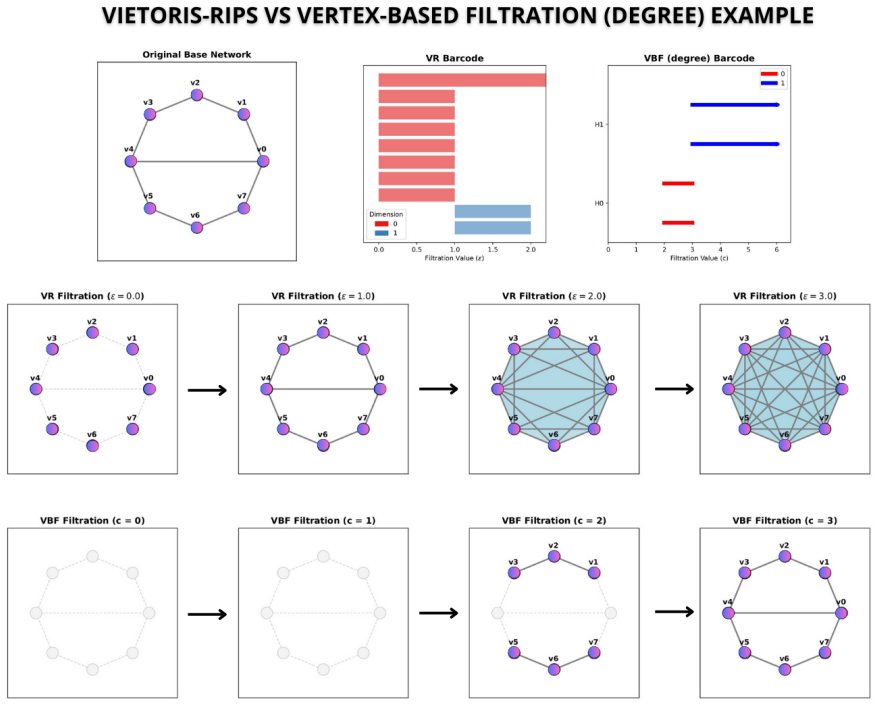
Topological data analysis (TDA) has established itself as a useful tool for capturing multiscale structures in complex networks, such as connected components, cycles, and cavities. Although Vietoris-Rips (VR) filtering is widely used in network analysis, it tends to be computationally expensive, especially for large networks. This work explores vertex function-based (VFB) filtering based on network measures, applying persistent homology to identify relevant topological structures in cancer-associated protein networks, and compares its effectiveness with the VR approach. The results show that VFB reproduces the second-order structures (Betti-2) identified by VR, recovering previously reported essential genes. In addition, VFB detected new driver genes, confirmed in databases such as IntOGen and NCG, and allowed analysis of third-order structures (Betti-3) that was not feasible with VR. Thus, VFB represents a scalable alternative to VR, preserving biological interpretability and complementing classical network metrics.
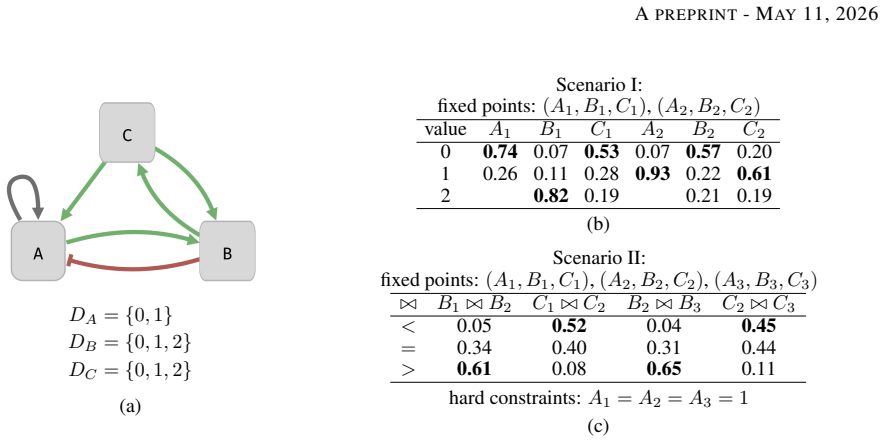
Qualitative models provide crucial instruments for modelling complex biological systems. While advances in automated reasoning and symbolic encodings have enabled rigorous inference of these models from data, the process remains highly fragile. First, biological measurement errors inevitably propagate into formal model specifications. Second, when a specification becomes unsatisfiable, distinguishing between fundamental design flaws and minor technical errors is notoriously difficult. This uncertainty often leads to under-specification, as it is unclear which observations are still ``safe'' to incorporate. To overcome these challenges, we introduce a robust inference method based on weighted MaxSMT. By encoding uncertain biological observations as weighted soft constraints, our approach enables the solver to identify a model best reflecting the observations, even with some conflicting constraints. Our method allows for Boolean and multi-valued variable domains, alongside observations derived from discretisation (level constraints) and differential expression (ordering constraints). We show our approach can be used to successfully infer neural cell differentiation models from prior-knowledge networks with 200--1300 genes using ordering constraints on all included genes.
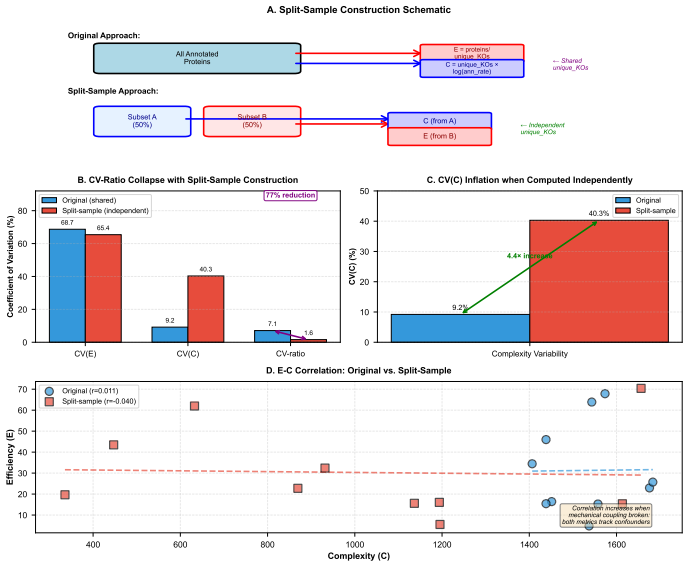
Biological systems operate under simultaneous energetic and informational constraints, yet direct evidence that such constraints shape real metabolic networks is limited. The Network-Weighted Action Principle predicts that networks under these constraints should organize toward high modularity. We tested this prediction in marine microbiome metabolic networks reconstructed from Tara Oceans metagenomes using two complementary approaches. Composite metrics of protein-deployment efficiency and functional-repertoire complexity (n=10) failed under causal-inference diagnostics, with apparent structure dominated by shared-component bias. In contrast, network modularity (n=7) was high (Q ~ 0.987), but this value was shown to arise from sparsity alone. The biologically meaningful signal is the excess over null models: modularity exceeded configuration-model, label-permutation, and bipartite-incidence nulls by Delta Q ~ 0.15-0.40 (p < 0.001), with the largest effect under the bipartite-incidence control. Fine-grained communities recovered by the network partition are not arbitrary: 25% recur across samples, and the most consistent modules map to known functional units, including enzyme subunits, biosynthetic sequences, and transporter complexes. Together, these results show that modularity excess - rather than absolute modularity - is the appropriate signature of biological organization, and that such excess is consistent with cost-minimization principles operating at the scale of natural metabolic networks.
Hill functions, the standard tool for modelling gene regulatory networks, carry three structural flaws when the cooperativity exponent is non-integer: loss of global smoothness, silent complex-valued arithmetic corruption of ODE trajectories, and an identically zero basal production rate that traps bistable models in off-states. Logistic functions $f^\pm$, being globally $C^\infty$, real-valued for all arguments, and strictly positive at zero, resolve all three simultaneously. For a two-gene negative-feedback oscillator, local asymptotic stability is established for all positive parameters via the Routh--Hurwitz criterion, and no Hopf bifurcation is possible without time delays. For bistable positive autoregulation, saddle-node thresholds are characterised through explicit transcendental equations; with biophysically grounded \textit{E.~coli} parameters, basal logistic production drives off-state escape in $\approx 44$~min while the Hill model remains permanently trapped. The 11-gene Traynard cell-cycle Boolean network is translated automatically via the product-of-logistics De~Morgan formalism and integrated without warnings, all variables remaining bounded and non-negative. The De~Morgan framework places every repressor threshold at a positive measurable concentration, whereas the weighted-sum formulation of Samuilik et al.\ places repressor critical points at negative concentrations, rendering them biologically inert. On an 80-gene Boolean-derived ODE system with $n = 3.509$, the Hill solver entered silent complex-valued contamination at $t \approx 52.64$ and terminated near $t \approx 63$--$65$; the logistic formulation completed $t \in [0, 200]$ without a single warning. The always-positive production rate ensures full controllability, enabling sliding mode, model predictive, and feedback-linearisation strategies where Hill-based formulations fail.
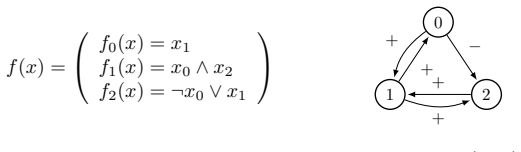
Boolean networks are powerful mathematical tools for modeling the qualitative dynamics of genetic regulation. Yet inferred models often generate spurious attractors that lack biological viability. In this paper, we propose a parsimonious computational framework to systematically refine Boolean network models by eliminating these non-biological asymptotic behaviors while strictly preserving known, biologically relevant attractors. Through an exhaustive exploration of local function substitutions, we generate a comprehensive set of candidate models. To identify the most biologically consistent networks, we implement an incremental pruning protocol that filters candidates based on structural interaction digraph similarity, attraction basin topological organization, trajectorial isomorphism, and the minimization of dynamical instability and frustration. We apply this methodology to a 9-node genetic control model of the osteogenesis regulation network. Our protocol effectively evaluates a syntactic search space of 51,138 potential networks, ultimately narrowing them down to a robust family of 6 parsimonious models that are fully compatible with current biological knowledge.
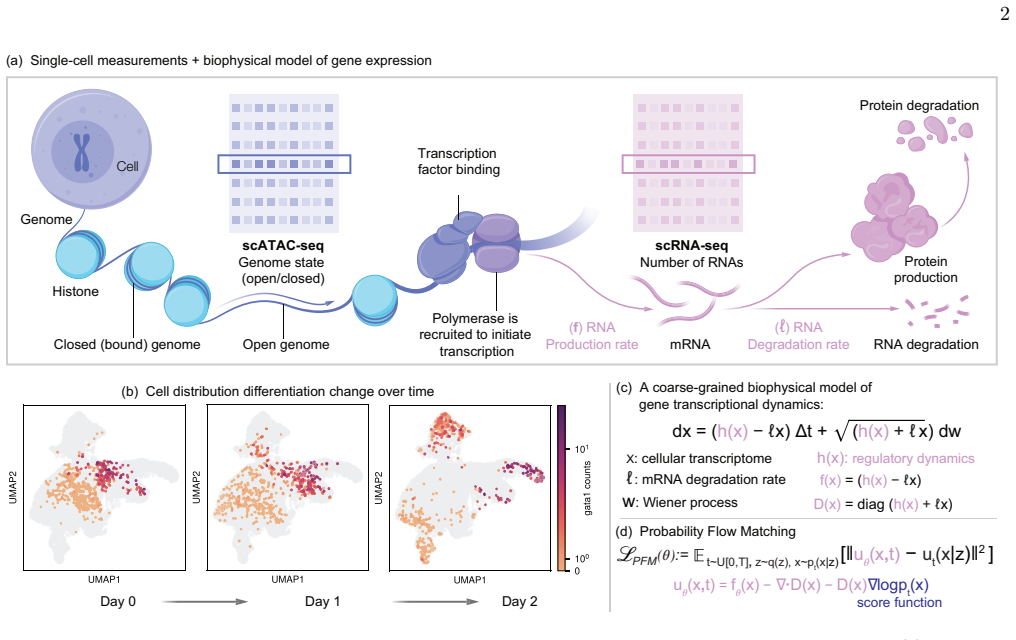
Cellular differentiation is governed by gene regulatory networks, the high-dimensional stochastic biochemical systems that determine the transcriptional landscape and mediate cellular responses to signals and perturbations. Although single-cell RNA sequencing provides quantitative snapshots of the transcriptome, current methods for inferring gene-regulatory dynamics often lack mechanistic interpretability and fail to generalize to unseen conditions. Here we introduce Probability Flow Matching (PFM), a scalable framework for learning biophysically consistent stochastic processes directly from time-resolved single-cell measurements. Applying PFM to three hematopoiesis datasets, we show that models with similar interpolation accuracy can encode fundamentally different dynamics, with only biophysically consistent formulations accurately capturing mechanisms of lineage transitions, fate specification, and gene perturbation responses. We further demonstrate that PFM accommodates unbalanced populations, enabling simultaneous inference of cellular proliferation and death dynamics. Together, these results establish PFM as a flexible, scalable framework for integrating mechanistic modeling with single-cell omics.
Conservation laws in low-dimensional non-redundant networks prevent fixed species concentrations at steady states for generic rates.
abstractclick to expand
Absolute concentration robustness (ACR) means the concentration of certain species stays the same in all the steady states. In this work, we study how conservation laws might effect non-vacuous ACR in reaction networks. The goal is to show whether non-vacuous ACR can be preserved or precluded by adding species that depend on the existing species. We have the following two main results. (i) For networks with conservation laws, we prove a criterion: for a nondegenerate network, augmenting it with one new species that depends on the original species leads to the resulting network having no non-vacuous ACR for any generic choice of rate constants in the new species. (ii) We characterize all non-redundant zero-one networks with dimension of at most two that exhibit non-vacuous ACR for any generic choice of rate constants according to the number of distinct rows in the stoichiometric matrices. An important finding is that if there are at least four distinct rows in the stoichiometric matrix, then the corresponding network has no non-vacuous ACR for any generic choice of rate constants, which implies that many conservation laws prevent non-vacuous ACR in non-redundant zero-one reaction networks.
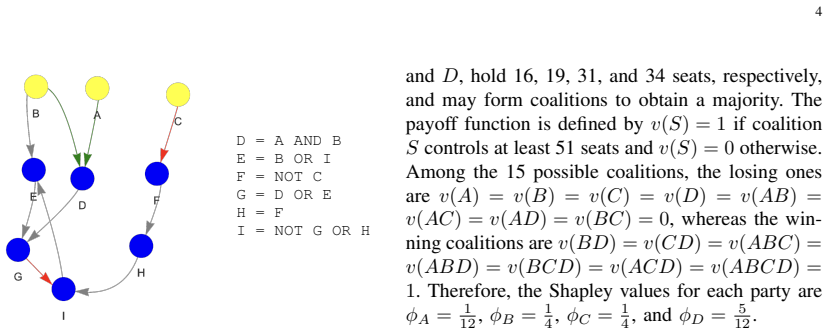
Identifying dynamically influential nodes in biological networks is a central problem in systems biology, particularly for prioritizing intervention targets in gene regulatory networks. In this paper, we propose a Shapley-value-based framework for assessing the importance of nodes in a Boolean network with respect to a given target node. The framework comprises two complementary measures: the Knock-out and the Knock-in Shapley values. Moreover, we present a propagation-based method that enables their efficient computation. By exploiting the logical structure of the network, the method avoids exhaustive simulations. The approach is exact for acyclic networks and provides good approximations for cyclic networks. Evaluation on benchmark models from the Cell Collective database shows that the propagation method accurately recovers node importance rankings while achieving substantial speed-ups.
Systems of differential equations have been used to model biological systems such as gene and neural networks. A problem of particular interest is to understand the number of stable steady states. Here we propose conjunctive networks (systems of differential equations equations created using AND gates) to achieve any desired number of stable steady states. Our approach uses combinatorial tools to predict the number of stable steady states from the structure of the wiring diagram. Furthermore, AND gates have been successfully engineered by experimentalists for gene networks, so our results provide a modular approach to design gene networks that achieve arbitrary number of phenotypes.