Analytic Benchmarks for Coherence-to-Entanglement Conversion under Post-Gate Noise in CNOT-Based Protocols
Pith reviewed 2026-07-03 23:24 UTC · model grok-4.3
The pith
CNOT conversion from coherence to entanglement obeys noiseless negativity exactly equal to half the l1 coherence for arbitrary mixed inputs.
A machine-rendered reading of the paper's core claim, the machinery that carries it, and where it could break.
Core claim
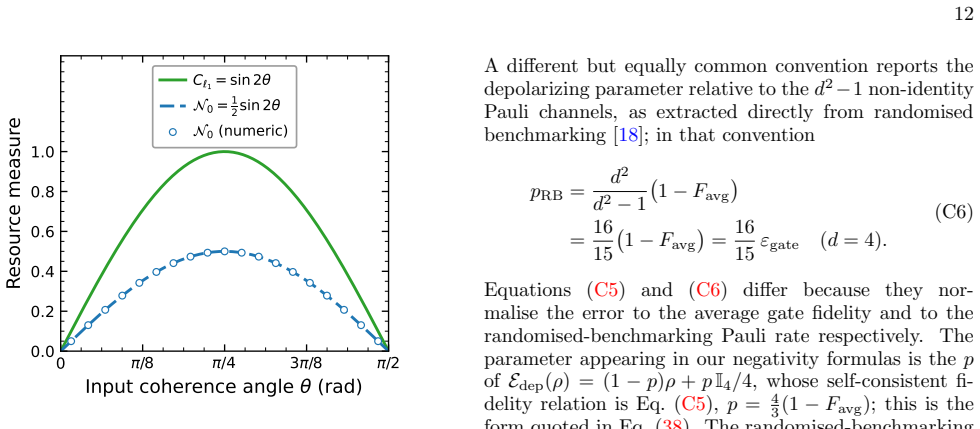
We prove the noiseless law N0 = C_l1 / 2, valid for arbitrary mixed inputs, and obtain exact negativities, survival fractions, and entanglement-sudden-death thresholds. For all X-state-preserving channels, a master relation shows that entanglement loss results from the competition between coherence suppression and partial-transpose spectral shifts.
What carries the argument
The master relation for X-state-preserving channels that expresses entanglement loss as the competition between coherence suppression and partial-transpose spectral shifts.
If this is right
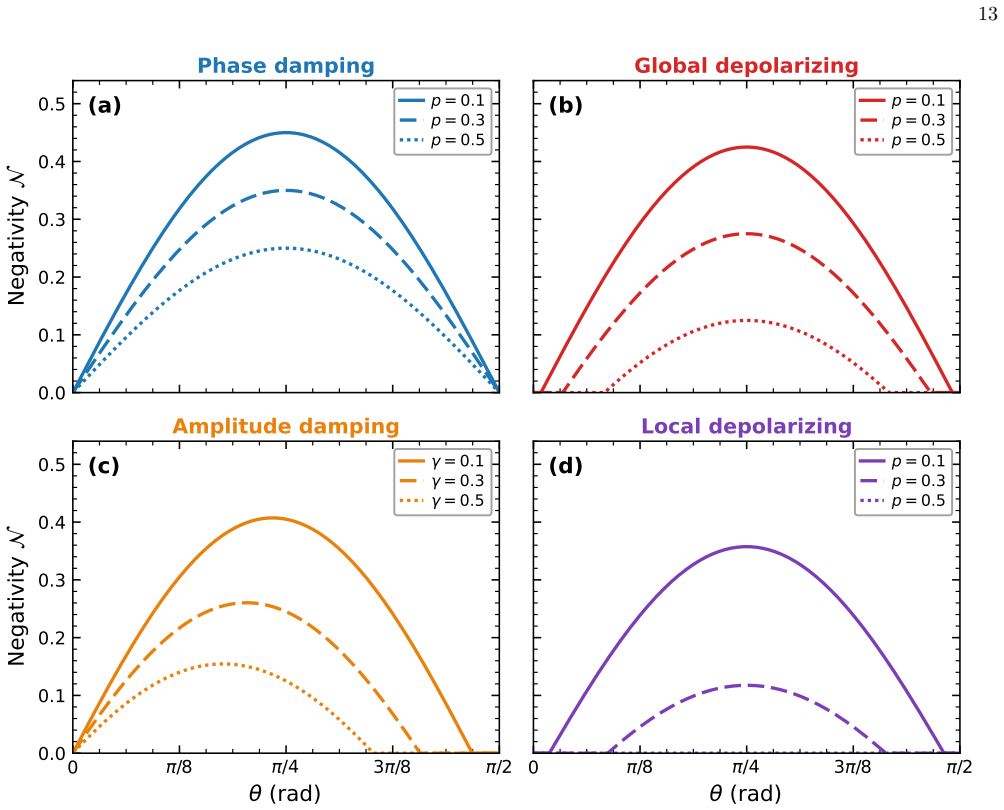
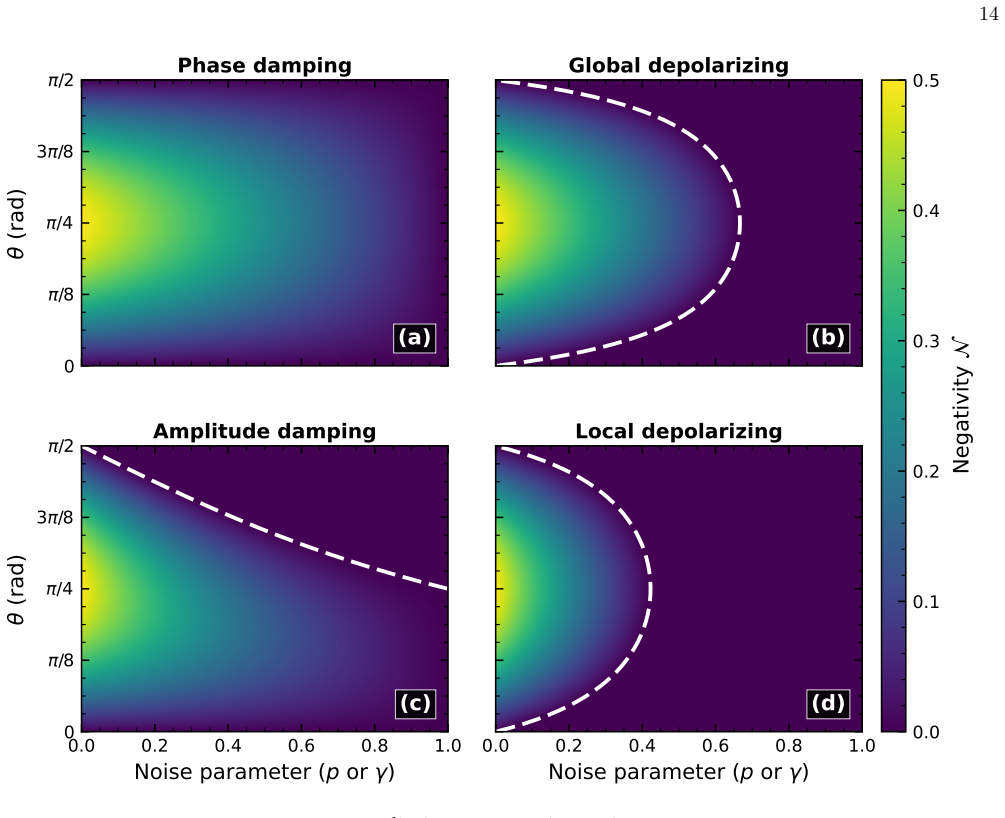
- Phase damping produces survival fraction eta=1-p with no finite-noise sudden death.
- Global depolarizing noise yields coherence-dependent sudden death.
- Amplitude damping adds an excited-population penalty and triggers sudden death only for theta greater than pi/4.
- Local depolarization is most destructive at equal noise strength on both qubits.
- Initial survival slopes equal -1, -3/2, -2 and -3 for the four channels and serve as noise fingerprints.
Where Pith is reading between the lines
- The closed forms enable direct inference of effective noise parameters from measured entanglement without simulation.
- Because concurrence equals twice the negativity for these states, all robustness orderings carry over to concurrence.
- The same master-relation approach may apply to other entangling gates that produce X-states from single-qubit coherence.
Load-bearing premise
Post-gate noise channels preserve the X-state form of the two-qubit density matrix.
What would settle it
An experiment that applies known phase-damping noise of strength p after the CNOT and measures negativity deviating from the predicted factor (1-p) times the ideal value.
Figures



read the original abstract
Coherence-to-entanglement conversion transforms single-qubit superposition into a practical two-qubit resource, but noise limits this process in near-term quantum hardware. We derive closed-form benchmarks for a minimal CNOT primitive in which a coherent qubit and an incoherent ancilla generate entanglement before undergoing phase damping, global depolarizing, amplitude damping, or independent local depolarizing noise. Using the $\ell_1$-norm of coherence and negativity, we prove the noiseless law $\mathcal{N}_0=C_{\ell_1}/2$, valid for arbitrary mixed inputs, and obtain exact negativities, survival fractions, and entanglement-sudden-death thresholds. For all $X$-state-preserving channels, a master relation shows that entanglement loss results from the competition between coherence suppression and partial-transpose spectral shifts. Phase damping yields $\eta=1-p$ without finite-noise sudden death; global depolarization gives coherence-dependent sudden death; amplitude damping adds an excited-population penalty and sudden death only for $\theta>\pi/4$; while local depolarization is most destructive at equal depolarizing strength. The initial survival slopes, $-1$, $-3/2$, $-2$, and $-3$, act as compact noise fingerprints. Since concurrence satisfies $C=2\mathcal{N}$ for the generated states, all robustness rankings remain unchanged. Mapping channel parameters to $T_1$, $T_\varphi$, and average gate fidelity connects the theory to hardware-level performance.
Editorial analysis
A structured set of objections, weighed in public.
Referee Report
Summary. The manuscript derives closed-form analytic benchmarks for coherence-to-entanglement conversion via a CNOT gate acting on a coherent qubit and diagonal ancilla, followed by one of four post-gate noise channels (phase damping, global depolarizing, amplitude damping, independent local depolarizing). It proves the noiseless relation N_0 = C_{l1}/2 valid for arbitrary mixed inputs to the protocol, obtains exact negativities, survival fractions and entanglement-sudden-death thresholds, and presents a master relation for all X-state-preserving channels in which entanglement loss arises from the competition between coherence suppression and partial-transpose spectral shifts. Initial survival slopes (-1, -3/2, -2, -3) are identified as noise fingerprints, and concurrence is noted to satisfy C = 2N for the generated states, leaving robustness rankings unchanged. Channel parameters are mapped to T1, T_φ and average gate fidelity.
Significance. If the derivations hold, the work supplies exact, parameter-free expressions that function as hardware-independent benchmarks for near-term CNOT-based entanglement generation. The noiseless law and master relation are falsifiable predictions that follow directly from channel action on X-states without fitted parameters or self-referential definitions; the explicit ranking of the four channels by destructiveness and the hardware mapping add practical utility. These features allow direct experimental comparison and could serve as reference standards in the field.
minor comments (2)
- [Abstract / §1] The abstract states the noiseless law holds for 'arbitrary mixed inputs'; the introduction should explicitly restate the precise input class (coherent qubit ⊗ diagonal ancilla) to avoid any ambiguity about the scope.
- [§3] Notation for the survival fraction η and the partial-transpose eigenvalues in the master relation should be cross-referenced to the definitions in the X-state section for immediate readability.
Simulated Author's Rebuttal
We thank the referee for their positive assessment of the manuscript, the accurate summary of our results, and the recommendation to accept. No major comments were raised in the report.
Circularity Check
No significant circularity in derivation chain
full rationale
The central results (noiseless law N0 = C_l1/2 and master relation for X-state-preserving channels) are obtained by direct computation: the post-CNOT state is an X-state whose negativity equals half the input l1 coherence by explicit matrix construction, and the listed channels (phase damping, depolarizing, amplitude damping) are shown to map X-states to X-states by their action on off-diagonal and diagonal elements. No parameter is fitted then renamed as prediction, no self-citation supplies a load-bearing uniqueness theorem, and no ansatz is smuggled in. The derivation chain is self-contained against the stated assumptions and does not reduce to its inputs by construction.
Axiom & Free-Parameter Ledger
axioms (2)
- standard math Standard quantum mechanics: density-matrix evolution under completely positive trace-preserving maps
- domain assumption X-state preservation under the considered noise channels
Reference graph
Works this paper leans on
-
[1]
We derive closed-form entanglement-survival frac- tionη(θ, p) =N/N 0 underfournoise channels and compare them analytically and graphically
-
[2]
We show that the four channels produce quali- tatively distinct degradation patterns: (i) multi- plicative suppression with no sudden death (phase damping); (ii) coherence-dependent sudden death for all nonzero inputs, with more coherent inputs more robust (global depolarizing); (iii) population- transfer correction causing sudden death only for θ > π/4, ...
-
[3]
We show that all four channels are gov- erned by a single master relationN= max[0, f(noise) 1 2 sin 2θ−g(noise)], reducing the four-channel comparison to a per-channel pair of coherence-suppression and spectrum-shift func- arXiv:2606.16916v2 [quant-ph] 1 Jul 2026 2 tions (Table I), and derive the analytic sudden- death thresholds as explicit functions of ...
work page internal anchor Pith review Pith/arXiv arXiv 2026
-
[4]
We establish that all results aremeasure- independent: every state in the protocol satisfies C= 2Nexactly (concurrence equals twice the neg- ativity), so all thresholds and orderings are identi- cal under either measure, and the noiseless identity N0 = 1 2 Cℓ1 holds for arbitrary mixed single-qubit inputs, not only pure ones
-
[5]
The CNOT gate throughout this paper is assumed ideal; all noise is applied after the gate as an indepen- dent post-gate channel
We connect the noise parameters to physical de- vice quantities (T 1,T 2, gate fidelity) and provide order-of-magnitude estimates for superconducting processors. The CNOT gate throughout this paper is assumed ideal; all noise is applied after the gate as an indepen- dent post-gate channel. This deliberate idealisation al- lows each channel’s effect to be ...
-
[6]
Whether this ratio isoptimal—that is, whether 1 2 is the largest output negativity obtain- able per unit input coherence under any incoherent two- qubit operation, or whether a different entangling gate or measurement-assisted protocol could exceed it—is not addressed here and remains open. Establishing 1 2 as a tight bound, or exhibiting a protocol that ...
-
[7]
Applying to|ψ A⟩ ⊗ |0⟩gives |Ψ⟩as in Eq
Noiseless CNOT Output UCNOT |a, b⟩=|a, a⊕b⟩. Applying to|ψ A⟩ ⊗ |0⟩gives |Ψ⟩as in Eq. (5) with density matrix having entriesa= cos2 θ,b= sin 2 θ,c= 1 2 e−iϕ sin(2θ). Proposition 1 then follows fromN(ρ X) =|c|= 1 2 sin(2θ) = 1 2 Cℓ1
-
[8]
The 2×2 block has eigenvalues±|c ′|; the unique negative eigenvalue givesN=|c ′|
Proof of Proposition 2 and Phase-Damping Spectrum For the restrictedX-state (6), the partial transpose ρTB X is block-diagonal with a 2×2 block 0c ′ c′∗ 0 and 1×1 blocksa ′,b ′. The 2×2 block has eigenvalues±|c ′|; the unique negative eigenvalue givesN=|c ′|. For phase damping,c ′ = (1−p)csoN phase = 1 2(1−p) sin(2θ)
-
[9]
For such anX-state the Wootters concur- rence [16] evaluates to C= 2 max |c| −f,− √ ab = 2 max |c| −f,0 ,(A1) the second alternative being non-positive
Equivalence of Negativity and Concurrence (C= 2N) Every state produced in this work—the noiseless out- put (6) and the four noisy outputs—has the generalX- state formρ= diag(a, f, f, b) +c|00⟩⟨11|+c ∗ |11⟩⟨00|, in which the only off-diagonal coherence lies in the {|00⟩,|11⟩}block and the{|01⟩,|10⟩}block carries equal incoherent populationsf(withf= 0 for p...
-
[10]
Depolarizing Partial-Transpose Spectrum The depolarizing output has anti-diagonal coherence c′ = 1 2(1−p) sin(2θ) (the input coherence suppressed by (1−p)) and diagonal entries shifted byp/4. The 2×2 block in the{|01⟩,|10⟩}subspace of the partial transpose is p/4c ′ c′∗ p/4 with eigenvaluesp/4± 1 2(1−p) sin(2θ), giving the negative eigenvalueλ − =p/4− 1 2...
-
[11]
Summing, the|00⟩⟨00|entry becomesa= cos 2θ+ γ2 sin2θ, the|11⟩⟨11|entryb= (1−γ) 2 sin2θ, and the two central populationsf=γ(1−γ) sin 2θ, reproduc- ing Eq
Amplitude Damping: Derivation ofρ AD WithA ij =A i ⊗A j, the four contributions (Aij)ρ(Aij)† toρ AD = P i,j(Aij)ρ(Aij)† are (writing the input CNOT-output entries as cos 2θ, sin 2θ, and c= 1 2 e−iϕ sin(2θ)): (A00) : cos 2θ|00⟩⟨00|+ (1−γ)c|00⟩⟨11| + (1−γ)c ∗ |11⟩⟨00|+ (1−γ) 2 sin2θ|11⟩⟨11|, (A01) :γ(1−γ) sin 2θ|10⟩⟨10|, (A10) :γ(1−γ) sin 2θ|01⟩⟨01|, (A11) ...
-
[12]
ApplyingE p⊗Ep to the CNOT out- put (6), the coherence acquires a factor (1−p) 2 on each qubit’s off-diagonal, giving anti-diagonal element (1− p)2c
Local Depolarizing: Derivation ofρ loc Each single-qubit depolarizing map sends|0⟩⟨0| →(1− p 2)|0⟩⟨0|+ p 2 |1⟩⟨1|,|1⟩⟨1| → p 2 |0⟩⟨0|+ (1− p 2)|1⟩⟨1|, and |0⟩⟨1| →(1−p)|0⟩⟨1|. ApplyingE p⊗Ep to the CNOT out- put (6), the coherence acquires a factor (1−p) 2 on each qubit’s off-diagonal, giving anti-diagonal element (1− p)2c. The|00⟩⟨00|population receives ...
-
[13]
from both cos2θand sin 2θ, givingβ= p 2(1− p
-
[14]
The partial-transpose{|01⟩,|10⟩}block is β(1−p) 2c (1−p)2c∗ β with negative eigenvalueλ − =β−(1−p) 2|c|, reproducing Eq
=p(2−p)/4. The partial-transpose{|01⟩,|10⟩}block is β(1−p) 2c (1−p)2c∗ β with negative eigenvalueλ − =β−(1−p) 2|c|, reproducing Eq. (23). Settingλ − = 0 withu= 1−pands= sin(2θ) givesu 2(2s+1) = 1, hencep loc c = 1−1/√2s+ 1 [Eq. (24)]. Appendix B: Numerical Validation We verify all closed-form results (negativity, survival fraction, and threshold for each ...
-
[15]
M. A. Nielsen and I. L. Chuang,Quantum Computation and Quantum Information(Cambridge University Press, Cambridge, 2010). 14 0 /8 /4 3 /8 /2 (rad) Phase damping (a) Global depolarizing (b) 0.0 0.2 0.4 0.6 0.8 1.0 Noise parameter (p or ) 0 /8 /4 3 /8 /2 (rad) Amplitude damping (c) 0.0 0.2 0.4 0.6 0.8 1.0 Noise parameter (p or ) Local depolarizing (d) 0.0 0....
2010
-
[16]
Horodecki, P
R. Horodecki, P. Horodecki, M. Horodecki, and K. Horodecki, Quantum entanglement, Reviews of Mod- ern Physics81, 865 (2009)
2009
-
[17]
T. Baumgratz, M. Cramer, and M. B. Plenio, Quanti- fying coherence, Physical Review Letters113, 140401 (2014), arXiv:1311.0275 [quant-ph]
work page internal anchor Pith review Pith/arXiv arXiv 2014
-
[18]
Streltsov, G
A. Streltsov, G. Adesso, and M. B. Plenio, Colloquium: Quantum coherence as a resource, Reviews of Modern Physics89, 041003 (2017)
2017
-
[19]
Naseri, T
M. Naseri, T. V. Kondra, S. Goswami, M. Fellous-Asiani, and A. Streltsov, Entanglement and coherence in the bernstein–vazirani algorithm, Physical Review A106, 062429 (2022)
2022
-
[20]
Shi, S.-Y
H.-L. Shi, S.-Y. Liu, X.-H. Wang, W.-L. Yang, Z.- Y. Yang, and H. Fan, Coherence depletion in the grover quantum search algorithm, Physical Review A95, 032307 (2017)
2017
-
[21]
C. Feng, L. Chen, and L.-J. Zhao, Coherence and entan- glement in grover and harrow–hassidim–lloyd algorithm, Physica A: Statistical Mechanics and its Applications 626, 129048 (2023)
2023
-
[22]
Y.-C. Liu, J. Shang, and X. Zhang, Coherence depletion in quantum algorithms, Entropy21, 260 (2019)
2019
-
[23]
Ahnefeld, T
F. Ahnefeld, T. Theurer, D. Egloff, J. M. Matera, and M. B. Plenio, Coherence as a resource for shor’s algo- rithm, Physical Review Letters129, 120501 (2022)
2022
-
[24]
L. Ye, Z. Wu, and S.-M. Fei, Coherence and entangle- ment dynamics in shor’s algorithm, Communications in Theoretical Physics78, 015102 (2026), arXiv:2604.06639 [quant-ph]
work page internal anchor Pith review Pith/arXiv arXiv 2026
-
[25]
Streltsov, U
A. Streltsov, U. Singh, H. S. Dhar, M. N. Bera, and G. Adesso, Measuring quantum coherence with entan- glement, Physical Review Letters115, 020403 (2015)
2015
-
[26]
A. A. Clerk, M. H. Devoret, S. M. Girvin, F. Mar- quardt, and R. J. Schoelkopf, Introduction to quantum noise, measurement, and amplification, Reviews of Mod- ern Physics82, 1155 (2010)
2010
-
[27]
Suter and G
D. Suter and G. A. ´Alvarez, Colloquium: Protecting 15 0.0 0.1 0.2 0.3 0.4 0.5 0.6 Negativity Phase damp. Global dep. Ampl. damp. Local dep. (a) 0.0 0.2 0.4 0.6 0.8 1.0 Survival fraction = / 0 Phase damp. Global dep. Ampl. damp. Local dep. (b) 0.0 0.2 0.4 0.6 0.8 1.0 Noise parameter (p or ) 10 16 10 14 10 12 | | 10 12 bound (c) 0.0 0.2 0.4 0.6 0.8 1.0 Noi...
2016
-
[28]
A computable measure of entanglement
G. Vidal and R. F. Werner, Computable measure of entanglement, Physical Review A65, 032314 (2002), arXiv:quant-ph/0102117
work page internal anchor Pith review Pith/arXiv arXiv 2002
-
[29]
M. B. Plenio and S. Virmani, An introduction to entan- glement measures, Quantum Information and Computa- tion7, 1 (2007), arXiv:quant-ph/0504163
work page internal anchor Pith review Pith/arXiv arXiv 2007
-
[30]
W. K. Wootters, Entanglement of formation of an arbi- trary state of two qubits, Physical Review Letters80, 2245 (1998)
1998
-
[31]
M. A. Nielsen, A simple formula for the average gate fi- delity of a quantum dynamical operation, Physics Letters A303, 249 (2002)
2002
-
[32]
Magesan, J
E. Magesan, J. M. Gambetta, and J. Emerson, Scalable and robust randomized benchmarking of quantum pro- cesses, Physical Review Letters106, 180504 (2011)
2011
-
[33]
Yu and J
T. Yu and J. H. Eberly, Quantum open system theory: Bipartite aspects, Physical Review Letters97, 140403 (2006)
2006
-
[34]
Krantz, M
P. Krantz, M. Kjaergaard, F. Yan, T. P. Orlando, S. Gus- tavsson, and W. D. Oliver, A quantum engineer’s guide to superconducting qubits, Applied Physics Reviews6, 021318 (2019). 16 0 /8 /4 3 /8 /2 (rad) 0.0 0.2 0.4 0.6 0.8 1.0Critical noise threshold Global dep. pc Local dep. ploc c Ampl. damp. c Phase damp. (no ESD) (a) 0.0 0.2 0.4 0.6 0.8 1.0 Noise par...
2019
discussion (0)
Sign in with ORCID, Apple, or X to comment. Anyone can read and Pith papers without signing in.