Wildly Oscillating Stars -- Unexplained dense ridge-like frequency agglomerations in A and F type pulsators
Pith reviewed 2026-06-27 02:27 UTC · model grok-4.3
The pith
Dense ridge-like frequency clusters appear in A and F stars only near the delta Sct and gamma Dor overlap and are not reproduced by existing pulsation models.
A machine-rendered reading of the paper's core claim, the machinery that carries it, and where it could break.
Core claim
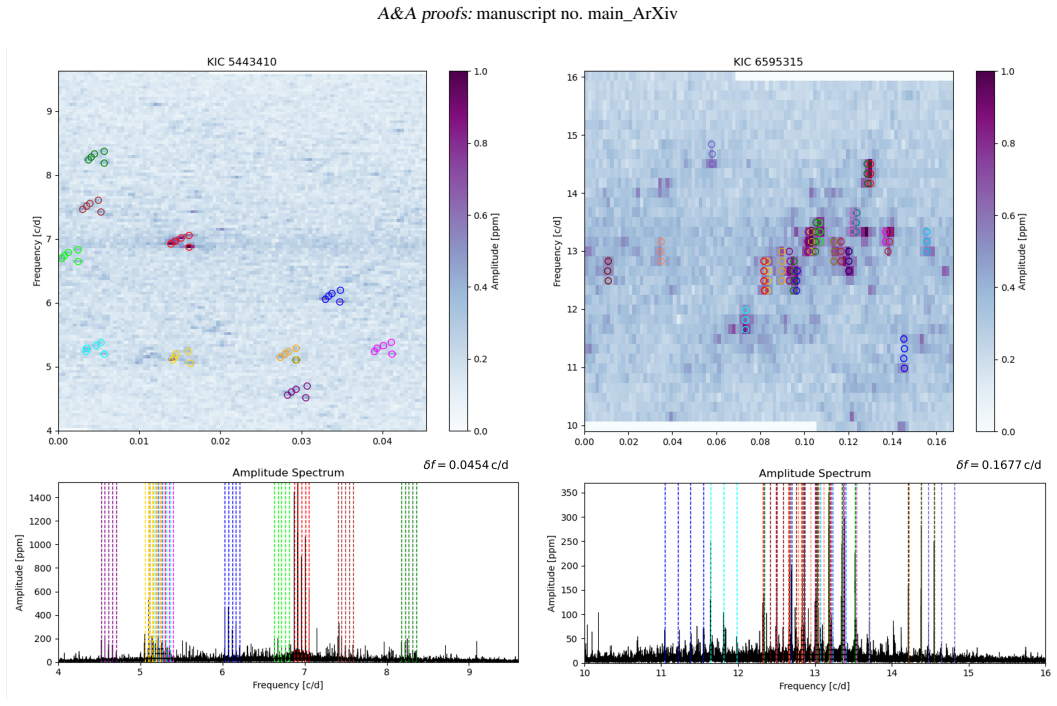
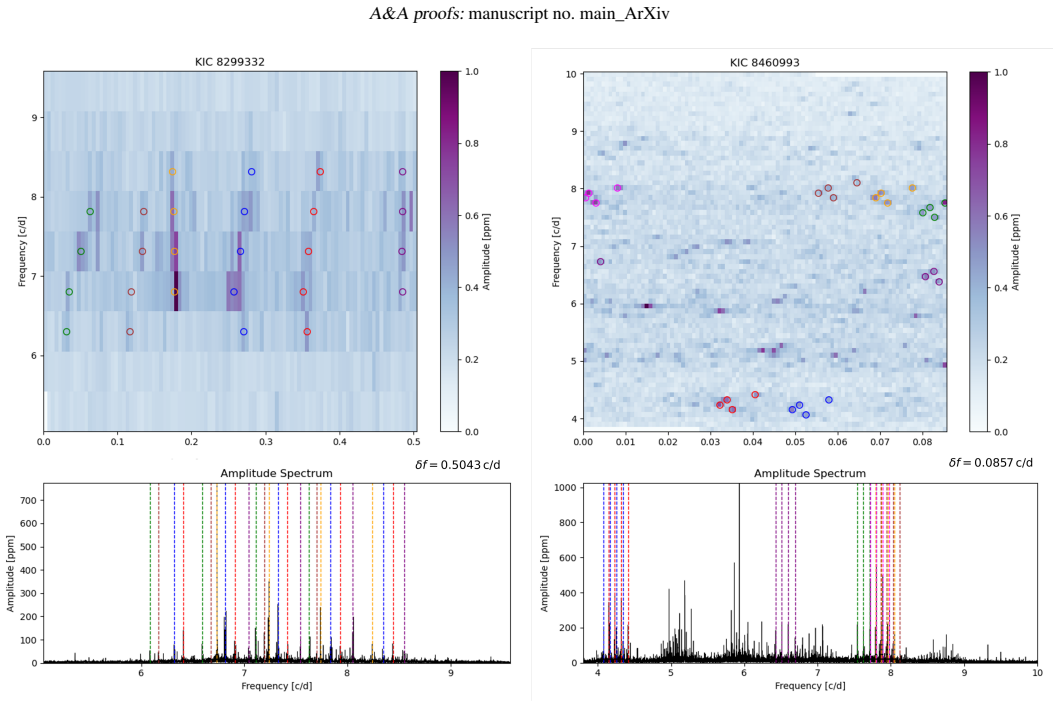
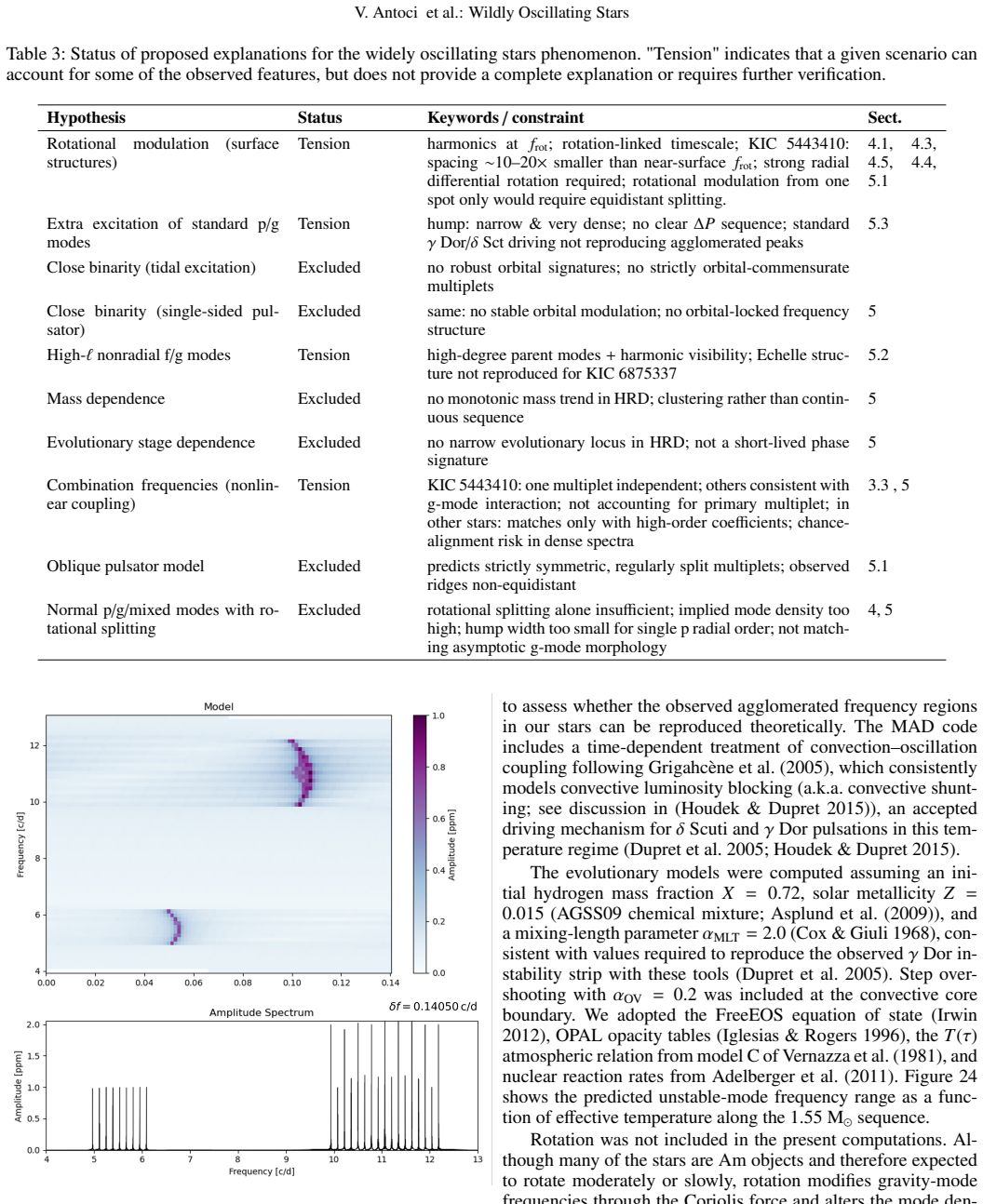
The WOS consist of dense ridge-like frequency agglomerations confined to a narrow region near the overlap of the delta Sct and gamma Dor instability strips. These cannot be reproduced by asymptotic g-mode behaviour, low-order p modes, binarity, or typical rotational splitting. In at least two stars a significant fraction of peaks can be explained as nonlinear combination frequencies, but this requires parent modes located inside the agglomerated band itself. Non-adiabatic stability calculations reproduce the classical instability domains yet do not predict unstable modes with the observed density or organised ridge structure, indicating that the WOS represent a pulsational regime not capture
What carries the argument
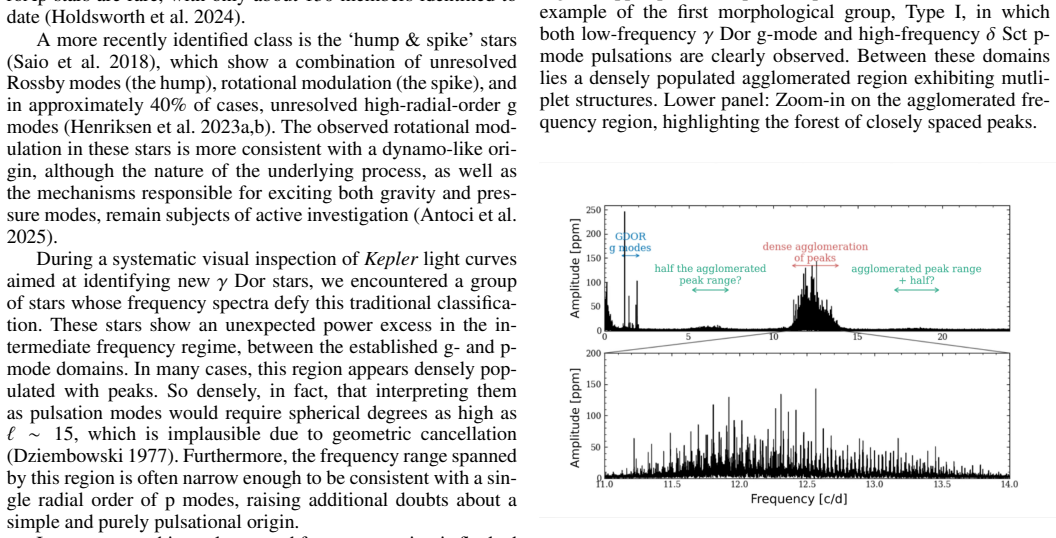
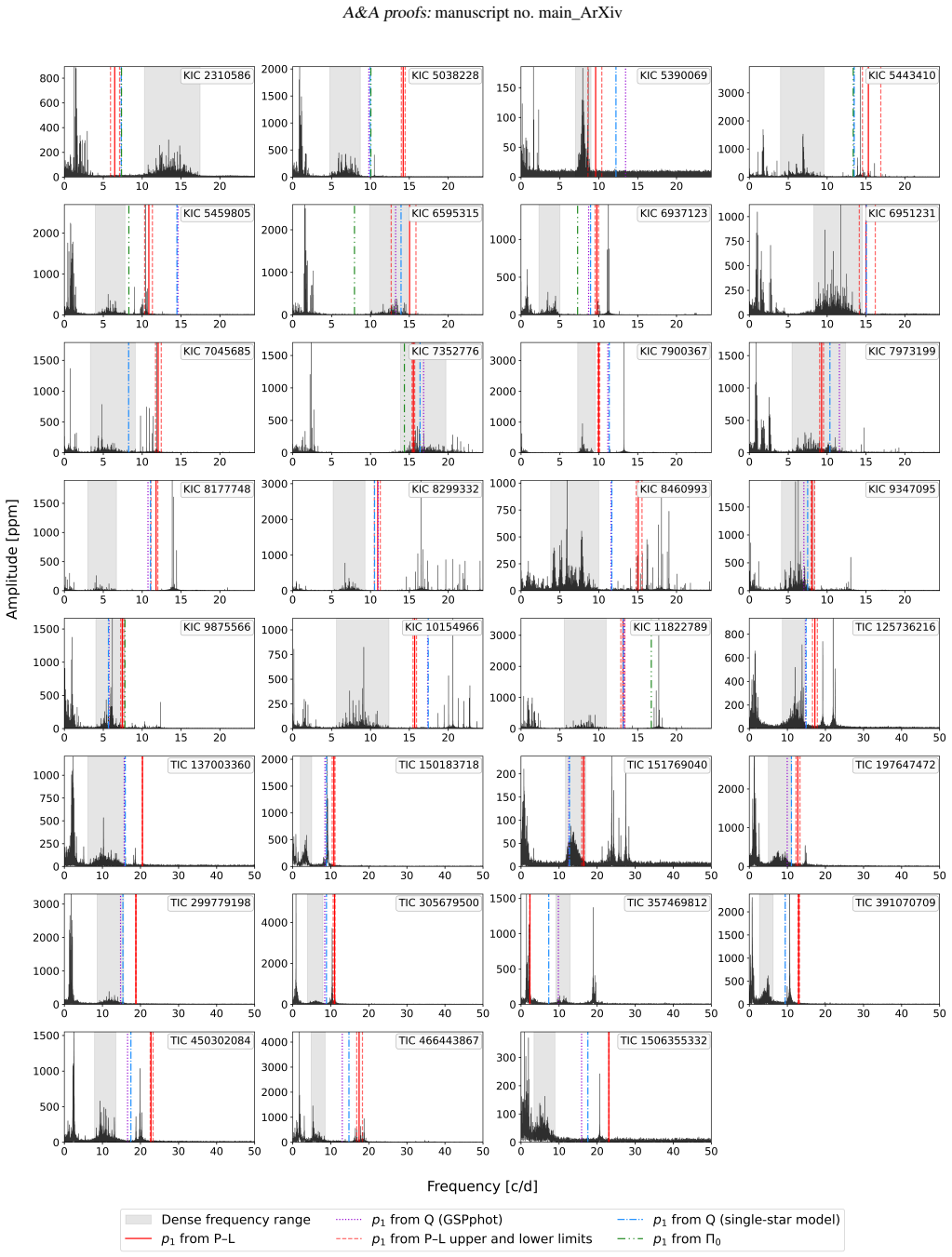
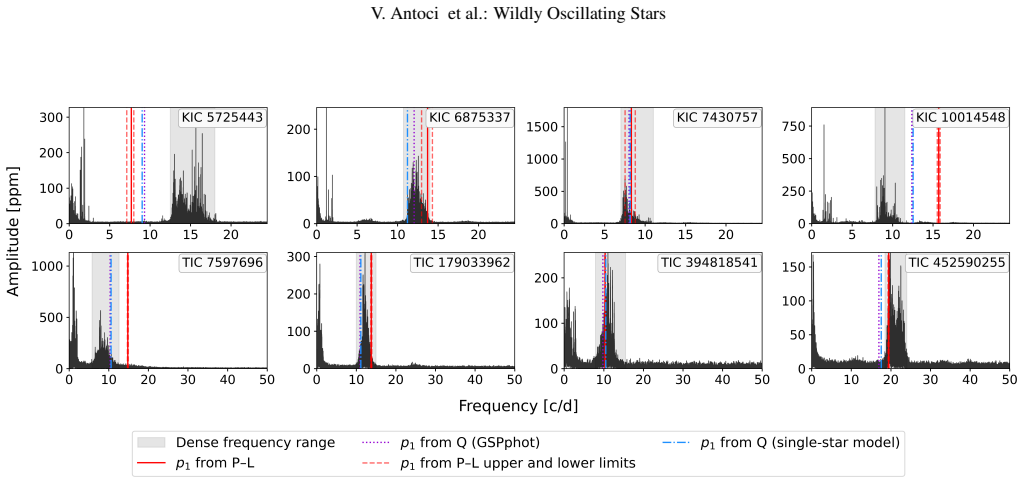
The agglomerated frequency regions, which are dense ridge-like clusters of peaks occupying a confined intermediate-frequency band below the fundamental radial mode.
If this is right
- The WOS phenomenon is restricted to a narrow region of stellar parameter space near the delta Sct and gamma Dor overlap.
- A mechanism is required that selects or excites modes in a confined intermediate-frequency band and organises them into ridges.
- Some observed peaks arise as combinations of parent modes that must themselves lie inside the agglomerated region.
- Current models of mode excitation and stability must be extended to account for this organised structure.
Where Pith is reading between the lines
- The confinement to a narrow parameter window may indicate a critical dependence on a specific combination of effective temperature, rotation, or evolutionary state.
- Higher-precision photometry could test whether the ridges correspond to families of modes with a common spacing or geometry.
- If the parent modes required for combinations are confirmed, the phenomenon supplies a direct probe of nonlinear coupling in this frequency range.
Load-bearing premise
Non-adiabatic stability calculations are assumed to predict all possible unstable modes, and the observed frequencies are assumed to be intrinsic stellar pulsations rather than residual instrumental effects or untested nonlinear processes.
What would settle it
A non-adiabatic calculation that produces unstable modes with the observed density and ridge morphology inside the intermediate-frequency band, or the detection of similar ridges in stars well outside the narrow overlap region of the two instability strips.
Figures






read the original abstract
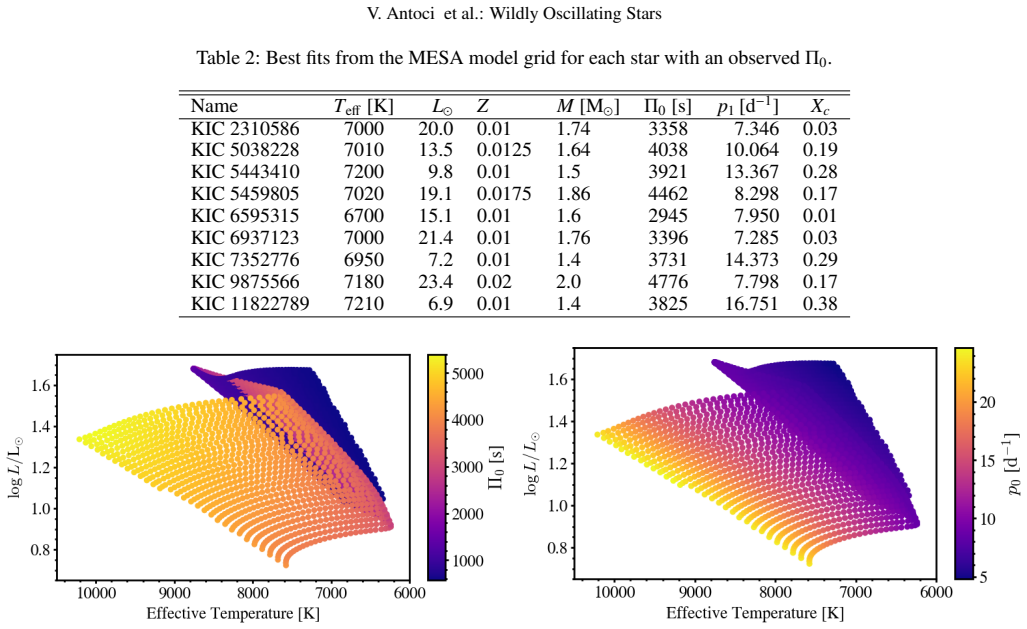
We investigate the origin of the dense, ridge-like frequency clusters observed in a subset of A and F type pulsating stars, which we refer to as `wildly oscillating' stars (WOS). These agglomerated frequency regions occupy a confined part of the frequency spectrum, typically below the fundamental radial mode, and are not explained by pulsation theory. We analyse Kepler and TESS data, construct echelle diagrams, and perform searches for combination frequencies. We determine the fundamental radial mode in order to place the agglomerated regions in a seismic context. Rotational modulation is examined through phase-folded light curves and amplitude-phase analysis, and binarity and geometric modulation scenarios are tested. The WOS phenomenon is confined to a narrow region near the overlap of the delta Sct and gamma Dor instability strips. The observed ridge morphology and mode density cannot be reproduced by simple asymptotic g-mode behaviour, low-order p modes, binarity, or typical rotational splitting. In at least two stars, a significant fraction of peaks in the agglomerated region can be explained as nonlinear combination frequencies involving high-order g modes. However, these combinations require parent modes located within the agglomerated frequency band itself, indicating that intrinsic pulsation modes must be present there. Non-adiabatic stability calculations reproduce the classical instability domains but do not predict unstable modes with the observed density or organised ridge structure in the agglomerated region. The WOS appear to represent a pulsational regime not captured by current models of mode excitation or rotational modulation. The agglomerated frequency phenomenon requires a mechanism that selects or excites a confined intermediate-frequency band and produces organised ridge structures within a narrow region of stellar parameter space (abridged for arXiv).
Editorial analysis
A structured set of objections, weighed in public.
Referee Report
Summary. The manuscript claims that a subset of A/F-type pulsators exhibit dense ridge-like frequency agglomerations (termed WOS) below the fundamental radial mode that cannot be explained by standard pulsation theory, rotational splitting, binarity, or asymptotic g-mode behaviour. Analysis of Kepler/TESS light curves, echelle diagrams, combination-frequency searches, and non-adiabatic stability calculations shows the phenomenon is confined to a narrow region near the δ Sct/γ Dor overlap; in at least two stars the agglomerated peaks include nonlinear combinations whose parents must lie inside the same band, implying intrinsic modes not predicted by current models.
Significance. If the central observational claim holds, the work identifies a previously unrecognised pulsational regime whose mode density and ridge organisation are not reproduced by existing non-adiabatic calculations or simple geometric/rotational effects. The requirement that parent modes reside inside the agglomerated band supplies a direct falsifiable test for any proposed excitation mechanism.
major comments (2)
- [Combination frequency search] Combination-frequency search (abstract and associated methods): the statement that 'a significant fraction of peaks ... can be explained as nonlinear combination frequencies' is load-bearing for the claim that intrinsic modes must exist inside the agglomerated band, yet no amplitude threshold, frequency-resolution criterion, or false-alarm probability is reported for the search completeness.
- [Non-adiabatic stability calculations] Non-adiabatic stability calculations (abstract): the assertion that these calculations 'reproduce the classical instability domains but do not predict unstable modes with the observed density or organised ridge structure' is central to the conclusion that current models fail; however, the convection treatment, the frequency range explicitly searched, and any test for missed intermediate-frequency modes are not specified.
minor comments (1)
- [Abstract] The parenthetical '(abridged for arXiv)' should be removed from the abstract in the manuscript version.
Simulated Author's Rebuttal
We thank the referee for their careful and constructive review. The two major comments identify important methodological details that were insufficiently specified in the original manuscript. We address each point below and will revise the text accordingly.
read point-by-point responses
-
Referee: [Combination frequency search] Combination-frequency search (abstract and associated methods): the statement that 'a significant fraction of peaks ... can be explained as nonlinear combination frequencies' is load-bearing for the claim that intrinsic modes must exist inside the agglomerated band, yet no amplitude threshold, frequency-resolution criterion, or false-alarm probability is reported for the search completeness.
Authors: We agree that explicit search criteria are required to support the claim. In the revised manuscript we will add the following details to the methods section: (i) amplitude threshold of 4 times the local noise level in the periodogram, (ii) frequency match within 1.5 times the Rayleigh resolution, and (iii) false-alarm probability < 0.001 based on the analytic expression of Horne & Baliunas (1986). These criteria will be applied uniformly to the two stars discussed and the results tabulated. revision: yes
-
Referee: [Non-adiabatic stability calculations] Non-adiabatic stability calculations (abstract): the assertion that these calculations 'reproduce the classical instability domains but do not predict unstable modes with the observed density or organised ridge structure' is central to the conclusion that current models fail; however, the convection treatment, the frequency range explicitly searched, and any test for missed intermediate-frequency modes are not specified.
Authors: We accept that these computational details must be stated. The revised version will specify: convection treatment via mixing-length theory with α = 1.8 and no overshooting; frequency search performed from 0.05 d⁻¹ to 120 d⁻¹; and verification that all computed modes in the intermediate-frequency range (0.5–20 d⁻¹) were examined, with no additional unstable modes found that could account for the observed ridge density. These parameters will be added to the methods and figure captions. revision: yes
Circularity Check
No circularity: purely observational comparison to external models
full rationale
The paper is an observational study that identifies frequency agglomerations in Kepler/TESS light curves of A/F stars, places them relative to the radial fundamental mode, searches for combination frequencies, and directly compares the observed ridge structures and mode densities against published non-adiabatic stability calculations. No derivation, equation, or parameter fit is introduced whose output is then relabeled as a prediction; the central claim that models fail to reproduce the phenomenon follows from the mismatch between observed frequencies and the instability domains already computed by independent codes. No self-citation supplies a uniqueness theorem or ansatz, and no renaming of known results occurs. The analysis is therefore self-contained against external benchmarks of photometry and existing pulsation models.
Axiom & Free-Parameter Ledger
axioms (2)
- domain assumption Kepler and TESS time-series photometry accurately recovers stellar pulsation frequencies without dominant instrumental artifacts in the analyzed targets.
- domain assumption Current non-adiabatic stability calculations capture the full set of linearly unstable modes in the relevant stellar parameter space.
Reference graph
Works this paper leans on
-
[1]
Abt, H. A. & Moyd, K. I. 1973, ApJ, 182, 809
1973
-
[2]
G., García, A., Robertson, R
Adelberger, E. G., García, A., Robertson, R. G. H., et al. 2011, Reviews of Mod- ern Physics, 83, 195
2011
-
[3]
2025, A&A, 696, A111
Antoci, V ., Cantiello, M., Khalack, V ., et al. 2025, A&A, 696, A111
2025
-
[4]
2014, ApJ, 796, 118
Antoci, V ., Cunha, M., Houdek, G., et al. 2014, ApJ, 796, 118
2014
-
[5]
S., Bowman, D
Antoci, V ., Cunha, M. S., Bowman, D. M., et al. 2019, MNRAS, 490, 4040
2019
-
[6]
J., & Scott, P
Asplund, M., Grevesse, N., Sauval, A. J., & Scott, P. 2009, ARA&A, 47, 481
2009
-
[7]
Bailer-Jones, C. A. L., Rybizki, J., Fouesneau, M., Demleitner, M., & Andrae, R. 2021, AJ, 161, 147
2021
-
[8]
Balona, L. A. 1994, MNRAS, 268, 119
1994
-
[9]
A., Krisciunas, K., & Cousins, A
Balona, L. A., Krisciunas, K., & Cousins, A. W. J. 1994, MNRAS, 270, 905
1994
-
[10]
R., Murphy, S
Barac, N., Bedding, T. R., Murphy, S. J., & Hey, D. R. 2022, MNRAS, 516, 2080
2022
-
[11]
R., Murphy, S
Bedding, T. R., Murphy, S. J., Crawford, C., et al. 2023, ApJ, 946, L10
2023
-
[12]
2025, ApJ, 995, 128
Berry, I., Huber, D., Li, Y ., et al. 2025, ApJ, 995, 128
2025
-
[13]
& Dziembowski, W
Bigot, L. & Dziembowski, W. A. 2002, A&A, 391, 235
2002
-
[14]
2013, MNRAS, 429, 2500
Bouabid, M.-P., Dupret, M.-A., Salmon, S., et al. 2013, MNRAS, 429, 2500
2013
-
[15]
Bowman, D. M. & Kurtz, D. W. 2018, MNRAS, 476, 3169
2018
-
[16]
2000, in Astronomical Society of the Pacific Conference Series, V ol
Breger, M. 2000, in Astronomical Society of the Pacific Conference Series, V ol. 210, Delta Scuti and Related Stars, ed. M. Breger & M. Montgomery, 3
2000
-
[17]
1999, A&A, 349, 225
Breger, M., Handler, G., Garrido, R., et al. 1999, A&A, 349, 225
1999
-
[18]
1993, A&A, 271, 482
Breger, M., Stich, J., Garrido, R., et al. 1993, A&A, 271, 482
1993
-
[19]
M., Latham, D
Brown, T. M., Latham, D. W., Everett, M. E., & Esquerdo, G. A. 2011, AJ, 142, 112
2011
-
[20]
M., Antoci, V ., & Salmon, S
Christophe, S., Ballot, J., Ouazzani, R. M., Antoci, V ., & Salmon, S. J. A. J. 2018, A&A, 618, A47
2018
-
[21]
Cox, J. P. & Giuli, R. T. 1968, Principles of stellar structure
1968
-
[22]
M., Still, M., Schellart, P., et al
Crawford, S. M., Still, M., Schellart, P., et al. 2010, in Society of Photo-Optical Instrumentation Engineers (SPIE) Conference Series, V ol. 7737, Observatory Operations: Strategies, Processes, and Systems III, ed. D. R. Silva, A. B. Peck, & B. T. Soifer, 773725
2010
-
[23]
L., Sordo, R., Pailler, F., et al
Creevey, O. L., Sordo, R., Pailler, F., et al. 2023, A&A, 674, A26
2023
-
[24]
S., Antoci, V ., Holdsworth, D
Cunha, M. S., Antoci, V ., Holdsworth, D. L., et al. 2019, MNRAS, 487, 3523 Daszy´nska-Daszkiewicz, J., Dziembowski, W. A., Pamyatnykh, A. A., & Goupil, M.-J. 2002, A&A, 392, 151
2019
-
[25]
2016, A&A, 589, A140
Deal, M., Richard, O., & Vauclair, S. 2016, A&A, 589, A140
2016
-
[26]
Dupret, M. A. 2001, A&A, 366, 166
2001
-
[27]
A., De Ridder, J., Neuforge, C., Aerts, C., & Scuflaire, R
Dupret, M. A., De Ridder, J., Neuforge, C., Aerts, C., & Scuflaire, R. 2002, A&A, 385, 563
2002
-
[28]
A., Grigahcène, A., Garrido, R., Gabriel, M., & Scuflaire, R
Dupret, M. A., Grigahcène, A., Garrido, R., Gabriel, M., & Scuflaire, R. 2005, A&A, 435, 927
2005
-
[29]
2004, A&A, 414, L17 Dürfeldt-Pedros, O., Antoci, V ., Lecoanet, D., Guo, Z., & Labadie-Bartz, J
Dupret, M.-A., Grigahcène, A., Garrido, R., Gabriel, M., & Scuflaire, R. 2004, A&A, 414, L17 Dürfeldt-Pedros, O., Antoci, V ., Lecoanet, D., Guo, Z., & Labadie-Bartz, J. 2026, A&A, arXiv:2606.12148 Dürfeldt-Pedros, O., Antoci, V ., Smalley, B., et al. 2024, A&A, 690, A104
Pith/arXiv arXiv 2004
-
[30]
1977, Acta Astron., 27, 203
Dziembowski, W. 1977, Acta Astron., 27, 203
1977
-
[31]
Dziembowski, W. A. 2016, Commmunications of the Konkoly Observatory Hun- gary, 105, 23
2016
-
[32]
2024, New A Rev., 98, 101694
El-Badry, K. 2024, New A Rev., 98, 101694
2024
-
[33]
Fitch, W. S. 1981, ApJ, 249, 218
1981
-
[34]
2016, A&A, 594, A39 Gaia Collaboration, Vallenari, A., Brown, A
Frasca, A., Molenda- ˙Zakowicz, J., De Cat, P., et al. 2016, A&A, 594, A39 Gaia Collaboration, Vallenari, A., Brown, A. G. A., et al. 2022, Gaia Data Re- lease 3: Summary of the content and survey properties
2016
-
[35]
2022, A&A, 662, A82
Garcia, S., Van Reeth, T., De Ridder, J., et al. 2022, A&A, 662, A82
2022
-
[36]
Gautam, A., Murphy, S. J., & Bedding, T. R. 2025, arXiv e-prints, arXiv:2507.03561
Pith/arXiv arXiv 2025
-
[37]
Ginestet, N., Prieur, J.-L., Carquillat, J.-M., & Griffin, R. F. 2003, MNRAS, 342, 61
2003
-
[38]
Gray, R. O. & Garrison, R. F. 1989, ApJS, 70, 623
1989
-
[39]
& Sauval, A
Grevesse, N. & Sauval, A. J. 1998, Space Sci. Rev., 85, 161 Grigahcène, A., Antoci, V ., Balona, L., et al. 2010, ApJ, 713, L192 Grigahcène, A., Dupret, M. A., Gabriel, M., Garrido, R., & Scuflaire, R. 2005, A&A, 434, 1055
1998
-
[40]
A., Kaye, A
Guzik, J. A., Kaye, A. B., Bradley, P. A., Cox, A. N., & Neuforge, C. 2000, ApJ, 542, L57
2000
-
[41]
& Shobbrook, R
Handler, G. & Shobbrook, R. R. 2002, MNRAS, 333, 251
2002
-
[42]
Higgins, M. E. & Bell, K. J. 2023, AJ, 165, 141
2023
-
[43]
L., Cunha, M
Holdsworth, D. L., Cunha, M. S., Kurtz, D. W., et al. 2021, MNRAS, 506, 1073
2021
-
[44]
L., Cunha, M
Holdsworth, D. L., Cunha, M. S., Lares-Martiz, M., et al. 2024, MNRAS, 527, 9548
2024
-
[45]
2008, Communications in Asteroseismology, 157, 137
Houdek, G. 2008, Communications in Asteroseismology, 157, 137
2008
-
[46]
& Dupret, M.-A
Houdek, G. & Dupret, M.-A. 2015, Living Reviews in Solar Physics, 12, 8
2015
-
[47]
Iglesias, C. A. & Rogers, F. J. 1993, ApJ, 412, 752
1993
-
[48]
Iglesias, C. A. & Rogers, F. J. 1996, ApJ, 464, 943
1996
-
[49]
Irwin, A. W. 2012, FreeEOS: Equation of State for stellar interiors calculations
2012
-
[50]
S., Bauer, E
Jermyn, A. S., Bauer, E. B., Schwab, J., et al. 2023, ApJS, 265, 15
2023
-
[51]
M., et al
Jordi, C., Gebran, M., Carrasco, J. M., et al. 2010, A&A, 523, A48
2010
-
[52]
B., Handler, G., Krisciunas, K., Poretti, E., & Zerbi, F
Kaye, A. B., Handler, G., Krisciunas, K., Poretti, E., & Zerbi, F. M. 1999, PASP, 111, 840
1999
-
[53]
G., Borucki, W
Koch, D. G., Borucki, W. J., Basri, G., et al. 2010, ApJ, 713, L79
2010
-
[54]
Kurtz, D. W. 1982, MNRAS, 200, 807
1982
-
[55]
Kurtz, D. W. 2022, ARA&A, 60, 31
2022
-
[56]
W., Saio, H., Takata, M., et al
Kurtz, D. W., Saio, H., Takata, M., et al. 2014, MNRAS, 444, 102
2014
-
[57]
W., Shibahashi, H., Murphy, S
Kurtz, D. W., Shibahashi, H., Murphy, S. J., Bedding, T. R., & Bowman, D. M. 2015, MNRAS, 450, 3015
2015
-
[58]
Labadie-Bartz, J., Hümmerich, S., Bernhard, K., Paunzen, E., & Shultz, M. E. 2023, A&A, 676, A55
2023
-
[59]
L., et al
Lallement, R., Babusiaux, C., Vergely, J. L., et al. 2019, A&A, 625, A135
2019
-
[60]
M., & Van Reeth, T
Lecoanet, D., Bowman, D. M., & Van Reeth, T. 2022, MNRAS, 512, L16
2022
-
[61]
& Breger, M
Lenz, P. & Breger, M. 2005, Communications in Asteroseismology, 146, 53
2005
-
[62]
R., et al
Li, G., Van Reeth, T., Bedding, T. R., et al. 2020, MNRAS, 491, 3586 Lightkurve Collaboration, Cardoso, J. V . d. M., Hedges, C., et al. 2018, Lightkurve: Kepler and TESS time series analysis in Python, Astrophysics Source Code Library
2020
-
[63]
Lovekin, C. C. & Guzik, J. A. 2017, ApJ, 849, 38
2017
-
[64]
1985, A&A, 151, 315
Mathys, G. 1985, A&A, 151, 315
1985
-
[65]
2008, MNRAS, 386, 1487
Miglio, A., Montalbán, J., Noels, A., & Eggenberger, P. 2008, MNRAS, 386, 1487
2008
-
[66]
Mombarg, J. S. G., Van Reeth, T., & Aerts, C. 2021, A&A, 650, A58
2021
-
[67]
J., Hey, D., Van Reeth, T., & Bedding, T
Murphy, S. J., Hey, D., Van Reeth, T., & Bedding, T. R. 2019, MNRAS, 485, 2380
2019
-
[68]
J., Moe, M., Kurtz, D
Murphy, S. J., Moe, M., Kurtz, D. W., et al. 2018, MNRAS, 474, 4322
2018
-
[69]
J., Shibahashi, H., & Kurtz, D
Murphy, S. J., Shibahashi, H., & Kurtz, D. W. 2013, MNRAS, 430, 2986 O’Connell, D. J. K. 1951, Publications of the Riverview College Observatory, 2, 85
2013
-
[70]
Pamyatnykh, A. A. 1999, Acta Astron., 49, 119 Pápics, P. I. 2012, Astronomische Nachrichten, 333, 1053
1999
-
[71]
2011, ApJS, 192, 3
Paxton, B., Bildsten, L., Dotter, A., et al. 2011, ApJS, 192, 3
2011
-
[72]
2013, ApJS, 208, 4
Paxton, B., Cantiello, M., Arras, P., et al. 2013, ApJS, 208, 4
2013
-
[73]
2015, ApJS, 220, 15
Paxton, B., Marchant, P., Schwab, J., et al. 2015, ApJS, 220, 15
2015
-
[74]
B., et al
Paxton, B., Schwab, J., Bauer, E. B., et al. 2018, ApJS, 234, 34
2018
-
[75]
2019, ApJS, 243, 10
Paxton, B., Smolec, R., Schwab, J., et al. 2019, ApJS, 243, 10
2019
-
[76]
Pedersen, M. G. & Bell, K. J. 2023, AJ, 165, 239
2023
-
[77]
A., Batten, A
Pourbaix, D., Tokovinin, A. A., Batten, A. H., et al. 2004, A&A, 424, 727
2004
-
[78]
2019, Research in Astronomy and As- trophysics, 19, 064
Qian, S.-B., Shi, X.-D., Zhu, L.-Y ., et al. 2019, Research in Astronomy and As- trophysics, 19, 064
2019
-
[79]
A., Jayaraman, R., Handler, G., et al
Rappaport, S. A., Jayaraman, R., Handler, G., et al. 2026, arXiv e-prints, arXiv:2604.18836
Pith/arXiv arXiv 2026
-
[80]
& Manfroid, J
Renson, P. & Manfroid, J. 2009, A&A, 498, 961
2009
discussion (0)
Sign in with ORCID, Apple, or X to comment. Anyone can read and Pith papers without signing in.