Single frequency filtering based multi-speaker direction of arrival estimation from stereo recordings
Pith reviewed 2026-06-27 02:18 UTC · model grok-4.3
The pith
Single-frequency filtering on stereo signals yields direction-of-arrival estimates for multiple speakers that match or exceed standard GCC methods under noise and reverberation.
A machine-rendered reading of the paper's core claim, the machinery that carries it, and where it could break.
Core claim
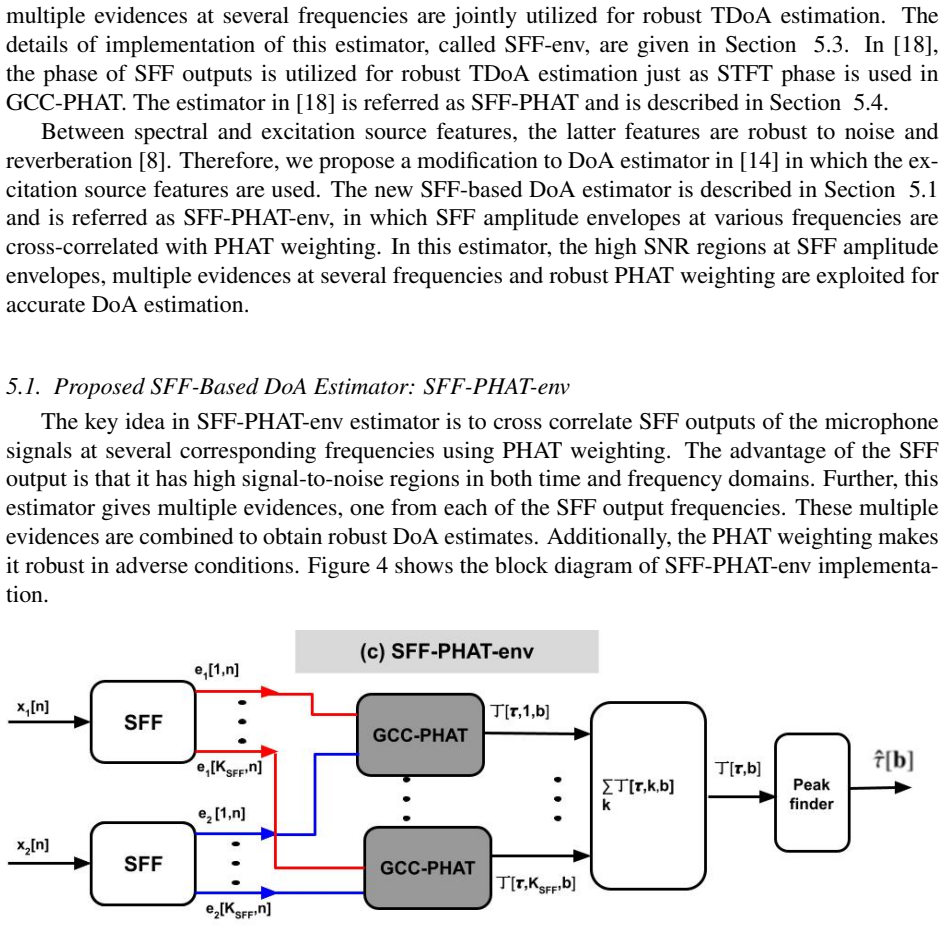
By correlating the envelopes produced by single frequency filtering across microphone channels with PHAT-weighted GCC, the method extracts direction information from excitation-source events that remain usable even when vocal-tract spectral features are degraded by noise and reverberation; real-room tests confirm this yields performance at least as good as the best conventional estimators for multiple simultaneous speakers.
What carries the argument
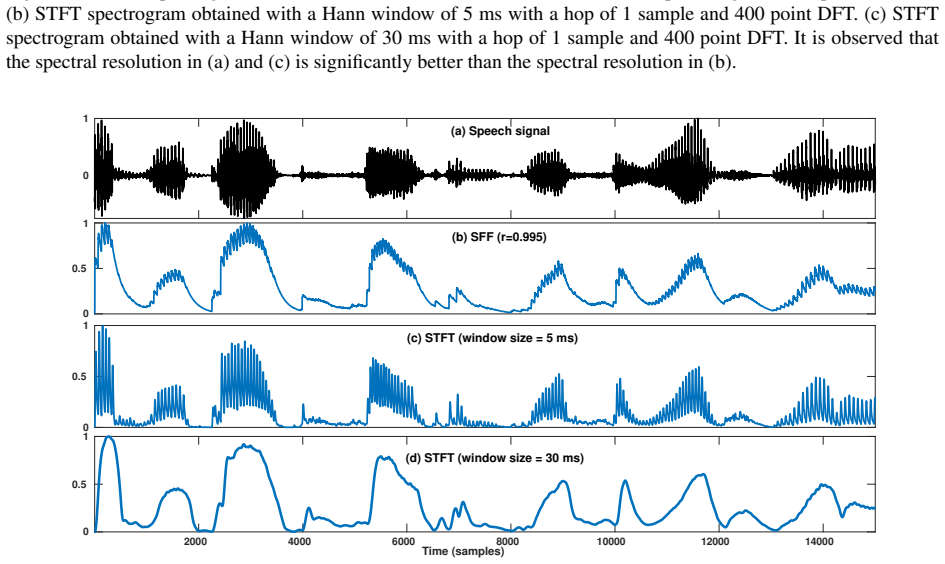
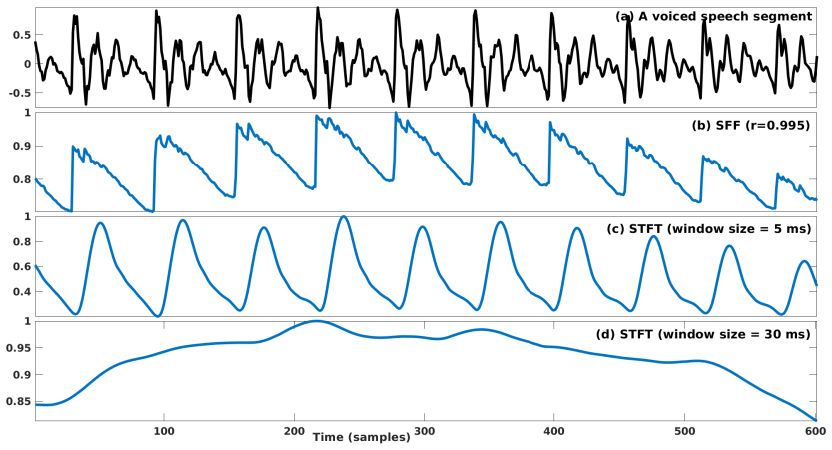
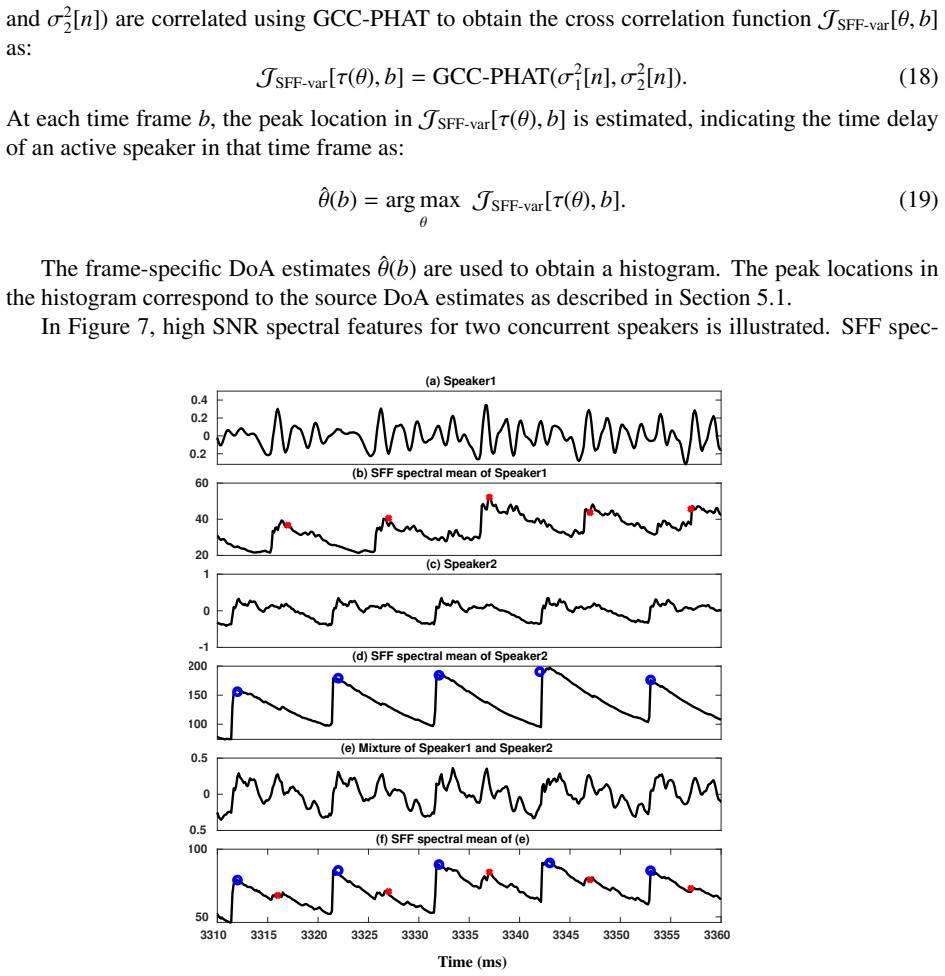
Single frequency filtering envelopes, which supply high spectral resolution of harmonics together with high temporal resolution of excitation events, correlated via PHAT-weighted generalized cross-correlation.
If this is right
- SFF-based estimators achieve detection and accuracy that are superior or comparable to the best GCC-based estimator in every tested reverberant, multi-speaker, and noise-corrupted condition.
- Restricting analysis to speech-dominant frequency bins measurably improves the robustness of GCC-PHAT.
- The evaluation on publicly available real-room recordings covers challenging acoustic conditions that conventional STFT-domain methods struggle with.
- The same envelope-correlation approach can be applied to refine existing SFF estimators without changing the underlying filtering stage.
Where Pith is reading between the lines
- The high temporal resolution of excitation events in SFF may allow better separation of overlapping speech onsets than spectral-only methods.
- Extending the stereo SFF correlation to larger microphone arrays could be tested directly on the same real-room data.
- The demonstrated benefit of speech-dominant bin selection suggests a weighting stage could be inserted into SFF pipelines to gain further robustness.
- Because SFF preserves harmonic structure at high spectral resolution, the method may remain stable when speakers move or change distance from the microphones.
Load-bearing premise
Excitation-source features extracted by single frequency filtering stay more robust to noise and reverberation than the spectral features produced by short-time Fourier transforms.
What would settle it
A dataset of real-room stereo recordings in which the SFF-based estimator reports lower detection rate or higher angular error than the strongest GCC-PHAT baseline for the same multi-speaker, high-reverberation conditions would falsify the performance claim.
Figures





read the original abstract
Robust direction-of-arrival (DoA) estimation from noisy and reverberant microphone signals remains challenging. Conventional estimators such as generalized cross-correlation (GCC) and its variants operate in the short-time Fourier transform (STFT) domain, where spectral features primarily reflect vocal-tract characteristics. Recent single frequency filtering (SFF)-based estimators instead use a time-frequency representation that provides high spectral resolution of harmonics along with high temporal resolution of excitation-source events, such as epoch-like impulses. Since excitation-source features have been shown to be more robust to noise and reverberation than spectral features, this work proposes an improved SFF-based DoA estimator that correlates the envelopes of SFF outputs across microphone channels using PHAT-weighted GCC. We further provide a comprehensive evaluation of SFF-based and state-of-the-art GCC-based estimators using publicly available real-room recordings under challenging reverberant, multi-speaker, and noise-corrupted conditions. Experimental results show that the proposed method and an existing SFF-based estimator achieve detection and accuracy performance that is superior or comparable to the best GCC-based estimator across all test cases. We also demonstrate that using speech-dominant bins improves GCC-PHAT robustness, motivating future incorporation of such weighting strategies into SFF-based DoA estimation.
Editorial analysis
A structured set of objections, weighed in public.
Referee Report
Summary. The manuscript proposes an improved single-frequency filtering (SFF)-based estimator for multi-speaker direction-of-arrival (DoA) from stereo recordings. It extracts excitation-source envelopes via SFF, applies PHAT-weighted generalized cross-correlation (GCC) across channels, and reports a comprehensive comparison against GCC-based baselines on publicly available real-room recordings under reverberant, multi-speaker, and noisy conditions. The central claim is that the proposed SFF method and an existing SFF estimator achieve detection and accuracy performance that is superior or comparable to the best GCC-based estimator across all test cases.
Significance. The evaluation on real-room data under challenging conditions is a positive aspect. If the performance advantage can be isolated to the SFF representation, the work would provide concrete evidence supporting the use of excitation-source features for robust DoA estimation and could motivate incorporation of speech-dominant bin weighting into SFF pipelines.
major comments (1)
- [Experimental evaluation / results] The experimental comparison (described in the abstract and results) applies PHAT-weighted GCC to SFF envelopes while the GCC-PHAT baselines operate on STFT features; no ablation is reported that freezes the correlation, PHAT weighting, and bin-selection steps while swapping only the time-frequency representation. This leaves the central performance claim open to the alternative explanation that gains arise from the backend processing rather than the claimed robustness of SFF excitation envelopes to noise and reverberation.
minor comments (1)
- The abstract states that speech-dominant bin selection improves GCC-PHAT robustness and motivates its future use in SFF pipelines, but the main text should clarify whether this improvement is quantified with the same detection/accuracy metrics used for the primary comparisons.
Simulated Author's Rebuttal
We thank the referee for the constructive feedback on our manuscript. We address the major comment below.
read point-by-point responses
-
Referee: [Experimental evaluation / results] The experimental comparison (described in the abstract and results) applies PHAT-weighted GCC to SFF envelopes while the GCC-PHAT baselines operate on STFT features; no ablation is reported that freezes the correlation, PHAT weighting, and bin-selection steps while swapping only the time-frequency representation. This leaves the central performance claim open to the alternative explanation that gains arise from the backend processing rather than the claimed robustness of SFF excitation envelopes to noise and reverberation.
Authors: We agree that the reported experiments do not include the specific ablation that holds the correlation function, PHAT weighting, and bin-selection fixed while varying only the underlying time-frequency representation. This leaves open the possibility that observed gains are attributable to the backend rather than the SFF envelopes. While the manuscript already compares both the proposed SFF-PHAT method and an existing SFF estimator against standard GCC-PHAT baselines, and additionally demonstrates the benefit of speech-dominant bin weighting for GCC-PHAT, we acknowledge that the requested controlled ablation would provide stronger evidence for the claimed robustness of the SFF representation. In the revised manuscript we will add this ablation. revision: yes
Circularity Check
No significant circularity; empirical claims are self-contained
full rationale
The paper proposes an SFF-based DoA method that correlates SFF envelopes using PHAT-weighted GCC and validates it via direct experimental comparisons against GCC baselines on real-room data. The motivation references prior demonstrations that excitation-source features are more robust, but this is external support rather than a self-citation chain or definitional reduction that forces the result. No equations, fitted parameters, or predictions reduce by construction to the paper's own inputs; the performance claims rest on independent empirical outcomes across test cases, making the derivation self-contained against external benchmarks.
Axiom & Free-Parameter Ledger
axioms (1)
- domain assumption Excitation-source features from SFF are more robust to noise and reverberation than vocal-tract spectral features from STFT.
Reference graph
Works this paper leans on
-
[1]
Thakallapalli, S
S. Thakallapalli, S. R. Kadiri, S. V . Gangashetty, Spectral Features Derived from Single Frequency Filter for Multispeaker Localization, in: Proc. National Conference on Commu- nications (NCC), 2020, pp. 1–6
2020
-
[2]
B. D. Van Veen, K. M. Buckley, Beamforming: A Versatile Approach to Spatial Filtering, IEEE ASSP Magazine 5 (2) (1988) 4–24
1988
-
[3]
M. Taseska, E. A. P. Habets, DOA-informed source extraction in the presence of competing talkers and background noise, EURASIP Journal on Advances in Signal Processingdoi: 10.1186/s13634-017-0495-7
-
[4]
S. U. N. Wood, J. Rouat, Unsupervised Low Latency Speech Enhancement with RT-GCC- NMF, IEEE Journal of Selected Topics in Signal Processing 13 (2) (2019) 332–346
2019
-
[5]
S. U. N. Wood, J. Rouat, S. Dupont, G. Pironkov, Blind Speech Separation and Enhancement with GCC-NMF, IEEE Trans. Audio, Speech, and Language Processing (TASLP) 25 (4) (2017) 745–755
2017
-
[6]
Pertilä, Online Blind Speech Separation Using Multiple Acoustic Speaker Tracking and Time-Frequency Masking, Computer Speech and Language 27 (3) (2013) 683 – 702
P. Pertilä, Online Blind Speech Separation Using Multiple Acoustic Speaker Tracking and Time-Frequency Masking, Computer Speech and Language 27 (3) (2013) 683 – 702
2013
-
[7]
Knapp, G
C. Knapp, G. Carter, The Generalized Correlation Method for Estimation of Time Delay, IEEE Trans. Acoustics Speech and Signal Processing (TASSP) 24 (4) (1976) 320–327
1976
-
[8]
V . C. Raykar, B. Yegnanarayana, S. R. M. Prasanna, R. Duraiswami, Speaker Localization Using Excitation Source Information in Speech, IEEE Trans. Speech and Audio Processing (TSAP) 13 (5) (2005) 751–761
2005
-
[9]
Christof, M
F. Christof, M. Juha, Source Localization in Complex Listening Situations: Selection of Binaural Cues Based on Interaural Coherence, JASA 116 (5) (2004) 3075–3089
2004
-
[10]
Loesch, B
B. Loesch, B. Yang, Source Number Estimation and Clustering for Under-Determined Blind Source Separation, in: Proc. IEEE Int. Workshop on Acoustic Signal Enhancement (IW AENC), 2008
2008
-
[11]
Mouba, H
J. Mouba, H. Marchand, Source Localization, Separation, Respatialization System Based on Unsupervised Classification of Interaural Cues, in: Proc. Conf. Digital Audio Effects, 2006, pp. 233–238. 31
2006
-
[12]
Viste, G
H. Viste, G. Evangelista, On the Use of Spatial Cues to Improve Binaural Source Separation, in: Proc. Conf. Digital Audio Effects, 2003, pp. 209–213
2003
-
[13]
Madhu, R
N. Madhu, R. Martin, A Scalable Framework for Multiple Speaker Localization and Track- ing, in: Proc. IEEE Int. Workshop on Acoustic Signal Enhancement (IW AENC), 2008, pp. 1–4
2008
-
[14]
Murthy, B
N. Murthy, B. Yegnanarayana, and S. R. Kadiri, Time Delay Estimation from Mixed Mul- tispeaker Speech Signals Using Single Frequency Filtering, Circuits, Systems, and Signal Processing
-
[15]
G. Aneeja, B. Yegnanarayana, Extraction of Fundamental Frequency From Degraded Speech Using Temporal Envelopes at High SNR Frequencies, IEEE Trans. Audio, Speech, and Lan- guage Processing (TASLP) 25 (4) (2017) 829–838.doi:10.1109/TASLP.2017.2666425
-
[16]
Pannala, G
V . Pannala, G. Aneeja, S. R. Kadiri, B. Yegnanarayana, Robust Estimation of Fundamen- tal Frequency Using Single Frequency Filtering Approach, in: Proc. Int. Conf. on Speech Communication and Technology (INTERSPEECH), 2016, pp. 2155–2159
2016
-
[17]
S. R. Kadiri, B. Yegnanarayana, Epoch Extraction from Emotional Speech using Single Fre- quency Filtering Approach, Speech Communication 86 (2017) 52 – 63
2017
-
[18]
Murthy, J
N. Murthy, J. Satyanarayana, N. Chennupati, B. Yegnanarayana, Instantaneous Time De- lay Estimation of Broadband Signals, in: Proc. Int. Conf. on Speech Communication and Technology (INTERSPEECH), 2020
2020
-
[19]
Virtanen, J
T. Virtanen, J. F. Gemmeke, B. Raj, P. Smaragdis, Compositional Models for Audio Pro- cessing: Uncovering the Structure of Sound Mixtures, IEEE Signal Processing Magazine 32 (2015) 125–144
2015
-
[20]
Zhong-Qiu Wang, Deep Learning Based Array Processing for Speech Separation, Local- ization, and Recognition, Ph.D
M. Zhong-Qiu Wang, Deep Learning Based Array Processing for Speech Separation, Local- ization, and Recognition, Ph.D. dissertation, The Ohio State University (2020)
2020
-
[21]
Zhang, D
C. Zhang, D. Florencio, Z. Zhang, Why Does PHAT Work Well in Lownoise, Reverbera- tive Environments?, in: Proc. Int. Conf. Acoustics Speech and Signal Processing (ICASSP), 2008, pp. 2565–2568
2008
-
[22]
Aneeja, B
G. Aneeja, B. Yegnanarayana, Single Frequency Filtering Approach for Discriminating Speech and Nonspeech, IEEE Trans. Audio, Speech, and Language Processing (TASLP) 23 (4) (2015) 705–717
2015
-
[23]
Gurugubelli and A
K. Gurugubelli and A. K. Vuppala, Perceptually Enhanced Single Frequency Filtering for Dysarthric Speech Detection and Intelligibility Assessment, in: Proc. Int. Conf. Acoustics Speech and Signal Processing (ICASSP), 2019, pp. 6410–6414
2019
-
[24]
Chennupati, S
N. Chennupati, S. R. Kadiri, B. Yegnanarayana, Significance of Phase in Single Frequency Filtering Outputs of Speech Signals, Speech Communication 97 (2018) 66 – 72. 32
2018
-
[25]
N. Ono, Z. Koldovský, S. Miyabe, N. Ito, The 2013 Signal Separation Evaluation Campaign, in: Proc. IEEE Int. Workshop on Machine Learning for Signal Processing (MLSP), 2013, pp. 1–6
2013
-
[26]
H. W. Löllmann, C. Evers, A. Schmidt, H. Mellmann, H. Barfuss, P. A. Naylor, W. Keller- mann, The LOCATA Challenge Data Corpus for Acoustic Source Localization and Track- ing, in: Proc. Sensor Array and Multichannel Signal Processing Workshop (SAM), 2018, pp. 410–414
2018
-
[27]
CSTR VCTK Corpus: English Multi-speaker Corpus for CSTR V oice Cloning Toolkit,
C. Veaux, J. Yamagishi, K. MacDonald, English Multi-speaker Corpus for CSTR V oice Cloning Toolkit, The Centre for Speech Technology Research (CSTR), University of Ed- inburgh (2019). URLhttps://doi.org/10.7488/ds/2645
-
[28]
J. Makhoul, Linear prediction: A Tutorial Review, Proceedings of the IEEE 63 (4) (1975) 561–580.doi:10.1109/PROC.1975.9792
-
[29]
Heinzel, A
G. Heinzel, A. Rüdiger, R. Schilling, Spectrum and Spectral Density Estimation by the Discrete Fourier Transform (DFT), Including a Comprehensive List of Window Functions and Some New At-Top Windows, Tech. rep., Albert-Einstein-Institute, Hannover,Germany (2002)
2002
-
[30]
DiBiase, A High-Accuracy, Low-Latency Technique for Talker Localization in Reverber- ant Environments, Ph.D
J. DiBiase, A High-Accuracy, Low-Latency Technique for Talker Localization in Reverber- ant Environments, Ph.D. dissertation, Brown University, Providence RI, USA, (2000)
2000
-
[31]
Varga, H
A. Varga, H. J. Steeneken, Assessment for Automatic Speech Recognition: II. NOISEX-92: A Database and an Experiment to Study the Effect of Additive Noise on Speech Recognition Systems, Speech Communication 12 (3) (1993) 247 – 251
1993
-
[32]
Yegnanarayana, C
B. Yegnanarayana, C. Avendano, H. Hermansky, P. S. Murthy, Speech Enhancement Using Linear Prediction Residual, Speech Communication 28 (1) (1999) 25 – 42
1999
-
[33]
Valin, F
J. Valin, F. Michaud, J. Rouat, D. Letourneau, Robust Sound Source Localization using a Microphone Array on a Mobile Robot, in: Proc. IEEE/RSJ International Conference on Intelligent Robots and Systems (IROS), V ol. 2, 2003, pp. 1228–1233
2003
-
[34]
Roman, D
N. Roman, D. Wang, G. J. Brown, Speech Segregation Based on Sound Localization, Journal of the Acoustical Soceity of America (JASA) 114 (4) (2003) 2236–2252
2003
-
[35]
Blandin, A
C. Blandin, A. Ozerov, E. Vincent, Multi-Source TDOA Estimation in Reverberant Audio Using Angular Spectra and Clustering, Signal Processing 92 (8) (2012) 1950 – 1960
2012
-
[36]
Valin, F
J.-M. Valin, F. Michaud, J. Rouat, Robust Localization and Tracking of Simultaneous Mov- ing Sound Sources using Beamforming and Particle Filtering, Robotics and Autonomous Systems 55 (3) (2007) 216–228. 33
2007
-
[37]
Grondin, F
F. Grondin, F. Michaud, Time Difference of Arrival Estimation Based on Binary Frequency Mask for Sound Source Localization on Mobile Robots, in: Proc. IEEE/RSJ International Conference on Intelligent Robots and Systems (IROS), 2015, pp. 6149–6154
2015
-
[38]
Z. Wang, X. Zhang, D. Wang, Robust Speaker Localization Guided by Deep Learning-Based Time-Frequency Masking, IEEE Trans. Audio, Speech, and Language Processing (TASLP) 27 (1) (2019) 178–188
2019
-
[39]
S. Thakallapalli, S. V . Gangashetty, N. Madhu, NMF-weighted SRP for Multi-speaker Di- rection of Arrival Estimation: Robustness to Spatial Aliasing while Exploiting Sparsity in the Atom-Time Domain, EURASIP J. Audio Speech Music. Process. 2021 (1) (2021) 13. doi:10.1186/s13636-021-00201-y. URLhttps://doi.org/10.1186/s13636-021-00201-y 34
discussion (0)
Sign in with ORCID, Apple, or X to comment. Anyone can read and Pith papers without signing in.