Line Outage Impact Factor (LOIF): A New Sensitivity Factor for Enhanced Transmission Observability
Pith reviewed 2026-06-27 02:21 UTC · model grok-4.3
The pith
The line outage impact factor (LOIF) selects monitoring locations that improve machine learning detection of transmission outages over the line outage distribution factor (LODF).
A machine-rendered reading of the paper's core claim, the machinery that carries it, and where it could break.
Core claim
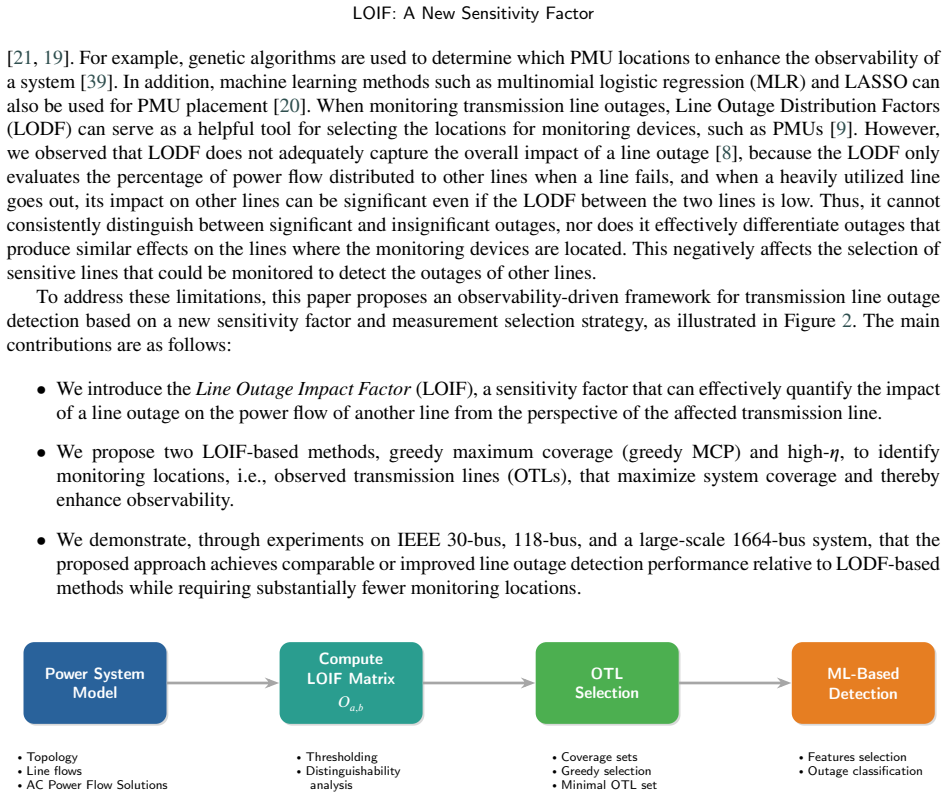
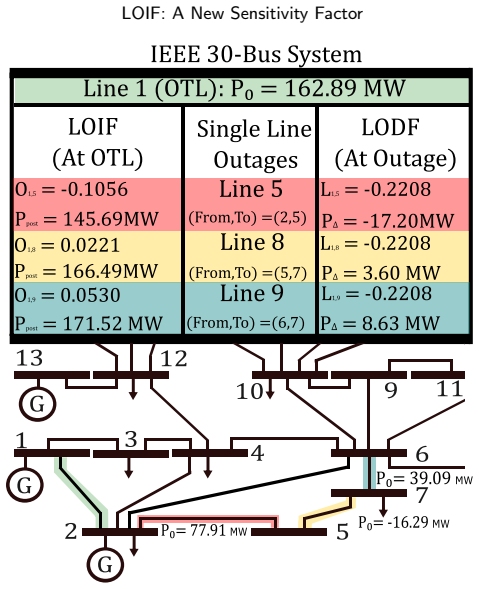
LOIF is a new sensitivity factor that reveals the impacts of a transmission outage on the power flow of other lines more effectively than LODF. When used to choose observed transmission lines for machine learning outage detection, it yields higher F1-scores than LODF selection in the three test systems, with the improvement especially consistent on large-scale systems.
What carries the argument
The Line Outage Impact Factor (LOIF), a sensitivity factor that quantifies outage effects on other lines' flows to guide selection of observed transmission lines (OTLs) for monitoring.
If this is right
- With a fixed number of observed transmission lines, LOIF selection produces higher F1-scores for outage detection than LODF selection.
- The performance gain from LOIF appears more reliable as the power system size increases.
- LOIF-based monitoring could therefore support more reliable real-time outage detection in practical grids.
Where Pith is reading between the lines
- If the F1 improvement holds, grid operators could achieve the same detection accuracy with fewer sensors by switching to LOIF selection.
- LOIF might also improve other monitoring tasks such as contingency ranking or state estimation that rely on sensitivity information.
- Repeating the comparison on systems with different topologies or with alternative detection algorithms would test whether the advantage is general.
Load-bearing premise
Differences in F1-scores arise from the sensitivity factor used for OTL selection rather than from unstated details of the machine learning setup, data handling, or the particular test systems.
What would settle it
An experiment that applies the identical machine learning pipeline and data preprocessing to OTL sets chosen by LOIF and by LODF on the same large test system and finds that LODF selection produces equal or higher F1-scores.
Figures




read the original abstract
Transmission failures can lead to cascading failures and system blackout affecting millions of customers if not handled in time, and choosing the best locations to monitor the condition of the transmission system is crucial for power system reliability. In this paper, we propose a new sensitivity factor, the line outage impact factor (LOIF), which is especially useful for power system monitoring and can reveal the impacts of a transmission outage on the power flow of other lines more effectively than existing sensitivity factors, such as the line outage distribution factors (LODF). In this study, we apply the LOIF in transmission line outage detection in three test systems and compare it with LODF using a number of observed transmission line (OTL) selection methods based on these two sensitivity factors. Then we apply a machine learning algorithm to detect the outages of other lines by monitoring the selected OTLs, and the detection accuracy is evaluated using the F1-score. The results show that, in general, with the same number of OTLs, detection using the OTLs selected using LOIF achieved higher F1-scores. The pattern was especially consistent in large-scale systems, showing its potential in real-world applications.
Editorial analysis
A structured set of objections, weighed in public.
Referee Report
Summary. The paper proposes a new sensitivity factor, the Line Outage Impact Factor (LOIF), claiming it outperforms the Line Outage Distribution Factor (LODF) for selecting observed transmission lines (OTLs) to enable more accurate machine learning detection of line outages, with higher F1-scores observed on three test systems and particularly consistent gains in large-scale systems.
Significance. If the central empirical claim holds after proper documentation, LOIF could improve transmission observability and outage detection reliability in power grids by providing a more effective sensitivity measure than LODF for OTL selection.
major comments (3)
- [Abstract] Abstract: the claim that LOIF 'can reveal the impacts of a transmission outage on the power flow of other lines more effectively than existing sensitivity factors, such as the line outage distribution factors (LODF)' is load-bearing for the contribution but supplies no derivation, definition, or equations for LOIF, making superiority impossible to verify.
- [Abstract] Abstract: the headline result that 'with the same number of OTLs, detection using the OTLs selected using LOIF achieved higher F1-scores' (especially in large-scale systems) cannot be assessed because the manuscript provides no details on the machine learning algorithm, data preprocessing, train/test splits, hyper-parameter tuning, or statistical tests, so differences cannot be attributed to LOIF versus LODF rather than unstated implementation choices.
- [Abstract] Abstract: the statement that the pattern 'was especially consistent in large-scale systems, showing its potential in real-world applications' lacks any description of the three test systems (e.g., bus counts or topologies) or quantitative evidence of consistency, which is required to support the scalability claim.
Simulated Author's Rebuttal
We thank the referee for the constructive feedback. We address each major comment below and will revise the abstract to improve clarity and verifiability while preserving the manuscript's core contributions.
read point-by-point responses
-
Referee: [Abstract] Abstract: the claim that LOIF 'can reveal the impacts of a transmission outage on the power flow of other lines more effectively than existing sensitivity factors, such as the line outage distribution factors (LODF)' is load-bearing for the contribution but supplies no derivation, definition, or equations for LOIF, making superiority impossible to verify.
Authors: We agree the abstract would be strengthened by including a brief definition of LOIF. The derivation from power flow sensitivities and the explicit formula for LOIF appear in Section II of the manuscript. We will revise the abstract to add a concise statement of the LOIF definition and equation, enabling readers to assess the claim directly from the abstract. revision: yes
-
Referee: [Abstract] Abstract: the headline result that 'with the same number of OTLs, detection using the OTLs selected using LOIF achieved higher F1-scores' (especially in large-scale systems) cannot be assessed because the manuscript provides no details on the machine learning algorithm, data preprocessing, train/test splits, hyper-parameter tuning, or statistical tests, so differences cannot be attributed to LOIF versus LODF rather than unstated implementation choices.
Authors: The machine learning details (random forest classifier, preprocessing steps, 70/30 train/test splits, cross-validation for hyperparameters, and paired statistical tests on F1-scores) are fully documented in Sections III and IV. The abstract is a high-level summary, but we will add a short clause referencing the ML approach and evaluation protocol to make the result more self-contained. revision: yes
-
Referee: [Abstract] Abstract: the statement that the pattern 'was especially consistent in large-scale systems, showing its potential in real-world applications' lacks any description of the three test systems (e.g., bus counts or topologies) or quantitative evidence of consistency, which is required to support the scalability claim.
Authors: The three test systems (including bus counts and topologies) are described in Section III-A, with quantitative F1-score results and consistency metrics across system sizes reported in Tables II–IV and Figure 5. We will revise the abstract to briefly identify the test systems and note the observed consistency in the largest case to support the scalability statement. revision: yes
Circularity Check
No circularity: LOIF defined independently; empirical F1 comparison does not reduce to inputs by construction
full rationale
The paper defines LOIF as a proposed sensitivity factor for outage impact and evaluates it via direct comparison of F1-scores against LODF on the same ML-based detection task across three test systems. No equations or steps are shown that equate the claimed performance gain to a fitted parameter, self-citation chain, or renamed input. The derivation chain is self-contained against external benchmarks (the test systems and F1 metric), with the central result being an observable difference rather than a tautology.
Axiom & Free-Parameter Ledger
axioms (1)
- standard math Standard DC or AC power flow equations and sensitivity factor definitions used in transmission system analysis
invented entities (1)
-
Line Outage Impact Factor (LOIF)
no independent evidence
Reference graph
Works this paper leans on
-
[1]
Transmissionlineoutageestimationthroughbuscurrentcomparisonutilizingcurrent phasor of pmu, in: Gupta, O.H., Sood, V.K
Alam,M.,Kundu,S.,Thakur,S.S.,Banerjee,S.,2021. Transmissionlineoutageestimationthroughbuscurrentcomparisonutilizingcurrent phasor of pmu, in: Gupta, O.H., Sood, V.K. (Eds.), Recent Advances in Power Systems, Springer Singapore, Singapore. pp. 377–389
2021
-
[2]
KNNBasedApproachforTransmissionLineOutageDetectionUsingSynchrophasor Data, in: Kumar, J., Tripathy, M., Jena, P
Alam,M.,Kundu,S.,Thakur,S.S.,Banerjee,S.,2022. KNNBasedApproachforTransmissionLineOutageDetectionUsingSynchrophasor Data, in: Kumar, J., Tripathy, M., Jena, P. (Eds.), Control Applications in Modern Power Systems, Springer Nature, Singapore. pp. 83–93
2022
-
[3]
Wide-Area Line Outage Monitoring by Sparse Phasor Measurements
Azizi, S., Jegarluei, M.R., Kettner, A.M., Dobakhshari, A.S., 2023. Wide-Area Line Outage Monitoring by Sparse Phasor Measurements. IEEE Transactions on Power Systems 38, 3621–3631
2023
-
[4]
Real-TimeGridMonitoringandProtection:AComprehensiveSurveyontheAdvantages of Phasor Measurement Units
Biswal,C.,Sahu,B.K.,Mishra,M.,Rout,P.K.,2023. Real-TimeGridMonitoringandProtection:AComprehensiveSurveyontheAdvantages of Phasor Measurement Units. Energies 16, 4054
2023
-
[5]
LearningPowerGridOutagesWithHigher-OrderTopologicalNeuralNetworks
Chen,Y.,Jacob,R.A.,Gel,Y.R.,Zhang,J.,Poor,H.V.,2024. LearningPowerGridOutagesWithHigher-OrderTopologicalNeuralNetworks. IEEE Transactions on Power Systems 39, 720–732
2024
-
[6]
Line Outage Identification Based on AC Power Flow and Synchronized Measurements, in: 2020 IEEE Power & Energy Society General Meeting (PESGM), pp
Dai, Z., Tate, J.E., 2020. Line Outage Identification Based on AC Power Flow and Synchronized Measurements, in: 2020 IEEE Power & Energy Society General Meeting (PESGM), pp. 1–5
2020
-
[7]
TheImpactofRenewablesonOperationalSecurity:OperatingPowerSystemsThatHaveExtremelyHighPenetrations of Nonsynchronous Renewable Sources
Dudurych,I.M.,2021. TheImpactofRenewablesonOperationalSecurity:OperatingPowerSystemsThatHaveExtremelyHighPenetrations of Nonsynchronous Renewable Sources. IEEE Power and Energy Magazine 19, 37–45
2021
-
[8]
Flores, D., McGarry, M.P., Sang, Y., 2025. Effective feature selection for line outage localization: Line outage impact factors (loif), in: 2025 57th North American Power Symposium (NAPS), pp. 1–6. doi:10.1109/NAPS66256.2025.11272235
-
[9]
TransmissionLineOutageDetectionwithLimitedInformationUsingMachineLearning,in:2023 North American Power Symposium (NAPS), pp
Flores,D.,Sang,Y.,McGarry,M.P.,2023. TransmissionLineOutageDetectionwithLimitedInformationUsingMachineLearning,in:2023 North American Power Symposium (NAPS), pp. 1–5
2023
-
[10]
Power System Analysis and Design
Glover, J.D., Sarma, M.S., Overbye, T., Birchfield, A., 2023. Power System Analysis and Design. 7 ed., Cengage Learning. URL:https: //www.cengage.com/c/power-system-analysis-and-design-7e-glover-sarma-overbye-birchfield/9780357676189/
arXiv 2023
-
[11]
Generalized line outage distribution factors
Güler, T., Gross, G., Liu, M., 2007. Generalized line outage distribution factors. IEEE Transactions on Power Systems 22, 879–881. doi:10.1109/TPWRS.2006.888950
-
[12]
GraphConvolutionalNeuralNetworksforPowerLineOutageIdentification,in:202025thInternationalConference on Pattern Recognition (ICPR), pp
He,J.,Cheng,M.,2021a. GraphConvolutionalNeuralNetworksforPowerLineOutageIdentification,in:202025thInternationalConference on Pattern Recognition (ICPR), pp. 4198–4205
-
[13]
Machine learning methods for power line outage identification
He, J., Cheng, M.X., 2021b. Machine learning methods for power line outage identification. The Electricity Journal 34
-
[14]
Performance comparison of classification methods for line outage detection, in: 2016 Eighteenth International Middle East Power Systems Conference (MEPCON), pp
Ibrahim, A.M., Ezzat, M., Abdelaziz, A.Y., 2016. Performance comparison of classification methods for line outage detection, in: 2016 Eighteenth International Middle East Power Systems Conference (MEPCON), pp. 26–32
2016
-
[15]
Challenges of renewable energy penetration on power system flexibility: A survey
Impram, S., Varbak Nese, S., Oral, B., 2020. Challenges of renewable energy penetration on power system flexibility: A survey. Energy Strategy Reviews 31, 100539
2020
-
[16]
AnalysisoftheImpactofHumanErrorsonEmergencyPowerOutagesinMediumandHighVoltagePower Grids, in: 2023 15th Electrical Engineering Faculty Conference (BulEF), pp
Ivanova,M.,Dimitrova,R.,2023. AnalysisoftheImpactofHumanErrorsonEmergencyPowerOutagesinMediumandHighVoltagePower Grids, in: 2023 15th Electrical Engineering Faculty Conference (BulEF), pp. 1–4
2023
-
[17]
AnalysisofHumanFactorsContributingtoOutagesintheOperationofElectricalPowerSystems,in:2025 17th Electrical Engineering Faculty Conference - Energetics and Efficiency (BulEF), pp
Ivanova,M.,Dimitrova,R.,2025. AnalysisofHumanFactorsContributingtoOutagesintheOperationofElectricalPowerSystems,in:2025 17th Electrical Engineering Faculty Conference - Energetics and Efficiency (BulEF), pp. 1–4
2025
-
[18]
Power Line Outage Identification Using PMU, in: 2022 IEEE 2nd International Symposium on Sustainable Energy, Signal Processing and Cyber Security (iSSSC), pp
Jha, V., Mishra, B., Vishwakarma, S.K., 2022. Power Line Outage Identification Using PMU, in: 2022 IEEE 2nd International Symposium on Sustainable Energy, Signal Processing and Cyber Security (iSSSC), pp. 1–6
2022
-
[19]
Acriticalreviewofmethodsforoptimalplacementofphasormeasurementunits
Johnson,T.,Moger,T.,2021. Acriticalreviewofmethodsforoptimalplacementofphasormeasurementunits. InternationalTransactionson Electrical Energy Systems 31, e12698
2021
-
[20]
PMUPlacementforLineOutageIdentificationviaMultinomialLogisticRegression
Kim,T.,Wright,S.J.,2018. PMUPlacementforLineOutageIdentificationviaMultinomialLogisticRegression. IEEETransactionsonSmart Grid 9, 122–131
2018
-
[21]
Aliteraturereviewonoptimalplacementofphasormeasurementunits,in:2013InternationalConferenceon Power, Energy and Control (ICPEC), pp
More,K.K.,Jadhav,H.T.,2013. Aliteraturereviewonoptimalplacementofphasormeasurementunits,in:2013InternationalConferenceon Power, Energy and Control (ICPEC), pp. 220–224
2013
-
[22]
Impactofvariablerenewableenergysourcesonthepowersystemfrequencystabilityandsystem inertia
Njoka,G.M.,Mogaka,L.,Wangai,A.,2024. Impactofvariablerenewableenergysourcesonthepowersystemfrequencystabilityandsystem inertia. Energy Reports 12, 4983–4997
2024
-
[23]
Phasor measurement unit integration: A review on optimal PMU placement methods in power system, in: 2017 IEEE Region 10 Humanitarian Technology Conference (R10-HTC), pp
Noureen, S.S., Roy, V., Bayne, S.B., 2017. Phasor measurement unit integration: A review on optimal PMU placement methods in power system, in: 2017 IEEE Region 10 Humanitarian Technology Conference (R10-HTC), pp. 328–332
2017
-
[24]
Phasor Measurement unit technology and its applications - a review, in: 2015 International Conference on Energy Systems and Applications, pp
Penshanwar, M.K., Gavande, M., Satarkar, M.F.A.R., 2015. Phasor Measurement unit technology and its applications - a review, in: 2015 International Conference on Energy Systems and Applications, pp. 318–323
2015
-
[25]
Cyber Attacks on Power Grids: Causes and Propagation of Cascading Failures
Rajkumar, V.S., Ştefanov, A., Presekal, A., Palensky, P., Torres, J.L.R., 2023. Cyber Attacks on Power Grids: Causes and Propagation of Cascading Failures. IEEE Access 11, 103154–103176
2023
-
[26]
Dynamical Analysis of Power System Cascading Failures Caused by Cyber Attacks
Rajkumar, V.S., Ştefanov, A., Rueda Torres, J.L., Palensky, P., 2024. Dynamical Analysis of Power System Cascading Failures Caused by Cyber Attacks. IEEE Transactions on Industrial Informatics 20, 8807–8817. D. Flores, Y. Sang, M. P. McGarry:Preprint submitted to ElsevierPage 14 of 15 LOIF: A New Sensitivity Factor
2024
-
[27]
Analysis of Weather and Climate Extremes Impact on Power System Outage, in: 2021 IEEE Power & Energy Society General Meeting (PESGM), pp
Ren, H., Hou, Z.J., Ke, X., Huang, Q., Makatov, Y., 2021. Analysis of Weather and Climate Extremes Impact on Power System Outage, in: 2021 IEEE Power & Energy Society General Meeting (PESGM), pp. 01–05
2021
-
[28]
Rimal, B., Paudel, N., Bhattarai, A., 2022. Optimal Placement of Phasor Measurement Units Ensuring Power System Observability, in: 2022 14th International Conference on Software, Knowledge, Information Management and Applications (SKIMA), pp. 7–12
2022
-
[29]
Rogers,J.,Lin,H.,Sun,Y.L.,2024.Prediction-BasedDataAugmentationforSmartGridLineOutageDetection,in:202456thNorthAmerican Power Symposium (NAPS), pp. 1–6
2024
-
[30]
Major Blackouts of the Decade: Underlying Causes, RecommendationsandArisingChallenges,in:20219thIEEEInternationalConferenceonPowerSystems(ICPS),pp.1–6
Sharma, N., Acharya, A., Jacob, I., Yamujala, S., Gupta, V., Bhakar, R., 2021. Major Blackouts of the Decade: Underlying Causes, RecommendationsandArisingChallenges,in:20219thIEEEInternationalConferenceonPowerSystems(ICPS),pp.1–6. ISSN:2691-0233
2021
-
[31]
Line Outage Detection Using Phasor Measurement Units
Srikumar M.S., Ananthapadmanbha, T., Khan, F.Z., Girish V., 2015. Line Outage Detection Using Phasor Measurement Units. Procedia Technology 21, 88–95
2015
-
[32]
A Machine Learning Framework for Event Identification via Modal Analysis of PMU Data
Taghipourbazargani, N., Dasarathy, G., Sankar, L., Kosut, O., 2023. A Machine Learning Framework for Event Identification via Modal Analysis of PMU Data. IEEE Transactions on Power Systems 38, 4165–4176
2023
-
[33]
Line Outage Detection Using Phasor Angle Measurements
Tate, J.E., Overbye, T.J., 2008. Line Outage Detection Using Phasor Angle Measurements. IEEE Transactions on Power Systems 23, 1644– 1652
2008
-
[34]
IEEE Access 12, 18147–18167
Tatipatri,N.,Arun,S.L.,2024.AComprehensiveReviewonCyber-AttacksinPowerSystems:ImpactAnalysis,Detection,andCyberSecurity. IEEE Access 12, 18147–18167
2024
-
[35]
Applications of synchrophasor technologies in power systems
Usman, M.U., Faruque, M.O., 2019. Applications of synchrophasor technologies in power systems. Journal of Modern Power Systems and Clean Energy 7, 211–226
2019
-
[36]
MajorPowerSystemBlackouts:ASurvey, in: 2024 10th International Conference on Electrical Energy Systems (ICEES), pp
Venkatanagaraju,K.,Rakesh,M.,Yenugu,B.C.,Sharma,P.P.,Andanapalli,K.,Biswal,M.,2024. MajorPowerSystemBlackouts:ASurvey, in: 2024 10th International Conference on Electrical Energy Systems (ICEES), pp. 1–6. ISSN: 2693-3934
2024
-
[37]
Analysis of the quantity and causes of outages in LV/MV electric grids
Vinogradov, A., Vinogradova, A., Bolshev, V., 2020. Analysis of the quantity and causes of outages in LV/MV electric grids. CSEE Journal of Power and Energy Systems 6, 537–542
2020
-
[38]
Power Generation, Operation, and Control
Wood, A.J., Wollenberg, B.F., 1996. Power Generation, Operation, and Control. 2 ed., John Wiley & Sons, New York
1996
-
[39]
OptimalPlacementofLimitedPMUsforTransmissionLineOutageDetectionandIdentification,in:2020 International Conference on Probabilistic Methods Applied to Power Systems (PMAPS), pp
Yang,X.,Chen,N.,Zhai,C.,2020. OptimalPlacementofLimitedPMUsforTransmissionLineOutageDetectionandIdentification,in:2020 International Conference on Probabilistic Methods Applied to Power Systems (PMAPS), pp. 1–6. ISSN: 2642-6757
2020
-
[40]
Sparse PMU Placement Algorithm for Enhanced Detection and Identification of Power Grid Events
Yildiz, T., Abur, A., 2025. Sparse PMU Placement Algorithm for Enhanced Detection and Identification of Power Grid Events. IEEE Transactions on Power Systems 40, 1843–1853
2025
-
[41]
Comprehensive Review of PMU Applications in Smart Grid: Enhancing Grid Reliability and Efficiency
Yu, S.S., Rahman, M.S., Zhang, G., Meraj, S.T., Trinh, H., 2025. Comprehensive Review of PMU Applications in Smart Grid: Enhancing Grid Reliability and Efficiency. Chinese Journal of Electrical Engineering 11, 19–59
2025
-
[42]
Złotecka, D., Sroka, K., 2018. The characteristics and main causes of power system failures basing on the analysis of previous blackouts in the world, in: 2018 International Interdisciplinary PhD Workshop (IIPhDW), pp. 257–262. D. Flores, Y. Sang, M. P. McGarry:Preprint submitted to ElsevierPage 15 of 15
2018
discussion (0)
Sign in with ORCID, Apple, or X to comment. Anyone can read and Pith papers without signing in.