ResAware: Cross-Environment Website Fingerprinting via Resource-Privileged Distillation
Pith reviewed 2026-06-27 01:34 UTC · model grok-4.3
The pith
Distilling knowledge from resource-level features into a traffic-only model makes website fingerprinting more robust to real-world drifts and browser differences.
A machine-rendered reading of the paper's core claim, the machinery that carries it, and where it could break.
Core claim
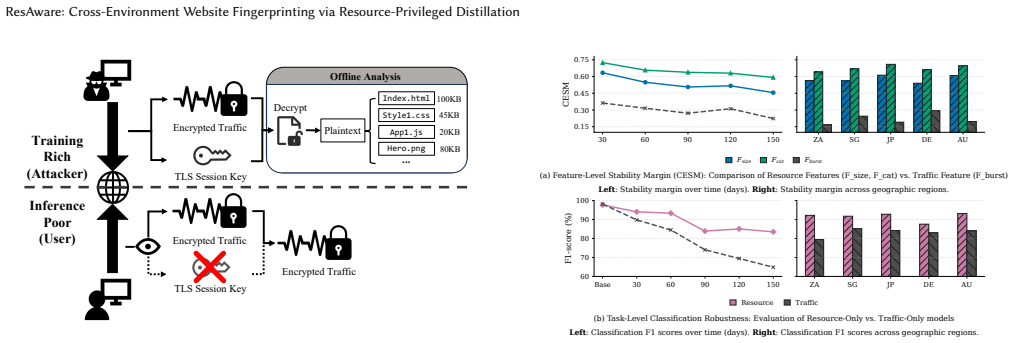
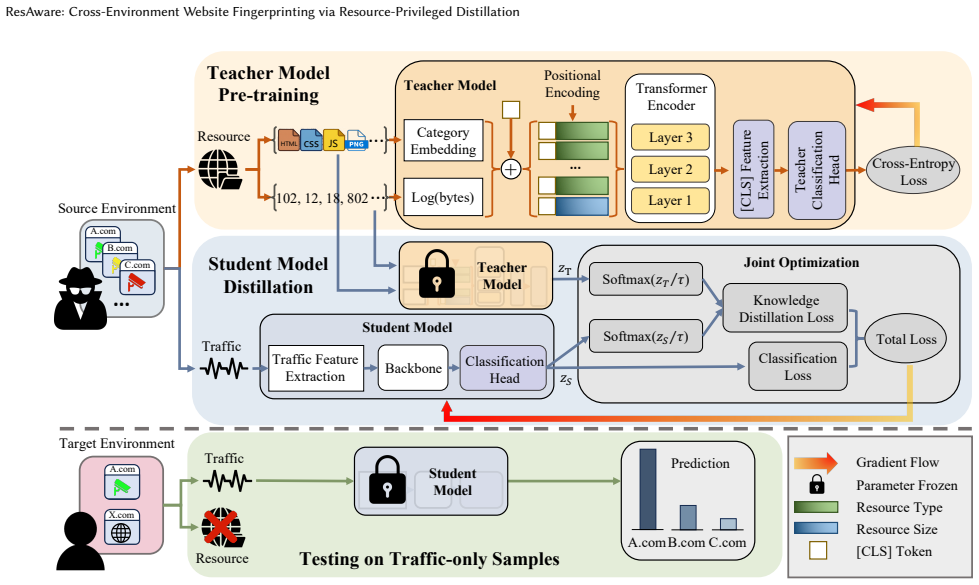
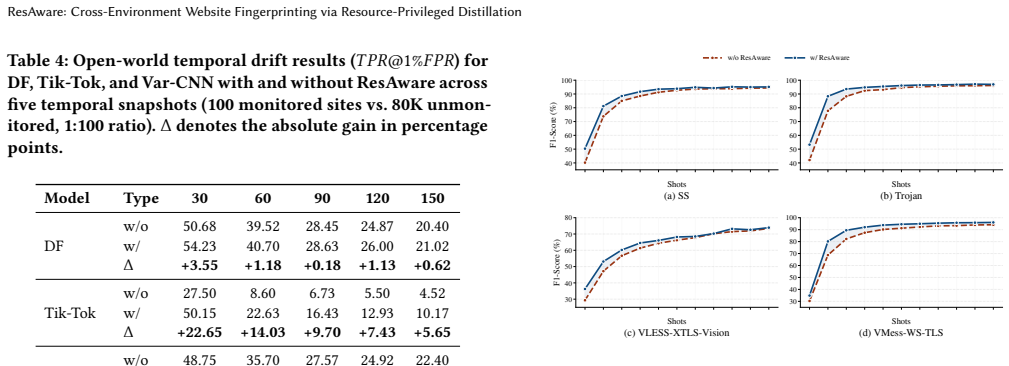
ResAware trains a teacher model on resource-level features and distills the privileged knowledge into a student model via heterogeneous knowledge distillation. At deployment the student uses only encrypted traffic. On a five-month dataset from six vantage points with over 160,000 samples, this raises Var-CNN F1-score from 72.77% to 81.49% under 150-day drift and open-world TPR@1%FPR from 22.40% to 27.20%.
What carries the argument
Heterogeneous knowledge distillation from a teacher trained on resource-level features to a student limited to encrypted traffic features.
If this is right
- Resource supervision improves robustness of existing WF baselines without changing their inference input.
- Performance gains hold under 150-day temporal drift and across global vantage points.
- The method requires no additional observation capabilities at attack time.
- Results generalize across multiple WF architectures including Var-CNN.
Where Pith is reading between the lines
- Similar distillation from rich auxiliary features could help other traffic-analysis tasks that suffer from distribution shift.
- Collecting paired resource-traffic datasets might become a standard preprocessing step for training detectors meant to survive real deployment.
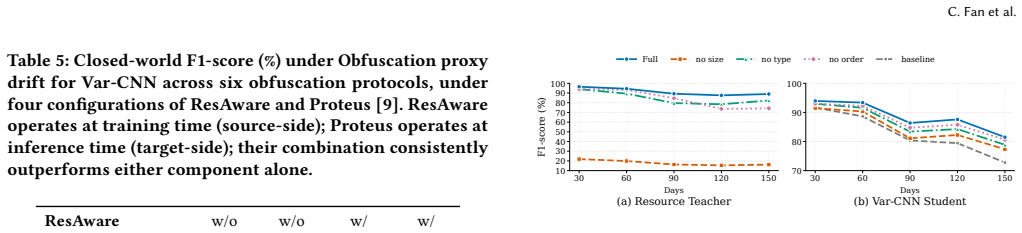
- Testing on additional obfuscation layers such as proxies would show how far the transferred knowledge survives.
Load-bearing premise
Resource-level features contain transferable information that improves predictions made from encrypted traffic alone even when environments change.
What would settle it
Apply the same training and distillation procedure to a fresh paired dataset collected after another 150 days and check whether the student still outperforms the non-distilled baseline on the new drifted traffic.
Figures




read the original abstract
While Website Fingerprinting (WF) attacks achieve high accuracy in controlled laboratory settings, they often degrade substantially in real-world environments due to spatio-temporal drift, browser heterogeneity, proxy obfuscation and etc. This limitation stems from their sole reliance on low-level traffic features that are noisy and highly sensitive to environmental perturbations. To address this problem, we propose \textbf{ResAware}, a cross-environment resource-aware distillation framework under a \textit{training-rich/inference-poor} asymmetric setting. Specifically, ResAware trains a teacher model on resource-level features, and then distills the resulting privileged knowledge into a student model through heterogeneous knowledge distillation. At deployment time, the student model performs inference using only encrypted traffic, incurring zero additional cost. We evaluate ResAware on a large-scale dataset collected over five months from six globally distributed vantage points, comprising more than $160{,}000$ paired samples. The results show that ResAware significantly enhances the cross-environment robustness of diverse WF baselines. Under a 150-day temporal drift, for example, ResAware improves the F1-score of Var-CNN from $72.77\%$ to $81.49\%$ and the open-world $TPR@1\%FPR$ from $22.40\%$ to $27.20\%$. Our results demonstrate that resource-level supervision improves WF robustness without expanding online observation capabilities.
Editorial analysis
A structured set of objections, weighed in public.
Referee Report
Summary. The paper proposes ResAware, a cross-environment resource-aware distillation framework for website fingerprinting under a training-rich/inference-poor asymmetric setting. A teacher model is trained on resource-level features and its privileged knowledge is distilled into a student model that performs inference using only encrypted traffic. The approach is evaluated on a large-scale dataset of over 160,000 paired samples collected over five months from six globally distributed vantage points, with reported gains including an F1-score increase for Var-CNN from 72.77% to 81.49% and open-world TPR@1%FPR from 22.40% to 27.20% under 150-day temporal drift.
Significance. If the results hold, the work demonstrates that resource-level supervision can be transferred via heterogeneous distillation to improve WF robustness to spatio-temporal drift, browser heterogeneity, and related factors without any additional inference-time cost or expanded observation capabilities. The scale of the paired dataset spanning multiple locations and months, together with the concrete numeric improvements on established baselines, would constitute a meaningful empirical contribution to practical WF research.
minor comments (1)
- Abstract: the phrasing 'and etc.' is informal; replace with an explicit enumeration of the environmental factors considered or remove the clause.
Simulated Author's Rebuttal
We thank the referee for the detailed summary of our work and for acknowledging its potential significance if the results hold. No specific major comments were listed in the report, so we have no point-by-point responses to provide at this time. We remain available to supply any additional details on the dataset collection, distillation procedure, or evaluation protocol that would help resolve the uncertainty in the recommendation.
Circularity Check
No significant circularity
full rationale
The paper presents an empirical distillation framework (teacher trained on resource features, student on traffic only) and reports concrete performance gains on an independently collected multi-month, multi-location dataset. No equations, fitted parameters, or derivation steps are described that reduce a claimed result to its own inputs by construction; the improvements are measured outcomes rather than self-referential predictions. The method follows standard asymmetric knowledge distillation without invoking self-citations for uniqueness theorems or smuggling ansatzes. The central claim remains externally falsifiable via the reported experiments.
Axiom & Free-Parameter Ledger
axioms (1)
- domain assumption Resource-level features contain transferable privileged knowledge that can be distilled to improve traffic-only inference under environmental drift.
Reference graph
Works this paper leans on
-
[1]
Alireza Bahramali, Ardavan Bozorgi, and Amir Houmansadr. 2023. Realistic Website Fingerprinting By Augmenting Network Traces. InProceedings of the 2023 ACM SIGSAC Conference on Computer and Communications Security, CCS 2023, Copenhagen, Denmark, November 26-30, 2023, Weizhi Meng, Christian Damsgaard Jensen, Cas Cremers, and Engin Kirda (Eds.). ACM, New Yo...
2023
-
[2]
doi:10.1145/3576915.3616639
-
[3]
Berndt and James Clifford
Donald J. Berndt and James Clifford. 1994. Using dynamic time warping to find patterns in time series. InProceedings of the 3rd International Conference on Knowledge Discovery and Data Mining(Seattle, WA)(AAAIWS’94). AAAI Press, 359–370
1994
-
[4]
Sanjit Bhat, David Lu, Albert Kwon, and Srinivas Devadas. 2019. Var-CNN: A Data-Efficient Website Fingerprinting Attack Based on Deep Learning.Proc. Priv. Enhancing Technol.2019, 4 (2019), 292–310. doi:10.2478/POPETS-2019-0070
-
[5]
Mantun Chen, Yongjun Wang, Hongzuo Xu, and Xiatian Zhu. 2021. Few-shot website fingerprinting attack.Comput. Netw.198, C (Oct. 2021), 12 pages. doi:10. 1016/j.comnet.2021.108298
arXiv 2021
-
[6]
Yifei Cheng, Yujia Zhu, Baiyang Li, Xinhao Deng, Yitong Cai, Yaochen Ren, and Qingyun Liu. 2025. STAR: Semantic-Traffic Alignment and Retrieval for Zero-Shot HTTPS Website Fingerprinting.CoRRabs/2512.17667 (2025). arXiv:2512.17667 doi:10.48550/ARXIV.2512.17667
-
[7]
Yifei Cheng, Yujia Zhu, Baiyang Li, Peishuai Sun, Yong Ding, Xinhao Deng, and Qingyun Liu. 2025. HOLMES & WATSON: A Robust and Lightweight HTTPS Website Fingerprinting through HTTP Version Parallelism. InProceedings of the ACM on Web Conference 2025, WWW 2025, Sydney, NSW, Australia, 28 April 2025- 2 May 2025, Guodong Long, Michale Blumestein, Yi Chang, L...
-
[8]
Giovanni Cherubin, Rob Jansen, and Carmela Troncoso. 2022. Online Website Fingerprinting: Evaluating Website Fingerprinting Attacks on Tor in the Real World. In31st USENIX Security Symposium, USENIX Security 2022, Boston, MA, USA, August 10-12, 2022, Kevin R. B. Butler and Kurt Thomas (Eds.). USENIX Association, 753–770. https://www.usenix.org/conference/...
2022
-
[9]
Xinhao Deng, Jingyou Chen, Linxiao Yu, Yixiang Zhang, Zhongyi Gu, Changhao Qiu, Xiyuan Zhao, Ke Xu, and Qi Li. 2025. Beyond a Single Perspective: Towards a Realistic Evaluation of Website Fingerprinting Attacks.CoRRabs/2510.14283 (2025). arXiv:2510.14283 doi:10.48550/ARXIV.2510.14283
-
[10]
Xinhao Deng, Yixiang Zhang, Qi Li, Zhuotao Liu, Yabo Wang, and Ke Xu. 2026. Enhancing Website Fingerprinting Attacks against Traffic Drift. InNetwork and Distributed System Security (NDSS) Symposium. Internet Society. https://www.ndss-symposium.org/ndss-paper/enhancing-website- fingerprinting-attacks-against-traffic-drift/
2026
-
[11]
Xianwen Deng, Ruijie Zhao, Yanhao Wang, Mingwei Zhan, Zhi Xue, and Yijun Wang. 2025. Countmamba: A Generalized Website Fingerprinting Attack via Coarse-Grained Representation and Fine-Grained Prediction. In2025 IEEE Sym- posium on Security and Privacy (SP). 1419–1437. doi:10.1109/SP61157.2025.00154
-
[12]
Fielding, Mark Nottingham, and Julian Reschke
Roy T. Fielding, Mark Nottingham, and Julian Reschke. 2022. HTTP Semantics. RFC 9110. doi:10.17487/RFC9110
-
[13]
Bo Gao, Weiwei Liu, Guangjie Liu, Fengyuan Nie, and Jianan Huang. 2025. Multi- Level Resource-Coherented Graph Learning for Website Fingerprinting Attacks. IEEE Trans. Inf. Forensics Secur.20 (2025), 693–708. doi:10.1109/TIFS.2024.3520014
-
[14]
Jamie Hayes and George Danezis. 2016. k-fingerprinting: A Robust Scalable Website Fingerprinting Technique. In25th USENIX Security Symposium, USENIX Security 16, Austin, TX, USA, August 10-12, 2016, Thorsten Holz and Stefan Savage (Eds.). USENIX Association, 1187–1203. https://www.usenix.org/conference/ usenixsecurity16/technical-sessions/presentation/hayes
2016
-
[15]
Hinton, Oriol Vinyals, and Jeffrey Dean
Geoffrey E. Hinton, Oriol Vinyals, and Jeffrey Dean. 2015. Distilling the Knowl- edge in a Neural Network.CoRRabs/1503.02531 (2015). arXiv:1503.02531 http://arxiv.org/abs/1503.02531
Pith/arXiv arXiv 2015
-
[16]
Andrew Hintz. 2002. Fingerprinting websites using traffic analysis. InProceed- ings of the 2nd International Conference on Privacy Enhancing Technologies(San Francisco, CA, USA)(PET’02). Springer-Verlag, Berlin, Heidelberg, 171–178
2002
-
[17]
Paul E. Hoffman and Patrick McManus. 2018. DNS Queries over HTTPS (DoH). RFC 8484. doi:10.17487/RFC8484
-
[18]
Guodong Huang, Chuan Ma, Ming Ding, Yuwen Qian, Chunpeng Ge, Liming Fang, and Zhe Liu. 2023. Efficient and Low Overhead Website Fingerprinting Attacks and Defenses based on TCP/IP Traffic. InProceedings of the ACM Web Conference 2023(Austin, TX, USA)(WWW ’23). Association for Computing Machinery, New York, NY, USA, 1991–1999. doi:10.1145/3543507.3583200
-
[19]
Tao Huang, Shan You, Fei Wang, Chen Qian, and Chang Xu. 2022. Knowledge distillation from a stronger teacher. InProceedings of the 36th International Con- ference on Neural Information Processing Systems(New Orleans, LA, USA)(NIPS ’22). Curran Associates Inc., Red Hook, NY, USA, Article 2443, 12 pages
2022
-
[20]
Marc Juarez, Sadia Afroz, Gunes Acar, Claudia Diaz, and Rachel Greenstadt
-
[21]
A Critical Evaluation of Website Fingerprinting Attacks. InProceedings of the 2014 ACM SIGSAC Conference on Computer and Communications Security (Scottsdale, Arizona, USA)(CCS ’14). Association for Computing Machinery, New York, NY, USA, 263–274. doi:10.1145/2660267.2660368
-
[22]
Changzhi Li, Lihai Nie, Laiping Zhao, and Keqiu Li. 2023. Robust website fin- gerprinting through resource loading sequence.World Wide Web (WWW)26, 5 (2023), 2329–2349. doi:10.1007/S11280-023-01138-2
-
[23]
Dongpu Li, Qifeng Yuan, Tan Li, Shuangwu Chen, and Jian Yang. 2020. Cross- domain Network Traffic Classification Using Unsupervised Domain Adaptation. In2020 International Conference on Information Networking (ICOIN). 245–250. doi:10.1109/ICOIN48656.2020.9016470
-
[24]
Jianfeng Li, Dongliang Wang, Yixuan Liu, Yifei Gao, Xiaorong Zhang, Zheng Lin, Xiaobo Ma, Xiapu Luo, and Xiaohong Guan. 2025. Cross-Environmental Website Fingerprinting. InIEEE INFOCOM 2025 - IEEE Conference on Computer Communications, London, United Kingdom, May 19-22, 2025. IEEE, 1–10. doi:10. 1109/INFOCOM55648.2025.11044569
arXiv 2025
-
[25]
David Lopez-Paz, Léon Bottou, Bernhard Schölkopf, and Vladimir Vapnik. 2016. Unifying distillation and privileged information. In4th International Conference on Learning Representations, ICLR 2016, San Juan, Puerto Rico, May 2-4, 2016, Conference Track Proceedings, Yoshua Bengio and Yann LeCun (Eds.). http: //arxiv.org/abs/1511.03643
Pith/arXiv arXiv 2016
-
[26]
Matthias Minderer, Josip Djolonga, Rob Romijnders, Frances Hubis, Xiaohua Zhai, Neil Houlsby, Dustin Tran, and Mario Lucic. 2021. Revisiting the Cali- bration of Modern Neural Networks. InAdvances in Neural Information Pro- cessing Systems 34: Annual Conference on Neural Information Processing Sys- tems 2021, NeurIPS 2021, December 6-14, 2021, virtual, Ma...
2021
-
[27]
Ravi Netravali, Ameesh Goyal, James Mickens, and Hari Balakrishnan. 2016. Polaris: Faster Page Loads Using Fine-grained Dependency Tracking. In13th USENIX Symposium on Networked Systems Design and Implementation, NSDI 2016, Santa Clara, CA, USA, March 16-18, 2016, Katerina J. Argyraki and Rebecca Isaacs (Eds.). USENIX Association, 123–136. https://www.use...
2016
-
[28]
Quanbo Pan, Yang Yu, Hanbing Yan, Maoli Wang, and Bingzhi Qi. 2024. ETKD: A Semi-Supervised Learning-based Knowledge Distillation Model for Encrypted Traffic Classification. In2024 IEEE International Conference on Systems, Man, and Cybernetics (SMC). 4528–4533. doi:10.1109/SMC54092.2024.10831035
-
[30]
Andriy Panchenko, Fabian Lanze, Jan Pennekamp, Thomas Engel, Andreas Zin- nen, Martin Henze, and Klaus Wehrle. 2016. Website Fingerprinting at Inter- net Scale. In23rd Annual Network and Distributed System Security Symposium, NDSS 2016, San Diego, California, USA, February 21-24, 2016. The Internet Soci- ety. http://wp.internetsociety.org/ndss/wp-content/...
2016
-
[31]
Victor Le Pochat, Tom van Goethem, Samaneh Tajalizadehkhoob, Maciej Korczyn- ski, and Wouter Joosen. 2019. Tranco: A Research-Oriented Top Sites Ranking Hardened Against Manipulation. In26th Annual Network and Distributed System Security Symposium, NDSS 2019, San Diego, California, USA, February 24-27, 2019. The Internet Society. https://www.ndss-symposiu...
2019
-
[32]
2020.Project X Xray-core
Project X Community. 2020.Project X Xray-core. Accessed: 2026-04-28
2020
-
[33]
Mohammad Saidur Rahman, Payap Sirinam, Nate Mathews, Kantha Girish Gan- gadhara, and Matthew Wright. 2020. Tik-Tok: The Utility of Packet Timing in Website Fingerprinting Attacks.Proc. Priv. Enhancing Technol.2020, 3 (2020), 5–24. doi:10.2478/POPETS-2020-0043
-
[34]
Eric Rescorla, Kazuho Oku, Nick Sullivan, and Christopher A. Wood. 2025.TLS Encrypted Client Hello. Internet-Draft draft-ietf-tls-esni-25. Internet Engineering Task Force. https://datatracker.ietf.org/doc/draft-ietf-tls-esni/25/ Work in Progress
2025
-
[35]
Vera Rimmer, Davy Preuveneers, Marc Juarez, Tom van Goethem, and Wouter Joosen. 2018. Automated Website Fingerprinting through Deep Learning. In25th Annual Network and Distributed System Security Symposium, NDSS 2018, San Diego, California, USA, February 18-21, 2018. The Internet Soci- ety. https://www.ndss-symposium.org/wp-content/uploads/2018/02/ndss201...
2018
-
[36]
Mohammadhamed Shadbeh, Khashayar Khajavi, and Tao Wang. 2026. Reality Check for Tor Website Fingerprinting in the Open World.CoRRabs/2603.07412 (2026). arXiv:2603.07412 doi:10.48550/ARXIV.2603.07412
-
[37]
2016.Shadowsocks — A fast tunnel proxy that helps you bypass firewalls
shadowsocks.org. 2016.Shadowsocks — A fast tunnel proxy that helps you bypass firewalls. https://shadowsocks.org/
2016
-
[38]
Meng Shen, Kexin Ji, Zhenbo Gao, Qi Li, Liehuang Zhu, and Ke Xu. 2023. Sub- verting Website Fingerprinting Defenses with Robust Traffic Representation. In 32nd USENIX Security Symposium (USENIX Security 23). USENIX Association, Anaheim, CA, 607–624. https://www.usenix.org/conference/usenixsecurity23/ presentation/shen-meng
2023
-
[39]
Meng Shen, Jinhe Wu, Junyu Ai, Qi Li, Chenchen Ren, Ke Xu, and Liehuang Zhu. 2025. Swallow: A Transfer-Robust Website Fingerprinting Attack via Consistent Feature Learning. InProceedings of the 2025 ACM SIGSAC Conference on Computer and Communications Security, CCS 2025, Taipei, Taiwan, October 13-17, 2025, Chun-Ying Huang, Jyh-Cheng Chen, Shiuh-Pyng Shie...
-
[40]
Anatoly Shusterman, Roie David, and Yossi Oren. 2026. Understanding and addressing concept drift in website fingerprinting.Computer Networks275 (1 Feb. 2026). doi:10.1016/j.comnet.2025.111811 Publisher Copyright:©2025 The Author(s)
-
[41]
Payap Sirinam, Mohsen Imani, Marc Juarez, and Matthew Wright. 2018. Deep Fin- gerprinting: Undermining Website Fingerprinting Defenses with Deep Learning. InProceedings of the 2018 ACM SIGSAC Conference on Computer and Commu- nications Security, CCS 2018, Toronto, ON, Canada, October 15-19, 2018, David Lie, Mohammad Mannan, Michael Backes, and XiaoFeng Wa...
-
[42]
Payap Sirinam, Nate Mathews, Mohammad Saidur Rahman, and Matthew Wright
-
[43]
Triplet Fingerprinting: More Practical and Portable Website Fingerprinting with N-shot Learning. InProceedings of the 2019 ACM SIGSAC Conference on Computer and Communications Security, CCS 2019, London, UK, November 11-15, 2019, Lorenzo Cavallaro, Johannes Kinder, XiaoFeng Wang, and Jonathan Katz (Eds.). ACM, 1131–1148. doi:10.1145/3319535.3354217
-
[44]
2023.Trojan Documentation — trojan-gfw.github.io
trojan-gfw. 2023.Trojan Documentation — trojan-gfw.github.io. Accessed: 2026- 04-28
2023
-
[45]
Vladimir Vapnik and Rauf Izmailov. 2015. Learning using privileged information: similarity control and knowledge transfer.J. Mach. Learn. Res.16 (2015), 2023–
2015
-
[46]
doi:10.5555/2789272.2886814
-
[47]
Vladimir Vapnik and Akshay Vashist. 2009. A new learning paradigm: Learning using privileged information.Neural Networks22, 5-6 (2009), 544–557. doi:10. 1016/J.NEUNET.2009.06.042
2009
-
[48]
Gomez, Łukasz Kaiser, and Illia Polosukhin
Ashish Vaswani, Noam Shazeer, Niki Parmar, Jakob Uszkoreit, Llion Jones, Aidan N. Gomez, Łukasz Kaiser, and Illia Polosukhin. 2017. Attention is all you need. InProceedings of the 31st International Conference on Neural Information Processing Systems(Long Beach, California, USA)(NIPS’17). Curran Associates Inc., Red Hook, NY, USA, 6000–6010
2017
-
[49]
Dequan Wang, Evan Shelhamer, Shaoteng Liu, Bruno Olshausen, and Trevor Darrell. 2021. Tent: Fully Test-Time Adaptation by Entropy Minimization. In International Conference on Learning Representations. https://openreview.net/ forum?id=uXl3bZLkr3c
2021
-
[50]
Tao Wang, Xiang Cai, Rishab Nithyanand, Rob Johnson, and Ian Goldberg
-
[51]
In Proceedings of the 23rd USENIX Security Symposium, San Diego, CA, USA, Au- gust 20-22, 2014, Kevin Fu and Jaeyeon Jung (Eds.)
Effective Attacks and Provable Defenses for Website Fingerprinting. In Proceedings of the 23rd USENIX Security Symposium, San Diego, CA, USA, Au- gust 20-22, 2014, Kevin Fu and Jaeyeon Jung (Eds.). USENIX Association, 143–
2014
-
[52]
https://www.usenix.org/conference/usenixsecurity14/technical-sessions/ presentation/wang_tao
-
[53]
Xiao Sophia Wang, Aruna Balasubramanian, Arvind Krishnamurthy, and David Wetherall. 2013. Demystifying Page Load Performance with WProf. In10th USENIX Symposium on Networked Systems Design and Implementation (NSDI 13). USENIX Association, Lombard, IL, 473–485. https://www.usenix.org/conference/ nsdi13/technical-sessions/presentation/wang_xiao
2013
-
[54]
Yi Xie, Jiahao Feng, Wenju Huang, Yixi Zhang, Xueliang Sun, Xiaochou Chen, and Xiapu Luo. 2024. Contrastive Fingerprinting: A Novel Website Fingerprinting Attack over Few-shot Traces. InProceedings of the ACM on Web Conference 2024, WWW 2024, Singapore, May 13-17, 2024, Tat-Seng Chua, Chong-Wah Ngo, Ravi Kumar, Hady W. Lauw, and Roy Ka-Wei Lee (Eds.). ACM...
arXiv 2024
-
[55]
Chen Xu, Quan Li, Junfeng Ge, Jinyang Gao, Xiaoyong Yang, Changhua Pei, Fei Sun, Jian Wu, Hanxiao Sun, and Wenwu Ou. 2020. Privileged Features Distillation at Taobao Recommendations. InProceedings of the 26th ACM SIGKDD International Conference on Knowledge Discovery & Data Mining(Virtual Event, CA, USA)(KDD ’20). Association for Computing Machinery, New ...
-
[56]
Guoqiang Zhang, Jiahao Cao, Mingwei Xu, and Xinhao Deng. 2023. Unsupervised and Adaptive Tor Website Fingerprinting. InInternational Conference on Security and Privacy in Communication Systems. Springer, 209–229
2023
-
[57]
Hongcheng Zou, Jinshu Su, Ziling Wei, Shuhui Chen, and Baokang Zhao. 2022. An efficient cross-domain few-shot website fingerprinting attack with Brow- nian distance covariance.Comput. Networks219 (2022), 109461. doi:10.1016/J. COMNET.2022.109461 A Open Science Research artifacts have been de-identified for double-blind review and are hosted at: https://gi...
work page doi:10.1016/j 2022
discussion (0)
Sign in with ORCID, Apple, or X to comment. Anyone can read and Pith papers without signing in.