SpecGen: Accelerating Agentic Kernel Optimization with Speculative Generation
Pith reviewed 2026-06-26 23:33 UTC · model grok-4.3
The pith
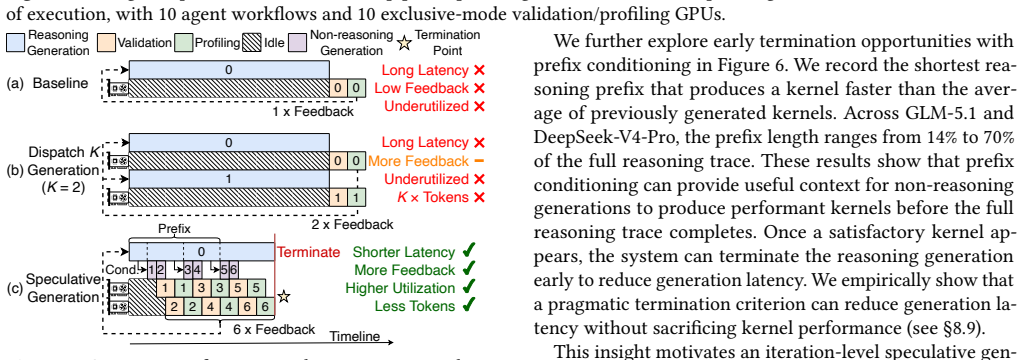
SpecGen accelerates agentic kernel optimization by forking non-reasoning generations during LLM reasoning traces to enable early termination and parallel profiling.
A machine-rendered reading of the paper's core claim, the machinery that carries it, and where it could break.
Core claim
SpecGen introduces speculative generation that forks non-reasoning generations at well-chosen trigger points in the reasoning trace to produce additional candidate kernels. These kernels are validated and profiled in parallel with the continuing reasoning generation, which allows the system to terminate the reasoning process early once a kernel satisfies the termination criterion. The approach is augmented by dynamic reallocation of validation and profiling GPU pools according to arrival rates and by using spare memory on those GPUs as remote KV cache storage to avoid prefix recomputation. Experiments on H200 hardware with two reasoning LLMs demonstrate reductions in end-to-end time relative
What carries the argument
Speculative generation by forking non-reasoning generations at trigger points in the reasoning trace, which supplies extra candidates for concurrent validation and enables early stopping of the main reasoning process.
If this is right
- End-to-end optimization time decreases compared with three baseline systems.
- The volume of profiling feedback per iteration increases.
- GPU resource utilization rises during the generation phase.
- Kernel speedups improve when total time or token budget is held constant.
Where Pith is reading between the lines
- The same forking pattern could be applied to other long-horizon agentic tasks that mix reasoning with fast verification steps.
- Dynamic pool reallocation might be generalized to heterogeneous accelerator clusters beyond H200 GPUs.
- The remote KV cache reuse technique could be tested as a standalone method for reducing recomputation in memory-constrained LLM serving.
Load-bearing premise
The assumption that forking non-reasoning generations at chosen trigger points will reliably produce kernels meeting the termination criterion often enough to justify early stopping and yield net speedup.
What would settle it
A controlled run that records the exact fraction of iterations where a forked kernel triggers early termination and measures whether the resulting wall-clock savings exceed the added overhead of forking and parallel scheduling.
Figures






read the original abstract
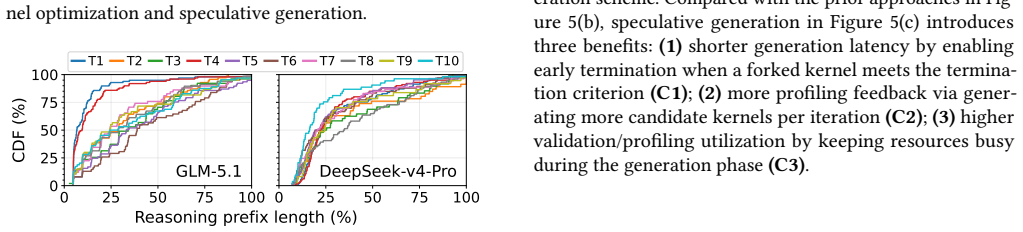
Agentic kernel optimization automates manual GPU kernel tuning via iterative generation, validation, and profiling with reasoning LLMs, casting the optimization task as feedback-guided search. However, our workload characterization reveals three system-level inefficiencies that limit search efficiency: (1) long generation latency due to LLM reasoning, (2) insufficient profiling feedback, and (3) underutilized validation/profiling resources. Our key insight is that the ongoing reasoning generation exposes a window for producing additional candidate kernels before it completes, allowing the system to terminate reasoning early once a satisfactory kernel appears. We present SpecGen, an agentic kernel optimization system with \emph{speculative generation}. First, SpecGen forks non-reasoning generations at well-chosen trigger points in the reasoning trace to yield kernels, increasing the candidate kernel count per iteration. These kernels are validated and profiled in parallel with the ongoing reasoning, increasing profiling feedback, and keeping resources busy during generation. When a kernel meets the termination criterion, SpecGen terminates the reasoning generation early to reduce the generation latency. Second, SpecGen dynamically reallocates validation and profiling GPU pools based on the arrival rate and prioritizes requests to reduce profiling feedback latency under bursty speculative generation load. Furthermore, SpecGen utilizes spare memory of the validation/profiling GPUs as remote KV cache storage to eliminate prefix recomputation of speculative generations under limited memory budget. Experiments with two reasoning LLMs on H200 show that SpecGen reduces end-to-end time over three baseline systems, while producing more profiling feedback, increasing resource utilization, and improving kernel speedup under a fixed time and token budget.
Editorial analysis
A structured set of objections, weighed in public.
Referee Report
Summary. The paper introduces SpecGen, a system for accelerating agentic kernel optimization with reasoning LLMs. It addresses three inefficiencies (long generation latency, insufficient profiling feedback, underutilized resources) by forking non-reasoning generations at trigger points in the reasoning trace, validating and profiling them in parallel, and terminating the main generation early when a kernel meets the termination criterion. Additional mechanisms include dynamic reallocation of validation/profiling GPU pools and using spare memory as remote KV cache to avoid prefix recomputation. Experiments with two reasoning LLMs on H200 GPUs claim reduced end-to-end time versus three baselines, more profiling feedback, higher resource utilization, and improved kernel speedups under fixed time/token budgets.
Significance. If the empirical results hold with reproducible details on success rates and baselines, the work could meaningfully advance automated GPU kernel tuning by adapting speculative execution ideas to LLM-driven search. The combination of parallel speculative forking, early termination, and resource management under bursty loads addresses practical bottlenecks in agentic optimization systems.
major comments (2)
- [Abstract] Abstract: the central claim of end-to-end time reduction over three baselines rests on the empirical frequency of successful early terminations from non-reasoning speculative forks. No data, tables, or discussion of this success rate, number of early stops, or how often forks meet the termination criterion are provided, leaving the net speedup (after forking/validation overhead) unverifiable.
- [Abstract] Abstract: the experimental results claim wins on H200 but supply no details on the three baseline systems, statistical significance, variance across runs, how termination criteria were selected, or the specific trigger points used. This prevents assessment of whether gains are attributable to the speculative mechanism.
Simulated Author's Rebuttal
We thank the referee for their comments highlighting the need for greater empirical detail in the abstract. We respond to each major comment below and propose targeted revisions.
read point-by-point responses
-
Referee: [Abstract] Abstract: the central claim of end-to-end time reduction over three baselines rests on the empirical frequency of successful early terminations from non-reasoning speculative forks. No data, tables, or discussion of this success rate, number of early stops, or how often forks meet the termination criterion are provided, leaving the net speedup (after forking/validation overhead) unverifiable.
Authors: We agree that the abstract would be strengthened by including quantitative support for the early-termination mechanism. The manuscript body reports these metrics in the evaluation section. We will revise the abstract to include a concise statement summarizing the observed early-termination frequency and its contribution to net speedup after overhead. revision: yes
-
Referee: [Abstract] Abstract: the experimental results claim wins on H200 but supply no details on the three baseline systems, statistical significance, variance across runs, how termination criteria were selected, or the specific trigger points used. This prevents assessment of whether gains are attributable to the speculative mechanism.
Authors: We acknowledge that the abstract omits these experimental details. The three baselines, statistical tests, variance, termination criteria, and trigger points are defined in Sections 3 and 4 with results in Section 5. We will revise the abstract to name the baselines and note that results are statistically validated, with full details remaining in the body. revision: yes
Circularity Check
No circularity: system description and empirical claims are independent of inputs
full rationale
The paper presents an engineering system (SpecGen) for speculative generation in agentic kernel optimization. The abstract and description outline an architecture with forking at trigger points, parallel validation, dynamic reallocation, and KV cache reuse, followed by experimental claims of reduced end-to-end time on H200 hardware. No equations, fitted parameters, predictions, or derivations are present. No self-citations are invoked as load-bearing premises. The central claims rest on measured performance deltas against baselines rather than any reduction to self-defined quantities or prior author results. This matches the default case of a self-contained systems paper with no detectable circular steps.
Axiom & Free-Parameter Ledger
free parameters (2)
- trigger points in reasoning trace
- termination criterion
Reference graph
Works this paper leans on
-
[1]
Hydra: Sequentially-dependent draft heads for medusa decoding.CoRR, abs/2402.05109, 2024
Zachary Ankner, Rishab Parthasarathy, Aniruddha Nrusimha, Christo- pher Rinard, Jonathan Ragan-Kelley, and William Brandon. Hydra: Sequentially-dependent draft heads for medusa decoding.CoRR, abs/2402.05109, 2024
arXiv 2024
-
[2]
Kevin: Multi-turn RL for generating CUDA kernels.CoRR, abs/2507.11948, 2025
Carlo Baronio, Pietro Marsella, Ben Pan, Simon Guo, and Silas Al- berti. Kevin: Multi-turn RL for generating CUDA kernels.CoRR, abs/2507.11948, 2025
arXiv 2025
-
[3]
Dynamic depth decoding: Faster speculative decoding for llms
Oscar Brown, Zhengjie Wang, Andrea Do, Nikhil Mathew, and Cheng Yu. Dynamic depth decoding: Faster speculative decoding for llms. CoRR, abs/2409.00142, 2024
arXiv 2024
-
[4]
Lee, Deming Chen, and Tri Dao
Tianle Cai, Yuhong Li, Zhengyang Geng, Hongwu Peng, Jason D. Lee, Deming Chen, and Tri Dao. Medusa: Simple LLM inference acceler- ation framework with multiple decoding heads. In Ruslan Salakhut- dinov, Zico Kolter, Katherine A. Heller, Adrian Weller, Nuria Oliver, Jonathan Scarlett, and Felix Berkenkamp, editors,Forty-first Interna- tional Conference on ...
2024
-
[5]
Shiyi Cao, Ziming Mao, Joseph E. Gonzalez, and Ion Stoica. K-search: LLM kernel generation via co-evolving intrinsic world model.CoRR, abs/2602.19128, 2026
arXiv 2026
-
[6]
Accelerating large language model decoding with speculative sampling.CoRR, abs/2302.01318, 2023
Charlie Chen, Sebastian Borgeaud, Geoffrey Irving, Jean-Baptiste Lespiau, Laurent Sifre, and John Jumper. Accelerating large language model decoding with speculative sampling.CoRR, abs/2302.01318, 2023
Pith/arXiv arXiv 2023
-
[7]
Weinan Dai, Hanlin Wu, Qiying Yu, Huan-Ang Gao, Jiahao Li, Chengquan Jiang, Weiqiang Lou, Yufan Song, Hongli Yu, Jiaze Chen, Wei-Ying Ma, Ya-Qin Zhang, Jingjing Liu, Mingxuan Wang, Xin Liu, and Hao Zhou. CUDA agent: Large-scale agentic RL for high- performance CUDA kernel generation.CoRR, abs/2602.24286, 2026
arXiv 2026
-
[8]
Flashattention-2: Faster attention with better parallelism and work partitioning
Tri Dao. Flashattention-2: Faster attention with better parallelism and work partitioning. 2024
2024
-
[9]
Fu, Stefano Ermon, Atri Rudra, and Christopher Ré
Tri Dao, Daniel Y. Fu, Stefano Ermon, Atri Rudra, and Christopher Ré. Flashattention: Fast and memory-efficient exact attention with io-awareness. In Sanmi Koyejo, S. Mohamed, A. Agarwal, Danielle Belgrave, K. Cho, and A. Oh, editors,Advances in Neural Information Processing Systems 35: Annual Conference on Neural Information Pro- cessing Systems 2022, Ne...
2022
-
[10]
DeepSeek-V4: Towards highly efficient million-token context intelligence.https://huggingface.co/deepseek-ai/DeepSeek- V4-Pro, 2026
DeepSeek-AI. DeepSeek-V4: Towards highly efficient million-token context intelligence.https://huggingface.co/deepseek-ai/DeepSeek- V4-Pro, 2026. Technical Report available athttps://huggingface.co/ deepseek-ai/DeepSeek-V4-Pro/blob/main/DeepSeek_V4.pdf
2026
-
[11]
STARK: strategic team of agents for refining kernels.CoRR, abs/2510.16996, 2025
Juncheng Dong, Yang Yang, Tao Liu, Yang Wang, Feng Qi, Vahid Tarokh, Kaushik Rangadurai, and Shuang Yang. STARK: strategic team of agents for refining kernels.CoRR, abs/2510.16996, 2025
arXiv 2025
-
[12]
Shengjun Kris Dong, Sahil Modi, Dima Nikiforov, Sana Damani, Ed- ward Lin, Siva Kumar Sastry Hari, and Christos Kozyrakis. Ker- nelblaster: Continual cross-task CUDA optimization via memory- augmented in-context reinforcement learning.CoRR, abs/2602.14293, 2026
arXiv 2026
-
[13]
Kernel- smith: A unified recipe for evolutionary kernel optimization.CoRR, abs/2603.28342, 2026
He Du, Qiming Ge, Jiakai Hu, Aijun Yang, Zheng Cai, Zixian Huang, Sheng Yuan, Qinxiu Cheng, Xinchen Xie, Yicheng Chen, Yining Li, Jiaxing Xie, Huanan Dong, Yaguang Wu, Xiangjun Huang, Jian Yang, Hui Wang, Bowen Zhou, Bowen Li, Qipeng Guo, and Kai Chen. Kernel- smith: A unified recipe for evolutionary kernel optimization.CoRR, abs/2603.28342, 2026
Pith/arXiv arXiv 2026
-
[14]
GLM-5: from vibe coding to agentic engineering.CoRR, abs/2602.15763, 2026
GLM. GLM-5: from vibe coding to agentic engineering.CoRR, abs/2602.15763, 2026
Pith/arXiv arXiv 2026
-
[15]
Siqi Guo, Ming Lin, and Tianbao Yang. Drtriton: Large-scale syn- thetic data reinforcement learning for triton kernel generation.CoRR, abs/2603.21465, 2026
Pith/arXiv arXiv 2026
-
[16]
Siva Kumar Sastry Hari, Vignesh Balaji, Sana Damani, Qijing Huang, and Christos Kozyrakis. Improving efficiency of GPU kernel opti- mization agents using a domain-specific language and speed-of-light guidance.CoRR, abs/2603.29010, 2026
arXiv 2026
-
[17]
Jaber Jaber and Osama Jaber. Autokernel: Autonomous GPU kernel optimization via iterative agent-driven search.CoRR, abs/2603.21331, 13 2026
arXiv 2026
-
[18]
Efficient memory management for large language model serving with pagedattention
Woosuk Kwon, Zhuohan Li, Siyuan Zhuang, Ying Sheng, Lianmin Zheng, Cody Hao Yu, Joseph Gonzalez, Hao Zhang, and Ion Stoica. Efficient memory management for large language model serving with pagedattention. In Jason Flinn, Margo I. Seltzer, Peter Druschel, An- toine Kaufmann, and Jonathan Mace, editors,Proceedings of the 29th Symposium on Operating Systems...
2023
-
[19]
Fast inference from transformers via speculative decoding
Yaniv Leviathan, Matan Kalman, and Yossi Matias. Fast inference from transformers via speculative decoding. In Andreas Krause, Emma Brunskill, Kyunghyun Cho, Barbara Engelhardt, Sivan Sabato, and Jonathan Scarlett, editors,International Conference on Machine Learn- ing, ICML 2023, 23-29 July 2023, Honolulu, Hawaii, USA, Proceedings of Machine Learning Res...
2023
-
[20]
Haonan Li, Keyu Man, Partha Kanuparthy, Hanning Chen, Wei Sun, Sreen Tallam, Chenguang Zhu, Kevin Zhu, and Zhiyun Qian. Tri- tonforge: Profiling-guided framework for automated triton kernel optimization.CoRR, abs/2512.09196, 2025
arXiv 2025
-
[21]
Tritonbench: Benchmarking large language model capabilities for generating triton operators
Jianling Li, Shangzhan Li, Zhenye Gao, Qi Shi, Yuxuan Li, Zefan Wang, Jiacheng Huang, WangHaojie WangHaojie, Jianrong Wang, Xu Han, Zhiyuan Liu, and Maosong Sun. Tritonbench: Benchmarking large language model capabilities for generating triton operators. In Wanxi- ang Che, Joyce Nabende, Ekaterina Shutova, and Mohammad Taher Pilehvar, editors,Findings of ...
2025
-
[22]
Xiaoya Li, Xiaofei Sun, Albert Wang, Jiwei Li, and Chris Shum. CUDA- L1: improving CUDA optimization via contrastive reinforcement learn- ing.CoRR, abs/2507.14111, 2025
arXiv 2025
-
[23]
EAGLE: speculative sampling requires rethinking feature uncertainty
Yuhui Li, Fangyun Wei, Chao Zhang, and Hongyang Zhang. EAGLE: speculative sampling requires rethinking feature uncertainty. pages 28935–28948, 2024
2024
-
[24]
Kangaroo: Lossless self-speculative decod- ing for accelerating llms via double early exiting
Fangcheng Liu, Yehui Tang, Zhenhua Liu, Yunsheng Ni, Duyu Tang, Kai Han, and Yunhe Wang. Kangaroo: Lossless self-speculative decod- ing for accelerating llms via double early exiting. 2024
2024
-
[25]
Wei Liu, Jiawei Xu, Yingru Li, Longtao Zheng, Tianjian Li, Qian Liu, and Junxian He. Dr. kernel: Reinforcement learning done right for triton kernel generations.CoRR, abs/2602.05885, 2026
arXiv 2026
-
[26]
KernelAgent: Autonomous GPU ker- nel generation & optimization via deep agents, 2025
Meta PyTorch Team. KernelAgent: Autonomous GPU ker- nel generation & optimization via deep agents, 2025. Blog post:https://pytorch.org/blog/kernelfalcon-autonomous-gpu-kernel- generation-via-deep-agents/
2025
-
[27]
Alexander Novikov, Ngân Vu, Marvin Eisenberger, Emilien Dupont, Po-Sen Huang, Adam Zsolt Wagner, Sergey Shirobokov, Borislav Ko- zlovskii, Francisco J. R. Ruiz, Abbas Mehrabian, M. Pawan Kumar, Abi- gail See, Swarat Chaudhuri, George Holland, Alex Davies, Sebastian Nowozin, Pushmeet Kohli, and Matej Balog. Alphaevolve: A coding agent for scientific and al...
Pith/arXiv arXiv 2025
-
[28]
Zhang, William Hu, Christopher Ré, and Azalia Mirhoseini
Anne Ouyang, Simon Guo, Simran Arora, Alex L. Zhang, William Hu, Christopher Ré, and Azalia Mirhoseini. Kernelbench: Can llms write efficient GPU kernels? In Aarti Singh, Maryam Fazel, Daniel Hsu, Si- mon Lacoste-Julien, Felix Berkenkamp, Tegan Maharaj, Kiri Wagstaff, and Jerry Zhu, editors,Forty-second International Conference on Ma- chine Learning, ICML...
2025
-
[29]
Mooncake: Trad- ing more storage for less computation - A kvcache-centric architecture for serving LLM chatbot
Ruoyu Qin, Zheming Li, Weiran He, Jialei Cui, Feng Ren, Mingxing Zhang, Yongwei Wu, Weimin Zheng, and Xinran Xu. Mooncake: Trad- ing more storage for less computation - A kvcache-centric architecture for serving LLM chatbot. In Haryadi S. Gunawi and Vasily Tarasov, editors,23rd USENIX Conference on File and Storage Technologies, FAST 2025, Santa Clara, CA...
2025
-
[30]
Tara Saba, Anne Ouyang, Xujie Si, and Fan Long. Cutegen: An llm- based agentic framework for generation and optimization of high- performance GPU kernels using cute.CoRR, abs/2604.01489, 2026
Pith/arXiv arXiv 2026
-
[31]
Flashattention-3: Fast and accurate attention with asynchrony and low-precision
Jay Shah, Ganesh Bikshandi, Ying Zhang, Vijay Thakkar, Pradeep Ra- mani, and Tri Dao. Flashattention-3: Fast and accurate attention with asynchrony and low-precision. In Amir Globersons, Lester Mackey, Danielle Belgrave, Angela Fan, Ulrich Paquet, Jakub M. Tomczak, and Cheng Zhang, editors,Advances in Neural Information Processing Sys- tems 38: Annual Con...
2024
-
[32]
Openevolve: an open-source evolutionary coding agent, 2025
Asankhaya Sharma. Openevolve: an open-source evolutionary coding agent, 2025
2025
-
[33]
Kernelskill: A multi-agent framework for GPU kernel optimization.CoRR, abs/2603.10085, 2026
Qitong Sun, Jun Han, Tianlin Li, Zhe Tang, Sheng Chen, Fei Yang, Aishan Liu, Xianglong Liu, and Yang Liu. Kernelskill: A multi-agent framework for GPU kernel optimization.CoRR, abs/2603.10085, 2026
arXiv 2026
-
[34]
KernelEvolve Team and Meta Platforms. Kernelevolve: Scaling agen- tic kernel coding for heterogeneous AI accelerators at meta.CoRR, abs/2512.23236, 2025
arXiv 2025
-
[35]
Ali Tehrani, Yahya Emara, Essam Wissam, Wojciech Paluch, Waleed Atallah, Lukasz Dudziak, and Mohamed S. Abdelfattah. Fine-tuning GPT-5 for GPU kernel generation.CoRR, abs/2602.11000, 2026
arXiv 2026
-
[36]
Arya Tschand, Muhammad A. Awad, Ryan Swann, Kesavan Ramakr- ishnan, Jeffrey Jian Ma, Keith Lowery, Ganesh Dasika, and Vijay Janapa Reddi. Swizzleperf: Hardware-aware llms for GPU kernel performance optimization.CoRR, abs/2508.20258, 2025
arXiv 2025
-
[37]
Astra: A multi-agent system for GPU kernel performance optimization.CoRR, abs/2509.07506, 2025
Anjiang Wei, Tianran Sun, Yogesh Seenichamy, Hang Song, Anne Ouyang, Azalia Mirhoseini, Ke Wang, and Alex Aiken. Astra: A multi-agent system for GPU kernel performance optimization.CoRR, abs/2509.07506, 2025
arXiv 2025
-
[38]
Tritonrl: Training llms to think and code triton without cheating
Jiin Woo, Shaowei Zhu, Allen Nie, Zhen Jia, Yida Wang, and Youngsuk Park. Tritonrl: Training llms to think and code triton without cheating. CoRR, abs/2510.17891, 2025
arXiv 2025
-
[39]
SWIFT: on-the-fly self-speculative decoding for LLM inference acceleration
Heming Xia, Yongqi Li, Jun Zhang, Cunxiao Du, and Wenjie Li. SWIFT: on-the-fly self-speculative decoding for LLM inference acceleration. 2025
2025
-
[40]
Zijian Zhang, Rong Wang, Shiyang Li, Yuebo Luo, Mingyi Hong, and Caiwen Ding. Cudaforge: An agent framework with hardware feed- back for CUDA kernel optimization.CoRR, abs/2511.01884, 2025
arXiv 2025
-
[41]
Cross-attention speculative decoding.CoRR, abs/2505.24544, 2025
Wei Zhong, Manasa Bharadwaj, Yixiao Wang, Nikhil Verma, Yipeng Ji, and Chul Lee. Cross-attention speculative decoding.CoRR, abs/2505.24544, 2025
arXiv 2025
-
[42]
Qimeng-kernel: Macro-thinking micro-coding paradigm for llm-based high-performance GPU kernel generation
Xinguo Zhu, Shaohui Peng, Jiaming Guo, Yunji Chen, Qi Guo, Yuanbo Wen, Hang Qin, Ruizhi Chen, Qirui Zhou, Ke Gao, Yanjun Wu, Chen Zhao, and Ling Li. Qimeng-kernel: Macro-thinking micro-coding paradigm for llm-based high-performance GPU kernel generation. pages 29168–29176, 2026. 14
2026
discussion (0)
Sign in with ORCID, Apple, or X to comment. Anyone can read and Pith papers without signing in.