The Incidence of Large Ionized Bubbles at Redshift 13
Pith reviewed 2026-06-27 00:33 UTC · model grok-4.3
The pith
JWST UV luminosity functions imply ionized bubbles of radius 2.5 cMpc occur at z=13 with surface density 1.33×10^{-2} arcmin^{-2} per Δz=1.
A machine-rendered reading of the paper's core claim, the machinery that carries it, and where it could break.
Core claim
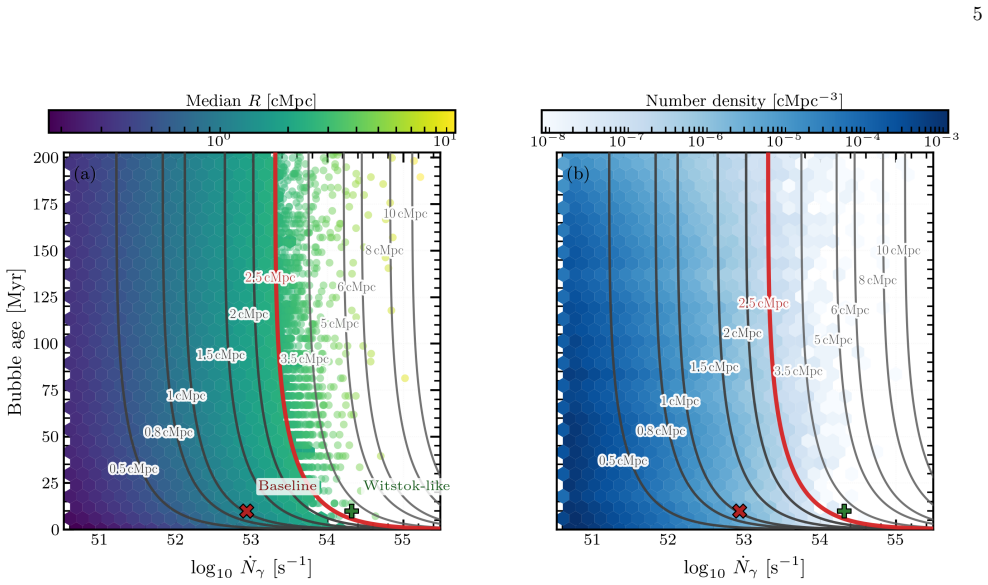
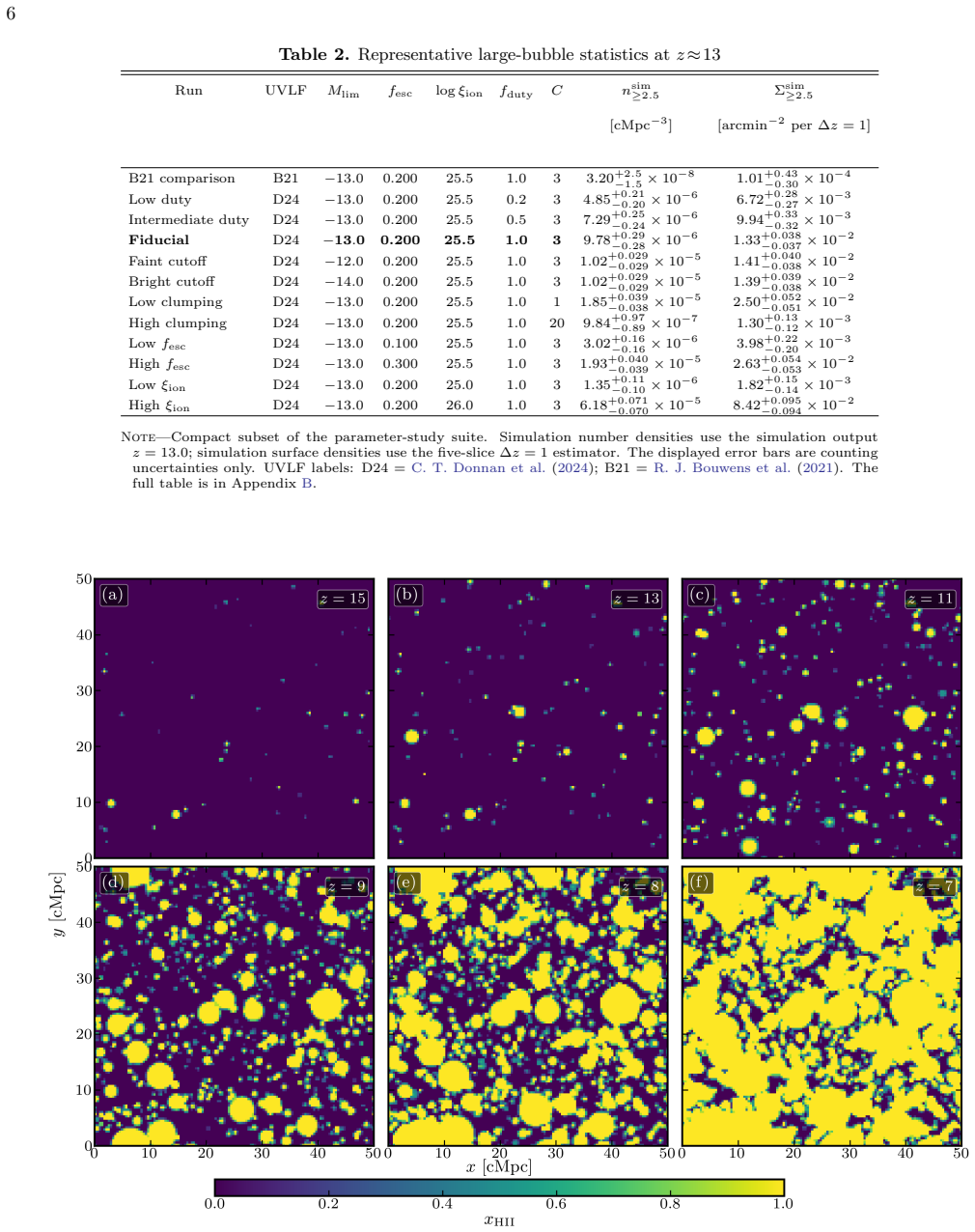
We model the incidence of galaxy-driven ionized bubbles at z≈13 using JWST UV luminosity functions and take the Witstok et al. (2025) Lyα source as a benchmark for the relevant bubble scale of R ≥ 2.5 cMpc. For the fiducial case with UVLF from Donnan et al. 2024, f_esc=0.2, log ξ_ion=25.5, f_duty=1, and C=3, the sky surface density Σ≥2.5 is ≃ 1.33×10^{-2} arcmin^{-2} per Δz=1. Bubbles are treated as independent spheres, making this a conservative baseline. We conclude that Witstok-sized regions are plausible in UVLF-calibrated galaxy-driven models, though the specific source may require unusual conditions.
What carries the argument
The sky surface density Σ≥2.5 of independent ionized spheres with comoving radius R ≥ 2.5 cMpc, computed by integrating the bubble production rate over the UV luminosity function using fixed ionizing parameters.
Load-bearing premise
The model assumes fixed uniform values for the ionizing escape fraction, efficiency, duty cycle, and clumping factor across the entire galaxy population at z≈13 with no redshift evolution or scatter.
What would settle it
A direct count of Lyα emitters or large ionized regions at z=13 showing a surface density substantially different from 1.33×10^{-2} arcmin^{-2} per unit redshift would test whether the fiducial parameters correctly predict the incidence.
Figures



read the original abstract
Ionized bubbles around the first galaxies link early galaxy growth, ionizing photon escape, intergalactic-medium topology, Ly{\alpha} visibility, 21 cm structure, and the timing of reionization. With JWST now constraining both the abundance of luminous galaxies at $z\gtrsim 10$ and rare Ly$\alpha$ emitters deep in the neutral era, it is timely to ask how often galaxy populations produce large ionized environments. We model the incidence of galaxy-driven ionized bubbles at $z\approx 13$ using JWST UV luminosity functions, taking the Ly$\alpha$ source reported by Witstok et al. (2025) as a benchmark for the relevant bubble scale. We quantify the incidence of regions with comoving radius $R\ge 2.5$ cMpc through the sky surface density $\Sigma_{\ge 2.5}$ at $z\approx 13$. For our fiducial case (UVLF from Donnan et al. 2024 with $f_{\mathrm{esc}}=0.2$, $\log\xi_{\mathrm{ion}}=25.5$, $f_{\mathrm{duty}}=1$, and $C=3$), we find $\Sigma_{\ge 2.5}\simeq 1.33\times 10^{-2}$ arcmin$^{-2}$ per $\Delta z=1$. Because bubbles are treated as independent spheres with random source positions and no union of overlaps, this is a conservative baseline for the abundance of connected ionized environments. We conclude that Witstok-sized regions are plausible in UVLF-calibrated galaxy-driven models. This is a population-level statement, however, and the specific Witstok source may still require unusual effective ionizing efficiency, recent fading or burstiness, or a non-stellar ionizing contribution.
Editorial analysis
A structured set of objections, weighed in public.
Referee Report
Summary. The paper calculates the incidence of galaxy-driven ionized bubbles with comoving radius R ≥ 2.5 cMpc at z ≈ 13 by integrating the Donnan et al. (2024) UV luminosity function above the luminosity threshold set by fiducial parameters (f_esc = 0.2, log ξ_ion = 25.5, f_duty = 1, C = 3). Under the independent-sphere approximation with random source positions, it reports a surface density Σ_≥2.5 ≃ 1.33 × 10^{-2} arcmin^{-2} per Δz = 1 and concludes that Witstok-sized regions are plausible in UVLF-calibrated models, while noting that the specific observed source may require additional factors such as burstiness.
Significance. If the central calculation holds, the work supplies a quantitative, population-level baseline for the abundance of large ionized regions at z ≈ 13 that directly connects recent JWST UVLF constraints to IGM topology, Lyα visibility, and the timing of reionization. The explicit conservative treatment via non-overlapping spheres strengthens its utility as a reference point for interpreting rare high-redshift Lyα emitters.
major comments (2)
- [Abstract (fiducial case)] Abstract (fiducial case): The reported Σ_≥2.5 is obtained by integrating the UVLF above the minimum galaxy luminosity that produces R = 2.5 cMpc when the ionizing photon rate is computed with the fixed values f_esc = 0.2, log ξ_ion = 25.5, f_duty = 1 and the recombination rate with C = 3. Because the bright-end UVLF slope at z ≈ 13 is steep, this integral is exponentially sensitive to small shifts in these parameters, yet the manuscript presents only the single fiducial point with no sensitivity tests, scatter, or error propagation.
- [Abstract] Abstract: The conclusion that Witstok-sized regions are plausible rests on this single fiducial surface density. Without quantifying the plausible range of Σ_≥2.5 under reasonable variations of the four free parameters (consistent with lower-redshift constraints), the robustness of the population-level claim cannot be assessed.
Simulated Author's Rebuttal
We thank the referee for their careful reading of the manuscript and for identifying the need to assess sensitivity to the model parameters. We agree that this strengthens the robustness of the population-level claim and will revise the manuscript accordingly.
read point-by-point responses
-
Referee: [Abstract (fiducial case)] The reported Σ_≥2.5 is obtained by integrating the UVLF above the minimum galaxy luminosity that produces R = 2.5 cMpc when the ionizing photon rate is computed with the fixed values f_esc = 0.2, log ξ_ion = 25.5, f_duty = 1 and the recombination rate with C = 3. Because the bright-end UVLF slope at z ≈ 13 is steep, this integral is exponentially sensitive to small shifts in these parameters, yet the manuscript presents only the single fiducial point with no sensitivity tests, scatter, or error propagation.
Authors: We agree that the steep bright-end slope renders the integral sensitive to the adopted parameters and that presenting only the fiducial case limits evaluation of robustness. In the revised manuscript we will add a new section (or appendix) that quantifies Σ_≥2.5 for plausible variations of f_esc, log ξ_ion, f_duty and C drawn from lower-redshift constraints. This will include a table of resulting surface densities and a brief discussion of the range. revision: yes
-
Referee: [Abstract] The conclusion that Witstok-sized regions are plausible rests on this single fiducial surface density. Without quantifying the plausible range of Σ_≥2.5 under reasonable variations of the four free parameters (consistent with lower-redshift constraints), the robustness of the population-level claim cannot be assessed.
Authors: We concur that an explicit range under parameter variations will better support the population-level statement. The revised version will provide this quantification, allowing direct assessment of how Σ_≥2.5 changes across the adopted parameter space while retaining the fiducial result as the baseline case motivated by typical values at lower redshift. revision: yes
Circularity Check
No significant circularity; standard model evaluation using external UVLF
full rationale
The paper computes Σ_≥2.5 by integrating the external Donnan et al. (2024) UVLF above the luminosity threshold set by the explicitly chosen fiducial parameters f_esc=0.2, log ξ_ion=25.5, f_duty=1 and C=3 in the standard bubble-radius relation. This is a direct model evaluation, not a derivation that reduces to its own inputs by construction. No self-citations are load-bearing, no parameters are fitted within the paper and then relabeled as predictions, and the result is presented as a population-level plausibility check rather than an independent first-principles claim. The derivation chain is self-contained against the stated external inputs and assumptions.
Axiom & Free-Parameter Ledger
free parameters (4)
- f_esc =
0.2
- log ξ_ion =
25.5
- f_duty =
1
- C =
3
axioms (2)
- domain assumption Bubbles can be treated as independent, non-overlapping spheres with random source positions.
- domain assumption The UV luminosity function from Donnan et al. 2024 accurately represents the galaxy population at z≈13.
Reference graph
Works this paper leans on
-
[1]
Planck 2018 results. VI. Cosmological parameters
, keywords =. doi:10.1051/0004-6361/201833910 , archiveprefix =. 1807.06209 , primaryclass =
work page internal anchor Pith review Pith/arXiv arXiv doi:10.1051/0004-6361/201833910
-
[2]
doi:10.1051/0004-6361/201936630 , archiveprefix =
, keywords =. doi:10.1051/0004-6361/201936630 , archiveprefix =. 1908.09856 , primaryclass =
-
[3]
The Growth of HII Regions During Reionization
, keywords =. doi:10.1086/423025 , archiveprefix =. astro-ph/0403697 , primaryclass =
work page internal anchor Pith review Pith/arXiv arXiv doi:10.1086/423025
-
[4]
2007, MNRAS, 382, 1415, doi: 10.1111/j.1365-2966.2007.12487.x
, keywords =. doi:10.1111/j.1365-2966.2007.11489.x , archiveprefix =. astro-ph/0610094 , primaryclass =
-
[5]
Simulations and Analytic Calculations of Bubble Growth During Hydrogen Reionization
, keywords =. doi:10.1086/509597 , archiveprefix =. astro-ph/0604177 , primaryclass =
work page internal anchor Pith review Pith/arXiv arXiv doi:10.1086/509597
-
[6]
Reionization Through the Lens of Percolation Theory
, keywords =. doi:10.1093/mnras/stw104 , archiveprefix =. 1511.01521 , primaryclass =
work page internal anchor Pith review Pith/arXiv arXiv doi:10.1093/mnras/stw104
-
[7]
The Distribution of Bubble Sizes During Reionization
, keywords =. doi:10.1093/mnras/stw1542 , archiveprefix =. 1511.01506 , primaryclass =
work page internal anchor Pith review Pith/arXiv arXiv doi:10.1093/mnras/stw1542
-
[8]
Bubble size statistics during reionization from 21-cm tomography
, keywords =. doi:10.1093/mnras/stx2539 , archiveprefix =. 1706.00665 , primaryclass =
work page internal anchor Pith review Pith/arXiv arXiv doi:10.1093/mnras/stx2539
-
[9]
doi:10.3847/2041-8213/acade4 , archiveprefix =
, keywords =. doi:10.3847/2041-8213/acade4 , archiveprefix =. 2211.05792 , primaryclass =
-
[10]
doi:10.3847/1538-4357/ad9b2c , archiveprefix =
, keywords =. doi:10.3847/1538-4357/ad9b2c , archiveprefix =. 2406.18352 , primaryclass =
-
[11]
doi:10.3847/1538-3881/abf83e , archiveprefix =
, keywords =. doi:10.3847/1538-3881/abf83e , archiveprefix =. 2102.07775 , primaryclass =
-
[13]
, keywords =. doi:10.3847/1538-4357/aab0a7 , archiveprefix =. 1709.05356 , primaryclass =
work page internal anchor Pith review Pith/arXiv arXiv doi:10.3847/1538-4357/aab0a7
-
[14]
Tang, Mengtao and Hutchison, Thomas and Whitler, Luke and Endsley, Ryan and Stark, Daniel P. and others , title =. Monthly Notices of the Royal Astronomical Society , year =. doi:10.1093/mnras/stae2037 , archiveprefix =. 2403.03171 , primaryclass =
-
[15]
, keywords =. doi:10.1093/mnras/stae1857 , archiveprefix =. 2306.05295 , primaryclass =
-
[16]
doi:10.3847/1538-4357/addc74 , archiveprefix =
, keywords =. doi:10.3847/1538-4357/addc74 , archiveprefix =. 2410.01905 , primaryclass =
-
[17]
doi:10.3847/1538-4357/ae486c , archiveprefix =
, keywords =. doi:10.3847/1538-4357/ae486c , archiveprefix =. 2602.16706 , primaryclass =
-
[18]
, keywords =. doi:10.1093/mnras/stag415 , archiveprefix =. 2601.07912 , primaryclass =
work page internal anchor Pith review Pith/arXiv arXiv doi:10.1093/mnras/stag415
-
[19]
doi:10.1038/s41586-025-08779-5 , archiveprefix =
, keywords =. doi:10.1038/s41586-025-08779-5 , archiveprefix =. 2408.16608 , primaryclass =
-
[20]
doi:10.3847/1538-4357/acaf50 , archiveprefix =
, keywords =. doi:10.3847/1538-4357/acaf50 , archiveprefix =. 2210.04912 , primaryclass =
-
[21]
doi:10.1051/0004-6361/202554158 , archiveprefix =
, keywords =. doi:10.1051/0004-6361/202554158 , archiveprefix =. 2503.05576 , primaryclass =
-
[22]
doi:10.3847/1538-4357/adda45 , archiveprefix =
, keywords =. doi:10.3847/1538-4357/adda45 , archiveprefix =. 2505.09097 , primaryclass =
-
[23]
, keywords =. doi:10.1111/j.1365-2966.2009.14486.x , archiveprefix =. 0807.3963 , primaryclass =
-
[24]
2012, MNRAS, 427, 1266, doi: 10.1111/j.1365-2966.2012.22060.x
, keywords =. doi:10.1111/j.1365-2966.2012.22114.x , archiveprefix =. 1209.2489 , primaryclass =
-
[25]
Inhomogeneous recombinations during cosmic reionization
, keywords =. doi:10.1093/mnras/stu377 , archiveprefix =. 1402.2298 , primaryclass =
work page internal anchor Pith review Pith/arXiv arXiv doi:10.1093/mnras/stu377
-
[26]
, keywords =. doi:10.1093/pasj/58.3.485 , archiveprefix =. astro-ph/0512154 , primaryclass =
work page internal anchor Pith review Pith/arXiv arXiv doi:10.1093/pasj/58.3.485
-
[27]
doi:10.1111/j.1365-2966.2010.17535.x , eprint =
, keywords =. doi:10.1111/j.1365-2966.2010.16701.x , archiveprefix =. 1001.3415 , primaryclass =
-
[28]
, keywords =. doi:10.3847/1538-4357/aad6dc , archiveprefix =. 1802.06066 , primaryclass =
work page internal anchor Pith review Pith/arXiv arXiv doi:10.3847/1538-4357/aad6dc
-
[29]
The Discovery of A Luminous Broad Absorption Line Quasar at A Redshift of 7.02
, keywords =. doi:10.3847/2041-8213/aaf1d2 , archiveprefix =. 1810.11925 , primaryclass =
work page internal anchor Pith review Pith/arXiv arXiv doi:10.3847/2041-8213/aaf1d2 2041
-
[30]
doi:10.1093/mnras/stac825 , archiveprefix =
, keywords =. doi:10.1093/mnras/stac825 , archiveprefix =. 2112.04091 , primaryclass =
-
[31]
doi:10.1093/mnras/staa505 , archiveprefix =
, keywords =. doi:10.1093/mnras/staa505 , archiveprefix =. 1912.01050 , primaryclass =
-
[32]
doi:10.3847/1538-4357/ae232b , archiveprefix =
, keywords =. doi:10.3847/1538-4357/ae232b , archiveprefix =. 2504.04683 , primaryclass =
-
[33]
Constraining the neutral fraction of hydrogen in the IGM at redshift 7.5
, keywords =. doi:10.3847/1538-4357/ab1de7 , archiveprefix =. 1901.09001 , primaryclass =
work page internal anchor Pith review Pith/arXiv arXiv doi:10.3847/1538-4357/ab1de7 1901
-
[34]
Inferences on the Timeline of Reionization at z~8 From the KMOS Lens-Amplified Spectroscopic Survey
, keywords =. doi:10.1093/mnras/stz632 , archiveprefix =. 1901.11045 , primaryclass =
work page internal anchor Pith review Pith/arXiv arXiv doi:10.1093/mnras/stz632 1901
-
[35]
doi:10.1093/mnras/stac1963 , archiveprefix =
, keywords =. doi:10.1093/mnras/stac1963 , archiveprefix =. 2111.14912 , primaryclass =
-
[36]
Model-independent evidence in favor of an end to reionization by z~6
, keywords =. doi:10.1093/mnras/stu2449 , archiveprefix =. 1411.5375 , primaryclass =
work page internal anchor Pith review Pith/arXiv arXiv doi:10.1093/mnras/stu2449
-
[37]
doi:10.1093/mnras/staf1862 , archiveprefix =
, keywords =. doi:10.1093/mnras/staf1862 , archiveprefix =. 2510.25829 , primaryclass =
-
[38]
doi:10.1038/s41586-024-07043-6 , archiveprefix =
, keywords =. doi:10.1038/s41586-024-07043-6 , archiveprefix =. 2308.08540 , primaryclass =
-
[39]
doi:10.1038/s41586-024-07052-5 , archiveprefix =
, keywords =. doi:10.1038/s41586-024-07052-5 , archiveprefix =. 2305.12492 , primaryclass =
-
[40]
, keywords =. doi:10.1038/s41586-024-07227-0 , archiveprefix =. 2302.14155 , primaryclass =
-
[41]
doi:10.1093/mnras/stab3710 , archiveprefix =
, keywords =. doi:10.1093/mnras/stab3710 , archiveprefix =. 2110.00584 , primaryclass =
-
[42]
doi:10.1093/mnras/staa1266 , archiveprefix =
, keywords =. doi:10.1093/mnras/staa1266 , archiveprefix =. 1811.11192 , primaryclass =
-
[43]
doi:10.1093/mnras/stae839 , archiveprefix =
, keywords =. doi:10.1093/mnras/stae839 , archiveprefix =. 2309.06475 , primaryclass =
-
[44]
doi:10.1093/mnras/stad3605 , archiveprefix =
, keywords =. doi:10.1093/mnras/stad3605 , archiveprefix =. 2310.01112 , primaryclass =
-
[45]
doi:10.1051/0004-6361/202345866 , archiveprefix =
, keywords =. doi:10.1051/0004-6361/202345866 , archiveprefix =. 2301.02816 , primaryclass =
-
[46]
, keywords =. doi:10.1051/0004-6361/202347132 , archiveprefix =. 2306.04536 , primaryclass =
-
[47]
doi:10.1093/mnras/stad2228 , archiveprefix =
, keywords =. doi:10.1093/mnras/stad2228 , archiveprefix =. 2210.06504 , primaryclass =
-
[48]
doi:10.1051/0004-6361/202553820 , archiveprefix =
, keywords =. doi:10.1051/0004-6361/202553820 , archiveprefix =. 2501.11702 , primaryclass =
-
[49]
doi:10.3847/1538-4357/ad1e5f , archiveprefix =
, keywords =. doi:10.3847/1538-4357/ad1e5f , archiveprefix =. 2309.05714 , primaryclass =
-
[50]
doi:10.3847/1538-4357/ab7cc9 , archiveprefix =
, keywords =. doi:10.3847/1538-4357/ab7cc9 , archiveprefix =. 1907.13130 , primaryclass =
-
[51]
doi:10.1038/s41550-023-01918-w , archiveprefix =
Nature Astronomy , keywords =. doi:10.1038/s41550-023-01918-w , archiveprefix =. 2212.04568 , primaryclass =
-
[52]
doi:10.1051/0004-6361/202346159 , archiveprefix =
, keywords =. doi:10.1051/0004-6361/202346159 , archiveprefix =. 2302.07256 , primaryclass =
-
[53]
doi:10.1093/mnras/stac1046 , archiveprefix =
, keywords =. doi:10.1093/mnras/stac1046 , archiveprefix =. 2108.03699 , primaryclass =
-
[54]
doi:10.1038/s41550-024-02397-3 , archiveprefix =
Nature Astronomy , keywords =. doi:10.1038/s41550-024-02397-3 , archiveprefix =. 2403.10491 , primaryclass =
-
[55]
, keywords =. doi:10.1146/annurev-astro-081811-125615 , archiveprefix =. 1403.0007 , primaryclass =
work page internal anchor Pith review Pith/arXiv arXiv doi:10.1146/annurev-astro-081811-125615
discussion (0)
Sign in with ORCID, Apple, or X to comment. Anyone can read and Pith papers without signing in.