Measurement of isolated photon plus two-jet correlations in Pb+Pb and pp collisions at 5.02 TeV with ATLAS
Pith reviewed 2026-06-26 22:14 UTC · model grok-4.3
The pith
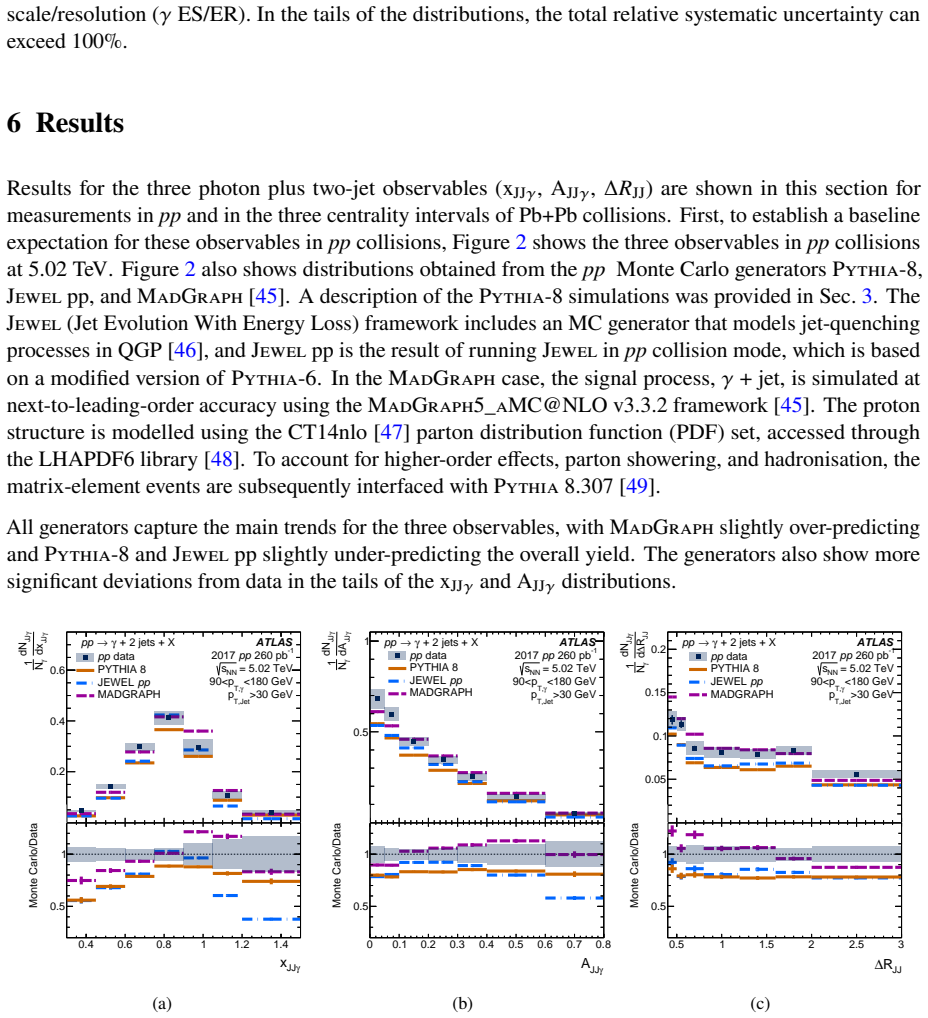
Photon plus two-jet events show significant yield suppression in Pb+Pb versus pp collisions at 5.02 TeV.
A machine-rendered reading of the paper's core claim, the machinery that carries it, and where it could break.
Core claim
Significant suppression of per-photon two-jet yields is observed in all three observables, with I_AA less than one, as a direct result of parton-medium interactions.
What carries the argument
The ratio I_AA of background-subtracted per-photon yields for the observables x_JJγ, A_JJγ and ΔR_JJ between Pb+Pb and pp collisions.
If this is right
- Suppression in x_JJγ indicates net energy loss of the entire multiparton system.
- A_JJγ isolates the difference in energy loss experienced by the two jets.
- ΔR_JJ reveals any medium-driven change in the angular separation of the jets.
- Comparison to JEWEL, JETSCAPE and LBT tests distinct implementations of parton energy loss.
Where Pith is reading between the lines
- The background-subtraction method could be reused for other multi-jet or photon-tagged correlations.
- Model-data agreement or disagreement may help separate radiative from collisional loss mechanisms.
- Higher-statistics runs could map the dependence of suppression on photon transverse momentum.
Load-bearing premise
The multijet mixing technique removes uncorrelated background without biasing the distributions of x_JJγ, A_JJγ and ΔR_JJ.
What would settle it
Measurement of I_AA values consistent with one in all centrality intervals and for all three observables would falsify the suppression claim.
Figures



read the original abstract
This paper presents a measurement of photon plus two-jet events in $pp$ and Pb+Pb collisions, i.e. events in which the transverse momentum of a single photon is balanced by two distinct jets. The measurement was performed using $pp$ data taken in 2017 with an integrated luminosity 260 pb$^{-1}$, and Pb+Pb data taken in 2018 with an integrated luminosity 1.72 nb$^{-1}$, both at $\sqrt{s_\mathrm{NN}}$ =5.02 TeV, as recorded by the ATLAS detector. Events with photons in the transverse momentum range 90-180 GeV and at least two anti-$k_t$ $R = 0.2$ jets with a $p_\mathrm{T}$ > 30 GeV are selected, and three observables are measured: ${\mathrm{x}}_{\mathrm{JJ}\gamma}$, $\mathrm{A}_{\mathrm{JJ}\gamma}$, and $\Delta R_{\mathrm{JJ}}$. These observables characterise the overall energy loss of the multiparton system from medium interactions (${\mathrm{x}}_{\mathrm{JJ}\gamma}$), the relative energy loss between the two colour-charge carriers ($\mathrm{A}_{\mathrm{JJ}\gamma}$), and medium-induced modifications to their opening angle ($\Delta R_{\mathrm{JJ}}$). The observables are corrected for uncorrelated combinatoric background contributions using a novel multijet mixing technique, for photon purity, and for detector resolution effects via iterative unfolding. Final results are presented per photon, and the ratio ($I_\mathrm{AA}$) is taken between measurements in Pb+Pb and $pp$ collisions, for Pb+Pb centrality intervals of 30-80%, 10-30%, and 0-10%. Significant suppression of per photon two-jet yields in all three observables, $I_\mathrm{AA} < 1$, is observed as a result of parton-medium interactions. The experimental measurements are compared to three different jet quenching models: JEWEL, JETSCAPE, and LBT.
Editorial analysis
A structured set of objections, weighed in public.
Referee Report
Summary. The paper measures isolated photon + two-jet correlations in pp (260 pb^{-1}) and Pb+Pb (1.72 nb^{-1}) collisions at √s_NN=5.02 TeV with ATLAS. Events are selected with photons 90<p_T<180 GeV and ≥2 anti-k_t R=0.2 jets p_T>30 GeV. Three observables (x_JJγ, A_JJγ, ΔR_JJ) are defined to probe overall energy loss, relative loss between jets, and angular modifications. After subtracting uncorrelated background with a novel multijet mixing technique, correcting for photon purity, and unfolding detector effects, the ratio I_AA (Pb+Pb/pp) is reported in three centrality classes; significant suppression (I_AA<1) is observed and compared to JEWEL, JETSCAPE, and LBT jet-quenching models.
Significance. If the background subtraction is unbiased, the measurement supplies new multiparton observables that constrain the relative energy loss and angular broadening of color-charged partons traversing the QGP, extending single-jet and photon-jet studies with direct model comparisons.
major comments (1)
- [Abstract and corrections section] Abstract and § on corrections: the novel multijet mixing technique is load-bearing for the I_AA<1 claim. The manuscript must demonstrate, via explicit closure tests in MC and data-driven variations of mixing parameters, that the procedure leaves the shapes of x_JJγ, A_JJγ, and ΔR_JJ undistorted; residual flow or UE correlations could otherwise mimic suppression.
minor comments (2)
- [Methods] Clarify the exact definition and binning of the three observables in the methods section; the abstract description is insufficient for reproducibility.
- [Results] Add a table or figure showing the centrality dependence of the raw yields before and after mixing to allow direct assessment of the background subtraction magnitude.
Simulated Author's Rebuttal
We thank the referee for their careful reading and the constructive comment on the validation of the background subtraction procedure. We address the point below and will incorporate additional material in the revised manuscript.
read point-by-point responses
-
Referee: [Abstract and corrections section] Abstract and § on corrections: the novel multijet mixing technique is load-bearing for the I_AA<1 claim. The manuscript must demonstrate, via explicit closure tests in MC and data-driven variations of mixing parameters, that the procedure leaves the shapes of x_JJγ, A_JJγ, and ΔR_JJ undistorted; residual flow or UE correlations could otherwise mimic suppression.
Authors: We agree that explicit validation of the multijet mixing technique is necessary to support the robustness of the reported I_AA suppression. The current manuscript describes the technique and its application but does not contain the specific closure tests requested. In the revised version we will add a dedicated subsection (or appendix) presenting (i) closure tests in Monte Carlo samples where the true signal shapes are known a priori and (ii) data-driven variations of the mixing parameters (different event-mixing criteria, centrality windows, and photon isolation requirements). These tests will quantify any residual distortion to the shapes of x_JJγ, A_JJγ, and ΔR_JJ. The abstract will be updated to reference the validation if space allows. This addition directly addresses the concern that residual flow or underlying-event correlations could mimic the observed suppression. revision: yes
Circularity Check
No circularity: pure experimental measurement with observables defined directly from data
full rationale
This is an experimental measurement paper reporting yields and ratios (I_AA) of photon+two-jet observables in Pb+Pb vs pp collisions. The observables x_JJγ, A_JJγ, and ΔR_JJ are defined from reconstructed photon and jet kinematics; the multijet mixing technique, purity correction, and unfolding are data-driven corrections applied to the measured distributions. No derivation chain exists that reduces a claimed prediction or first-principles result to fitted parameters or self-citations by construction. The comparison to external models (JEWEL, JETSCAPE, LBT) is post-measurement and does not feed back into the reported results. The paper is self-contained against external benchmarks with no load-bearing self-referential steps.
Axiom & Free-Parameter Ledger
axioms (2)
- standard math Standard model of particle physics and perturbative QCD govern high-energy collisions and jet production
- domain assumption The ATLAS detector simulation accurately models photon and jet reconstruction efficiencies and resolutions in both pp and Pb+Pb environments
Reference graph
Works this paper leans on
-
[1]
W. Busza, K. Rajagopal and W. van der Schee, Heavy Ion Collisions: The Big Picture, and the Big Questions, Ann. Rev. Nucl. Part. Sci.68(2018) 339, arXiv:1802.04801 [hep-ph]. 15
Pith/arXiv arXiv 2018
-
[2]
PHENIX Collaboration,Suppression of hadrons with large transverse momentum in central Au+Au collisions at√𝑠𝑁 𝑁 = 130-GeV, Phys. Rev. Lett.88(2002) 022301, arXiv:nucl-ex/0109003
Pith/arXiv arXiv 2002
-
[3]
ATLAS Collaboration,Measurements of the Nuclear Modification Factor for Jets in Pb+Pb Collisions at√𝑠NN =2.76TeV with the ATLAS Detector, Phys. Rev. Lett.114(2015) 072302, arXiv:1411.2357 [hep-ex]
Pith/arXiv arXiv 2015
-
[4]
L. Cunqueiro and A. M. Sickles,Studying the QGP with Jets at the LHC and RHIC, Prog. Part. Nucl. Phys.124(2022) 103940, arXiv:2110.14490 [nucl-ex]
arXiv 2022
-
[5]
ATLAS Collaboration,Measurement of the nuclear modification factor for inclusive jets in Pb+Pb collisions at√𝑠NN =5.02TeV with the ATLAS detector, Phys. Lett. B790(2019) 108, arXiv:1805.05635 [nucl-ex]
Pith/arXiv arXiv 2019
-
[6]
ATLAS Collaboration, Measurements of the suppression and correlations of dijets in Pb+Pb collisions at√𝑠NN =5.02TeV , Phys. Rev. C107(2023) 054908, arXiv:2205.00682 [nucl-ex], Erratum: Phys. Rev. C109(2024) 029901
arXiv 2023
-
[7]
ATLAS Collaboration,Measurements of azimuthal anisotropies of jet production in Pb+Pb collisions at√𝑠NN =5.02TeV with the ATLAS detector, Phys. Rev. C105(2022) 064903, arXiv:2111.06606 [nucl-ex]
arXiv 2022
-
[8]
CMS Collaboration,Measurement of transverse momentum relative to dijet systems in PbPb and𝑝 𝑝 collisions at√𝑠NN =2.76TeV, JHEP01(2016) 006, arXiv:1509.09029 [hep-ex]
Pith/arXiv arXiv 2016
-
[9]
CMS Collaboration, Measurement of the Splitting Function in𝑝 𝑝and Pb–Pb Collisions at√𝑠NN =5.02TeV, Phys. Rev. Lett.120(2018) 142302, arXiv:1708.09429 [hep-ex]
Pith/arXiv arXiv 2018
-
[10]
CMS Collaboration, First measurement of large area jet transverse momentum spectra in heavy-ion collisions, JHEP05(2021) 284, arXiv:2102.13080 [hep-ex]
arXiv 2021
-
[11]
ALICE Collaboration, Measurement of jet suppression in central Pb-Pb collisions at√𝑠NN = 2.76 TeV, Phys. Lett. B746(2015) 1, arXiv:1502.01689 [nucl-ex]
Pith/arXiv arXiv 2015
-
[12]
J. Casalderrey-Solana, Y. Mehtar-Tani, C. A. Salgado and K. Tywoniuk, New picture of jet quenching dictated by color coherence, Phys. Lett. B725(2013) 357, arXiv:1210.7765 [hep-ph]
Pith/arXiv arXiv 2013
-
[13]
J. Casalderrey-Solana, G. Milhano, D. Pablos and K. Rajagopal,Modification of Jet Substructure in Heavy Ion Collisions as a Probe of the Resolution Length of Quark-Gluon Plasma, JHEP01(2020) 044, arXiv:1907.11248 [hep-ph]
arXiv 2020
-
[14]
ATLAS Collaboration,Measurement of substructure-dependent jet suppression in Pb+Pb collisions at5.02TeV with the ATLAS detector, Phys. Rev. C107(2023) 054909, arXiv:2211.11470 [nucl-ex]
arXiv 2023
-
[15]
ATLAS Collaboration,Measurement of isolated-photon plus two-jet production in𝑝 𝑝collisions at√𝑠=13TeV with the ATLAS detector, JHEP03(2020) 179, arXiv:1912.09866 [hep-ex]
arXiv 2020
-
[16]
ATLAS Collaboration,Measurement of photon-jet transverse momentum correlations in5.02TeV Pb+Pb and𝑝 𝑝collisions with ATLAS, Phys. Lett. B789(2019) 167, arXiv:1809.07280 [nucl-ex]. 16
Pith/arXiv arXiv 2019
-
[17]
ATLAS Collaboration,Comparison of inclusive and photon-tagged jet suppression in5.02TeV Pb+Pb collisions with ATLAS, Phys. Lett. B846(2023) 138154, arXiv:2303.10090 [nucl-ex], Erratum: Phys. Lett. B858(2024) 138998
arXiv 2023
-
[18]
CMS Collaboration,Study of jet quenching with isolated-photon+jet correlations in PbPb and𝑝 𝑝 collisions at√𝑠NN =5.02TeV, Phys. Lett. B785(2018) 14, arXiv:1711.09738 [hep-ex]
Pith/arXiv arXiv 2018
-
[19]
ALICE Collaboration,Measurement of the groomed jet radius and momentum splitting fraction in pp and Pb−Pb collisions at√𝑠𝑁 𝑁 =5.02TeV, Phys. Rev. Lett.128(2022) 102001, arXiv:2107.12984 [nucl-ex]
arXiv 2022
-
[20]
CMS Collaboration,Girth and groomed radius of jets recoiling against isolated photons in lead–lead and proton–proton collisions at√𝑠NN =5.02TeV, Phys. Lett. B861(2025) 139088, arXiv:2405.02737 [nucl-ex]
arXiv 2025
-
[21]
ATLAS Collaboration,The ATLAS Experiment at the CERN Large Hadron Collider, JINST3(2008) S08003
2008
-
[22]
ATLAS Collaboration,The ATLAS Collaboration Software and Firmware, ATL-SOFT-PUB-2021-001, 2021,url:https://cds.cern.ch/record/2767187
arXiv 2021
-
[23]
ATLAS Collaboration,Performance of the ATLAS trigger system in 2015, Eur. Phys. J. C77(2017) 317, arXiv:1611.09661 [hep-ex]
Pith/arXiv arXiv 2015
-
[24]
ATLAS Collaboration,Performance of electron and photon triggers in ATLAS during LHC Run 2, Eur. Phys. J. C80(2020) 47, arXiv:1909.00761 [hep-ex]
arXiv 2020
-
[25]
ATLAS Collaboration,Comparison of Fragmentation Functions for Jets Dominated by Light Quarks and Gluons from𝑝 𝑝and Pb+Pb Collisions in ATLAS, Phys. Rev. Lett.123(2019) 042001, arXiv:1902.10007 [nucl-ex]
arXiv 2019
-
[26]
ATLAS Collaboration,Electron and photon performance measurements with the ATLAS detector using the 2015–2017 LHC proton–proton collision data, JINST14(2019) P12006, arXiv:1908.00005 [hep-ex]
arXiv 2015
-
[27]
ATLAS Collaboration,Measurement of the jet radius and transverse momentum dependence of inclusive jet suppression in lead–lead collisions at√𝑠NN =2.76TeV with the ATLAS detector, Phys. Lett. B719(2013) 220, arXiv:1208.1967 [hep-ex]
Pith/arXiv arXiv 2013
-
[28]
ATLAS Collaboration,Measurement of the photon identification efficiencies with the ATLAS detector using LHC Run 2 data collected in 2015 and 2016, Eur. Phys. J. C79(2019) 205, arXiv:1810.05087 [hep-ex]
Pith/arXiv arXiv 2015
-
[29]
M. Cacciari, G. P. Salam and G. Soyez,The anti-𝑘𝑡 jet clustering algorithm, JHEP04(2008) 063, arXiv:0802.1189 [hep-ph]
Pith/arXiv arXiv 2008
-
[30]
M. Cacciari, G. P. Salam and G. Soyez,FastJet User Manual, Eur. Phys. J. C72(2012) 1896, arXiv:1111.6097 [hep-ph]
Pith/arXiv arXiv 2012
-
[31]
ATLAS Collaboration,Energy scale and resolution for anti-𝑘𝑡 jets with radius parameters𝑅=0.2 and0.6measured in proton–proton collisions at√𝑠=13TeV with the ATLAS detector, Eur. Phys. J. C85(2025) 791, arXiv:2412.15783 [hep-ex]
arXiv 2025
-
[32]
M. L. Miller, K. Reygers, S. J. Sanders and P. Steinberg, Glauber modeling in high energy nuclear collisions, Ann. Rev. Nucl. Part. Sci.57(2007) 205, arXiv:nucl-ex/0701025. 17
Pith/arXiv arXiv 2007
-
[33]
ATLAS Collaboration,Prompt and non-prompt𝐽/𝜓and𝜓(2S)suppression at high transverse momentum in5.02TeV Pb+Pb collisions with the ATLAS experiment, Eur. Phys. J. C78(2018) 762, arXiv:1805.04077 [nucl-ex]
Pith/arXiv arXiv 2018
-
[34]
T. Sjostrand, S. Mrenna and P. Skands,A Brief Introduction to PYTHIA 8.1, Comput. Phys. Commun.178(2008) 852, arXiv:0710.3820 [hep-ph]
Pith/arXiv arXiv 2008
-
[35]
ATLAS Collaboration,ATLAS Pythia 8 tunes to7TeV data, ATL-PHYS-PUB-2014-021, 2014, url:https://cds.cern.ch/record/1966419
arXiv 2014
-
[36]
Agostinelli et al.,GEANT4–a simulation toolkit, Nucl
S. Agostinelli et al.,GEANT4–a simulation toolkit, Nucl. Instrum. Meth. A506(2003) 250
2003
-
[37]
ATLAS Collaboration,Measurement of azimuthal anisotropy of muons from charm and bottom hadrons in Pb+Pb collisions at√𝑠NN =5.02TeV with the ATLAS detector, Phys. Lett. B807(2020) 135595, arXiv:2003.03565 [nucl-ex]
arXiv 2020
-
[38]
ATLAS Collaboration,Measurement of the inclusive isolated prompt photon cross section in𝑝 𝑝 collisions at√𝑠=8TeV with the ATLAS detector, JHEP08(2016) 005, arXiv:1605.03495 [hep-ex]
Pith/arXiv arXiv 2016
-
[39]
ATLAS Collaboration,Measurement of the cross section for inclusive isolated-photon production in 𝑝 𝑝collisions at √𝑠=13TeV using the ATLAS detector, Phys. Lett. B770(2017) 473, arXiv:1701.06882 [hep-ex]
Pith/arXiv arXiv 2017
-
[40]
ATLAS Collaboration,Measurement of the inclusive isolated prompt photons cross section in𝑝 𝑝 collisions at√𝑠=7TeV with the ATLAS detector using4.6fb−1, Phys. Rev. D89(2014) 052004, arXiv:1311.1440 [hep-ex]
Pith/arXiv arXiv 2014
-
[41]
ATLAS Collaboration,High-𝐸T isolated-photon plus jets production in𝑝 𝑝collisions at√𝑠=8TeV with the ATLAS detector, Nucl. Phys. B918(2017) 257, arXiv:1611.06586 [hep-ex]
Pith/arXiv arXiv 2017
-
[42]
D’Agostini,A Multidimensional unfolding method based on Bayes’ theorem, Nucl
G. D’Agostini,A Multidimensional unfolding method based on Bayes’ theorem, Nucl. Instrum. Meth. A362(1995) 487
1995
-
[43]
T. Adye, ‘Unfolding algorithms and tests using RooUnfold’,PHYSTAT 2011, Geneva: CERN, 2011 313, arXiv:1105.1160 [physics.data-an]
Pith/arXiv arXiv 2011
-
[44]
ATLAS Collaboration,Electron and photon energy calibration with the ATLAS detector using 2015–2016 LHC proton–proton collision data, JINST14(2019) P03017, arXiv:1812.03848 [hep-ex]
Pith/arXiv arXiv 2015
-
[45]
J. Alwall et al.,The automated computation of tree-level and next-to-leading order differential cross sections, and their matching to parton shower simulations, JHEP07(2014) 079, arXiv:1405.0301 [hep-ph]
Pith/arXiv arXiv 2014
-
[46]
K. Zapp, G. Ingelman, J. Rathsman, J. Stachel and U. A. Wiedemann, A Monte Carlo model for ’jet quenching’, Eur. Phys. J. C60(2009) 617, arXiv:0804.3568 [hep-ph]
Pith/arXiv arXiv 2009
-
[47]
S. Dulat et al., New parton distribution functions from a global analysis of quantum chromodynamics, Phys. Rev. D93(2016) 033006, arXiv:1506.07443 [hep-ph]
Pith/arXiv arXiv 2016
-
[48]
Buckley et al.,LHAPDF6: parton density access in the LHC precision era, Eur
A. Buckley et al.,LHAPDF6: parton density access in the LHC precision era, Eur. Phys. J. C75(2015) 132, arXiv:1412.7420 [hep-ph]
Pith/arXiv arXiv 2015
-
[49]
Bierlich et al.,A comprehensive guide to the physics and usage of PYTHIA 8.3, SciPost Phys
C. Bierlich et al.,A comprehensive guide to the physics and usage of PYTHIA 8.3, SciPost Phys. Codeb.2022(2022) 8, arXiv:2203.11601 [hep-ph]. 18
Pith/arXiv arXiv 2022
-
[50]
M. Habich, J. L. Nagle and P. Romatschke,Particle spectra and HBT radii for simulated central nuclear collisions of C + C, Al + Al, Cu + Cu, Au + Au, and Pb + Pb from√𝑠=62.4 - 2760 GeV, Eur. Phys. J. C75(2015) 15, arXiv:1409.0040 [nucl-th]
Pith/arXiv arXiv 2015
-
[51]
Zapp,JEWEL 2.0.0: directions for use, Eur
K. Zapp,JEWEL 2.0.0: directions for use, Eur. Phys. J. C74(2014) 2762, arXiv:1311.0048 [hep-ph]
Pith/arXiv arXiv 2014
-
[52]
R. Kunnawalkam Elayavalli and K. C. Zapp, Simulating V+jet processes in heavy ion collisions with JEWEL, Eur. Phys. J. C76(2016) 695, arXiv:1608.03099 [hep-ph]
Pith/arXiv arXiv 2016
-
[53]
JETSCAPE Collaboration,Hard jet substructure in a multistage approach, Phys. Rev. C110(2024) 044907, arXiv:2301.02485 [hep-ph]
arXiv 2024
-
[54]
JETSCAPE Collaboration,Inclusive jet and hadron suppression in a multistage approach, Phys. Rev. C107(2023) 034911, arXiv:2204.01163 [hep-ph]
arXiv 2023
-
[55]
JETSCAPE Collaboration,Multiscale evolution of charmed particles in a nuclear medium, Phys. Rev. C107(2023) 054901, arXiv:2208.00983 [nucl-th]
arXiv 2023
-
[56]
T. Luo, S. Cao, Y. He and X.-N. Wang, Multiple jets and𝛾-jet correlation in high-energy heavy-ion collisions, Phys. Lett. B782(2018) 707, arXiv:1803.06785 [hep-ph]
Pith/arXiv arXiv 2018
-
[57]
ATLAS Collaboration,ATLAS Computing Acknowledgements, ATL-SOFT-PUB-2026-001, 2026, url:https://cds.cern.ch/record/2952666. 19 The ATLAS Collaboration G. Aad 104, E. Aakvaag 17, B. Abbott 122, S. Abdelhameed 85b, K. Abeling 55, N.J. Abicht 49, S.H. Abidi 30, M. Aboelela 45, A. Aboulhorma 36e, H. Abramowicz 156, Y. Abulaiti 119, B.S. Acharya 69a,69b,n, A. A...
arXiv 2026
discussion (0)
Sign in with ORCID, Apple, or X to comment. Anyone can read and Pith papers without signing in.