An Optimization Framework for Automated Assessment of Biological Plausibility of Spiking Neurons
Pith reviewed 2026-06-26 21:53 UTC · model grok-4.3
The pith
An optimization framework assesses biological plausibility of spiking neuron models by tuning parameters to reproduce Izhikevich firing patterns as black boxes.
A machine-rendered reading of the paper's core claim, the machinery that carries it, and where it could break.
Core claim
By encoding Izhikevich canonical firing patterns into objective functions and optimizing model parameters accordingly, the framework enables empirical assessment of biological plausibility in spiking neuron models without requiring prior analytical modeling, treating the models as black boxes to characterize their dynamic capabilities in a practical and flexible manner.
What carries the argument
An optimization framework that encodes Izhikevich canonical firing patterns as objective functions to tune parameters of black-box neuron models.
If this is right
- The framework enables empirical assessment of plausibility without prior analytical modeling of the neuron equations.
- It provides a practical means to characterize the dynamic capabilities of both established and custom neuron models.
- Compatibility with PyTorch and Norse supports use in machine learning contexts for spiking networks.
- It serves as a starting point for systematic study of how plausibility relates to network metrics such as accuracy, energy efficiency, robustness, and adaptability.
Where Pith is reading between the lines
- The black-box optimization could be applied to select neuron models for specific neuromorphic hardware constraints.
- Success or failure rates across patterns might highlight which firing behaviors are hardest to achieve in simplified models.
- Automated pipelines built on this could speed up iteration when designing spiking networks for particular tasks.
- The method might extend to other biological pattern sets beyond the Izhikevich classification to refine plausibility tests.
Load-bearing premise
Replicating Izhikevich canonical firing patterns via parameter optimization is a valid and sufficient proxy for a neuron model's biological plausibility.
What would settle it
Finding a neuron model that optimization tunes to match all Izhikevich patterns yet fails to match other documented biological firing behaviors, or a biologically accepted model that the optimization cannot fit to the patterns.
Figures

read the original abstract
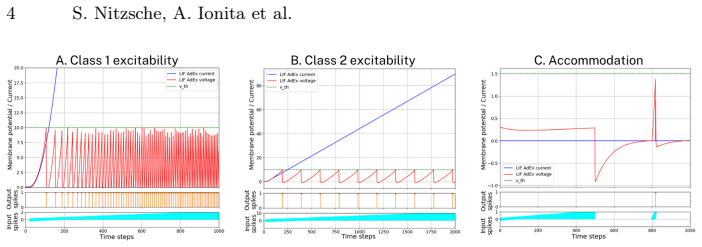
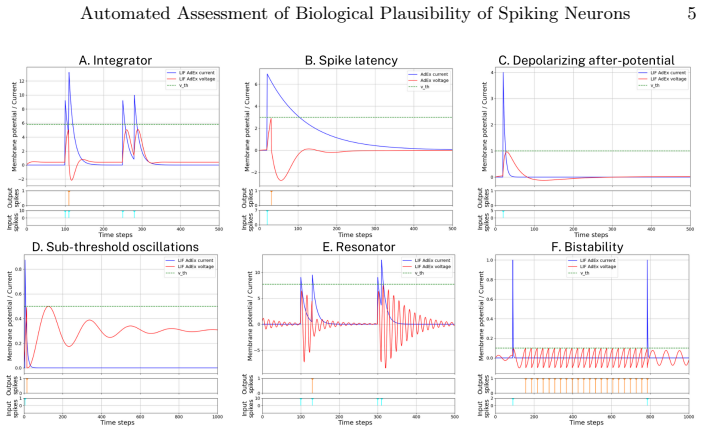
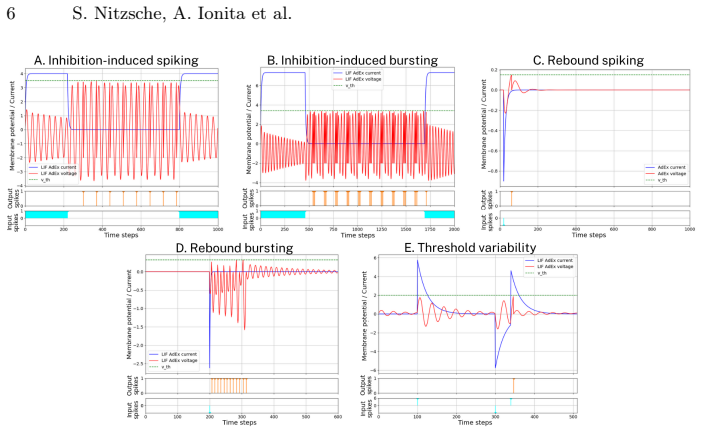
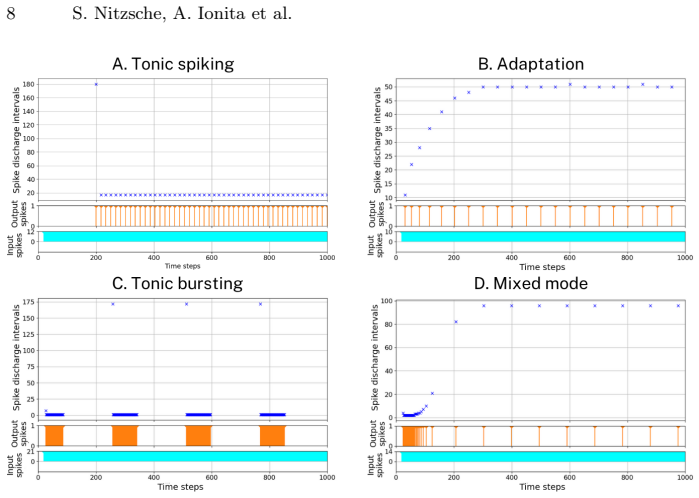
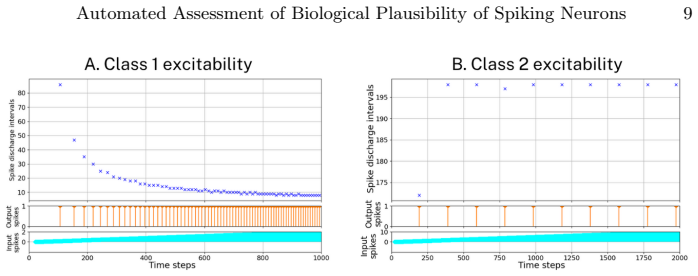
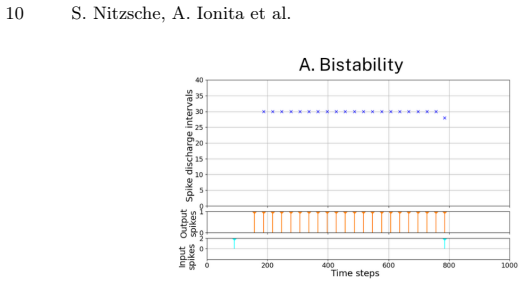
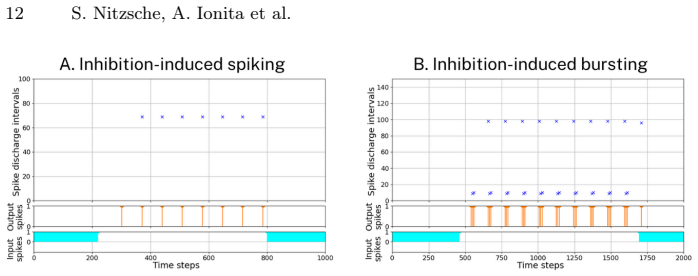
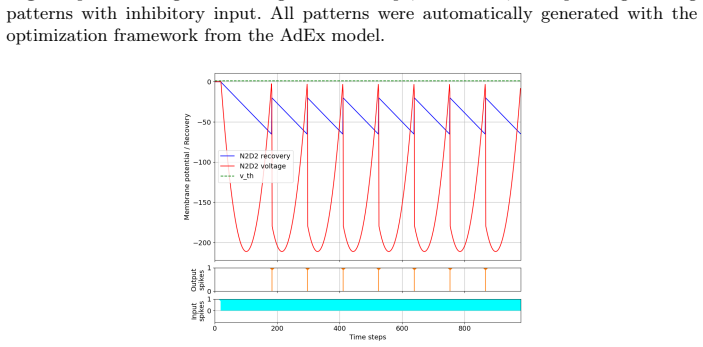
Biological plausibility is a key concept in neuromorphic computing and spiking neural networks, yet it remains inconsistently defined and difficult to quantify. In this work, we present an open-source framework for the automated assessment of biological plausibility in spiking neuron models. Our method builds on the idea of evaluating a model's ability to replicate canonical neuronal firing patterns observed in biological systems, following the classification proposed by Izhikevich. By encoding these patterns into objective functions and optimizing model parameters accordingly, our framework enables empirical assessment without requiring prior analytical modeling. Treating neuron models as black boxes, it provides a practical and flexible means of characterizing their dynamic capabilities. We demonstrate the effectiveness of the framework on several established models and a previously unexplored custom model. Implemented in Python and compatible with PyTorch and the Norse library, the framework is tailored for machine learning contexts. It is intended as a starting point for systematic research into the relationship between biological plausibility and network-level performance metrics such as accuracy, energy efficiency, robustness, and adaptability.
Editorial analysis
A structured set of objections, weighed in public.
Referee Report
Summary. The paper introduces an open-source Python framework that treats spiking neuron models as black boxes and uses parameter optimization to fit them to Izhikevich's canonical firing patterns, with the goal of providing an empirical, automated assessment of biological plausibility without analytical modeling. It encodes the patterns as objective functions, demonstrates the approach on established models plus a custom one, and positions the tool for use in machine-learning contexts with PyTorch and Norse.
Significance. If the optimization results could be shown to align with independent biological constraints or network-level metrics, the framework might supply a reproducible starting point for comparing neuron models in neuromorphic computing; the black-box treatment and open-source implementation are practical strengths.
major comments (1)
- [Abstract] Abstract: the central claim that successful optimization to Izhikevich patterns constitutes an assessment of 'biological plausibility' is not supported by the described method. The framework performs unconstrained optimization over model parameters with no restriction to biologically observed ranges (e.g., conductances, time constants) or post-hoc validation of parameter interpretability; this means low objective values only demonstrate dynamical expressivity, not plausibility, directly undermining the title and the stated purpose.
minor comments (2)
- [Abstract] Abstract: the statement that the framework was 'demonstrated on several established models and a previously unexplored custom model' supplies no quantitative results, error metrics, convergence statistics, or comparison tables, leaving the effectiveness claim unevaluated.
- The manuscript does not specify how the objective functions are constructed for each of the Izhikevich patterns or which optimization algorithm and hyperparameters are used, which would be required for reproducibility.
Simulated Author's Rebuttal
We thank the referee for the detailed review and constructive feedback on our manuscript. We address the major comment below and will make corresponding revisions to clarify the scope and limitations of the proposed framework.
read point-by-point responses
-
Referee: [Abstract] Abstract: the central claim that successful optimization to Izhikevich patterns constitutes an assessment of 'biological plausibility' is not supported by the described method. The framework performs unconstrained optimization over model parameters with no restriction to biologically observed ranges (e.g., conductances, time constants) or post-hoc validation of parameter interpretability; this means low objective values only demonstrate dynamical expressivity, not plausibility, directly undermining the title and the stated purpose.
Authors: We agree that the current wording in the abstract and title overstates the direct link to biological plausibility. The optimization procedure, as implemented, is unconstrained and evaluates the ability of models to reproduce the target firing patterns through parameter tuning; this indeed demonstrates dynamical expressivity rather than full biological plausibility, which would additionally require parameter values to lie within experimentally observed ranges and post-hoc interpretability checks. We will revise the abstract, introduction, and discussion to explicitly state that the framework offers an automated, empirical assessment of a model's capacity to exhibit Izhikevich canonical patterns as a necessary (but not sufficient) component of plausibility evaluation. The title will be adjusted to "An Optimization Framework for Automated Assessment of Dynamical Expressivity in Spiking Neuron Models" or similar to better reflect the method. These changes will also emphasize the framework's role as a reproducible starting point for subsequent biological validation. revision: yes
Circularity Check
No circularity; framework applies external Izhikevich classification via standard optimization
full rationale
The paper introduces an optimization framework that encodes Izhikevich's externally published canonical firing patterns into objective functions and tunes black-box neuron parameters to match them. This is a new methodological tool rather than a derivation whose central result reduces to its own inputs. No self-citations are load-bearing, no fitted parameters are relabeled as independent predictions, and the method does not define plausibility in terms of the optimization outcome by construction. The approach is self-contained against the cited external classification and standard numerical optimization techniques.
Axiom & Free-Parameter Ledger
axioms (1)
- domain assumption Izhikevich classification of neuronal firing patterns serves as a canonical reference for biological behavior
Reference graph
Works this paper leans on
-
[1]
In: Proceedings of the 25th ACM SIGKDD International Conference on Knowledge Discovery and Data Min- ing (2019)
Akiba, T., Sano, S., Yanase, T., Ohta, T., Koyama, M.: Optuna: A next- generation hyperparameter optimization framework. In: Proceedings of the 25th ACM SIGKDD International Conference on Knowledge Discovery and Data Min- ing (2019)
2019
-
[2]
Almog, M., Korngreen, A.: Is realistic neuronal modeling realistic? Journal of neu- rophysiology116(5), 2180–2209 (2016)
2016
-
[3]
In: Proceedings of the 7th annual neuro- inspired computational elements workshop
Blouw, P., Choo, X., Hunsberger, E., Eliasmith, C.: Benchmarking keyword spot- ting efficiency on neuromorphic hardware. In: Proceedings of the 7th annual neuro- inspired computational elements workshop. pp. 1–8 (2019) 16 S. Nitzsche, A. Ionita et al
2019
-
[4]
IEEE Transactions on Emerging Topics in Computational Intelligence7(3), 731–741 (2022)
Dampfhoffer, M., Mesquida, T., Valentian, A., Anghel, L.: Are snns really more energy-efficient than anns? an in-depth hardware-aware study. IEEE Transactions on Emerging Topics in Computational Intelligence7(3), 731–741 (2022)
2022
-
[5]
arXiv preprint arXiv:2401.00369 (2023)
De Florio, M., Kahana, A., Karniadakis, G.E.: Analysis of biologically plausi- ble neuron models for regression with spiking neural networks. arXiv preprint arXiv:2401.00369 (2023)
-
[6]
Frontiers in neuroscience1, 56 (2007)
Druckmann, S., Banitt, Y., Gidon, A.A., Schürmann, F., Markram, H., Segev, I.: A novel multiple objective optimization framework for constraining conductance- based neuron models by experimental data. Frontiers in neuroscience1, 56 (2007)
2007
-
[7]
Com- munications Engineering3(1), 22 (2024)
Ganguly, C., Bezugam, S.S., Abs, E., Payvand, M., Dey, S., Suri, M.: Spike fre- quency adaptation: bridging neural models and neuromorphic applications. Com- munications Engineering3(1), 22 (2024)
2024
-
[8]
Cambridge University Press (2014)
Gerstner, W., Kistler, W.M., Naud, R., Paninski, L.: Neuronal dynamics: From single neurons to networks and models of cognition. Cambridge University Press (2014)
2014
-
[9]
Gerstner, W., Naud, R.: How good are neuron models? Science326(5951), 379–380 (2009)
2009
-
[10]
IEEE transactions on evolutionary computation6(6), 580–593 (2002)
Han, K.H., Kim, J.H.: Quantum-inspired evolutionary algorithm for a class of combinatorial optimization. IEEE transactions on evolutionary computation6(6), 580–593 (2002)
2002
- [11]
-
[12]
Biological cybernetics99, 417– 426 (2008)
Jolivet, R., Schürmann, F., Berger, T.K., Naud, R., Gerstner, W., Roth, A.: The quantitative single-neuron modeling competition. Biological cybernetics99, 417– 426 (2008)
2008
-
[13]
Philosophical Transactions of the Royal Society B376(1815), 20190632 (2021)
Love, B.C.: Levels of biological plausibility. Philosophical Transactions of the Royal Society B376(1815), 20190632 (2021)
2021
-
[14]
the case of the cerebellar granule cell
Marín, M., Sáez-Lara, M.J., Ros, E., Garrido, J.A.: Optimization of efficient neu- ron models with realistic firing dynamics. the case of the cerebellar granule cell. Frontiers in Cellular Neuroscience14, 161 (2020)
2020
-
[15]
Nature communications 9(1), 4812 (2018)
McClean, J.R., Boixo, S., Smelyanskiy, V.N., Babbush, R., Neven, H.: Barren plateaus in quantum neural network training landscapes. Nature communications 9(1), 4812 (2018)
2018
-
[16]
arXiv preprint arXiv:2402.01373 (2024)
Nomura, M., Shibata, M.: cmaes: A simple yet practical python library for cma-es. arXiv preprint arXiv:2402.01373 (2024)
-
[17]
Norse: A deep learning library for spiking neural networks,
Pehle, C., Pedersen, J.E.: Norse - A deep learning library for spiking neural networks (Jan 2021).https://doi.org/10.5281/zenodo.4422025,https://doi. org/10.5281/zenodo.4422025, documentation: https://norse.ai/docs/
-
[18]
Nature Reviews Neuroscience22(8), 488–502 (2021)
Pulvermüller, F., Tomasello, R., Henningsen-Schomers, M.R., Wennekers, T.: Bio- logical constraints on neural network models of cognitive function. Nature Reviews Neuroscience22(8), 488–502 (2021)
2021
-
[19]
Fron- tiers in Computational Neuroscience17, 1215824 (2023)
Sanaullah, Koravuna, S., Rückert, U., Jungeblut, T.: Exploring spiking neural net- works: a comprehensive analysis of mathematical models and applications. Fron- tiers in Computational Neuroscience17, 1215824 (2023)
2023
-
[20]
The Jour- nal of Chemical Physics159(4) (2023)
Singh, H., Majumder, S., Mishra, S.: Benchmarking of different optimizers in the variational quantum algorithms for applications in quantum chemistry. The Jour- nal of Chemical Physics159(4) (2023)
2023
-
[21]
Frontiers in Artificial Intelligence6, 1240653 (2023) Automated Assessment of Biological Plausibility of Spiking Neurons 17
Stiefel, K.M., Coggan, J.S.: The energy challenges of artificial superintelligence. Frontiers in Artificial Intelligence6, 1240653 (2023) Automated Assessment of Biological Plausibility of Spiking Neurons 17
2023
-
[22]
npj Unconventional Computing1(1), 2 (2024)
Stoffel, M., Tandale, S.B.: Spiking neural networks for nonlinear regression of com- plex transient signals on sustainable neuromorphic processors. npj Unconventional Computing1(1), 2 (2024)
2024
-
[23]
Zhang, G.: Quantum-inspired evolutionary algorithms: a survey and empirical study. Journal of Heuristics17(3), 303–351 (2011) Supplementary Firing pattern 1/τmem 1/τsyn vleak vth vreset tonic spiking 60 836 0 18 0 class 1 excitability 100 100 0 18 0 integrator 200 200 0 3 0 T able 1.LIF neuron parameters Firing pattern 1/τmem 1/τsyn 1/τada vleak vth vrese...
2011
discussion (0)
Sign in with ORCID, Apple, or X to comment. Anyone can read and Pith papers without signing in.