Experimental Characterization and Modeling of Measurement-Induced State-Transitions in a Fluxonium Superconducting Qubit
Pith reviewed 2026-06-27 00:46 UTC · model grok-4.3
The pith
Numerical model of measurement-induced state transitions in fluxonium qubits accurately predicts eleven regions of increased error across the full flux range by accounting for superinductor array modes.
A machine-rendered reading of the paper's core claim, the machinery that carries it, and where it could break.
Core claim
The numerical calculation of measurement-induced state-transition rates, when it incorporates both transitions to higher fluxonium levels and transitions that involve the transmission-line-like array modes of the superinductor, accurately locates all eleven experimentally observed regions of elevated MIST error over the full external flux range.
What carries the argument
Numerical model of MIST rates that sums transition probabilities to higher fluxonium levels and to superinductor array modes under the applied readout drive.
If this is right
- Readout drive strength can be increased at flux values outside the eleven regions without incurring extra state-transition errors.
- Fluxonium designs must treat the superinductor as a multimode transmission line rather than a single inductor when predicting readout errors.
- Avoiding the identified flux points during operation reduces the dominant source of non-QND errors in these qubits.
- The same modeling approach can be used to screen new fluxonium parameters before fabrication.
Where Pith is reading between the lines
- The result suggests that array-mode engineering could become a new design knob for lowering MIST in fluxonium devices.
- If the model generalizes, similar array-mode contributions may appear in other superinductor-based qubits such as the 0-pi qubit.
- Routine mapping of MIST versus flux could be added to qubit calibration routines to select optimal operating points.
Load-bearing premise
The numerical model includes every physical mechanism that can produce the observed MIST errors and the experimental scan has not been distorted by unmodeled noise or artifacts.
What would settle it
A measurement at one of the eleven predicted flux points that finds the MIST error rate remains low instead of rising as the model forecasts.
Figures


read the original abstract
Superconducting qubits are most often measured using dispersive readout, which, ideally, implements a projective quantum non-demolition (QND) measurement. While a larger readout drive can increase the signal and, thus, reduce discrimination errors in the readout, strong microwave drives may also cause non-QND errors by driving the qubit to a state outside the computational subspace. In this work, we experimentally characterize measurement-induced state transitions (MIST) in a fluxonium qubit over its full external flux range. We further numerically calculate the MIST errors, and find that the theory accurately predicts eleven experimentally identified regions with increased MIST. In addition to transitions to higher fluxonium levels, we also find that, at certain flux points, MIST errors are dominated by transitions that include the transmission-line-like array modes of the fluxonium's superinductor. The excellent match between theory and experiment validates that the models accurately predict the occurrence of MIST in these systems, and further highlights the influence of array modes in fluxonium readout.
Editorial analysis
A structured set of objections, weighed in public.
Referee Report
Summary. The manuscript experimentally characterizes measurement-induced state transitions (MIST) in a fluxonium superconducting qubit over its full external flux range. The authors identify eleven regions of increased MIST and compare them to numerical calculations from a model that includes transitions to higher fluxonium levels as well as transmission-line-like array modes of the superinductor. They report an excellent match between the predicted and observed regions, with array modes dominating the errors at certain flux points, and conclude that the models accurately predict MIST occurrence.
Significance. If the central claim holds, the work provides direct experimental validation of a numerical model for predicting non-QND errors during dispersive readout of fluxonium qubits. The explicit demonstration that array modes of the superinductor contribute significantly at specific flux points supplies a concrete design consideration for improving readout fidelity. The parameter-independent comparison between theory and experiment (no free parameters fitted to the MIST data) is a notable strength.
minor comments (2)
- The criteria used to identify the eleven regions of increased MIST (e.g., threshold on error rate, flux binning, or statistical significance) should be stated explicitly, ideally with a supplementary table or figure showing the raw error rates versus flux.
- Figure captions and axis labels should include the precise definition of the plotted quantity (e.g., whether the MIST probability is normalized to the computational subspace or includes leakage to array modes).
Simulated Author's Rebuttal
We thank the referee for the positive summary and significance assessment of our work. The recommendation for minor revision is noted. No specific major comments were provided in the report.
Circularity Check
No significant circularity: independent numerical model validated against experiment
full rationale
The paper's central claim is an experimental identification of eleven MIST regions across flux, followed by a separate numerical calculation of the same quantity using the fluxonium Hamiltonian (including superinductor array modes) that is reported to match the data. No equations or text indicate that model parameters were fitted to the MIST dataset itself, that a prediction is redefined from the same observations, or that a uniqueness result or ansatz is imported via self-citation to force the outcome. The comparison is presented as validation of an a-priori model rather than a closed loop, making the derivation self-contained against external benchmarks.
Axiom & Free-Parameter Ledger
Reference graph
Works this paper leans on
-
[1]
Blais, R.-S
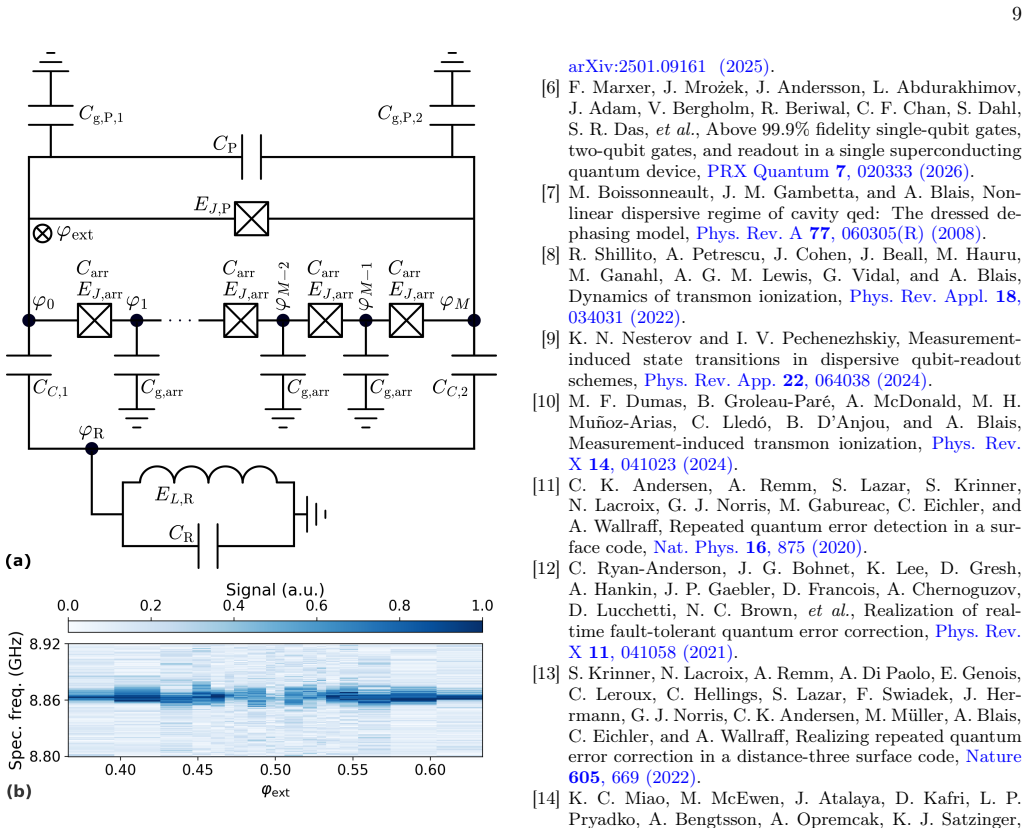
A. Blais, R.-S. Huang, A. Wallraff, S. M. Girvin, and R. J. Schoelkopf, Cavity quantum electrodynamics for superconducting electrical circuits: An architecture for 9 FIG. 6. (a) Circuit diagram of a floating fluxonium with the individual Josephson junctions that make-up the array, and with the capacitively coupled readout resonator. (b) Two- tone spectros...
2004
-
[2]
Blais, A
A. Blais, A. L. Grimsmo, S. M. Girvin, and A. Wallraff, Circuit quantum electrodynamics, Rev. Mod. Phys.93, 025005 (2021)
2021
-
[3]
Swiadek, R
F. Swiadek, R. Shillito, P. Magnard, A. Remm, C. Hellings, N. Lacroix, Q. Ficheux, D. C. Zanuz, G. J. Norris, A. Blais, S. Krinner, and A. Wallraff, Enhanc- ing dispersive readout of superconducting qubits through dynamic control of the dispersive shift: Experiment and theory, PRX Quantum5, 040326 (2024)
2024
-
[4]
P. A. Spring, L. Milanovic, Y. Sunada, S. Wang, A. F. Van Loo, S. Tamate, and Y. Nakamura, Fast multiplexed superconducting-qubit readout with intrinsic purcell fil- tering using a multiconductor transmission line, PRX Quantum6, 020345 (2025)
2025
-
[5]
P. D. Kurilovich, T. Connolly, C. G. L. Bøttcher, D. K. Weiss, S. Hazra, V. R. Joshi, A. Z. Ding, H. Nho, S. Di- amond, V. D. Kurilovich, W. Dai, V. Fatemi, L. Frun- zio, L. I. Glazman, and M. H. Devoret, High-frequency readout free from transmon multi-excitation resonances, arXiv:2501.09161 (2025)
-
[6]
Marxer, J
F. Marxer, J. Mrożek, J. Andersson, L. Abdurakhimov, J. Adam, V. Bergholm, R. Beriwal, C. F. Chan, S. Dahl, S. R. Das,et al., Above 99.9% fidelity single-qubit gates, two-qubit gates, and readout in a single superconducting quantum device, PRX Quantum7, 020333 (2026)
2026
-
[7]
Boissonneault, J
M. Boissonneault, J. M. Gambetta, and A. Blais, Non- linear dispersive regime of cavity qed: The dressed de- phasing model, Phys. Rev. A77, 060305(R) (2008)
2008
-
[8]
Shillito, A
R. Shillito, A. Petrescu, J. Cohen, J. Beall, M. Hauru, M. Ganahl, A. G. M. Lewis, G. Vidal, and A. Blais, Dynamics of transmon ionization, Phys. Rev. Appl.18, 034031 (2022)
2022
-
[9]
K. N. Nesterov and I. V. Pechenezhskiy, Measurement- induced state transitions in dispersive qubit-readout schemes, Phys. Rev. App.22, 064038 (2024)
2024
-
[10]
M. F. Dumas, B. Groleau-Paré, A. McDonald, M. H. Muñoz-Arias, C. Lledó, B. D’Anjou, and A. Blais, Measurement-induced transmon ionization, Phys. Rev. X14, 041023 (2024)
2024
-
[11]
C. K. Andersen, A. Remm, S. Lazar, S. Krinner, N. Lacroix, G. J. Norris, M. Gabureac, C. Eichler, and A. Wallraff, Repeated quantum error detection in a sur- face code, Nat. Phys.16, 875 (2020)
2020
-
[12]
Ryan-Anderson, J
C. Ryan-Anderson, J. G. Bohnet, K. Lee, D. Gresh, A. Hankin, J. P. Gaebler, D. Francois, A. Chernoguzov, D. Lucchetti, N. C. Brown,et al., Realization of real- time fault-tolerant quantum error correction, Phys. Rev. X11, 041058 (2021)
2021
-
[13]
Leroux, C
S.Krinner, N.Lacroix, A.Remm, A.DiPaolo, E.Genois, C. Leroux, C. Hellings, S. Lazar, F. Swiadek, J. Her- rmann, G.J.Norris, C.K.Andersen, M.Müller, A.Blais, C. Eichler, and A. Wallraff, Realizing repeated quantum error correction in a distance-three surface code, Nature 605, 669 (2022)
2022
-
[14]
K. C. Miao, M. McEwen, J. Atalaya, D. Kafri, L. P. Pryadko, A. Bengtsson, A. Opremcak, K. J. Satzinger, Z. Chen, P. V. Klimov,et al., Overcoming leakage in quantum error correction, Nat. Phys.19, 1780 (2023)
2023
-
[15]
Google Quantum AI and Collaborators, Quantum error correction below the surface code threshold, Nature638, 920 (2025)
2025
-
[16]
Bluvstein, A
D. Bluvstein, A. A. Geim, S. H. Li, S. J. Evered, J. P. Bonilla Ataides, G. Baranes, A. Gu, T. Manovitz, M. Xu, M. Kalinowski,et al., A fault-tolerant neutral-atom ar- chitecture for universal quantum computation, Nature 649, 39 (2026)
2026
-
[17]
D. Sank, Z. Chen, M. Khezri, J. Kelly, R. Barends, B. Campbell, Y. Chen, B. Chiaro, A. Dunsworth, A. Fowler,et al., Measurement-induced state transitions in a superconducting qubit: Beyond the rotating wave approximation, Phys. Rev. Lett.117, 190503 (2016)
2016
-
[18]
Khezri, A
M. Khezri, A. Opremcak, Z. Chen, K. C. Miao, M. McEwen, A. Bengtsson, T. White, O. Naaman, D. Sank, A. N. Korotkov, Y. Chen, and V. Smelyan- skiy, Measurement-induced state transitions in a super- conducting qubit: Within the rotating-wave approxima- tion, Phys. Rev. App.20, 054008 (2023)
2023
-
[19]
Féchant, M
M. Féchant, M. F. Dumas, D. Bénâtre, N. Gosling, P. Lenhard, M. Spiecker, S. Geisert, S. Ihssen, W. Werns- dorfer, B. D’Anjou, A. Blais, and I. M. Pop, Offset charge dependence of measurement-induced transitions in trans- mons, Phys. Rev. Lett.135, 180603 (2025). 10
2025
-
[20]
Thorbeck, Z
T. Thorbeck, Z. Xiao, A. Kamal, and L. C. G. Govia, Readout-induced suppression and enhancement of super- conducting qubit lifetimes, Phys. Rev. Lett.132, 090602 (2024)
2024
-
[21]
Hazra, W
S. Hazra, W. Dai, T. Connolly, P. D. Kurilovich, Z. Wang, L. Frunzio, and M. H. Devoret, Benchmark- ing the readout of a superconducting qubit for repeated measurements, Phys. Rev. Lett.134, 100601 (2025)
2025
-
[22]
T. Connolly, P. D. Kurilovich, V. D. Kurilovich, C. G. L. Bøttcher, S. Hazra, W. Dai, A. Z. Ding, V. R. Joshi, H. Nho, S. Diamond, D. K. Weiss, V. Fatemi, L. Frunzio, L. I. Glazman, and M. H. Devoret, Full characterization of measurement-induced transitions of a superconducting qubit, arXiv:2506.05306 (2025)
-
[23]
N. Zobrist, J. M. Kreikebaum, M. Khezri, S. V. Isakov, B. J. Lester, Y. Zhang, A. Di Paolo, D. Sank, and W. C. Smith, Measurement-induced state transitions in inductively-shunted transmons, arXiv:2603.12114 (2026)
-
[24]
Z. Wang, B. D’Anjou, P. Gigon, A. Blais, and M. S. Blok, Probing excited-state dynamics of transmon ionization, arXiv:2505.00639 (2026)
work page internal anchor Pith review Pith/arXiv arXiv 2026
-
[25]
Y. Li, W. Nuerbolati, C. Deng, X. Ma, H. Xiong, and H. Yu, Mitigating state-transition errors during readout with a synchronized flux pulse, Phys. Rev. Appl.25, 054045 (2026)
2026
-
[26]
Singh, G
S. Singh, G. Refael, A. Clerk, and E. Rosenfeld, Impact of josephson-junction array modes on fluxonium readout, PRX Quantum6, 040304 (2025)
2025
-
[27]
A. A. Chapple, B. M. Varbanov, A. McDonald, and A. Blais, Measurement-induced state transitions across the fluxonium qubit landscape, arXiv:2604.08515 (2026)
work page internal anchor Pith review Pith/arXiv arXiv 2026
-
[28]
Bothara, S
G. Bothara, S. Das, K. V. Salunkhe, M. Chand, J. Desh- mukh, M. P. Patankar, and R. Vijay, High-fidelity qnd readout and measurement back-action in a tantalum- based high-coherence fluxonium qubit, APL Quantum2, 026103 (2025)
2025
-
[29]
J. Koch, T. M. Yu, J. Gambetta, A. A. Houck, D. I. Schuster, J. Majer, A. Blais, M. H. Devoret, S. M. Girvin, and R. J. Schoelkopf, Charge-insensitive qubit design de- rived from the cooper pair box, Phys. Rev. A76, 042319 (2007)
2007
-
[30]
V. E. Manucharyan, J. Koch, L. I. Glazman, and M. H. Devoret, Fluxonium: Single cooper-pair circuit free of charge offsets, Science326, 113 (2009)
2009
-
[31]
Somoroff, Q
A. Somoroff, Q. Ficheux, R. A. Mencia, H. Xiong, R. Kuzmin, and V. E. Manucharyan, Millisecond coher- ence in a superconducting qubit, Phys. Rev. Lett.130, 267001 (2023)
2023
-
[32]
T. Wang, F. Wu, F. Wang, X. Ma, G. Zhang, J. Chen, H. Deng, R. Gao, R. Hu, L. Ma,et al., Efficient initializa- tion of fluxonium qubits based on auxiliary energy levels, Phys. Rev. Lett.132, 230601 (2024)
2024
-
[33]
D. A. Rower, L. Ding, H. Zhang, M. Hays, J. An, P. M. Harrington, I. T. Rosen, J. M. Gertler, T. M. Hazard, B. M. Niedzielski,et al., Suppressing counter-rotating errors for fast single-qubit gates with fluxonium, PRX Quantum5, 040342 (2024)
2024
-
[34]
L. Ding, M. Hays, Y. Sung, B. Kannan, J. An, A. Di Paolo, A. H. Karamlou, T. M. Hazard, K. Azar, D. K. Kim,et al., High-fidelity, frequency-flexible two- qubit fluxonium gates with a transmon coupler, Phys. Rev. X13, 031035 (2023)
2023
-
[35]
Bista, M
A. Bista, M. Thibodeau, K. Nie, K. Chow, B. K. Clark, and A. Kou, Readout-induced leakage of the fluxonium qubit, Phys. Rev. Appl.25, 034058 (2026)
2026
-
[36]
C. W. Gardiner and M. J. Collett, Input and output in damped quantum systems: Quantum stochastic differen- tial equations and the master equation, Phys. Rev. A31, 3761 (1985)
1985
-
[37]
Salathé, P
Y. Salathé, P. Kurpiers, T. Karg, C. Lang, C. K. An- dersen, A. Akin, S. Krinner, C. Eichler, and A. Wallraff, Low-latency digital signal processing for feedback and feedforward in quantum computing and communication, Phys. Rev. Appl.9, 034011 (2018)
2018
-
[38]
M. A. Rol, F. Battistel, F. K. Malinowski, C. C. Bultink, B. M. Tarasinski, R. Vollmer, N. Haider, N. Muthusub- ramanian, A. Bruno, B. M. Terhal, and L. DiCarlo, Fast, high-fidelity conditional-phase gate exploiting leakage in- terference in weakly anharmonic superconducting qubits, Phys. Rev. Lett.123, 120502 (2019)
2019
-
[39]
C. C. Bultink, B. Tarasinski, N. Haandbæk, S. Poletto, N. Haider, D. J. Michalak, A. Bruno, and L. DiCarlo, General method for extracting the quantum efficiency of dispersive qubit readout in circuit qed, Appl. Phys. Lett. 112, 092601 (2018)
2018
-
[40]
Heinsoo, C
J. Heinsoo, C. K. Andersen, A. Remm, S. Krinner, T. Walter, Y. Salathé, S. Gasparinetti, J.-C. Besse, A. Potočnik, A. Wallraff, and C. Eichler, Rapid high- fidelity multiplexed readout of superconducting qubits, Phys. Rev. Appl.10, 034040 (2018)
2018
-
[41]
T. V. Stefanski and C. K. Andersen, Flux-pulse-assisted readout of a fluxonium qubit, Phys. Rev. Appl.22, 014079 (2024)
2024
- [42]
-
[43]
Cohen, A
J. Cohen, A. Petrescu, R. Shillito, and A. Blais, Reminis- cence of classical chaos in driven transmons, PRX Quan- tum4, 020312 (2023)
2023
-
[44]
Lanczos, An iteration method for the solution of the eigenvalue problem of linear differential and integral op- erators, J
C. Lanczos, An iteration method for the solution of the eigenvalue problem of linear differential and integral op- erators, J. Res. Nat. Bur. Stand.45, 255 (1950)
1950
-
[45]
S.Gonzaléz-García, A.Szasz, A.Pagano, D.Kafri, G.Vi- dal, and A. Di Paolo, Multi-target density matrix renor- malization group X algorithm and its application to cir- cuit quantum electrodynamics, arXiv:2506.24109 (2025)
- [46]
-
[47]
M. A. Rol, L. Ciorciaro, F. K. Malinowski, B. M. Tarasin- ski, R. E. Sagastizabal, C. C. Bultink, Y. Salathe, N. Haandbæk, J. Sedivy, and L. DiCarlo, Time-domain characterization and correction of on-chip distortion of control pulses in a quantum processor, Appl. Phys. Lett. 116, 054001 (2020)
2020
-
[48]
Hellings, N
C. Hellings, N. Lacroix, A. Remm, R. Boell, J. Her- rmann, S. Lazăr, S. Krinner, F. Swiadek, C. K. Ander- sen, C. Eichler, and A. Wallraff, Calibrating magnetic flux control in superconducting circuits by compensating distortions on timescales from nanoseconds up to tens of microseconds, Phys. Rev. Res.7, 043142 (2025)
2025
-
[49]
Delft High Performance Computing Center (DHPC), DelftBlue Supercomputer (Phase 2) (2024)
2024
-
[50]
Data repository, http://doi.org/10.4121/22122209-2f78- 4a66-8d04-fe18ac8b244e. 11
-
[51]
GitHub repository, https://github.com/ andersenqubitlab/fluxonium-mist
-
[52]
Yilmaz, S
F. Yilmaz, S. Singh, M. F. S. Zwanenburg, J. Hu, T. V. Stefanski, and C. K. Andersen, Energy-participation- ratio analysis for very anharmonic superconducting cir- cuits, Phys. Rev. Appl.25, 044021 (2026)
2026
-
[53]
Deppe, S
F. Deppe, S. Saito, H. Tanaka, and H. Takayanagi, Deter- mination of the capacitance of nm scale josephson junc- tions, J. Appl. Phys95, 2607–2613 (2004)
2004
discussion (0)
Sign in with ORCID, Apple, or X to comment. Anyone can read and Pith papers without signing in.