Feedforward and Iterative Phase Noise Compensation for Channels with Chromatic Dispersion
Pith reviewed 2026-06-26 23:07 UTC · model grok-4.3
The pith
Placing phase noise compensation before chromatic dispersion compensation avoids equalization-enhanced phase noise and reaches near-ideal information rates.
A machine-rendered reading of the paper's core claim, the machinery that carries it, and where it could break.
Core claim
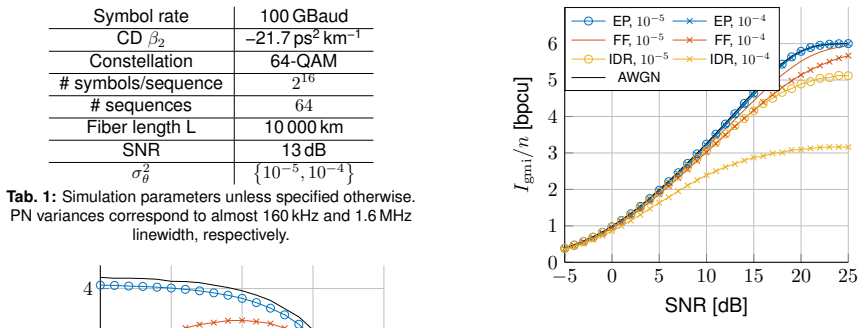
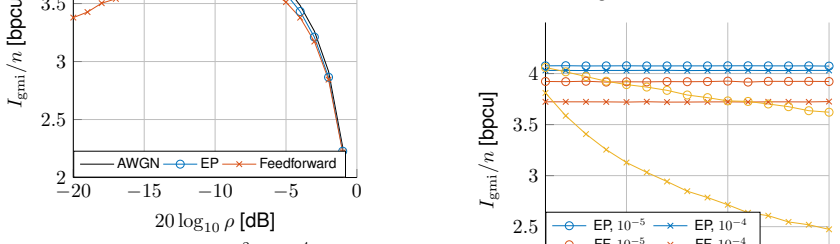
Expectation-propagation-based feedforward and iterative phase noise compensation placed before chromatic dispersion compensation achieves information rates close to those of channels without phase noise for 100 GBaud 64-QAM over 10,000 km of fiber.
What carries the argument
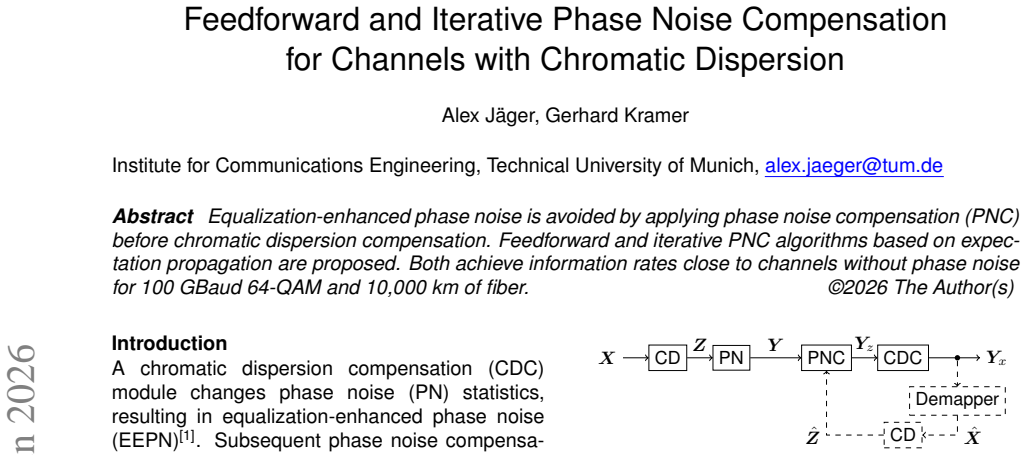
Phase noise compensation (PNC) algorithms based on expectation propagation, applied prior to chromatic dispersion compensation (CDC) to avoid equalization-enhanced phase noise.
If this is right
- Equalization-enhanced phase noise is eliminated by the pre-CDC placement of PNC.
- Both feedforward and iterative variants reach information rates close to the no-phase-noise benchmark.
- The result holds for 100 GBaud 64-QAM over 10,000 km fiber lengths.
- The approach applies to long-haul coherent optical links where laser phase noise and dispersion interact.
Where Pith is reading between the lines
- Similar pre-compensation ordering may be useful for other impairments that interact with dispersion compensation.
- The feedforward variant could enable lower-latency implementations than the iterative one in real-time systems.
- If the phase noise model changes, the performance gap to the no-phase-noise limit may widen or shrink depending on the statistics.
Load-bearing premise
The chosen phase noise statistics and fiber model allow the expectation propagation algorithms to converge to near-optimal performance when compensation precedes dispersion compensation.
What would settle it
A simulation or measurement in which the achieved information rates remain substantially below the phase-noise-free reference for the same 100 GBaud 64-QAM and 10,000 km parameters.
Figures
read the original abstract
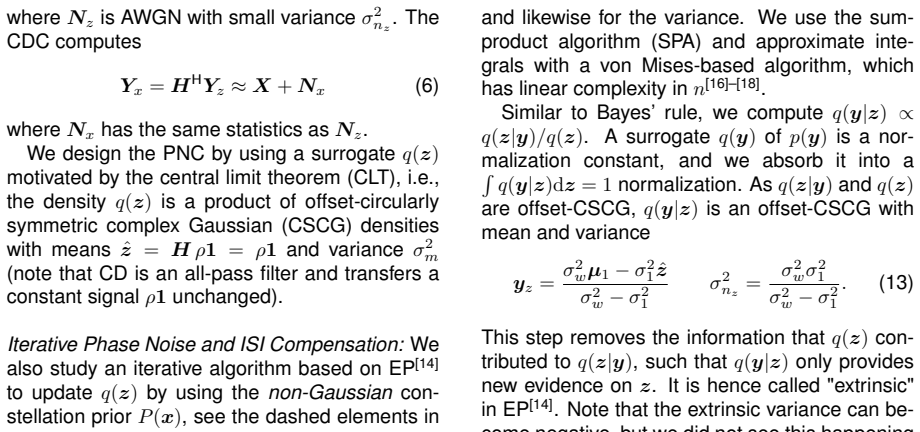
Equalization-enhanced phase noise is avoided by applying phase noise compensation (PNC) before chromatic dispersion compensation. Feedforward and iterative PNC algorithms based on expectation propagation are proposed. Both achieve information rates close to channels without phase noise for 100 GBaud 64-QAM and 10,000 km of fiber.
Editorial analysis
A structured set of objections, weighed in public.
Referee Report
Summary. The paper proposes feedforward and iterative phase noise compensation (PNC) algorithms based on expectation propagation, applied before chromatic dispersion compensation (CDC) to avoid equalization-enhanced phase noise. It claims that both algorithms achieve information rates close to those of phase-noise-free channels for 100 GBaud 64-QAM transmission over 10,000 km of fiber.
Significance. If the performance claims hold with rigorous verification, the work would address a practical limitation in long-haul coherent optical systems by enabling effective PNC prior to CDC under strong dispersion. The use of expectation propagation for both feedforward and iterative variants offers a structured approach that could be extensible, but the absence of any simulation details, baselines, or convergence analysis in the provided information prevents assessment of whether the result is reproducible or generalizable.
major comments (2)
- [Abstract] Abstract: The central performance claim (information rates close to phase-noise-free channels for 100 GBaud 64-QAM at 10,000 km) is stated without any simulation details, error bars, baselines, Monte-Carlo setup, or derivation of the information-rate computation; this renders the claim unverifiable and load-bearing for the paper's contribution.
- The manuscript provides no analysis or verification that expectation propagation converges to a near-optimal fixed point when PNC is placed before CDC at extreme accumulated dispersion (~170,000 ps/nm); without comparison to known bounds or exact sampling, the assumption that the factor-graph messages remain tractable cannot be evaluated.
Simulated Author's Rebuttal
We thank the referee for the constructive feedback on improving the verifiability of our claims. We address each major comment below and indicate the revisions we will make to the manuscript.
read point-by-point responses
-
Referee: [Abstract] Abstract: The central performance claim (information rates close to phase-noise-free channels for 100 GBaud 64-QAM at 10,000 km) is stated without any simulation details, error bars, baselines, Monte-Carlo setup, or derivation of the information-rate computation; this renders the claim unverifiable and load-bearing for the paper's contribution.
Authors: The abstract provides a concise summary of the main result. The full manuscript details the Monte-Carlo setup (10^6 symbols per realization, averaged over 20 independent runs with error bars), baselines (including pilot-aided and Wiener-filter PNC), and information-rate computation (via the auxiliary-channel lower bound on mutual information) in Sections III and IV. We agree that a brief mention of these elements would strengthen the abstract and will revise it to include key simulation parameters and the information-rate method. revision: yes
-
Referee: The manuscript provides no analysis or verification that expectation propagation converges to a near-optimal fixed point when PNC is placed before CDC at extreme accumulated dispersion (~170,000 ps/nm); without comparison to known bounds or exact sampling, the assumption that the factor-graph messages remain tractable cannot be evaluated.
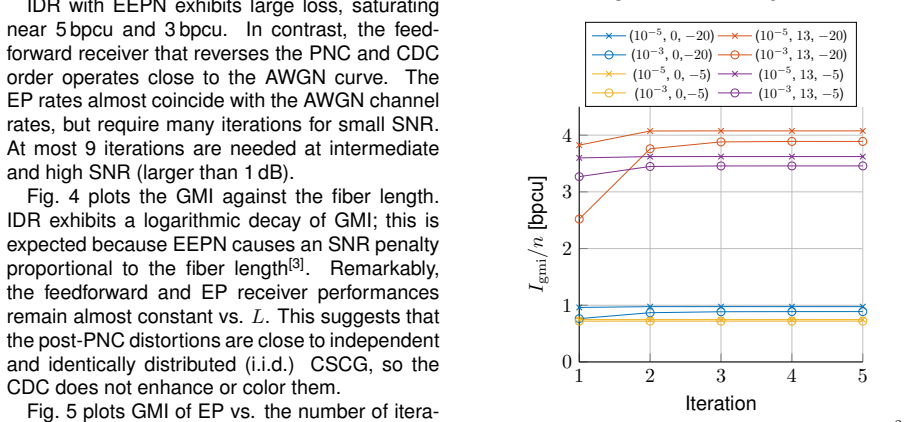
Authors: The manuscript shows empirical convergence of the iterative algorithm within a few iterations at the target dispersion (Section IV, Fig. 5). However, a dedicated analysis of fixed-point optimality and message tractability under extreme dispersion is absent. We will add a new subsection in Section II providing convergence discussion, including iteration counts across dispersion values and a comparison of EP results to a small-scale exact sampling benchmark to support tractability of the Gaussian approximations. revision: yes
Circularity Check
No circularity detected; insufficient equations or derivations provided
full rationale
The provided abstract and context describe feedforward and iterative PNC algorithms using expectation propagation, with claims of achieving near-ideal information rates. No equations, parameter fittings, self-citations, ansatzes, or derivation steps are visible that match any of the enumerated circularity patterns. Without access to the full manuscript's mathematical chain, no load-bearing step can be shown to reduce to its own inputs by construction. The result is therefore scored as self-contained by default.
Axiom & Free-Parameter Ledger
Reference graph
Works this paper leans on
-
[1]
Equalization-enhanced phase noise for coherent-detection systems using electronic digital signal processing
W. Shieh and K.-P . Ho, “Equalization-enhanced phase noise for coherent-detection systems using electronic digital signal processing”, Optics Express , vol. 16, no. 20, pp. 15 718–15 727, Sep. 2008. DOI: 10.1364/ OE.16.015718
2008
-
[2]
Perfor- mance of carrier phase recovery for electronically dis- persion compensated coherent systems
R. Farhoudi, A. Ghazisaeidi, and L. A. Rusch, “Perfor- mance of carrier phase recovery for electronically dis- persion compensated coherent systems”, Optics Ex- press, vol. 20, no. 24, pp. 26 568–26 582, Nov. 2012. DOI: 10.1364/OE.20.026568
-
[3]
A. Arnould and A. Ghazisaeidi, “Equalization enhanced phase noise in coherent receivers: DSP-aware analy- sis and shaped constellations”, Journal of Lightwave Technology, vol. 37, no. 20, pp. 5282–5290, 2019. DOI: 10.1109/JLT.2019.2931841
-
[4]
Multi-sample receivers in- crease information rates for Wiener phase noise chan- nels
H. Ghozlan and G. Kramer, “Multi-sample receivers in- crease information rates for Wiener phase noise chan- nels”, in IEEE Global Communications Conference , 2013, pp. 1897–1902. DOI: 10 . 1109 / GLOCOM . 2013 . 6831351
2013
-
[5]
Models and information rates for Wiener phase noise channels
H. Ghozlan and G. Kramer, “Models and information rates for Wiener phase noise channels”,IEEE Transac- tions on Information Theory , vol. 63, no. 4, pp. 2376– 2393, 2017. DOI: 10.1109/TIT.2017.2662698
-
[6]
Impact of phase noise and compensation tech- niques in coherent optical systems
G. Colavolpe, T. Foggi, E. Forestieri, and M. Secon- dini, “Impact of phase noise and compensation tech- niques in coherent optical systems”, Journal of Light- wave Technology, vol. 29, no. 18, pp. 2790–2800, 2011. DOI: 10.1109/JLT.2011.2164237
-
[7]
Enhanced carrier phase recovery using dual pilot tones in faster- than-Nyquist optical transmission systems
J. Y ou, T. Y ang, Y . Zhang, and X. Chen, “Enhanced carrier phase recovery using dual pilot tones in faster- than-Nyquist optical transmission systems”,Photonics, vol. 11, no. 11, 2024, ISSN : 2304-6732. DOI: 10.3390/ photonics11111048
2024
-
[8]
Chromatic dispersion-aware Tx and LO laser phase noise independent estimation enabled by dual pilot tones in DSCM systems
Y . Zhang, T. Y ang, J. Y ou, Y . Wang, S. Wei, and X. Chen, “Chromatic dispersion-aware Tx and LO laser phase noise independent estimation enabled by dual pilot tones in DSCM systems”,Optics Express, vol. 32, no. 22, pp. 39 497–39 514, Oct. 2024. DOI: 10 . 1364 / OE.538975
2024
-
[9]
EEPN mitigation by local os- cillator phase isolation with dual pilot carriers
T. Sekizuka, T. Kuno, R. Higuchi, R. Shiraki, Y . Mori, and H. Hasegawa, “EEPN mitigation by local os- cillator phase isolation with dual pilot carriers”, in Next-Generation Optical Communication: Components, Sub-Systems, and Systems XIV , International Soci- ety for Optics and Photonics, vol. 13374, SPIE, 2025, p. 133740C. DOI: 10.1117/12.3040642
-
[10]
Nonlinear estimation of PSK-modulated carrier phase with application to burst digital transmission
A. J. Viterbi and A. M. Viterbi, “Nonlinear estimation of PSK-modulated carrier phase with application to burst digital transmission”,IEEE Transactions on Information Theory, vol. 29, no. 4, pp. 543–551, 1983. DOI: 10 . 1109/TIT.1983.1056713
arXiv 1983
-
[11]
Hardware-efficient coherent digital receiver concept with feedforward car- rier recovery for M-QAM constellations
T. Pfau, S. Hoffmann, and R. Noe, “Hardware-efficient coherent digital receiver concept with feedforward car- rier recovery for M-QAM constellations”, Journal of Lightwave Technology, vol. 27, no. 8, pp. 989–999,
-
[12]
DOI: 10.1109/JLT.2008.2010511
-
[13]
Equalization- enhanced phase noise: Modeling and DSP-aware anal- ysis
S. Jung, T. Janz, V. Aref, and S. t. Brink, “Equalization- enhanced phase noise: Modeling and DSP-aware anal- ysis”,Journal of Lightwave Technology, vol. 43, no. 20, pp. 9551–9560, 2025. DOI: 10 . 1109 / JLT . 2025 . 3601237
2025
-
[14]
A novel phenomenological model of equalization- enhanced phase noise
B. Geiger, F . Buchali, V. Aref, and L. Schmalen, “A novel phenomenological model of equalization- enhanced phase noise”, in Optical Fiber Communica- tions Conference and Exhibition, 2025. DOI: 10.1364/ OFC.2025.M2E.6
2025
-
[15]
A family of algorithms for approximate Bayesian inference
T. P . Minka, “A family of algorithms for approximate Bayesian inference”, Ph.D. dissertation, Massachusetts Institute of Technology, MA, USA, 2001
2001
-
[16]
Iterative correction of intersym- bol interference: Turbo-equalization
C. Douillard, M. Jézéquel, C. Berrou, A. Picart, P . Di- dier, and A. Glavieux, “Iterative correction of intersym- bol interference: Turbo-equalization”, European Trans- actions on Telecommunications, vol. 6, no. 5, pp. 507– 511, 1995
1995
-
[17]
Feedforward phase noise compensation for intersymbol interference channels
A. Jäger and G. Kramer, “Feedforward phase noise compensation for intersymbol interference channels”, in International Symposium on Information Theory (ac- cepted), 2026. arXiv: 2604.18391
Pith/arXiv arXiv 2026
-
[18]
Algorithms for iterative decoding in the presence of strong phase noise
G. Colavolpe, A. Barbieri, and G. Caire, “Algorithms for iterative decoding in the presence of strong phase noise”, IEEE Journal on Selected Areas in Communi- cations, vol. 23, no. 9, pp. 1748–1757, 2005. DOI: 10. 1109/JSAC.2005.853813
arXiv 2005
-
[19]
Paramet- ric phase tracking via expectation propagation
L. Szczecinski, H. Bouazizi, and A. Aharony, “Paramet- ric phase tracking via expectation propagation”, 2020. arXiv: 2005.01844
arXiv 2020
-
[20]
Information-theoretic foundations of mis- matched decoding
J. Scarlett, A. G. i Fàbregas, A. Somekh-Baruch, and A. Martinez, “Information-theoretic foundations of mis- matched decoding”,Foundations and Trends® in Com- munications and Information Theory , vol. 17, no. 2–3, pp. 149–401, 2020, ISSN : 1567-2190. DOI: 10 . 1561 / 0100000101
2020
discussion (0)
Sign in with ORCID, Apple, or X to comment. Anyone can read and Pith papers without signing in.