Multigrid Preconditioning for FEEC using Mass-Lumping and Transforming Smoothers
Pith reviewed 2026-06-27 00:10 UTC · model grok-4.3
The pith
Mass-lumped FEEC operators are spectrally equivalent to the original consistent operators under mild assumptions, allowing multigrid cycles for the lumped systems to precondition the indefinite FEEC systems.
A machine-rendered reading of the paper's core claim, the machinery that carries it, and where it could break.
Core claim
Under mild h-uniform norm-equivalence assumptions and for trivial topology, the mass-lumped FEEC systems are stable and spectrally equivalent to the original FEEC operators. This spectral equivalence motivates the use of multigrid cycles constructed for the mass-lumped operators as preconditioners for the consistent FEEC systems, with transforming smoothers enabling effective relaxation on the transformed block-diagonal system.
What carries the argument
Mass-lumped FEEC mass matrices combined with transforming smoothers that map the indefinite operator to a block form having positive definite diagonal blocks, permitting Gauss-Seidel-type smoothing.
If this is right
- Multigrid cycles built for the explicitly invertible mass-lumped operators can precondition the original indefinite FEEC systems without loss of effectiveness.
- The same framework applies to the Hodge-Dirac operator, mixed Hodge-Laplacians, and magnetostatics saddle-point problems in two and three dimensions.
- Transforming smoothers convert the problem into one where standard Gauss-Seidel relaxation is well-defined on positive definite blocks.
- The approach focuses on algorithmic construction rather than a full convergence theory for the preconditioned multigrid iteration.
Where Pith is reading between the lines
- The method may remain effective on problems with non-trivial topology if the norm-equivalence assumptions are suitably strengthened or modified.
- Transforming smoothers could be adapted to other mixed or saddle-point finite element methods that produce indefinite systems outside the FEEC setting.
- The observed numerical robustness suggests the preconditioner may scale to larger three-dimensional problems in electromagnetism or fluid mechanics without additional tuning.
- Formal convergence analysis of the combined multigrid-preconditioner iteration would be a natural next step left open by the current algorithmic focus.
Load-bearing premise
Mild h-uniform norm-equivalence assumptions hold between the mass-lumped and original FEEC spaces, and the domain has trivial topology.
What would settle it
A concrete finite element mesh and operator where the mass-lumped system loses stability or spectral equivalence when the norm-equivalence constants grow with mesh refinement, or on a domain with non-trivial topology.
Figures








read the original abstract
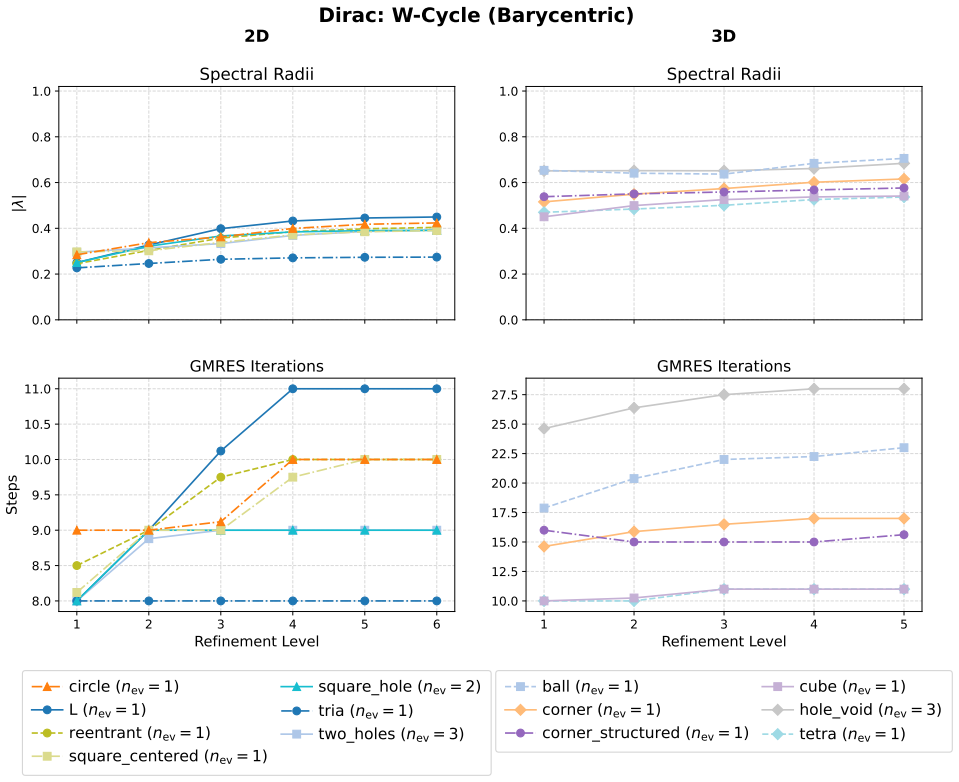
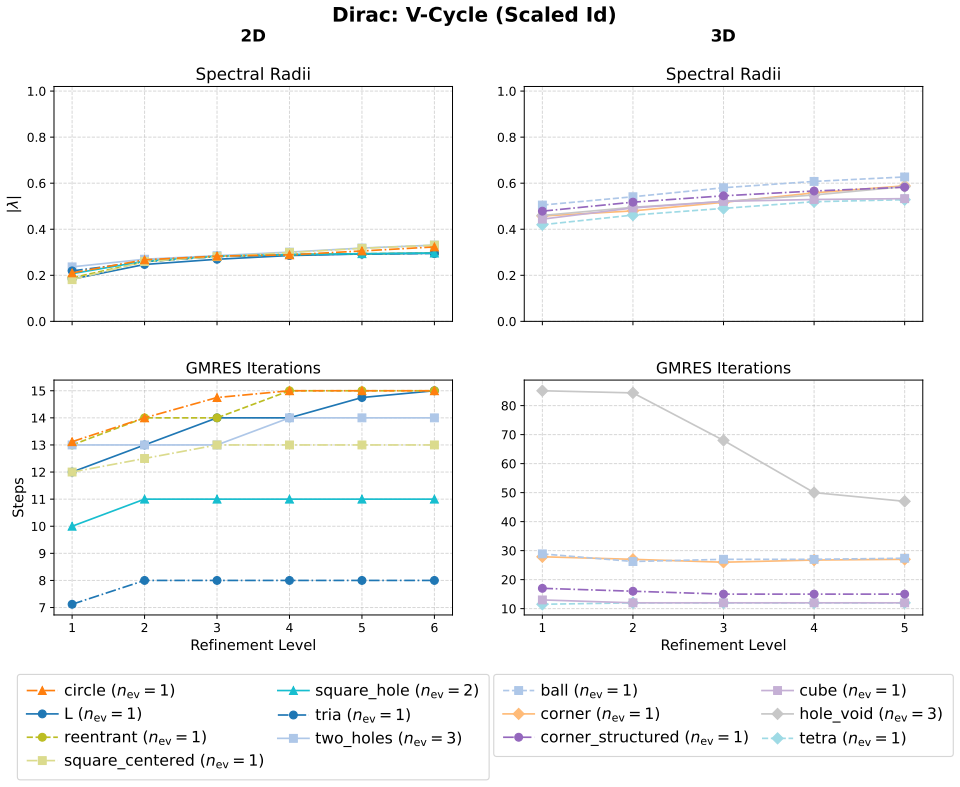
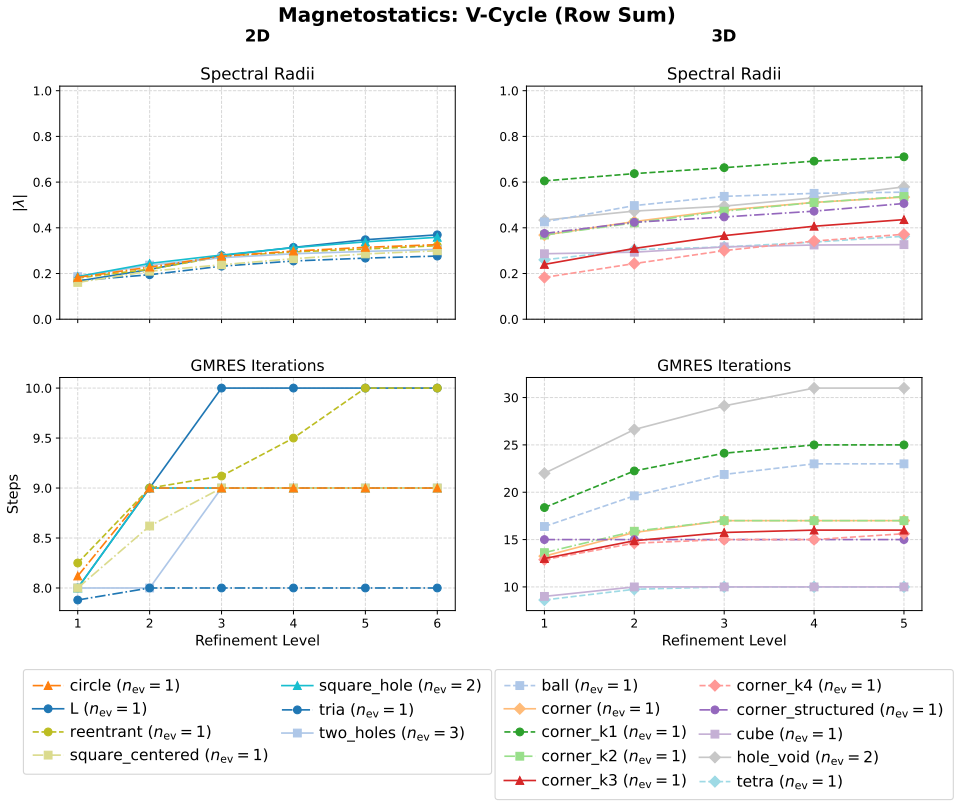
For PDEs naturally posed in the de Rham complex, structure-preserving mixed and saddle-point finite element discretizations typically produce indefinite linear systems. We propose a multigrid preconditioning framework that combines mass-lumped (explicitly invertible) FEEC mass matrices with transforming smoothers that map the operator to a block form with positive definite diagonal blocks, enabling Gauss-Seidel-type relaxation on the transformed system. Under mild h-uniform norm-equivalence assumptions (and for trivial topology), we prove stability of the mass-lumped systems, and by extension spectral equivalence between the mass-lumped and original FEEC operators, which motivates using multigrid cycles designed for the mass-lumped operators as preconditioners for the consistent FEEC systems. While our primary focus is on algorithmic design rather than formal convergence theory, extensive numerical experiments on the Hodge-Dirac operator, mixed Hodge-Laplacians, and a magnetostatics saddle-point system in 2D and 3D demonstrate the robustness of the approach.
Editorial analysis
A structured set of objections, weighed in public.
Referee Report
Summary. The paper proposes a multigrid preconditioning framework for structure-preserving FEEC discretizations of de Rham complex PDEs. It combines explicitly invertible mass-lumped FEEC mass matrices with transforming smoothers that convert the indefinite operator into a block form amenable to Gauss-Seidel relaxation. Under mild h-uniform norm-equivalence assumptions (and trivial topology), stability of the lumped systems is proved, implying spectral equivalence to the consistent operators; this justifies using lumped-operator multigrid cycles as preconditioners for the original systems. Extensive 2D/3D numerical tests on the Hodge-Dirac operator, mixed Hodge-Laplacians, and a magnetostatics saddle-point problem are reported to demonstrate robustness.
Significance. If the norm-equivalence assumptions hold with h-independent constants, the approach supplies a practical, explicitly invertible route to robust preconditioning of indefinite FEEC systems without sacrificing structure preservation. The combination of a stability proof (even if conditional) with transforming smoothers and broad numerical validation on multiple model problems is a concrete algorithmic contribution to the FEEC literature.
major comments (2)
- [Abstract / stability proof] Abstract and stability section: The central stability and spectral-equivalence claims rest entirely on 'mild h-uniform norm-equivalence assumptions' between lumped and consistent mass matrices. The manuscript states these assumptions but supplies neither an a-priori proof that the hidden constants remain bounded independently of h (and of polynomial degree) on shape-regular meshes for the concrete FEEC spaces, nor numerical verification of the equivalence ratio in the 2-D/3-D experiments. Because this equivalence is the sole bridge to the preconditioner motivation, the load-bearing claim remains conditional.
- [Transforming smoothers] Transforming-smoother construction (presumably §4): The transformation is asserted to map the operator to a block form with positive-definite diagonal blocks, enabling standard relaxation. The precise definition of the transformation operator, its dependence on the mass-lumping, and the proof that the transformed diagonal blocks remain uniformly positive definite under the same mild assumptions must be stated explicitly; otherwise the Gauss-Seidel step lacks a clear foundation.
minor comments (2)
- Notation for the de Rham complex spaces and the precise FEEC element families (e.g., which Whitney or trimmed polynomial spaces) should be fixed at the first appearance rather than introduced piecemeal in the experiments.
- Figure captions for the convergence plots should include the specific mesh sizes, polynomial degrees, and the measured equivalence ratios (or iteration counts) so that readers can directly assess whether the 'mild' assumptions appear to hold in the reported runs.
Simulated Author's Rebuttal
We thank the referee for the careful reading of the manuscript and the constructive comments. We address the two major comments below.
read point-by-point responses
-
Referee: [Abstract / stability proof] Abstract and stability section: The central stability and spectral-equivalence claims rest entirely on 'mild h-uniform norm-equivalence assumptions' between lumped and consistent mass matrices. The manuscript states these assumptions but supplies neither an a-priori proof that the hidden constants remain bounded independently of h (and of polynomial degree) on shape-regular meshes for the concrete FEEC spaces, nor numerical verification of the equivalence ratio in the 2-D/3-D experiments. Because this equivalence is the sole bridge to the preconditioner motivation, the load-bearing claim remains conditional.
Authors: We agree that the stability and spectral-equivalence results are conditional on the stated h-uniform norm-equivalence assumptions, which is already explicit in the manuscript. We do not claim or supply a general a-priori proof that the equivalence constants remain bounded independently of h and polynomial degree for arbitrary FEEC spaces on shape-regular meshes, as such a proof would require additional analysis specific to each finite-element family. The numerical experiments demonstrate robustness of the resulting preconditioners on the tested problems, but we acknowledge that explicit reporting of the equivalence ratios is absent. In the revision we will add tables or figures computing and displaying these ratios for the 2D/3D experiments to provide direct numerical support for the assumptions. revision: partial
-
Referee: [Transforming smoothers] Transforming-smoother construction (presumably §4): The transformation is asserted to map the operator to a block form with positive-definite diagonal blocks, enabling standard relaxation. The precise definition of the transformation operator, its dependence on the mass-lumping, and the proof that the transformed diagonal blocks remain uniformly positive definite under the same mild assumptions must be stated explicitly; otherwise the Gauss-Seidel step lacks a clear foundation.
Authors: Section 4 defines the transforming smoother via an explicit block-diagonal transformation operator whose blocks are the inverses of the mass-lumped mass matrices on the individual de Rham spaces; this construction directly exploits the explicit invertibility provided by mass lumping. Under the norm-equivalence assumptions we prove that the resulting diagonal blocks of the transformed operator are uniformly positive definite with h-independent bounds. We accept that the current presentation would benefit from greater explicitness. In the revised manuscript we will expand Section 4 to include a self-contained statement of the transformation operator, its precise dependence on the lumped matrices, and a clearer step-by-step outline of the positive-definiteness argument. revision: yes
Circularity Check
No circularity: stability proof is self-contained under explicit assumptions
full rationale
The paper derives spectral equivalence from a stability proof of the mass-lumped operators under stated mild h-uniform norm-equivalence assumptions (for trivial topology). This is a direct mathematical implication rather than a reduction to fitted parameters, self-referential definitions, or load-bearing self-citations. No prediction is called out that collapses to an input by construction, and the algorithmic motivation follows from the proved equivalence without smuggling ansatzes or renaming known results. The derivation chain remains independent of the target FEEC systems.
Axiom & Free-Parameter Ledger
axioms (1)
- domain assumption mild h-uniform norm-equivalence assumptions (and for trivial topology)
Reference graph
Works this paper leans on
-
[1]
Robert Anderson, Julian Andrej, Andrew Barker, Jamie Bramwell, Jean-Sylvain Camier, Jakub Cerveny, Veselin Dobrev, Yohann Dudouit, Aaron Fisher, Tzanio Kolev, Will Pazner, Mark Stowell, Vladimir Tomov, Ido Akkerman, Johann Dahm, David Medina, and Stefano Zampini. Mfem: A modular finite element methods library.Computers & Mathematics with Appli- cations, 8...
-
[2]
Douglas N. Arnold.Finite Element Exterior Calculus. Society for Industrial and Applied Mathe- matics, December 2018. ISBN 9781611975543. doi:10.1137/1.9781611975543
-
[3]
Daniele Boffi, Franco Brezzi, and Michel Fortin.Mixed Finite Element Methods and Applications. Springer Berlin Heidelberg, 2013. ISBN 9783642365195. doi:10.1007/978-3-642-36519-5. URL http://dx.doi.org/10.1007/978-3-642-36519-5
-
[4]
Achi Brandt and Nathan Dinar.Multigrid Solutions to Elliptic Flow Problems, page 53–147. Elsevier, 1979. ISBN 9780125460507. doi:10.1016/b978-0-12-546050-7.50008-3. URLhttp: //dx.doi.org/10.1016/B978-0-12-546050-7.50008-3
-
[5]
Long Chen, Yongke Wu, Lin Zhong, and Jie Zhou. Multigrid preconditioners for mixed fi- nite element methods of the vector laplacian.Journal of Scientific Computing, 77(1):101–128, March 2018. ISSN 1573-7691. doi:10.1007/s10915-018-0697-7. URLhttp://dx.doi.org/10. 1007/s10915-018-0697-7
-
[6]
Snorre H. Christiansen. On eigenmode approximation for Dirac equations: differential forms and fractional Sobolev spaces.Math. Comp., 87(310):547–580, 2018. ISSN 0025-5718. doi:10.1090/mcom/3233. URLhttps://doi.org/10.1090/mcom/3233
-
[7]
Multigrid solver for boundary value problems for the dirac operator
Radovan Dabeti ´c. Multigrid solver for boundary value problems for the dirac operator. Master’s thesis, ETH Zurich, Department of Mathematics (D-MATH), Z ¨urich, Switzerland, September
-
[8]
URLhttps://people.math.ethz.ch/ ~hiptmair/StudentProjects/Dabetic.Radovan/ MScThesis_RadovanDabetic.pdf
-
[9]
Fritschi
S. Fritschi. Discontinuous galerkin methods for the dirac operator. Msc thesis in cse, D-MATH, ETH Z ¨urich, 2023. URLhttps://people.math.ethz.ch/ ~hiptmair/StudentProjects/ Fritschi.Severin/Thesis_DG_Dirac_Curl.pdf. 38
2023
-
[10]
Johnny Guzm ´an and Pratyush Potu. A framework for analysis of dec approximations to hodge- laplacian problems using generalized whitney forms, 2025. URLhttps://arxiv.org/abs/ 2505.08934
work page internal anchor Pith review Pith/arXiv arXiv 2025
-
[11]
Springer Berlin Heidelberg, 1985
Wolfgang Hackbusch.Multi-Grid Methods and Applications. Springer Berlin Heidelberg, 1985. ISBN 9783662024270. doi:10.1007/978-3-662-02427-0
-
[12]
R. Hiptmair. Operator preconditioning.Computers & Mathematics with Applications, 52(5): 699–706, September 2006. ISSN 0898-1221. doi:10.1016/j.camwa.2006.10.008. URLhttp: //dx.doi.org/10.1016/j.camwa.2006.10.008
-
[13]
Paul Leopardi and Ari Stern. The abstract hodge–dirac operator and its stable discretiza- tion.SIAM Journal on Numerical Analysis, 54(6):3258–3279, January 2016. ISSN 1095-7170. doi:10.1137/15m1047684
-
[14]
Spectra: a C++ library for large scale eigenvalue problems
Yixuan Qiu. Spectra: a C++ library for large scale eigenvalue problems. GitHub repository. URLhttps://github.com/yixuan/spectra. Accessed 2026-06-07
2026
-
[15]
G. Wittum. Multi-grid methods for stokes and navier-stokes equations: Transforming smoothers: algorithms and numerical results.Numerische Mathematik, 54(5):543–563, September
-
[16]
ISSN 0945-3245. doi:10.1007/bf01396361. URLhttp://dx.doi.org/10.1007/BF01396361
-
[17]
Gabriel Wittum. On the convergence of multi-grid methods with transforming smoothers: Theory with applications to the navier-stokes equations.Numerische Mathematik, 57(1):15–38, December 1990. ISSN 0945-3245. doi:10.1007/bf01386394. 39
discussion (0)
Sign in with ORCID, Apple, or X to comment. Anyone can read and Pith papers without signing in.