Probing jet evolution with charged energy correlators in small systems
Pith reviewed 2026-06-26 21:41 UTC · model grok-4.3
The pith
Charged energy correlators inside jets separate parton shower effects from hadronization in small collision systems.
A machine-rendered reading of the paper's core claim, the machinery that carries it, and where it could break.
Core claim
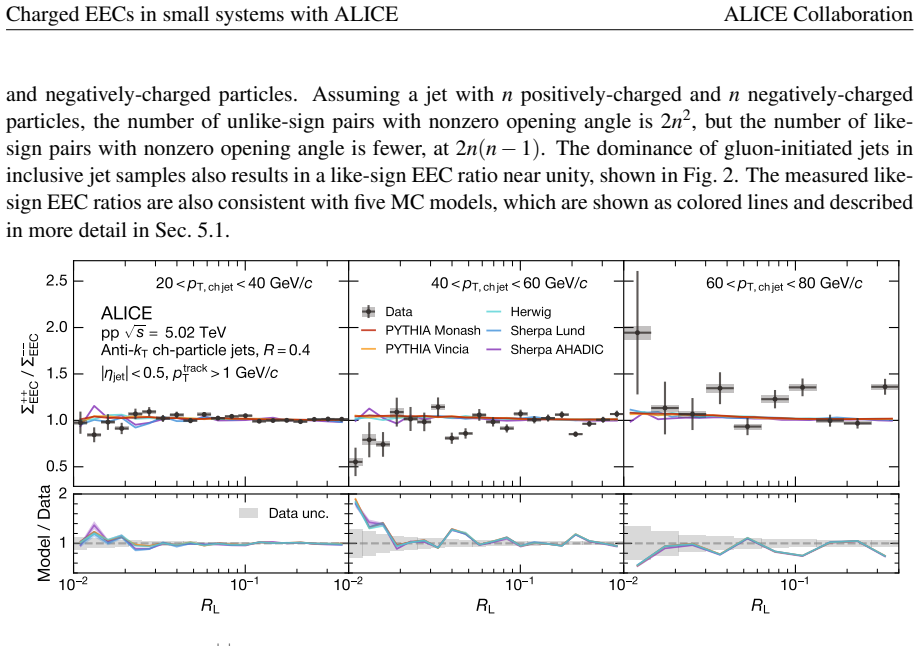
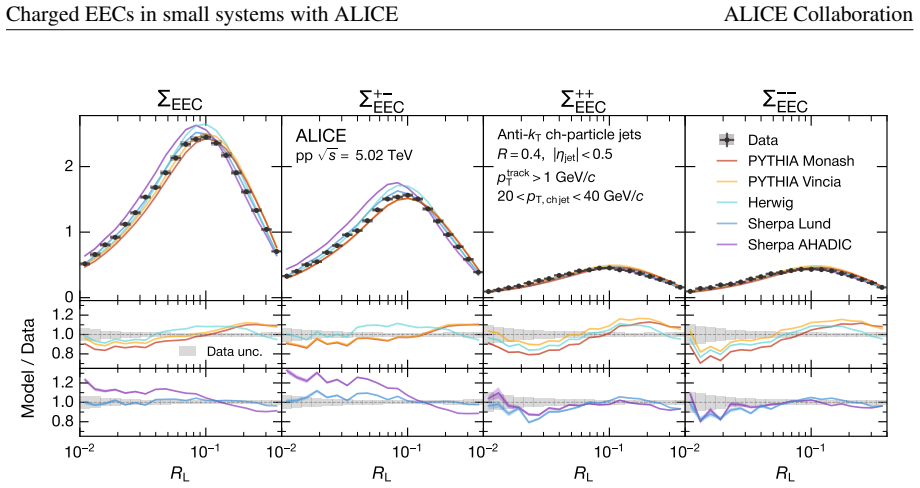
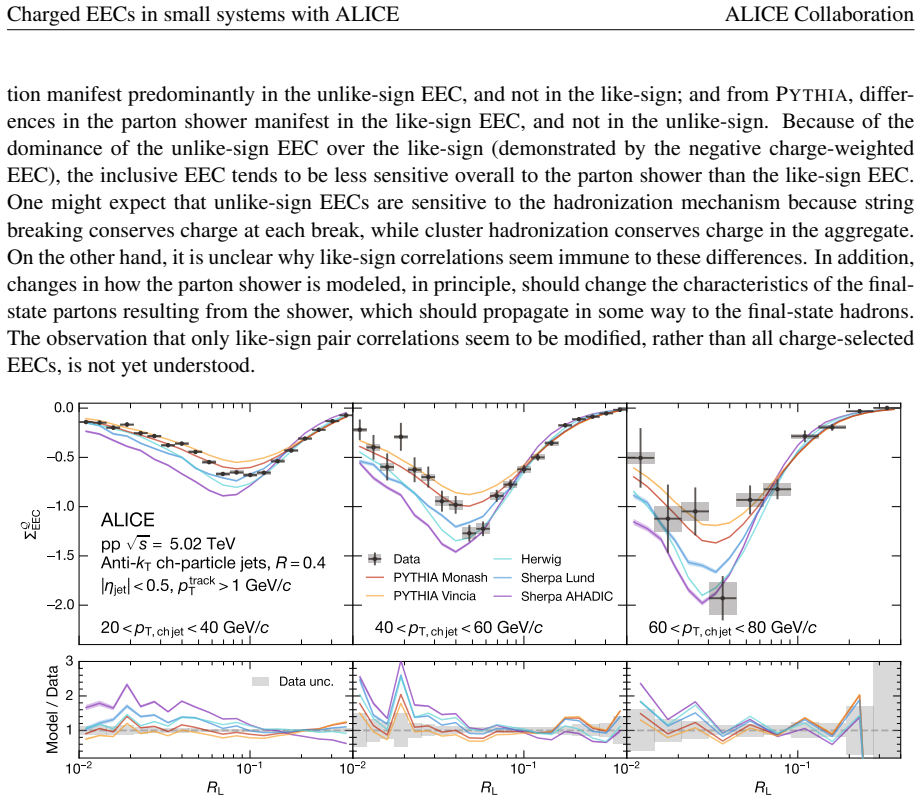
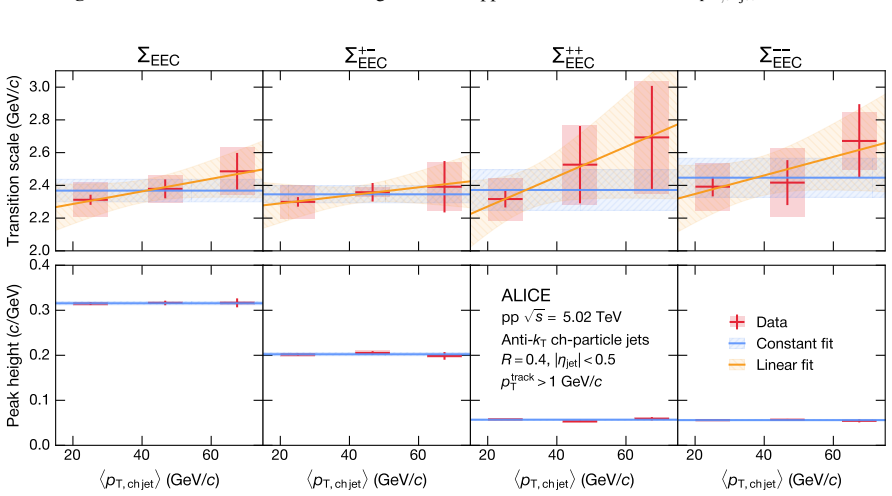
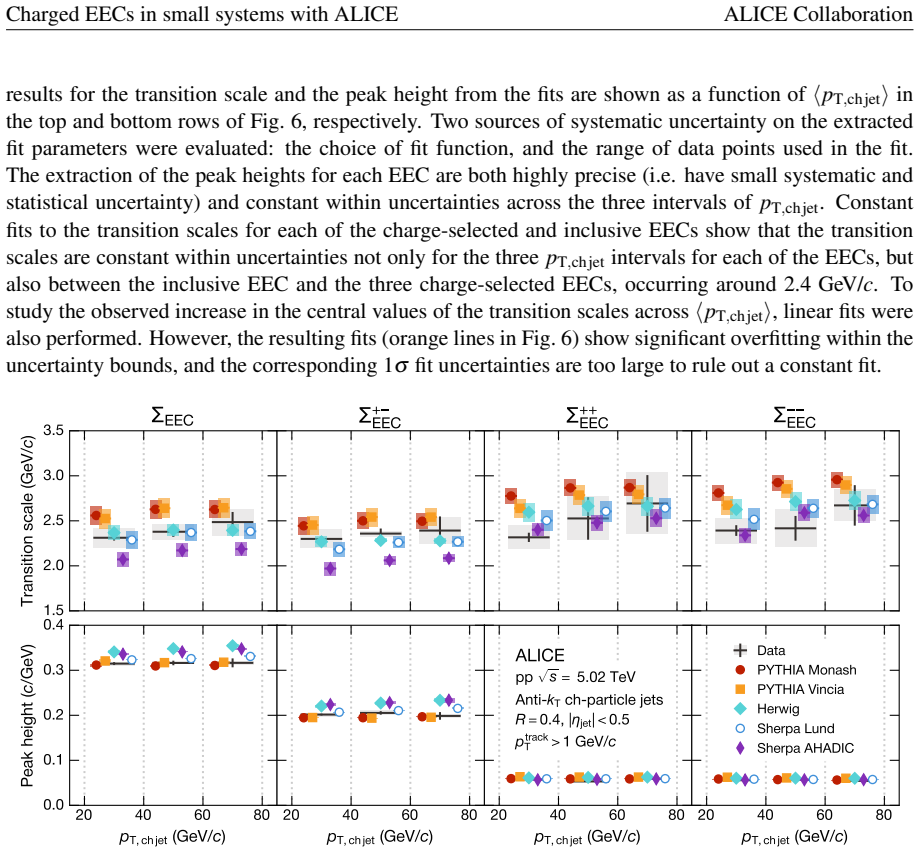
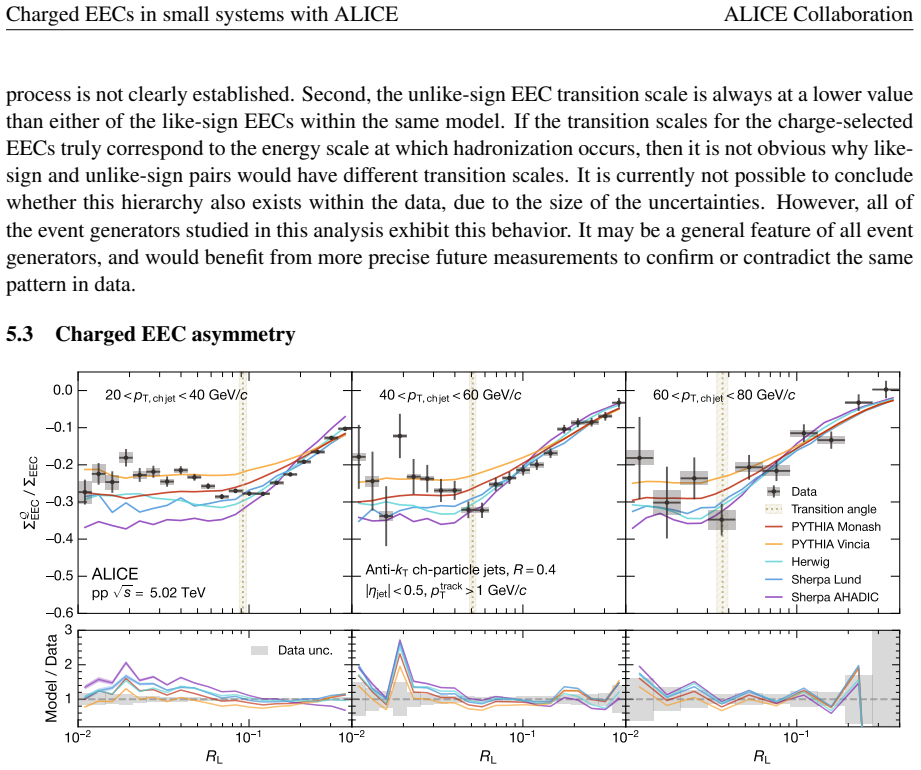
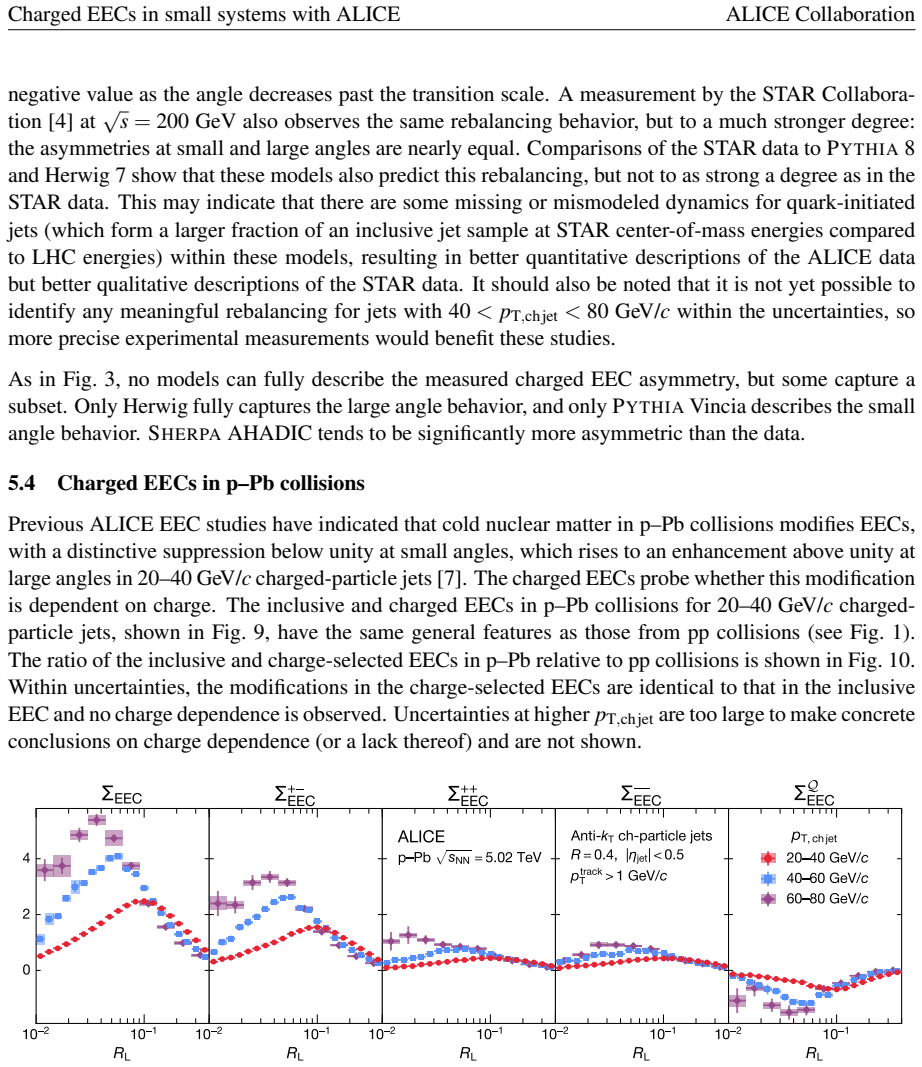
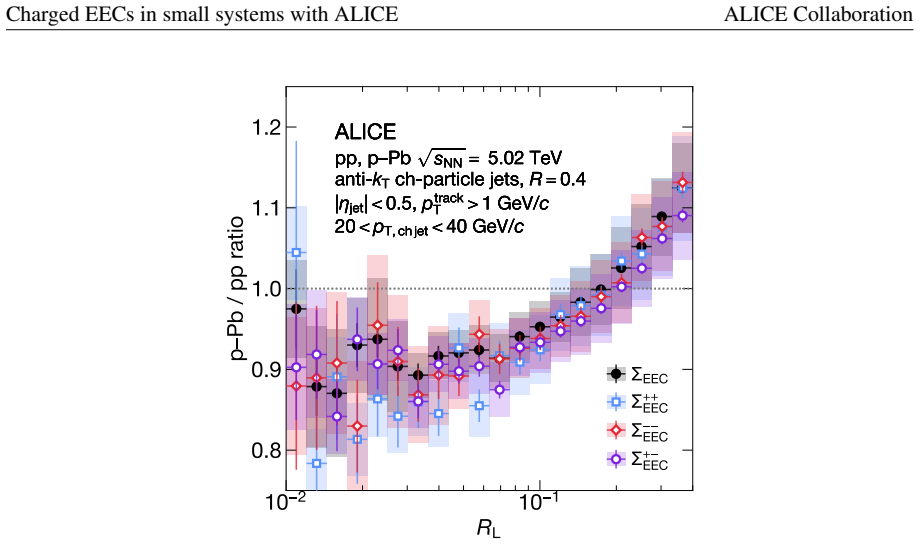
In proton-proton collisions, like-sign charged EECs are sensitive to parton shower modeling while unlike-sign charged EECs are sensitive to hadronization schemes. In proton-lead collisions, cold nuclear matter effects on charged EECs are consistent with charge-independent behavior.
What carries the argument
charged energy-energy correlators, which measure the angular distribution of energy carried by pairs of charged particles inside jets and are split by like-sign versus unlike-sign combinations
If this is right
- Like-sign EECs can be used to tune parton shower parameters in event generators.
- Unlike-sign EECs can be used to test and refine hadronization models.
- Cold nuclear matter effects can be treated as charge-independent when modeling jet observables in proton-nucleus collisions.
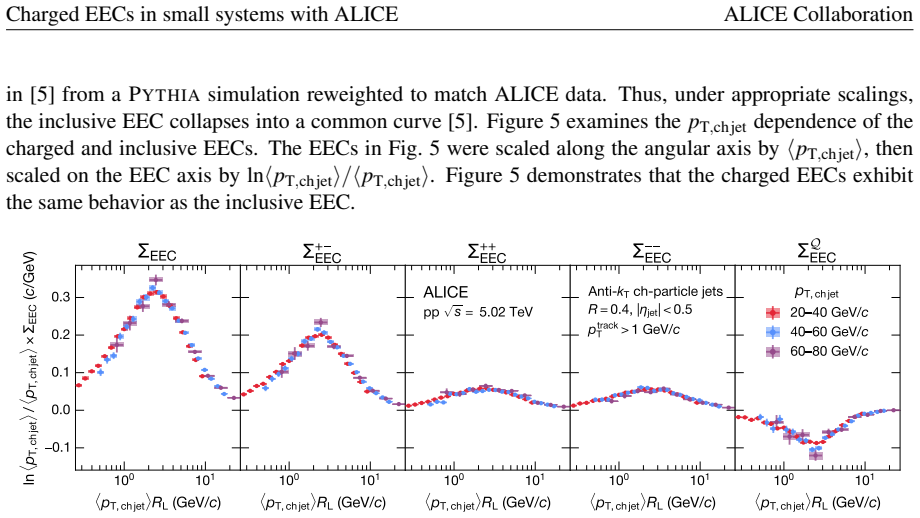
- The same observables can be measured in different jet transverse momentum ranges to map the energy scales of fragmentation.
Where Pith is reading between the lines
- The charge-sign separation could serve as a baseline for isolating medium-induced modifications when the same observables are measured in heavy-ion collisions.
- Applying the method to jets initiated by identified partons or in electron-positron collisions would add flavor or purity information to the constraints.
- The observables may help quantify the relative importance of perturbative and non-perturbative stages across a wider range of collision energies.
Load-bearing premise
Differences between event generators can be attributed mainly to isolated changes in their parton shower or hadronization modules.
What would settle it
Repeating the comparison with a generator set in which parton shower and hadronization modules are exchanged independently while all other components stay fixed would show whether the like-sign and unlike-sign sensitivities remain cleanly separated.
Figures


read the original abstract
The ALICE Collaboration presents measurements of charged energy-energy correlators (charged EECs) within charged-particle jets at $\sqrt{s_{\rm NN}} = 5.02$ Tev in proton-proton and proton-lead collisions at the LHC. Charged EECs are a class of jet substructure observables that trace the flow of energy and electric charge within a jet, and provide a tool for disentangling the energy scales involved in the jet fragmentation process through the angular separation and charges of particle pairs. The interplay between energy distribution and charge conservation enables charged EECs to provide novel constraints on hadronization mechanisms. Measurements of charged EECs in proton--proton collisions in charged-particle jets with $20 < p_{\rm T,chjet} < 80$ GeV/$c$ are compared to event generators to investigate different hadronization mechanisms and parton shower models. These model comparisons show that the like-sign EECs are sensitive to changes in parton shower modeling, while unlike-sign EECs are sensitive to different hadronization schemes. Measurements in proton-lead collisions indicate that cold nuclear matter effects on charged EECs are consistent with charge-independent behavior.
Editorial analysis
A structured set of objections, weighed in public.
Referee Report
Summary. The ALICE Collaboration reports measurements of charged energy-energy correlators (EECs) in charged-particle jets (20 < p_T,chjet < 80 GeV/c) at √s_NN = 5.02 TeV in pp and p-Pb collisions. Like-sign and unlike-sign charged EECs are compared to event generators to extract sensitivities to parton-shower modeling versus hadronization schemes; p-Pb results are used to assess cold-nuclear-matter effects, which are found to be charge-independent.
Significance. If the generator comparisons isolate the varied components, the work supplies a new experimental handle on the interplay of energy flow and charge conservation inside jets. The direct LHC data and the reported separation between like-sign (shower-sensitive) and unlike-sign (hadronization-sensitive) observables constitute a concrete, falsifiable input for fragmentation modeling that is not available from conventional jet observables.
major comments (1)
- [Model comparisons] Model-comparison section: the attribution that unlike-sign EECs are sensitive to hadronization schemes (while like-sign EECs respond to parton showers) presupposes that the compared generators differ only in the hadronization module, with shower ordering, color reconnection, PDFs, and MPI settings held fixed. The manuscript must document the exact generator versions, tunes, and parameter lists used for each comparison; absent such documentation the observed differences cannot be cleanly assigned to hadronization.
minor comments (2)
- [Abstract] Abstract and introduction: the phrase 'different hadronization schemes' should be accompanied by a brief parenthetical listing the specific models (e.g., Lund string vs. cluster) that are actually varied.
- [Figures] Figure captions: axis labels and legend entries for like-sign versus unlike-sign distributions should be made consistent across all panels to avoid reader confusion when comparing pp and p-Pb results.
Simulated Author's Rebuttal
We thank the referee for the careful reading of the manuscript and the constructive comment on the model-comparison section. We address the point below and will incorporate the requested documentation in the revised version.
read point-by-point responses
-
Referee: Model-comparison section: the attribution that unlike-sign EECs are sensitive to hadronization schemes (while like-sign EECs respond to parton showers) presupposes that the compared generators differ only in the hadronization module, with shower ordering, color reconnection, PDFs, and MPI settings held fixed. The manuscript must document the exact generator versions, tunes, and parameter lists used for each comparison; absent such documentation the observed differences cannot be cleanly assigned to hadronization.
Authors: We agree that explicit documentation of the generator configurations is necessary to support the attribution of sensitivities. In the revised manuscript we will add a new table (or expanded subsection) that lists, for each generator and tune employed in the comparisons: the exact version number, the tune name and reference, the PDF set, the MPI and color-reconnection settings, and any other parameters that were varied or held fixed. This will allow readers to verify the extent to which the observed differences can be ascribed to hadronization versus parton-shower modeling. The generators were selected following standard practices in the field to isolate the targeted physics components, but we acknowledge that the current text does not provide the full parameter list and will correct this omission. revision: yes
Circularity Check
No significant circularity; data-driven measurement with external generator comparisons
full rationale
This is an experimental measurement paper reporting charged EEC distributions in pp and p-Pb collisions and comparing them to external event generators. The central claims concern observed sensitivities (like-sign to shower modeling, unlike-sign to hadronization) extracted from those comparisons rather than any internal derivation, fit, or self-referential equation. No self-definitional steps, fitted inputs renamed as predictions, or load-bearing self-citations appear in the abstract or described content. The attribution of differences to specific generator modules is an interpretive statement whose validity can be checked against the cited external codes; it does not reduce the reported measurements to the paper's own inputs by construction. This is the expected non-circular outcome for a data-driven analysis.
Axiom & Free-Parameter Ledger
axioms (1)
- domain assumption Standard assumptions in charged-particle jet reconstruction and background subtraction at mid-rapidity in the ALICE detector
Reference graph
Works this paper leans on
-
[1]
The anti-kt jet clustering algorithm
M. Cacciari, G. P. Salam, and G. Soyez, “The anti-kt jet clustering algorithm”,JHEP2008(Apr.,
-
[2]
063–063,arXiv:0802.1189 [hep-ph]
-
[3]
Energy Correlations in Electron-Positron Annihilation: Testing Quantum Chromodynamics
C. L. Basham, L. S. Brown, S. D. Ellis, and S. T. Love, “Energy Correlations in Electron-Positron Annihilation: Testing Quantum Chromodynamics”,Phys. Rev. Lett.41(Dec, 1978) 1585–1588. [4]STARCollaboration, B. E. Aboonaet al., “Measurement of Two-Point Energy Correlators within Jets inp+pCollisions at √s=200 GeV”,Phys. Rev. Lett.135(Sep, 2025) 111901, arX...
arXiv 1978
-
[4]
Gluon Polarimetry with Energy-Energy Correlators
Y .-K. Song, S.-Y . Wei, L. Yang, and J. Zhou, “Gluon Polarimetry with Energy-Energy Correlators”,Phys. Rev. Lett.136(Mar, 2026) 131901,arXiv:2509.14960 [hep-ph]
arXiv 2026
-
[5]
J. Barata, J. G. Milhano, A. V . Sadofyev, and J. M. Silva, “Early-Time Dynamics of Heavy-Ion Collisions through Energy Correlators: celestial blocks and the spacetime structure of out-of-equilibrium QCD matter”,arXiv:2512.17009 [hep-ph]
-
[6]
Simple Scaling Laws for Energy Correlators in Nuclear Matter
C. Andres, F. Dominguez, J. Holguin, C. Marquet, and I. Moult, “Simple Scaling Laws for Energy Correlators in Nuclear Matter”,Phys. Rev. Lett.136(Mar, 2026) 122301,arXiv:2411.15298 [hep-ph]
arXiv 2026
-
[7]
Energy Correlators: A Journey From Theory to Experiment
I. Moult and H. X. Zhu, “Energy Correlators: A Journey From Theory to Experiment”, arXiv:2506.09119 [hep-ph]
-
[8]
Energy Correlators Taking Charge
K. Lee and I. Moult, “Energy Correlators Taking Charge”,arXiv:2308.00746 [hep-ph]
-
[9]
AnalyzingN-Point Energy Correlators inside Jets with CMS Open Data
P. T. Komiske, I. Moult, J. Thaler, and H. X. Zhu, “AnalyzingN-Point Energy Correlators inside Jets with CMS Open Data”,Phys. Rev. Lett.130(Feb, 2023) 051901,arXiv:2201.07800 [hep-ph]
arXiv 2023
-
[10]
Parton fragmentation and string dynamics
B. Andersson, G. Gustafson, G. Ingelman, and T. Sjöstrand, “Parton fragmentation and string dynamics”,Phys. Rept.97(1983) 31–145
1983
-
[11]
Jet fragmentation of multiparton configurations in a string framework
T. Sjöstrand, “Jet fragmentation of multiparton configurations in a string framework”,Nuclear Physics B248(1984) 469–502
1984
-
[12]
A comprehensive guide to the physics and usage of PYTHIA 8.3
C. Bierlich, S. Chakraborty,et al., “A comprehensive guide to the physics and usage of PYTHIA 8.3”SciPost Phys. Codebases(2022) 8,arXiv:2203.11601 [hep-ph]
Pith/arXiv arXiv 2022
-
[13]
G. Bewick, S. F. Ravasio,et al., “Herwig 7.3 release note”,arXiv:2312.05175 [hep-ph]
-
[14]
Event generation with Sherpa 3
E. Bothmann, L. Flower,et al., “Event generation with Sherpa 3”,arXiv:2410.22148 [hep-ph]. [22]ALICECollaboration, E. Abbaset al., “Performance of the ALICE VZERO system”,JINST8 (2013) P10016,arXiv:1306.3130 [nucl-ex]. [23]ALICECollaboration, K. Aamodtet al., “Alignment of the ALICE Inner Tracking System with cosmic-ray tracks”,JINST5(2010) P03003,arXiv:1...
arXiv 2013
-
[15]
J. Alme, Y . Andres,et al., “The ALICE TPC, a large 3-dimensional tracking device with fast readout for ultra-high multiplicity events”,Nucl. Instrum. Meth. A622(Oct., 2010) 316–367, arXiv:arXiv:1001.1950 [physics.ins-det]. [25]ALICECollaboration, B. Abelevet al., “Performance of the ALICE Experiment at the CERN LHC”,Int. J. Mod. Phys. A29(2014) 1430044,a...
Pith/arXiv arXiv 2010
-
[16]
G. P. Salam, “Towards jetography”,Eur . Phys. J. C67(May, 2010) 637–686,arXiv:0906.1833 [hep-ph]
Pith/arXiv arXiv 2010
-
[17]
M. Cacciari, G. P. Salam, and G. Soyez, “FastJet User Manual”,Eur . Phys. J. C72(2012) 1896, arXiv:1111.6097 [hep-ph]. 19 Charged EECs in small systems with ALICE ALICE Collaboration
Pith/arXiv arXiv 2012
-
[18]
Pileup subtraction using jet areas
M. Cacciari and G. P. Salam, “Pileup subtraction using jet areas”,Phys. Lett. B659(Jan., 2008) 119–126,arXiv:0707.1378 [hep-ph]
Pith/arXiv arXiv 2008
-
[19]
M. Cacciari, G. P. Salam, and G. Soyez, “The Catchment Area of Jets”,JHEP2008(Apr., 2008) 005–005,arXiv:0802.1188 [hep-ph]
Pith/arXiv arXiv 2008
-
[20]
R. Brunet al.,GEANT. CERN Program Library. CERN, Geneva, 1993. https://cds.cern.ch/record/1073159. Long Writeup W5013
arXiv 1993
-
[21]
T. Sjöstrandet al., “An introduction to PYTHIA 8.2”Comput. Phys. Commun.191(June, 2015) 159–177,arXiv:1410.3012 [hep-ph]
Pith/arXiv arXiv 2015
-
[22]
Tuning PYTHIA 8.1: the Monash 2013 tune
P. Skands, S. Carrazza, and J. Rojo, “Tuning PYTHIA 8.1: the Monash 2013 tune”,Eur . Phys. J. C 74(Aug, 2014) 3024,arXiv:1404.5630 [hep-ph]
Pith/arXiv arXiv 2013
-
[23]
The Monte Carlo event generator DPMJET-III
S. Roesler, R. Engel, and J. Ranft, “The Monte Carlo event generator DPMJET-III”, in International Conference on Advanced Monte Carlo for Radiation Physics, Particle Transport Simulation and Applications (MC 2000), pp. 1033–1038. 12, 2000.arXiv:hep-ph/0012252
Pith/arXiv arXiv 2000
-
[24]
Photoproduction within the two-component Dual Parton Model: amplitudes and cross sections
R. Engel, “Photoproduction within the two-component Dual Parton Model: amplitudes and cross sections”,Z. Phys. C66(Mar, 1995) 203–214
1995
-
[25]
A. Fedynitch,Cascade equations and hadronic interactions at very high energies. PhD thesis, KIT, Karlsruhe, Dept. Phys., 11, 2015. [36]ALICECollaboration, S. Acharyaet al., “Azimuthally-differential pion femtoscopy relative to the third harmonic event plane in Pb-Pb collisions at √sNN = 2.76 TeV”,Phys. Lett. B785(2018) 320–331,arXiv:1803.10594 [nucl-ex]. ...
Pith/arXiv arXiv 2015
-
[26]
A multidimensional unfolding method based on Bayes’ theorem
G. D’Agostini, “A multidimensional unfolding method based on Bayes’ theorem”,Nucl. Instrum. Meth. A362(1994) 487–498
1994
-
[27]
Comparison of unfolding methods using RooFitUnfold
L. Brenner, R. Balasubramanian, C. Burgard, W. Verkerke, G. Cowan, P. Verschuuren, and V . Croft, “Comparison of unfolding methods using RooFitUnfold”,Int. J. Mod. Phys. A35(2020) 2050145,arXiv:1910.14654 [physics.data-an]
arXiv 2020
-
[28]
PYTHIA 6.4 physics and manual
T. Sjöstrand, S. Mrenna, and P. Skands, “PYTHIA 6.4 physics and manual”,JHEP2006(May,
-
[29]
026–026,arXiv:hep-ph/0603175 [hep-ph]
-
[30]
Tuning Monte Carlo generators: The Perugia tunes
P. Z. Skands, “Tuning Monte Carlo generators: The Perugia tunes”,Phys. Rev. D82(Oct, 2010) 074018,arXiv:1005.3457 [hep-ph]
Pith/arXiv arXiv 2010
-
[31]
HIJING: A Monte Carlo model for multiple jet production in pp, pA, and AA collisions
X.-N. Wang and M. Gyulassy, “HIJING: A Monte Carlo model for multiple jet production in pp, pA, and AA collisions”,Phys. Rev. D44(Dec, 1991) 3501–3516
1991
-
[32]
M. Bähr, S. Gieseke,et al., “Herwig++ physics and manual”,Eur . Phys. J. C58(Nov., 2008) 639–707,arXiv:0803.0883 [hep-ph]
Pith/arXiv arXiv 2008
-
[33]
Transverse-momentum-ordered showers and interleaved multiple interactions
T. Sjöstrand and P. Z. Skands, “Transverse-momentum-ordered showers and interleaved multiple interactions”,Eur . Phys. J. C39(Feb, 2005) 129–154,arXiv:hep-ph/0408302 [hep-ph]
Pith/arXiv arXiv 2005
-
[34]
N. Fischer, S. Prestel, M. Ritzmann, and P. Skands, “VINCIA for hadron colliders”,Eur . Phys. J. C76(Oct., 2016) 589,arXiv:1605.06142 [hep-ph]. 20 Charged EECs in small systems with ALICE ALICE Collaboration
Pith/arXiv arXiv 2016
-
[35]
Sector showers for hadron collisions
H. Brooks, C. T. Preuss, and P. Skands, “Sector showers for hadron collisions”,JHEP2020(Jul,
-
[36]
32,arXiv:2003.00702 [hep-ph]
arXiv 2003
-
[37]
A simple shower and matching algorithm
W. T. Giele, D. A. Kosower, and P. Z. Skands, “A simple shower and matching algorithm”,Phys. Rev. D78(Jul, 2008) 014026,arXiv:0707.3652 [hep-ph]
Pith/arXiv arXiv 2008
-
[38]
Multipole photon radiation in the Vincia parton shower
P. Skands and R. Verheyen, “Multipole photon radiation in the Vincia parton shower”,Phys. Lett. B811(2020) 135878,arXiv:2002.04939 [hep-ph]
arXiv 2020
-
[39]
A parton shower algorithm based on Catani-Seymour dipole factorisation
S. Schumann and F. Krauss, “A parton shower algorithm based on Catani-Seymour dipole factorisation”,JHEP2008(Mar., 2008) 038–038,arXiv:0709.1027 [hep-ph]
Pith/arXiv arXiv 2008
-
[40]
A modified cluster-hadronisation model
J.-C. Winter, F. Krauss, and G. Soff, “A modified cluster-hadronisation model”,Eur . Phys. J. C36 (Aug., 2004) 381–395,arXiv:hep-ph/0311085 [hep-ph]. 21 Charged EECs in small systems with ALICE ALICE Collaboration A The ALICE Collaboration D.A.H. Abdallah 134, I.J. Abualrob 112, S. Acharya 49, K. Agarwal II,23, G. Aglieri Rinella 32, L. Aglietta 24, N. Ag...
Pith/arXiv arXiv 2004
discussion (0)
Sign in with ORCID, Apple, or X to comment. Anyone can read and Pith papers without signing in.