A minimizing-movement framework for geometric gradient flows with admissible tangential motion
Pith reviewed 2026-06-26 23:39 UTC · model grok-4.3
The pith
A minimizing-movement framework for geometric gradient flows incorporates admissible tangential motion to recover classical schemes with unconditional energy stability.
A machine-rendered reading of the paper's core claim, the machinery that carries it, and where it could break.
Core claim
Under the admissibility condition that the identity map satisfies the weak constraint, the minimizing-movement problem produces fully discrete schemes for geometric flows that are unconditionally energy stable, with the identity serving as the comparison map, recovering the BGN and MDR schemes and allowing new variants with existence and uniqueness.
What carries the argument
The admissibility condition on the weak constraint for the deformation map, which keeps the identity map available as a comparison function to derive the natural stability estimate.
Load-bearing premise
The admissibility condition must hold for the identity map to satisfy the constraint and provide the comparison function needed for the energy stability proof.
What would settle it
A numerical experiment or analytical example in which an admissible scheme exhibits energy increase over a time step despite satisfying the nondegeneracy assumptions.
Figures


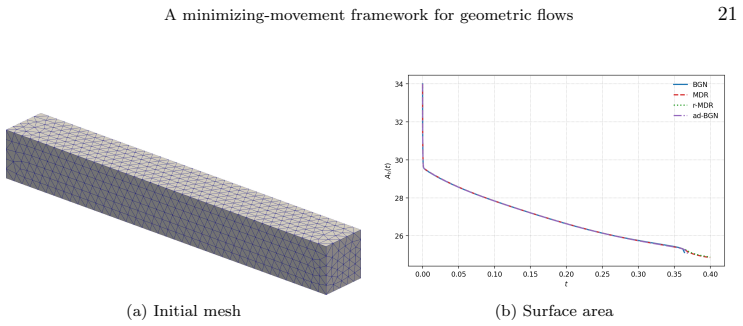


read the original abstract
We develop a minimizing-movement framework for parametric finite element approximations of geometric gradient flows with admissible tangential motion. At each time step, the discrete variational problem combines a metric dissipation term for the normal displacement with a surface Dirichlet energy. The metric determines the normal geometric evolution: the $L^2(\Gamma)$ metric gives mean curvature flow, while the $H^{-1}(\Gamma)$ metric gives surface diffusion flow. Tangential velocity is selected independently through weak constraints on the deformation map. The central structural condition is admissibility, namely, that the identity map satisfies the constraint. This condition keeps the identity map available as a comparison function and yields the natural stability estimate. The framework recovers the classical Barrett--Garcke--N\"urnberg (BGN) scheme from the unconstrained formulation and the dual minimal-deformation-rate (MDR) scheme from the MDR constraint. We further introduce two new admissible variants: an admissible BGN scheme and a relaxed MDR scheme. For the resulting fully discrete schemes, we prove existence and uniqueness under natural nondegeneracy assumptions and establish unconditional energy stability. Numerical experiments compare the admissible and classical schemes and illustrate their stability properties and mesh-quality behavior.
Editorial analysis
A structured set of objections, weighed in public.
Referee Report
Summary. The paper develops a minimizing-movement framework for parametric finite-element approximations of geometric gradient flows (mean curvature flow via L² metric, surface diffusion via H^{-1} metric) that incorporates admissible tangential motion through weak constraints on the deformation map. The central condition is admissibility of the identity map, which recovers the classical BGN scheme (unconstrained) and dual MDR scheme (MDR constraint), introduces two new admissible variants, and yields proofs of existence, uniqueness, and unconditional energy stability for the fully discrete schemes under natural nondegeneracy assumptions.
Significance. If the admissibility verification and stability estimates hold in the discrete setting, the framework supplies a unified variational construction that guarantees unconditional energy stability while controlling tangential motion, which is valuable for long-time numerical simulations of geometric flows where mesh quality is a concern.
major comments (1)
- [Admissibility condition and stability derivation (framework and existence/stability sections)] The admissibility of the identity map under the MDR constraint (abstract and the definition of the weak constraint in the framework section) is load-bearing for the stability argument: the energy estimate is obtained by testing with the identity as competitor. The manuscript must explicitly verify that ∫_Γ (id - id) · φ dA = 0 holds for all admissible test functions φ on the polyhedral surfaces actually used in the FEM discretization, without invoking C² regularity or integration-by-parts that assumes a smooth closed manifold. If this step is only shown under extra regularity, the unconditional stability claim for the MDR and relaxed MDR schemes does not follow in the discrete setting.
minor comments (2)
- Notation for the weak constraint and the precise statement of nondegeneracy assumptions should be collected in a single preliminary section for readability.
- The numerical experiments section would benefit from a direct comparison table of energy decay rates between the admissible and classical schemes on the same meshes.
Simulated Author's Rebuttal
We thank the referee for the careful reading of the manuscript and the constructive comment regarding the admissibility verification. We respond to the major comment below.
read point-by-point responses
-
Referee: [Admissibility condition and stability derivation (framework and existence/stability sections)] The admissibility of the identity map under the MDR constraint (abstract and the definition of the weak constraint in the framework section) is load-bearing for the stability argument: the energy estimate is obtained by testing with the identity as competitor. The manuscript must explicitly verify that ∫_Γ (id - id) · φ dA = 0 holds for all admissible test functions φ on the polyhedral surfaces actually used in the FEM discretization, without invoking C² regularity or integration-by-parts that assumes a smooth closed manifold. If this step is only shown under extra regularity, the unconditional stability claim for the MDR and relaxed MDR schemes does not follow in the discrete setting.
Authors: The admissibility of the identity map is verified by direct substitution into the weak constraint defining the MDR (and relaxed MDR) scheme. This substitution yields the integrand (id - id) · φ, whose integral is identically zero for any test function φ (admissible or otherwise) on any polyhedral surface where the integral is defined. No integration by parts, C² regularity, or other smoothness assumptions on the manifold are used or required; the identity holds at the level of the integrand. Consequently, the identity map remains admissible in the fully discrete polyhedral setting, the identity can be used as a competitor, and the unconditional energy stability follows exactly as stated. We will add an explicit paragraph in the framework section making this direct verification clear for the discrete case. revision: yes
Circularity Check
No circularity; direct variational construction with independent stability argument
full rationale
The framework defines admissibility as the structural condition that the identity map satisfies the weak constraint, then uses this to justify the identity as a competitor yielding the energy stability estimate. This is a standard variational assumption rather than a self-referential reduction. No fitted parameters renamed as predictions, no load-bearing self-citations, and no ansatz smuggled via prior work appear in the abstract or description. The recovery of BGN and MDR schemes and the proofs of existence/uniqueness/stability are presented as consequences of the variational problem under the stated nondegeneracy assumptions, without the derivation collapsing to its inputs by construction. The paper is self-contained against external benchmarks.
Axiom & Free-Parameter Ledger
axioms (1)
- domain assumption Natural nondegeneracy assumptions are required for existence and uniqueness of the discrete variational problems.
Reference graph
Works this paper leans on
-
[1]
A finite element method for surface diffusion: the parametric case , author =. J. Comput. Phys. , volume =. 2005 , issn =
2005
-
[2]
Balzani, Nadine and Rumpf, Martin , TITLE =. Interfaces Free Bound. , FJOURNAL =. 2012 , NUMBER =. doi:10.4171/IFB/287 , URL =
-
[3]
A singular example for the
Blatt, Simon , journal =. A singular example for the. 2009 , publisher=
2009
-
[4]
Bai, Genming and Hu, Jiashun and Li, Buyang , title =. SIAM J. Numer. Anal. , volume =. 2024 , doi =
2024
-
[5]
An energy-stable parametric finite element method for the
Weizhu Bao and Yifei Li and Dongmin Wang , year=. An energy-stable parametric finite element method for the
-
[6]
Bao, Weizhu and Li, Yifei , title =. SIAM J. Sci. Comput. , volume =. 2023 , doi =
2023
-
[7]
On the variational approximation of combined second and fourth order geometric evolution equations , author=. SIAM J. Sci. Comput. , volume=. 2007 , publisher=
2007
-
[8]
Numerical approximation of anisotropic geometric evolution equations in the plane , author=. IMA J. Numer. Anal. , volume=. 2008 , publisher=
2008
-
[9]
Interfaces Free Bound
Parametric approximation of surface clusters driven by isotropic and anisotropic surface energies , author=. Interfaces Free Bound. , volume=
-
[10]
Finite-element approximation of coupled surface and grain boundary motion with applications to thermal grooving and sintering , author=. Euro. J. Appl. Math. , volume=. 2010 , publisher=
2010
-
[11]
Finite element discretization of the
B. Finite element discretization of the. Numer. Math. , volume=. 2001 , publisher=
2001
-
[12]
Computer models for subassembly simulation , author=. Nucl. Engrg. Des. , volume=. 1978 , publisher=
1978
-
[13]
Stability and geometric conservation laws for
Boffi, Daniele and Gastaldi, Lucia , journal=. Stability and geometric conservation laws for. 2004 , publisher=
2004
-
[14]
Local mass conservation of
Boffi, Daniele and Cavallini, Nicola and Gardini, Francesca and Gastaldi, Lucia , journal=. Local mass conservation of. 2012 , publisher=
2012
-
[15]
Boyer, Franck and Lapuerta, C. Transp. Porous Media , volume=. 2010 , publisher=
2010
-
[16]
A structure-preserving parametric finite element method for surface diffusion , author=. SIAM J. Numer. Anal. , volume=. 2021 , publisher=
2021
-
[17]
Bao, Weizhu and Garcke, Harald and N\"urnberg, Robert and Zhao, Quan , title =. Numer. Methods Partial Diff. Equ. , volume = 39, number = 1, year = 2023, pages =
2023
-
[18]
Bao, Weizhu and Li, Yifei , TITLE =. SIAM J. Numer. Anal. , VOLUME =. 2025 , NUMBER =. doi:10.1137/24M1633893 , URL =
-
[19]
A variational formulation of anisotropic geometric evolution equations in higher dimensions , author=. Numer. Math. , volume=. 2008 , publisher=
2008
-
[20]
Parametric finite element approximations of curvature driven interface evolutions , author=. Handb. Numer. Anal. (Andrea Bonito and Ricardo H. Nochetto, eds.) , year=
-
[21]
A parametric finite element method for fourth order geometric evolution equations , author=. J. Comput. Phys. , volume=. 2007 , publisher=
2007
-
[22]
On the parametric finite element approximation of evolving hypersurfaces in
Barrett, John W and Garcke, Harald and N. On the parametric finite element approximation of evolving hypersurfaces in. J. Comput. Phys. , volume=. 2008 , publisher=
2008
-
[23]
Parametric approximation of
Barrett, John W and Garcke, Harald and N. Parametric approximation of. SIAM J. Sci. Comput. , volume=. 2008 , publisher=
2008
-
[24]
Computational parametric
Barrett, John W and Garcke, Harald and N. Computational parametric. SIAM J. Numer. Anal. , volume=. 2016 , publisher=
2016
-
[25]
Finite element methods for fourth order axisymmetric geometric evolution equations , author=. J. Comput. Phys. , volume=. 2019 , publisher=
2019
-
[26]
BARRETT and HARALD GARCKE and ROBERT NÜRNBERG , journal =
JOHN W. BARRETT and HARALD GARCKE and ROBERT NÜRNBERG , journal =. FINITE ELEMENT APPROXIMATION FOR THE DYNAMICS OF ASYMMETRIC FLUIDIC BIOMEMBRANES , urldate =
-
[27]
Variational discretization of axisymmetric curvature flows , author=. Numer. Math. , volume=. 2019 , publisher=
2019
-
[28]
Stable variational approximations of boundary value problems for
Barrett, John W and Garcke, Harald and N. Stable variational approximations of boundary value problems for. IMA J. Numer. Anal. , volume=. 2017 , publisher=
2017
-
[29]
ESAIM: Math
Stable approximations for axisymmetric Willmore flow for closed and open surfaces , author=. ESAIM: Math. Mod. Numer. Anal. , volume=. 2021 , publisher=
2021
-
[30]
Phase-field approximations of the
Bretin, Elie and Masnou, Simon and Oudet, Edouard , journal=. Phase-field approximations of the. 2015 , publisher=
2015
-
[31]
Volume-preserving parametric finite element methods for axisymmetric geometric evolution equations , author=. J. Comput. Phys. , volume=. 2022 , publisher=
2022
-
[32]
Andrea Bonito and Ricardo H. Nochetto and M. Parametric. J. Comput. Phys. , volume =. 2010 , issn =. doi:https://doi.org/10.1016/j.jcp.2009.12.036 , url =
-
[33]
Numerical Methods and Uniqueness for the Canham-Helfrich Model of Biomembranes , address =
Chen, Jingmin , doi =. Numerical Methods and Uniqueness for the Canham-Helfrich Model of Biomembranes , address =
-
[34]
Structure-preserving discretizations of two-phase
Garcke, Harald and N. Structure-preserving discretizations of two-phase. J. Comput. Phys. , volume =. 2023 , publisher =
2023
-
[35]
Unfitted finite element approximations of the axisymmetric two-phase flow , journal=
Garcke, Harald and N. Unfitted finite element approximations of the axisymmetric two-phase flow , journal=
-
[36]
Stable fully discrete finite element methods with
Garcke, Harald and N. Stable fully discrete finite element methods with. J. Sci. Comput. , volume = 105, number = 2, pages =. doi:10.1007/s10915-025-03068-9 , url =
-
[37]
On stable parametric finite element methods for the Stefan problem and the Mullins--Sekerka problem with applications to dendritic growth , author=. J. Comput. Phys. , volume=. 2010 , publisher=
2010
-
[38]
Acta Metall
Surface motion by surface diffusion , author=. Acta Metall. Mater. , volume=. 1994 , publisher=
1994
-
[39]
Chen, Ying and Lowengrub, John and Shen, Jie and Wang, Cheng and Wise, Steven , TITLE =. J. Comput. Phys. , FJOURNAL =. 2018 , PAGES =. doi:10.1016/j.jcp.2018.03.024 , URL =
-
[40]
Clarenz, Ulrich and Diewald, Udo and Dziuk, Gerd and Rumpf, Martin and Rusu, Raluca , title =. Comput. Aided Geom. Design , fjournal =. doi:10.1016/j.cagd.2004.02.004 , URL =
-
[41]
Dziuk, Gerhard , TITLE =. Numer. Math. , FJOURNAL =. 2008 , NUMBER =. doi:10.1007/s00211-008-0179-1 , URL =
-
[42]
Evolution of elastic curves in
Dziuk, Gerhard and Kuwert, Ernst and Sch. Evolution of elastic curves in. SIAM J. Math. Anal. , FJOURNAL =. 2002 , NUMBER =
2002
-
[43]
Davis, Timothy A. , TITLE =. ACM Trans. Math. Software , FJOURNAL =. 2004 , NUMBER =. doi:10.1145/992200.992206 , URL =
-
[44]
, TITLE =
Davis, Timothy A. , TITLE =. ACM Trans. Math. Software , FJOURNAL =. 2011 , doi =
2011
-
[45]
Proceedings of the 26th annual conference on Computer graphics and interactive techniques , pages=
Implicit fairing of irregular meshes using diffusion and curvature flow , author=. Proceedings of the 26th annual conference on Computer graphics and interactive techniques , pages=
-
[46]
Acta Numer
Computation of geometric partial differential equations and mean curvature flow , author=. Acta Numer. , volume=. 2005 , publisher=
2005
-
[47]
Dziuk, Gerhard , title =. Numer. Math. , fjournal =. doi:10.1007/BF01385643 , URL =
-
[48]
A level set formulation for
Droske, Marc and Rumpf, Martin , journal=. A level set formulation for
-
[49]
New artificial tangential motions for parametric finite element approximation of surface evolution , author=. SIAM J. Sci. Comput. , volume=. 2024 , publisher=
2024
-
[50]
High-order fully discrete energy diminishing evolving surface finite element methods for a class of geometric curvature flows , author=. Ann. Appl. Math , volume=
-
[51]
A phase field approach in the numerical study of the elastic bending energy for vesicle membranes , author=. J. Comput. Phys. , volume=. 2004 , publisher=
2004
-
[52]
Duan, Beiping , title =. SIAM J. Numer. Anal. , volume =. 2025 , doi =
2025
-
[53]
Eto, Tokuhiro and Garcke, Harald and N\"urnberg, Robert , title =. Numer. Math. , FJOURNAL =
-
[54]
Modeling and computation of two phase geometric biomembranes using surface finite elements , journal =. 2010 , issn =. doi:https://doi.org/10.1016/j.jcp.2010.05.014 , url =
-
[55]
An ALE ESFEM for solving PDEs on evolving surfaces , author=. Milan J. Math. , volume=. 2012 , publisher=
2012
-
[56]
Franken, Martina and Rumpf, Martin and Wirth, Benedikt , TITLE =. Int. J. Numer. Anal. Model. , FJOURNAL =. 2013 , NUMBER =
2013
-
[57]
Gao, Guangwei and Garcke, Harald and Li, Buyang and Tang, Rong , title =. SIAM J. Sci. Comput. , volume =. 2026 , doi =
2026
-
[58]
2026 , howpublished =
Dual formulations of geometric curvature flows and their discretizations , author=. 2026 , howpublished =
2026
-
[59]
Arbitrary
Garcke, Harald and N. Arbitrary. Comput. Math. Appl. , volume=. 2024 , publisher=
2024
-
[60]
Discrete differential geometry , SERIES =
Grinspun, Eitan , TITLE =. Discrete differential geometry , SERIES =. 2008 , ISBN =. doi:10.1007/978-3-7643-8621-4\_17 , URL =
-
[61]
Gruber, Anthony and Aulisa, Eugenio , title =. 2020 , publisher =. doi:10.1145/3369387 , journal =
-
[62]
Garcke, Harald and Jiang, Wei and Su, Chunmei and Zhang, Ganghui , title =. SIAM J. Sci. Comput. , volume =. 2025 , doi =
2025
-
[63]
An Energy-Stable Parametric Finite Element Method for
Garcke, Harald and N\". An Energy-Stable Parametric Finite Element Method for. SIAM J. Sci. Comput. , volume =. 2026 , doi =
2026
-
[64]
Evolving finite element methods with an artificial tangential velocity for mean curvature flow and
Hu, Jiashun and Li, Buyang , journal=. Evolving finite element methods with an artificial tangential velocity for mean curvature flow and. 2022 , publisher=
2022
-
[65]
Elastic properties of lipid bilayers: theory and possible experiments , author=. Z. Naturforsch C , volume=. 1973 , publisher=
1973
-
[66]
Scripta Mater
Solid-state dewetting and island morphologies in strongly anisotropic materials , author=. Scripta Mater. , volume=. 2016 , publisher=
2016
-
[67]
Journal of Computational Physics , volume=
A second-order in time, BGN-based parametric finite element method for geometric flows of curves , author=. Journal of Computational Physics , volume=. 2024 , publisher=
2024
-
[68]
Stable backward differentiation formula time discretization of BGN-based parametric finite element methods for geometric flows , author=. SIAM J. Sci. Comput. , volume=. 2024 , publisher=
2024
-
[69]
Structure-preserving numerical methods for constrained gradient flows of planar closed curves with explicit tangential velocities , author=. Japan J. Ind. Appl. Math. , volume=. 2025 , publisher=
2025
-
[70]
A convergent evolving finite element algorithm for
Kov\'. A convergent evolving finite element algorithm for. Numer. Math. , FJOURNAL =. 2021 , NUMBER =. doi:10.1007/s00211-021-01238-z , URL =
-
[71]
Gradient Flow for the
Kuwert, Ernst and Sch. Gradient Flow for the. Comm. Anal. Geom. , volume =
-
[72]
Kuwert, Ernst and Sch. The. J. Differ. Geom. , volume=. 2001 , publisher=
2001
-
[73]
Yihe Liu and Xianmin Xu , title =. CSIAM Trans. Appl. Math. , year=. doi:10.4208/csiam-am.SO-2024-0005 , number=
-
[74]
PLOS ONE , year =
Lee, Seunggyu and Choi, Yongho , title =. PLOS ONE , year =
-
[75]
Elliott, Charles and Fritz, Hans , journal=
M. Elliott, Charles and Fritz, Hans , journal=. On approximations of the curve shortening flow and of the mean curvature flow based on the. 2017 , publisher=
2017
-
[76]
Min-max theory and the
Marques, Fernando C and Neves, Andr. Min-max theory and the. Ann. Math. , volume =. 2014 , publisher=
2014
-
[77]
A numerical scheme for axisymmetric solutions of curvature-driven free boundary problems, with applications to the
Mayer, Uwe F and Simonett, Gieri , journal=. A numerical scheme for axisymmetric solutions of curvature-driven free boundary problems, with applications to the
-
[78]
An energy-stable parametric finite element approximation for axisymmetric
Ma, Cuiling and Xiao, Xufeng and Feng, Xinlong , journal=. An energy-stable parametric finite element approximation for axisymmetric. 2025 , publisher=
2025
-
[79]
Numerical shape optimization of the. J. Comput. Phys. , volume =. 2023 , issn =. doi:https://doi.org/10.1016/j.jcp.2023.112218 , url =
-
[80]
W. W. Mullins , title=. J. Appl. Phys. , volume=. 1957 , publisher=
1957
discussion (0)
Sign in with ORCID, Apple, or X to comment. Anyone can read and Pith papers without signing in.