Magnon-dislon hybridization in magnetic insulators
Pith reviewed 2026-06-26 22:31 UTC · model grok-4.3
The pith
An elastic gauge field mediates magnon-dislon hybridization whose character is fixed by dislocation topology in magnetic insulators.
A machine-rendered reading of the paper's core claim, the machinery that carries it, and where it could break.
Core claim
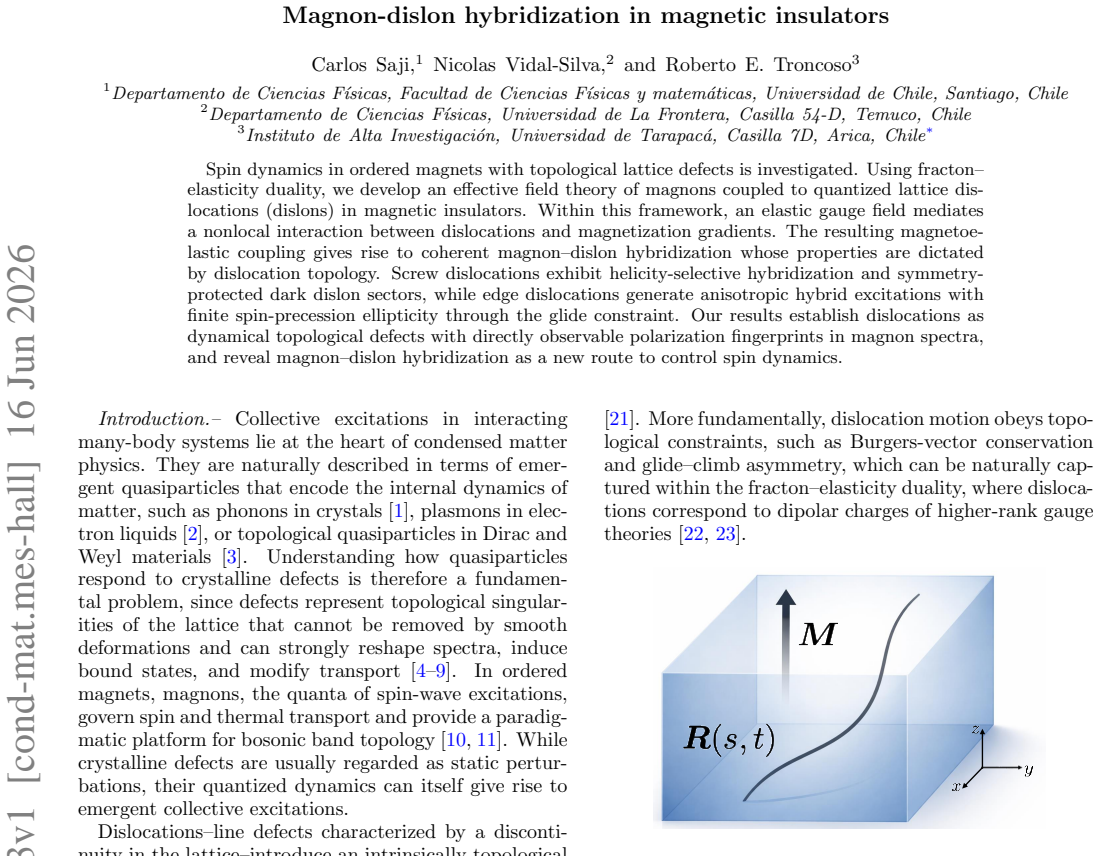
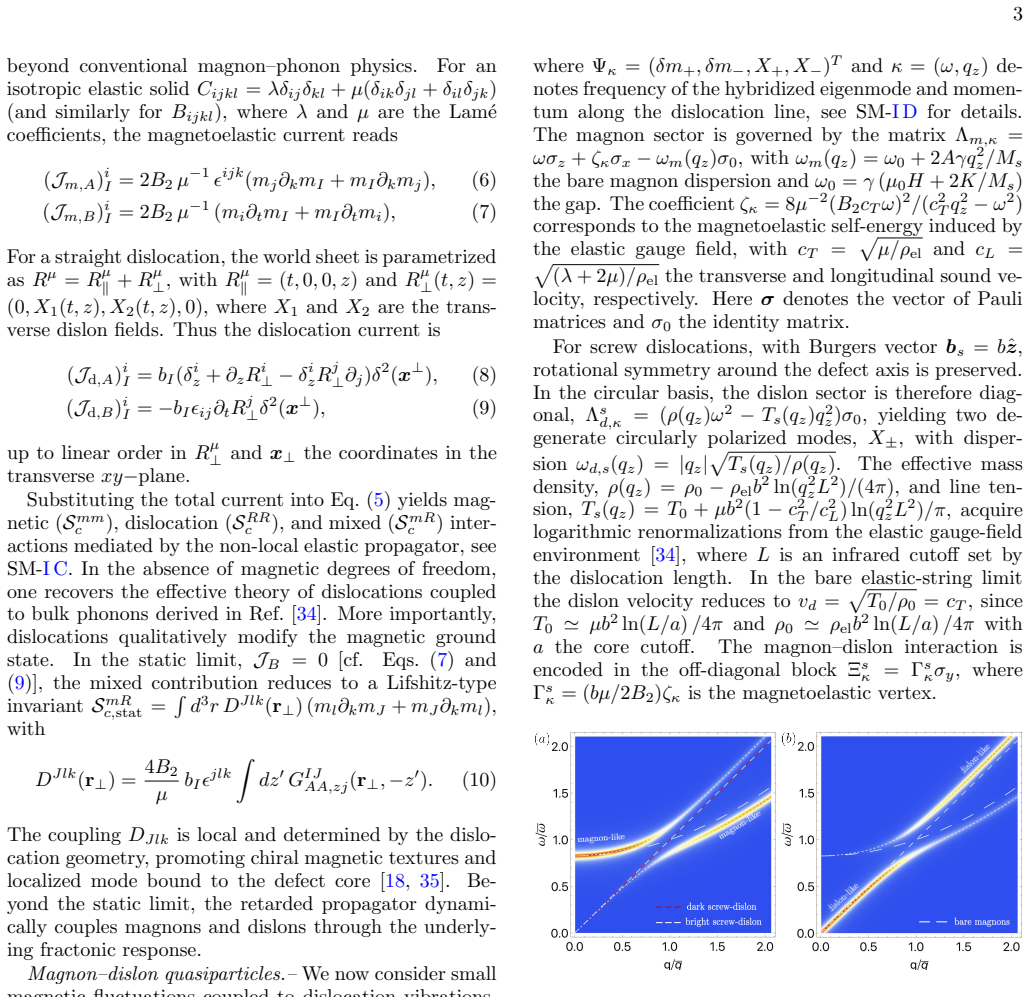
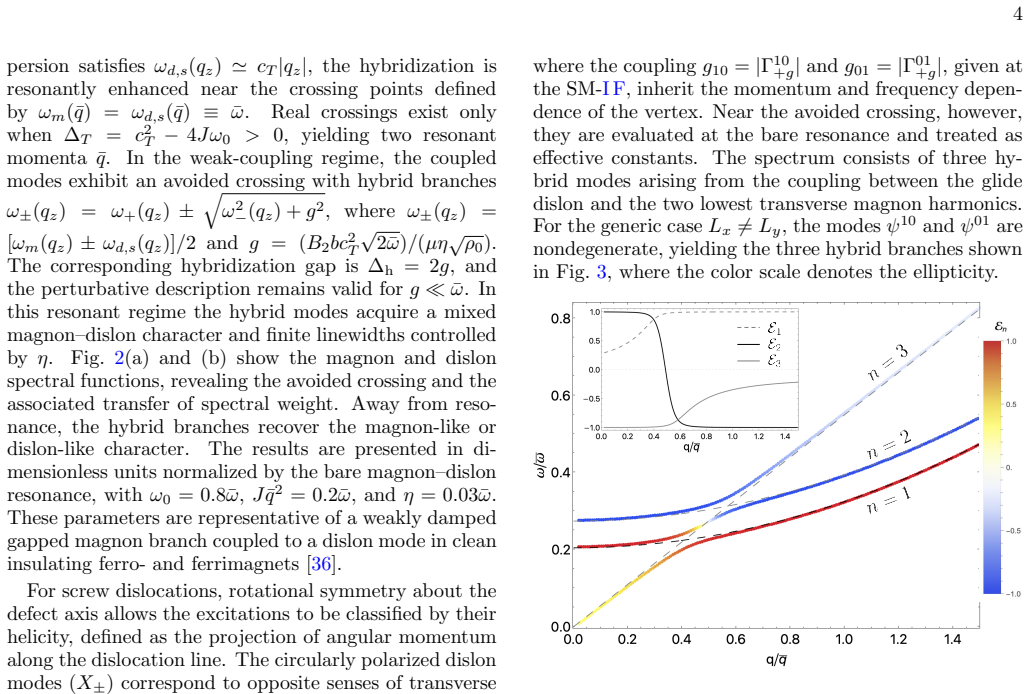
Using fracton-elasticity duality, an effective field theory is constructed in which an elastic gauge field mediates nonlocal coupling between quantized dislocations and magnetization gradients in magnetic insulators. The resulting magnetoelastic coupling gives rise to coherent magnon-dislon hybridization whose properties are dictated by dislocation topology. Screw dislocations exhibit helicity-selective hybridization and symmetry-protected dark dislon sectors, while edge dislocations generate anisotropic hybrid excitations with finite spin-precession ellipticity through the glide constraint.
What carries the argument
The elastic gauge field that mediates nonlocal interaction between dislocations and magnetization gradients.
If this is right
- Dislocations function as dynamical topological defects that imprint polarization fingerprints directly onto magnon spectra.
- Magnon-dislon hybridization supplies a route to control spin dynamics through lattice topology.
- Screw dislocations produce helicity-selective coupling and protected dark states.
- Edge dislocations produce anisotropic hybrid excitations carrying finite spin-precession ellipticity.
Where Pith is reading between the lines
- The same duality framework could be applied to other topological defects such as disclinations to predict additional hybrid modes.
- Microwave or Brillouin-light-scattering experiments on strained magnetic films could test for the predicted anisotropic ellipticity in edge-dislocation samples.
- Engineering arrays of specific dislocation types might allow selective filtering of magnon helicities in spintronic devices.
Load-bearing premise
Fracton-elasticity duality supplies a consistent effective field theory in which an elastic gauge field couples quantized dislocations to magnetization gradients.
What would settle it
Detection or absence of helicity-selective hybridization together with symmetry-protected dark sectors in the magnon spectrum of a magnetic insulator containing screw dislocations.
Figures
read the original abstract
Spin dynamics in ordered magnets with topological lattice defects is investigated. Using fracton--elasticity duality, we develop an effective field theory of magnons coupled to quantized lattice dislocations (dislons) in magnetic insulators. Within this framework, an elastic gauge field mediates a nonlocal interaction between dislocations and magnetization gradients. The resulting magnetoelastic coupling gives rise to coherent magnon-dislon hybridization whose properties are dictated by dislocation topology. Screw dislocations exhibit helicity-selective hybridization and symmetry-protected dark dislon sectors, while edge dislocations generate anisotropic hybrid excitations with finite spin-precession ellipticity through the glide constraint. Our results establish dislocations as dynamical topological defects with directly observable polarization fingerprints in magnon spectra, and reveal magnon-dislon hybridization as a new route to control spin dynamics.
Editorial analysis
A structured set of objections, weighed in public.
Referee Report
Summary. The manuscript develops an effective field theory for spin dynamics in magnetic insulators containing topological lattice defects. Using fracton-elasticity duality, it couples magnons to quantized dislocations (termed dislons) via an elastic gauge field that mediates nonlocal magnetoelastic interactions. The central claims are that this produces coherent magnon-dislon hybridization whose character is fixed by dislocation topology: screw dislocations yield helicity-selective hybridization plus symmetry-protected dark dislon sectors, while edge dislocations produce anisotropic hybrid modes with finite spin-precession ellipticity enforced by the glide constraint. The work positions dislocations as dynamical defects with directly observable polarization signatures in magnon spectra.
Significance. If the effective theory is internally consistent and the 3D lift of the duality is rigorously controlled, the results would identify a new mechanism for defect-mediated control of spin dynamics with potential experimental fingerprints in magnon spectra. The framework introduces quantized dislons and an elastic gauge field as dynamical entities; credit is due for attempting to link fracton-inspired ideas to concrete magnetoelastic observables, though the absence of external benchmarks or independent calculations limits immediate impact assessment.
major comments (1)
- [Abstract, §1] Abstract and §1: The central claim that fracton-elasticity duality produces a consistent elastic gauge field mediating nonlocal coupling between quantized dislons and magnetization gradients rests on lifting a 2D construction to 3D magnetic insulators. No explicit check is provided that the resulting commutation relations for dislon operators, the form of the magnetoelastic term, and the glide constraint for edge dislocations are preserved without extraneous longitudinal modes or violations of spin-precession ellipticity. This is load-bearing for the predicted helicity-selective hybridization and dark sectors.
minor comments (2)
- Notation for the elastic gauge field and dislon operators should be introduced with explicit commutation relations in the main text rather than assumed from the duality reference.
- [Abstract] The abstract states that results are 'dictated by dislocation topology' but does not clarify whether this follows from symmetry alone or requires additional assumptions about the magnetoelastic coupling strength.
Simulated Author's Rebuttal
We thank the referee for their careful reading of the manuscript and for identifying the need for explicit verification of the 3D lift. We address the concern below and will incorporate additional derivations to strengthen the presentation.
read point-by-point responses
-
Referee: [Abstract, §1] Abstract and §1: The central claim that fracton-elasticity duality produces a consistent elastic gauge field mediating nonlocal coupling between quantized dislons and magnetization gradients rests on lifting a 2D construction to 3D magnetic insulators. No explicit check is provided that the resulting commutation relations for dislon operators, the form of the magnetoelastic term, and the glide constraint for edge dislocations are preserved without extraneous longitudinal modes or violations of spin-precession ellipticity. This is load-bearing for the predicted helicity-selective hybridization and dark sectors.
Authors: We agree that an explicit check of the commutation relations, magnetoelastic term, and glide constraint under the 3D lift is not provided in the current manuscript. The effective theory is constructed by extending the 2D fracton-elasticity duality while preserving the topological character of the dislocations and the form of the elastic gauge field. To address the concern directly, we will add a new appendix that (i) derives the dislon commutation relations from the 3D duality, (ii) confirms the magnetoelastic coupling term remains free of extraneous longitudinal modes, and (iii) verifies that the glide constraint for edge dislocations is preserved without altering the required spin-precession ellipticity. These additions will explicitly support the helicity-selective hybridization and symmetry-protected dark sectors. revision: yes
Circularity Check
No significant circularity detected
full rationale
The derivation starts from fracton-elasticity duality as an external input to construct the effective field theory, then derives hybridization properties from dislocation topology and the glide constraint. No quoted step shows a self-definitional reduction, a fitted parameter renamed as a prediction, or a load-bearing self-citation chain that collapses the central claims back to the paper's own inputs. The framework is presented as self-contained once the duality is adopted, with observable predictions (helicity selectivity, dark sectors, ellipticity) following from the stated magnetoelastic coupling rather than being presupposed by it.
Axiom & Free-Parameter Ledger
axioms (1)
- domain assumption fracton-elasticity duality applies to magnetic insulators and permits an effective field theory of magnons coupled to dislocations
invented entities (2)
-
dislons
no independent evidence
-
elastic gauge field
no independent evidence
Reference graph
Works this paper leans on
-
[1]
N. W. Ashcroft and N. D. Mermin,Solid State Physics (Holt, Rinehart and Winston, 1976)
1976
-
[2]
Pines and P
D. Pines and P. Nozi` eres,The Theory of Quantum Liq- uids(W. A. Benjamin, 1966)
1966
-
[3]
N. P. Armitage, E. J. Mele, and A. Vishwanath, Weyl and dirac semimetals in three-dimensional solids, Reviews of Modern Physics90, 015001 (2018)
2018
-
[4]
Friedel,Dislocations, Addison-Wesley series in metal- lurgy and materials (Pergamon Press; [U.S.A
J. Friedel,Dislocations, Addison-Wesley series in metal- lurgy and materials (Pergamon Press; [U.S.A. ed. dis- tributed by Addison-Wesley Publishing Company, Read- ing, Mass.], 1964)
1964
-
[5]
J. C. Y. Teo and C. L. Kane, Topological defects and gapless modes in insulators and superconductors, Phys. Rev. B82, 115120 (2010)
2010
-
[6]
Slager, A
R.-J. Slager, A. Mesaros, V. Juriˇ ci´ c, and J. Zaanen, In- terplay between electronic topology and crystal symme- try: Dislocation-line modes in topological band insula- tors, Phys. Rev. B90, 241403 (2014)
2014
-
[7]
Lund and B
F. Lund and B. Scheihing H., Scattering of phonons by quantum-dislocation segments in an elastic continuum, Phys. Rev. B99, 214102 (2019)
2019
-
[8]
Churochkin and F
D. Churochkin and F. Lund, Diffusion of elastic waves in a continuum solid with a random array of pinned dislo- cations, Phys. Rev. B106, 024105 (2022)
2022
-
[9]
Fall and K
A. Fall and K. Dayal, Dislocation patterning as a mech- anism for flat band formation, Phys. Rev. B111, 155116 (2025)
2025
-
[10]
A. V. Chumak, A. A. Serga, and B. Hillebrands, Magnon spintronics, Nature Communications6, 8171 (2015)
2015
-
[11]
A. Mook, J. Henk, and I. Mertig, Edge states in topolog- ical magnon insulators, Phys. Rev. B90, 024412 (2014)
2014
-
[12]
J. P. Hirth and J. Lothe,Theory of Dislocations(Wiley, 1982)
1982
-
[13]
Y. Ran, Y. Zhang, and A. Vishwanath, One-dimensional topologically protected modes in topological insulators with lattice dislocations, Nature Physics5, 298–303 (2009)
2009
-
[14]
H. Xue, D. Jia, Y. Ge, Y.-j. Guan, Q. Wang, S.-q. Yuan, H.-x. Sun, Y. D. Chong, and B. Zhang, Observa- tion of dislocation-induced topological modes in a three- dimensional acoustic topological insulator, Phys. Rev. Lett.127, 214301 (2021)
2021
-
[15]
L. Ye, C. Qiu, M. Xiao, T. Li, J. Du, M. Ke, and Z. Liu, Topological dislocation modes in three- dimensional acoustic topological insulators, Nature Com- munications13, 10.1038/s41467-022-28182-2 (2022)
-
[16]
C. Saji, N. Vidal-Silva, A. S. Nunez, and R. E. Troncoso, Topological magnonic dislocation modes, Phys. Rev. B 111, 165146 (2025)
2025
-
[17]
C. Saji and R. E. Troncoso, Quantum geometry, localiza- tion, and topological bounds of spin fluctuations (2025), arXiv:2512.17454 [cond-mat.mes-hall]
arXiv 2025
-
[18]
C. Larronde, I. Castro, A. S. Nunez, R. E. Troncoso, and N. Vidal-Silva, Scattering theory of spin waves by lat- tice dislocation defects (2026), arXiv:2602.09546 [cond- mat.mes-hall]
arXiv 2026
-
[19]
M. Li, Q. Song, T.-H. Liu, L. Meroueh, G. D. Mahan, M. S. Dresselhaus, and G. Chen, Tailoring supercon- ductivity with quantum dislocations, Nano Letters17, 4604–4610 (2017)
2017
-
[20]
M. Li, Y. Tsurimaki, Q. Meng, N. Andrejevic, Y. Zhu, G. D. Mahan, and G. Chen, Theory of elec- tron–phonon–dislon interacting system—toward a quan- tized theory of dislocations, New Journal of Physics20, 023010 (2018)
2018
-
[21]
Fomethe and G
A. Fomethe and G. Maugin, Influence of dislocations on magnon-phonon couplings, International Journal of En- gineering Science20, 1125–1144 (1982)
1982
-
[22]
Pretko and L
M. Pretko and L. Radzihovsky, Fracton-elasticity duality, Phys. Rev. Lett.120, 195301 (2018)
2018
-
[23]
Pretko, Z
M. Pretko, Z. Zhai, and L. Radzihovsky, Crystal-to- fracton tensor gauge theory dualities, Phys. Rev. B100, 134113 (2019)
2019
-
[24]
Huebl, C
H. Huebl, C. W. Zollitsch, J. Lotze, F. Hocke, M. Greifen- stein, A. Marx, R. Gross, and S. T. B. Goennenwein, High cooperativity in coupled microwave resonator ferri- magnetic insulator hybrids, Phys. Rev. Lett.111, 127003 (2013)
2013
-
[25]
Tabuchi, T
Y. Tabuchi, T. Ishikawa, A. Ishikawa, R. Yamazaki, K. Usami, and Y. Nakamura, Coherent coupling between a ferromagnetic magnon and a superconducting qubit, Science349, 405 (2015)
2015
-
[26]
Zhang, C.-L
X. Zhang, C.-L. Zou, L. Jiang, and H. X. Tang, Strongly coupled magnons and cavity microwave photons, Phys. 6 Rev. Lett.113, 156401 (2014)
2014
-
[27]
S. O. Demokritov, B. Hillebrands, and A. N. Slavin, Brillouin light scattering studies of confined spin waves: linear and nonlinear confinement, Phys. Rep.348, 441 (2001)
2001
-
[28]
Streib, N
S. Streib, N. Vidal-Silva, K. Shen, and G. E. W. Bauer, Magnon-phonon interactions in magnetic insula- tors, Phys. Rev. B99, 184442 (2019)
2019
-
[29]
H. T. Simensen, R. E. Troncoso, A. Kamra, and A. Brataas, Magnon-polarons in cubic collinear antifer- romagnets, Phys. Rev. B99, 064421 (2019)
2019
-
[30]
H. T. Simensen, A. Kamra, R. E. Troncoso, and A. Brataas, Magnon decay theory of gilbert damping in metallic antiferromagnets, Phys. Rev. B101, 020403 (2020)
2020
-
[31]
J. D. Mella, L. E. F. F. Torres, and R. E. Troncoso, Chiral magnon-polaron edge states in heisenberg-kitaev magnets, Phys. Rev. B110, 104433 (2024)
2024
-
[32]
It satisfies a compatibility relation of the form εik¯ϵjℓ∂i∂j¯ϵkℓ =ρ, withρencoding the defect density
-
[33]
This constraint can be solved identically byT=∗dA, where∗denotes the Hodge-star operator andAthe gauge field
-
[34]
J.-Y. Lin, I. Z. Rothstein, and S. Pavaskar, Dispersion relations for dislocation modes and their sensitivity to the lattice structure, Phys. Rev. B112, 184316 (2025)
2025
-
[35]
Latorre, J
M. Latorre, J. Barra, J. Pablo Vera, J. Martinez, M. Cas- tro, S. Allende, and A. S Nunez, Dislocation-based skyrmion traps, Journal of Physics: Condensed Matter 38, 165802 (2026)
2026
-
[36]
A. G. Gurevich and G. A. Melkov,Magnetization Oscil- lations and Waves(CRC Press, Boca Raton, FL, 1996)
1996
-
[37]
S. W. Lovesey,Theory of Neutron Scattering from Con- densed Matter(Oxford University Press, 1984)
1984
-
[38]
Rondin, J.-P
L. Rondin, J.-P. Tetienne, T. Hingant, J.-F. Roch, P. Maletinsky, and V. Jacques, Magnetometry with nitrogen-vacancy defects in diamond, Reports on Progress in Physics77, 056503 (2014)
2014
-
[39]
F. Casola, T. van der Sar, and A. Yacoby, Probing condensed matter physics with magnetometry based on nitrogen-vacancy centres in diamond, Nature Reviews Materials3, 10.1038/natrevmats.2017.88 (2018)
-
[40]
Elgvin, F
C. Elgvin, F. S. Hage, O. Prytz, K. Elyas, K. H¨ oflich, C. T. Koch, and H. C. Nerl, Advances in momentum- resolved eels of phonons, excitons and plasmons in 2d materials and their heterostructures, Phys. Rev. Mater. 10, 020201 (2026)
2026
-
[41]
Jiang, T
H. Jiang, T. Wang, Z. Zhang, R. Shi, X. Xu, Z. Wang, C. Ma, B. Sheng, F. Liu, W. Ge, P. Wang, B. Shen, P. Gao, L. R. Lindsay, and X. Wang, Single-atom- resolved vibrational spectroscopy of a dislocation, Nano Letters25, 14279–14285 (2025). I. SUPPLEMENT AL MA TERIAL A. Derivation of the total action The gauge structure of elasticity in the presence of top...
2025
-
[42]
The magnetic current–current interaction generates a correction to the quadratic magnon 11 action proportional to the transverse responseR T (κ)
Magnon sector The quadratic magnon action is, S(2) m = Z dκ δm∗ + δm∗ − Λm(κ) δm+ δm− ,(60) where Λ m(κ) =ωσ z +ζ κσx −ω m(qz)σ0, with the bare magnon dispersionω m(qz) =ω 0 +J q 2 z,J= 2Aγ/M s, and ω0 =γ(µ 0H+ 2K/M s). The magnetic current–current interaction generates a correction to the quadratic magnon 11 action proportional to the transverse response...
-
[43]
Dislon sector The bare quadratic action for transverse dislocation fluctuations is S(2) R = 1 2 Z dκ Xa(−κ) ρ0ω2 −T 0q2 z δabXb(κ).(62) The elastic gauge field generates an additional dislon self-energy, S RR,(2) c = Z dκ Xa(−κ)Πab RR(κ)Xb(κ),(63) with Πab RR(κ) =b I bJ h q2 z GIJ,ab AA +ωq z GIJ,ac AB ϵcb +ϵ acGIJ,cb BA +ω 2ϵacGIJ,cd BB ϵdb i .(64) The f...
-
[44]
Total magnon–dislon theory The quadratic interaction between magnons and dislons is given by S mR,(2) c = 2B2 µ Z dκ δma(−κ)V ad(κ)Xd(κ) + h.c. ,(72) where the vertex is V ad(κ) =b I h q2 z GIz,ac AA ϵcd −ω 2ϵac GIz,cd BB +G Id,cz BB −ωq z GId,az AB +G Iz,ad AB −ϵ acGIz,ce BA ϵed i .(73) Thus the coupled magnon–dislon theory has the compact form Seff = Z ...
discussion (0)
Sign in with ORCID, Apple, or X to comment. Anyone can read and Pith papers without signing in.