Shrinkage priors for Bayesian Substitute Confounders
Pith reviewed 2026-06-26 22:59 UTC · model grok-4.3
The pith
Shrinkage priors on Bayesian factor models produce substitute confounders that preserve multi-cause overlap for consistent causal estimation.
A machine-rendered reading of the paper's core claim, the machinery that carries it, and where it could break.
Core claim
A Bayesian factor assignment framework with shrinkage priors learns sparse substitute confounders that retain coarse multi-cause dependence. The theory is stated at the level of posterior concentration, factor score contraction, and overlap-preserving assignment geometry and does not rely on a particular shrinkage prior. Under these conditions, the proposed regression-adjusted estimators are consistent for mean potential outcomes when the corresponding latent variable identification assumptions hold.
What carries the argument
Bayesian factor assignment framework with shrinkage priors that favor low-dimensional factors supported by multiple causes, discourage single-cause factors, and induce an ordering of latent factors through progressive shrinkage.
If this is right
- The regression-adjusted estimators remain consistent for mean potential outcomes under the stated posterior concentration and latent identification conditions.
- Shrinkage priors systematically discourage factors that encode only single-cause variation or collapse treatment overlap.
- The framework induces an ordering among latent factors through progressive shrinkage without requiring a specific prior form.
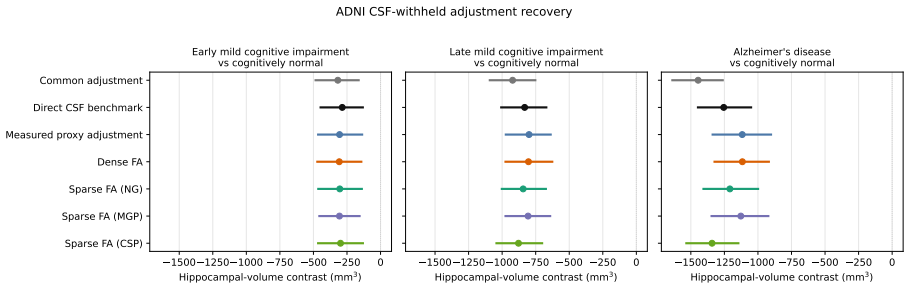
- In applications, sparse substitute scores can recover much of the adjustment obtained by conditioning directly on observed biomarkers.
Where Pith is reading between the lines
- The same shrinkage mechanism could be tested on other multi-cause observational datasets where direct biomarker measurement is unavailable.
- Diagnostics for factor collapse could be extended to monitor overlap geometry in real time during posterior sampling.
- The ordering induced by progressive shrinkage may offer a built-in way to select the number of substitute factors without separate cross-validation.
Load-bearing premise
The latent variable identification assumptions hold and the posterior concentrates on factors that preserve overlap geometry.
What would settle it
A simulation or dataset in which the latent confounder satisfies the identification assumptions yet the fitted factors produce scores whose posterior fails to contract while maintaining overlap, resulting in inconsistent estimators for the mean potential outcomes.
Figures


read the original abstract
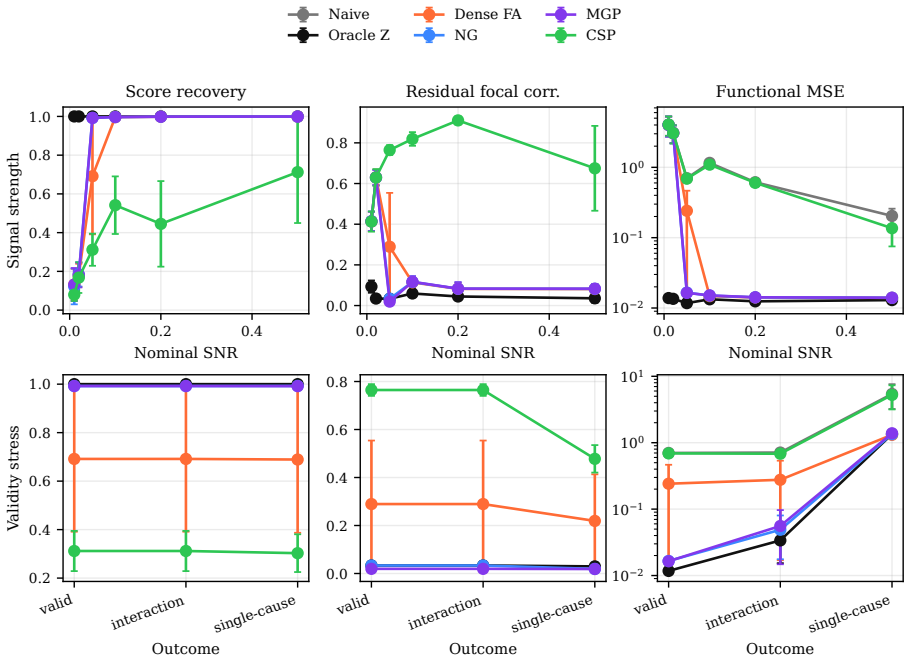
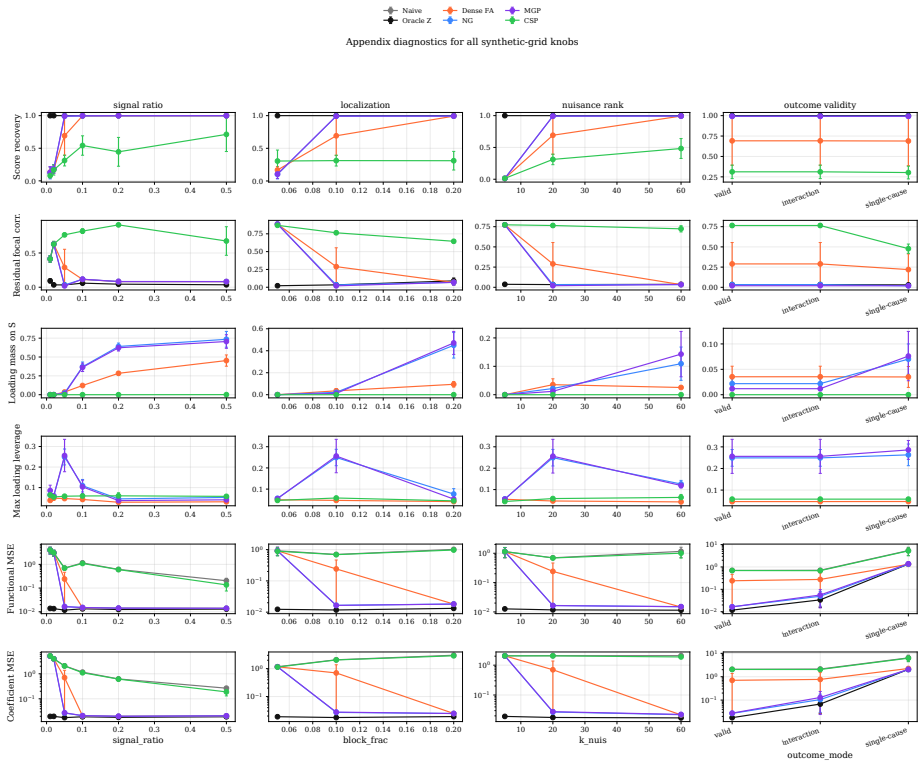
Multi-cause observational studies contain information about unmeasured confounding through the dependence structure among causes. However, literal imputation of the unobserved confounder is often more complex than learning a lower-dimensional substitute score that preserves the shared assignment variation needed for stable causal adjustment. The deconfounder (Wang and Blei, 2019) and related substitute confounder methods exploit this idea, but flexible assignment models can fit the joint distribution of the causes while producing scores that over-encode the treatment vector, collapse overlap, or capture single-cause variation. We develop a Bayesian factor assignment framework for learning sparse substitute confounders that retain coarse multi-cause dependence with shrinkage priors. The theory is stated at the level of posterior concentration, factor score contraction, and overlap-preserving assignment geometry and therefore does not rely on a particular shrinkage prior. Under these conditions, the proposed regression-adjusted estimators are consistent for mean potential outcomes when the corresponding latent variable identification assumptions hold. Shrinkage priors provide a natural tool for latent structural learning: they favour low-dimensional factors supported by multiple causes, discourage effectively single-cause factors, and induce an ordering of the latent factors through progressive shrinkage. Synthetic experiments illustrate the roles of signal strength, outcome validity, and geometry-aware regularization. In an Alzheimer's Disease Neuroimaging Initiative (ADNI) baseline analysis, sparse substitute scores recover much of the adjustment obtained by directly conditioning on invasive cerebrospinal-fluid biomarkers, while collapse diagnostics identify when fitted factors reduce to individual observed measurements.
Editorial analysis
A structured set of objections, weighed in public.
Referee Report
Summary. The manuscript develops a Bayesian factor assignment model equipped with shrinkage priors to learn sparse substitute confounders that capture shared multi-cause variation while avoiding over-encoding of the treatment vector or collapse of overlap. The central theoretical result states consistency of the resulting regression-adjusted estimators for mean potential outcomes, conditional on posterior concentration, factor-score contraction, and overlap-preserving assignment geometry together with the usual latent-variable identification assumptions; the argument is deliberately formulated at this general level and does not depend on any particular shrinkage prior. Synthetic experiments examine the roles of signal strength, outcome validity, and geometry-aware regularization, while an ADNI baseline analysis compares the sparse substitute scores against direct conditioning on cerebrospinal-fluid biomarkers.
Significance. If the stated posterior-concentration and geometry-preservation conditions can be verified in practice, the framework supplies a principled, prior-agnostic route to substitute-confounder estimation that directly targets the multi-cause dependence structure required for stable adjustment. The emphasis on shrinkage-induced ordering of latent factors and the explicit diagnostics for factor collapse constitute concrete methodological contributions. The ADNI illustration provides an existence proof that the approach can recover much of the adjustment obtained from invasive biomarkers, which is a non-trivial empirical demonstration in a high-stakes domain.
minor comments (3)
- [Abstract / §1] The abstract and introduction both refer to “overlap-preserving assignment geometry” without a concise definition or pointer to the precise mathematical statement; a short displayed equation or boxed definition early in the paper would improve readability.
- [§5] Table or figure captions for the synthetic experiments should explicitly state the sample size, number of Monte Carlo replications, and the precise metric used to assess “collapse,” so that readers can judge the reported improvements without returning to the main text.
- [§6] The ADNI analysis reports that sparse scores “recover much of the adjustment,” but does not provide a quantitative comparison (e.g., change in estimated treatment effect or width of confidence intervals) relative to the biomarker-adjusted benchmark; adding this would strengthen the practical claim.
Simulated Author's Rebuttal
We thank the referee for their careful reading and positive assessment of the manuscript. The referee summary and significance statement accurately reflect the paper's contributions and the level at which the consistency result is stated. No major comments were raised in the report, and the recommendation is for minor revision. We will incorporate any editorial or minor clarifications in the revised version.
Circularity Check
No significant circularity identified
full rationale
The paper's central consistency claim for regression-adjusted estimators is explicitly conditioned on external latent variable identification assumptions plus general posterior concentration, factor score contraction, and overlap-preserving geometry properties. It states that the theory does not rely on any particular shrinkage prior and is framed at the level of these abstract properties rather than specific fitted quantities or self-referential definitions. No equations reduce the claimed result to inputs by construction, no fitted parameters are relabeled as predictions, and no load-bearing self-citation chain is invoked. The derivation chain remains self-contained against the stated assumptions.
Axiom & Free-Parameter Ledger
free parameters (1)
- shrinkage hyperparameters
axioms (2)
- domain assumption latent variable identification assumptions hold
- domain assumption posterior concentration on overlap-preserving factors
invented entities (1)
-
sparse substitute confounder factors
no independent evidence
Reference graph
Works this paper leans on
-
[1]
Foundations and Trends in Econometrics , year =
Jushan Bai , title =. Foundations and Trends in Econometrics , year =
-
[2]
Journal of the American Statistical Association , volume=
The blessings of multiple causes , author=. Journal of the American Statistical Association , volume=. 2019 , publisher=
2019
-
[3]
Neurobiology of Aging , volume=
The dynamics of Alzheimer's disease biomarkers in the Alzheimer's Disease Neuroimaging Initiative cohort , author=. Neurobiology of Aging , volume=. 2010 , publisher=
2010
-
[4]
Generalizability of findings from a clinical sample to a community-based sample: A comparison of
Gianattasio, Kan Z and Bennett, Erin E and Wei, Jingkai and Mehrotra, Megha L and Mosley, Thomas and Gottesman, Rebecca F and Wong, Dean F and Stuart, Elizabeth A and Griswold, Michael E and Couper, David and Glymour, M Maria and Power, Melinda C and Alzheimer's Disease Neuroimaging Initiative , journal=. Generalizability of findings from a clinical sampl...
-
[5]
Screening and enrollment of underrepresented ethnocultural and educational populations in the Alzheimer's Disease Neuroimaging Initiative (
Ashford, Miriam T and Raman, Rema and Miller, Garrett and Donohue, Michael C and Okonkwo, Ozioma C and Mindt, Monica Rivera and Nosheny, Rachel L and Coker, Godfrey A and Petersen, Ronald C and Aisen, Paul S and Weiner, Michael W and Alzheimer's Disease Neuroimaging Initiative , journal=. Screening and enrollment of underrepresented ethnocultural and educ...
-
[6]
2017 , publisher=
Fundamentals of nonparametric Bayesian inference , author=. 2017 , publisher=
2017
-
[7]
Linear Algebra and its Applications , volume=
Generic global indentification in factor analysis , author=. Linear Algebra and its Applications , volume=. 1997 , publisher=
1997
-
[8]
New approaches to Bayesian consistency , author=
-
[9]
Linear algebra and its applications , volume=
Three-way arrays: rank and uniqueness of trilinear decompositions, with application to arithmetic complexity and statistics , author=. Linear algebra and its applications , volume=. 1977 , publisher=
1977
-
[11]
Biometrika , volume=
Identifiability of causal effects with multiple causes and a binary outcome , author=. Biometrika , volume=. 2022 , publisher=
2022
-
[12]
Nature genetics , volume=
A unified mixed-model method for association mapping that accounts for multiple levels of relatedness , author=. Nature genetics , volume=. 2006 , publisher=
2006
-
[13]
Biometrika , volume=
Kernel methods for causal functions: dose, heterogeneous and incremental response curves , author=. Biometrika , volume=. 2024 , publisher=
2024
-
[14]
Journal of Machine Learning Research , volume=
Directed Cyclic Graphs for Simultaneous Discovery of Time-Lagged and Instantaneous Causality from Longitudinal Data Using Instrumental Variables , author=. Journal of Machine Learning Research , volume=
-
[15]
Mueller, Susanne G and Weiner, Michael W and Thal, Leon J and Petersen, Ronald C and Jack, Clifford and Jagust, William and Trojanowski, John Q and Toga, Arthur W and Beckett, Laurel , journal=. The. 2005 , publisher=
2005
-
[16]
Journal of medical Internet research , volume=
Real-life gait performance as a digital biomarker for motor fluctuations: the Parkinson@ Home validation study , author=. Journal of medical Internet research , volume=. 2020 , publisher=
2020
-
[17]
Journal of the Royal Statistical Society Series B: Statistical Methodology , pages=
Augmented balancing weights as linear regression , author=. Journal of the Royal Statistical Society Series B: Statistical Methodology , pages=. 2025 , publisher=
2025
-
[18]
Artificial intelligence and statistics , pages=
Handling sparsity via the horseshoe , author=. Artificial intelligence and statistics , pages=. 2009 , organization=
2009
-
[19]
Bayesian Analysis , volume=
Inference with Normal-Gamma prior distributions in regression problems , author=. Bayesian Analysis , volume=
-
[20]
Advances in Neural Information Processing Systems , volume=
Using embeddings to correct for unobserved confounding in networks , author=. Advances in Neural Information Processing Systems , volume=
-
[22]
Annals of Statistics , volume =
Tensor Decompositions and Sparse Log--linear Models , author =. Annals of Statistics , volume =
-
[23]
and van der Vaart, Aad W
Ghosal, Subhashis and Ghosh, Jayanta K. and van der Vaart, Aad W. , title =. Annals of Statistics , year =
-
[24]
arXiv preprint arXiv:2406.19604 , year=
Geodesic Causal Inference , author=. arXiv preprint arXiv:2406.19604 , year=
-
[25]
Journal of the National Cancer institute , volume=
Smoking and lung cancer: recent evidence and a discussion of some questions , author=. Journal of the National Cancer institute , volume=. 1959 , publisher=
1959
-
[26]
The American Economic Review , volume=
Nonparametric bounds on treatment effects , author=. The American Economic Review , volume=. 1990 , publisher=
1990
-
[27]
Annals of internal medicine , volume=
Sensitivity analysis in observational research: introducing the E-value , author=. Annals of internal medicine , volume=. 2017 , publisher=
2017
-
[28]
Journal of the Royal Statistical Society Series B: Statistical Methodology , volume=
Making sense of sensitivity: Extending omitted variable bias , author=. Journal of the Royal Statistical Society Series B: Statistical Methodology , volume=. 2020 , publisher=
2020
-
[30]
Biometrika , volume=
Identifying causal effects with proxy variables of an unmeasured confounder , author=. Biometrika , volume=. 2018 , publisher=
2018
-
[31]
Biometrika , pages=
Measurement bias and effect restoration in causal inference , author=. Biometrika , pages=. 2014 , publisher=
2014
-
[32]
Journal of the American statistical Association , volume=
Identification of causal effects using instrumental variables , author=. Journal of the American statistical Association , volume=. 1996 , publisher=
1996
-
[33]
Review of Economic Studies , volume=
Inference on treatment effects after selection among high-dimensional controls , author=. Review of Economic Studies , volume=. 2014 , publisher=
2014
-
[34]
2018 , publisher=
Double/debiased machine learning for treatment and structural parameters , author=. 2018 , publisher=
2018
-
[35]
Journal of Econometrics , volume=
Robust inference on average treatment effects with possibly more covariates than observations , author=. Journal of Econometrics , volume=. 2015 , publisher=
2015
-
[36]
Journal of the American Statistical Association , volume=
Matrix completion methods for causal panel data models , author=. Journal of the American Statistical Association , volume=. 2021 , publisher=
2021
-
[37]
Political Analysis , volume=
Generalized synthetic control method: Causal inference with interactive fixed effects models , author=. Political Analysis , volume=. 2017 , publisher=
2017
-
[38]
Journal of the American Statistical Association , volume=
Estimation and inference of heterogeneous treatment effects using random forests , author=. Journal of the American Statistical Association , volume=. 2018 , publisher=
2018
-
[41]
Journal of the Royal Statistical Society: Series B (Methodological) , volume=
Assessing sensitivity to an unobserved binary covariate in an observational study with binary outcome , author=. Journal of the Royal Statistical Society: Series B (Methodological) , volume=. 1983 , publisher=
1983
-
[42]
Journal of Econometrics , volume=
Overlap in observational studies with high-dimensional covariates , author=. Journal of Econometrics , volume=. 2021 , publisher=
2021
-
[43]
1997 , publisher=
Foundations of modern probability , author=. 1997 , publisher=
1997
-
[44]
Journal of Multivariate Analysis , volume =
Olav Kallenberg , title =. Journal of Multivariate Analysis , volume =
-
[45]
arXiv preprint arXiv:2503.05024 , year=
Kernel-based estimators for functional causal effects , author=. arXiv preprint arXiv:2503.05024 , year=
-
[46]
arXiv preprint arXiv:2003.04948 , year=
Towards clarifying the theory of the deconfounder , author=. arXiv preprint arXiv:2003.04948 , year=
arXiv 2003
-
[47]
Journal of the American Statistical Association , volume=
The blessings of multiple causes: Rejoinder , author=. Journal of the American Statistical Association , volume=. 2019 , publisher=
2019
-
[49]
Biometrika , volume=
Causal diagrams for empirical research , author=. Biometrika , volume=. 1995 , publisher=
1995
-
[50]
, author=
Estimating causal effects of treatments in randomized and nonrandomized studies. , author=. Journal of educational Psychology , volume=. 1974 , publisher=
1974
-
[51]
2019 , publisher=
Ogburn, Elizabeth L and Shpitser, Ilya and Tchetgen, Eric J Tchetgen , journal=. 2019 , publisher=
2019
-
[52]
2013 , month = jan, note =
Tim Austin , title =. 2013 , month = jan, note =
2013
-
[53]
Journal of Machine Learning Research , year =
Samuel Heaps , title =. Journal of Machine Learning Research , year =
-
[54]
Journal of the American Statistical Association , volume=
Dirichlet--Laplace priors for optimal shrinkage , author=. Journal of the American Statistical Association , volume=. 2015 , publisher=
2015
-
[55]
Bernardo and Adrian F
Jose M. Bernardo and Adrian F. M. Smith , title =. 2000 , edition =
2000
-
[56]
Dunson , title =
Anirban Bhattacharya and David B. Dunson , title =. Biometrika , year =
-
[57]
arXiv preprint arXiv:1312.6114 , year=
Auto-encoding variational bayes , author=. arXiv preprint arXiv:1312.6114 , year=
-
[58]
1932 , publisher=
Selected studies of the principle of relative frequency in language , author=. 1932 , publisher=
1932
-
[59]
Statistics & Probability Letters , volume=
A note on the multiplicative gamma process , author=. Statistics & Probability Letters , volume=. 2017 , publisher=
2017
-
[60]
Microarrays, empirical
Efron, Bradley , journal=. Microarrays, empirical. 2008 , publisher=
2008
-
[61]
IEEE Transactions on signal processing , volume=
K-SVD: An algorithm for designing overcomplete dictionaries for sparse representation , author=. IEEE Transactions on signal processing , volume=. 2006 , publisher=
2006
-
[62]
PLoS Genetics , volume=
Analysis of population structure: a unifying framework and novel methods based on sparse factor analysis , author=. PLoS Genetics , volume=. 2010 , publisher=
2010
-
[63]
Biometrika , volume=
Bayesian cumulative shrinkage for infinite factorizations , author=. Biometrika , volume=. 2020 , publisher=
2020
-
[64]
arXiv preprint arXiv:1310.4792 , year=
A latent factor model with a mixture of sparse and dense factors to model gene expression data with confounding effects , author=. arXiv preprint arXiv:1310.4792 , year=
-
[65]
Journal of the American Statistical Association , volume=
Partially collapsed Gibbs samplers: Theory and methods , author=. Journal of the American Statistical Association , volume=. 2008 , publisher=
2008
-
[66]
Biometrika , pages=
Sparse Bayesian infinite factor models , author=. Biometrika , pages=
-
[67]
arXiv preprint arXiv:1802.03426 , year=
Umap: uniform manifold approximation and projection for dimension reduction , author=. arXiv preprint arXiv:1802.03426 , year=
-
[68]
Journal of Machine Learning Research , volume=
Visualizing data using t-SNE , author=. Journal of Machine Learning Research , volume=
-
[69]
Wang, Lianming and Dunson, David B , journal=. Fast. 2011 , publisher=
2011
-
[70]
URL http://yann
The MNIST database of handwritten digits, 1998 , author=. URL http://yann. lecun. com/exdb/mnist , volume=
1998
-
[71]
Notes on optimization on
Tagare, Hemant D , booktitle=. Notes on optimization on. 2011 , publisher=
2011
-
[72]
Raftery, Adrian E and Lewis, Steven M , journal=. [. 1992 , publisher=
1992
-
[73]
M. J. Bayarri and J. O. Berger and F. Liu , title =. Bayesian Analysis , number =
-
[74]
The Journal of Machine Learning Research , volume=
Pymanopt: A python toolbox for optimization on manifolds using automatic differentiation , author=. The Journal of Machine Learning Research , volume=. 2016 , publisher=
2016
-
[75]
Khatri, CG and Mardia, Kanti V , journal=. The von. 1977 , publisher=
1977
-
[76]
Annals of Mathematics , pages=
Bessel functions of matrix argument , author=. Annals of Mathematics , pages=. 1955 , publisher=
1955
-
[77]
Ghahramani, Zoubin and Hinton, Geoffrey E and others , year=. The
-
[78]
Journal of proteome research , Year =
Interactive visual exploration of 3D mass spectrometry imaging data using hierarchical stochastic neighbor embedding reveals spatiomolecular structures at full data resolution , Author =. Journal of proteome research , Year =
-
[79]
The Journal of Immunology , Year =
Using visualization of t-distributed stochastic neighbor embedding to identify immune cell subsets in mouse tumors , Author =. The Journal of Immunology , Year =
-
[80]
1985 , Pages =
Exchangeability and related topics , Author =. 1985 , Pages =
1985
-
[81]
Journal of the Royal Statistical Society: Series B (Methodological) , Year =
On the statistical analysis of dirty pictures , Author =. Journal of the Royal Statistical Society: Series B (Methodological) , Year =
-
[82]
Neural computation , Year =
GTM: The generative topographic mapping , Author =. Neural computation , Year =
-
[83]
IEEE transactions on pattern analysis and machine intelligence , Year =
Combinatorial clustering and the beta negative binomial process , Author =. IEEE transactions on pattern analysis and machine intelligence , Year =
-
[84]
Bernoulli , Year =
Posteriors, conjugacy, and exponential families for completely random measures , Author =. Bernoulli , Year =
-
[85]
IEEE Transactions on Signal Processing , Year =
Compressive sensing on manifolds using a nonparametric mixture of factor analyzers: Algorithm and performance bounds , Author =. IEEE Transactions on Signal Processing , Year =
-
[86]
Signal processing , Year =
Independent component analysis, a new concept? , Author =. Signal processing , Year =
discussion (0)
Sign in with ORCID, Apple, or X to comment. Anyone can read and Pith papers without signing in.