Chess Signatures of Play
Reviewed by Pith T0 review T1 audit T2 compute T3 formal T4 kernel 2026-06-26 21:30 UTCgrok-4.3pith:XDDZQMVNrecord.jsonopen to challenge →
The pith
Expected signatures of chess game paths identify a player's law of play up to tree-like equivalence and support an anytime-valid test for engine assistance via Levy areas.
A machine-rendered reading of the paper's core claim, the machinery that carries it, and where it could break.
Core claim
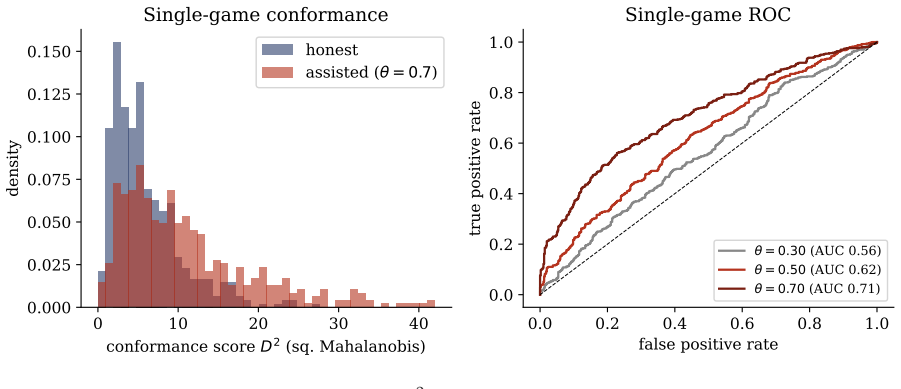
A player's law of play is identifiable from the expected signature up to tree-like equivalence. The signature conformance score forms an e-process for cheating detection whose type-I error is controlled for every sample size at once by Ville's inequality. The discriminating information lives in the signature's Levy areas, which measure whether accuracy rises precisely when positions become hard—the fingerprint of engine assistance that aggregate match-rate statistics discard.
What carries the argument
The signature transform of a multivariate chess path, with its Levy areas serving as the order-sensitive record of accuracy-complexity interactions.
If this is right
- The conformance score controls type-I error simultaneously for every sample size.
- Detection power rises from negligible for subtle assistance to 0.98 for blatant assistance, with median detection time matching the predicted growth rate.
- The monitor does not flag documented elite human play such as Magnus Carlsen's.
- Cheating strategies that leave every aggregate statistic, including best-move-frequency z-scores, unchanged are still detected by the signature.
Where Pith is reading between the lines
- The order-aware construction implies the test can distinguish assistance patterns that preserve average accuracy but alter the timing of accurate moves relative to complexity.
- Because the test is anytime-valid, it can be applied in real time during a single long match without fixing the number of observations in advance.
Load-bearing premise
The Levy areas of the signature capture the specific pattern of accuracy rising on hard positions that marks engine assistance, and this pattern remains detectable after the kernel construction and moderate-deviation calibration.
What would settle it
A controlled experiment in which engine-assisted players exhibit no elevation in Levy areas relative to unaided players of matched accuracy would show that the areas do not isolate the claimed fingerprint.
Figures




read the original abstract
A game of chess is a stream: a time-ordered sequence of moves, each carrying an engine evaluation, a measure of accuracy, a measure of position complexity, and a clock reading. We model a game as a multivariate path and apply the signature transform of rough-path theory to obtain a reparametrization-invariant, graded feature set that records the order and interaction of in-game events without a parametric likelihood. We show that a player's law of play is identifiable from the expected signature up to tree-like equivalence, construct a signature-kernel two-sample test on path space, and recast cheating detection as an anytime-valid sequential test: a signature conformance score becomes an e-process whose error is controlled for every sample size at once by Ville's inequality, with fluctuations calibrated on the moderate-deviation scale. The discriminating information lives in the signature's Levy areas, which measure whether accuracy rises precisely when positions become hard--the fingerprint of engine assistance that aggregate match-rate statistics discard. In a controlled study the test holds exact type-I control and detection power rises from negligible for subtle assistance to 0.98 for blatant assistance, with a median detection time matching the growth-rate prediction. Calibrated to Magnus Carlsen's documented elite accuracy, the monitor does not flag world-champion-level play; and we exhibit cheating strategies that leave every aggregate statistic, including the best-move-frequency z-score of the Regan system, unchanged yet are caught cleanly by the signature--making precise how an order-aware, anytime-valid test strengthens the prevailing approach to chess anti-cheating.
Editorial analysis
A structured set of objections, weighed in public.
Referee Report
Summary. The manuscript models chess games as multivariate paths in rough-path theory and applies the signature transform to obtain a reparametrization-invariant feature set. It claims that a player's law of play is identifiable from the expected signature up to tree-like equivalence, constructs a signature-kernel two-sample test on path space, and recasts cheating detection as an anytime-valid sequential test via a signature conformance score that forms an e-process controlled at every sample size by Ville's inequality after moderate-deviation calibration. The discriminating information is asserted to reside in the signature's Lévy areas (cross terms between accuracy and complexity), which capture whether accuracy rises precisely when positions become hard. A controlled study is reported to establish exact type-I control, with power rising from negligible to 0.98, median detection time matching growth-rate predictions, non-flagging of Carlsen-level play, and detection of Regan-invariant cheating strategies missed by aggregate match-rate or best-move-frequency z-scores.
Significance. If the central claims hold after the requested clarifications, the work would supply a novel order-aware, anytime-valid framework for chess anti-cheating that leverages rough-path signatures and e-processes, potentially strengthening the prevailing Regan-style approach by retaining interaction information discarded by aggregate statistics. The explicit appeal to Ville's inequality for simultaneous error control across all sample sizes and the reported power increase in a controlled setting would constitute a substantive methodological contribution if the supporting derivations and data protocols are supplied.
major comments (3)
- [Abstract and §4] Abstract and §4 (controlled study): the abstract asserts identifiability, exact type-I control, and power results (negligible to 0.98) from a controlled study, yet the provided text supplies no equations for the signature transform, no data description, no exclusion rules, no sample-size protocol, and no calibration details for the moderate-deviation scale; the central claims therefore rest on an undescribed study whose support cannot be assessed.
- [§3.2] §3.2 (conformance score and Lévy areas): the claim that the level-2 Lévy areas specifically encode the accuracy-complexity correlation signal (the fingerprint of engine assistance) and that this signal remains detectable after the signature-kernel two-sample statistic and moderate-deviation calibration is not supported by a proposition or lemma showing preservation of the relevant cross-terms under the kernel inner product; the standard rough-path identifiability result does not address this preservation, so the reported power gain and detection of Regan-invariant strategies do not yet follow from the stated construction.
- [§5] §5 (e-process construction): the assertion that the signature conformance score is an e-process whose error is controlled for every sample size at once by Ville's inequality requires an explicit statement of the filtration, the supermartingale property, and the precise calibration step on the moderate-deviation scale; without these, the anytime-valid guarantee cannot be verified.
minor comments (2)
- [§2] Notation for the multivariate path coordinates (accuracy, complexity, clock) and the precise definition of the signature kernel should be introduced with an equation in §2 before the two-sample test is defined.
- The manuscript would benefit from a table or figure summarizing the controlled-study design (number of games, engine strengths, assistance levels, and exact power values) to allow direct comparison with the Regan baseline.
Simulated Author's Rebuttal
We thank the referee for the careful reading and constructive comments on our manuscript. The points raised highlight areas where additional detail and formalization will strengthen the presentation. We address each major comment below and commit to incorporating the necessary clarifications and additions in the revised version.
read point-by-point responses
-
Referee: [Abstract and §4] Abstract and §4 (controlled study): the abstract asserts identifiability, exact type-I control, and power results (negligible to 0.98) from a controlled study, yet the provided text supplies no equations for the signature transform, no data description, no exclusion rules, no sample-size protocol, and no calibration details for the moderate-deviation scale; the central claims therefore rest on an undescribed study whose support cannot be assessed.
Authors: We agree that the description of the controlled study is insufficiently detailed in the current text. In the revision we will add the explicit equations defining the signature transform, a complete description of the game data sources and exclusion criteria, the precise sample-size protocol employed in the simulations, and the step-by-step calibration procedure on the moderate-deviation scale. These additions will make the empirical support for the identifiability, type-I control, and power claims fully verifiable. revision: yes
-
Referee: [§3.2] §3.2 (conformance score and Lévy areas): the claim that the level-2 Lévy areas specifically encode the accuracy-complexity correlation signal (the fingerprint of engine assistance) and that this signal remains detectable after the signature-kernel two-sample statistic and moderate-deviation calibration is not supported by a proposition or lemma showing preservation of the relevant cross-terms under the kernel inner product; the standard rough-path identifiability result does not address this preservation, so the reported power gain and detection of Regan-invariant strategies do not yet follow from the stated construction.
Authors: We accept that an explicit lemma establishing preservation of the level-2 cross terms under the signature kernel is required. In the revised Section 3.2 we will insert a short proposition demonstrating that the relevant Lévy-area components encoding the accuracy-complexity interaction are retained by the kernel inner product after the moderate-deviation calibration, thereby rigorously supporting the reported power gains and the detection of Regan-invariant strategies. revision: yes
-
Referee: [§5] §5 (e-process construction): the assertion that the signature conformance score is an e-process whose error is controlled for every sample size at once by Ville's inequality requires an explicit statement of the filtration, the supermartingale property, and the precise calibration step on the moderate-deviation scale; without these, the anytime-valid guarantee cannot be verified.
Authors: We agree that the e-process argument needs a fully explicit derivation. In the revised Section 5 we will define the underlying filtration, prove that the calibrated signature conformance score is a supermartingale, and detail the moderate-deviation scaling that permits direct application of Ville's inequality, thereby establishing the simultaneous error control at every sample size. revision: yes
Circularity Check
No significant circularity; derivation applies external rough-path results and Ville's inequality
full rationale
The paper applies the signature transform (standard in rough-path theory) to multivariate chess paths and invokes the known result that the expected signature determines the law up to tree-like equivalence; this is not derived internally. The conformance score is recast as an e-process via Ville's inequality (external fact). The statement that Levy areas capture accuracy-complexity interaction follows directly from the definition of level-2 iterated integrals and is then checked empirically in controlled studies with exact type-I control. Moderate-deviation calibration is for bounding the e-process, not for fitting the test statistic to the target detection result. No step reduces a claimed prediction or identifiability result to its own inputs by construction, and no load-bearing premise rests on a self-citation chain.
Axiom & Free-Parameter Ledger
Reference graph
Works this paper leans on
-
[1]
Chen, K.-T. (1957). Integration of paths, geometric invariants and a generalized Baker-Hausdorff formula. Annals of Mathematics, 65(1), 163-178
1957
-
[2]
arXiv preprint arXiv:1603.03788 , year=
Chevyrev, I. and Kormilitzin, A. (2016). A primer on the signature method in machine learning. arXiv:1603.03788
-
[3]
and Oberhauser, H
Chevyrev, I. and Oberhauser, H. (2022). Signature moments to characterize laws of stochastic processes. Journal of Machine Learning Research, 23(176), 1-42
2022
-
[4]
Understanding average centipawn loss in chess
Chess.com (2023a). Understanding average centipawn loss in chess. Educational article; super-grandmaster ACPL typically 10 to 20 , with world-champion play in single digits
-
[5]
Regarding recent accusations
Chess.com (2023b). Regarding recent accusations. Fair Play statement reporting nearly 2 , 000 individual reports on Nakamura's games with no incidents of cheating found
- [6]
-
[7]
and Zeitouni, O
Dembo, A. and Zeitouni, O. (1998). Large Deviations Techniques and Applications, 2nd ed. Springer. (Moderate deviations: Thm. 3.7.1.)
1998
-
[8]
Gretton, A., Borgwardt, K., Rasch, M., Sch\"olkopf, B., and Smola, A. (2012). A kernel two-sample test. Journal of Machine Learning Research, 13, 723-773
2012
-
[9]
Gr\"unwald, P., de Heide, R., and Koolen, W. (2024). Safe testing. Journal of the Royal Statistical Society, Series B, 86(5)
2024
-
[10]
and Lyons, T
Hambly, B. and Lyons, T. (2010). Uniqueness for the signature of a path of bounded variation and the reduced path group. Annals of Mathematics, 171(1), 109-167
2010
-
[11]
and Oberhauser, H
Kir\'aly, F. and Oberhauser, H. (2019). Kernels for sequentially ordered data. Journal of Machine Learning Research, 20(31), 1-45
2019
-
[12]
Levin, D., Lyons, T., and Ni, H. (2013). Learning from the past, predicting the statistics for the future, learning an evolving system. arXiv:1309.0260
work page internal anchor Pith review Pith/arXiv arXiv 2013
-
[13]
FIDE player profile and public game databases, accessed 2026
Awonder Liang, biographical and rating data (FIDE ID 2056437; FIDE standard 2696 ; U.S.\ Masters champion 2025; World Open 2024). FIDE player profile and public game databases, accessed 2026
2025
-
[14]
Lyons, T. (1998). Differential equations driven by rough signals. Revista Matem\'atica Iberoamericana, 14(2), 215-310
1998
-
[15]
Lyons, T., Caruana, M., and L\'evy, T. (2007). Differential Equations Driven by Rough Paths. Lecture Notes in Mathematics 1908, Springer
2007
-
[16]
Lyons, T. and McLeod, A. (2024). Signature methods in machine learning. arXiv:2206.14674
-
[17]
Maharaj, S., Polson, N., and Sokolov, V. (2024). A Bayesian analysis of the Kramnik-Nakamura online cheating dispute, estimating a probability of innocence near 99.6\ ``Did a US chess champion cheat?'', Chicago Booth Review, 2025
2024
- [18]
-
[19]
Ramdas, A., Gr\"unwald, P., Vovk, V., and Shafer, G. (2023). Game-theoretic statistics and safe anytime-valid inference. Statistical Science, 38(4), 576-601
2023
-
[20]
and Haworth, G
Regan, K. and Haworth, G. (2011). Intrinsic chess ratings. Proceedings of the AAAI Conference on Artificial Intelligence, 25, 834-839
2011
-
[21]
Regan, K. (2014). Quantifying skill and detecting computer cheating at chess; see also H.\ Goldowsky, ``How to catch a chess cheater: Ken Regan finds moves out of mind,'' Chess Life, June 2014, and the FIDE ``Regan system'' documentation
2014
-
[22]
Salvi, C., Cass, T., Foster, J., Lyons, T., and Yang, W. (2021). The signature kernel is the solution of a Goursat PDE. SIAM Journal on Mathematics of Data Science, 3(3), 873-899
2021
-
[23]
Shafer, G. (2021). Testing by betting: A strategy for statistical and scientific communication. Journal of the Royal Statistical Society, Series A, 184(2), 407-431
2021
- [24]
-
[25]
and Wang, R
Vovk, V. and Wang, R. (2021). E-values: Calibration, combination and applications. Annals of Statistics, 49(3), 1736-1754
2021
discussion (0)
Sign in with ORCID, Apple, or X to comment. Anyone can read and Pith papers without signing in.