Adaptive COVID-19 Trajectory Forecasting Using MAB-Inspired Ensemble Weighting
Pith reviewed 2026-06-26 18:41 UTC · model grok-4.3
The pith
MAB-inspired weighting strategies improve epidemic ensemble forecasts when model performance varies over time.
A machine-rendered reading of the paper's core claim, the machinery that carries it, and where it could break.
Core claim
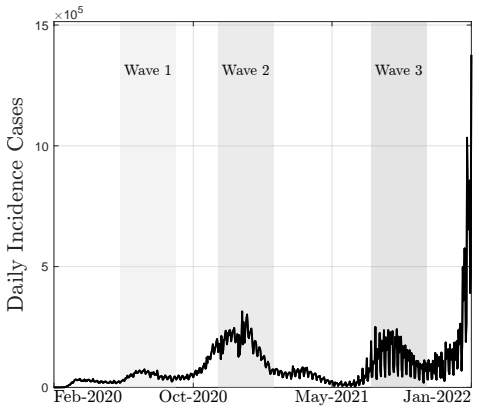
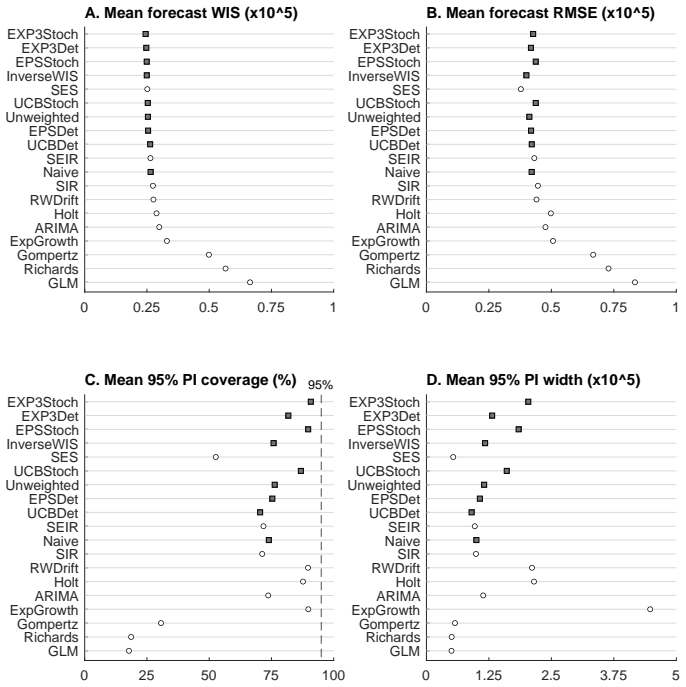
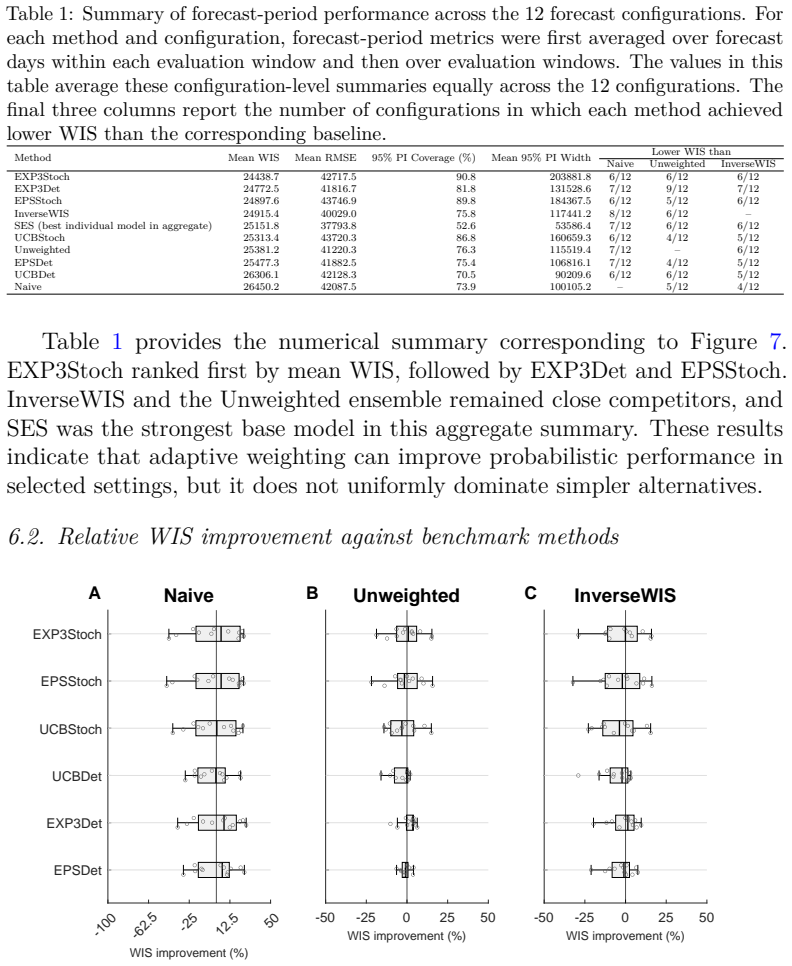
Using U.S. COVID-19 data from three epidemic waves, the EXP3Stoch, EXP3Det, and EPSStoch adaptive weighting rules achieved the lowest mean forecast WIS across waves, calibration windows, and forecast horizons compared to individual models and naive ensemble benchmarks. The gains were concentrated in probabilistic forecast quality, especially WIS and interval coverage.
What carries the argument
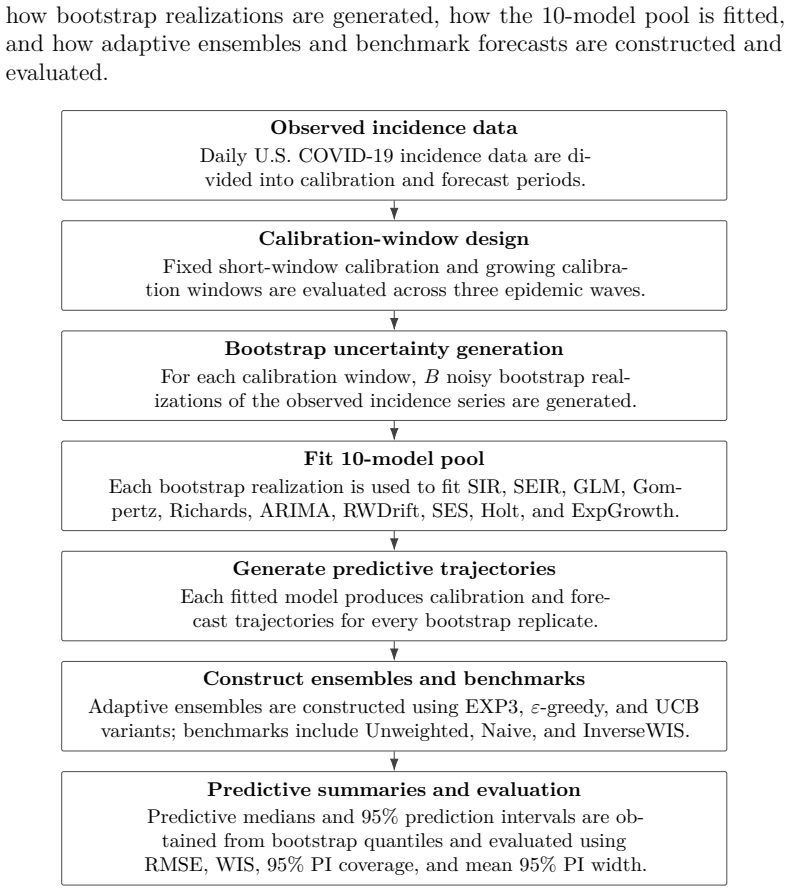
Multi-armed bandit inspired weighting rules (UCB, EXP3, epsilon-greedy) applied to a pool of models including SIR, SEIR, GLM, ARIMA and others, with fixed short-window and growing calibration windows, in both deterministic and stochastic ensemble variants.
If this is right
- Adaptive ensembles provide better probabilistic forecasts than unweighted or inverse-WIS ensembles in time-varying conditions.
- Simple benchmarks remain competitive in some settings, indicating adaptive methods are complementary rather than always superior.
- Main benefits occur in interval coverage and WIS rather than uniform reductions in point forecast error.
- These methods are useful when component model skill changes over epidemic phases.
Where Pith is reading between the lines
- Similar adaptive weighting could be tested on forecasting for other infectious diseases with shifting dynamics.
- Real-time deployment would require monitoring for overfitting in the calibration windows chosen.
- Combining these with other ensemble techniques like stacking might further improve results.
- The approach assumes sufficient historical data per wave to calibrate the bandit algorithms effectively.
Load-bearing premise
Component model performance changes over time in a way that bandit algorithms can detect and exploit for weighting without introducing high variance or overfitting in the calibration periods.
What would settle it
New COVID-19 waves or other epidemic data where EXP3Stoch, EXP3Det, and EPSStoch do not produce lower mean WIS than the unweighted or inverse-WIS ensembles across multiple horizons.
Figures

read the original abstract
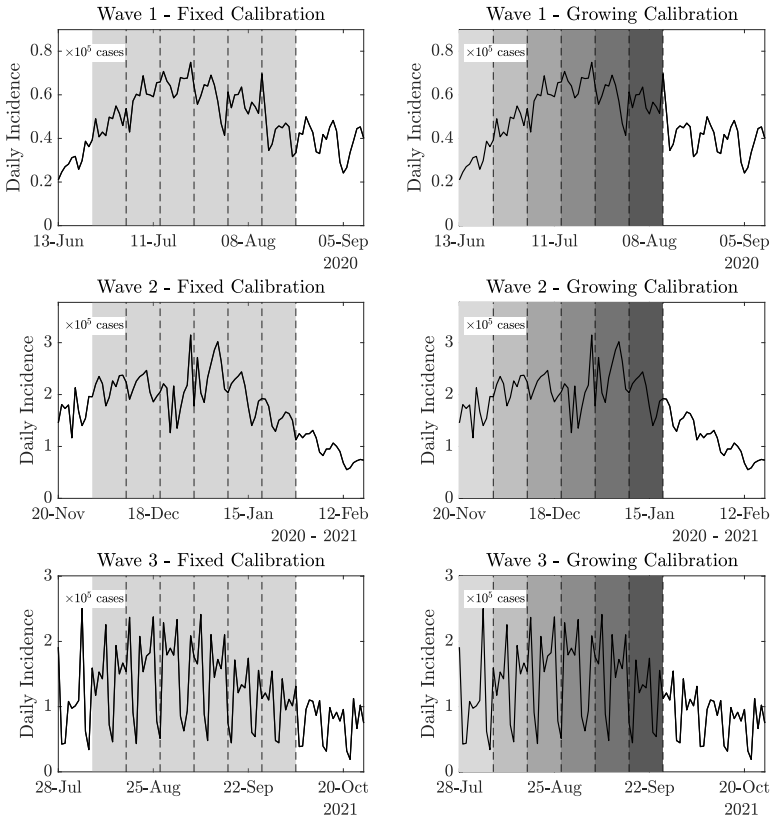
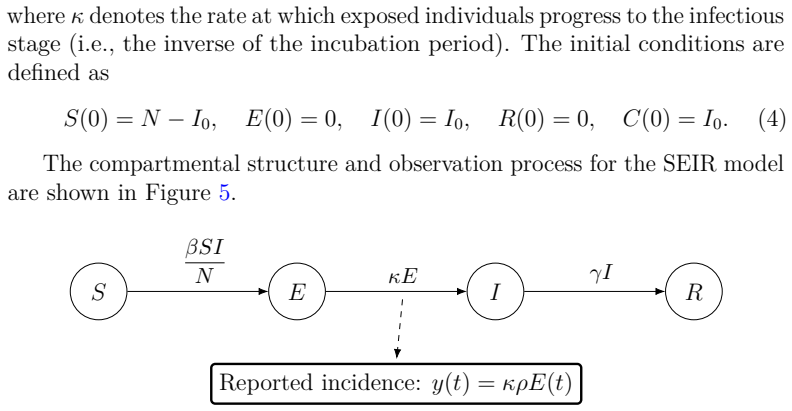
Forecasting epidemic trajectories is important for public health decision-making, but no single model is consistently reliable across epidemic phases and forecasting settings. We evaluate Multi-Armed Bandit (MAB)-inspired adaptive weighting strategies for combining epidemic forecasting models when component-model performance changes over time. Using U.S. COVID-19 incidence data from three epidemic waves, we compare UCB, EXP3, and epsilon-greedy weighting rules under fixed short-window and growing calibration windows, with both deterministic and stochastic ensemble variants. The model pool includes SIR, SEIR, GLM, Gompertz, Richards, ARIMA, random walk with drift, simple exponential smoothing, Holt's linear trend method, and exponential growth. Adaptive ensembles are compared with individual models and with naive, unweighted, and inverse-WIS weighted ensemble benchmarks. Forecast performance is assessed using RMSE, weighted interval score (WIS), 95% prediction-interval coverage, and mean 95% prediction-interval width. Across waves, calibration windows, and forecast horizons, EXP3Stoch, EXP3Det, and EPSStoch achieved the lowest mean forecast WIS. The main gains were in probabilistic forecast quality, especially WIS and interval coverage, rather than uniformly lower point forecast error. Simple benchmarks, including the unweighted and inverse-WIS ensembles, remained competitive in several settings. These results suggest that MAB-inspired adaptive weighting is a useful complementary tool for epidemic forecasting, especially when model skill is time-varying and forecast uncertainty is substantial.
Editorial analysis
A structured set of objections, weighed in public.
Referee Report
Summary. The manuscript evaluates multi-armed bandit (MAB) inspired adaptive weighting strategies (UCB, EXP3, epsilon-greedy) for ensembling epidemic models including SIR, SEIR, GLM, Gompertz, Richards, ARIMA and others on U.S. COVID-19 incidence data across three epidemic waves. It compares deterministic and stochastic variants under fixed short-window and growing calibration schemes against individual models and naive/unweighted/inverse-WIS ensemble benchmarks, reporting that EXP3Stoch, EXP3Det and EPSStoch achieve the lowest mean weighted interval score (WIS) across waves, windows and horizons, with primary gains in probabilistic metrics rather than point forecasts.
Significance. If the results hold after robustness checks, the work shows that MAB-inspired adaptive ensembling can serve as a useful complementary tool for improving probabilistic epidemic forecasts when component model skill varies over time. The comparison against multiple public-data benchmarks and the focus on WIS and interval coverage are strengths that could inform practical forecasting pipelines.
major comments (2)
- [Results] The central claim that EXP3Stoch, EXP3Det and EPSStoch variants produce the lowest mean forecast WIS relies on the assumption that the bandit rules exploit genuine time-varying performance rather than fitting noise in the chosen calibration windows; however, the manuscript reports no weight-variance diagnostics, sensitivity analyses to window length, or hold-out checks beyond the calibration periods themselves (see abstract and results on benchmark competitiveness).
- [Results] No statistical significance tests, standard errors on WIS differences, or effect-size quantification accompany the reported lowest-mean-WIS rankings, which is load-bearing because the abstract states that simple benchmarks remained competitive in several settings.
minor comments (2)
- [Abstract] Clarify the exact number of forecast horizons and waves evaluated when stating 'across waves, calibration windows, and forecast horizons'.
- [Results] Consider adding a table or figure showing ensemble weight trajectories over time to allow readers to assess stability.
Simulated Author's Rebuttal
We thank the referee for their detailed review and constructive suggestions. We address the major comments below and outline revisions to enhance the robustness of our findings on adaptive ensemble weighting for epidemic forecasts.
read point-by-point responses
-
Referee: [Results] The central claim that EXP3Stoch, EXP3Det and EPSStoch variants produce the lowest mean forecast WIS relies on the assumption that the bandit rules exploit genuine time-varying performance rather than fitting noise in the chosen calibration windows; however, the manuscript reports no weight-variance diagnostics, sensitivity analyses to window length, or hold-out checks beyond the calibration periods themselves (see abstract and results on benchmark competitiveness).
Authors: We recognize the importance of verifying that the adaptive weighting captures genuine temporal variations in model performance rather than overfitting to noise within calibration windows. To address this, the revised manuscript will incorporate weight-variance diagnostics, sensitivity analyses across different window lengths, and additional hold-out validation on unseen periods. These enhancements will provide stronger evidence supporting the time-varying adaptation claim while maintaining the observation that simple benchmarks can be competitive in some cases. revision: yes
-
Referee: [Results] No statistical significance tests, standard errors on WIS differences, or effect-size quantification accompany the reported lowest-mean-WIS rankings, which is load-bearing because the abstract states that simple benchmarks remained competitive in several settings.
Authors: We agree that quantifying the statistical reliability of the WIS rankings is essential, particularly given the competitiveness of simple benchmarks noted in the abstract. In the revision, we will report standard errors via resampling methods, conduct appropriate significance tests for differences in mean WIS, and include effect size metrics. This will allow readers to better assess the practical significance of the improvements from the MAB-inspired methods. revision: yes
Circularity Check
No circularity: empirical evaluation of existing algorithms on public data
full rationale
The paper conducts an empirical comparison of MAB-inspired weighting rules (UCB, EXP3, epsilon-greedy) against benchmarks using U.S. COVID-19 incidence data across waves and windows. Forecast performance is measured directly via RMSE, WIS, coverage, and interval width on held-out observations. No derivations, predictions, or uniqueness claims reduce by the paper's own equations to fitted quantities defined in terms of themselves. Component models and bandit rules are standard and applied without self-referential fitting or load-bearing self-citations for core results.
Axiom & Free-Parameter Ledger
free parameters (2)
- calibration window lengths
- MAB hyperparameters (e.g., epsilon, exploration rate)
axioms (1)
- domain assumption Component model skill varies over time in a way that recent performance is predictive of near-future performance
Reference graph
Works this paper leans on
-
[1]
SIAM journal on computing , volume=
The nonstochastic multiarmed bandit problem , author=. SIAM journal on computing , volume=. 2002 , publisher=
2002
-
[2]
Machine learning , volume=
Finite-time analysis of the multiarmed bandit problem , author=. Machine learning , volume=. 2002 , publisher=
2002
-
[3]
1998 , edition=
Reinforcement learning: An introduction , author=. 1998 , edition=
1998
-
[4]
Journal of Biomedical Research & Innovation , volume=
Mathematical modeling and epidemic prediction of COVID-19 and its significance to epidemic prevention and control measures , author=. Journal of Biomedical Research & Innovation , volume=
-
[5]
Bridge: Journal of Multidisciplinary Explorations , volume=
Mathematical modeling of epidemic dynamics: Integrating public health and data science , author=. Bridge: Journal of Multidisciplinary Explorations , volume=
-
[6]
Statistical Methods in Medical Research , volume=
Comparative study of Bayesian and frequentist methods for epidemic forecasting: Insights from simulated and historical data , author=. Statistical Methods in Medical Research , volume=. 2026 , publisher=
2026
-
[7]
Mathematics , volume=
Parameter Estimation and Forecasting Strategies for Cholera Dynamics: Insights from the 1991--1997 Peruvian Epidemic , author=. Mathematics , volume=. 2025 , publisher=
1991
-
[8]
Scientific Reports , volume=
A compartmental model that predicts the effect of social distancing and vaccination on controlling COVID-19 , author=. Scientific Reports , volume=. 2021 , publisher=
2021
-
[9]
BMC Public Health , volume=
Applying infectious disease forecasting to public health: a path forward using influenza forecasting examples , author=. BMC Public Health , volume=. 2019 , publisher=
2019
-
[10]
Health security , volume=
Real-time epidemic forecasting: challenges and opportunities , author=. Health security , volume=. 2019 , publisher=
2019
-
[11]
Ensemble forecasts of coronavirus disease 2019 (COVID-19) in the
Ray, Evan L and Wattanachit, Nutcha and Niemi, Jarad and Kanji, Abdul Hannan and House, Katie and Cramer, Estee Y and Bracher, Johannes and Zheng, Andrew and Yamana, Teresa K and Xiong, Xinyue and others , journal=. Ensemble forecasts of coronavirus disease 2019 (COVID-19) in the. 2020 , doi=
2019
-
[12]
BMC Infectious Diseases , volume=
Time series modelling and forecasting of mpox incidence and mortality in Nigeria , author=. BMC Infectious Diseases , volume=. 2025 , publisher=
2025
-
[13]
Clinical Infectious Diseases , volume=
Improving pandemic response: employing mathematical modeling to confront coronavirus disease 2019 , author=. Clinical Infectious Diseases , volume=. 2022 , publisher=
2019
-
[14]
New England Journal of Medicine , volume=
Ebola virus disease in West Africa—the first 9 months of the epidemic and forward projections , author=. New England Journal of Medicine , volume=. 2014 , publisher=
2014
-
[15]
One Health , volume=
Recurrent Ebola outbreaks in the eastern Democratic Republic of the Congo: A wake-up call to scale up the integrated disease surveillance and response strategy , author=. One Health , volume=. 2022 , publisher=
2022
-
[16]
Nature communications , volume=
Evaluation of FluSight influenza forecasting in the 2021--22 and 2022--23 seasons with a new target laboratory-confirmed influenza hospitalizations , author=. Nature communications , volume=. 2024 , publisher=
2021
-
[17]
Prevention and control of seasonal influenza with vaccines: Recommendations of the Advisory Committee on Immunization Practices---
Grohskopf, Lisa A and Blanton, Lenee H and Ferdinands, Jill M and Chung, Jessie R and Broder, Karen R and Talbot, H Keipp and Morgan, Rebecca L and Fry, Alicia M , journal=. Prevention and control of seasonal influenza with vaccines: Recommendations of the Advisory Committee on Immunization Practices---. 2022 , publisher=
2022
-
[18]
Trends in ecology & evolution , volume=
Forecasting epidemiological and evolutionary dynamics of infectious diseases , author=. Trends in ecology & evolution , volume=. 2016 , publisher=
2016
-
[19]
Policy and complex systems , volume=
Modeling infectious behaviors: The need to account for behavioral adaptation in COVID-19 models , author=. Policy and complex systems , volume=
-
[20]
Journal of the operational research society , volume=
A novel healthcare resource allocation decision support tool: A forecasting-simulation-optimization approach , author=. Journal of the operational research society , volume=. 2021 , publisher=
2021
-
[21]
Statistical Methods in Medical Research , volume=
Uncertainty quantification for epidemiological forecasts of COVID-19 through combinations of model predictions , author=. Statistical Methods in Medical Research , volume=. 2022 , publisher=
2022
-
[22]
2013 , address=
Modeling the interplay between human behavior and the spread of infectious diseases , author=. 2013 , address=
2013
-
[23]
2012 , address=
Modeling infectious disease parameters based on serological and social contact data: a modern statistical perspective , author=. 2012 , address=
2012
-
[24]
An epidemiological forecast model and software assessing interventions on the
Wang, Lili and Zhou, Yiwang and He, Jie and Zhu, Bin and Wang, Fei and Tang, Lu and Eisenberg, Marisa and Song, Peter XK , journal=. An epidemiological forecast model and software assessing interventions on the. 2020 , doi=
2020
-
[25]
International Journal of Forecasting , volume=
Testing big data in a big crisis: Nowcasting under COVID-19 , author=. International Journal of Forecasting , volume=. 2023 , publisher=
2023
-
[26]
Comparative study of
Karami, Hamed and Luo, Ruiyan and Sanaei, Pejman and Chowell, Gerardo , journal=. Comparative study of. 2016 , publisher=
2016
-
[27]
Eras and paradigms
Choosing a future for epidemiology: I. Eras and paradigms. , author=. American journal of public health , volume=. 1996 , publisher=
1996
-
[28]
International journal of forecasting , volume=
Forecasting for COVID-19 has failed , author=. International journal of forecasting , volume=. 2022 , publisher=
2022
-
[29]
1988 , address=
A skeptic’s guide to computer models , author=. 1988 , address=
1988
-
[30]
Wiley interdisciplinary reviews: Climate change , volume=
Ensemble modeling, uncertainty and robust predictions , author=. Wiley interdisciplinary reviews: Climate change , volume=. 2013 , publisher=
2013
-
[31]
Lindstr. A. PLoS computational biology , volume=. 2015 , publisher=
2015
-
[32]
International Journal of Epidemiology , volume=
Ensemble modelling in descriptive epidemiology: burden of disease estimation , author=. International Journal of Epidemiology , volume=. 2020 , publisher=
2020
-
[33]
Transportation Research Part C: Emerging Technologies , volume=
The ensemble approach to forecasting: A review and synthesis , author=. Transportation Research Part C: Emerging Technologies , volume=. 2021 , publisher=
2021
-
[34]
BMC medical research methodology , volume=
Ensemble bootstrap methodology for forecasting dynamic growth processes using differential equations: application to epidemic outbreaks , author=. BMC medical research methodology , volume=. 2021 , publisher=
2021
-
[35]
A collaborative multiyear, multimodel assessment of seasonal influenza forecasting in the
Reich, Nicholas G and Brooks, Logan C and Fox, Spencer J and Kandula, Sasikiran and McGowan, Craig J and Moore, Evan and Osthus, Dave and Ray, Evan L and Tushar, Abhinav and Yamana, Teresa K and others , journal=. A collaborative multiyear, multimodel assessment of seasonal influenza forecasting in the. 2019 , publisher=
2019
-
[36]
Individual versus superensemble forecasts of seasonal influenza outbreaks in the
Yamana, Teresa K and Kandula, Sasikiran and Shaman, Jeffrey , journal=. Individual versus superensemble forecasts of seasonal influenza outbreaks in the. 2017 , publisher=
2017
-
[37]
Viboud, C. The. Epidemics , volume=. 2018 , publisher=
2018
-
[38]
Bulletin of the American Mathematical Society , year =
Robbins, Herbert , title =. Bulletin of the American Mathematical Society , year =
-
[39]
Foundations and Trends
Regret Analysis of Stochastic and Nonstochastic Multi-Armed Bandit Problems , author =. Foundations and Trends. 2012 , publisher =
2012
-
[40]
and Gneiting, Tilmann and Balabdaoui, Fadoua and Polakowski, Michael , journal =
Raftery, Adrian E. and Gneiting, Tilmann and Balabdaoui, Fadoua and Polakowski, Michael , journal =. Using. 2005 , publisher =
2005
-
[41]
Algorithms for multi-armed bandit problems
Algorithms for Multi-Armed Bandit Problems , author =. arXiv preprint arXiv:1402.6028 , year =
work page internal anchor Pith review Pith/arXiv arXiv
-
[42]
Advances in Applied Mathematics , volume =
Asymptotically Efficient Adaptive Allocation Rules , author =. Advances in Applied Mathematics , volume =. 1985 , publisher =
1985
-
[43]
Strictly Proper Scoring Rules, Prediction, and Estimation , author =. Journal of the American Statistical Association , year =. doi:10.1198/016214506000001437 , url =
-
[44]
PLoS computational biology , volume=
Evaluating epidemic forecasts in an interval format , author=. PLoS computational biology , volume=. 2021 , publisher=
2021
-
[45]
Excess Tuberculosis Incidence in the
Karami, Hamed and Rajaram, Varun and Lee, Sunmi and Mamelund, Svenn-Erik and Chowell, Gerardo , journal =. Excess Tuberculosis Incidence in the. 2026 , doi =
2026
-
[46]
medRxiv , pages=
State-Level Excess Drug Overdose Mortality by Race/Ethnicity in the US, 2020--2023: A Population-Scaling Analysis During the COVID-19 Pandemic , author=. medRxiv , pages=. 2026 , publisher=
2020
-
[47]
BMC Public Health , volume=
Global excess tuberculosis mortality during COVID-19: a country-level modeling study of policy and development correlates , author=. BMC Public Health , volume=. 2025 , publisher=
2025
-
[48]
medRxiv , pages=
Estimating Excess Mortality Among People Living with HIV/AIDS During the COVID-19 Pandemic in the USA , author=. medRxiv , pages=. 2025 , publisher=
2025
-
[49]
Infectious Disease Modelling , volume=
Fitting dynamic models to epidemic outbreaks with quantified uncertainty: A primer for parameter uncertainty, identifiability, and forecasts , author=. Infectious Disease Modelling , volume=. 2017 , publisher=
2017
-
[50]
Cramer, Estee Y and Huang, Yuxin and Wang, Yijin and Ray, Evan L and Cornell, Matthew and Bracher, Johannes and Brennen, Andrea and Rivadeneira, Alvaro J Castro and Gerding, Aaron and House, Katie and others , journal=. The. 2022 , publisher=
2022
-
[51]
JMIR Public Health and Surveillance , volume=
Prediction of COVID-19 Infections for Municipalities in the Netherlands: Algorithm Development and Interpretation , author=. JMIR Public Health and Surveillance , volume=. 2022 , publisher=
2022
-
[52]
Limitations of Ensemble
Graefe, Andreas and K. Limitations of Ensemble. International Journal of Forecasting , volume=. 2015 , publisher=
2015
-
[53]
Calibrated surface temperature forecasts from the Canadian ensemble prediction system using
Wilson, Laurence J and Beauregard, Stephane and Raftery, Adrian E and Verret, Richard , journal=. Calibrated surface temperature forecasts from the Canadian ensemble prediction system using
-
[54]
Energies , volume=
Stacking ensemble learning for short-term electricity consumption forecasting , author=. Energies , volume=. 2018 , publisher=
2018
-
[55]
Reviews of Geophysics , volume=
A review of multimodel superensemble forecasting for weather, seasonal climate, and hurricanes , author=. Reviews of Geophysics , volume=. 2016 , publisher=
2016
-
[56]
Monthly Weather Review , volume=
Calibrated ensemble forecasts using quantile regression forests and ensemble model output statistics , author=. Monthly Weather Review , volume=
-
[57]
Monthly Weather Review , volume=
Ensemble reforecasting: Improving medium-range forecast skill using retrospective forecasts , author=. Monthly Weather Review , volume=
-
[58]
Journal of the Royal Statistical Society Series A: Statistics in Society , volume=
Integrating testing volume into bandit algorithms for infectious disease surveillance , author=. Journal of the Royal Statistical Society Series A: Statistics in Society , volume=. 2025 , publisher=
2025
-
[59]
2025 , note=
Adaptive bandit algorithms increase efficiency of mobile tuberculosis screening programs , author=. 2025 , note=
2025
-
[60]
Phenomenological and mechanistic models for predicting early transmission data of COVID-19 , author=. Math. Biosci. Eng , volume=
-
[61]
Fractals , volume=
Forecasting the COVID-19 using the discrete generalized logistic model , author=. Fractals , volume=. 2022 , doi=
2022
-
[62]
Journal of statistical software , volume=
Automatic time series forecasting: the forecast package for R , author=. Journal of statistical software , volume=
-
[63]
2018 , publisher=
Forecasting: principles and practice , author=. 2018 , publisher=
2018
-
[64]
PLoS computational biology , volume=
Post-processing and weighted combination of infectious disease nowcasts , author=. PLoS computational biology , volume=. 2025 , publisher=
2025
-
[65]
2025 , note=
The influence of ensemble size and composition on the performance of combined real-time COVID-19 forecasts , author=. 2025 , note=
2025
-
[66]
Evaluation of individual and ensemble probabilistic forecasts of COVID-19 mortality in the
Cramer, Estee Y and Ray, Evan L and Lopez, Velma K and Bracher, Johannes and Brennen, Andrea and Castro Rivadeneira, Alvaro J and Gerding, Aaron and Gneiting, Tilmann and House, Katie H and Huang, Yuxin and others , journal=. Evaluation of individual and ensemble probabilistic forecasts of COVID-19 mortality in the. 2022 , publisher=
2022
-
[67]
International Journal of Forecasting , volume=
Why the “best” point forecast depends on the error or accuracy measure , author=. International Journal of Forecasting , volume=. 2020 , publisher=
2020
-
[68]
PLoS Computational Biology , volume=
An ensemble n-sub-epidemic modeling framework for short-term forecasting epidemic trajectories: Application to the COVID-19 pandemic in the USA , author=. PLoS Computational Biology , volume=. 2022 , publisher=
2022
-
[69]
PLOS Computational Biology , volume=
A comparative study of simulation-based inference methods for epidemic models with identifiability considerations , author=. PLOS Computational Biology , volume=. 2026 , publisher=
2026
-
[70]
Parameter uncertainty in dynamical models: a practical identifiability index
Parameter uncertainty in dynamical models: a practical identifiability index , author=. arXiv preprint arXiv:2606.08475 , year=
work page internal anchor Pith review Pith/arXiv arXiv
-
[71]
Epidemics , pages=
Enhancing Influenza-Like Illness forecasting: An ensemble approach combining mathematical and deep learning models amidst the COVID-19 pandemic , author=. Epidemics , pages=. 2026 , publisher=
2026
-
[72]
BMC Medical Informatics and Decision Making , volume=
BayesianFitForecast: a user-friendly R toolbox for parameter estimation and forecasting with ordinary differential equations , author=. BMC Medical Informatics and Decision Making , volume=. 2025 , publisher=
2025
discussion (0)
Sign in with ORCID, Apple, or X to comment. Anyone can read and Pith papers without signing in.