Separation of Statistical Complexity and Trainability in Variational Quantum Circuits
Pith reviewed 2026-06-26 21:08 UTC · model grok-4.3
The pith
Statistical signatures of randomness can appear in variational quantum circuits before trainability is lost.
A machine-rendered reading of the paper's core claim, the machinery that carries it, and where it could break.
Core claim
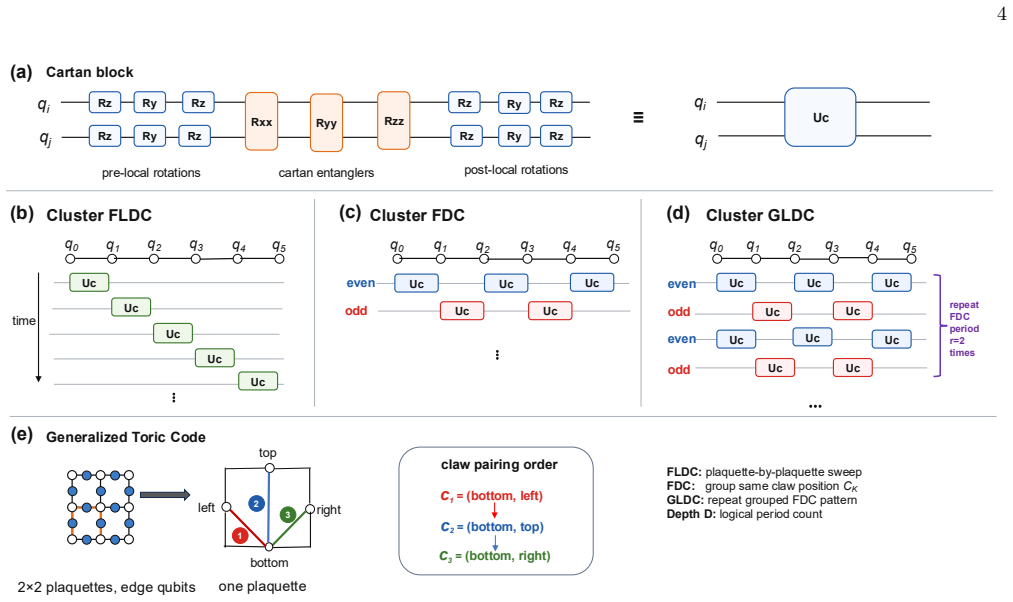
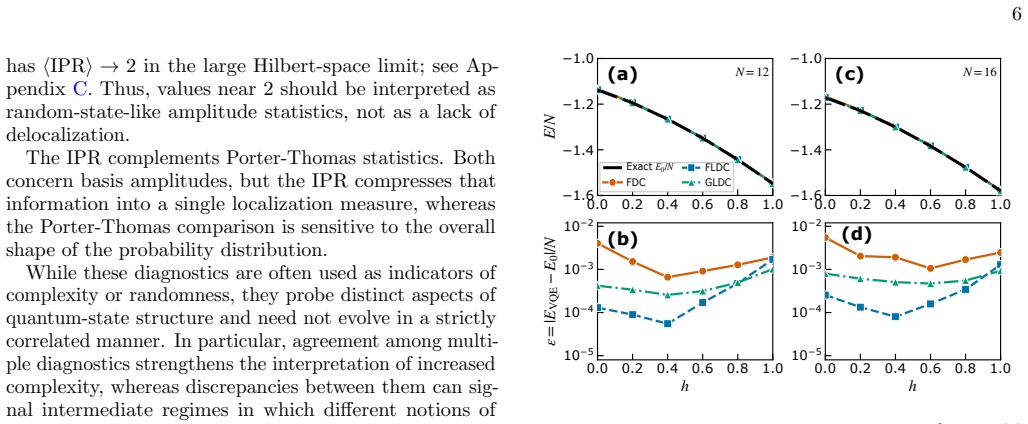
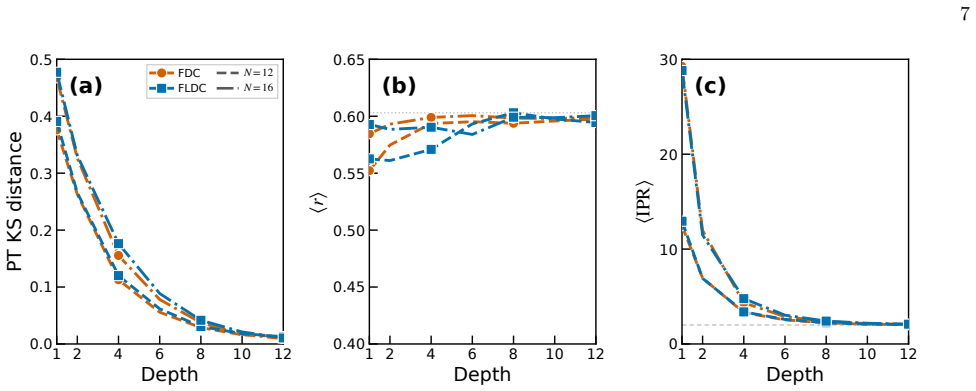
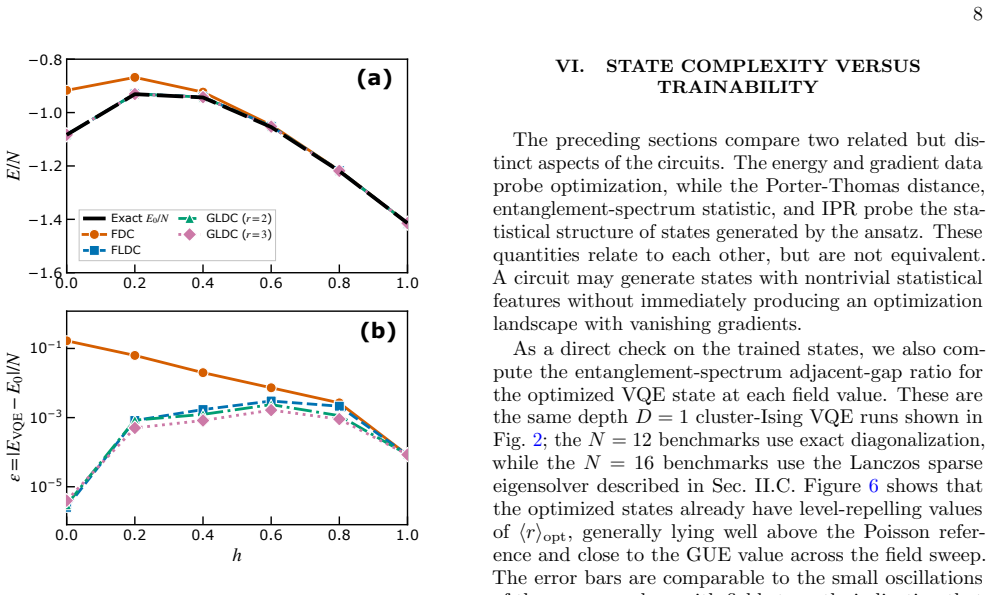
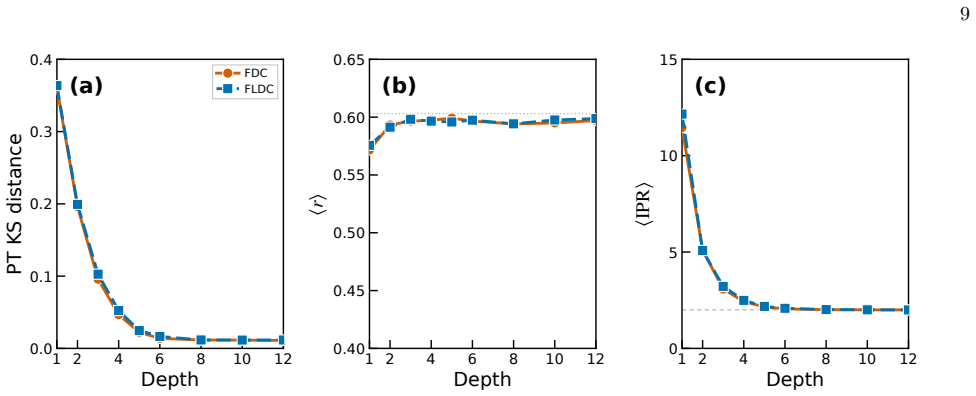
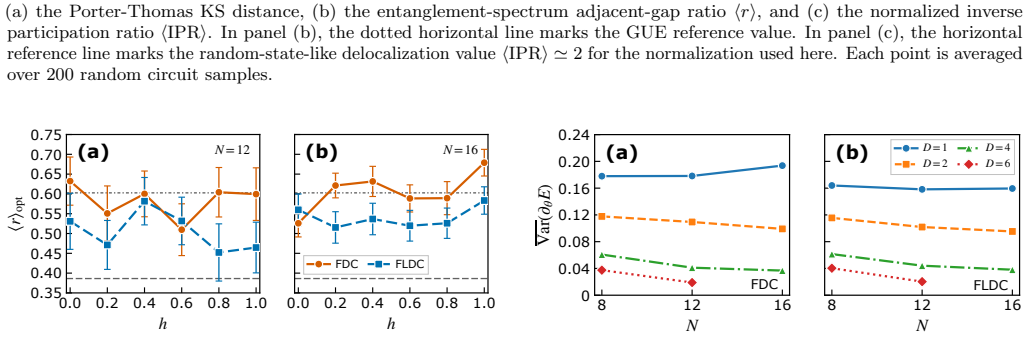
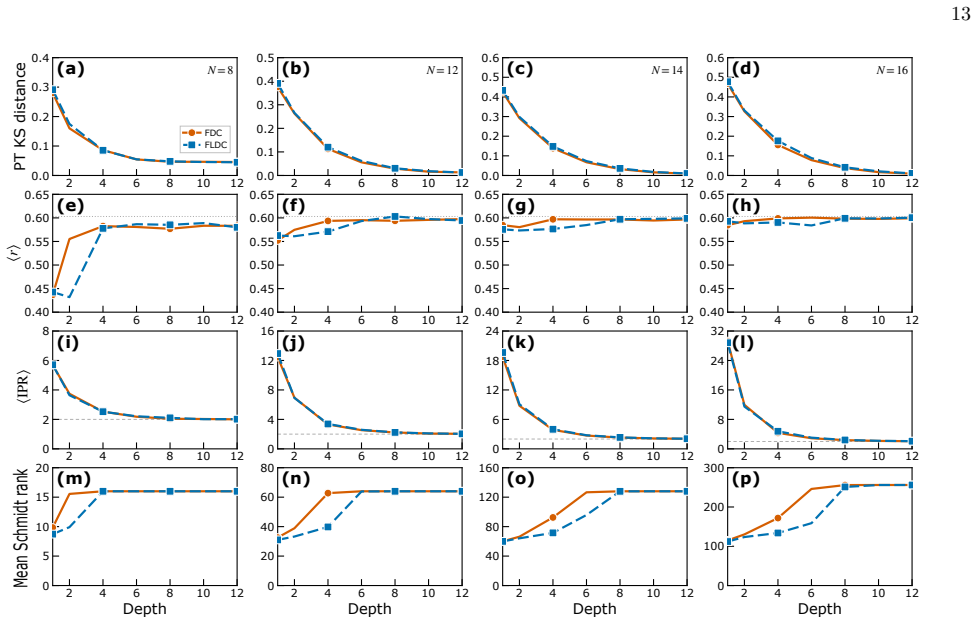
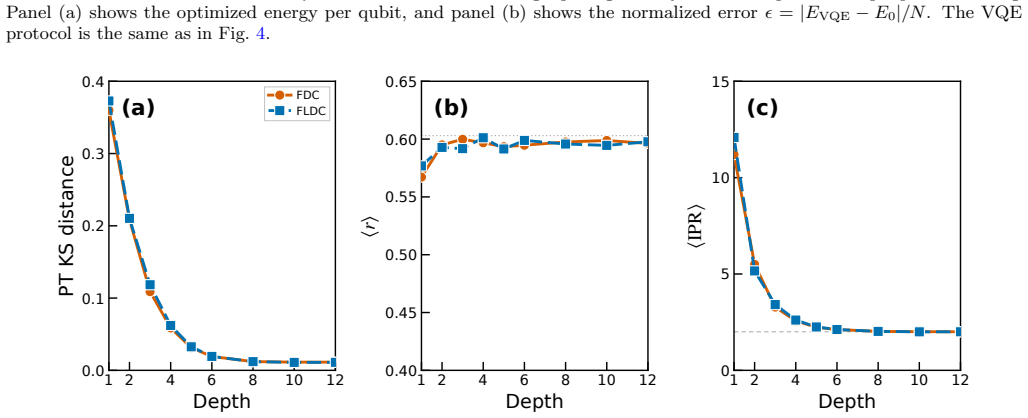
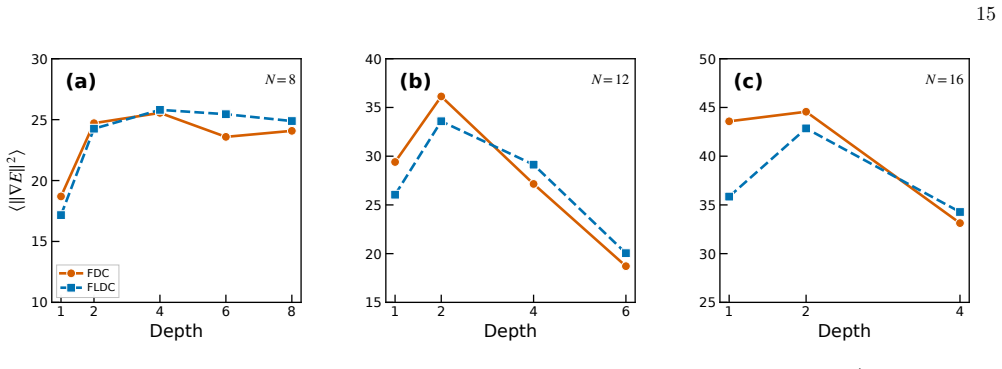
In structured variational circuits applied to the one-dimensional cluster-Ising model and a generalized toric code Hamiltonian, increasing circuit depth drives Porter-Thomas statistics, entanglement-spectrum level statistics, and inverse participation ratios toward random-state-like or random-matrix-like behavior, while variational optimization remains effective with no evidence of exponential gradient suppression. The interpretation offered is that spectral correlations develop at relatively shallow depth through locally generated structure, while global state randomization and the associated concentration-of-measure effects are not yet realized.
What carries the argument
The separation between locally generated spectral correlations that appear at moderate depth and the global randomization plus concentration-of-measure effects that would suppress gradients.
If this is right
- Commonly used statistical diagnostics of complexity do not by themselves determine trainability.
- Locality in the circuit allows spectral correlations to develop before global concentration effects appear.
- Finite-depth variational circuits can exhibit near-random statistics while remaining trainable for the studied models.
- Trainability is tied to the absence of full global randomization rather than to the saturation of local complexity measures.
Where Pith is reading between the lines
- Circuit designers might deliberately limit global scrambling while allowing rapid local structure formation.
- The observed separation could be checked in other Hamiltonians or with different gate connectivities.
- Mapping the exact depth where gradients begin to vanish against the saturation depths of the three diagnostics would test the locality interpretation across a wider range of systems.
Load-bearing premise
The continued success of optimization at the depths studied is due to the absence of full global randomization rather than to the specific Hamiltonians or circuit structures chosen.
What would settle it
A calculation or simulation showing exponential decay of gradient variance with increasing system size or depth at the same circuit depths where Porter-Thomas statistics, level-spacing ratios, and inverse participation ratios have already saturated to their random values.
Figures

read the original abstract
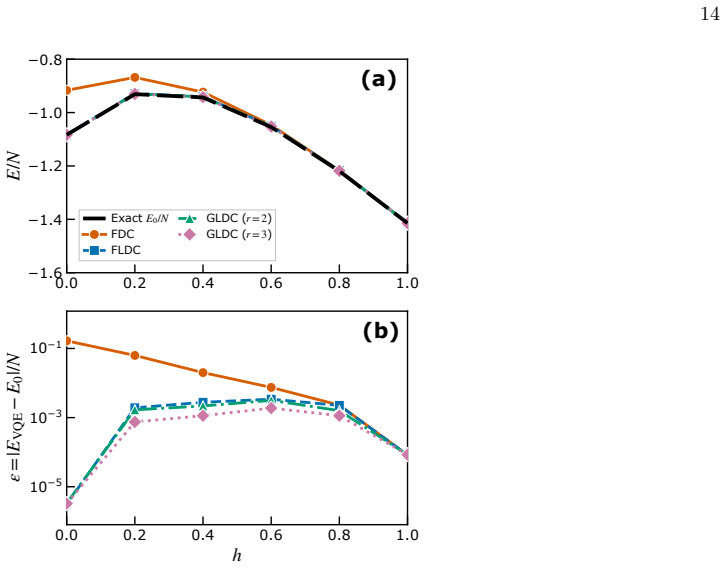
Variational quantum algorithms (VQAs) are among the leading approaches for near-term quantum computing, yet their performance can degrade in barren plateau regimes characterized by vanishing gradients. A widely held intuition is that increasing circuit expressivity, often associated with random-state behavior, leads to a loss of trainability. Existing results show that sufficiently random circuits can lead to barren plateaus. Here we show that standard statistical signatures of randomness can emerge well before this regime, without degrading trainability. We demonstrate this behavior in structured variational circuits applied to the one-dimensional cluster-Ising model and a generalized toric code Hamiltonian. To characterize state complexity, we analyze Porter-Thomas statistics, entanglement-spectrum level statistics, and inverse participation ratios. Across both models, increasing circuit depth drives these diagnostics toward random-state-like or random-matrix-like behavior, while variational optimization remains effective, with no evidence of exponential gradient suppression in the regime studied. We interpret this behavior in terms of locality. Spectral correlations develop at relatively shallow depth through locally generated structure, while global state randomization and the associated concentration-of-measure effects are not yet realized. These results show that commonly used statistical diagnostics of complexity do not by themselves determine trainability. Instead, they point to a separation between different aspects of complexity in finite-depth variational circuits.
Editorial analysis
A structured set of objections, weighed in public.
Referee Report
Summary. The paper claims that in structured variational quantum circuits applied to the 1D cluster-Ising model and a generalized toric code Hamiltonian, standard statistical diagnostics of state complexity (Porter-Thomas statistics, entanglement-spectrum level statistics, and inverse participation ratios) approach random-state or random-matrix values with increasing circuit depth, while gradient-based variational optimization remains effective with no observed exponential gradient suppression. The authors interpret this as evidence that spectral correlations can arise from locally generated structure at relatively shallow depths before global randomization and concentration-of-measure effects set in, implying that statistical complexity diagnostics do not by themselves determine trainability.
Significance. If the central empirical observation holds, the result would usefully separate notions of complexity in finite-depth VQCs and show that common randomness diagnostics (Porter-Thomas, level statistics, IPR) can appear without inducing barren-plateaus in these ansätze. The numerical demonstrations on two local Hamiltonians provide concrete, falsifiable evidence against the strongest form of the 'expressivity implies untrainability' intuition, which is a modest but clear contribution to the barren-plateau literature.
major comments (2)
- [Abstract, final paragraph] Abstract and final paragraph: the locality-based interpretation (spectral correlations from local structure while global concentration-of-measure effects are absent) is not directly supported by the reported diagnostics, all of which are global properties of the full state. Subsystem or scaling analysis (e.g., reduced-density-matrix statistics or depth-dependent variance of local observables) would be required to distinguish the proposed mechanism from the simpler possibility that the studied depths remain below the barren-plateau onset for these particular ansätze.
- [Methods] Methods section (implied by abstract): details on gradient computation (analytic vs. parameter-shift), circuit depth scaling, number of random initializations, and error bars on the reported diagnostics are not provided in the summary description, making it impossible to assess whether the absence of exponential suppression is robust or an artifact of the chosen regime.
minor comments (2)
- Clarify the precise definition of 'effective' optimization (e.g., final loss value relative to random guessing, or success probability over initializations) and report the corresponding quantitative thresholds.
- Add a brief comparison table or plot overlaying the three diagnostics against a fully random circuit ensemble at the same depth to make the approach to random-matrix behavior quantitative.
Simulated Author's Rebuttal
We thank the referee for the constructive report and the opportunity to clarify our work. We address each major comment below, with revisions made to the manuscript where appropriate to improve clarity and completeness.
read point-by-point responses
-
Referee: [Abstract, final paragraph] Abstract and final paragraph: the locality-based interpretation (spectral correlations from local structure while global concentration-of-measure effects are absent) is not directly supported by the reported diagnostics, all of which are global properties of the full state. Subsystem or scaling analysis (e.g., reduced-density-matrix statistics or depth-dependent variance of local observables) would be required to distinguish the proposed mechanism from the simpler possibility that the studied depths remain below the barren-plateau onset for these particular ansätze.
Authors: We agree that the reported diagnostics (Porter-Thomas, entanglement spectrum statistics, and IPR) are global properties of the full state and do not directly probe local structure or subsystem scaling. Our locality-based interpretation is motivated by the explicit construction of the ansätze (nearest-neighbor gates on 1D local Hamiltonians) rather than by additional local observables. We have revised the abstract and concluding paragraph to present this as a plausible mechanism consistent with the models studied, rather than a claim of direct support from the global diagnostics alone. We also added a short discussion noting that distinguishing the two scenarios would require the suggested subsystem analyses, which lie outside the scope of the present study focused on standard full-state complexity measures. revision: partial
-
Referee: [Methods] Methods section (implied by abstract): details on gradient computation (analytic vs. parameter-shift), circuit depth scaling, number of random initializations, and error bars on the reported diagnostics are not provided in the summary description, making it impossible to assess whether the absence of exponential suppression is robust or an artifact of the chosen regime.
Authors: The full manuscript contains these details (parameter-shift rule for all gradients, depths scaled from 2 to 24 layers, 500 random initializations per point, and bootstrap-derived error bars), but they were not summarized in the abstract or introductory sections. We have added a dedicated Methods subsection that explicitly lists the gradient rule, depth range, initialization count, and statistical error estimation procedure to ensure the robustness of the trainability results can be assessed directly from the text. revision: yes
Circularity Check
No circularity; empirical numerical study with independent diagnostics
full rationale
The manuscript presents direct numerical computations of Porter-Thomas statistics, entanglement-spectrum level statistics, and inverse participation ratios on two concrete Hamiltonians (1D cluster-Ising and generalized toric code) as circuit depth increases. Trainability is assessed via explicit gradient-based optimization runs. No equations reduce any reported quantity to a fitted parameter or self-referential definition, and no load-bearing self-citations or uniqueness theorems are invoked. The locality interpretation is explicitly labeled as such rather than derived from prior results by the same authors. The central observation therefore remains self-contained against external benchmarks.
Axiom & Free-Parameter Ledger
Reference graph
Works this paper leans on
-
[1]
Amplitude statistics, through the computational- basis probability distribution [25, 41]
-
[2]
Spectral correlations, through the entanglement spectrum [26, 27, 42]
-
[3]
complexity
Basis delocalization, through the inverse partici- pation ratio [28]. Each diagnostic reflects a different notion of randomness and complements direct measures of trainability, such as gradient-variance and optimization-landscape analyses [31, 32]. Agreement between them suggests increasing complexity, whereas disagreement can also be informative. E. Port...
-
[4]
Peruzzo, J
A. Peruzzo, J. McClean, P. Shadbolt, M.-H. Yung, X.-Q. Zhou, P. J. Love, A. Aspuru-Guzik, and J. L. O’Brien, Nature Communications5, 4213 (2014)
2014
-
[5]
J. R. McClean, J. Romero, R. Babbush, and A. Aspuru- Guzik, New Journal of Physics18, 023023 (2016)
2016
-
[6]
A Quantum Approximate Optimization Algorithm
E. Farhi, J. Goldstone, and S. Gutmann, A quan- tum approximate optimization algorithm (2014), arXiv:1411.4028
work page internal anchor Pith review Pith/arXiv arXiv 2014
-
[7]
Hadfield, Z
S. Hadfield, Z. Wang, B. O’Gorman, E. G. Rieffel, D. Ven- turelli, and R. Biswas, Algorithms12, 34 (2019)
2019
-
[8]
Bravo-Prieto, R
C. Bravo-Prieto, R. LaRose, M. Cerezo, Y. Subasi, L. Cin- cio, and P. J. Coles, Quantum7, 1188 (2023)
2023
-
[9]
X. Xu, J. Sun, S. Endo, Y. Li, S. C. Benjamin, and X. Yuan, Science Bulletin66, 2181 (2021)
2021
-
[10]
McArdle, T
S. McArdle, T. Jones, S. Endo, Y. Li, S. C. Benjamin, and X. Yuan, npj Quantum Information5, 75 (2019)
2019
-
[11]
Cerezo, A
M. Cerezo, A. Arrasmith, R. Babbush, S. C. Benjamin, S. Endo, K. Fujii, J. R. McClean, K. Mitarai, X. Yuan, L. Cincio,et al., Nature Reviews Physics3, 625 (2021)
2021
-
[12]
Tilly, H
J. Tilly, H. Chen, S. Cao, D. Picozzi, K. Setia, Y. Li, E. Grant, L. Wossnig, I. Rungger, G. H. Booth,et al., Physics Reports986, 1 (2022)
2022
-
[13]
Preskill, Quantum2, 79 (2018)
J. Preskill, Quantum2, 79 (2018)
2018
-
[14]
N. Moll, P. Barkoutsos, L. S. Bishop, J. M. Chow, A. Cross, D. J. Egger, S. Filipp, A. Fuhrer, J. M. Gam- betta, M. Ganzhorn,et al., Quantum Science and Tech- nology3, 030503 (2018)
2018
-
[15]
Wecker, M
D. Wecker, M. B. Hastings, and M. Troyer, Physical Review A92, 042303 (2015)
2015
-
[16]
J. R. McClean, S. Boixo, V. N. Smelyanskiy, R. Babbush, and H. Neven, Nature Communications9, 4812 (2018)
2018
-
[17]
Cerezo, A
M. Cerezo, A. Sone, T. Volkoff, L. Cincio, and P. J. Coles, Nature Communications12, 1791 (2021)
2021
-
[18]
Holmes, K
Z. Holmes, K. Sharma, M. Cerezo, and P. J. Coles, PRX Quantum3, 010313 (2022)
2022
-
[19]
Uvarov and J
A. Uvarov and J. D. Biamonte, Journal of Physics A: Mathematical and Theoretical54, 245301 (2021)
2021
-
[20]
Bittel and M
L. Bittel and M. Kliesch, Physical Review Letters127, 120502 (2021)
2021
-
[21]
Grant, L
E. Grant, L. Wossnig, M. Ostaszewski, and M. Benedetti, Quantum3, 214 (2019)
2019
-
[22]
S. Wang, E. Fontana, M. Cerezo, K. Sharma, A. Sone, L. Cincio, and P. J. Coles, Nature Communications12, 6961 (2021)
2021
-
[23]
Ortiz Marrero, M
C. Ortiz Marrero, M. Kieferov´ a, and N. Wiebe, PRX Quantum2, 040316 (2021)
2021
-
[24]
T. L. Patti, K. Najafi, X. Gao, and S. F. Yelin, Physical Review Research3, 033090 (2021)
2021
-
[25]
Zhang, S
H.-K. Zhang, S. Liu, and S.-X. Zhang, Physical Review Letters132, 150603 (2024)
2024
-
[26]
Pesah, M
A. Pesah, M. Cerezo, S. Wang, T. Volkoff, A. T. Sorn- borger, and P. J. Coles, Physical Review X11, 041011 (2021)
2021
-
[27]
Miao and T
Q. Miao and T. Barthel, Physical Review A109, L050402 (2024)
2024
-
[28]
C. E. Porter and R. G. Thomas, Physical Review104, 483 (1956)
1956
-
[29]
Oganesyan and D
V. Oganesyan and D. A. Huse, Physical Review B75, 155111 (2007)
2007
-
[30]
Y. Y. Atas, E. Bogomolny, O. Giraud, and G. Roux, Physical Review Letters110, 084101 (2013)
2013
-
[31]
L. F. Santos and M. Rigol, Physical Review E81, 036206 (2010)
2010
-
[32]
Shaffer, C
D. Shaffer, C. Chamon, A. Hamma, and E. R. Mucciolo, Journal of Statistical Mechanics: Theory and Experiment 2014, P12007 (2014)
2014
-
[33]
Iaconis, PRX Quantum2, 010329 (2021)
J. Iaconis, PRX Quantum2, 010329 (2021)
2021
-
[34]
Larocca, P
M. Larocca, P. Czarnik, K. Sharma, G. Muraleedharan, P. J. Coles, and M. Cerezo, Quantum6, 824 (2022)
2022
-
[35]
Arrasmith, M
A. Arrasmith, M. Cerezo, P. Czarnik, L. Cincio, and P. J. Coles, Quantum5, 558 (2021)
2021
-
[36]
Raussendorf and H
R. Raussendorf and H. J. Briegel, Physical Review Letters 86, 5188 (2001)
2001
-
[37]
Smacchia, L
P. Smacchia, L. Amico, P. Facchi, R. Fazio, G. Florio, S. Pascazio, and V. Vedral, Physical Review A84, 022304 (2011)
2011
-
[38]
A. Y. Kitaev, Annals of Physics303, 2 (2003)
2003
-
[39]
Zhang, J
J. Zhang, J. Vala, S. Sastry, and K. B. Whaley, Physical Review A67, 042313 (2003)
2003
-
[40]
Vatan and C
F. Vatan and C. Williams, Physical Review A69, 032315 (2004)
2004
-
[41]
Zhang, J
S.-X. Zhang, J. Allcock, Z.-Q. Wan, S. Liu, J. Sun, H. Yu, X.-H. Yang, J. Qiu, Z. Ye, Y.-Q. Chen,et al., Quantum 7, 912 (2023). 16
2023
-
[42]
Bradbury, R
J. Bradbury, R. Frostig, P. Hawkins, M. J. Johnson, C. Leary, D. Maclaurin, G. Necula, A. Paszke, J. Vander- Plas, S. Wanderman-Milne,et al., JAX: composable trans- formations of Python+NumPy programs (2018), available athttps://github.com/jax-ml/jax
2018
-
[43]
D. P. Kingma and J. Ba, Adam: A method for stochastic optimization (2014), arXiv:1412.6980
work page internal anchor Pith review Pith/arXiv arXiv 2014
-
[44]
Hayden, D
P. Hayden, D. W. Leung, and A. Winter, Communications in Mathematical Physics265, 95 (2006)
2006
-
[45]
Li and F
H. Li and F. D. M. Haldane, Physical Review Letters 101, 010504 (2008)
2008
-
[46]
Arute, K
F. Arute, K. Arya, R. Babbush, D. Bacon, J. C. Bardin, R. Barends, R. Biswas, S. Boixo, F. G. Brandao, D. A. Buell,et al., Nature574, 505 (2019)
2019
-
[47]
Ragone, B
M. Ragone, B. N. Bakalov, F. Sauvage, A. F. Kemper, C. Ortiz Marrero, M. Larocca, and M. Cerezo, Nature Communications15, 7172 (2024)
2024
-
[48]
Chamon, A
C. Chamon, A. Hamma, and E. R. Mucciolo, Physical Review Letters112, 240501 (2014)
2014
-
[49]
Z.-C. Yang, C. Chamon, A. Hamma, and E. R. Mucciolo, Physical Review Letters115, 267206 (2015)
2015
-
[50]
Z.-C. Yang, A. Hamma, S. M. Giampaolo, E. R. Mucciolo, and C. Chamon, Physical Review B96, 020408 (2017)
2017
-
[51]
A. Deshpande, M. Hinsche, K. Najafi, K. Sharma, R. Sweke, and C. Zoufal, Dynamic parameterized quan- tum circuits: expressive and barren-plateau free (2024), arXiv:2411.05760
-
[52]
Characterizing and Benchmarking Dynamic Quantum Circuits
S. Shirgure, E. K¨ okc¨ u, A. Mitra, W. A. de Jong, C. Iancu, and S. Niu, Characterizing and benchmarking dynamic quantum circuits (2026), arXiv:2604.03360
work page internal anchor Pith review Pith/arXiv arXiv 2026
-
[53]
K. J. Sung, J. Yao, M. P. Harrigan, N. C. Rubin, Z. Jiang, L. Lin, R. Babbush, and J. R. McClean, Quantum Science and Technology5, 044008 (2020)
2020
-
[54]
Volkoff and P
T. Volkoff and P. J. Coles, Quantum Science and Tech- nology6, 025008 (2021)
2021
-
[55]
X. Liu, G. Liu, H.-K. Zhang, J. Huang, and X. Wang, IEEE Transactions on Quantum Engineering5, 1 (2024)
2024
-
[56]
Zlokapa, B
A. Zlokapa, B. Villalonga, S. Boixo, and D. A. Lidar, npj Quantum Information9, 36 (2023)
2023
discussion (0)
Sign in with ORCID, Apple, or X to comment. Anyone can read and Pith papers without signing in.