PMO Polaris CO survey. I. A 100 deg² view of the Polaris Flare
Pith reviewed 2026-06-26 20:38 UTC · model grok-4.3
The pith
A 100 square degree CO survey of the Polaris Flare identifies seven complexes, a global velocity gradient, and a three-layer dynamical hierarchy traced by different CO isotopes.
A machine-rendered reading of the paper's core claim, the machinery that carries it, and where it could break.
Core claim
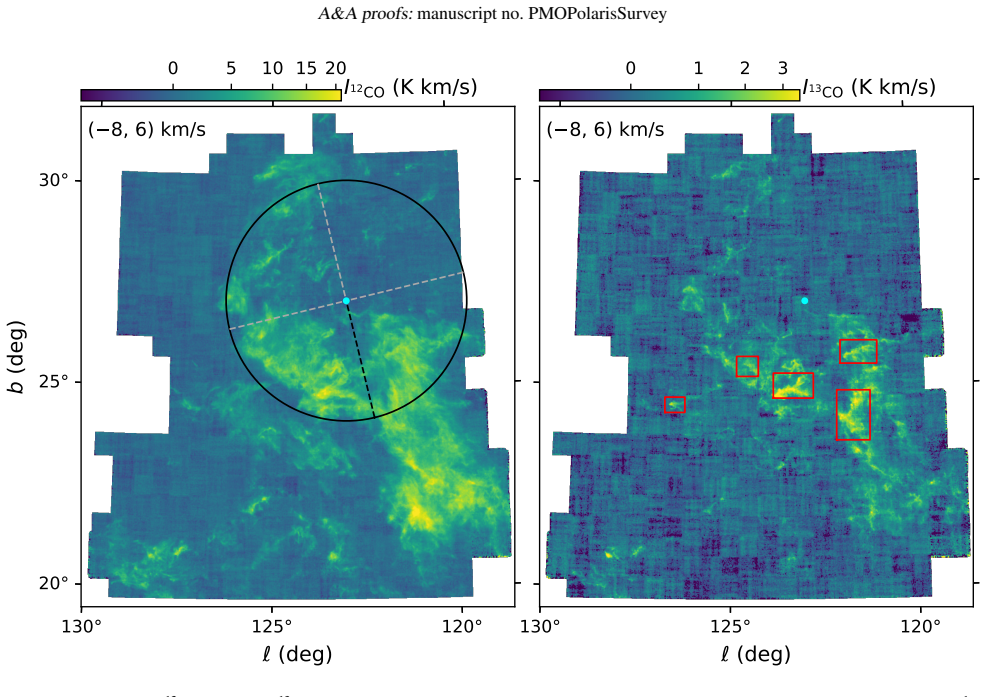
The survey data organize the CO emission into a three-layer hierarchy in which 12CO traces a dynamically assembling and dispersing periphery, 13CO traces a more stable intermediate kernel, and C18O traces gravitationally bound compact cores. This structure is supported by the global velocity gradient, the systematic narrowing of line widths from 12CO to 13CO, and the spatial division of emission into groups aligned with or perpendicular to the gradient, possibly regulated by large-scale coherent dynamics. The cloud shows conditions resembling giant molecular clouds despite its high-latitude location and lacks firmly associated young stellar objects.
What carries the argument
The three-layer hierarchy of the molecular cloud, distinguished by the spatial distributions, line widths, and intensity ratios of the three CO isotopologues.
If this is right
- The Polaris Flare provides an ideal laboratory for studying turbulence, hierarchical structure, and early cloud evolution in a nearby simple environment.
- Large-scale coherent dynamics appear to regulate the division of emission into groups aligned with and perpendicular to the velocity gradient.
- Line widths and intensity ratios in this high-latitude cloud resemble those in giant molecular clouds.
- The absence of associated young stellar objects indicates the cloud is in a pre-star-formation evolutionary phase.
Where Pith is reading between the lines
- Higher-resolution maps could test whether the C18O-traced cores are truly gravitationally bound.
- Similar surveys of other high-latitude clouds could determine whether the three-layer pattern is common in early molecular cloud evolution.
- The observed velocity gradient may connect to larger galactic shear or magnetic field structures.
Load-bearing premise
Intensity ratios and line-width differences map directly to distinct dynamical layers without major line-of-sight confusion or excitation variations.
What would settle it
Detection of young stellar objects firmly associated with the molecular gas or widespread multiple velocity components across most pixels would undermine the proposed hierarchy and early-stage interpretation.
Figures




read the original abstract
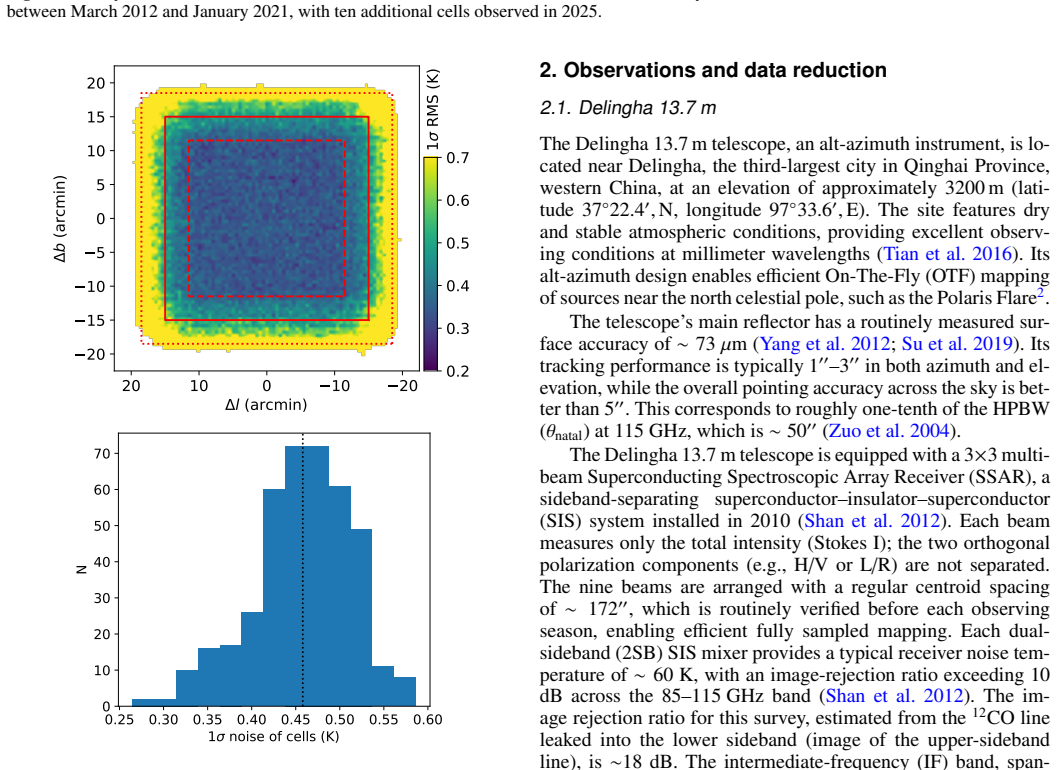
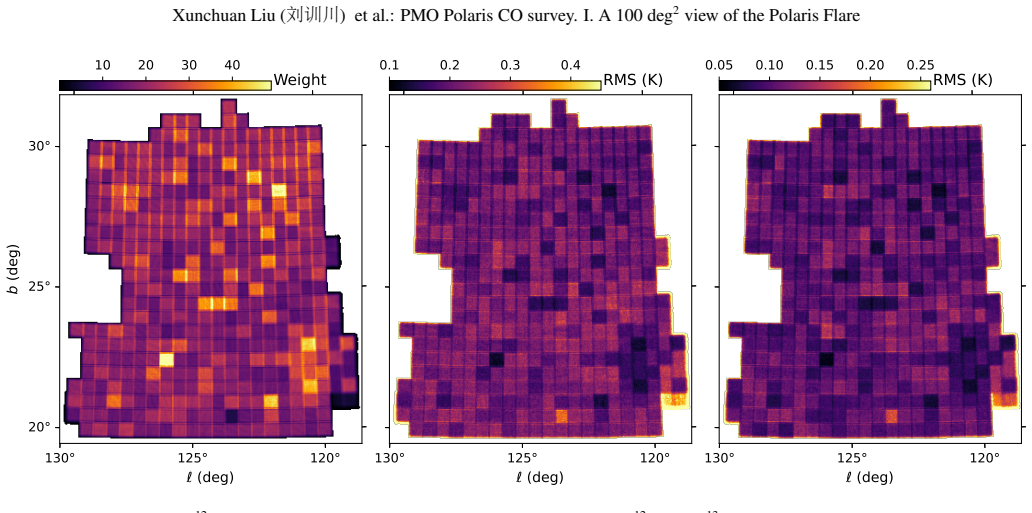
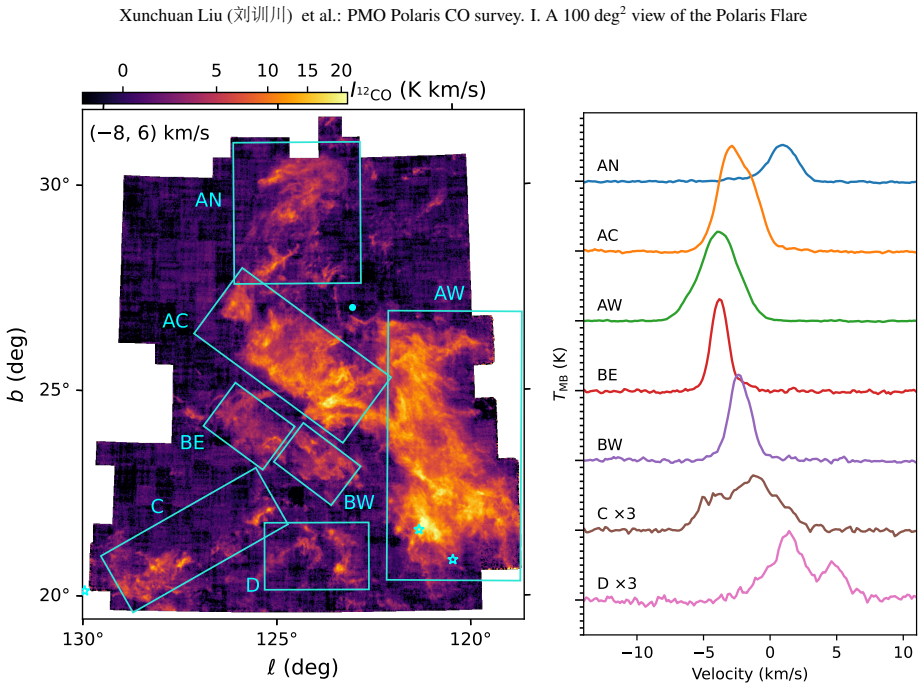
Large-area CO surveys are essential for studying molecular cloud dynamics and evolution; however, most have focused on the Galactic plane, leaving high-latitude clouds less explored. We present the PMO Polaris CO Survey (PPCOS), which maps a 100~deg$^2$ region of the Polaris Flare in the $J=1-0$ transitions of $^{12}$CO, $^{13}$CO, and C$^{18}$O using the Delingha 13.7~m telescope. As the first large-area CO survey at high Galactic latitude ($|b| > 20^{\circ}$) with sub-arcminute resolution, PPCOS achieves sensitivities of $\sim$0.46~K for $^{12}$CO and $\sim$0.23~K for $^{13}$CO and C$^{18}$O at a spectral resolution of 0.16~km~s$^{-1}$ and an angular resolution of 50\arcsec. The $^{12}$CO emission reveals seven distinct complexes, where only $\sim$10\% of pixels display multiple velocity components, alongside a global velocity gradient of 0.18~km~s$^{-1}$~pc$^{-1}$. Typical line widths are $1.2 \pm 0.6$~\mbox{km~s$^{-1}$} for $^{12}$CO, while $^{13}$CO components are systematically narrower ($\lesssim 0.7\,\Delta V_{\rm ^{12}CO}$). The $^{12}$CO/$^{13}$CO intensity ratios (5--25) indicate widespread $^{12}$CO optical thickness, resembling conditions found in giant molecular clouds (GMCs). Globally, the CO emission divides into two groups: a major group aligned with the velocity gradient and a secondary group elongated perpendicular to it, possibly regulated by large-scale coherent dynamics. We propose a three-layer hierarchy: a dynamically assembling and dispersing periphery traced by $^{12}$CO, a more stable intermediate kernel traced by $^{13}$CO, and gravitationally bound compact cores traced by C$^{18}$O. No young stellar objects are firmly associated with the molecular gas. PPCOS provides an ideal laboratory for studying turbulence, hierarchical structure, and early cloud evolution in a nearby, relatively simple molecular cloud.
Editorial analysis
A structured set of objections, weighed in public.
Referee Report
Summary. The manuscript presents the PMO Polaris CO Survey (PPCOS), a 100 deg² mapping of the Polaris Flare in the J=1-0 lines of 12CO, 13CO, and C18O using the Delingha 13.7 m telescope. It reports seven distinct complexes in 12CO emission, a global velocity gradient of 0.18 km s^{-1} pc^{-1}, line widths of 1.2 ± 0.6 km s^{-1} for 12CO with 13CO components narrower by ≲0.7, intensity ratios of 5–25 indicating optical thickness, division of emission into a major group aligned with the gradient and a secondary group elongated perpendicular to it, and proposes a three-layer hierarchy (12CO periphery, 13CO kernel, C18O cores). No YSOs are firmly associated, and the cloud is positioned as a laboratory for turbulence and early evolution studies.
Significance. The observational dataset is a clear strength: the first large-area, sub-arcminute resolution CO survey at |b| > 20° provides a valuable resource for high-latitude cloud studies, with reported sensitivities, resolutions, and basic statistics (seven complexes, ~10% multiple-velocity pixels) directly supported by the survey data. The interpretive claims on dynamical regulation and hierarchy add potential significance for cloud evolution models if substantiated, but currently rest on untested mappings from line ratios and widths.
major comments (2)
- [Abstract, final paragraph] Abstract, final paragraph: The claim that the two emission groups are 'possibly regulated by large-scale coherent dynamics' and the proposed three-layer hierarchy (dynamically assembling 12CO periphery, stable 13CO kernel, bound C18O cores) is load-bearing for the paper's positioning of the cloud as an 'ideal laboratory.' However, the supporting evidence—12CO/13CO ratios of 5–25 and 13CO line widths ≲0.7 ΔV_12CO—is also consistent with optical-depth and excitation variations without requiring distinct dynamical layers; no quantitative test (e.g., excitation modeling or position-velocity diagram analysis) excludes line-of-sight confusion or projection effects.
- [Abstract] Abstract: The assertion that only ~10% of pixels show multiple velocity components is used to downplay LOS overlap and support the group division and hierarchy, but the identification method, velocity-separation threshold, and spatial distribution of these pixels are not specified, making it impossible to evaluate whether this fraction sufficiently rules out projection effects in a high-latitude cloud.
minor comments (3)
- [Abstract] The rms sensitivity values (~0.46 K for 12CO, ~0.23 K for 13CO/C18O) should explicitly state whether they are per-channel or integrated, and reference the relevant methods or table where the noise properties are derived.
- Notation for velocity gradient (0.18 km s^{-1} pc^{-1}) and line widths should be standardized (e.g., consistent use of km s^{-1} vs. km/s) across the text and any tables.
- [Abstract] The angular resolution is given as 50 arcsec; use the standard 50'' symbol for consistency with astronomical literature.
Simulated Author's Rebuttal
We thank the referee for the constructive report and the recommendation for major revision. We address the two major comments below with proposed changes to the abstract that qualify interpretive language and add methodological detail while preserving the scientific content of the survey results.
read point-by-point responses
-
Referee: [Abstract, final paragraph] Abstract, final paragraph: The claim that the two emission groups are 'possibly regulated by large-scale coherent dynamics' and the proposed three-layer hierarchy (dynamically assembling 12CO periphery, stable 13CO kernel, bound C18O cores) is load-bearing for the paper's positioning of the cloud as an 'ideal laboratory.' However, the supporting evidence—12CO/13CO ratios of 5–25 and 13CO line widths ≲0.7 ΔV_12CO—is also consistent with optical-depth and excitation variations without requiring distinct dynamical layers; no quantitative test (e.g., excitation modeling or position-velocity diagram analysis) excludes line-of-sight confusion or projection effects.
Authors: We agree that the line-ratio and width data alone admit alternative explanations based on optical-depth and excitation gradients. The proposed hierarchy is presented as an interpretive framework consistent with the observed spatial and kinematic patterns (alignment of the major group with the global gradient, perpendicular elongation of the secondary group, and the systematic narrowing from 12CO to 13CO). No excitation modeling or full position-velocity analysis is performed in the current manuscript. We will revise the abstract to replace definitive phrasing with 'suggestive of' and 'we propose as a possible interpretation,' and we will add a short clause noting that the low fraction of multiple-velocity pixels and the high-latitude location reduce but do not eliminate projection effects. A more quantitative test is beyond the scope of this survey paper but could be addressed in follow-up work. revision: partial
-
Referee: [Abstract] Abstract: The assertion that only ~10% of pixels show multiple velocity components is used to downplay LOS overlap and support the group division and hierarchy, but the identification method, velocity-separation threshold, and spatial distribution of these pixels are not specified, making it impossible to evaluate whether this fraction sufficiently rules out projection effects in a high-latitude cloud.
Authors: The ~10% figure comes from a multi-Gaussian decomposition applied to the 12CO spectra (described in Section 3.2 of the manuscript) with a minimum velocity separation of 0.8 km s^{-1} between components and a peak S/N threshold of 3. The multiple-component pixels are concentrated at the boundaries of the seven complexes rather than uniformly distributed. Because the abstract must remain concise, these details were omitted. We will revise the abstract to include a brief parenthetical statement: 'identified via multi-Gaussian decomposition with a 0.8 km s^{-1} separation threshold.' This makes the claim self-contained while directing readers to the methods section for full criteria. revision: yes
Circularity Check
Purely observational survey; no derivations or predictions that reduce to inputs
full rationale
The paper reports a CO mapping survey with measured quantities (velocity gradient 0.18 km s^{-1} pc^{-1}, line widths, intensity ratios 5-25, ~10% multiple components) and offers an interpretive proposal of a three-layer hierarchy. No equations, fitted parameters, or self-citations appear in the provided text that would allow any claim to reduce by construction to the paper's own inputs. All load-bearing statements are direct observational reports or qualitative interpretation, with no self-definitional loops, renamed predictions, or imported uniqueness theorems.
Axiom & Free-Parameter Ledger
Reference graph
Works this paper leans on
-
[1]
2010, A&A, 518, L102 Armijos-Abendaño, J., Banda-Barragán, W
André, P., Men’shchikov, A., Bontemps, S., et al. 2010, A&A, 518, L102 Armijos-Abendaño, J., Banda-Barragán, W. E., Martín-Pintado, J., et al. 2020, MNRAS, 499, 4918 Astropy Collaboration, Price-Whelan, A. M., Lim, P. L., et al. 2022, ApJ, 935, 167
2010
-
[2]
E., Blæsild, P., & Schmiegel, J
Barndorff-Nielsen, O. E., Blæsild, P., & Schmiegel, J. 2004, European Physical Journal B, 41, 345
2004
-
[3]
J., Muller, E., Indermuehle, B., et al
Barnes, P. J., Muller, E., Indermuehle, B., et al. 2015, ApJ, 812, 6
2015
-
[4]
2010, MNRAS, 406, 2713
Barriault, L., Joncas, G., Falgarone, E., et al. 2010, MNRAS, 406, 2713
2010
-
[5]
1983, A&A, 119, 109
Bastien, P. 1983, A&A, 119, 109
1983
-
[6]
& Bovy, J
Bennett, M. & Bovy, J. 2018, Monthly Notices of the Royal Astronomical Soci- ety, 482, 1417
2018
-
[7]
2003, ApJ, 591, 1013
Bensch, F., Leuenhagen, U., Stutzki, J., & Schieder, R. 2003, ApJ, 591, 1013
2003
-
[8]
P., Abergel, A., Ristorcelli, I., et al
Bernard, J. P., Abergel, A., Ristorcelli, I., et al. 1999, A&A, 347, 640
1999
-
[9]
& McKee, C
Bertoldi, F. & McKee, C. F. 1992, ApJ, 395, 140
1992
-
[10]
2020, A&A, 644, A27
Bonne, L., Bontemps, S., Schneider, N., et al. 2020, A&A, 644, A27
2020
-
[11]
2020, A&A, 644, A5
Bracco, A., Bresnahan, D., Palmeirim, P., et al. 2020, A&A, 644, A5
2020
-
[12]
G., Blackwell, R., et al
Braiding, C., Burton, M. G., Blackwell, R., et al. 2015, PASA, 32, e020
2015
-
[13]
Brunt, C. M. 2003, ApJ, 583, 280
2003
-
[14]
& Park, Y .-S
Chi, S.-Y . & Park, Y .-S. 2006, Journal of Korean Astronomical Society, 39, 9
2006
-
[15]
M., Hartmann, D., & Thaddeus, P
Dame, T. M., Hartmann, D., & Thaddeus, P. 2001, ApJ, 547, 792
2001
-
[16]
F., Heithausen, A., et al
Falgarone, E., Panis, J. F., Heithausen, A., et al. 1998, A&A, 331, 669 Fernández-López, M., Arce, H. G., Looney, L., et al. 2014, ApJ, 790, L19
1998
-
[17]
2021, PASJ, 73, S1
Fukui, Y ., Habe, A., Inoue, T., Enokiya, R., & Tachihara, K. 2021, PASJ, 73, S1
2021
-
[18]
2018, PASJ, 70, S46 Gaia Collaboration, Vallenari, A., Brown, A
Fukui, Y ., Ohama, A., Kohno, M., et al. 2018, PASJ, 70, S46 Gaia Collaboration, Vallenari, A., Brown, A. G. A., et al. 2023, A&A, 674, A1
2018
-
[19]
F., Heyer, M., Narayanan, G., et al
Goldsmith, P. F., Heyer, M., Narayanan, G., et al. 2008, ApJ, 680, 428
2008
-
[20]
Goldsmith, P. F. & Kauffmann, J. 2017, ApJ, 841, 25
2017
-
[21]
E., Heitsch, F., et al
Hacar, A., Clark, S. E., Heitsch, F., et al. 2023, in Astronomical Society of the Pacific Conference Series, V ol. 534, Protostars and Planets VII, ed. S. Inut- suka, Y . Aikawa, T. Muto, K. Tomida, & M. Tamura, 153
2023
-
[22]
2016, A&A, 587, A97
Hacar, A., Kainulainen, J., Tafalla, M., Beuther, H., & Alves, J. 2016, A&A, 587, A97
2016
-
[23]
2013, A&A, 554, A55 Article number, page 21 of 22 A&A proofs:manuscript no
Hacar, A., Tafalla, M., Kauffmann, J., & Kovács, A. 2013, A&A, 554, A55 Article number, page 21 of 22 A&A proofs:manuscript no. PMOPolarisSurvey
2013
-
[24]
& Burton, W
Hartmann, D. & Burton, W. B. 1993, in American Institute of Physics Confer- ence Series, V ol. 278, Back to the Galaxy, ed. S. S. Holt & F. Verter, 279–282
1993
-
[25]
& Troland, T
Heiles, C. & Troland, T. H. 2003, ApJ, 586, 1067
2003
-
[26]
2002, A&A, 383, 591
Heithausen, A., Bertoldi, F., & Bensch, F. 2002, A&A, 383, 591
2002
-
[27]
G., de Vries, H
Heithausen, A., Stacy, J. G., de Vries, H. W., Mebold, U., & Thaddeus, P. 1993, A&A, 268, 265
1993
-
[28]
& Thaddeus, P
Heithausen, A. & Thaddeus, P. 1990, ApJ, 353, L49
1990
-
[29]
& Inutsuka, S.-i
Hennebelle, P. & Inutsuka, S.-i. 2019, Frontiers in Astronomy and Space Sci- ences, 6, 5
2019
-
[30]
D., Caselli, P., Fontani, F., Jiménez-Serra, I., & Tan, J
Henshaw, J. D., Caselli, P., Fontani, F., Jiménez-Serra, I., & Tan, J. C. 2014, MNRAS, 440, 2860
2014
-
[31]
& Dame, T
Heyer, M. & Dame, T. M. 2015, ARA&A, 53, 583
2015
-
[32]
F., Yıldız, U
Heyer, M., Goldsmith, P. F., Yıldız, U. A., et al. 2016, MNRAS, 461, 3918 HI4PI Collaboration, Ben Bekhti, N., Flöer, L., et al. 2016, A&A, 594, A116
2016
-
[33]
& Blitz, L
Imara, N. & Blitz, L. 2011, ApJ, 732, 78
2011
-
[34]
G., Bania, T
Ingalls, J. G., Bania, T. M., Lane, A. P., Rumitz, M., & Stark, A. A. 2000, ApJ, 535, 211
2000
-
[35]
M., Rathborne, J
Jackson, J. M., Rathborne, J. M., Shah, R. Y ., et al. 2006, ApJS, 163, 145
2006
-
[36]
Jeffreson, S. M. R. & Kruijssen, J. M. D. 2018, MNRAS, 476, 3688
2018
-
[37]
2020, A&A, 644, A151
Juvela, M. 2020, A&A, 644, A151
2020
-
[38]
Kalberla, P. M. W., Kerp, J., & Haud, U. 2020, A&A, 639, A26
2020
-
[39]
Kennicutt, Jr., R. C. 1998, ApJ, 498, 541
1998
-
[40]
Koenig, X. P. & Leisawitz, D. T. 2014, ApJ, 791, 131 Könyves, V ., André, P., Men’shchikov, A., et al. 2010, A&A, 518, L106
2014
-
[41]
R., McKee, C
Krumholz, M. R., McKee, C. F., & Tumlinson, J. 2009, ApJ, 693, 216
2009
-
[42]
Lagache, G., Abergel, A., Boulanger, F., & Puget, J. L. 1998, A&A, 333, 709
1998
-
[43]
D., Goldsmith, P
Langer, W. D., Goldsmith, P. F., Carlson, E. R., & Wilson, R. W. 1980, ApJ, 235, L39
1980
-
[44]
Li, P. S. & Klein, R. I. 2019, MNRAS, 485, 4509
2019
-
[45]
2021, Chinese Astronomy and Astrophysics, 45, 559
Li, Z., Zhang, X., Li, J., et al. 2021, Chinese Astronomy and Astrophysics, 45, 559
2021
-
[46]
2025, arXiv e-prints, arXiv:2502.20458
Liu, X. 2025, arXiv e-prints, arXiv:2502.20458
Pith/arXiv arXiv 2025
-
[47]
2025a, Nature Astronomy [arXiv:2502.10897]
Liu, X., Liu, T., Li, P.-S., et al. 2025a, Nature Astronomy [arXiv:2502.10897]
- [48]
-
[49]
C., Wu, Y ., Zhang, C., et al
Liu, X. C., Wu, Y ., Zhang, C., et al. 2019, A&A, 622, A32
2019
-
[50]
Lorensen, W. E. & Cline, H. E. 1987, in SIGGRAPH, ed. M. C. Stone (ACM), 163–169
1987
-
[51]
1985, ApJ, 295, 402
Magnani, L., Blitz, L., & Mundy, L. 1985, ApJ, 295, 402
1985
-
[52]
V ., Paladini, R., et al
Marton, G., Tóth, L. V ., Paladini, R., et al. 2016, MNRAS, 458, 3479 Men’shchikov, A., André, P., Didelon, P., et al. 2010, A&A, 518, L103
2016
-
[53]
& Heithausen, A
Meyerdierks, H. & Heithausen, A. 1996, A&A, 313, 929
1996
-
[54]
N., Savage, C., Brewster, M
Milam, S. N., Savage, C., Brewster, M. A., Ziurys, L. M., & Wyckoff, S. 2005, ApJ, 634, 1126 Miville-Deschênes, M. A., Martin, P. G., Abergel, A., et al. 2010, A&A, 518, L104
2005
-
[55]
Monaci, M., Magnani, L., & Shore, S. N. 2022, A&A, 668, L9
2022
-
[56]
H., Brunt, C., et al
Narayanan, G., Heyer, M. H., Brunt, C., et al. 2008, ApJS, 177, 341
2008
-
[57]
1996, ApJ, 465, 815
Onishi, T., Mizuno, A., Kawamura, A., Ogawa, H., & Fukui, Y . 1996, ApJ, 465, 815
1996
-
[58]
2002, A&A, 391, 295
Ossenkopf, V . 2002, A&A, 391, 295
2002
-
[59]
& Mac Low, M
Ossenkopf, V . & Mac Low, M. M. 2002, A&A, 390, 307
2002
-
[60]
Ossenkopf-Okada, V ., Csengeri, T., Schneider, N., Federrath, C., & Klessen, R. S. 2016, A&A, 590, A104
2016
-
[61]
2016, ApJ, 827, L27
Park, G., Koo, B.-C., Kang, J.-h., et al. 2016, ApJ, 827, L27
2016
-
[62]
2023, in Astronomical Society of the Pacific Conference Series, V ol
Pattle, K., Fissel, L., Tahani, M., Liu, T., & Ntormousi, E. 2023, in Astronomical Society of the Pacific Conference Series, V ol. 534, Protostars and Planets VII, ed. S. Inutsuka, Y . Aikawa, T. Muto, K. Tomida, & M. Tamura, 193
2023
-
[63]
A., André, P., et al
Peretto, N., Fuller, G. A., André, P., et al. 2014, A&A, 561, A83
2014
-
[64]
2005, in SF2A-2005: Semaine de l’Astrophysique Francaise, ed
Pety, J. 2005, in SF2A-2005: Semaine de l’Astrophysique Francaise, ed. F. Ca- soli, T. Contini, J. M. Hameury, & L. Pagani, 721
2005
-
[65]
G., Huggins, P
Phillips, T. G., Huggins, P. J., Wannier, P. G., & Scoville, N. Z. 1979, ApJ, 231, 720 Planck Collaboration, Abergel, A., Ade, P. A. R., et al. 2014, A&A, 571, A11 Planck Collaboration, Ade, P. A. R., Aghanim, N., et al. 2016, A&A, 594, A28
1979
-
[66]
A., Di Francesco, J., Kirk, H., et al
Ridge, N. A., Di Francesco, J., Kirk, H., et al. 2006, AJ, 131, 2921
2006
-
[67]
2003, ApJ, 599, 258
Rosolowsky, E., Engargiola, G., Plambeck, R., & Blitz, L. 2003, ApJ, 599, 258
2003
-
[68]
D., Bohlin, R
Savage, B. D., Bohlin, R. C., Drake, J. F., & Budich, W. 1977, ApJ, 216, 291
1977
-
[69]
2012, IEEE Transactions on Terahertz Science and Technology, 2, 593
Shan, W., Yang, J., Shi, S., et al. 2012, IEEE Transactions on Terahertz Science and Technology, 2, 593
2012
-
[70]
2025, ApJ, 981, 158
Shimoikura, T., Dobashi, K., Nakamura, F., & Taniguchi, K. 2025, ApJ, 981, 158
2025
-
[71]
2012, ApJ, 745, 195
Shimoikura, T., Dobashi, K., Sakurai, T., et al. 2012, ApJ, 745, 195
2012
-
[72]
2023, A&A, 673, A76
Skalidis, R., Gkimisi, K., Tassis, K., et al. 2023, A&A, 673, A76
2023
-
[73]
M., Scoville, N
Solomon, P. M., Scoville, N. Z., & Sanders, D. B. 1979, ApJ, 232, L89
1979
-
[74]
1978, Physical Processes in the Interstellar Medium (New York: Wiley-Interscience), cited by over 5,000 times as of 2025
Spitzer, L. 1978, Physical Processes in the Interstellar Medium (New York: Wiley-Interscience), cited by over 5,000 times as of 2025
1978
-
[75]
1998, A&A, 336, 697
Stutzki, J., Bensch, F., Heithausen, A., Ossenkopf, V ., & Zielinsky, M. 1998, A&A, 336, 697
1998
-
[76]
2019, ApJS, 240, 9
Su, Y ., Yang, J., Zhang, S., et al. 2019, ApJS, 240, 9
2019
-
[77]
X., Lu, D
Sun, J. X., Lu, D. R., Yang, J., et al. 2018, Acta Astronomica Sinica, 59, 3
2018
-
[78]
2021, ApJS, 256, 32
Sun, Y ., Yang, J., Yan, Q.-Z., et al. 2021, ApJS, 256, 32
2021
-
[79]
F., Deng, L
Tian, J. F., Deng, L. C., Zhang, X. B., et al. 2016, PASP, 128, 105003
2016
-
[80]
& Tassis, K
Tritsis, A. & Tassis, K. 2016, MNRAS, 462, 3602
2016
discussion (0)
Sign in with ORCID, Apple, or X to comment. Anyone can read and Pith papers without signing in.