Covert Blockwise Coding with Sequential Detection over Thermal-Loss Bosonic Channels
Pith reviewed 2026-06-26 19:32 UTC · model grok-4.3
The pith
Bob detects active blocks before they end in covert bosonic communication by using uniform signaling that exploits linear information growth against quadratic eavesdropper detectability.
A machine-rendered reading of the paper's core claim, the machinery that carries it, and where it could break.
Core claim
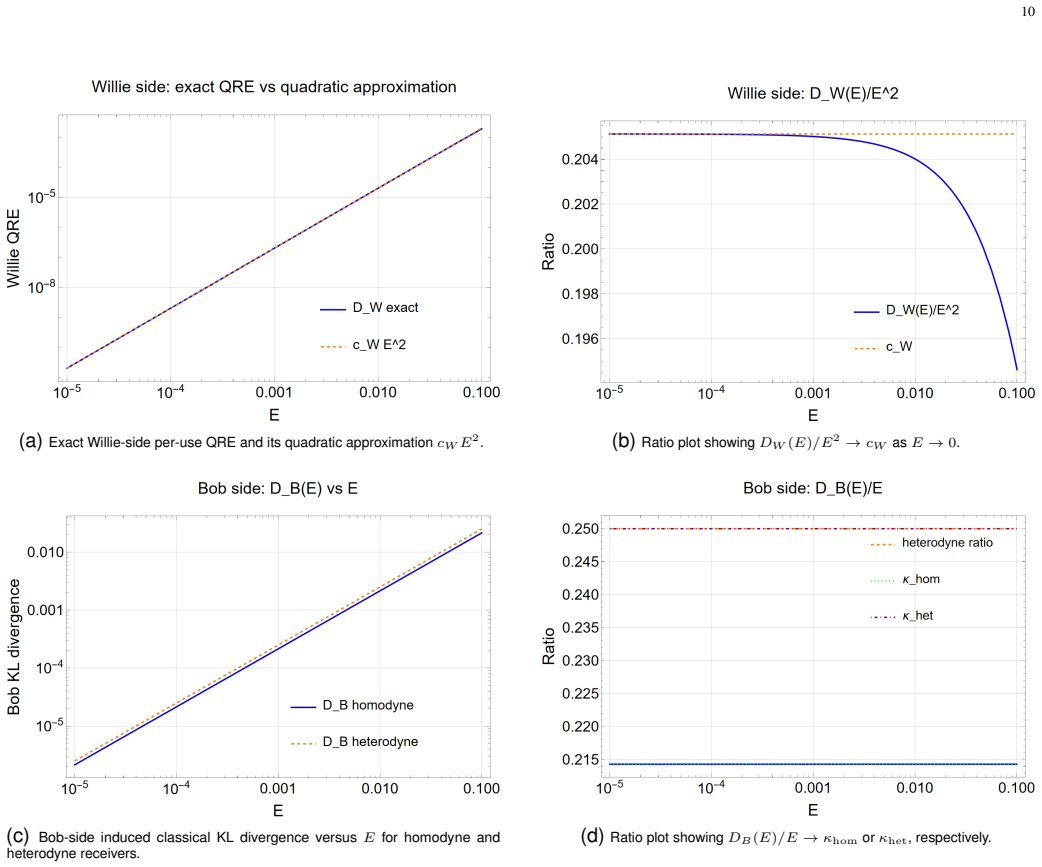
For any fixed physically realizable general-dyne receiver, Bob's post-change information growth is linear in the small-signal regime, whereas Willie's detectability obeys a quadratic quantum relative entropy law. Exploiting this asymmetry, the asymptotically optimal signaling strategy is uniform across the detection segment, and an explicit minimum-length condition is derived under which a single-pass CUSUM detector crosses threshold within the same block with exponentially high probability.
What carries the argument
The linear post-change information growth for Bob contrasted with the quadratic quantum relative entropy law for Willie, which justifies uniform signaling and the derived CUSUM minimum-length condition.
If this is right
- The approach produces a covert blockwise binary codebook that operates over a finite transmission horizon.
- Explicit minimum-length conditions connect bosonic covert communication directly to sequential detection and blockwise signaling design.
- The results supply concrete design rules for covert quantum systems that use physically realizable receivers.
- Information-theoretic covertness guarantees are linked to implementable receiver-aware optical communication.
Where Pith is reading between the lines
- The same linear-quadratic asymmetry might be tested in other quantum channel models or with non-general-dyne receivers to see whether uniform signaling remains optimal.
- Multi-block or adaptive variants of the CUSUM rule could be derived by relaxing the single-pass restriction while preserving per-block covertness.
- Hardware experiments could measure actual CUSUM crossing times in thermal-loss optical links to check the minimum-length formula under realistic noise.
Load-bearing premise
The per-block covertness budget is small enough that the linear-versus-quadratic asymmetry dominates and allows uniform signaling to meet the stated CUSUM crossing probability.
What would settle it
A numerical simulation or optical experiment in which, for a small per-block covertness budget, the single-pass CUSUM detector fails to cross threshold within the block at the claimed exponential probability when uniform signaling is used.
Figures


read the original abstract
We develop, to our knowledge, the first receiver-centric blockwise sequential-detection framework for covert communication over thermal-loss bosonic channels. In this architecture, each block serves as a binary super-symbol, and the key design problem is to determine the minimum detection-segment length that enables Bob to detect an active block before the block ends while remaining covert to Willie. For any fixed physically realizable general-dyne receiver, Bob's post-change information growth is linear in the small-signal regime, whereas Willie's detectability obeys a quadratic quantum relative entropy law. Exploiting this asymmetry, we show that under a per-block covertness budget the asymptotically optimal signaling strategy is uniform across the detection segment, and we derive an explicit minimum-length condition under which a single-pass cumulative sum (CUSUM) detector crosses threshold within the same block with exponentially high probability. The resulting design law yields a covert blockwise binary codebook over a finite transmission horizon and establishes a concrete link between bosonic covert communication, sequential detection, and blockwise signaling design. More broadly, these results provide design guidance for covert quantum communication systems with physically realizable receivers, and help bridge information-theoretic covertness guarantees with implementable receiver-aware optical communication design.
Editorial analysis
A structured set of objections, weighed in public.
Referee Report
Summary. The paper develops the first receiver-centric blockwise sequential-detection framework for covert communication over thermal-loss bosonic channels. Each block acts as a binary super-symbol; for any fixed physically realizable general-dyne receiver, Bob's post-change log-likelihood ratio grows linearly in the small-signal regime while Willie's detectability follows a quadratic quantum relative entropy law. Exploiting this asymmetry under a per-block covertness budget, the authors conclude that uniform signaling across the detection segment is asymptotically optimal and derive an explicit minimum-length condition ensuring a single-pass CUSUM detector crosses its threshold within the block with exponentially high probability. The resulting design yields a covert blockwise binary codebook over finite horizons and links bosonic covert communication to sequential detection and blockwise signaling.
Significance. If the central claims hold, the work supplies a concrete, receiver-aware design law that bridges information-theoretic covertness guarantees with implementable optical systems. The explicit minimum-length condition and the explicit exploitation of the linear-vs-quadratic asymmetry constitute genuine strengths; the framework also opens a path toward sequential-detection analyses of other physically realizable receivers.
major comments (2)
- [§3] §3 (asymptotic optimality of uniform signaling) and the subsequent derivation of the minimum-length condition: the move from the stated linear growth for Bob and quadratic QRE for Willie to the conclusion that uniform allocation is optimal (and that the CUSUM bound holds) rests on the premise that the per-block covertness budget ε is small enough for higher-order terms to remain negligible. No explicit ε-threshold or remainder bound is supplied that would delineate the regime in which this dominance holds for a general fixed general-dyne receiver; without it the optimality claim and the length condition are not yet fully justified.
- [CUSUM analysis] The CUSUM crossing-probability statement (the exponential bound derived after the uniform-signaling step): the proof sketch invokes the small-ε regime to control the overshoot and the drift, yet the same missing remainder estimate appears here. A concrete test (e.g., an explicit O(ε^{3/2}) or higher-order expansion) would be needed to confirm that the claimed exponential probability remains valid outside the infinitesimal-ε limit.
minor comments (2)
- Notation for the per-block covertness parameter ε is introduced without an immediate reminder of its physical units or its relation to the usual total-variation or relative-entropy covertness metrics used elsewhere in the bosonic literature.
- Figure captions for the receiver block diagram and the CUSUM trajectory plots could usefully include the precise values of the thermal-noise parameter and the mean-photon-number scaling used in the numerical examples.
Simulated Author's Rebuttal
We thank the referee for the careful reading and constructive comments. We address the two major comments point by point below.
read point-by-point responses
-
Referee: [§3] §3 (asymptotic optimality of uniform signaling) and the subsequent derivation of the minimum-length condition: the move from the stated linear growth for Bob and quadratic QRE for Willie to the conclusion that uniform allocation is optimal (and that the CUSUM bound holds) rests on the premise that the per-block covertness budget ε is small enough for higher-order terms to remain negligible. No explicit ε-threshold or remainder bound is supplied that would delineate the regime in which this dominance holds for a general fixed general-dyne receiver; without it the optimality claim and the length condition are not yet fully justified.
Authors: The derivations in §3 are performed in the asymptotic small-ε regime (ε → 0), where the linear growth of Bob’s post-change log-likelihood ratio for any fixed general-dyne receiver strictly dominates Willie’s quadratic quantum relative entropy term. This asymmetry directly yields the asymptotic optimality of uniform signaling and the associated minimum-length condition. We agree that the manuscript does not supply an explicit finite-ε threshold or remainder bound. In the revision we will add an explicit statement that all claims are asymptotic as ε → 0 and include a short paragraph clarifying the small-signal assumptions under which higher-order terms become negligible. revision: partial
-
Referee: [CUSUM analysis] The CUSUM crossing-probability statement (the exponential bound derived after the uniform-signaling step): the proof sketch invokes the small-ε regime to control the overshoot and the drift, yet the same missing remainder estimate appears here. A concrete test (e.g., an explicit O(ε^{3/2}) or higher-order expansion) would be needed to confirm that the claimed exponential probability remains valid outside the infinitesimal-ε limit.
Authors: The exponential bound on the CUSUM crossing probability is likewise obtained in the same asymptotic regime, where the leading linear drift and quadratic overshoot terms govern the large-deviation behavior. We acknowledge that a higher-order expansion (e.g., O(ε^{3/2})) is not derived. The revision will explicitly note the asymptotic character of the bound and the reliance on the small-ε approximation; a full non-asymptotic expansion for arbitrary general-dyne receivers lies beyond the present scope. revision: partial
Circularity Check
No significant circularity; derivation uses standard quantum asymmetries
full rationale
The central claims rest on the established linear-vs-quadratic growth rates (Bob's post-change LLR linear in small-signal regime, Willie's detectability quadratic in QRE) for general-dyne receivers on thermal-loss bosonic channels. These are independent quantum-information facts, not derived within the paper. The move to uniform signaling optimality and the explicit minimum-length CUSUM condition is presented as following from this asymmetry under a per-block covertness budget; no quoted equation reduces the derived length bound or optimality statement to a fitted parameter or self-citation by construction. No self-definitional steps, no renaming of known results, and no load-bearing self-citation chains appear in the provided derivation outline. The small-ε regime condition is an explicit modeling assumption rather than a hidden tautology.
Axiom & Free-Parameter Ledger
Reference graph
Works this paper leans on
-
[1]
Quantum-secure covert communication on bosonic channels,
B. A. Bash, A. H. Gheorghe, M. Patel, J. L. Habif, D. Goeckel, D. Towsley, and S. Guha, “Quantum-secure covert communication on bosonic channels,”Nature Communications, vol. 6, p. 8626, 2015. [Online]. Available: https://doi.org/10.1038/ncomms9626
-
[2]
Covert capacity of bosonic channels,
C. N. Gagatsos, M. S. Bullock, and B. A. Bash, “Covert capacity of bosonic channels,”IEEE Journal on Selected Areas in Information Theory, vol. 1, no. 2, p. 555–567, Aug. 2020. [Online]. Available: http://dx.doi.org/10.1109/JSAIT.2020.3017199
-
[3]
Fundamental limits of quantum-secure covert communication over bosonic channels,
M. S. Bullock, C. N. Gagatsos, S. Guha, and B. A. Bash, “Fundamental limits of quantum-secure covert communication over bosonic channels,”IEEE Journal on Selected Areas in Communications, vol. 38, no. 3, pp. 471–482, 2020. [Online]. Available: https: //doi.org/10.1109/JSAC.2020.2968995
-
[4]
C. Weedbrook, S. Pirandola, R. García-Patrón, N. J. Cerf, T. C. Ralph, J. H. Shapiro, and S. Lloyd, “Gaussian quantum information,”Reviews of Modern Physics, vol. 84, no. 2, pp. 621–669, May 2012. [Online]. Available: https://link.aps.org/doi/10.1103/RevModPhys.84.621
-
[5]
Quantum information with continuous variables,
S. L. Braunstein and P. van Loock, “Quantum information with continuous variables,”Reviews of Modern Physics, vol. 77, no. 2, p. 513–577, Jun
-
[6]
Quantum information with continuous variables,
[Online]. Available: http://dx.doi.org/10.1103/RevModPhys.77.513
-
[7]
Continuous inspection schemes,
E. S. Page, “Continuous inspection schemes,”Biometrika, vol. 41, no. 1/2, pp. 100–115, 1954. [Online]. Available: http://www.jstor.org/stable/ 2333009
1954
-
[8]
Procedures for reacting to a change in distribution,
G. Lorden, “Procedures for reacting to a change in distribution,”The Annals of Mathematical Statistics, vol. 42, no. 6, pp. 1897–1908, 1971. [Online]. Available: http://www.jstor.org/stable/2240115
arXiv 1908
-
[9]
Optimal detection of a change in distribution,
M. Pollak, “Optimal detection of a change in distribution,”The Annals of Statistics, vol. 13, no. 1, pp. 206–227, 1985. [Online]. Available: http://www.jstor.org/stable/2241154
arXiv 1985
-
[10]
V . V . Veeravalli and T. Banerjee, “Quickest change detection,” 2012. [Online]. Available: https://arxiv.org/abs/1210.5552
Pith/arXiv arXiv 2012
-
[11]
Sequential change-point detection: Computation versus statistical performance,
H. Wang and Y . Xie, “Sequential change-point detection: Computation versus statistical performance,” 2023. [Online]. Available: https: //arxiv.org/abs/2210.05181
arXiv 2023
-
[12]
Window-limited cusum for sequential change detection,
L. Xie, G. V . Moustakides, and Y . Xie, “Window-limited cusum for sequential change detection,”IEEE Transactions on Information Theory, vol. 69, no. 9, pp. 5990–6005, 2023. [Online]. Available: http://dx.doi.org/10.1109/TIT.2023.3274646
-
[13]
Timing, carrier, and frame synchronization of burst-mode cpm,
E. Hosseini and E. Perrins, “Timing, carrier, and frame synchronization of burst-mode cpm,”IEEE Transactions on Communications, vol. 61, no. 12, p. 5125–5138, Dec. 2013. [Online]. Available: http: //dx.doi.org/10.1109/TCOMM.2013.111613.130667
-
[14]
A. A. Nasir, S. Durrani, H. Mehrpouyan, S. D. Blostein, and R. A. Kennedy, “Timing and carrier synchronization in wireless communication systems: a survey and classification of research in the last 5 years,”EURASIP Journal on Wireless Communications and Networking, vol. 2016, no. 1, Aug. 2016. [Online]. Available: http://dx.doi.org/10.1186/s13638-016-0670-9
-
[15]
M. Zebarjadi and M. Teimouri, “Non-cooperative burst detection and synchronisation in downlink tdma-based wireless communication networks,”IET Communications, vol. 13, no. 7, p. 863–872, Apr. 2019. [Online]. Available: https://doi.org/10.1049/iet-com.2018.5536
-
[16]
Massoud Salehi and J
P. Massoud Salehi and J. Proakis,Digital Communications. McGraw- Hill Education, 2007. [Online]. Available: https://books.google.com/ books?id=HroiQAAACAAJ
2007
-
[17]
Lpd communication: A sequential change-point detection perspective,
K.-W. Huang, H.-M. Wang, D. Towsley, and H. V . Poor, “Lpd communication: A sequential change-point detection perspective,”IEEE Transactions on Communications, vol. 68, no. 4, pp. 2474–2490, 2020. [Online]. Available: http://dx.doi.org/10.1109/TCOMM.2020.2969416
-
[18]
Achievability of covert quantum communication,
E. J. D. Anderson, M. S. Bullock, F. Rozp˛ edek, and B. A. Bash, “Achievability of covert quantum communication,” 2025. [Online]. Available: https://arxiv.org/abs/2501.13103
arXiv 2025
-
[19]
Quantum limits of covert target detection,
G. Y . Tham, R. Nair, and M. Gu, “Quantum limits of covert target detection,”Phys. Rev. Lett., vol. 133, p. 110801, Sep 2024. [Online]. Available: https://link.aps.org/doi/10.1103/PhysRevLett.133.110801
-
[20]
Quickest change detection in continuous-time in presence of a covert adversary,
A. R. Ramtin, P. Nain, and D. Towsley, “Quickest change detection in continuous-time in presence of a covert adversary,” 2025. [Online]. Available: https://arxiv.org/abs/2509.17778
arXiv 2025
-
[21]
Ultimate limits for quickest quantum change-point detection,
M. Fanizza, C. Hirche, and J. Calsamiglia, “Ultimate limits for quickest quantum change-point detection,”Physical Review Letters, vol. 131, no. 2, p. 020602, 2023
2023
-
[22]
M. Basseville and I. V . Nikiforov,Detection of Abrupt Changes: Theory and Application. Englewood Cliffs, NJ: Prentice Hall, 1993. [Online]. Available: https://www.researchgate.net/publication/2406812_Detection_ of_Abrupt_Change_Theory_and_Application
arXiv 1993
-
[23]
A. G. Tartakovsky, I. V . Nikiforov, and M. Basseville,Sequential Analysis: Hypothesis Testing and Changepoint Detection. Boca Raton: CRC Press, 2014. [Online]. Available: https://doi.org/10.1201/b17279
-
[24]
H. V . Poor and O. Hadjiliadis,Quickest Detection. Cambridge: Cambridge University Press, 2009. [Online]. Available: https://doi.org/ 10.1017/CBO9780511754678
-
[25]
Relative entropies and their use in quantum information theory,
F. Leditzky, “Relative entropies and their use in quantum information theory,” 2016. [Online]. Available: https://arxiv.org/abs/1611.08802
Pith/arXiv arXiv 2016
-
[26]
Lecture notes on information theory,
Y . Polyanskiy and Y . Wu, “Lecture notes on information theory,” 2023, (Chap 4.3 gives small-perturbation expansions of f-divergences with Fisher information). [Online]. Available: https://ocw.mit.edu/courses/ 6-441-information-theory-spring-2016/pages/lecture-notes/
2023
-
[27]
M. M. Wilde,Quantum Information Theory, 2nd ed. Cambridge, UK: Cambridge University Press, 2017. [Online]. Available: https://www.cambridge.org/core/books/quantum-information-theory/ 247A740E156416531AA8CB97DFDAE438
2017
-
[28]
Fundamental limits of communication with low probability of detection,
L. Wang, G. W. Wornell, and L. Zheng, “Fundamental limits of communication with low probability of detection,”IEEE Transactions on Information Theory, vol. 62, no. 6, pp. 3493–3503, 2016. [Online]. Available: https://doi.org/10.1109/TIT.2016.2548471
-
[29]
Sufficiency, kms condition and relative entropy in von neumann algebras,
F. Hiai, M. Ohya, and M. Tsukada, “Sufficiency, kms condition and relative entropy in von neumann algebras,”Pacific Journal of Mathematics, vol. 96, no. 1, pp. 99–109, 1981. [Online]. Available: https://doi.org/10.1142/9789812794208_0030
-
[30]
Continuous variable quantum information: Gaussian states and beyond,
G. Adesso, S. Ragy, and A. R. Lee, “Continuous variable quantum information: Gaussian states and beyond,”Open Systems & Information Dynamics, vol. 21, no. 1-2, p. 1440001, 2014. [Online]. Available: https://doi.org/10.1142/S1230161214400010
-
[31]
The semigroup structure of gaussian channels,
T. Heinosaari, A. S. Holevo, and M. M. Wolf, “The semigroup structure of gaussian channels,” 2009. [Online]. Available: https: //arxiv.org/abs/0909.0408
Pith/arXiv arXiv 2009
-
[32]
On the classical capacity of quantum gaussian channels,
C. Lupo, S. Pirandola, P. Aniello, and S. Mancini, “On the classical capacity of quantum gaussian channels,”Physica Scripta, vol. T143, p. 014016, 2011. [Online]. Available: https://doi.org/10.1088/0031-8949/ 2011/T143/014016
-
[33]
Optimal gaussian measurements for phase estimation in single-mode gaussian metrology,
C. Oh, C. Lee, C. Rockstuhl, H. Jeong, J. Kim, H. Nha, and S.-Y . Lee, “Optimal gaussian measurements for phase estimation in single-mode gaussian metrology,”npj Quantum Information, vol. 5, no. 1, Jan. 2019. [Online]. Available: http://dx.doi.org/10.1038/s41534-019-0124-4
-
[34]
On the classical capacity of general quantum gaussian measurement,
A. Holevo, “On the classical capacity of general quantum gaussian measurement,”Entropy, vol. 23, no. 3, p. 377, Mar. 2021. [Online]. Available: http://dx.doi.org/10.3390/e23030377
-
[35]
G. Mauro D’Ariano, M. G. Paris, and M. F. Sacchi,Quantum Tomography. Elsevier, 2003, p. 205–308. [Online]. Available: http://dx.doi.org/10.1016/S1076-5670(03)80065-4
-
[36]
On the properties of kullback-leibler divergence between multivariate gaussian distributions,
Y . Zhang, J. Pan, L. K. Li, W. Liu, Z. Chen, X. Liu, and J. Wang, “On the properties of kullback-leibler divergence between multivariate gaussian distributions,” inAdvances in Neural Information Processing Systems, A. Oh, T. Naumann, A. Globerson, K. Saenko, M. Hardt, and S. Levine, Eds., vol. 36. Curran Associates, Inc., 2023, pp. 58 152–58 165. [Online...
2023
-
[37]
The matrix cookbook,
K. B. Petersen and M. S. Pedersen, “The matrix cookbook,” nov 2012, version 20121115. [Online]. Available: http://www2.compute.dtu.dk/ pubdb/pubs/3274-full.html
2012
discussion (0)
Sign in with ORCID, Apple, or X to comment. Anyone can read and Pith papers without signing in.