Unified 1D Theory and Design Principles for Harmonic Electrothermal Characterization of Nanoscale Conductors
Pith reviewed 2026-06-26 18:51 UTC · model grok-4.3
The pith
A unified thermal transfer function predicts dc through 3ω voltage responses for both suspended and substrate-supported nanoscale conductors.
A machine-rendered reading of the paper's core claim, the machinery that carries it, and where it could break.
Core claim
A unified thermal transfer function that incorporates finite conductor length l, thermal mass, and environmental coupling strength allows quantitative prediction of the DC, 1ω, 2ω, and 3ω voltage signals produced by an AC Joule-heating current in both suspended and substrate-supported geometries; the characteristic frequency ω_c = α/l² marks the onset of thermal-mass-dominated behavior provided environmental coupling remains sufficiently weak.
What carries the argument
The unified thermal transfer function that bridges suspended and substrate-supported heat-transfer regimes while retaining finite length and thermal mass.
If this is right
- Voltage signals at DC, 1ω, 2ω, and 3ω can be calculated for any combination of conductor length, thermal diffusivity, and environmental impedance.
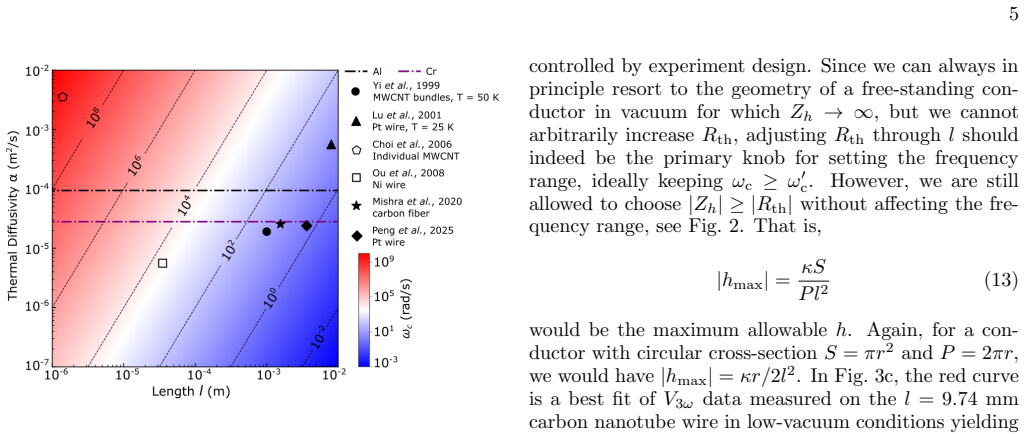
- Conductor length l sets the frequency scale ω_c = α/l² that separates thermal-mass-dominated from environment-dominated regimes.
- Weak environmental coupling is required for the length-dependent frequency ω_c to control the onset of thermal-mass effects.
- Reducing interfacial thermal resistance or tuning environmental thermal impedance can increase temperature resolution and enable on-substrate measurements.
Where Pith is reading between the lines
- The same transfer-function approach could be tested on conductors whose cross-sections vary along their length to check whether the 1D reduction still captures the dominant behavior.
- If the framework holds, it supplies a practical route to extract both thermal diffusivity and interfacial resistance from a single set of harmonic measurements on one device.
- The design principles suggest that deliberately lengthening a nanoscale heater on a substrate could shift its useful bandwidth into a more accessible frequency window without changing the substrate material.
Load-bearing premise
The one-dimensional approximation and the explicit mathematical form chosen for the unified thermal transfer function remain accurate for every coupling strength and frequency range examined.
What would settle it
Direct measurement of the 3ω voltage amplitude versus frequency on a conductor whose length and interface resistance place it near the predicted transition; systematic deviation from the transfer-function curve at frequencies around α/l² would falsify the central claim.
Figures


read the original abstract
Electrothermal characterization based on the third or other harmonics of an ac Joule heating current is widely deployed for the thermal analysis of solid conductors and their environment, including solid substrates and fluids. However, a unified theory that bridges heat transfer in two archetypal experimental geometries - suspended vs. substrate-supported conductor - has been missing. Here, we present and validate such a theory that explicitly accounts for finite conductor length, thermal mass, and environmental coupling through a unified thermal transfer function. This framework enables the prediction of voltage responses at all harmonics of the driving current (dc, 1$\omega$, 2$\omega$, 3$\omega$) and the formulation of design principles for the characterization of nanoscale conductors. The conductor length $l$ is the primary parameter controlling the frequency regime at which the conductor's thermal mass dominates the thermal response, with the characteristic frequency $\omega_\mathrm{c}=\alpha/l^2$, where $\alpha$ is the conductor's thermal diffusivity - closely related to a criterion previously reported for suspended wires free from environmental coupling. Our unified framework generalizes this result, revealing that sufficiently weak environmental coupling is a necessary condition for $\omega_\mathrm{c}$ to govern the onset of thermal-mass-dominated response. Optimization of interfacial thermal resistance and environmental thermal impedance may further improve temperature resolution and facilitate on-substrate implementations.
Editorial analysis
A structured set of objections, weighed in public.
Referee Report
Summary. The manuscript presents and validates a unified 1D theory for harmonic electrothermal characterization of nanoscale conductors. It introduces a single thermal transfer function that incorporates finite conductor length, thermal mass, and arbitrary environmental coupling to bridge suspended and substrate-supported geometries. The framework predicts voltage responses at dc, 1ω, 2ω, and 3ω harmonics of the driving current and yields design principles, with conductor length l as the primary parameter setting the thermal-mass onset frequency ω_c = α/l² (valid only under sufficiently weak environmental coupling).
Significance. If the transfer function is derived from the 1D heat equation and recovers the known limiting cases, the result would provide a practical, generalizable tool for electrothermal measurements on nanoscale devices, extending prior suspended-wire criteria and enabling optimized on-substrate implementations via interfacial resistance tuning.
major comments (2)
- [Theory section] Theory section (derivation of unified transfer function): the manuscript must explicitly demonstrate that the transfer function recovers the known suspended-wire limit as environmental coupling strength → 0 and the supported-substrate limit for strong coupling. If the function is constructed by ad-hoc matching rather than direct solution of the position-dependent 1D heat equation with consistent boundary conditions, the claimed unification is formal rather than physical and undermines the central claim.
- [Results/Validation] Results/Validation (comparison to higher-dimensional models): no quantitative threshold (e.g., Biot number or dimensionless coupling strength) is supplied for the regime where ω_c governs thermal-mass onset, nor is the 1D solution compared against 2D/3D substrate models at the crossover. This is load-bearing because the abstract asserts validity across the full range of environmental coupling strengths and frequencies.
minor comments (1)
- [Abstract] Abstract: the precise mathematical form of the unified thermal transfer function and its dependence on position-dependent boundary conditions should be stated explicitly rather than described only qualitatively.
Simulated Author's Rebuttal
We thank the referee for the positive assessment of the significance of our work and for the constructive major comments. We address each point below.
read point-by-point responses
-
Referee: [Theory section] Theory section (derivation of unified transfer function): the manuscript must explicitly demonstrate that the transfer function recovers the known suspended-wire limit as environmental coupling strength → 0 and the supported-substrate limit for strong coupling. If the function is constructed by ad-hoc matching rather than direct solution of the position-dependent 1D heat equation with consistent boundary conditions, the claimed unification is formal rather than physical and undermines the central claim.
Authors: The unified thermal transfer function is obtained by direct solution of the position-dependent 1D heat equation for a finite-length conductor with consistent boundary conditions at the ends and distributed environmental coupling. In the revised manuscript we will add explicit analytic limits: as environmental coupling strength → 0 the transfer function reduces to the known suspended-wire form containing the thermal-mass term with ω_c = α/l²; in the strong-coupling limit it recovers the supported-substrate expression with suppressed thermal-mass effects. These limits will be shown in a dedicated subsection to confirm the physical rather than formal character of the unification. revision: yes
-
Referee: [Results/Validation] Results/Validation (comparison to higher-dimensional models): no quantitative threshold (e.g., Biot number or dimensionless coupling strength) is supplied for the regime where ω_c governs thermal-mass onset, nor is the 1D solution compared against 2D/3D substrate models at the crossover. This is load-bearing because the abstract asserts validity across the full range of environmental coupling strengths and frequencies.
Authors: We agree a quantitative threshold is needed. The manuscript already states that ω_c governs onset only under sufficiently weak environmental coupling; we will introduce an explicit dimensionless coupling parameter (ratio of environmental to internal conductance, analogous to a Biot number) to delineate this regime. We will also revise the abstract to qualify the validity range accordingly. Direct numerical comparison of the 1D solution against 2D/3D substrate models at the crossover lies outside the scope of the present work, which centers on the analytic 1D framework and its limiting cases. revision: partial
Circularity Check
No circularity; unified transfer function presented as derived result without reduction to self-defined inputs
full rationale
The provided abstract and context contain no equations, fitted parameters, or self-citations that reduce the claimed unified thermal transfer function or harmonic predictions to inputs by construction. The framework is asserted to generalize the suspended-wire limit (ω_c = α/l²) under weak coupling, but this is presented as an independent generalization rather than a tautological renaming or fit. No load-bearing self-citation chain or ansatz smuggling is visible in the text. The derivation chain is therefore treated as self-contained against external benchmarks, consistent with the default expectation that most papers exhibit no circularity.
Axiom & Free-Parameter Ledger
Reference graph
Works this paper leans on
-
[1]
Corbino, O. M. , title =. Phys. Z. , volume =. 1910 , type =
1910
-
[2]
Corbino, O. M. , title =. Phys. Z. , volume =. 1911 , type =
1911
-
[3]
Heat transfer and superfluidity of helium II , author=. Phys. Rev. , volume=. 1941 , publisher=
1941
-
[4]
The study of heat transfer in helium II , author=. J. Phys.(Moscow) , volume=
-
[5]
The hydrodynamics of solutions of impurities in helium II , author=. Zh. Eksp. Teor. Fiz , volume=
-
[6]
Natural-convection heat transfer at reduced pressure , author=. Chem. Eng. Prog. , volume=
-
[7]
, title =
Mazo, Robert M. , title =. 1955 , address =
1955
-
[8]
Two-dimensional convection from heated wires at low Reynolds numbers , author=. J. Fluid Mech. , volume=. 1959 , publisher=
1959
-
[9]
Canadian Journal of Physics , volume=
The transport of heat between dissimilar solids at low temperatures , author=. Canadian Journal of Physics , volume=. 1959 , publisher=
1959
-
[10]
Lees, Lester and Liu, Chung‐Yen , title =. Phys. Fluids , volume =. doi:10.1063/1.1706498 , year =
-
[11]
SOVIET PHYSICS JETP-USSR , volume=
An investigation of the temperature discontinuity at the boundary between a solid and superfluid helium , author=. SOVIET PHYSICS JETP-USSR , volume=. 1962 , publisher=
1962
-
[12]
Powell, R. W. and Ho, C. Y. and Liley, P. E. , title =. National Standard Reference Data Series , publisher =. 1966 , type =
1966
-
[13]
Springer, G. S. , title =. Advances in Heat Transfer , editor =. 1971 , type =
1971
-
[14]
Furukawa, George T. and Reilly, Martin L. and Gallagher, John S. , title =. J. Phys. Chem. Ref. Data , volume =. doi:10.1063/1.3253137 , year =
-
[15]
Raudzis, C. E. and Schatz, F. and Wharam, D. , title =. J. Appl. Phys. , volume =. doi:10.1063/1.1569663 , year =
-
[16]
Heat transfer between sapphire and lead , author=. J. Low Temp. Phys. , volume=. 1980 , publisher=
1980
-
[17]
Thermal resistance of cylinder-flat contacts: theoretical analysis and experimental verification of a line-contact model , author=. Nucl. Eng. Des. , volume=. 1985 , publisher=
1985
-
[18]
Yuen, W. W. and Miller, F. J. and Hunt, A. J. , title =. Int. Commun. Heat Mass Transf. , volume =. doi:https://doi.org/10.1016/0735-1933(86)90054-0 , year =
-
[19]
Swartz, E. T. and Pohl, R. O. , title =. Rev. Mod. Phys. , volume =. doi:10.1103/RevModPhys.61.605 , year =
-
[20]
Cahill, David G. , title =. Rev. Sci. Instrum. , volume =. doi:10.1063/1.1141498 , year =
-
[21]
Cahill, David G. and Katiyar, M. and Abelson, J. R. , title =. Phys. Rev. B , volume =. doi:10.1103/PhysRevB.50.6077 , year =
-
[22]
The 3 technique for measuring dynamic specific heat and thermal conductivity of a liquid or solid , author=. Rev. Sci. Instrum. , volume=. 1996 , DOI =
1996
-
[23]
Lee, S. M. and Cahill, David G. , title =. J. Appl. Phys. , volume =. doi:10.1063/1.363923 , year =
-
[24]
Thermal conductivity and ballistic-phonon transport in the cross-plane direction of superlattices , author=. Phys. Rev. B , volume=. 1998 , publisher=
1998
-
[25]
Dayton, B. B. , title =. Foundations of Vacuum Science and Technology , editor =. 1998 , type =
1998
-
[26]
Yi, W. and Lu, L. and Dian-lin, Zhang and Pan, Z. W. and Xie, S. S. , title =. Phys. Rev. B , volume =. doi:10.1103/PhysRevB.59.R9015 , year =
-
[27]
Lu, L. and Yi, W. and Zhang, D. L. , title =. Rev. Sci. Instrum. , volume =. doi:10.1063/1.1378340 , year =
-
[28]
Data reduction in 3 method for thin-film thermal conductivity determination , author=. Rev. Sci. Instrum. , volume=. 2001 , DOI =
2001
-
[29]
Cahill, David G. and Ford, Wayne K. and Goodson, Kenneth E. and Mahan, Gerald D. and Majumdar, Arun and Maris, Humphrey J. and Merlin, Roberto and Phillpot, Simon R. , title =. J. Appl. Phys. , volume =. doi:10.1063/1.1524305 , year =
-
[30]
Bahadur, V. and Xu, J. and Liu, Y. and Fisher, T. S. , title =. J. Heat Transf. , volume =. doi:10.1115/1.1865217 , year =
-
[31]
Prasher, Ravi , title =. Nano Lett. , volume =. doi:10.1021/nl051710b , year =
-
[32]
Dames, Chris and Chen, Gang , title =. Rev. Sci. Instrum. , volume =. doi:10.1063/1.2130718 , year =
-
[33]
Choi, Tae-Youl and Poulikakos, Dimos and Tharian, Joy and Sennhauser, Urs , title =. Nano Lett. , volume =. doi:10.1021/nl060331v , year =
-
[34]
Hou, Jinbo and Wang, Xinwei and Vellelacheruvu, Pallavi and Guo, Jiaqi and Liu, Chang and Cheng, Hui-Ming , title =. J. Appl. Phys. , volume =. doi:10.1063/1.2402973 , year =
-
[35]
Tong, Tao and Majumdar, Arun , title =. Rev. Sci. Instrum. , volume =. doi:10.1063/1.2349601 , year =
-
[36]
Nonequilibrium
Wang, Jian-Sheng and Wang, Jian and Zeng, Nan , journal=. Nonequilibrium. 2006 , publisher=
2006
-
[37]
Wang, Z. L. and Tang, D. W. and Liu, S. and Zheng, X. H. and Araki, N. , title =. Int. J. Thermophys. , volume =. doi:10.1007/s10765-007-0254-3 , year =
-
[38]
Pop, Eric and Mann, David A. and Goodson, Kenneth E. and Dai, Hongjie , title =. J. Appl. Phys. , volume =. 2007 , type =. doi:10.1063/1.2717855 , url =
-
[39]
Hu, Ming and Shenogin, Sergei and Keblinski, Pawel and Raravikar, Nachiket , title =. Appl. Phys. Lett. , volume =. doi:10.1063/1.2746954 , year =
-
[40]
Thermal conductivity measurement and sedimentation detection of aluminum oxide nanofluids by using the 3 method , author=. Int. J. Heat Fluid Flow , volume=. 2008 , publisher=
2008
-
[41]
Electrical and thermal transport in single nickel nanowire , author=. Appl. Phys. Lett. , volume=. 2008 , pages=. doi:10.1063/1.2839572 , publisher=
-
[42]
Acoustic mismatch model for thermal contact resistance of van der Waals contacts , author=. Appl. Phys. Lett. , volume=. 2009 , publisher=
2009
-
[43]
S.H. Kim, G.W. Mulholland, M.R. Zachariah , title =. Carbon , volume =. doi:10.1016/j.carbon.2009.01.011. , year =
-
[44]
Thermal conductivity measurement of fluids using the 3 method , author=. Rev. Sci. Instrum. , volume=. 2009 , publisher=
2009
-
[45]
Hsu, I. Kai and Pettes, Michael T. and Aykol, Mehmet and Shi, Li and Cronin, Stephen B. , title =. J. Appl. Phys. , volume =. doi:10.1063/1.3499256 , year =
-
[46]
Pop, Eric , title =. Nano Res. , volume =. doi:10.1007/s12274-010-1019-z , year =
-
[47]
Liao, Albert and Alizadegan, Rouholla and Ong, Zhun-Yong and Dutta, Sumit and Xiong, Feng and Hsia, K. Jimmy and Pop, Eric , title =. Phys. Rev. B , volume =. 2010 , type =. doi:10.1103/PhysRevB.82.205406 , url =
-
[48]
Ong, Zhun-Yong and Pop, Eric , title =. Phys. Rev. B , volume =. 2010 , type =. doi:10.1103/PhysRevB.81.155408 , url =
-
[49]
, title =
Balandin, Alexander A. , title =. Nat. Mater. , volume =. 2011 , DOI =
2011
-
[50]
and Harvey, Allan H
Huber, Marcia L. and Harvey, Allan H. , title =. CRC Handbook of Chemistry and Physics , editor =. 2011 , edition =
2011
-
[51]
Cheng, Chun and Fan, Wen and Cao, Jinbo and Ryu, Sang Gil and Ji, Jie and Grigoropoulos, Costas P. and Wu, Junqiao , title =. ACS Nano , volume =. doi:10.1021/nn204072n , year =
-
[52]
Hsu, I. Kai and Pettes, Michael T. and Aykol, Mehmet and Chang, Chia-Chi and Hung, Wei-Hsuan and Theiss, Jesse and Shi, Li and Cronin, Stephen B. , title =. J. Appl. Phys. , volume =. doi:10.1063/1.3627236 , year =
-
[53]
Schiffres, Scott N. and Malen, Jonathan A. , title =. Rev. Sci. Instrum. , volume =. doi:10.1063/1.3593372 , year =
-
[54]
Improved 3-omega measurement of thermal conductivity in liquid, gases, and powders using a metal-coated optical fiber , author=. Rev. Sci. Instrum. , volume=. 2011 , publisher=
2011
-
[55]
Dames, Chris , title =. Annu. Rev. Heat Transf. , volume =. 2013 , DOI =
2013
-
[56]
Marconnet, Amy M. and Panzer, Matthew A. and Goodson, Kenneth E. , title =. Rev. Mod. Phys. , volume =. 2013 , type =. doi:10.1103/RevModPhys.85.1295 , url =
-
[57]
doi:10.1080/15567265.2013.878419 , author =
Wang, Hai-Dong and Liu, Jin-Hui and Guo, Zeng-Yuan and Zhang, Xing and Zhang, Ru-Fan and Wei, Fei and Li, Tian-Yi , title =. Nanoscale Microscale Thermophys. Eng. , volume =. doi:10.1080/15567265.2013.794438 , year =
-
[58]
Wang, Hai-Dong and Liu, Jin-Hui and Zhang, Xing and Li, Tian-Yi and Zhang, Ru-Fan and Wei, Fei , title =. J. Nanomater. , volume =. doi:10.1155/2013/181543 , year =
-
[59]
Wang, Z. L. and Tang, D. W. , title =. Int. J. Therm. Sci. , volume =. doi:https://doi.org/10.1016/j.ijthermalsci.2012.08.002 , year =
-
[60]
First-principles calculation of thermal transport in metal/graphene systems , author=. Phys. Rev. B , volume=. 2013 , publisher=
2013
-
[61]
Cahill, David G. and Braun, Paul V. and Chen, Gang and Clarke, David R. and Fan, Shanhui and Goodson, Kenneth E. and Keblinski, Pawel and King, William P. and Mahan, Gerald D. and Majumdar, Arun and Maris, Humphrey J. and Phillpot, Simon R. and Pop, Eric and Shi, Li , title =. Appl. Phys. Rev. , volume =. doi:10.1063/1.4832615 , year =
-
[62]
Xing, Changhu and Jensen, Colby and Munro, Troy and White, Benjamin and Ban, Heng and Chirtoc, Mihai , title =. Appl. Therm. Eng. , volume =. doi:https://doi.org/10.1016/j.applthermaleng.2014.07.035 , year =
-
[63]
Xing, Changhu and Jensen, Colby and Munro, Troy and White, Benjamin and Ban, Heng and Chirtoc, Mihai , title =. Appl. Therm. Eng. , volume =. doi:https://doi.org/10.1016/j.applthermaleng.2014.06.022 , year =
-
[64]
Thermal conductance imaging of graphene contacts , author=. J. Appl. Phys. , volume=. 2014 , publisher=
2014
-
[65]
Conductive heat transfer in rarefied polyatomic gases confined between parallel plates via various kinetic models and the. Int. J. Heat Mass Transf. , volume =. 2015 , doi =
2015
-
[66]
and Lavine, Adrienne S
Bergman, Theodore L. and Lavine, Adrienne S. , title =. 2017 , type =
2017
-
[67]
Rough boundary effect in thermal transport: A
Chen, Hongyuan and Wang, Huan and Yang, Yu and Li, Nianbei and Zhang, Lifa , journal=. Rough boundary effect in thermal transport: A. 2018 , publisher=
2018
-
[68]
Thermal rectification induced by geometrical asymmetry: A two-dimensional multiparticle
Wang, Huan and Yang, Yu and Chen, Hongyuan and Li, Nianbei and Zhang, Lifa , journal=. Thermal rectification induced by geometrical asymmetry: A two-dimensional multiparticle. 2019 , publisher=
2019
-
[69]
Jaffe, Gabriel R. and Smith, Keenan J. and Brar, Victor W. and Lagally, Max G. and Eriksson, Mark A. , title =. Appl. Phys. Lett. , volume =. doi:10.1063/5.0011627 , year =
-
[70]
Mishra, Ketaki and Garnier, Bertrand and Le Corre, Steven and Boyard, Nicolas , title =. J. Therm. Anal. Calorim. , volume =. doi:10.1007/s10973-019-08568-z , year =
-
[71]
Communications Physics , volume=
Thermal conductance across harmonic-matched epitaxial Al-sapphire heterointerfaces , author=. Communications Physics , volume=. 2020 , publisher=
2020
-
[72]
A free convection heat transfer correlation for very thin horizontal wires in rarefied atmospheres , author=. Exp. Therm. Fluid Sci. , volume=. 2021 , publisher=
2021
-
[73]
Bhardwaj, Ravindra G. and Khare, Neeraj , title =. Int. J. Thermophys. , volume =. doi:10.1007/s10765-022-03056-3 , year =
-
[74]
Chen, Jie and Xu, Xiangfan and Zhou, Jun and Li, Baowen , title =. Rev. Mod. Phys. , volume =. 2022 , type =. doi:10.1103/RevModPhys.94.025002 , url =
-
[75]
Sekimoto, Yuki and Abe, Ryo and Kojima, Hirotaka and Benten, Hiroaki and Nakamura, Masakazu , title =. J. Therm. Anal. Calorim. , volume =. doi:10.1007/s10973-022-11892-6 , year =
-
[76]
IOP Conference Series: Materials Science and Engineering , volume=
Modified 3 conductivity technique for measurements of thermal conductivity in cryogenic fluids , author=. IOP Conference Series: Materials Science and Engineering , volume=. 2024 , organization=
2024
-
[77]
doi:10.5281/zenodo.15586066 , note =
Peng, Chuyue and Ginzburg, Joshua and Dickman, Uri and Bair, Jacob and Kuehne, Matthias , title =. doi:10.5281/zenodo.15586066 , note =
-
[78]
Peng, Chuyue and Ginzburg, Joshua and Dickman, Uri and Bair, Jacob and Kuehne, Matthias , title =. Phys. Rev. Appl. , volume =. 2025 , DOI =
2025
-
[79]
and Goldhaber-Gordon, David and Cumings, John , title =
Brintlinger, Todd and Qi, Yi and Baloch, Kamal H. and Goldhaber-Gordon, David and Cumings, John , title =. Nano Lett. , volume =. doi:10.1021/nl0729375 , year =
-
[80]
Fujii, Motoo and Zhang, Xing and Xie, Huaqing and Ago, Hiroki and Takahashi, Koji and Ikuta, Tatsuya and Abe, Hidekazu and Shimizu, Tetsuo , title =. Phys. Rev. Lett. , volume =. doi:10.1103/PhysRevLett.95.065502 , year =
discussion (0)
Sign in with ORCID, Apple, or X to comment. Anyone can read and Pith papers without signing in.