Dynamical evolution of dark matter subhaloes in the Milky Way: role of the Galactic disc
Pith reviewed 2026-06-26 20:11 UTC · model grok-4.3
The pith
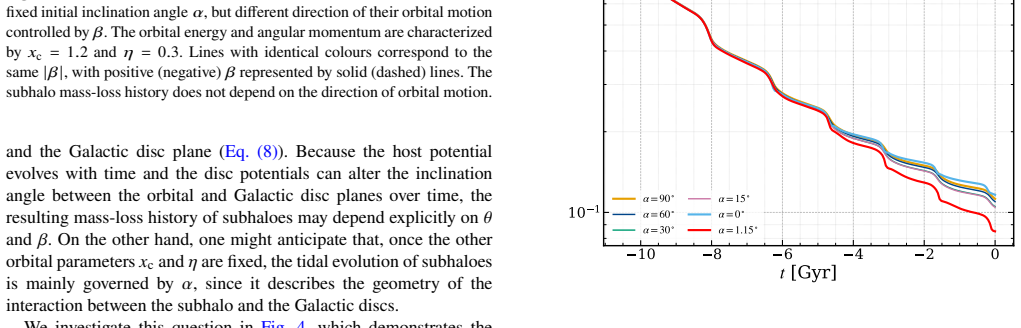
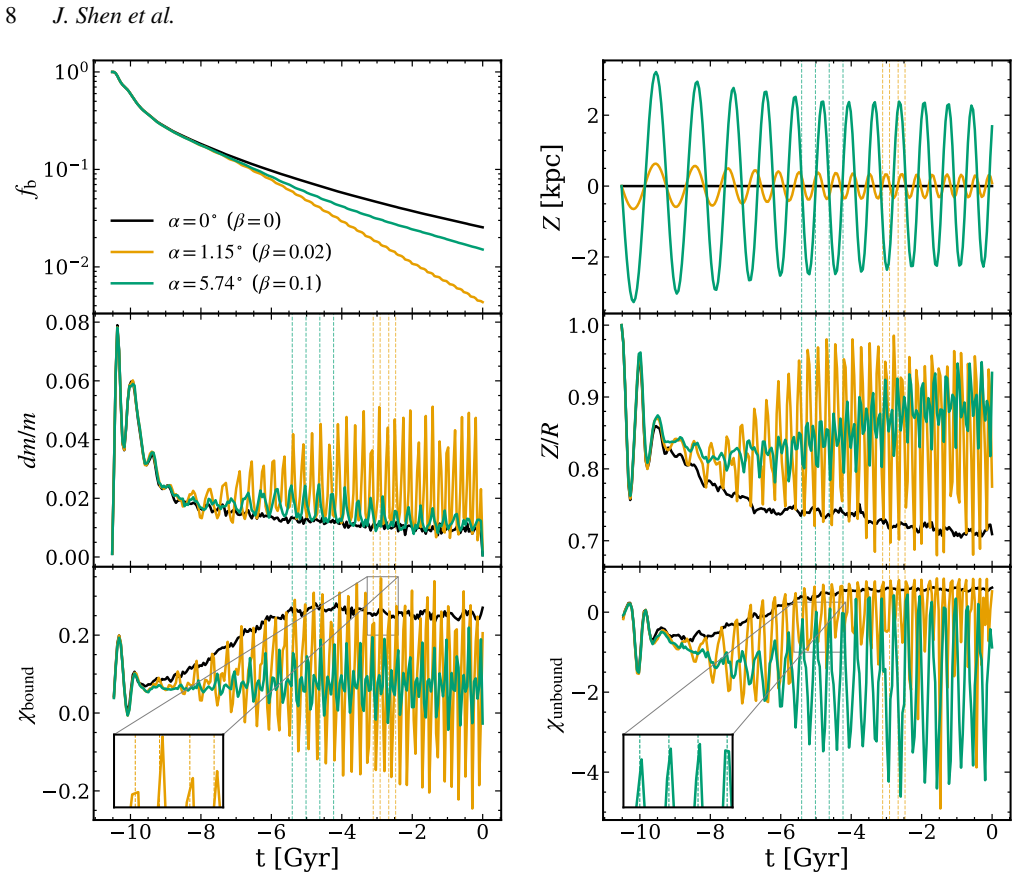
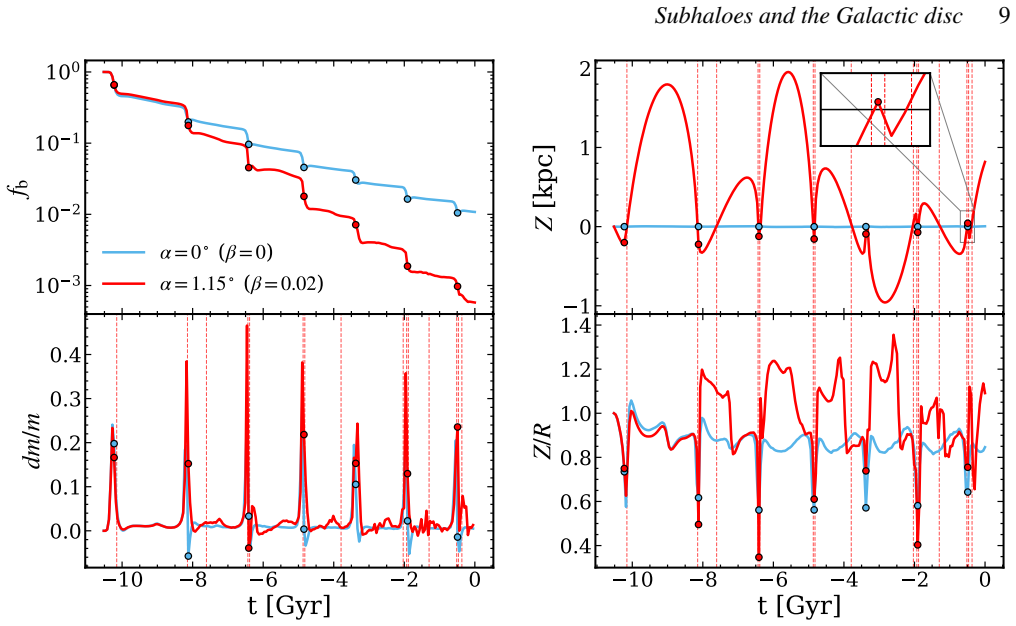
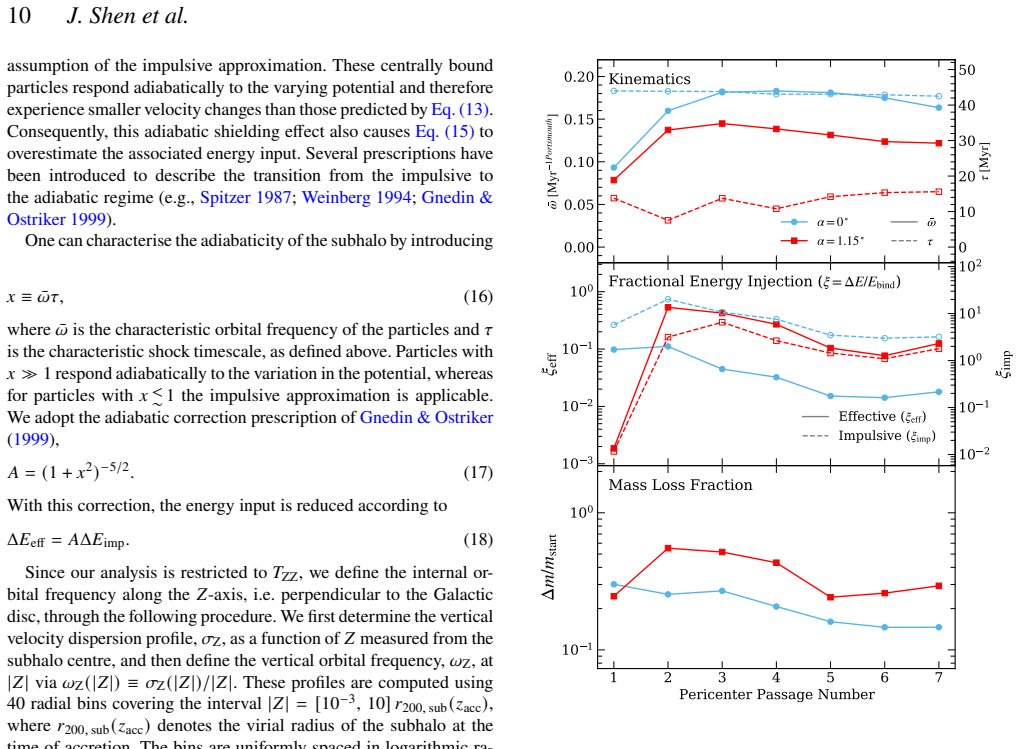
Subhaloes on orbits tilted a few degrees to the Milky Way disc lose mass faster than exactly coplanar ones because quick disc crossings amplify tidal shocks.
A machine-rendered reading of the paper's core claim, the machinery that carries it, and where it could break.
Core claim
N-body simulations demonstrate that subhaloes whose orbits are inclined by only a few degrees with respect to the Galactic disc pass through it quickly, enhancing tidal shock heating and increasing mass-loss efficiency, while exactly coplanar orbits experience adiabatic shielding that suppresses energy input from tidal shocks and reduces mass-loss efficiency. Tidal stripping lowers dark matter density inside subhaloes and thereby weakens their annihilation signals, so subhaloes at 0.3-2 kpc from the disc plane are expected to emit only weak signals whereas those embedded in the disc remain more promising targets provided baryonic emission is carefully modeled and subtracted. Mass-loss histor
What carries the argument
Orbital inclination angle relative to the Galactic disc, which sets whether subhaloes experience rapid disc crossings that amplify tidal shocks or adiabatic shielding that damps shock energy input.
If this is right
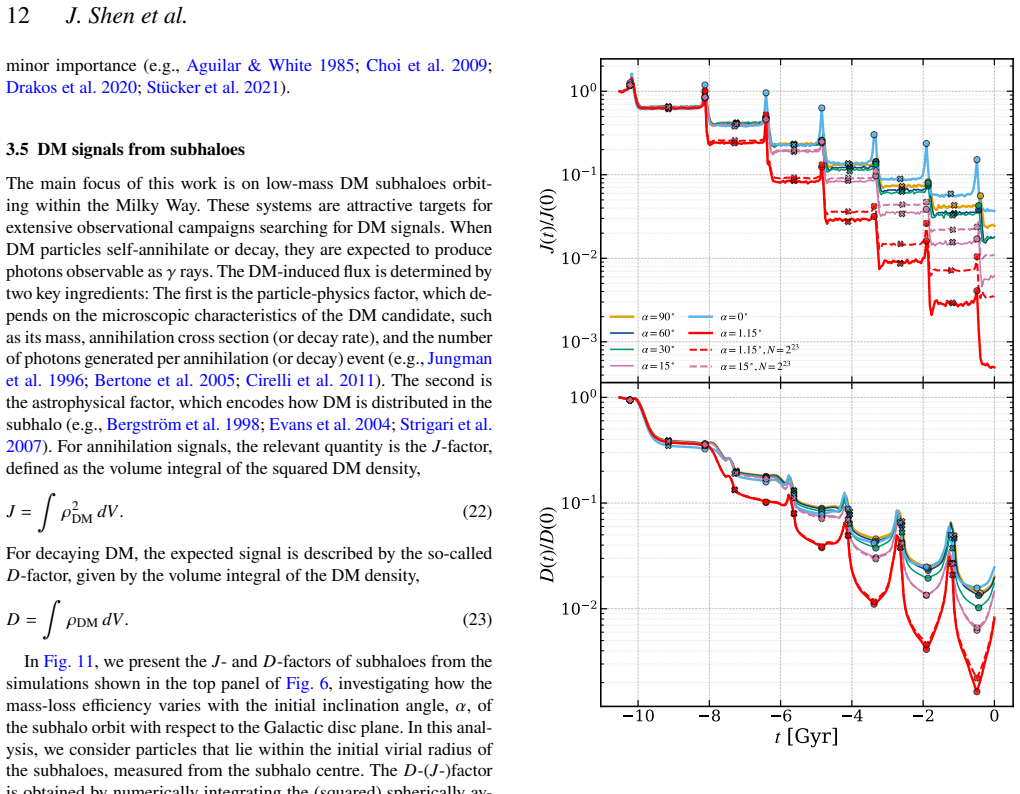
- Subhaloes located 0.3-2 kpc from the disc plane lose more mass and produce weaker dark matter annihilation signals.
- Subhaloes that stay embedded inside the disc retain higher densities and remain better candidates for indirect detection after baryonic foregrounds are removed.
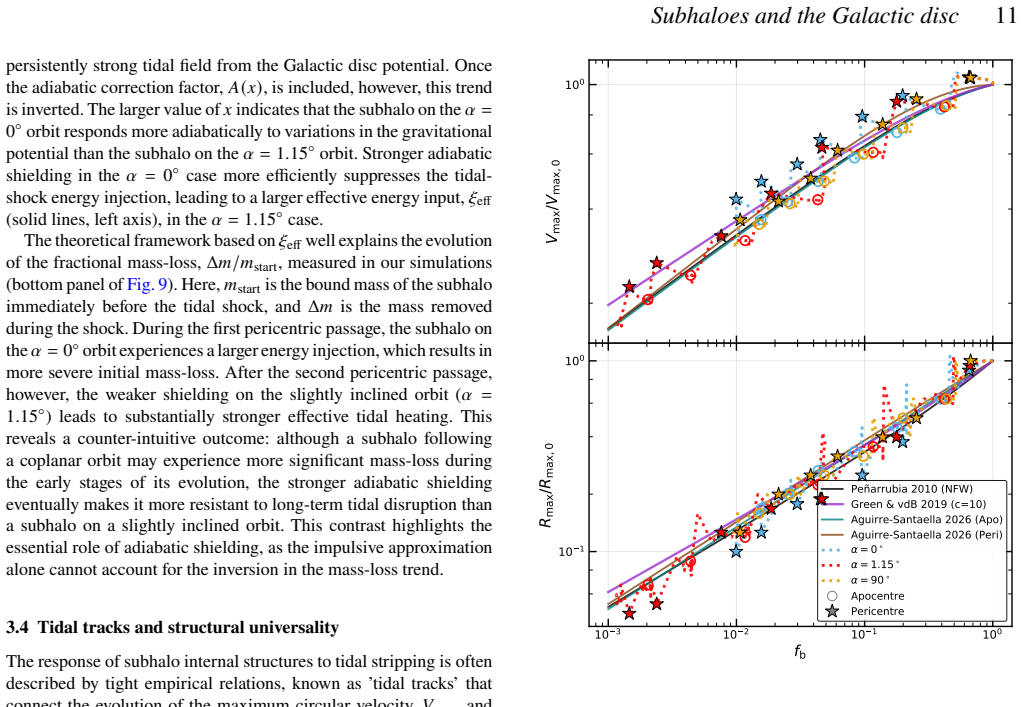
- Structural properties of surviving subhaloes still follow the same tidal tracks found in earlier studies even though their total mass-loss rates differ by inclination.
- Predictions for the spatial distribution of detectable subhalo signals inside the Milky Way must account for orbital orientation relative to the disc.
Where Pith is reading between the lines
- The same inclination-dependent shielding mechanism may operate in other disc galaxies and alter the surviving subhalo population there.
- Gamma-ray or neutrino surveys could test the model by checking whether signal strength varies with distance from the disc plane in the predicted way.
- Future dynamical models of the Milky Way should include the disc's orientation when forecasting which subhaloes survive to the present day.
Load-bearing premise
The N-body simulations correctly isolate the Galactic disc as the main cause of the difference in mass-loss rates between low-inclination and coplanar orbits without major effects from the chosen Milky Way potential, resolution limits, or initial subhalo setups.
What would settle it
A map of faint gamma-ray signals from subhaloes that shows systematically stronger depletion at 0.3-2 kpc above and below the disc plane than inside the plane itself would support the claim; an absence of this pattern or the opposite pattern would falsify it.
Figures
read the original abstract
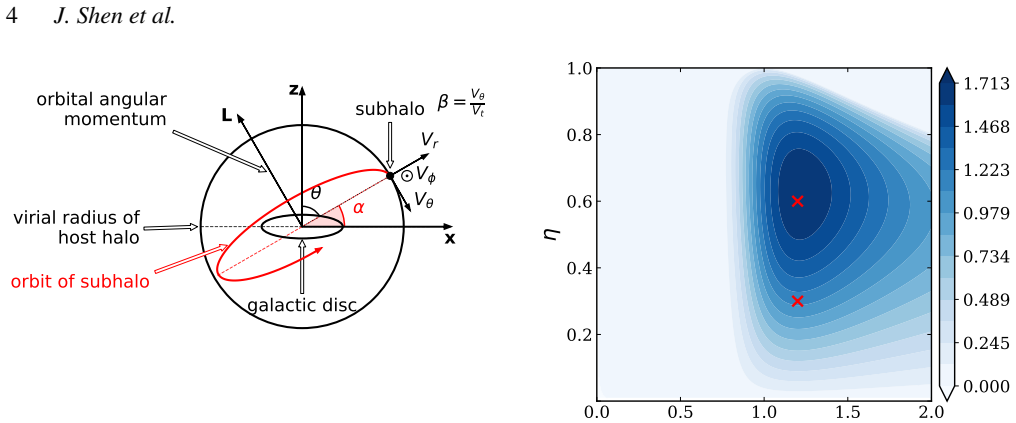
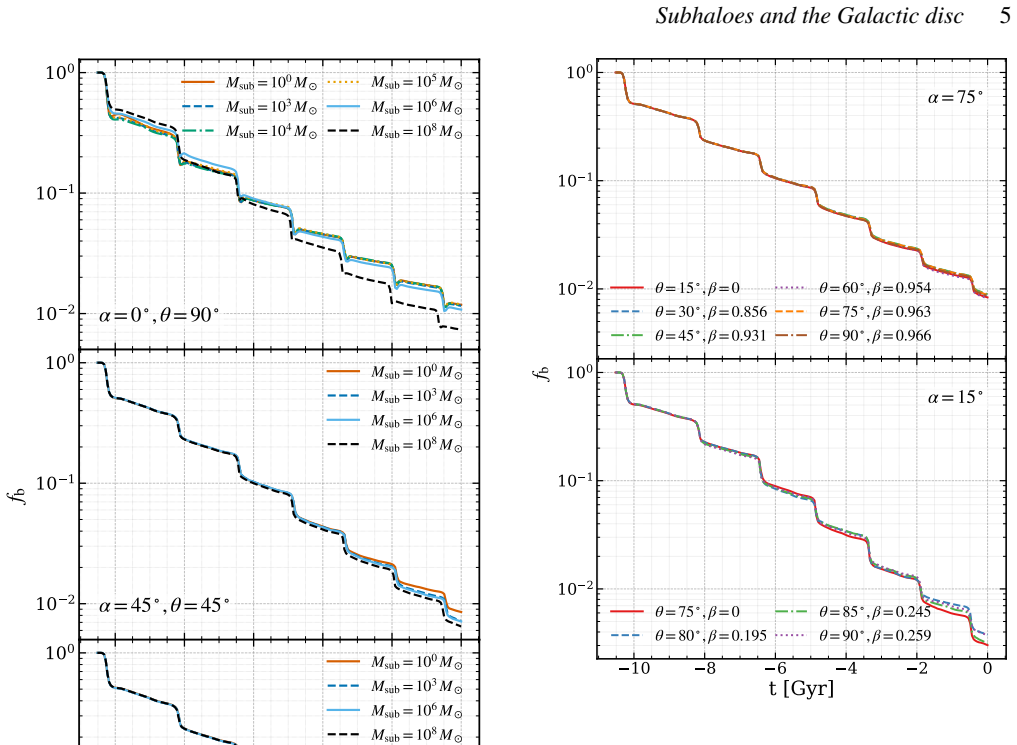
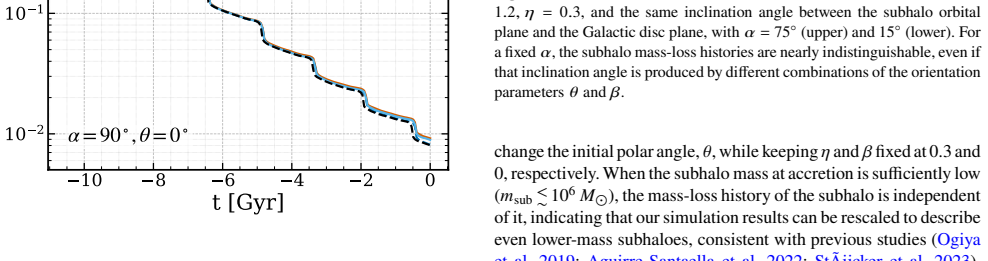
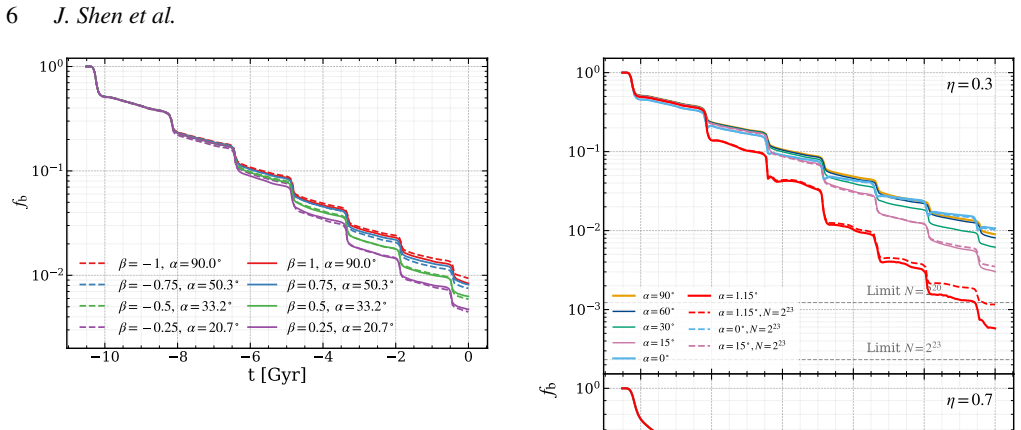
Dark matter (DM) subhaloes orbiting inside the Milky Way (MW) are promising targets for DM searches, and reliable predictions for the detectability and spatial distribution of their signals are crucial for probing the nature of DM. Recent work showed that tidal forces from the baryonic components of the MW boost the efficiency of subhalo mass-loss, although the underlying physical processes remain insufficiently understood. This study focuses on clarifying the role of the Galactic disc. By using $N$-body simulations, we examine how the dynamical evolution of subhaloes varies with the inclination angle between their orbits and the Galactic disc. Subhaloes whose orbits are inclined by only a few degrees with respect to the Galactic disc pass through it quickly, which enhances tidal shock heating and leads to a pronounced increase in mass-loss efficiency. In contrast, when a subhalo orbit is exactly coplanar with the Galactic disc, adiabatic shielding suppresses the energy input from tidal shocks, resulting in a lower mass-loss efficiency. Tidal stripping lowers the DM density within subhaloes, thereby attenuating the luminosity of their DM signals. Consequently, we expect that subhaloes located at distances of $\sim 0.3$--$2$\,kpc from the Galactic disc plane emit only weak signals, whereas those remaining embedded in the disc are more promising candidates for indirect DM detection, provided that contamination from baryonic emission sources can be carefully modelled and subtracted. Although their mass-loss histories differ significantly, the structural evolution of subhaloes is still well described by the tidal tracks reported in the literature.
Editorial analysis
A structured set of objections, weighed in public.
Referee Report
Summary. The manuscript uses N-body simulations to examine the dynamical evolution of dark matter subhaloes orbiting in the Milky Way, focusing on the role of the Galactic disc as a function of orbital inclination. It claims that subhaloes on orbits inclined by only a few degrees experience rapid disc passages that enhance tidal shock heating and increase mass-loss efficiency, while exactly coplanar orbits undergo adiabatic shielding that suppresses energy input from shocks and reduces mass-loss efficiency. This inclination-dependent mass loss attenuates DM density and thus signal luminosity, implying that subhaloes at ~0.3-2 kpc from the disc plane emit weak signals while those embedded in the disc are more promising for indirect detection (after baryonic subtraction). Structural evolution nonetheless follows literature tidal tracks.
Significance. If the reported inclination-dependent mass-loss mechanism holds after verification, the result would be significant for refining predictions of subhalo spatial distributions and DM annihilation signals in the inner Milky Way. It provides a physical explanation for how the disc modulates tidal effects beyond generic stripping, with direct implications for target selection in indirect detection experiments. The simulations' ability to distinguish shock heating from adiabatic shielding, if robust, adds mechanistic insight to existing tidal-track descriptions.
major comments (2)
- [Abstract] Abstract (simulation setup and results paragraph): The central claim that mass-loss efficiency differs due to tidal shock heating versus adiabatic shielding rests on N-body outcomes, yet no resolution tests, particle-number convergence studies, force-softening variations, or comparisons against alternative Milky Way potential models are mentioned. This leaves open whether the reported difference between few-degree inclinations and exactly coplanar orbits is isolated from numerical artifacts or the specific potential choice, directly undermining in the mechanism isolation.
- [Abstract] Abstract (results on mass-loss efficiency): No error bars, statistical measures of mass-loss differences, or quantitative comparison to analytic expectations for shock heating and adiabatic invariants are supplied, making it impossible to assess the magnitude or statistical significance of the inclination effect that underpins the detectability conclusions.
minor comments (1)
- [Abstract] Abstract: The phrase 'pass through it quickly' for low-inclination orbits would benefit from a quantitative definition (e.g., crossing time relative to orbital period) to clarify the physical regime.
Simulated Author's Rebuttal
We thank the referee for their thorough review and valuable comments on our manuscript. We address the major comments point by point below.
read point-by-point responses
-
Referee: [Abstract] Abstract (simulation setup and results paragraph): The central claim that mass-loss efficiency differs due to tidal shock heating versus adiabatic shielding rests on N-body outcomes, yet no resolution tests, particle-number convergence studies, force-softening variations, or comparisons against alternative Milky Way potential models are mentioned. This leaves open whether the reported difference between few-degree inclinations and exactly coplanar orbits is isolated from numerical artifacts or the specific potential choice, directly undermining in the mechanism isolation.
Authors: We agree with the referee that explicit demonstration of numerical convergence is crucial for the credibility of the results. The original manuscript focused on the physical mechanism but did not sufficiently highlight the tests performed. In the revised version, we will add a new subsection detailing resolution tests with varying particle numbers, force softening lengths, and comparisons to alternative Milky Way potential models. We will also briefly mention the robustness in the abstract. revision: yes
-
Referee: [Abstract] Abstract (results on mass-loss efficiency): No error bars, statistical measures of mass-loss differences, or quantitative comparison to analytic expectations for shock heating and adiabatic invariants are supplied, making it impossible to assess the magnitude or statistical significance of the inclination effect that underpins the detectability conclusions.
Authors: We acknowledge the lack of quantitative error analysis in the presented results. We will revise the manuscript to include error bars on all mass-loss curves, provide statistical significance measures for the differences between inclination angles, and add comparisons to analytic predictions for tidal shock heating and adiabatic shielding effects. This will strengthen the assessment of the inclination-dependent mass loss. revision: yes
Circularity Check
No significant circularity: results from forward N-body integrations
full rationale
The paper's central claims derive from direct N-body simulations of subhalo orbits interacting with a fixed Galactic disc potential. Mass-loss differences between low-inclination and coplanar orbits are reported as simulation outputs, not as quantities fitted from the same data and then relabeled as predictions. No self-citation chains, ansatzes smuggled via prior work, or redefinitions of inputs appear in the provided text; the structural evolution is explicitly tied to external literature tidal tracks rather than internal re-derivation. The derivation chain is therefore self-contained against the simulation setup and does not reduce to its own inputs by construction.
Axiom & Free-Parameter Ledger
axioms (1)
- domain assumption N-body simulations with the chosen Milky Way potential accurately capture the tidal shock and adiabatic response of subhaloes to the galactic disc
Reference graph
Works this paper leans on
-
[1]
and Frenk, Carlos S
Navarro, Julio F. and Frenk, Carlos S. and White, Simon D. M. , title =. , volume =. 1997 , doi =
1997
-
[2]
, volume =
Kuijken, Konrad and Dubinski, John , title =. , volume =. 1994 , doi =
1994
-
[3]
, volume =
van den Bosch, Frank C and Ogiya, Go , title =. , volume =. 2018 , doi =
2018
-
[4]
Eddington, A. S. , title =. , volume =. 1916 , doi =
1916
-
[5]
, title =
Chandrasekhar, S. , title =. , volume =. 1943 , doi =
1943
-
[6]
and White, Simon D
Mo, Houjun and van den Bosch, Frank C. and White, Simon D. M. , title =
-
[7]
, volume =
Aguirre-Santaella, Alejandra and Sánchez-Conde, Miguel A and Ogiya, Go and Stücker, Jens and Angulo, Raul E , title =. , volume =. 2022 , doi =
2022
-
[8]
, volume =
Kelley, Tyler and Bullock, James S and Garrison-Kimmel, Shea and Boylan-Kolchin, Michael and Pawlowski, Marcel S and Graus, Andrew S , title =. , volume =. 2019 , doi =
2019
-
[9]
and Wyithe, J
Correa, Camila A. and Wyithe, J. Stuart B. and Schaye, Joop and Duffy, Alan R. , title =. , volume =. 2015 , doi =
2015
-
[10]
and Bose, Sownak and Angulo, Raúl E
Ludlow, Aaron D. and Bose, Sownak and Angulo, Raúl E. and Wang, Lan and Hellwing, Wojciech A. and Navarro, Julio F. and Cole, Shaun and Frenk, Carlos S. , title =. , volume =. 2016 , doi =
2016
-
[11]
, volume =
Hernquist, Lars , title =. , volume =. 1990 , doi =
1990
-
[12]
and Flynn, C
Smith, R. and Flynn, C. and Candlish, G. N. and Fellhauer, M. and Gibson, B. K. , title =. , volume =. 2015 , doi =
2015
-
[13]
, volume =
Behroozi, Peter and Wechsler, Risa H and Hearin, Andrew P and Conroy, Charlie , title =. , volume =. 2019 , doi =
2019
-
[14]
and Caputi, K
Popping, G. and Caputi, K. I. and Trager, S. C. and Somerville, R. S. and Dekel, A. and Kassin, S. A. and Kocevski, D. D. and Koekemoer, A. M. and Faber, S. M. and Ferguson, H. C. and Galametz, A. and Grogin, N. A. and Guo, Y. and Lu, Y. and Wel, A. Van Der and Weiner, B. J. , title =. , volume =. 2015 , doi =
2015
-
[15]
and others , title =
Van Der Wel, A. and others , title =. , volume =. 2014 , doi =
2014
-
[16]
Yang, Xiaohu and Mo, H. J. and Zhang, Youcai and van den Bosch, Frank C. , title =. , volume =. 2011 , doi =
2011
-
[17]
Li, Zhao-Zhou and Zhao, Dong-Hai and Jing, Y. P. and Han, Jiaxin and Dong, Fu-Yu , title =. , volume =. 2020 , doi =
2020
-
[18]
, title =
Hopkins, Philip F. , title =. , volume =. 2015 , doi =
2015
-
[19]
Plummer, H. C. , title =. , volume =
-
[20]
, volume =
van den Bosch, Frank C and Ogiya, Go and Hahn, Oliver and Burkert, Andreas , title =. , volume =. 2018 , doi =
2018
-
[21]
, volume =
D'Onghia, Elena and Springel, Volker and Hernquist, Lars and Keres, Dusan , title =. , volume =. 2010 , doi =
2010
-
[22]
and Hopkins, Philip F
Garrison-Kimmel, Shea and Wetzel, Andrew and Bullock, James S. and Hopkins, Philip F. and Boylan-Kolchin, Michael and Faucher-Giguère, Claude-André and Kereš, Dušan and Quataert, Eliot and Sanderson, Robyn E. and Graus, Andrew S. and Kelley, Tyler , title =. , volume =. 2017 , doi =
2017
-
[23]
, volume =
Green, Sheridan B and van den Bosch, Frank C and Jiang, Fangzhou , title =. , volume =. 2022 , doi =
2022
-
[24]
, volume =
Ogiya, Go and van den Bosch, Frank C and Hahn, Oliver and Green, Sheridan B and Miller, Tim B and Burkert, Andreas , title =. , volume =. 2019 , doi =
2019
-
[25]
and Aguirre-Santaella, Alejandra and Sánchez-Conde, Miguel A
Stücker, Jens and Ogiya, Go and Angulo, Raul E. and Aguirre-Santaella, Alejandra and Sánchez-Conde, Miguel A. , title =. , volume =. 2023 , doi =
2023
-
[26]
, volume =
Bertone, Gianfranco and Hooper, Dan and Silk, Joseph , title =. , volume =. 2005 , doi =
2005
-
[27]
Bertone, Gianfranco and Hooper, Dan , title =. Rev. Mod. Phys. , volume =. 2018 , doi =
2018
-
[28]
Garrett, Katherine and Dūda, Gintaras , title =. Adv. Astron. , volume =. 2011 , doi =
2011
-
[29]
and others , title =
Aghanim, N. and others , title =. , volume =. 2021 , doi =
2021
-
[30]
Kahlhoefer, Felix , title =. Int. J. Mod. Phys. A , volume =. 2017 , doi =
2017
-
[31]
Bertone, GIANFRANCO and Merritt, DAVID , title =. Mod. Phys. Lett. A , volume =. 2005 , doi =
2005
-
[32]
A , title =
Hinton, J. A , title =. New Astron. Rev. , volume =. 2004 , doi =
2004
-
[33]
C and others , title =
Weekes, T. C and others , title =. Astropart. Phys. , volume =. 2002 , doi =
2002
-
[34]
Astropart. Phys. , volume =. 1999 , doi =
1999
-
[35]
and others , title =
Achterberg, A. and others , title =. Astropart. Phys. , volume =. 2006 , doi =
2006
-
[36]
Battiston, Roberto , title =. Nucl. Instrum. Methods Phys. Res. A , volume =. 2008 , doi =
2008
-
[37]
and others , title =
Picozza, P. and others , title =. Astropart. Phys. , volume =. 2007 , doi =
2007
-
[38]
and Johnson, Robert P
Porter, Troy A. and Johnson, Robert P. and Graham, Peter W. , title =. , volume =. 2011 , doi =
2011
-
[39]
and White, Simon D
Springel, Volker and Frenk, Carlos S. and White, Simon D. M. , title =. , volume =. 2006 , doi =
2006
-
[40]
and White, S.d.m
Frenk, C.s. and White, S.d.m. , title =. Ann. Phys. , volume =. 2012 , doi =
2012
-
[41]
, title =
Zavala, Jesús and Frenk, Carlos S. , title =. Galaxies , volume =. 2019 , doi =
2019
-
[42]
, volume =
Diemand, Jürg and Kuhlen, Michael and Madau, Piero , title =. , volume =. 2007 , doi =
2007
-
[43]
Nature Reviews Physics , volume =
Vogelsberger, Mark and Marinacci, Federico and Torrey, Paul and Puchwein, Ewald , title =. Nature Reviews Physics , volume =. 2020 , doi =
2020
-
[44]
and Hahn, Oliver , title =
Angulo, Raul E. and Hahn, Oliver , title =. Living Rev. Comput. Astrophys. , volume =. 2022 , doi =
2022
-
[45]
, volume =
Vogelsberger, Mark and others , title =. , volume =. 2014 , doi =
2014
-
[46]
, volume =
Sawala, Till and others , title =. , volume =. 2016 , doi =
2016
-
[47]
, volume =
Fattahi, Azadeh and others , title =. , volume =. 2016 , doi =
2016
-
[48]
and Baugh, Carlton M
Angulo, Raul E. and Baugh, Carlton M. and Frenk, Carlos S. and Lacey, Cedric G. , title =. , volume =. 2014 , doi =
2014
-
[49]
and Kuhlen, M
Diemand, J. and Kuhlen, M. and Madau, P. and Zemp, M. and Moore, B. and Potter, D. and Stadel, J. , title =. , volume =. 2008 , doi =
2008
-
[50]
and others , title =
Springel, V. and others , title =. , volume =. 2008 , doi =
2008
-
[51]
, volume =
Ishiyama, Tomoaki and others , title =. , volume =. 2021 , doi =
2021
-
[52]
and Taylor, James E
Hayashi, Eric and Navarro, Julio F. and Taylor, James E. and Stadel, Joachim and Quinn, Thomas , title =. , volume =. 2003 , doi =
2003
-
[53]
, volume =
Errani, Raphaël and Peñarrubia, Jorge , title =. , volume =. 2020 , doi =
2020
-
[54]
, title =
Amorisco, Nicola C. , title =. , volume =. 2021 , doi =
2021
-
[55]
, volume =
Grand, Robert J J and others , title =. , volume =. 2021 , doi =
2021
-
[56]
, volume =
Grand, Robert J J and White, Simon D M , title =. , volume =. 2020 , doi =
2020
-
[57]
, volume =
Searching for. , volume =. 2015 , doi =
2015
-
[58]
, volume =
Coronado-Blázquez, Javier and others , title =. , volume =. 2019 , doi =
2019
-
[59]
Galaxies , volume =
Ando, Shin’ichiro and Ishiyama, Tomoaki and Hiroshima, Nagisa , title =. Galaxies , volume =. 2019 , doi =
2019
-
[60]
and Prada, Francisco , title =
Sánchez-Conde, Miguel A. and Prada, Francisco , title =. , volume =. 2014 , doi =
2014
-
[61]
and Palomares-Ruiz, Sergio and Prada, Francisco , title =
Moliné, Ángeles and Sánchez-Conde, Miguel A. and Palomares-Ruiz, Sergio and Prada, Francisco , title =. , volume =. 2017 , doi =
2017
-
[62]
, volume =
Hiroshima, Nagisa and Ando, Shin’ichiro and Ishiyama, Tomoaki , title =. , volume =. 2018 , doi =
2018
-
[63]
, volume =
Fujii, Michiko and Funato, Yoko and Makino, Junichiro , title =. , volume =. 2006 , doi =
2006
-
[64]
, volume =
Miller, Tim B and van den Bosch, Frank C and Green, Sheridan B and Ogiya, Go , title =. , volume =. 2020 , doi =
2020
-
[65]
Nature Physics , volume =
Buchmueller, Oliver and Doglioni, Caterina and Wang, Lian-Tao , title =. Nature Physics , volume =. 2017 , doi =
2017
-
[66]
Penning, Björn , title =. J. Phys. G: Nucl. Part. Phys. , volume =. 2018 , doi =
2018
-
[67]
and Harnik, Roni and Kopp, Joachim and Tsai, Yuhsin , title =
Fox, Patrick J. and Harnik, Roni and Kopp, Joachim and Tsai, Yuhsin , title =. , volume =. 2012 , doi =
2012
-
[68]
Gravitational Lensing , author =. Class. Quantum Grav. , volume =. 2010 , doi =
2010
-
[69]
, volume =
Strong Lensing by Galaxies , author =. , volume =. 2010 , doi =
2010
-
[70]
, volume =
Streams in the Galaxy , author =. , volume =. 2002 , doi =
2002
-
[71]
, volume =
Forensics of Subhalo–Stream Encounters: The Three Phases of Gap Growth , author =. , volume =. 2016 , doi =
2016
-
[72]
, year = 1992, volume = 256, pages =
Suppressing the formation of dwarf galaxies via photoionization. , year = 1992, volume = 256, pages =
1992
-
[73]
, year = 2000, volume = 542, number = 2, pages =
Effect of Reionization on Structure Formation in the Universe. , year = 2000, volume = 542, number = 2, pages =
2000
-
[74]
, year = 2008, volume = 390, number = 3, pages =
Mass loss of galaxies caused by the background radiation field. , year = 2008, volume = 390, number = 3, pages =
2008
-
[75]
, year = 1975, volume = 27, pages =
Three-dimensional models for the distribution of mass in galaxies. , year = 1975, volume = 27, pages =
1975
-
[76]
A numerical convergence study
The inner structure of CDM haloes - I. A numerical convergence study. , year = 2003, volume = 338, number = 1, pages =
2003
-
[77]
, volume =
Jungman, Gerard and Kamionkowski, Marc and Griest, Kim , title = ". , volume =. 1996 , doi =
1996
-
[78]
, volume =
Cirelli, Marco and Corcella, Gennaro and Hektor, Andi and others , title = ". , volume =. 2011 , doi =
2011
-
[79]
om, Lars and Ullio, Piero and Buckley, James H. , title =
Bergstr\"om, Lars and Ullio, Piero and Buckley, James H. , title = ". Astropart. Phys. , volume =. 1998 , doi =
1998
-
[80]
Wyn and Ferrer, Francesc and Sarkar, Subir , title = "
Evans, N. Wyn and Ferrer, Francesc and Sarkar, Subir , title = ". , volume =. 2004 , doi =
2004
discussion (0)
Sign in with ORCID, Apple, or X to comment. Anyone can read and Pith papers without signing in.