SCR-Guided Difficulty-Aware Optimization for Infrared Small Target Detection
Pith reviewed 2026-06-26 21:59 UTC · model grok-4.3
The pith
Computing a local signal-to-clutter ratio from the input image allows reweighting of the training loss to better detect low-visibility infrared targets.
A machine-rendered reading of the paper's core claim, the machinery that carries it, and where it could break.
Core claim
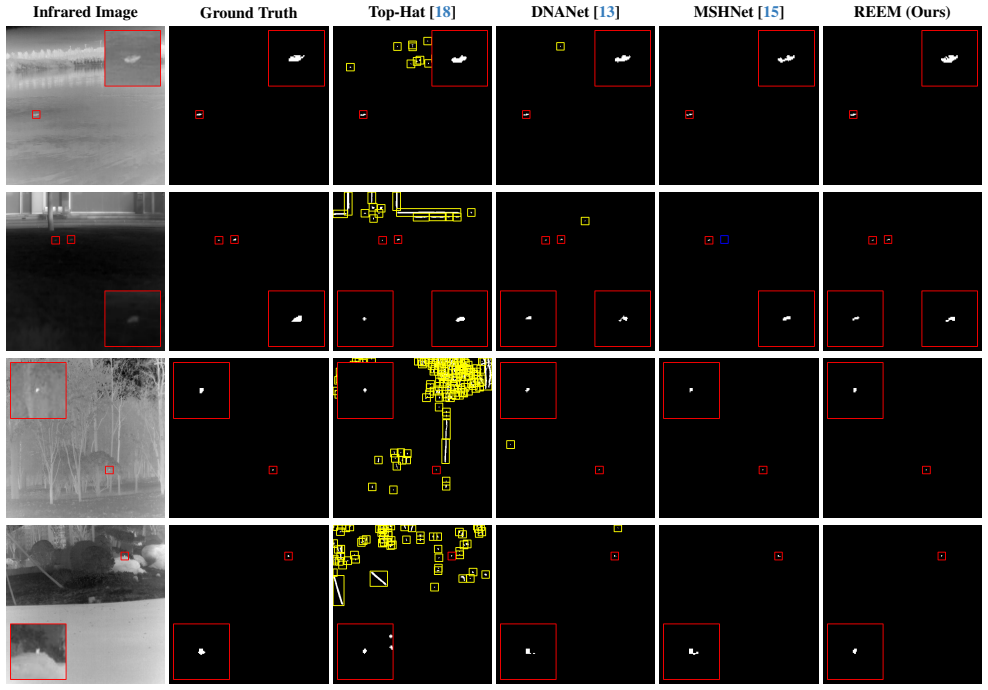
REEM is a lightweight SCR-guided difficulty-aware optimization framework that computes a ground-truth local SCR from the input image and applies a differentiable modulation to the soft-IoU learning signal. This emphasizes low-visibility targets while preserving stable optimization and identical inference behavior. It integrates into a U-Net-based MSHNet with no additional parameters or overhead. Experiments demonstrate consistent improvements over the baseline with higher IoU and Pd and reduced FA, particularly under low-visibility conditions.
What carries the argument
Differentiable modulation of the soft-IoU loss by local signal-to-clutter ratio (SCR), serving as an explicit visibility prior to reweight the learning signal toward difficult targets.
If this is right
- Higher IoU scores for detected targets
- Increased detection probability (Pd) for small targets
- Substantially reduced false alarms (FA)
- Particularly effective under low-visibility conditions
- No change to inference behavior or model parameters
Where Pith is reading between the lines
- This approach indicates that physics-based priors like SCR can complement overlap-based losses in other detection problems with variable target visibility.
- The method could be tested on different backbone architectures beyond U-Net to check broader applicability.
- It raises the question of whether similar visibility metrics exist in other imaging modalities such as visible light or radar.
Load-bearing premise
A local SCR value computed from the input image constitutes a reliable, stable, and differentiable visibility prior whose modulation of soft-IoU will improve optimization for low-visibility targets without introducing training instability or unintended bias.
What would settle it
Training the baseline model with and without SCR modulation and observing no improvement or a decrease in Pd and increase in FA on a held-out set of low-visibility infrared targets.
Figures


read the original abstract
Infrared small target detection remains challenging due to severe background clutter, low contrast, and weak spatial responses where geometric overlap alone is insufficient to characterize detection quality. In this work, we propose REEM (Reweighted Explicit-visibility Enhanced Modulation), a lightweight SCR-guided difficulty-aware optimization framework that incorporates Signal-to-Clutter Ratio (SCR) as a physically meaningful visibility prior during training. Instead of modifying the network architecture or directly optimizing SCR, REEM computes a ground-truth local SCR from the input image and applies a differentiable modulation to the soft-IoU learning signal, emphasizing low-visibility targets while preserving stable optimization and identical inference behavior. REEM is integrated into a U-Net-based MSHNet without introducing additional parameters, architectural modifications, or inference-time overhead. Extensive experiments demonstrate consistent improvements over the baseline, achieving higher IoU and detection probability (Pd) together with substantially reduced false alarms (FA), particularly under challenging low-visibility conditions. These results suggest that SCR-guided difficulty-aware optimization provides an effective and physically grounded complement to conventional overlap-based objectives for infrared small target detection. The code is available at https://github. com/yall-in-one/Reemm.
Editorial analysis
A structured set of objections, weighed in public.
Referee Report
Summary. The manuscript proposes REEM, a lightweight training-time framework for infrared small target detection. It computes a ground-truth local Signal-to-Clutter Ratio (SCR) from each input image and applies a differentiable modulation to the soft-IoU loss of a U-Net-based MSHNet, with the goal of emphasizing low-visibility targets during optimization. The method introduces no architectural changes, extra parameters, or inference overhead, and the authors report consistent gains in IoU, detection probability (Pd), and reduced false alarms (FA) relative to the baseline, especially under low-visibility conditions.
Significance. If the central claim holds, the work supplies a physically motivated, training-only modulation that complements overlap-based losses without altering the deployed model. This could be useful for infrared detection pipelines where visibility varies strongly and where inference cost must remain fixed. The absence of added parameters and the public code release are positive features.
major comments (2)
- [Method] Method section (description of REEM): the exact definition of the local support region, background sampling strategy, and SCR formula (e.g., whether mean/std is taken over an annulus, how target pixels are excluded, and any smoothing) is not supplied. Because the modulation is derived directly from this quantity, the lack of a reproducible specification makes it impossible to verify that the visibility prior is stable rather than an arbitrary hyperparameter choice.
- [Experiments] Experiments section: the reported Pd/FA and IoU improvements are presented without error bars, statistical significance tests, or explicit description of how visibility strata were defined and how data were split. This weakens the claim that gains are specifically attributable to the SCR modulation under low-visibility conditions.
minor comments (1)
- [Abstract] The GitHub link in the abstract contains a space (“https://github. com”) and should be corrected.
Simulated Author's Rebuttal
We thank the referee for the constructive comments, which highlight important aspects of reproducibility and experimental rigor. We address each major comment below and will revise the manuscript accordingly to strengthen the presentation.
read point-by-point responses
-
Referee: [Method] Method section (description of REEM): the exact definition of the local support region, background sampling strategy, and SCR formula (e.g., whether mean/std is taken over an annulus, how target pixels are excluded, and any smoothing) is not supplied. Because the modulation is derived directly from this quantity, the lack of a reproducible specification makes it impossible to verify that the visibility prior is stable rather than an arbitrary hyperparameter choice.
Authors: We agree that the manuscript does not provide a fully explicit, self-contained specification of the local support region, background sampling, and SCR computation details. This limits independent verification. In the revised version we will add a dedicated subsection (new Section 3.2) containing the precise definitions: the local support region is an annulus with inner radius equal to the target bounding-box extent and outer radius 3 imes that extent; target pixels are masked out before computing background mean and standard deviation; SCR is computed as (target_mean − bg_mean) / bg_std with a small epsilon for numerical stability; and any Gaussian smoothing applied to the SCR map is stated with its kernel size. The accompanying code release already implements these choices, and we will also include the exact pseudocode in the paper. revision: yes
-
Referee: [Experiments] Experiments section: the reported Pd/FA and IoU improvements are presented without error bars, statistical significance tests, or explicit description of how visibility strata were defined and how data were split. This weakens the claim that gains are specifically attributable to the SCR modulation under low-visibility conditions.
Authors: The referee correctly notes the absence of error bars, significance testing, and explicit stratification details. We will revise the Experiments section to report mean and standard deviation over five independent training runs with different random seeds, include paired t-test p-values comparing REEM against the baseline, and add a clear paragraph defining the visibility strata (low: SCR < 1.5, medium: 1.5 ≤ SCR < 4, high: SCR ≥ 4) together with the exact train/validation/test split ratios and how the strata were applied to the reported metrics. These additions will directly support the claim that gains are concentrated in the low-visibility regime. revision: yes
Circularity Check
No circularity: SCR modulation is an independent training prior
full rationale
The paper defines REEM as computing a ground-truth local SCR directly from the input image (using target location) and applying it as a differentiable multiplier to the soft-IoU loss. This step is presented as an externally derived visibility statistic rather than a fitted parameter whose value is later renamed a prediction. No equation reduces the claimed IoU/Pd/FA gains to the same constants by construction, and the abstract contains no load-bearing self-citations or uniqueness theorems imported from prior author work. The derivation chain therefore remains self-contained; performance claims rest on experimental comparison, not on algebraic identity with the inputs.
Axiom & Free-Parameter Ledger
axioms (2)
- domain assumption Local SCR computed from the input image is a stable and meaningful proxy for target visibility.
- standard math The chosen modulation function remains differentiable and numerically stable across the observed range of SCR values.
Reference graph
Works this paper leans on
-
[1]
Bushberg, J
Jerrold T. Bushberg, J. Anthony Seibert, Edwin M. Leid- holdt, and John M. Boone.The Essential Physics of Medical Imaging. Lippincott Williams & Wilkins, 2011. 3
2011
-
[2]
IRSTFormer: A hierarchical vision transformer for infrared small target de- tection.Remote Sensing, 14(14):3258, 2022
Gao Chen, Weihua Wang, and Sirui Tan. IRSTFormer: A hierarchical vision transformer for infrared small target de- tection.Remote Sensing, 14(14):3258, 2022. 2
2022
-
[3]
MiM-ISTD: Mamba-in-mamba for efficient infrared small-target detec- tion.IEEE Transactions on Geoscience and Remote Sensing, 62:1–13, 2024
Tianxiang Chen, Zi Ye, Zhentao Tan, Tao Gong, Yue Wu, Qi Chu, Bin Liu, Nenghai Yu, and Jieping Ye. MiM-ISTD: Mamba-in-mamba for efficient infrared small-target detec- tion.IEEE Transactions on Geoscience and Remote Sensing, 62:1–13, 2024. Art. no. 5007613. 2
2024
-
[4]
Yimian Dai and Yiquan Wu. Reweighted infrared patch- tensor model with both nonlocal and local priors for single- frame small target detection.IEEE Journal of Selected Top- ics in Applied Earth Observations and Remote Sensing, 10 (8):3752–3767, 2017. 6
2017
-
[5]
At- tentional local contrast networks for infrared small target de- tection.IEEE Transactions on Geoscience and Remote Sens- ing, 59(11):9813–9824, 2021
Yimian Dai, Yiqun Wu, Feng Zhou, and Kobus Barnard. At- tentional local contrast networks for infrared small target de- tection.IEEE Transactions on Geoscience and Remote Sens- ing, 59(11):9813–9824, 2021. 6
2021
-
[6]
Asymmetric contextual modulation for infrared small target detection
Yimian Dai, Yiqun Wu, Feng Zhou, and Kobus Barnard. Asymmetric contextual modulation for infrared small target detection. InProceedings of the IEEE/CVF Winter Con- ference on Applications of Computer Vision (WACV), pages 949–958, 2021. 1, 2, 3
2021
-
[7]
Deshpande, Meng Hwa Er, Ronda Venkateswarlu, and Philip Chan
Suyog D. Deshpande, Meng Hwa Er, Ronda Venkateswarlu, and Philip Chan. Max-mean and max-median filters for de- tection of small targets. InSignal and Data Processing of Small Targets, pages 74–83. SPIE, 1999. 2, 3, 6
1999
-
[8]
Hauptmann
Chenqiang Gao, Deyu Meng, Yi Yang, Yongtao Wang, Xi- aofang Zhou, and Alexander G. Hauptmann. Infrared patch- image model for small target detection in a single image. IEEE Transactions on Image Processing, 22(12):4996–5009,
-
[9]
A local contrast method for infrared small-target detection utilizing a tri-layer window
Jinhui Han, Saed Moradi, Iman Faramarzi, Chengyin Liu, Honghui Zhang, and Qian Zhao. A local contrast method for infrared small-target detection utilizing a tri-layer window. IEEE Geoscience and Remote Sensing Letters, 17(10):1822– 1826, 2019. 2, 3, 6
2019
-
[10]
Infrared small tar- get detection based on the weighted strengthened local con- trast measure.IEEE Geoscience and Remote Sensing Letters, 18(9):1670–1674, 2020
Jinhui Han, Saed Moradi, Iman Faramarzi, Honghui Zhang, Qian Zhao, Xiaojian Zhang, and Nan Li. Infrared small tar- get detection based on the weighted strengthened local con- trast measure.IEEE Geoscience and Remote Sensing Letters, 18(9):1670–1674, 2020. 6
2020
-
[11]
High-speed incoming infrared target detection by fusion of spatial and temporal detectors.Sensors, 15(4): 7267–7293, 2015
Sungho Kim. High-speed incoming infrared target detection by fusion of spatial and temporal detectors.Sensors, 15(4): 7267–7293, 2015. 1, 2
2015
-
[12]
Focus-and-detect: A small object detection framework for aerial images.Signal Processing: Image Communication, 104:116675, 2022
Onur Can Koyun, Reyhan Kevser Keser, Ibrahim Batuhan Akkaya, and Behc ¸et U˘gur T ¨oreyin. Focus-and-detect: A small object detection framework for aerial images.Signal Processing: Image Communication, 104:116675, 2022. 1
2022
-
[13]
Dense nested attention network for infrared small target detection.IEEE Transactions on Image Processing, 32:1745–1758, 2023
Boyang Li, Chao Xiao, Longguang Wang, Yingqian Wang, Zaiping Lin, Miao Li, Wei An, and Yulan Guo. Dense nested attention network for infrared small target detection.IEEE Transactions on Image Processing, 32:1745–1758, 2023. 1, 2, 5, 6, 7
2023
-
[14]
Image small target detection based on deep learning with SNR controlled sample genera- tion
Ming Liu, Hao yuan Du, Yue jin Zhao, Li quan Dong, Mei Hui, and Shawn Xiong Wang. Image small target detection based on deep learning with SNR controlled sample genera- tion. InCurrent Trends in Computer Science and Mechanical Automation, pages 211–220. De Gruyter Open Poland, 2017. 2, 3
2017
-
[15]
Infrared small target detection with scale and loca- tion sensitivity
Qiankun Liu, Rui Liu, Bolun Zheng, Hongkui Wang, and Ying Fu. Infrared small target detection with scale and loca- tion sensitivity. InProceedings of the IEEE/CVF Conference on Computer Vision and Pattern Recognition (CVPR), pages 17490–17499, 2024. 2, 3, 4, 5, 6, 7
2024
-
[16]
YOLOv3: An Incremental Improvement
Joseph Redmon and Ali Farhadi. Yolov3: An incremental improvement.arXiv preprint arXiv:1804.02767, 2018. 1
work page internal anchor Pith review Pith/arXiv arXiv 2018
-
[17]
Generalized in- tersection over union: A metric and a loss for bounding box regression
Hamid Rezatofighi, Nathan Tsoi, JunYoung Gwak, Amir Sadeghian, Ian Reid, and Silvio Savarese. Generalized in- tersection over union: A metric and a loss for bounding box regression. InProceedings of the IEEE/CVF Conference on Computer Vision and Pattern Recognition (CVPR), pages 658–666, 2019. 3
2019
-
[18]
Detection of dim targets in digital infrared imagery by morphological image processing.Optical Engineering, 35(7):1886–1893, 1996
Jean-Francois Rivest and Roger Fortin. Detection of dim targets in digital infrared imagery by morphological image processing.Optical Engineering, 35(7):1886–1893, 1996. 6, 7
1996
-
[19]
U- Net: Convolutional networks for biomedical image segmen- tation
Olaf Ronneberger, Philipp Fischer, and Thomas Brox. U- Net: Convolutional networks for biomedical image segmen- tation. InMedical Image Computing and Computer-Assisted Intervention (MICCAI), pages 234–241. Springer, 2015. 2
2015
-
[20]
Sudre, Wenqi Li, Tom Vercauteren, Sebastien Ourselin, and M
Carole H. Sudre, Wenqi Li, Tom Vercauteren, Sebastien Ourselin, and M. Jorge Cardoso. Generalised dice overlap as a deep learning loss function for highly unbalanced segmen- tations. InDeep Learning in Medical Image Analysis and Multimodal Learning for Clinical Decision Support, pages 240–248. Springer, 2017. 2, 3
2017
-
[21]
Yang Sun, Jungang Yang, and Wei An. Infrared dim and small target detection via multiple subspace learning and spatial–temporal patch-tensor model.IEEE Transactions on Geoscience and Remote Sensing, 59(5):3737–3752, 2020. 2, 6
2020
-
[22]
Miss detection vs
Huan Wang, Luping Zhou, and Lei Wang. Miss detection vs. false alarm: Adversarial learning for small target detec- tion in infrared images. InProceedings of the IEEE/CVF International Conference on Computer Vision (ICCV), pages 8509–8518, 2019. 2, 3, 6
2019
-
[23]
Mapping degeneration meets label evolution: Learning infrared small target detection with single point supervision
Xinyi Ying, Li Liu, Yingqian Wang, Ruojing Li, Nuo Chen, Zaiping Lin, Weidong Sheng, and Shilin Zhou. Mapping degeneration meets label evolution: Learning infrared small target detection with single point supervision. InProceed- ings of the IEEE/CVF Conference on Computer Vision and Pattern Recognition, pages 15528–15538, 2023. 2
2023
-
[24]
SCTransNet: Spatial-channel cross transformer network for infrared small target detection.IEEE Trans- actions on Geoscience and Remote Sensing, 62:1–15, 2024
Shuai Yuan, Hanlin Qin, Xiang Yan, Naveed Akhtar, and Aj- mal Mian. SCTransNet: Spatial-channel cross transformer network for infrared small target detection.IEEE Trans- actions on Geoscience and Remote Sensing, 62:1–15, 2024. Art. no. 5002615. 2
2024
-
[25]
Re- view of dim small target detection algorithms in single-frame infrared images
Ke Zhang, Shuyan Ni, Dashuang Yan, and Aidi Zhang. Re- view of dim small target detection algorithms in single-frame infrared images. InIEEE Advanced Information Manage- ment, Communicates, Electronic and Automation Control Conference (IMCEC), pages 2115–2120. IEEE, 2021. 1
2021
-
[26]
Infrared small target detection via non- convex rank approximation minimization joint l2,1 norm
Landan Zhang, Lingbing Peng, Tianfang Zhang, Siying Cao, and Zhenming Peng. Infrared small target detection via non- convex rank approximation minimization joint l2,1 norm. Remote Sensing, 10(11):1821, 2018. 6
2018
-
[27]
Isnet: Shape matters for infrared small target detection
Mingjin Zhang, Rui Zhang, Yuxiang Yang, Haichen Bai, Jing Zhang, and Jie Guo. Isnet: Shape matters for infrared small target detection. InProceedings of the IEEE/CVF Con- ference on Computer Vision and Pattern Recognition, pages 877–886, 2022. 1, 2, 3, 5, 6
2022
-
[28]
SAIST: Segment any infrared small tar- get model guided by contrastive language-image pretraining
Mingjin Zhang, Xiaolong Li, Fei Gao, Jie Guo, Xinbo Gao, and Jing Zhang. SAIST: Segment any infrared small tar- get model guided by contrastive language-image pretraining. InProceedings of the IEEE/CVF Conference on Computer Vision and Pattern Recognition (CVPR), pages 9549–9558,
-
[29]
Mingxin Zhao, Lei Cheng, Xu Yang, Peng Feng, Liyuan Liu, and Nanjian Wu. TBC-Net: A real-time detector for in- frared small target detection using semantic constraint.arXiv preprint arXiv:2001.05852, 2019. 2
-
[30]
Single-frame infrared small-target detection: A survey
Mingjing Zhao, Wei Li, Lu Li, Jin Hu, Pengge Ma, and Ran Tao. Single-frame infrared small-target detection: A survey. IEEE Geoscience and Remote Sensing Magazine, 10(2):87– 119, 2022. 1, 2, 3
2022
-
[31]
Distance-IoU loss: Faster and bet- ter learning for bounding box regression
Zhaohui Zheng, Ping Wang, Wei Liu, Jinze Li, Rongguang Ye, and Dongwei Ren. Distance-IoU loss: Faster and bet- ter learning for bounding box regression. InProceedings of the AAAI Conference on Artificial Intelligence, pages 12993– 13000, 2020. 3
2020
-
[32]
Hu Zhu, Haopeng Ni, Shiming Liu, Guoxia Xu, and Lizhen Deng. TNLRS: Target-aware non-local low-rank modeling with saliency filtering regularization for infrared small tar- get detection.IEEE Transactions on Image Processing, 29: 9546–9558, 2020. 1, 2, 3, 6
2020
-
[33]
Object detection in 20 years: A survey.Proceed- ings of the IEEE, 111(3):257–276, 2023
Zhengxia Zou, Keyan Chen, Zhenwei Shi, Yuhong Guo, and Jieping Ye. Object detection in 20 years: A survey.Proceed- ings of the IEEE, 111(3):257–276, 2023. 1
2023
discussion (0)
Sign in with ORCID, Apple, or X to comment. Anyone can read and Pith papers without signing in.