The Array Control and Data Acquisition software of the Cherenkov Telescope Array Observatory
Pith reviewed 2026-06-26 19:44 UTC · model grok-4.3
The pith
The ACADA system enables sub-minute response to astronomical transients via integrated real-time alert generation and scheduling in the Cherenkov Telescope Array Observatory.
A machine-rendered reading of the paper's core claim, the machinery that carries it, and where it could break.
Core claim
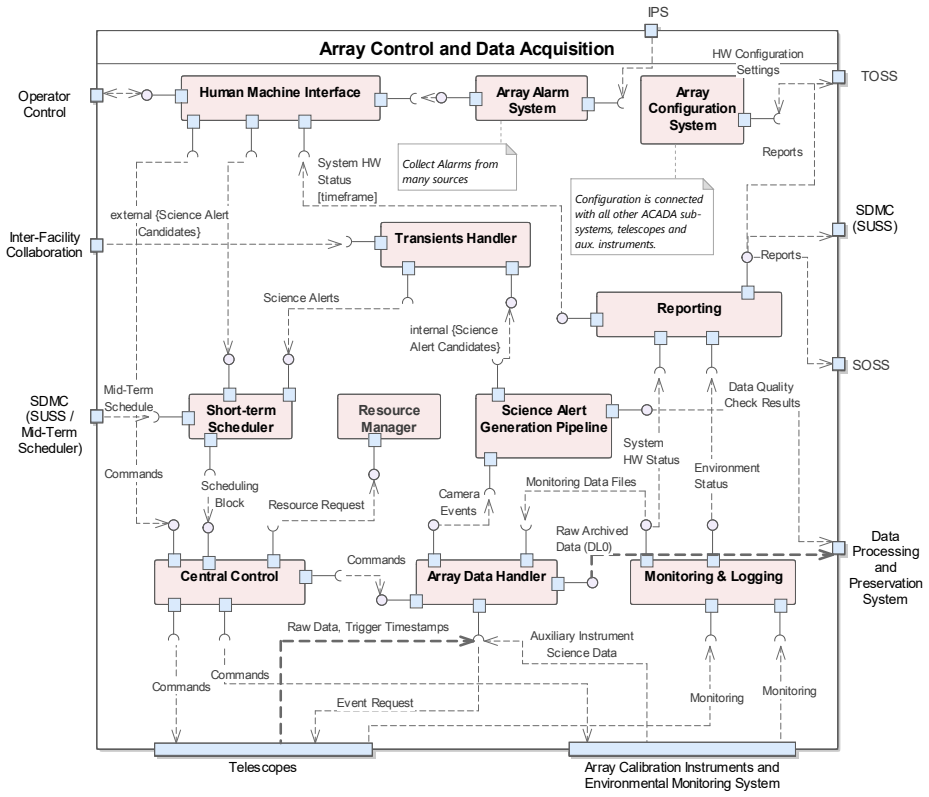
The central claim is that the Science Alert Generation Pipeline, Transients Handler, and Short-Term Scheduler within ACADA can be operated together to modify observations on sub-minute timescales while handling the high data rates from the telescopes and auxiliary instruments, thereby making the observatory well suited for studying astronomical transients.
What carries the argument
The Science Alert Generation Pipeline together with the Transients Handler and Short-Term Scheduler, which together process incoming data streams in real time to generate alerts and adjust the observation schedule.
If this is right
- Ongoing observations can be interrupted or redirected within tens of seconds when a science alert or external transient alert arrives.
- The system supports efficient coordination of observations across the northern and southern sites and across telescope sizes.
- Data from calibration and environmental instruments such as LIDAR systems are incorporated into the same control and acquisition framework.
- The observatory becomes capable of responding to alerts from other instruments for multi-messenger follow-up.
Where Pith is reading between the lines
- This architecture could support coordinated observations with gravitational-wave or neutrino detectors by ingesting their alerts directly into the scheduler.
- Rapid response might allow capture of short-lived phenomena such as gamma-ray bursts or flaring active galactic nuclei that would otherwise be missed.
- The design implies that future expansions of the array can reuse the same alert-to-schedule pipeline without major redesign.
Load-bearing premise
That the Science Alert Generation Pipeline, Transients Handler, and Short-Term Scheduler can be integrated and operated to achieve sub-minute response times with the multi-gigabit-per-second data streams from the telescopes.
What would settle it
A commissioning test or operational log showing that the time from alert generation or external alert receipt to schedule modification consistently exceeds one minute.
Figures


read the original abstract
The Cherenkov Telescope Array Observatory (CTAO) aims to advance knowledge of the gamma-ray sky as the largest gamma-ray observatory ever built. The CTAO will be deployed at two sites, one in the Northern Hemisphere and the other in the Southern Hemisphere, containing telescopes of three sizes to cover different energy domains. Commissioning of the prototype CTAO Large-Sized Telescope (LST-1) is being finalized at the northern site, while three additional LSTs are under construction. Additional calibration and environmental monitoring instruments, such as laser imaging detection and ranging (LIDAR) systems and weather stations, will support telescope operations. The Array Control and Data Acquisition (ACADA) system serves as the central element for on-site CTAO operations. ACADA controls, supervises, and handles the data generated by the telescopes and the auxiliary instruments. It drives the efficient planning and execution of observations while managing the multi-gigabit-per-second data streams produced by each CTAO telescope. The ACADA system contains the CTAO Science Alert Generation Pipeline - a real-time data processing and analysis pipeline, dedicated to automatically generating science alert candidates as data are acquired. These science alerts, along with external alerts received from other scientific instruments, are managed by the Transients Handler (TH) component. The TH informs ACADA's Short-Term Scheduler (STS) about relevant science alerts, enabling modification of ongoing observations on sub-minute timescales. This capability for rapid response, combined with the fast slewing of CTAO telescopes, makes the Observatory an excellent instrument for studying high-impact astronomical transients.
Editorial analysis
A structured set of objections, weighed in public.
Referee Report
Summary. The manuscript describes the Array Control and Data Acquisition (ACADA) system for the Cherenkov Telescope Array Observatory (CTAO). It outlines the system's role in telescope control, data handling from multi-gigabit-per-second streams, and the integration of the Science Alert Generation Pipeline, Transients Handler (TH), and Short-Term Scheduler (STS) to enable automatic generation of science alerts and modification of observations on sub-minute timescales in response to transients.
Significance. The architectural overview of ACADA is relevant to CTAO operations and transient astronomy. The claimed rapid-response capability, if validated, would strengthen CTAO's position for high-impact transient studies, but the manuscript supplies no performance data to support this.
major comments (2)
- [Abstract] Abstract: The central claim that the TH informs the STS to enable observation modifications on sub-minute timescales with multi-Gbps data streams is unsupported; the manuscript provides only a high-level component description with no latency budgets, throughput measurements, end-to-end timing analysis, or test results under realistic loads.
- [Science Alert Generation Pipeline and TH] Section describing the Science Alert Generation Pipeline and TH integration: No details are given on how real-time processing scales with telescope data rates or on validation of the pipeline's alert generation latency, which is required to substantiate the rapid-response functionality.
minor comments (2)
- The manuscript would benefit from a dedicated section on system interfaces between ACADA components and auxiliary instruments such as LIDAR and weather stations.
- Figure or diagram clarity: Any architectural diagrams should include data-flow arrows with approximate rates to illustrate the multi-Gbps handling.
Simulated Author's Rebuttal
We thank the referee for the constructive comments on our manuscript describing the ACADA system. We address each major comment below and propose revisions to clarify the scope of the paper.
read point-by-point responses
-
Referee: [Abstract] Abstract: The central claim that the TH informs the STS to enable observation modifications on sub-minute timescales with multi-Gbps data streams is unsupported; the manuscript provides only a high-level component description with no latency budgets, throughput measurements, end-to-end timing analysis, or test results under realistic loads.
Authors: We agree that the manuscript is an architectural overview and does not include quantitative performance data such as latency budgets or throughput measurements. The sub-minute response is described as a capability enabled by the TH-STS integration based on the system design. We will revise the abstract to state that this rapid-response functionality is a design feature whose performance validation under realistic loads will be reported in a dedicated follow-up paper on ACADA performance. revision: yes
-
Referee: [Science Alert Generation Pipeline and TH] Section describing the Science Alert Generation Pipeline and TH integration: No details are given on how real-time processing scales with telescope data rates or on validation of the pipeline's alert generation latency, which is required to substantiate the rapid-response functionality.
Authors: The relevant section provides a high-level description of component integration rather than performance scaling or latency validation. We will add a clarifying sentence noting that detailed analysis of real-time processing scaling with multi-Gbps data rates and alert generation latency measurements are outside the scope of this architecture paper and are addressed in the CTAO system requirements documentation and planned performance studies. revision: yes
Circularity Check
No circularity: high-level system architecture description only
full rationale
The manuscript is a descriptive overview of the ACADA software components, their roles in observation planning, data handling, and alert processing. It contains no equations, fitted parameters, predictions derived from models, or derivation chains. The claim regarding sub-minute response is stated as an intended capability of the described architecture (Science Alert Generation Pipeline, Transients Handler, Short-Term Scheduler) rather than a result obtained by reducing to prior fitted quantities or self-citations. No load-bearing steps reduce to inputs by construction.
Axiom & Free-Parameter Ledger
Reference graph
Works this paper leans on
-
[1]
doi:10.3847/1538-4357/ace89d. Bulgarelli, A., et al.,
-
[2]
doi:doi.org/10.1117/12.3017825. Caproni, A., Schmid, E.,
-
[3]
ICALEPCS 2017, p
The Integrated Alarm System for the ALMA Observatory, in: Proc. ICALEPCS 2017, p. MOCPL07. doi:10.18429/ JACoW-ICALEPCS2017-MOCPL07. Caroff, S., Aubert, P., Garcia, E., Maurin, G., Pollet, V ., Vuil- laume, T. (CTAO LST Project),
2017
-
[4]
doi:10.22323/1.444.0616. Chiozzi, G., et al.,
-
[5]
Costa, A., Munari, K., Incardona, F., Germani, S., Bruno, P., Mastriani, E., Spinello, S., Oya, I.,
doi:10.22323/1.501.0614. Costa, A., Munari, K., Incardona, F., Germani, S., Bruno, P., Mastriani, E., Spinello, S., Oya, I.,
-
[6]
The com- prehensive monitoring, logging, and alarm system for the Cherenkov Telescope Array Observatory, in: Software and Cyberinfrastructure for Astronomy VIII, SPIE. p. 1310132. doi:10.1117/12.3018799. Donath, A., et al.,
-
[7]
A systematic assessment of data volume reduction for iacts. Astroparticle Physics 167, 103078. doi:10.1016/j. astropartphys.2025.103078. Kosack, K., . Top-Level Data Model. D10000001009642, v. B001 (CTAO internal report). Kostunin, D., Jones, E., Sotnikov, V ., Sotnikov, V ., Golo- vachev, S., Strube, A.,
work page doi:10.1016/j 2025
- [8]
-
[9]
Methodology for the Integration of the Array Control and Data Acquisition System with Array Elements of the Cherenkov Telescope Array Observatory, in: Proc. SPIE, pp. 13101–16. doi:10.1117/12.3017493. McMuldroch, S., et al.,
-
[10]
Melkumyan, D., Fernandez, R., Kostunin, D., Murach, T., Oya, I., Sah, S., Schmidt, T.,
doi:doi.org/10.1117/12.3023226. Melkumyan, D., Fernandez, R., Kostunin, D., Murach, T., Oya, I., Sah, S., Schmidt, T.,
-
[11]
The resource manager and cen- tral control systems for the Cherenkov Telescope Array Ob- servatory, in: Software and Cyberinfrastructure for Astron- omy VIII, SPIE. p. 131012H. doi:10.1117/12.3018313. Oya, I., Füßling, M., Antonino, P.O., Conforti, V ., Hagge, L., Melkumyan, D., Morgenstern, A., Tosti, G., Schwanke, U., Schwarz, J., Wegner, P., Colomé, J....
-
[12]
The software architecture to control the Cherenkov Telescope Ar- ray, in: Software and Cyberinfrastructure for Astronomy IV , SPIE. p. 991303. doi:10.1117/12.2232520. 17 Oya, I., et al., 2018a. Designing and prototyping the control system for the cherenkov telescope array, IOP Publishing. p. 032045. doi:10.1088/1742-6596/1085/3/032045. Oya, I., et al., 20...
-
[13]
Astronomy and Computing 39, 100570
The rtapipe framework for the gamma- ray real-time analysis software development. Astronomy and Computing 39, 100570. doi:10.1016/j.ascom.2022. 100570. The CTA Consortium,
-
[14]
2019, Science with the Cherenkov Telescope Array, doi: 10.1142/10986
Science with the Cherenkov Telescope Array. World Scientific Publishing Co. Pte. Ltd. doi:10.1142/10986. 18
discussion (0)
Sign in with ORCID, Apple, or X to comment. Anyone can read and Pith papers without signing in.