texttt{TransFit-MAG}: Self-Consistent Modeling of Magnetar-Powered Transients from Shock Breakout to Spin-Down Heating
Pith reviewed 2026-06-26 20:05 UTC · model grok-4.3
The pith
A self-consistent model of magnetar engines coupled to shocks and radiative diffusion produces double peaks, merged peaks, or single broad peaks depending on parameter values.
A machine-rendered reading of the paper's core claim, the machinery that carries it, and where it could break.
Core claim
The central claim is that magnetar-powered transients can be modeled by coupling a radiative diffusion solver to the dynamics of a magnetar-inflated pulsar wind nebula and its forward shock in homologously expanding ejecta; this self-consistent treatment naturally generates well-separated double peaks, partially merged peaks, or single broad peaks for different choices of engine and ejecta parameters, placing early bumps and broad single peaks within one engine-shock-diffusion framework.
What carries the argument
The TransFit-MAG framework, which couples the TransFit diffusion solver to pulsar-wind-nebula dynamics and forward-shock propagation to compute the radiation-energy distribution, photospheric evolution, shock-heating location, and emergent luminosity self-consistently.
If this is right
- Different parameter values produce well-separated double peaks, partially merged peaks, or single broad peaks.
- Early bumps arise when shock heating occurs before the main radiative-diffusion peak.
- The observed diversity of engine-powered transients reflects the coupled timescales of central-engine power, shock propagation, and radiative transport.
- The model reproduces the multiband optical light curves of LSQ14bdq within this unified picture.
Where Pith is reading between the lines
- Extending the framework to a statistical sample of superluminous supernovae could test whether peak morphology correlates with inferred magnetar properties.
- The same coupling might apply to other central-engine events if homologous expansion holds at early times.
- Multi-band or spectroscopic data at the predicted shock-breakout epoch could provide an independent check on the model's photospheric evolution.
Load-bearing premise
The ejecta expands homologously and the coupling between pulsar-wind-nebula dynamics and the radiative-diffusion solver remains valid across all shock locations and optical depths.
What would settle it
An observed magnetar-powered transient whose light-curve morphology, including the relative timing and luminosity of any early bump and main peak, cannot be reproduced by any combination of magnetar spin period, magnetic field strength, ejecta mass, and velocity in the model.
Figures

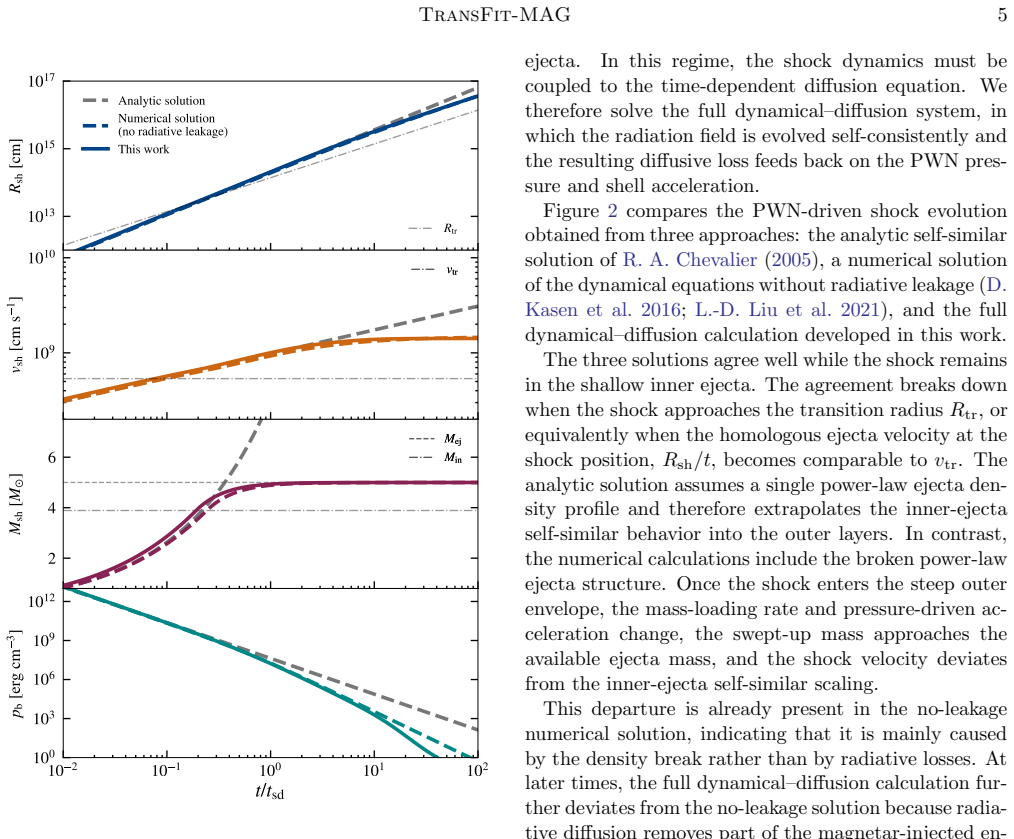


read the original abstract
Magnetar engines are widely invoked to power luminous optical transients, but their early emission depends on the coupled evolution of engine injection, shock heating, adiabatic cooling, and radiative diffusion. We present \texttt{TransFit-MAG}, a time-dependent radiative-diffusion framework for magnetar-powered transients. The model couples the \texttt{TransFit} diffusion solver to the dynamics of a magnetar-inflated pulsar wind nebula (PWN) and its forward shock propagating through homologously expanding ejecta, calculating the internal radiation-energy distribution, photospheric evolution, shock-heating location, and emergent luminosity self-consistently. For different parameter values, the model naturally produces well-separated double peaks, partially merged peaks, or single broad peaks. These results suggest that early bumps and broad single peaks in engine-powered transients may be understood within a unified engine--shock--diffusion framework, in which the observed diversity reflects the coupled evolution of central-engine power, shock propagation, and radiative transport through expanding ejecta. As an illustrative application, we fit the multiband optical light curves of the double-peaked SLSN-I LSQ14bdq.
Editorial analysis
A structured set of objections, weighed in public.
Referee Report
Summary. The paper introduces TransFit-MAG, a time-dependent radiative-diffusion framework that couples magnetar spin-down power, pulsar-wind-nebula forward-shock heating, and radiative diffusion through homologously expanding ejecta. It claims that varying the free parameters (magnetar spin period, magnetic field, ejecta mass, velocity profile) naturally yields well-separated double peaks, partially merged peaks, or single broad peaks, and illustrates the framework with a multiband fit to the double-peaked SLSN-I LSQ14bdq.
Significance. If the self-consistent coupling is shown to generate the reported morphologies from the underlying equations rather than parameter tuning, the work would supply a unified engine-shock-diffusion picture capable of explaining both early bumps and broad single peaks in engine-powered transients within a single set of assumptions. The explicit inclusion of shock-breakout to spin-down evolution and the illustrative data fit are positive features.
major comments (2)
- [Abstract] Abstract: the central claim that different peak morphologies 'naturally' emerge is presented without any equations, numerical tests, or parameter explorations that would demonstrate the morphologies arise from the coupled dynamics rather than from choices of the free parameters (magnetar spin period, magnetic field, ejecta mass, velocity profile). This directly undermines verification of the unified-framework assertion.
- [Abstract] Abstract: no information is supplied on how the PWN-radiative-diffusion coupling is implemented or validated across the range of shock locations and optical depths, leaving the weakest assumption (homologous expansion plus specific coupling) untested in the regimes where the double-peak versus single-peak transition is claimed to occur.
Simulated Author's Rebuttal
We thank the referee for their comments on the manuscript. We respond point-by-point to the two major comments below, noting that the abstract is a concise summary while the supporting derivations, tests, and explorations appear in the body of the paper.
read point-by-point responses
-
Referee: [Abstract] Abstract: the central claim that different peak morphologies 'naturally' emerge is presented without any equations, numerical tests, or parameter explorations that would demonstrate the morphologies arise from the coupled dynamics rather than from choices of the free parameters (magnetar spin period, magnetic field, ejecta mass, velocity profile). This directly undermines verification of the unified-framework assertion.
Authors: The abstract summarizes the main result. The governing equations for magnetar spin-down, PWN inflation, forward-shock propagation, and time-dependent radiative diffusion are derived in Section 2. Section 4 presents a systematic parameter exploration over ranges of spin period, magnetic field, ejecta mass, and velocity profile, showing that the transition between well-separated double peaks, merged peaks, and single broad peaks arises from the relative timescales of shock heating, diffusion, and engine power as solved from the coupled system, rather than from arbitrary tuning. revision: no
-
Referee: [Abstract] Abstract: no information is supplied on how the PWN-radiative-diffusion coupling is implemented or validated across the range of shock locations and optical depths, leaving the weakest assumption (homologous expansion plus specific coupling) untested in the regimes where the double-peak versus single-peak transition is claimed to occur.
Authors: Implementation of the PWN-radiative-diffusion coupling is described in Section 3: the PWN deposits energy at the inner boundary, the forward shock radius is evolved via momentum conservation, and the resulting heating term is inserted into the diffusion equation solved by the TransFit solver at each time step. Validation consists of recovery of analytic shock-breakout and pure-diffusion limits, plus numerical tests across optical depths and shock locations obtained by varying ejecta mass and velocity; these confirm the code remains stable and accurate through the double-peak to single-peak transition regime. The homologous-expansion assumption is standard post-explosion and is justified in the text. revision: no
Circularity Check
No significant circularity; model outputs are genuine simulation results
full rationale
The paper introduces TransFit-MAG as a new coupled framework for magnetar-powered transients, solving the time-dependent radiative diffusion together with PWN forward-shock dynamics in homologously expanding ejecta. The reported diversity of light-curve morphologies (double peaks, merged peaks, single broad peaks) is obtained by varying the model's free parameters and integrating the coupled equations forward in time; these shapes are therefore direct numerical outputs rather than inputs renamed as predictions. The LSQ14bdq fit is explicitly labeled an illustrative application of parameter adjustment to data, not an a-priori prediction. No self-definitional equations, fitted-input-as-prediction steps, or load-bearing self-citations appear in the derivation chain. The central claim—that a single engine–shock–diffusion coupling can accommodate observed diversity—rests on the explicit construction and numerical exploration of the model itself, which is self-contained against external benchmarks.
Axiom & Free-Parameter Ledger
free parameters (2)
- magnetar spin period and magnetic field
- ejecta mass and velocity profile
axioms (2)
- domain assumption Homologous expansion of ejecta
- domain assumption Coupled PWN-shock-diffusion evolution remains valid across optical-depth regimes
Reference graph
Works this paper leans on
-
[1]
R., Smith, M., Sullivan, M., et al
Angus, C. R., Smith, M., Sullivan, M., et al. 2019, MNRAS, 487, 2215, doi: 10.1093/mnras/stz1321
-
[2]
Arnett, W. D. 1980, ApJ, 237, 541, doi: 10.1086/157898
-
[3]
Arnett, W. D. 1982, ApJ, 253, 785, doi: 10.1086/159681
-
[4]
Bellm, E. C., Kulkarni, S. R., Graham, M. J., et al. 2019, PASP, 131, 018002, doi: 10.1088/1538-3873/aaecbe
-
[5]
Blinnikov, S. I., R¨ opke, F. K., Sorokina, E. I., et al. 2006, A&A, 453, 229, doi: 10.1051/0004-6361:20054594
-
[6]
Chatzopoulos, E., Wheeler, J. C., & Vinko, J. 2012, ApJ, 746, 121, doi: 10.1088/0004-637x/746/2/121
-
[7]
Chen, K.-J., Woosley, S. E., & Sukhbold, T. 2016, ApJ, 832, 73, doi: 10.3847/0004-637x/832/1/73
-
[8]
2026, ApJ, 1001, 59, doi: 10.3847/1538-4357/ae4c58
Chen, M., Kashiyama, K., & Sato, M. 2026, ApJ, 1001, 59, doi: 10.3847/1538-4357/ae4c58
-
[9]
Chevalier, R. A. 2005, ApJ, 619, 839, doi: 10.1086/426584
-
[10]
Chevalier, R. A., & Fransson, C. 1992, ApJ, 395, 540, doi: 10.1086/171674
-
[11]
Chevalier, R. A., & Soker, N. 1989, ApJ, 341, 867, doi: 10.1086/167545
-
[12]
Dai, Z. G., & Lu, T. 1998, PhRvL, 81, 4301, doi: 10.1103/physrevlett.81.4301
-
[13]
, archivePrefix = "arXiv", eprint =
Blondin, S. 2012, MNRAS, 426, L76, doi: 10.1111/j.1745-3933.2012.01329.x
-
[14]
2013, ApJ, 772, 30, doi: 10.1088/0004-637X/772/1/30
Dexter, J., & Kasen, D. 2013, ApJ, 772, 30, doi: 10.1088/0004-637X/772/1/30
-
[15]
R., Chornock, R., Soderberg, A
Drout, M. R., Chornock, R., Soderberg, A. M., et al. 2014, ApJ, 794, 23, doi: 10.1088/0004-637x/794/1/23
-
[16]
Gal-Yam, A. 2019, ARA&A, 57, 305, doi: 10.1146/annurev-astro-081817-051819
-
[17]
Galama, T. J., Vreeswijk, P. M., van Paradijs, J., et al. 1998, Nature, 395, 670, doi: 10.1038/27150
-
[18]
2003, Nature, 423, 847, doi: 10.1038/nature01750
Hjorth, J., Sollerman, J., Møller, P., et al. 2003, Nature, 423, 847, doi: 10.1038/nature01750
-
[19]
Ho, A. Y. Q., Phinney, E. S., Ravi, V., et al. 2019, ApJ, 871, 73, doi: 10.3847/1538-4357/aaf473
-
[20]
2019, Nature Astronomy, 3, 697, doi: 10.1038/s41550-019-0854-4 Ivezi´ c,ˇZ., Kahn, S
Inserra, C. 2019, Nature Astronomy, 3, 697, doi: 10.1038/s41550-019-0854-4 TransFit-MAG11 Ivezi´ c,ˇZ., Kahn, S. M., Tyson, J. A., et al. 2019, ApJ, 873, 111, doi: 10.3847/1538-4357/ab042c
-
[21]
2010, ApJ, 717, 245, doi: 10.1088/0004-637x/717/1/245
Kasen, D., & Bildsten, L. 2010, ApJ, 717, 245, doi: 10.1088/0004-637x/717/1/245
-
[22]
Kasen, D., Metzger, B. D., & Bildsten, L. 2016, ApJ, 821, 36, doi: 10.3847/0004-637x/821/1/36
-
[23]
2016, ApJ, 818, 94, doi: 10.3847/0004-637X/818/1/94
Margutti, R. 2016, ApJ, 818, 94, doi: 10.3847/0004-637X/818/1/94
-
[24]
2012, A&A, 541, A129, doi: 10.1051/0004-6361/201118498
Leloudas, G., Chatzopoulos, E., Dilday, B., et al. 2012, A&A, 541, A129, doi: 10.1051/0004-6361/201118498
-
[25]
2016, ApJ, 819, 120, doi: 10.3847/0004-637x/819/2/120
Li, S.-Z., & Yu, Y.-W. 2016, ApJ, 819, 120, doi: 10.3847/0004-637x/819/2/120
-
[26]
2025, arXiv e-prints, arXiv:2504.17034
Li, W.-X., Zhu, Z.-P., Zou, X.-Z., et al. 2025, arXiv e-prints, arXiv:2504.17034. https://arxiv.org/abs/2504.17034
arXiv 2025
-
[27]
2021, ApJL, 914, L2, doi: 10.3847/2041-8213/ac004a
Lin, W., Wang, X., Wang, L., & Dai, Z. 2021, ApJL, 914, L2, doi: 10.3847/2041-8213/ac004a
-
[28]
2022, ApJL, 935, L34, doi: 10.3847/2041-8213/ac86d2
Liu, J.-F., Zhu, J.-P., Liu, L.-D., Yu, Y.-W., & Zhang, B. 2022, ApJL, 935, L34, doi: 10.3847/2041-8213/ac86d2
-
[29]
2021, ApJ, 911, 142, doi: 10.3847/1538-4357/abf042
Liu, L.-D., Gao, H., Wang, X.-F., & Yang, S. 2021, ApJ, 911, 142, doi: 10.3847/1538-4357/abf042
-
[30]
2025, ApJ, 992, 20, doi: 10.3847/1538-4357/adfed6
Liu, L.-D., Zhang, Y.-H., Yu, Y.-W., et al. 2025, ApJ, 992, 20, doi: 10.3847/1538-4357/adfed6
-
[31]
Margutti, R., Metzger, B. D., Chornock, R., et al. 2019, ApJ, 872, 18, doi: 10.3847/1538-4357/aafa01
-
[32]
Matzner, C. D., & McKee, C. F. 1999, ApJ, 510, 379, doi: 10.1086/306571
-
[33]
J., M¨ uller, B., Chan, C., Heger, A., & Blinnikov, S
Moriya, T. J., M¨ uller, B., Chan, C., Heger, A., & Blinnikov, S. I. 2019, ApJ, 880, 21, doi: 10.3847/1538-4357/ab2643
-
[34]
Morozova, V., Piro, A. L., Renzo, M., et al. 2015, ApJ, 814, 63, doi: 10.1088/0004-637x/814/1/63
-
[35]
2017, ApJ, 850, 55, doi: 10.3847/1538-4357/aa9334
Nicholl, M., Guillochon, J., & Berger, E. 2017, ApJ, 850, 55, doi: 10.3847/1538-4357/aa9334
-
[36]
Nicholl, M., & Smartt, S. J. 2016, MNRAS, 457, L79, doi: 10.1093/mnrasl/slv210
-
[37]
Nicholl, M., Smartt, S. J., Jerkstrand, A., et al. 2015, ApJL, 807, L18, doi: 10.1088/2041-8205/807/1/L18
-
[38]
Pinto, P. A., & Eastman, R. G. 2000a, ApJ, 530, 744, doi: 10.1086/308376
-
[39]
Pinto, P. A., & Eastman, R. G. 2000b, ApJ, 530, 757, doi: 10.1086/308380
-
[40]
Piro, A. L., & Ott, C. D. 2011, ApJ, 736, 108, doi: 10.1088/0004-637X/736/2/108
-
[41]
2018, MNRAS, 481, 894, doi: 10.1093/mnras/sty2309
Pursiainen, M., Childress, M., Smith, M., et al. 2018, MNRAS, 481, 894, doi: 10.1093/mnras/sty2309
-
[42]
Smith, M., Sullivan, M., D’Andrea, C. B., et al. 2016, ApJL, 818, L8, doi: 10.3847/2041-8205/818/1/L8
-
[43]
Z., Matheson, T., Garnavich, P
Stanek, K. Z., Matheson, T., Garnavich, P. M., et al. 2003, ApJL, 591, L17, doi: 10.1086/376976
-
[44]
2025, Nature Astronomy, 9, 1073, doi: 10.1038/s41550-025-02571-1
Sun, H., Li, W.-X., Liu, L.-D., et al. 2025, Nature Astronomy, 9, 1073, doi: 10.1038/s41550-025-02571-1
-
[45]
2021, ApJ, 908, 217, doi: 10.3847/1538-4357/abd54c
Suzuki, A., & Maeda, K. 2021, ApJ, 908, 217, doi: 10.3847/1538-4357/abd54c
-
[46]
Woosley, S. E. 2010, ApJL, 719, L204, doi: 10.1088/2041-8205/719/2/l204
-
[47]
Woosley, S. E., & Bloom, J. S. 2006, ARA&A, 44, 507, doi: 10.1146/annurev.astro.43.072103.150558
-
[48]
2015, ApJL, 806, L6, doi: 10.1088/2041-8205/806/1/L6
Yu, Y.-W., Li, S.-Z., & Dai, Z.-G. 2015, ApJL, 806, L6, doi: 10.1088/2041-8205/806/1/L6
-
[49]
2013, ApJL, 776, L40, doi: 10.1088/2041-8205/776/2/L40
Yu, Y.-W., Zhang, B., & Gao, H. 2013, ApJL, 776, L40, doi: 10.1088/2041-8205/776/2/L40
-
[50]
2017, ApJ, 840, 12, doi: 10.3847/1538-4357/aa6c27
Yu, Y.-W., Zhu, J.-P., Li, S.-Z., L¨ u, H.-J., & Zou, Y.-C. 2017, ApJ, 840, 12, doi: 10.3847/1538-4357/aa6c27
-
[51]
2026, ApJ, 999, 186, doi: 10.3847/1538-4357/ae434a
Zhang, Y.-H., Liu, L.-D., Du, Z.-X., et al. 2026, ApJ, 999, 186, doi: 10.3847/1538-4357/ae434a
-
[52]
2022, ApJ, 936, 54, doi: 10.3847/1538-4357/ac8548
Zhang, Z.-D., Yu, Y.-W., & Liu, L.-D. 2022, ApJ, 936, 54, doi: 10.3847/1538-4357/ac8548
-
[53]
Zhu, J.-P., & Zhang, B. 2026, arXiv e-prints, arXiv:2604.21759, doi: 10.48550/arXiv.2604.21759
work page internal anchor Pith review Pith/arXiv arXiv doi:10.48550/arxiv.2604.21759 2026
discussion (0)
Sign in with ORCID, Apple, or X to comment. Anyone can read and Pith papers without signing in.