Wake Perturbations in Laser- and Beam-Driven Plasma Wakefield Accelerators: A Symmetry-Based Multipole Classification
Pith reviewed 2026-06-26 19:12 UTC · model grok-4.3
The pith
Transverse wake perturbations in plasma accelerators are classified by an integer azimuthal multipole order m that links specific symmetries to beam-quality observables.
A machine-rendered reading of the paper's core claim, the machinery that carries it, and where it could break.
Core claim
Transverse perturbations of the wake are classified by an integer azimuthal multipole order m labelling the irreducible representations of SO(2)_φ, with the lowest beam-quality observables coupling at a specific multipole: the bunch centroid at m=1, cross-plane emittance coupling at m=2. A symplectic analogy relates transverse matching to longitudinal beam loading.
What carries the argument
The symmetry group of the idealised blowout wake consisting of axisymmetry SO(2)_φ, adiabatic longitudinal translation, and propagation-direction parity, which organises perturbations into multipole channels labelled by m.
If this is right
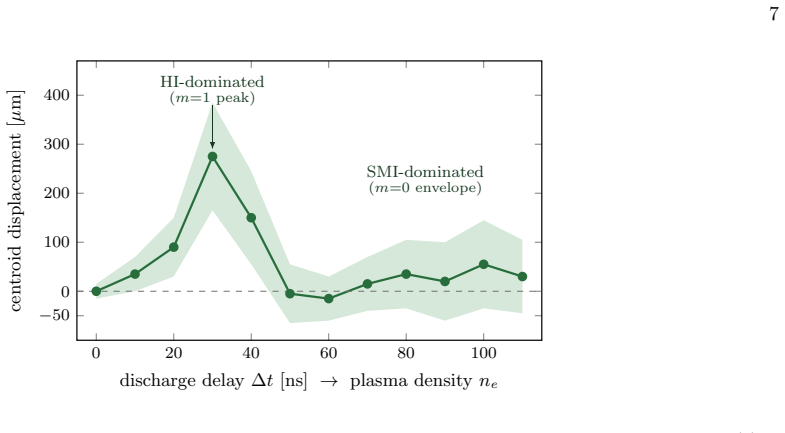
- Hose instabilities, pulse-front-tilt jitter, spot-asymmetry emittance growth, polarisation-dependent centroid motion and resonant cross-plane mixing all occupy the m=1 and m=2 channels.
- The positron-witness problem is reorganised as the selective abandonment of one symmetry feature from a finite set.
- An m=3 response channel is possible and its magnitude is left as an open question.
- The classification supplies a symmetry-equivariant language for Bayesian optimisation of plasma accelerators.
Where Pith is reading between the lines
- Design rules for suppressing m=1 and m=2 effects could be translated into concrete tolerances on laser or beam asymmetry.
- The same multipole language may organise wake response in non-blowout regimes once the symmetry assumptions are relaxed in a controlled way.
- Experimental diagnostics that resolve azimuthal Fourier components of the wake could directly test the m-channel assignments.
Load-bearing premise
The idealised blowout wake is exactly axisymmetric under SO(2)_φ, undergoes adiabatic longitudinal translation, and respects propagation-direction parity.
What would settle it
A measured transverse wake perturbation whose azimuthal structure cannot be decomposed into a single integer m or whose lowest-order coupling deviates from the predicted m=1 centroid and m=2 emittance channels.
Figures

read the original abstract
We review beam-quality physics in laser-driven (LWFA) and beam-driven (PWFA) plasma wakefield accelerators through the symmetry group of the idealised blowout wake -- axisymmetry $\mathrm{SO}(2)_\phi$, adiabatic longitudinal translation, and propagation-direction parity. Transverse perturbations of the wake are classified by an integer azimuthal multipole order $m$ labelling the irreducible representations of $\mathrm{SO}(2)_\phi$, with the lowest beam-quality observables coupling at a specific multipole: the bunch centroid at $m=1$, cross-plane emittance coupling at $m=2$. A symplectic analogy relates transverse matching to longitudinal beam loading. Several phenomena common to LWFA and PWFA -- hose instabilities, pulse-front-tilt jitter, spot-asymmetry emittance growth, polarisation-dependent centroid motion, resonant cross-plane mixing -- populate the two lowest non-trivial $m$-channels and admit a unified discussion. The positron-witness problem reorganises in the same language: each known mitigation abandons one specific feature of the uniform-density blowout, drawn from a finite set. The classification also raises the possibility of an $m=3$ response channel whose magnitude remains open. We note the connection to symmetry-equivariant Bayesian optimisation of plasma accelerators.
Editorial analysis
A structured set of objections, weighed in public.
Referee Report
Summary. The paper reviews beam-quality issues in LWFA and PWFA by classifying transverse wake perturbations according to the symmetry group of the idealised blowout wake (SO(2)_φ axisymmetry, adiabatic longitudinal translation, and propagation-direction parity). Perturbations are organized by azimuthal multipole order m corresponding to irreducible representations of SO(2)_φ; the lowest beam-quality observables are assigned to specific channels (centroid motion at m=1, cross-plane emittance coupling at m=2). Known effects including hose instabilities, pulse-front tilt, spot asymmetry, polarisation-dependent motion, and resonant mixing are reassigned to these channels, the positron-witness problem is reframed as selective breaking of blowout symmetries, and an open m=3 channel is noted together with a link to symmetry-equivariant optimisation.
Significance. If the classification is valid, the work supplies a parameter-free organisational scheme that unifies disparate beam-quality phenomena across LWFA and PWFA under standard representation theory applied to the stated symmetries. It reorganises existing observations without additional dynamical assumptions and identifies a possible m=3 response whose magnitude is left open. The explicit mapping of observables to m-channels and the symplectic analogy between transverse matching and longitudinal loading constitute concrete, falsifiable predictions that could guide mitigation strategies and symmetry-aware optimisation.
minor comments (2)
- The abstract states the symmetry group but does not explicitly list the generators or the precise action on the wake fields; a short appendix or paragraph in §2 would make the representation-theory step fully self-contained for readers outside the immediate subfield.
- The claim that the positron-witness mitigations each abandon one specific symmetry feature would be strengthened by a compact table mapping each mitigation to the broken symmetry (or symmetries).
Simulated Author's Rebuttal
We thank the referee for their careful reading and positive assessment of the manuscript. Their summary correctly identifies the symmetry-based classification and its implications for unifying beam-quality phenomena in LWFA and PWFA. We are pleased that the referee finds the mapping of observables to m-channels and the symplectic analogy to be concrete and falsifiable.
Circularity Check
No significant circularity; classification follows directly from stated symmetries
full rationale
The paper's central result is a multipole classification of transverse wake perturbations obtained by applying the irreducible representations of the explicitly listed symmetry group (SO(2)_φ axisymmetry plus longitudinal translation and parity) of the idealised blowout. The assignments of the bunch centroid to m=1 and cross-plane emittance coupling to m=2 are immediate consequences of the azimuthal Fourier content of the corresponding field perturbations; no parameters are fitted, no prior results are invoked via self-citation to justify the classification itself, and no quantity is redefined in terms of itself. The remaining discussion (hose, tilt, positron-witness mitigation, etc.) simply populates the channels already fixed by the symmetry analysis. The derivation is therefore self-contained against the stated assumptions and does not reduce to its inputs by construction.
Axiom & Free-Parameter Ledger
axioms (1)
- domain assumption The idealised blowout wake possesses axisymmetry SO(2)_φ, adiabatic longitudinal translation, and propagation-direction parity.
Reference graph
Works this paper leans on
-
[1]
[29] [their Eq
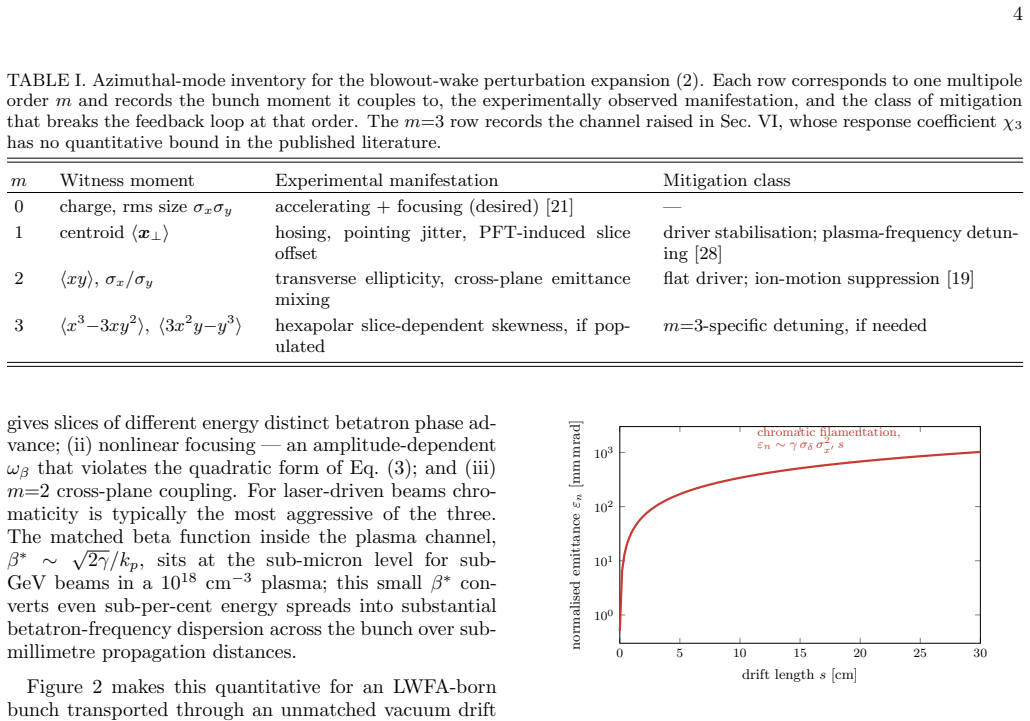
Chromaticity In an unmatched drift downstream of the plasma exit, the energy-dependent betatron frequencyk β =k p/√2γ shears the transverse distribution and the rms normalised emittance grows according to the model of Ref. [29] [their Eq. (5)], εn(s) =ε n,0 s 1 + γ σδ σ2 x′ s εn,0 2 ,(A1) linear in the drift lengthsat larges. The wake remains axisymmetric...
-
[2]
A saddle-point analysis of the coupled system yields the convective amplification Xc(ξ, s)∼exp 3 cr k2 β ξ s 4k p !1/3 ,(A3) the characteristic (ξs) 1/3 law
Hose instability The bunch centroidX c(ξ, s) and dipole wake centroid Xw(ξ, s) obey the coupled long-bunch system of [67, 68], ∂2Xc ∂s2 +k 2 βXc = cr k2 β 2 Xw, ∂2Xw ∂ξ 2 +k 2 pXw =k 2 pXc, (A2) withξthe co-moving coordinate,sthe propagation dis- tance, andc r an order-unity coupling coefficient. A saddle-point analysis of the coupled system yields the co...
-
[3]
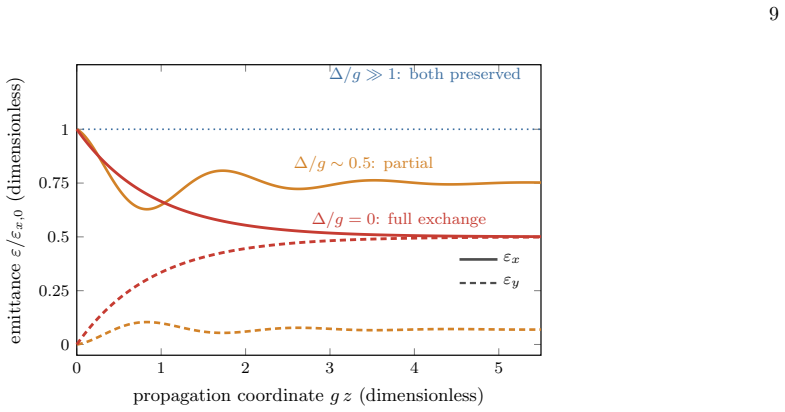
Mixing resonance as a Rabi exchange When the two transverse planes are nearly degenerate, kβ,x ≈k β,y, them=2 coupling exchanges single-particle action between them in direct analogy to a two-level system. With detuning ∆≡ω β,x −ω β,y and coupling strengthg, the actions obey dJx ds =−gsin(∆s+ϕ) p JxJy, dJy ds = +gsin(∆s+ϕ) p JxJy, (A4) whose single-partic...
-
[4]
Tajima and J
T. Tajima and J. M. Dawson, Laser electron accelerator, Phys. Rev. Lett.43, 267 (1979)
1979
-
[5]
Esarey, C
E. Esarey, C. B. Schroeder, and W. P. Leemans, Physics of laser-driven plasma-based electron accelerators, Rev. Mod. Phys.81, 1229 (2009)
2009
-
[6]
Albertet al., 2020 roadmap on plasma accelerators, New J
F. Albertet al., 2020 roadmap on plasma accelerators, New J. Phys.23, 031101 (2021)
2020
-
[7]
C. Adolphsen, D. Angal-Kalinin, T. Arndt, M. Arnold, , B. Auchmann, K. Aulenbacher, A. Ballarino, B. Bau- douy, P. Baudrenghien, M. Benedikt, S. Bentvelsen, , A. Bogacz, F. Bossi, L. Bottura, S. Bousson, O. Br¨ uning, R. Brinkmann, O. Brunner, P. N. Burrows, G. Burt, et al., European strategy for particle physics – ac- celerator r&d roadmap, CERN Yellow R...
-
[8]
S. Gessner, J. Osterhoff, C. A. Lindstrøm, K. Cas- sou, S. P. Griso, J. List, E. Adli, B. Foster, J. Palas- tro, E. Donegani, M. Chung, M. Polyanskiy, L. Gray, I. Pogorelsky, G. Chen, G. Sarri, B. Beaudoin, F. Willeke, D. Bruhwiler, J. Grames,et al., Design initiative for a 10 tev pcm wakefield collider, arXiv (2025), 2503.20214
arXiv 2025
-
[9]
V. I. Arnold,Mathematical Methods of Classical Mechan- ics, 2nd ed., Graduate Texts in Mathematics, Vol. 60 (Springer, New York, USA, 1989)
1989
-
[10]
Schwichtenberg,Physics from Symmetry, Undergrad- uate Lecture Notes in Physics (Springer, Cham, Switzer- land, 2015)
J. Schwichtenberg,Physics from Symmetry, Undergrad- uate Lecture Notes in Physics (Springer, Cham, Switzer- land, 2015)
2015
-
[11]
E. D. Courant and H. S. Snyder, Theory of the alternating-gradient synchrotron, Ann. Phys. (N.Y.)3, 1 (1958)
1958
-
[12]
A. W. Chao,Physics of Collective Beam Instabilities in High Energy Accelerators(Wiley, New York, USA, 1993)
1993
-
[13]
Reiser,Theory and Design of Charged Particle Beams, 2nd ed
M. Reiser,Theory and Design of Charged Particle Beams, 2nd ed. (Wiley-VCH, Weinheim, Germany, 2008)
2008
-
[14]
M. S. Dresselhaus, G. Dresselhaus, and A. Jorio,Group Theory: Application to the Physics of Condensed Matter (Springer, Berlin, Germany, 2008)
2008
-
[15]
Malka, Laser plasma accelerators, arXiv (2011), 1112.5054
V. Malka, Laser plasma accelerators, arXiv (2011), 1112.5054
Pith/arXiv arXiv 2011
-
[16]
Corde, K
S. Corde, K. Ta Phuoc, G. Lambert, R. Fitour, V. Malka, A. Rousse, A. Beck, and E. Lefebvre, Femtosecond x rays from laser-plasma accelerators, Rev. Mod. Phys.85, 1 (2013)
2013
-
[17]
Huang, W
C. Huang, W. Lu, M. Zhou, C. E. Clayton, C. Joshi, W. B. Mori, P. Muggli, S. Deng, E. Oz, T. Katsouleas, M. J. Hogan, I. Blumenfeld, F. J. Decker, R. Ischebeck, R. H. Iverson, N. A. Kirby, and D. Walz, Hosing insta- bility in the blow-out regime for plasma-wakefield accel- eration, Phys. Rev. Lett.99, 255001 (2007)
2007
-
[18]
T. Nechaeva, L. Verra, J. Pucek, L. Ranc, M. Bergam- aschi, G. Z. D. Porta, and P. M. A. Collaboration), Hos- ing of a long relativistic particle bunch in plasma, arXiv (2024), 2309.03785
arXiv 2024
- [19]
-
[20]
I. Moulanier, L. Dickson, C. Ballage, O. Vasilovici, A. Gremaud, S. Dobosz Dufrenoy, N. Delerue, L. Bernardi, A. Mahjoub, A. Cauchois, A. Specka, F. Massimo, G. Maynard, and B. Cros, Modeling of the driver transverse profile for laser wakefield electron ac- celeration at APOLLON research facility, arXiv (2023), 2305.02275
arXiv 2023
-
[21]
P. Manwani, Y. Kang, J. Mann, B. Naranjo, G. An- donian, and J. B. Rosenzweig, Analysis of the blowout plasma wakefields produced by drive beams with ellipti- cal symmetry, arXiv (2024), 2406.02719
arXiv 2024
-
[22]
S. Diederichs, C. Benedetti, A. F. Pousa, A. Sinn, J. Osterhoff, C. B. Schroeder, and M. Th´ evenet, Reso- nant emittance mixing of flat beams in plasma accelera- tors, Phys. Rev. Lett. 10.1103/PhysRevLett.133.265003 (2025), 2403.05871
-
[23]
Pukhov and J
A. Pukhov and J. Meyer-ter Vehn, Laser wake field accel- eration: the highly non-linear broken-wave regime, Appl. Phys. B74, 355 (2002)
2002
-
[24]
W. Lu, C. Huang, M. Zhou, W. B. Mori, and T. Kat- souleas, Nonlinear theory for relativistic plasma wake- fields in the blowout regime, Phys. Rev. Lett.96, 165002 (2006)
2006
-
[25]
Tzoufras, W
M. Tzoufras, W. Lu, F. S. Tsung, C. Huang, W. B. Mori, T. Katsouleas, J. Vieira, R. A. Fonseca, and L. O. Silva, Beam loading in the nonlinear regime of plasma-based acceleration, Phys. Rev. Lett.101, 145002 (2008)
2008
-
[27]
M. C. Kaluza, S. P. D. Mangles, A. G. R. Thomas, Z. Na- jmudin, A. E. Dangor, C. D. Murphy, J. L. Collier, E. J. Divall, P. S. Foster, C. J. Hooker, A. J. Langley, J. Smith, and K. Krushelnick, Observation of a long-wavelength hosing modulation of a high-intensity laser pulse in un- derdense plasma, Phys. Rev. Lett.105, 095003 (2010)
2010
-
[28]
X. L. Xu, Y. P. Wu, C. J. Zhang, F. Li, Y. Wan, J. F. Hua, C.-H. Pai, , P. Yu, and C. Joshi, Low emittance elec- tron beam generation from a laser wakefield accelerator using two laser pulses with different wavelengths, arXiv 10.1103/PhysRevSTAB.17.061301 (2015), 1402.5322
work page internal anchor Pith review Pith/arXiv arXiv doi:10.1103/physrevstab.17.061301 2015
-
[29]
A. C. R. Assmann, R. Bingham, T. Bohl, C. Bracco, B. Buttenschon, A. Butterworth, A. Caldwell, S. Chat- topadhyay, S. Cipiccia, E. Feldbaumer, R. Fonseca, B. Goddard, M. Gross, O. Grulke, E. Gschwendtner, J. Holloway, C. Huang, D. Jaroszynski, S. Jolly, P. Kemp- kes,et al., Proton-driven plasma wakefield acceleration: a path to the future of high-energy p...
Pith/arXiv arXiv 2014
-
[30]
C. A. Lindstrøm, Staging of plasma-wakefield accelera- tors, Phys. Rev. Accel. Beams24, 014801 (2021)
2021
-
[32]
Migliorati, A
M. Migliorati, A. Bacci, C. Benedetti, E. Chiadroni, M. Ferrario, A. Mostacci, L. Palumbo, A. R. Rossi, L. Serafini, and P. Antici, Intrinsic normalized emittance growth in laser-driven electron accelerators, Phys. Rev. ST Accel. Beams16, 011302 (2013)
2013
-
[33]
C. G. R. Geddes, K. Nakamura, G. R. Plateau, C. Toth, E. Cormier-Michel, E. Esarey, C. B. Schroeder, J. R. Cary, and W. P. Leemans, Plasma-density-gradient injec- tion of low absolute-momentum-spread electron bunches, Phys. Rev. Lett.100, 215004 (2008)
2008
-
[34]
A. Pak, K. A. Marsh, S. F. Martins, W. Lu, W. B. Mori, and C. Joshi, Injection and trapping of tunnel- ionized electrons into laser-produced wakes, Phys. Rev. Lett.104, 025003 (2010)
2010
-
[35]
Faure, C
J. Faure, C. Rechatin, A. Norlin, A. Lifschitz, Y. Glinec, and V. Malka, Controlled injection and acceleration of electrons in plasma wakefields by colliding laser pulses, Nature444, 737 (2006)
2006
-
[36]
Kalmykov, S
S. Kalmykov, S. A. Yi, V. Khudik, and G. Shvets, Elec- tron self-injection and trapping into an evolving plasma bubble, Phys. Rev. Lett.103, 135004 (2009)
2009
-
[37]
C. Hue, Y. Wan, E. Y. Levine, and V. Malka, Control of electron beam current, charge and energy spread us- ing density downramp injection in laser wakefield accel- erators, Phys. Plasmas 10.1063/5.0126293 (2025), matter Radiat. Extremes 8, 024401 (2023), 2209.04853. 13
- [38]
-
[39]
The REsonant Multi-Pulse Ionization injection
P. Tomassini, S. D. Nicola, L. Labate, P. Londrillo, R. Fedele, D. Terzani, and L. A. Gizzi, The resonant multi-pulse ionization injection, arXiv 10.1063/1.5000696 (2017), 1708.04957
work page internal anchor Pith review Pith/arXiv arXiv doi:10.1063/1.5000696 2017
-
[40]
A. M. d. l. Ossa, T. J. Mehrling, L. Schaper, M. J. V. Streeter, and J. Osterhoff, Wakefield-induced ioniza- tion injection in beam-driven plasma accelerators, AIP Conf. Proc. 10.1063/1.4929921 (2015), phys. Plasmas 22, 093107 (2015), 1506.05486
work page internal anchor Pith review Pith/arXiv arXiv doi:10.1063/1.4929921 2015
-
[41]
F. Li, J. F. Hua, X. L. Xu, C. J. Zhang, L. X. Yan, Y. C. Du, W. H. Huang, H. B. Cheng, C. X. Tang, , C. Joshi, and W. B. Mori, Generation of high brightness electron beams via ionization induced injection by transverse col- liding lasers in a beam-driven plasma wakefield acceler- ator, Phys. Rev. Lett. 10.1103/PhysRevLett.111.015003 (2015), 1301.2950
work page internal anchor Pith review Pith/arXiv arXiv doi:10.1103/physrevlett.111.015003 2015
-
[42]
Y. Li, G. Xia, K. V. Lotov, A. P. Sosedkin, K. Hana- hoe, and O. Mete-Apsimon, High quality electron beam generation in a proton-driven hollow plasma wakefield accelerator, Phys. Rev. Accel. Beams 10.1103/PhysRe- vAccelBeams.20.101301 (2018), li, Y., Xia, G., Lotov, K. V., Sosedkin, A. P., Hanahoe, K., & Mete-Apsimon, O. (2017). High-quality electron beam...
work page internal anchor Pith review Pith/arXiv arXiv doi:10.1103/physre- 2018
-
[43]
J. L. Shaw, F. S. Tsung, N. Vafaei-Najafabadi, K. A. Marsh, N. Lemos, W. B. Mori, and C. Joshi, Role of direct laser acceleration in energy gained by elec- trons in a laser wakefield accelerator with ionization injection, Plasma Phys. Control. Fusion 10.1088/0741- 3335/56/8/084006 (2015), 1404.4926
work page internal anchor Pith review Pith/arXiv arXiv doi:10.1088/0741- 2015
-
[44]
Synergistic Laser Wakefield/Direct Laser Acceleration in the Plasma Bubble Regime
X. Zhang, V. N. Khudik, and G. Shvets, Syner- gistic laser wakefield/direct laser acceleration in the plasma bubble regime, Phys. Rev. Lett. 10.1103/Phys- RevLett.114.184801 (2015), 1412.7202
work page internal anchor Pith review Pith/arXiv arXiv doi:10.1103/phys- 2015
-
[45]
Bargmann, L
V. Bargmann, L. Michel, and V. L. Telegdi, Precession of the polarization of particles moving in a homogeneous electromagnetic field, Phys. Rev. Lett.2, 435 (1959)
1959
-
[46]
M. Wen, M. Tamburini, and C. H. Keitel, Polarized laser- wakefield-accelerated kiloampere electron beams, Phys. Rev. Lett.122, 214801 (2019), 1809.10570
Pith/arXiv arXiv 2019
-
[47]
M. Wen, M. B¨ uscher, J. Thomas, A. Pukhov, and M. Tamburini, Generation of polarized particle beams at relativistic laser intensities, Light Sci. Appl.9, 55 (2020), 2006.06974
arXiv 2020
-
[48]
Z. Nie, F. Li, F. Morales, S. Patchkovskii, O. Smirnova, W. An, N. Nambu, D. Matteo, K. A. Marsh, F. Tsung, W. B. Mori, and C. Joshi, In situ generation of high- energy spin-polarized electrons in a beam-driven plasma wakefield accelerator, Phys. Rev. Lett.126, 054801 (2021), 2101.10378
arXiv 2021
- [49]
-
[50]
Y. Wu, L. Ji, X. Geng, Q. Yu, N. Wang, B. Feng, Z. Guo, W. Wang, C. Qin, X. Yan, L. Zhang, J. Thomas, A. H¨ utzen, A. Pukhov, M. B¨ uscher, R. Li, and Z. Xu, Po- larized electron-beam acceleration driven by vortex laser pulses, New J. Phys.21, 073052 (2019), 1904.03431
arXiv 2019
-
[51]
D. Del Sorbo, D. Seipt, A. G. R. Thomas, and C. P. Ridgers, Ultrarelativistic electron beam polarization in single-shot interaction with an ultraintense laser pulse, Phys. Rev. Lett.122, 154801 (2019), 1812.07229
Pith/arXiv arXiv 2019
-
[52]
H. C. Fan, X. Y. Liu, X. F. Li, J. F. Qu, Q. Yu, Q. Kong, S. M. Weng, M. Chen, M. B¨ uscher, P. Gibbon, and S. Kawata, Control of electron beam polarization in the bubble regime of laser-wakefield acceleration, New J. Phys.24, 083047 (2022), 2201.02969
arXiv 2022
-
[53]
Z. Gong, M. J. Quin, S. Bohlen, C. H. Keitel, K. P˜ oder, and M. Tamburini, Spin-polarized electron beam gener- ation in the colliding-pulse injection scheme, Matter Ra- diat. Extremes8, 064005 (2023), 2303.16966
arXiv 2023
-
[55]
Del Dotto, A
A. Del Dotto, A. C. Berceanu, A. Biagioni, M. Ferrario, G. Fortugno, R. Pompili, S. Romeo, A. R. Rossi, P. San- tangelo, V. Shpakov, and A. Zigler, Experimental obser- vation of the transition between hose and self-modulation instability regimes, Phys. Plasmas29, 100701 (2022)
2022
-
[56]
R. Ariniello, C. E. Doss, V. Lee, C. Hansel, J. R. Cary, and M. D. Litos, Chromatic dynamics of an electron beam in a plasma based accelerator, Phys. Rev. Res. 10.1103/PhysRevResearch.4.043120 (2022), phys. Rev. Research 4, (2022) 043120, 2111.02332
-
[57]
R. Pompili, M. Anania, M. Behtouei, M. Bellaveglia, A. Biagioni, F. Bisesto, M. Cesarini, E. Chiadroni, A. Cianchi, G. Costa, M. Croia, A. D. Dotto, D. D. Giovenale, M. Diomede, F. Dipace, M. Ferrario, A. Giri- bono, V. Lollo, L. Magnisi, M. Marongiu,et al., En- ergy spread minimization in a beam-driven plasma wake- field accelerator, Nat. Phys. 10.1038/s...
-
[58]
C. A. Lindstrøm, J. Beinortait˙ e, J. B. Svensson, L. Boul- ton, J. Chappell, S. Diederichs, B. Foster, J. M. Gar- land, P. G. Caminal, G. Loisch, F. Pe˜ na, S. Schr¨ oder, M. Th´ evenet, S. Wesch, M. Wing, J. C. Wood, R. D’Arcy, and J. Osterhoff, Emittance preservation in a plasma- wakefield accelerator, Nat. Commun. 10.1038/s41467- 024-50320-1 (2024), n...
-
[59]
R. Roussel, G. Andonian, W. Lynn, K. Sanwalka, R. Robles, C. Hansel, A. Deng, G. Lawler, and J. Rosenzweig, Single-shot characterization of high trans- former ratio wakefields in nonlinear plasma accelera- tion, Phys. Rev. Lett. 10.1103/PhysRevLett.124.044802 (2020), phys. Rev. Lett. 124, 044802 (2020), 1910.08601
-
[60]
G.J.Cao, C.A.Lindstrøm, E.Adli, S.Corde, and S.Gessner, Positron acceleration in plasma wakefields, arXiv (2024), 2309.10495
arXiv 2024
-
[61]
S. Diederichs, C. Benedetti, E. Esarey, A. Sinn, J. Os- terhoff, C. B. Schroeder, and M. Th´ evenet, Emittance- preserving acceleration of high-quality positron beams using warm plasma filaments, arXiv (2023), 2311.07402
arXiv 2023
-
[62]
C. A. Lindstrøm, E. Adli, J. M. Allen, W. An, C. Beek- man, C. I. Clarke, C. E. Clayton, S. Corde, A. Doche, J. Frederico, S. J. Gessner, S. Z. Green, M. J. Hogan, C. Joshi, M. Litos, W. Lu, K. A. Marsh, W. B. Mori, 14 B. D. O’Shea, N. Vafaei-Najafabadi, and V. Yakimenko, Measurement of transverse wakefields induced by a mis- aligned positron bunch in a h...
Pith/arXiv arXiv 2018
- [63]
-
[64]
C. A. Lindstrøm and M. Th´ evenet, Emittance preser- vation in advanced accelerators, J. Instrum.17(05), P05016, 2201.08876
-
[65]
Ferrario, Injection, extraction and matching, arXiv (2020), 2007.04102
M. Ferrario, Injection, extraction and matching, arXiv (2020), 2007.04102
arXiv 2020
-
[66]
Direct Measurement of Focusing Fields in Active Plasma Lenses
J.-H. R¨ ockemann, L. Schaper, S. K. Barber, N. A. Bo- brova, G. Boyle, S. Bulanov, N. Delbos, K. Floettmann, G. Kube, W. Lauth, W. P. Leemans, V. Libov, A. Maier, M. Meisel, P. Messner, P. V. Sasorov, C. B. Schroeder, J. v. Tilborg, S. Wesch, and J. Osterhoff, Direct measurement of focusing fields in active plasma lenses, Phys. Rev. Accel. Beams 10.1103/...
work page internal anchor Pith review Pith/arXiv arXiv doi:10.1103/physrevaccel- 2018
-
[67]
R. Pompili, E. Chiadroni, A. Cianchi, A. D. Dotto, L. Faillace, M. Ferrario, P. Iovine, and M. Ma- sullo, Plasma lens-based beam extraction and re- moval system for plasma wakefield acceleration exper- iments, Phys. Rev. Accel. Beams 10.1103/PhysRevAc- celBeams.22.121302 (2020), phys. Rev. Accel. Beams 22, 121302 (2019), 1909.01001
-
[68]
X. L. Xu, Y. P. Wu, C. J. Zhang, F. Li, Y. Wan, J. F. Hua, C.-H. Pai, W. Lu, P. Yu, W. An, W. B. Mori, M. J. Hogan, and C. J. Laboratory), Exact phase space matching for staging plasma and traditional accelera- tor components using longitudinally tailored plasma pro- files, Phys. Rev. Lett. 10.1103/PhysRevLett.116.124801 (2016), phys. Rev. Lett. 116, 1248...
work page internal anchor Pith review Pith/arXiv arXiv doi:10.1103/physrevlett.116.124801 2016
-
[69]
V. K. B. Olsen, E. Adli, and P. Muggli, Emit- tance preservation of an electron beam in a loaded quasi-linear plasma wakefield, Phys. Rev. Accel. Beams 10.1103/PhysRevAccelBeams.21.011301 (2018), 1710.04858
work page internal anchor Pith review Pith/arXiv arXiv doi:10.1103/physrevaccelbeams.21.011301 2018
-
[70]
D. H. Whittum, W. M. Sharp, S. S. Yu, M. Lampe, and G. Joyce, Electron-hose instability in the ion-focused regime, Phys. Rev. Lett.67, 991 (1991)
1991
-
[71]
C. B. Schroeder, C. Benedetti, E. Esarey, F. J. Gr¨ uner, and W. P. Leemans, Coupled beam hose and self- modulation instabilities in overdense plasma, Phys. Rev. E86, 026402 (2012)
2012
-
[72]
V. E. Balakin, A. V. Novokhatsky, and V. P. Smirnov, VLEPP: transverse beam dynamics, inProc. 12th Int. Conf. High Energy Accelerators(Fermilab, Batavia, IL, USA, 1983) pp. 119–120
1983
-
[73]
Vieira, W
J. Vieira, W. B. Mori, and P. Muggli, Hosing instability suppression in self-modulated plasma wakefields, Phys. Rev. Lett.112, 205001 (2014)
2014
-
[74]
Turner, E
M. Turner, E. Adli, A. Ahuja, O. Apsimon, R. Apsimon, A.-M. Bachmann, and AWAKE Collaboration, Experi- mental observation of plasma wakefield growth driven by the seeded self-modulation of a proton bunch, Phys. Rev. Lett.122, 054801 (2019)
2019
-
[75]
C. B. Schroeder, C. Benedetti, S. S. Bulanov, D. Terzani, E. Esarey, and C. G. R. Geddes, Beam dynamics chal- lenges in linear colliders based on laser-plasma accelera- tors, J. Instrum.17(05), P05011, 2203.06864
-
[76]
R. J. Shallooet al., Automation and control of laser wake- field accelerators using Bayesian optimization, Nat. Com- mun.11, 6355 (2020)
2020
-
[77]
Rousselet al., Bayesian optimization algorithms for accelerator physics, Phys
R. Rousselet al., Bayesian optimization algorithms for accelerator physics, Phys. Rev. Accel. Beams27, 084801 (2024)
2024
-
[78]
Irshad, C
F. Irshad, C. Eberle, F. M. Foerster, K. v. Grafenstein, F. Haberstroh, E. Travac, N. Weisse, S. Karsch, and A. D¨ opp, Pareto optimization and tuning of a laser wake- field accelerator, Phys. Rev. Lett.133, 085001 (2024)
2024
-
[79]
A. C. Berceanu, multipole-symmetry,https: //github.com/berceanu/multipole-symmetry(2026), GitHub repository
2026
discussion (0)
Sign in with ORCID, Apple, or X to comment. Anyone can read and Pith papers without signing in.