Investigating Inductive Biases for Machine Learning Emulation of Sudden Stratospheric Warmings in Idealised Isca Simulations
Pith reviewed 2026-06-26 21:25 UTC · model grok-4.3
The pith
Explicit three-dimensional vertical coupling is a key inductive bias for machine learning emulation of sudden stratospheric warmings.
A machine-rendered reading of the paper's core claim, the machinery that carries it, and where it could break.
Core claim
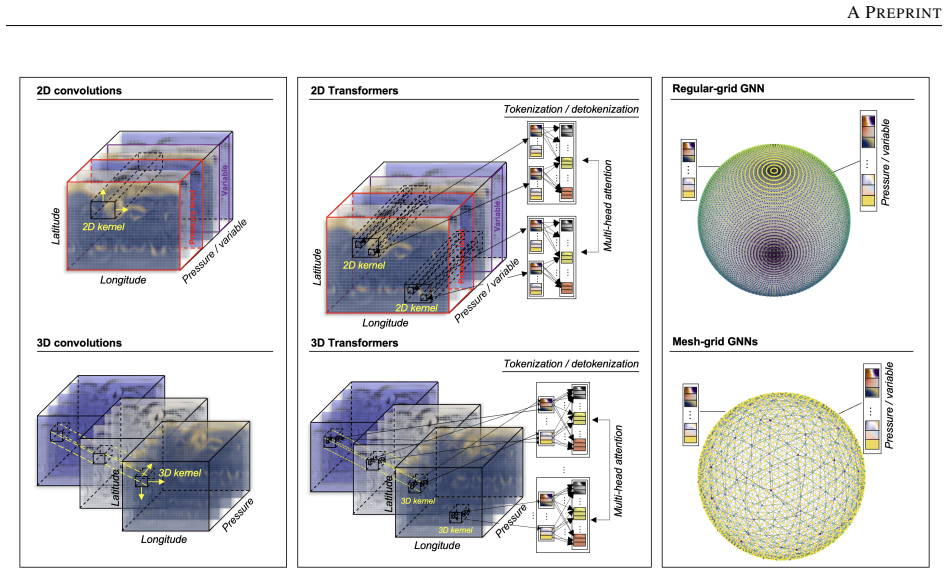
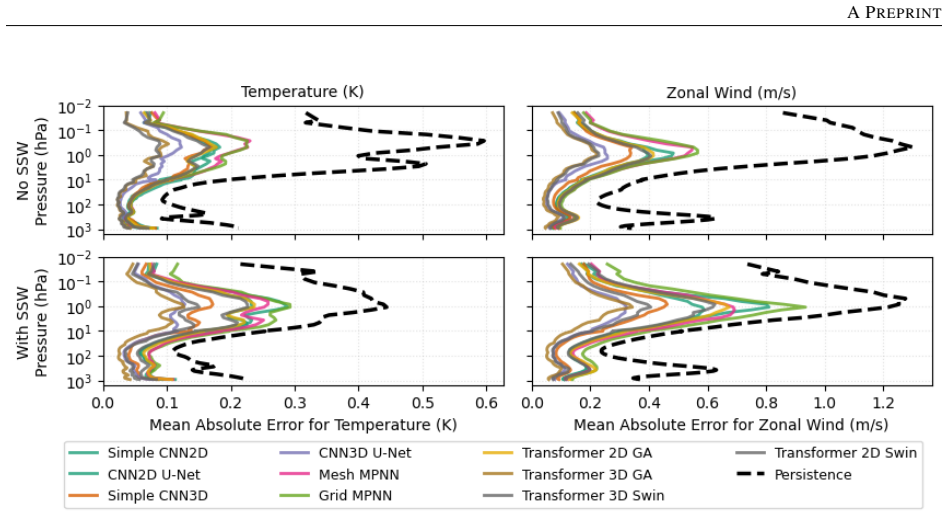
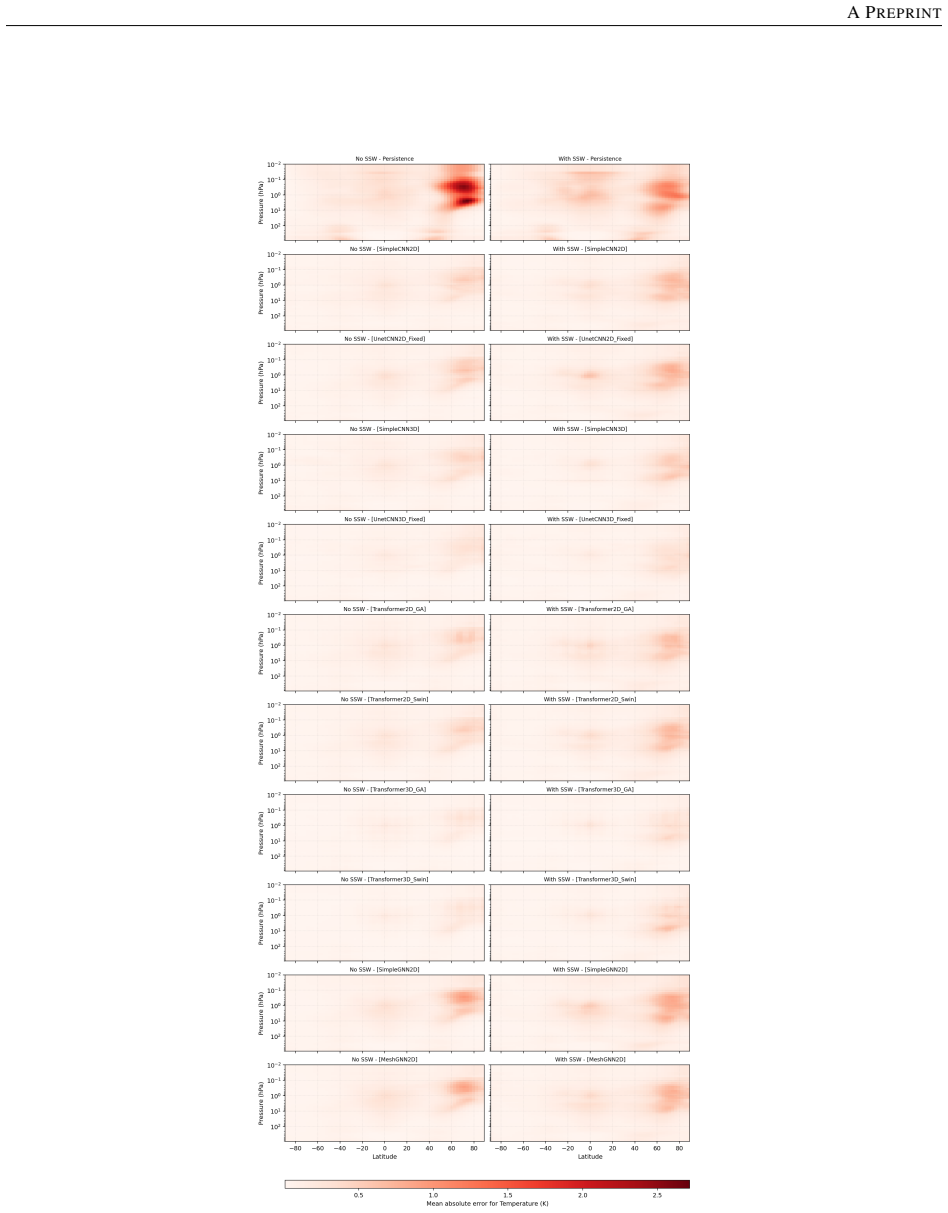
Across convolutional, transformer, and graph-based architectures trained for one-step prediction, model differences are modest when the stratosphere is dynamically quiet but widen substantially when SSW-like variability is active. Explicit three-dimensional vertical coupling emerges as the architectural feature that improves emulation of stratospheric dynamics. Eliassen-Palm flux diagnostics nevertheless reveal coherent errors in stratospheric wave-driving structure that persist even when forecast error is low.
What carries the argument
Explicit three-dimensional vertical coupling, the architectural feature that lets a model exchange information directly across atmospheric layers at different heights.
If this is right
- Architectural differences matter most during periods when the stratosphere exhibits strong variability rather than in quiet conditions.
- One-step prediction training benefits from vertical coupling when the target is to capture subseasonal predictability anchored in the stratosphere.
- Forecast error alone is insufficient to certify physical faithfulness; Eliassen-Palm flux structure must also be checked.
- Models lacking explicit three-dimensional vertical coupling will underperform specifically on sudden stratospheric warming dynamics.
Where Pith is reading between the lines
- The same inductive-bias test could be repeated on other vertically organised atmospheric features such as the tropospheric jet or tropical convection.
- Operational weather models might incorporate vertical coupling as a default design choice when emulating stratospheric influences on surface weather.
- Training objectives that penalise mismatches in Eliassen-Palm flux could close the gap between low error and physical correctness.
- Repeating the experiment in full-complexity models would show whether the idealised results survive additional sources of variability.
Load-bearing premise
The paired idealised Isca simulations that differ only in the imposed wave-2 heating perturbation create a controlled setting in which performance differences can be attributed to architectural inductive bias rather than other factors.
What would settle it
If models with and without explicit three-dimensional vertical coupling produced statistically indistinguishable forecast errors during the sudden stratospheric warming events in the Isca simulations, the claimed importance of that coupling would be falsified.
Figures





read the original abstract
Machine-learning emulators are increasingly used for weather prediction and have the potential to extend skill on subseasonal-to-seasonal timescales by learning dynamically important sources of predictability. A key challenge is whether the models can exploit predictability anchors, such as stratospheric variability, that influence tropospheric circulation beyond short lead times. We test how architectural inductive bias affects emulation of sudden stratospheric warming (SSW) dynamics using paired idealised Isca simulations that differ only in an imposed wave-2 heating perturbation. Across convolutional, transformer, and graph-based architectures trained for one-step prediction, model differences are modest when the stratosphere is dynamically quiet but widen substantially when SSW-like variability is active. Our results identify explicit three-dimensional vertical coupling as a key inductive bias for machine-learning emulation of stratospheric dynamics. However, Eliassen-Palm flux diagnostics show that low forecast error does not guarantee physically faithful wave-mean-flow interaction, with coherent errors remaining in stratospheric wave-driving structure.
Editorial analysis
A structured set of objections, weighed in public.
Referee Report
Summary. The manuscript investigates how architectural inductive biases affect machine-learning emulation of sudden stratospheric warming (SSW) dynamics. Using paired idealised Isca simulations that differ only by an imposed wave-2 heating perturbation, it compares convolutional, transformer, and graph-based architectures trained for one-step prediction. The central claim is that explicit three-dimensional vertical coupling is a key inductive bias, as performance differences are modest in dynamically quiet regimes but widen substantially during SSW-active periods. Eliassen-Palm flux diagnostics are used to show that low forecast error does not guarantee physically faithful wave-mean-flow interaction.
Significance. If the results hold after addressing the experimental-design concerns, the work would demonstrate that specific architectural features (3-D vertical connectivity) matter for faithful emulation of stratospheric dynamics on subseasonal timescales. A clear strength is the deployment of Eliassen-Palm flux diagnostics to evaluate dynamical fidelity beyond scalar error metrics; this provides a more physically grounded assessment than typical forecast-skill scores alone and could usefully inform ML model design for S2S prediction.
major comments (2)
- [Experimental design / abstract description of paired simulations] Experimental design (paired Isca runs): The attribution of performance gaps to the presence or absence of explicit 3-D vertical coupling rests on the assumption that the paired simulations isolate architectural inductive bias. Because the wave-2 heating perturbation is precisely the driver of SSW-like variability, the two data distributions differ systematically in wave driving and zonal-mean evolution. The manuscript supplies no evidence that training-set construction, normalization, or hyper-parameters were held identical across the paired runs, nor an ablation that isolates vertical connectivity from other architectural differences. This leaves open the possibility that observed gaps reflect differential sensitivity to altered data statistics rather than the claimed inductive bias.
- [Abstract and results] Abstract and results sections: The statements that 'model differences are modest' in the quiet regime and 'widen substantially' in the SSW-active regime are presented without quantitative error values, statistical significance tests, or ablation results. This absence prevents assessment of the magnitude and robustness of the claimed architectural effects.
minor comments (2)
- [Abstract] The abstract refers to 'one-step prediction' without stating the temporal resolution or lead time of the underlying Isca data.
- [Throughout] Notation for 'vertical coupling' and 'inductive bias' should be defined once and used consistently in the methods and results.
Simulated Author's Rebuttal
We thank the referee for the constructive feedback. We address the two major comments below and will revise the manuscript to strengthen the experimental description and quantitative support for the claims.
read point-by-point responses
-
Referee: Experimental design (paired Isca runs): The attribution of performance gaps to the presence or absence of explicit 3-D vertical coupling rests on the assumption that the paired simulations isolate architectural inductive bias. Because the wave-2 heating perturbation is precisely the driver of SSW-like variability, the two data distributions differ systematically in wave driving and zonal-mean evolution. The manuscript supplies no evidence that training-set construction, normalization, or hyper-parameters were held identical across the paired runs, nor an ablation that isolates vertical connectivity from other architectural differences. This leaves open the possibility that observed gaps reflect differential sensitivity to altered data statistics rather than the claimed inductive bias.
Authors: The paired Isca simulations were generated from the same model configuration and differed solely by the imposed wave-2 heating perturbation, with all other parameters fixed. Training procedures, including data construction, normalization, and hyperparameter choices, were identical across both simulations and all architectures. To address the concern about isolating vertical connectivity, we will add an explicit Methods subsection documenting these identical protocols and include a new ablation that varies only the 3-D vertical connectivity while holding other architectural components fixed. revision: yes
-
Referee: Abstract and results sections: The statements that 'model differences are modest' in the quiet regime and 'widen substantially' in the SSW-active regime are presented without quantitative error values, statistical significance tests, or ablation results. This absence prevents assessment of the magnitude and robustness of the claimed architectural effects.
Authors: We agree that the abstract and results would benefit from explicit quantitative support. In the revision we will insert specific error metrics (e.g., RMSE values) for the quiet and SSW-active regimes, report statistical significance tests on the differences, and expand the results with the ablation study noted above to quantify the contribution of vertical coupling. revision: yes
Circularity Check
Empirical ML architecture comparison on paired simulations contains no circular derivation steps
full rationale
The paper reports an empirical study comparing convolutional, transformer, and graph architectures on one-step prediction tasks using paired Isca simulations that differ by an imposed wave-2 heating perturbation. Performance differences are evaluated with forecast error and Eliassen-Palm flux diagnostics. No equations, derivations, or fitted parameters are presented that reduce any claimed result to its own inputs by construction. The central claim about three-dimensional vertical coupling as an inductive bias rests on observed performance gaps across architectures rather than self-definition, renaming of known results, or load-bearing self-citations. The experimental design and diagnostics are externally grounded and do not invoke uniqueness theorems or ansatzes from prior author work. This is a standard non-circular empirical comparison.
Axiom & Free-Parameter Ledger
axioms (1)
- domain assumption The idealised Isca simulations with an imposed wave-2 heating perturbation accurately represent SSW dynamics and allow clean isolation of architectural effects.
Reference graph
Works this paper leans on
-
[1]
Kochkov, Dmitrii and Yuval, Janni and Langmore, Ian and Norgaard, Peter and Smith, Jamie and Mooers, Griffin and Klöwer, Milan and Lottes, James and Rasp, Stephan and Düben, Peter and Hatfield, Sam and Battaglia, Peter and Sanchez-Gonzalez, Alvaro and Willson, Matthew and Brenner, Michael P. and Hoyer, Stephan , year=. Neural general circulation models fo...
-
[2]
Accurate medium-range global weather forecasting with 3D neural networks , volume =
Bi, Kaifeng and Xie, Lingxi and Zhang, Hengheng and Chen, Xin and Gu, Xiaotao and Tian, Qi , year =. Accurate medium-range global weather forecasting with 3D neural networks , volume =. Nature , doi =
-
[3]
Science , volume =
Remi Lam and Alvaro Sanchez-Gonzalez and Matthew Willson and Peter Wirnsberger and Meire Fortunato and Ferran Alet and Suman Ravuri and Timo Ewalds and Zach Eaton-Rosen and Weihua Hu and Alexander Merose and Stephan Hoyer and George Holland and Oriol Vinyals and Jacklynn Stott and Alexander Pritzel and Shakir Mohamed and Peter Battaglia , title =. Science...
2023
-
[4]
Pathak, Jaideep and Subramanian, Shashank and Harrington, Peter and Raja, Sanjeev and Chattopadhyay, Ashesh and Mardani, Morteza and Kurth, Thorsten and Hall, David and Li, Zongyi and Azizzadenesheli, Kamyar and Hassanzadeh, Pedram and Kashinath, Karthik and Anandkumar, Animashree , year =
-
[5]
and Messori, G
Scher, S. and Messori, G. , title =. Geoscientific Model Development , volume =. 2019 , number =
2019
-
[6]
Pritchard and Pierre Gentine , title =
Stephan Rasp and Michael S. Pritchard and Pierre Gentine , title =. Proceedings of the National Academy of Sciences , volume =. 2018 , doi =
2018
-
[7]
Brenowitz, N. D. and Bretherton, C. S. , title =. Geophysical Research Letters , volume =. doi:https://doi.org/10.1029/2018GL078510 , year =
-
[8]
Yuval, Janni and O’Gorman, Paul A. , year=. Stable machine-learning parameterization of subgrid processes for climate modeling at a range of resolutions , volume=. Nature Communications , publisher=. doi:10.1038/s41467-020-17142-3 , number=
-
[9]
Stable climate simulations using a realistic general circulation model with neural network parameterizations for atmospheric moist physics and radiation processes , volume =
Wang, Xin and Han, Yilun and Xue, Wei and Yang, Guangwen and Zhang, Guang , year =. Stable climate simulations using a realistic general circulation model with neural network parameterizations for atmospheric moist physics and radiation processes , volume =. Geoscientific Model Development , doi =
-
[10]
Dueben, P. D. and Bauer, P. , title =. Geoscientific Model Development , volume =. 2018 , number =
2018
-
[11]
and Mustafa, M
Kashinath, K. and Mustafa, M. and Albert, A. and Wu, J-L. and Jiang, C. and Esmaeilzadeh, S. and Azizzadenesheli, K. and Wang, R. and Chattopadhyay, A. and Singh, A. and Manepalli, A. and Chirila, D. and Yu, R. and Walters, R. and White, B. and Xiao, H. and Tchelepi, H. A. and Marcus, P. and Anandkumar, A. and Hassanzadeh, P. and Prabhat , title =. Philos...
2021
-
[12]
Vallis, G. K. and Colyer, G. and Geen, R. and Gerber, E. and Jucker, M. and Maher, P. and Paterson, A. and Pietschnig, M. and Penn, J. and Thomson, S. I. , title =. Geoscientific Model Development , volume =. 2018 , number =
2018
-
[13]
Isaac M. Held and Max J. Suarez , title =. Bulletin of the American Meteorological Society , year =. doi:10.1175/1520-0477(1994)075<1825:APFTIO>2.0.CO;2 , pages =
-
[14]
Mudhar, Regan and Seviour, William J. M. and Screen, James A. and Geen, Ruth and Lewis, Neil T. and Thomson, Stephen I. , title =. Journal of Geophysical Research: Atmospheres , volume =. doi:https://doi.org/10.1029/2023JD040416 , note =
-
[15]
Jucker, M. and Fueglistaler, S. and Vallis, G. K. , title =. Journal of Geophysical Research: Atmospheres , volume =. doi:https://doi.org/10.1002/2014JD022170 , year =
-
[16]
Journal of Atmospheric Sciences , year =
Taroh Matsuno , title =. Journal of Atmospheric Sciences , year =. doi:10.1175/1520-0469(1971)028<1479:ADMOTS>2.0.CO;2 , pages =
-
[17]
Baldwin and Timothy J
Mark P. Baldwin and Timothy J. Dunkerton , title =. Science , volume =. 2001 , doi =
2001
-
[18]
and Ayarzagüena, Blanca and Birner, Thomas and Butchart, Neal and Butler, Amy H
Baldwin, Mark P. and Ayarzagüena, Blanca and Birner, Thomas and Butchart, Neal and Butler, Amy H. and Charlton-Perez, Andrew J. and Domeisen, Daniela I. V. and Garfinkel, Chaim I. and Garny, Hella and Gerber, Edwin P. and Hegglin, Michaela I. and Langematz, Ulrike and Pedatella, Nicholas M. , title =. Reviews of Geophysics , volume =. doi:https://doi.org/...
-
[19]
, year =
Kidston, Joseph and Scaife, Adam and Hardiman, Steven and Mitchell, Daniel and Butchart, Neal and Baldwin, Mark and Gray, L. , year =. Stratospheric influence on tropospheric jet streams, storm tracks and surface weather , volume =. Nature Geoscience , doi =
-
[20]
Journal of Geophysical Research: Atmospheres , volume =
Wu, Zheng , title =. Journal of Geophysical Research: Atmospheres , volume =. doi:https://doi.org/10.1029/2025JD044852 , year =
-
[21]
Baxter, I. and Pahlavan, H. A. and Hassanzadeh, P. and Rucker, K. and Shaw, T. A. , title =. Geophysical Research Letters , volume =. doi:https://doi.org/10.1029/2025GL119877 , year =
-
[22]
Polvani, Lorenzo M. and Kushner, Paul J. , title =. Geophysical Research Letters , volume =. doi:https://doi.org/10.1029/2001GL014284 , year =
-
[23]
U-Net: Convolutional Networks for Biomedical Image Segmentation , booktitle=
Ronneberger, Olaf and Fischer, Philipp and Brox, Thomas , editor=. U-Net: Convolutional Networks for Biomedical Image Segmentation , booktitle=. 2015 , publisher=
2015
-
[24]
Attention is All you Need , volume =
Vaswani, Ashish and Shazeer, Noam and Parmar, Niki and Uszkoreit, Jakob and Jones, Llion and Gomez, Aidan N and Kaiser, ukasz and Polosukhin, Illia , booktitle =. Attention is All you Need , volume =
-
[25]
2021 , eprint=
Swin Transformer: Hierarchical Vision Transformer using Shifted Windows , author=. 2021 , eprint=
2021
-
[26]
2011 , doi =
Parameterization schemes: Keys to understanding numerical weather prediction models , author =. 2011 , doi =
2011
-
[27]
and Shaw, Tiffany and Simpson, I
Bordoni, Silvia and Kang, S. and Shaw, Tiffany and Simpson, I. and Zanna, Laure , year =. The futures of climate modeling , volume =. npj Climate and Atmospheric Science , doi =
-
[28]
Journal of Advances in Modeling Earth Systems , volume =
Jeevanjee, Nadir and Hassanzadeh, Pedram and Hill, Spencer and Sheshadri, Aditi , title =. Journal of Advances in Modeling Earth Systems , volume =. doi:https://doi.org/10.1002/2017MS001038 , year =
-
[29]
The quiet revolution of numerical weather prediction , volume =
Bauer, Peter and Thorpe, Alan and Brunet, Gilbert , year =. The quiet revolution of numerical weather prediction , volume =. Nature , doi =
-
[30]
and Medeiros, Brian and Merlis, Timothy M
Maher, Penelope and Gerber, Edwin P. and Medeiros, Brian and Merlis, Timothy M. and Sherwood, Steven and Sheshadri, Aditi and Sobel, Adam H. and Vallis, Geoffrey K. and Voigt, Aiko and Zurita-Gotor, Pablo , title =. Reviews of Geophysics , volume =. doi:https://doi.org/10.1029/2018RG000607 , year =
-
[31]
A foundation model for the Earth system , volume =
Bodnar, Cristian and Bruinsma, Wessel and Lucic, Ana and Stanley, Megan and Allen, Anna and Brandstetter, Johannes and Garvan, Patrick and Riechert, Maik and Weyn, Jonathan and Dong, Haiyu and Gupta, Jayesh and Thambiratnam, Kit and Archibald, Alexander and Wu, Chun-Chieh and Heider, Elizabeth and Welling, Max and Turner, Richard and Perdikaris, Paris , y...
-
[32]
, title =
Gunawardena, Nipun and Pallotta, Giuliana and Simpson, Matthew and Lucas, Donald D. , title =. Atmosphere , volume =. 2021 , number =
2021
-
[33]
Atmospheric and Oceanic Fluid Dynamics , doi =
Vallis, Geoffrey , year =. Atmospheric and Oceanic Fluid Dynamics , doi =
-
[34]
Vallis, Geoffrey K. , year=. Atmospheric and Oceanic Fluid Dynamics: Fundamentals and Large-Scale Circulation , publisher=
-
[35]
Domeisen, Daniela I.V. and Butler, Amy H. and Charlton-Perez, Andrew J. and Ayarzagüena, Blanca and Baldwin, Mark P. and Dunn-Sigouin, Etienne and Furtado, Jason C. and Garfinkel, Chaim I. and Hitchcock, Peter and Karpechko, Alexey Yu. and Kim, Hera and Knight, Jeff and Lang, Andrea L. and Lim, Eun-Pa and Marshall, Andrew and Roff, Greg and Schwartz, Chen...
-
[36]
Garfinkel, C. I. and Lawrence, Z. D. and Butler, A. H. and Dunn-Sigouin, E. and Erner, I. and Karpechko, A. Y. and Koren, G. and Abalos, M. and Ayarzag\"uena, B. and Barriopedro, D. and Calvo, N. and de la C\'amara, A. and Charlton-Perez, A. and Cohen, J. and Domeisen, D. I. V. and Garc\'. A process-based evaluation of biases in extratropical stratosphere...
2025
-
[37]
1987 , month =
Andrews, D G and Holton, J R and Leovy, C B , title =. 1987 , month =
1987
-
[38]
and Wright, J
Martineau, P. and Wright, J. S. and Zhu, N. and Fujiwara, M. , title =. Earth System Science Data , volume =. 2018 , number =
2018
-
[39]
H. J. Edmon and B. J. Hoskins and M. E. McIntyre , title =. Journal of Atmospheric Sciences , year =. doi:10.1175/1520-0469(1980)037<2600:EPCSFT>2.0.CO;2 , pages =
-
[40]
Lindgren, E. A. and Sheshadri, A. and Plumb, R. A. , title =. Journal of Geophysical Research: Atmospheres , volume =. doi:https://doi.org/10.1029/2018JD028537 , year =
-
[41]
Weyn, Jonathan A. and Durran, Dale R. and Caruana, Rich , title =. Journal of Advances in Modeling Earth Systems , volume =. doi:https://doi.org/10.1029/2020MS002109 , note =
-
[42]
Weyn, Jonathan A. and Durran, Dale R. and Caruana, Rich and Cresswell-Clay, Nathaniel , title =. Journal of Advances in Modeling Earth Systems , volume =. doi:https://doi.org/10.1029/2021MS002502 , note =
-
[43]
Daniel M. Mitchell and Andrew J. Charlton-Perez and Lesley J. Gray , title =. Journal of the Atmospheric Sciences , year =. doi:10.1175/2010JAS3555.1 , pages =
-
[44]
2022 , eprint=
Forecasting Global Weather with Graph Neural Networks , author=. 2022 , eprint=
2022
-
[45]
Seviour, William J. M. and Mitchell, Daniel M. and Gray, Lesley J. , title =. Geophysical Research Letters , volume =. doi:https://doi.org/10.1002/grl.50927 , year =
-
[46]
Lindgren, E. A. and Sheshadri, A. , title =. Weather and Climate Dynamics , volume =. 2020 , number =
2020
-
[47]
Waugh, Darry N. W. , title =. Quarterly Journal of the Royal Meteorological Society , volume =. doi:https://doi.org/10.1002/qj.49712354213 , year =
-
[48]
Atmospheric Science Letters , volume =
Jucker, Martin , title =. Atmospheric Science Letters , volume =. doi:https://doi.org/10.1002/asl.1020 , year =
-
[49]
Journal of Advances in Modeling Earth Systems , volume =
Bertoli, Guillaume and Mohebi, Salman and Ozdemir, Firat and Jucker, Jonas and Rüdisühli, Stefan and Perez-Cruz, Fernando and Salzmann, Mathieu and Schemm, Sebastian , title =. Journal of Advances in Modeling Earth Systems , volume =. doi:https://doi.org/10.1029/2025MS004956 , note =
-
[50]
2026 , eprint=
Earth System Foundation Model (ESFM): A unified framework for heterogeneous data integration and forecasting , author=. 2026 , eprint=
2026
-
[51]
Andrew J. Charlton and Lorenzo M. Polvani , title =. Journal of Climate , year =. doi:10.1175/JCLI3996.1 , pages=
-
[52]
and Pinnington, E
Moldovan, G. and Pinnington, E. and Prieto Nemesio, A. and Lang, S. and Ben Bouall\`egue, Z. and Dramsch, J. and Alexe, M. and Santa Cruz, M. and Hahner, S. and Cook, H. and Theissen, H. and Clare, M. and O'Brien, C. and Polster, J. and Magnusson, L. and Mertes, G. and Pinault, F. and Raoult, B. and de Rosnay, P. and Forbes, R. and Chantry, M. , TITLE =. ...
2026
discussion (0)
Sign in with ORCID, Apple, or X to comment. Anyone can read and Pith papers without signing in.